Samaaro + Your CRM: Zero Integration Fee for Annual Sign-Ups Until 30 June, 2025
- 00Days
- 00Hrs
- 00Min
Property launches events produce a surge of measurable activity. Attendance peaks. Inquiry volumes rise sharply. Sales teams exit the event with full pipelines and optimistic booking projections. On paper, demand appears strong.
Yet booking conversion tells a conflicting story.
In the weeks following the launch, buyer momentum slows. High inquiry volume fails to translate into proportional reservations. Buyers who showed interest during the event delay financial commitment afterward, creating financial tension.
The launch successfully generates attention, but booking velocity fails to sustain at the same level.
This gap exists because attention and conversion operate on different timelines. Excitement forms instantly. Commitment forms gradually.
Property launches events succeed at activating buyers. They fail when that activation is not structurally sustained.
This blog explores why buyer excitement created during launch events weakens after the event, and how conversion breaks before bookings are secured.

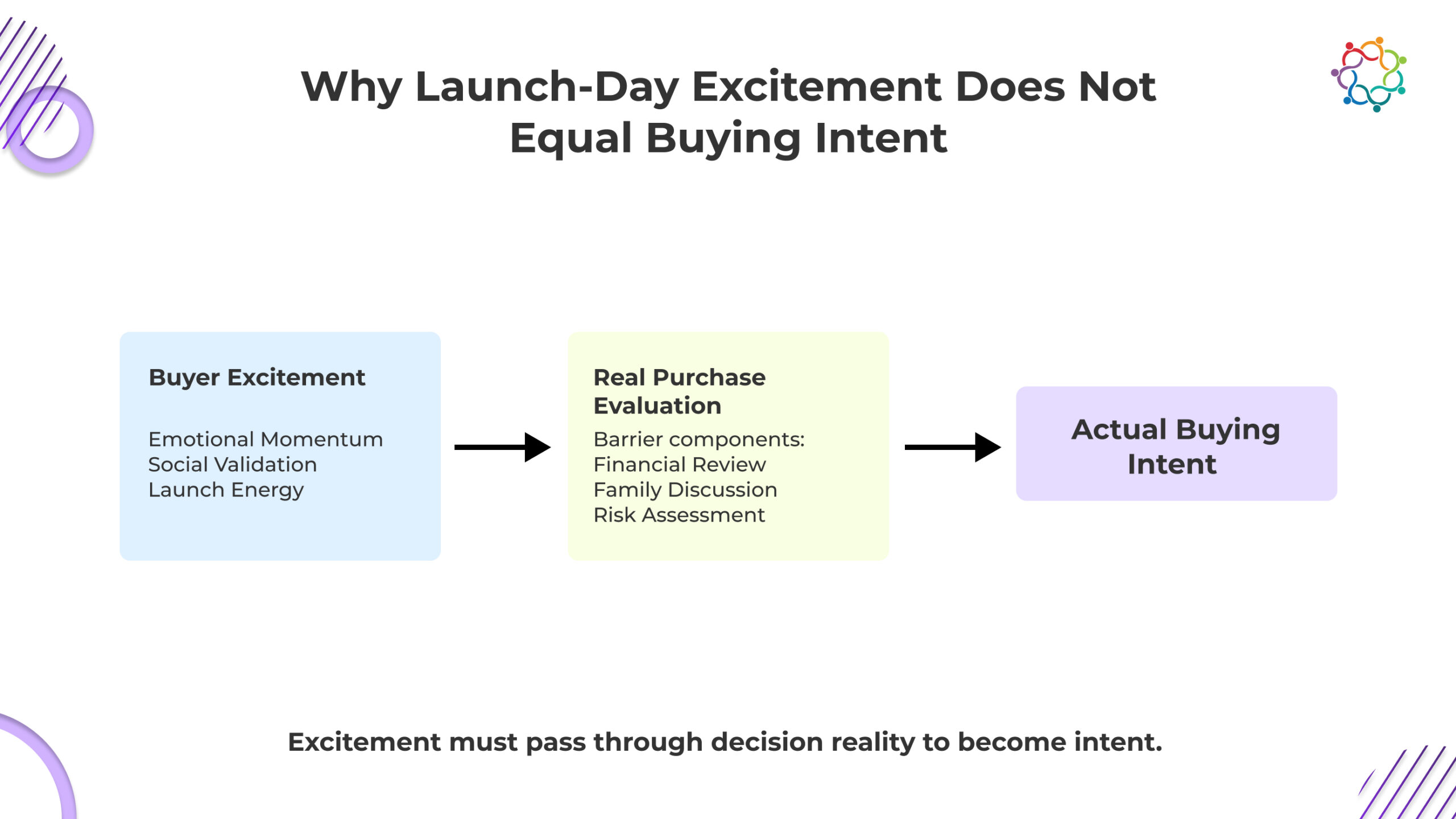
Property launch events are designed to capture buyer attention in a single decisive moment. Scarcity cues, social validation, and project reveals create emotional acceleration. Buyers feel closer to ownership than they did before entering the event.
But emotional proximity is not financial readiness.
No buyer completes their financial validation, risk assessment, or family consultation inside the launch environment. Those decision mechanisms activate after the event, when buyers return to independent evaluation. This is where most developers lose control of the decision trajectory.
Launch excitement creates psychological alignment. Buying intent requires decision validation.
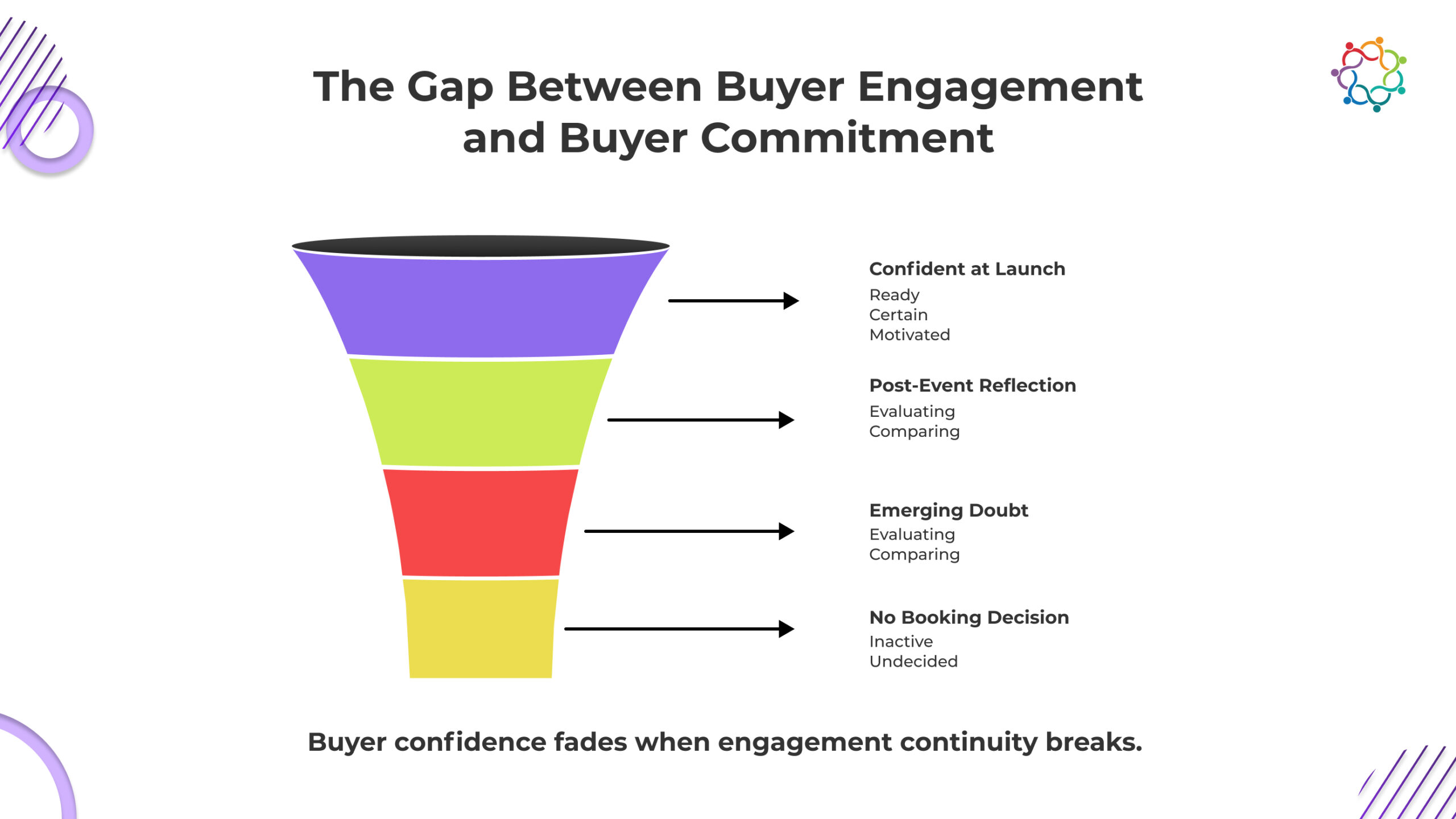
When the event ends, the emotional momentum you created enters its most fragile phase. Buyers begin questioning affordability, comparing alternatives, and reassessing urgency. If engagement continuity is not structurally maintained at this exact stage, confidence weakens before commitment stabilizes.
This is the uncomfortable reality.
Launch events do not fail because buyers were never interested. They fail because the system allows interest to decay before it becomes a booking.
If intent is not sustained after the launch, conversion loss is not accidental. It is inevitable.

During a launch event, buyers operate in a controlled high-certainty environment. Information is immediate, questions are answered on the spot, and confidence feels elevated. Buyers experience clarity, urgency, and reassurance, all the signals that drive temporary commitment.
But the moment buyers leave, all certainty evaporates. The environment that supported their confidence disappears. External factors re-enter the decision process: competing projects, financial doubts, family opinions, and risk assessments. Emotional momentum alone cannot carry a decision across this friction.
This creates a structural gap between engagement and commitment. Buyer interest during the launch signals potential, not actionable intent. The Buyer Hesitation Curve explains the phenomenon: confidence peaks at the event and declines progressively without reinforcement. Without structural engagement continuity, momentum collapses silently.
Key insights:
Conversion stalls because the system does not preserve decision certainty after the event.

Conversion does not collapse in a visible moment. It weakens in the operational gaps that developers choose not to see. Launch events create a surge of buyer intent, but intent alone does not produce revenue. What happens immediately after determines whether that intent survives or disappears.
Most developers assume conversion loss happens because buyers change their minds. Conversion loss occurs because the system fails to preserve decision continuity after the event. Once buyers leave the launch environment, their confidence becomes unstable. If engagement, prioritization, and visibility do not continue with precision, hesitation replaces urgency.
This is where projected revenue begins to leak silently. Not because demand was weak, but because the conversion system was never strong enough to protect it.
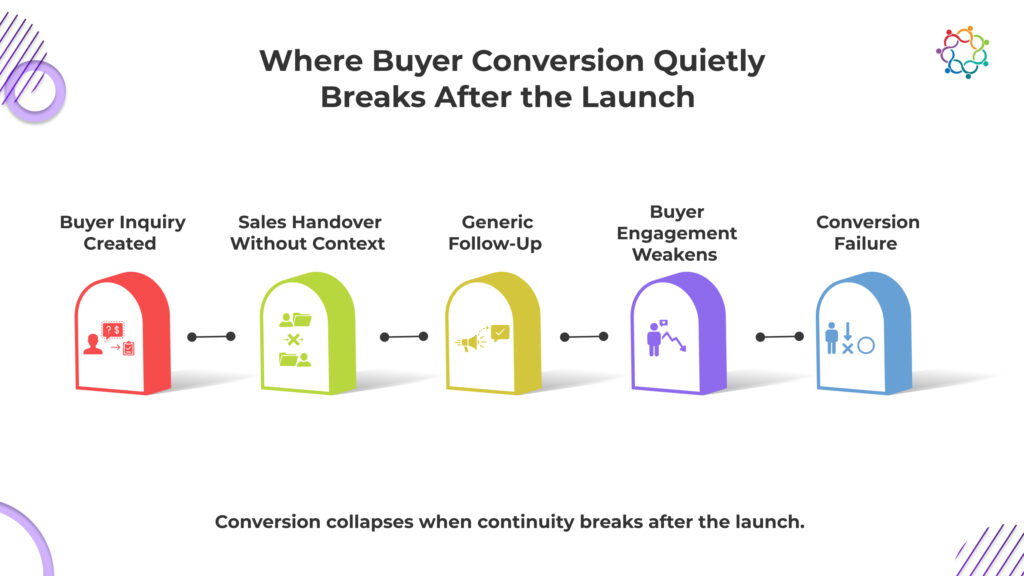
Marketing hands over leads. Sales inherits names without intent clarity. They cannot see who was ready and who was browsing.
High-intent buyers are treated like low-intent buyers. No prioritization. No urgency alignment.
By the time sales identify serious buyers, their urgency is already gone. Conversion did not fail because buyers disappeared. It failed because the system could not recognize them in time.
During the launch, buyers felt seen. After the launch, they feel processed. Follow-ups become generic. Context disappears. Emotional continuity breaks.
This signals something dangerous to the buyer. The urgency was situational, not structural.
Buyers respond by slowing down. Decision timelines stretch. Doubt enters.
Momentum does not survive generic engagement. It weakens inside it.
After the event, most developers lose sight of buyer progression. They cannot see who is advancing and who is disengaging.
Sales follow up blindly. Timing becomes guesswork. Serious buyers are missed. Hesitant buyers are over-pursued.
This is not a lead problem. It is a visibility failure. You cannot convert intent you cannot see.
Launch pipelines create revenue optimism. Numbers suggest future bookings. But pipelines do not generate revenue. Conversions do.
When intent is not sustained, buyers delay. When buyers delay, pipelines weaken. Projected revenue never materializes.
This is where the real loss happens.
Not during the launch. After it. Developers do not lose buyers because launches failed. They lose buyers because conversion was never structurally protected.

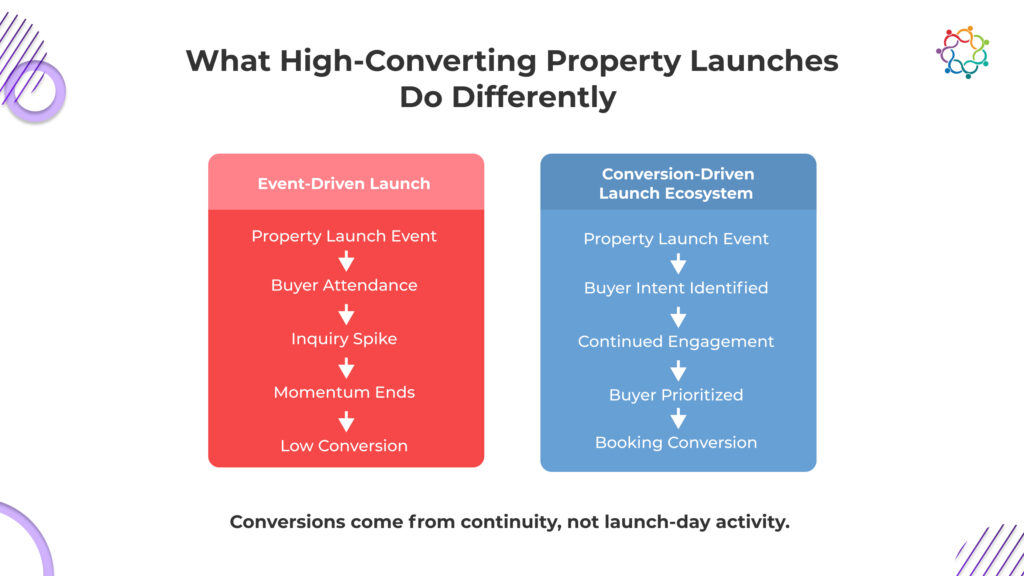
The difference between low-converting and high-converting launches is not launch-day performance. It is post-launch structural continuity.
Most developers optimize for visible activity. They measure attendance, inquiries, and immediate engagement response.
These metrics reflect attention, not conversion progression.
High-converting systems optimize for conversion continuity.
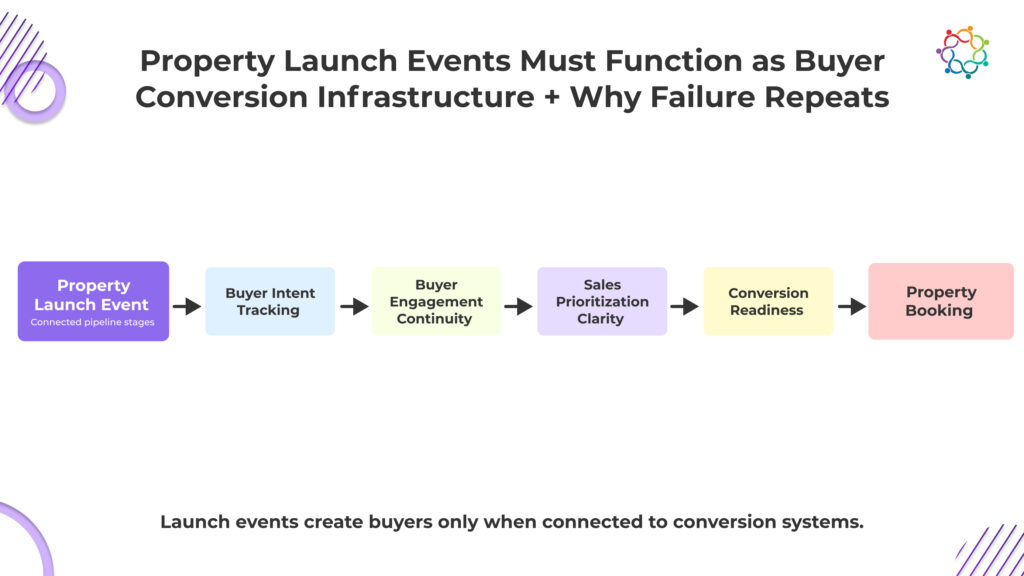
Property launch events that produce consistent booking outcomes operate inside conversion-centric ecosystems designed to sustain buyer progression beyond the event.
They focus on structural continuity across three critical dimensions:
This creates conversion stability. Buyer momentum does not collapse after the event. It transitions smoothly into decision progression. This structural difference reshapes revenue outcomes.
Low-converting systems create temporary attention spikes.
High-converting systems create sustained booking velocity.
This reframes how launch success must be evaluated. Launch success is not determined by how many buyers attend.
It is determined by how many buyers continue progressing toward commitment after the event. Conversion continuity becomes the true measure of commercial performance. Without continuity, launch momentum becomes conversion waste.

Launch events are often treated as isolated marketing moments. This perception limits their commercial impact. Their true function is architectural.
Conversion architecture is the system that governs how buyer intent moves from emotional activation to financial commitment without visibility loss.
Property launch events serve as entry points into a broader conversion system. They capture buyer intent signals and introduce buyers into the revenue pipeline.
But capturing intent is only the first stage.
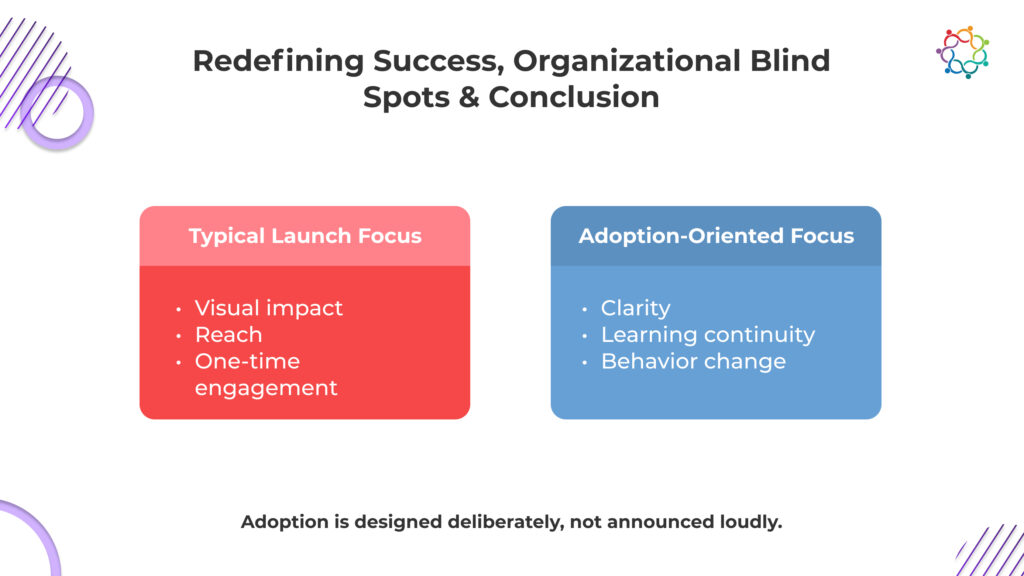
Conversion architecture requires structural continuity across three interconnected layers.
Intent Capture Layer
Launch environments generate initial buyer interest. They create emotional alignment and identify potential buyers.
This stage supplies the conversion system with raw intent signals.
Intent Preservation Layer
Buyer intent must remain visible after the event. Buyers move through independent decision phases. Their engagement signals must remain accessible.
Without preservation, intent disappears inside the pipeline.
Intent Conversion Layer
Sales engagement must align with buyer readiness. Buyers require reinforcement at specific decision stages.
Without alignment, buyers hesitate and delay commitment.
These layers determine conversion effectiveness.
Buyer progression stays stable only when conversion layers work together. Launch events supply intent, not revenue. If the conversion architecture is weak, attention never becomes bookings. The system fails to convert captured intent. Conversion strength, not launch intensity, determines revenue outcomes.
Conversion failure repeats because most developers are measuring the wrong victory. Inquiry volume gets reported. Attendance gets celebrated. Internal conversations focus on how much attention the launch generated.
But attention does not pay revenue. Bookings do.
This creates an uncomfortable organizational truth. Your system is optimized to create the appearance of demand, not the outcome of conversion. As long as launch success is declared before booking outcomes are proven, conversion loss will continue repeating without resistance.
This means conversion failure is not surprising. It is designed into the system.
Until leadership starts measuring buyer commitment instead of buyer activity, every launch will continue creating noise without delivering the revenue it promised.
Property launch events generate attention, excitement, and inquiries. Yet, attention alone does not create bookings. Without structured post-event engagement, buyer intent fades, confidence weakens, and revenue leaks silently.
High-performing developers treat launches as conversion infrastructure, preserving intent and aligning sales with readiness.
If a launch cannot sustain buyer engagement after the event, it cannot sustain bookings.
For developers building launch ecosystems that preserve intent beyond the event, this is a conversation worth having.
Success is not measured on launch day; it is earned in what happens next, or It rarely returns.
CME conferences look successful by every institutional measure that exists. Scientific content is strong. Expert faculty deliver credible education. Attendance is consistent. Compliance requirements are fully met. On paper, nothing is broken.
But educational impact does not come from content delivery. It comes from participant engagement. And that is where visibility disappears.
Organizations can confirm who attended. They cannot confirm who actively learned. They can document session completion. They cannot prove knowledge absorption or educational influence.
This creates a structural illusion. Education appears effective because it was delivered. Not because it changed anything.
When engagement is invisible, learning becomes an assumption rather than an outcome. Institutions protect the educational process while losing control over educational impact.
This blog covers why educational delivery creates institutional confidence without guaranteeing educational impact, and why engagement visibility is the missing link between content and learning.

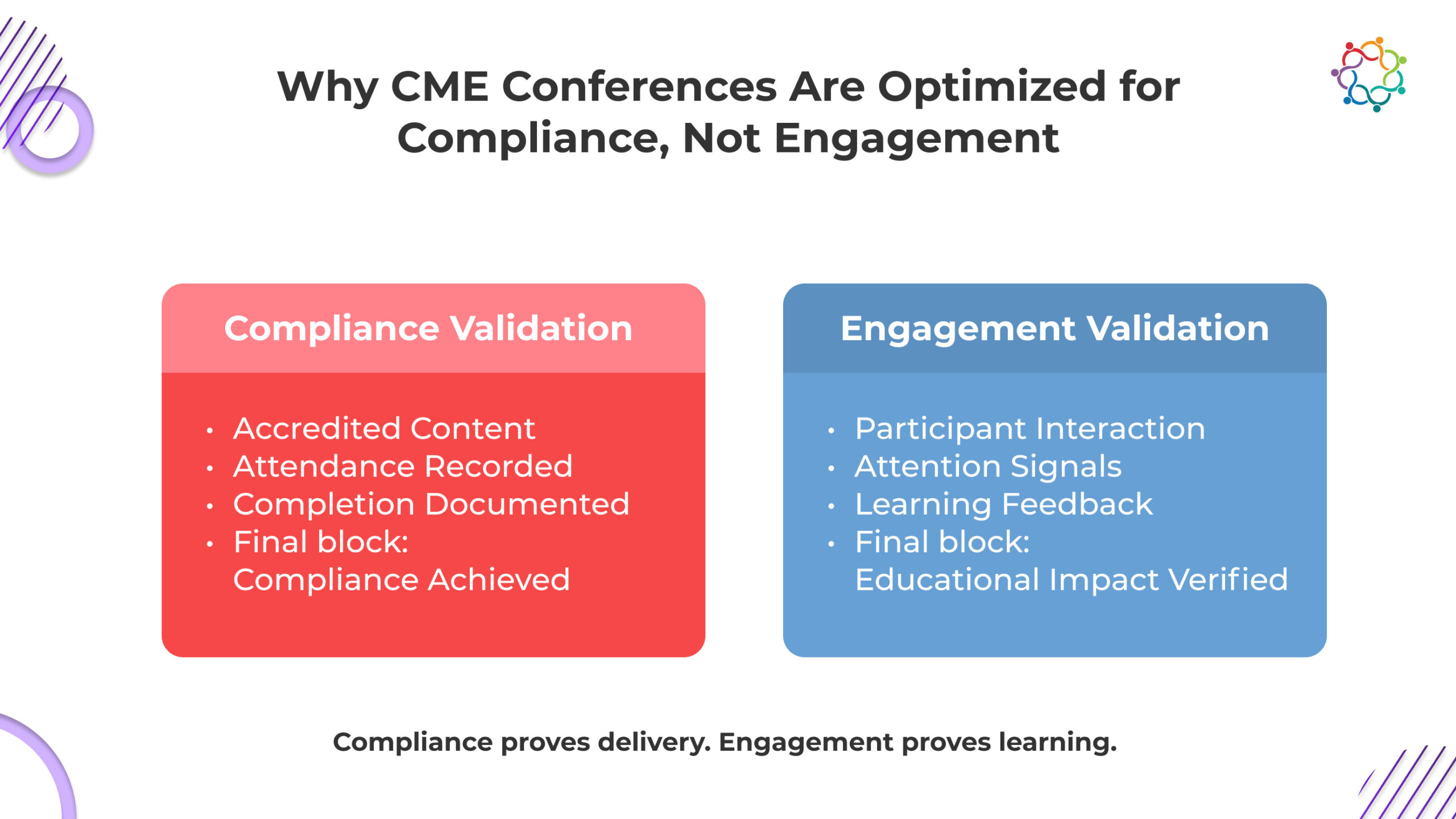
Compliance frameworks exist to protect educational credibility. They ensure scientific validity. They enforce content accuracy. They confirm that medical education meets institutional and ethical standards.
This structure serves an essential purpose. It protects trust in continuing medical education events. But compliance frameworks were never designed to measure engagement.
They confirm that the content was delivered correctly. They do not confirm that participants actively engaged with the content, causing structural misalignment.
When education systems optimize around compliance, they prioritize delivery integrity. Engagement becomes secondary. Interaction becomes optional. Participation depth becomes invisible.
The system rewards completion. It does not reward cognitive involvement.
This creates a predictable chain of consequences:
This is not a failure of intent. It is a structural outcome.
Compliance protects credibility. It does not create engagement. Educational effectiveness depends on interaction, reflection, and reinforcement. Compliance systems do not track these variables.
The institutional consequence is unavoidable. Education becomes operationally complete but educationally unverified. This creates a silent erosion of educational influence.
Organizations continue delivering education. They lose visibility into whether learning is actually occurring.

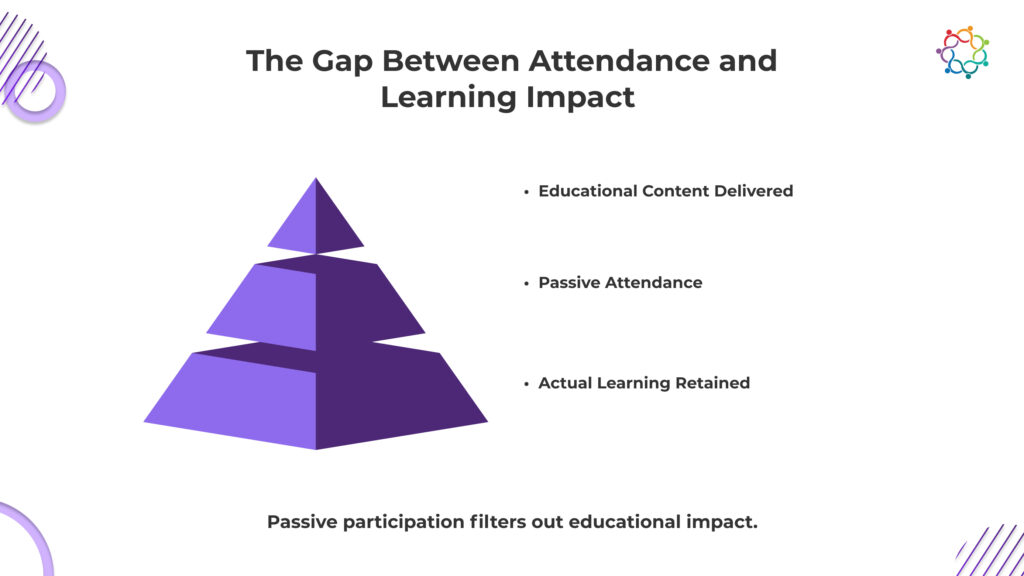
Attendance provides reportable metrics. It confirms participant presence and session completion. It does not confirm comprehension, retention, or applied change.

Presence in a session does not indicate cognitive engagement. Exposure to content does not demonstrate understanding. Completion does not establish clinical influence.
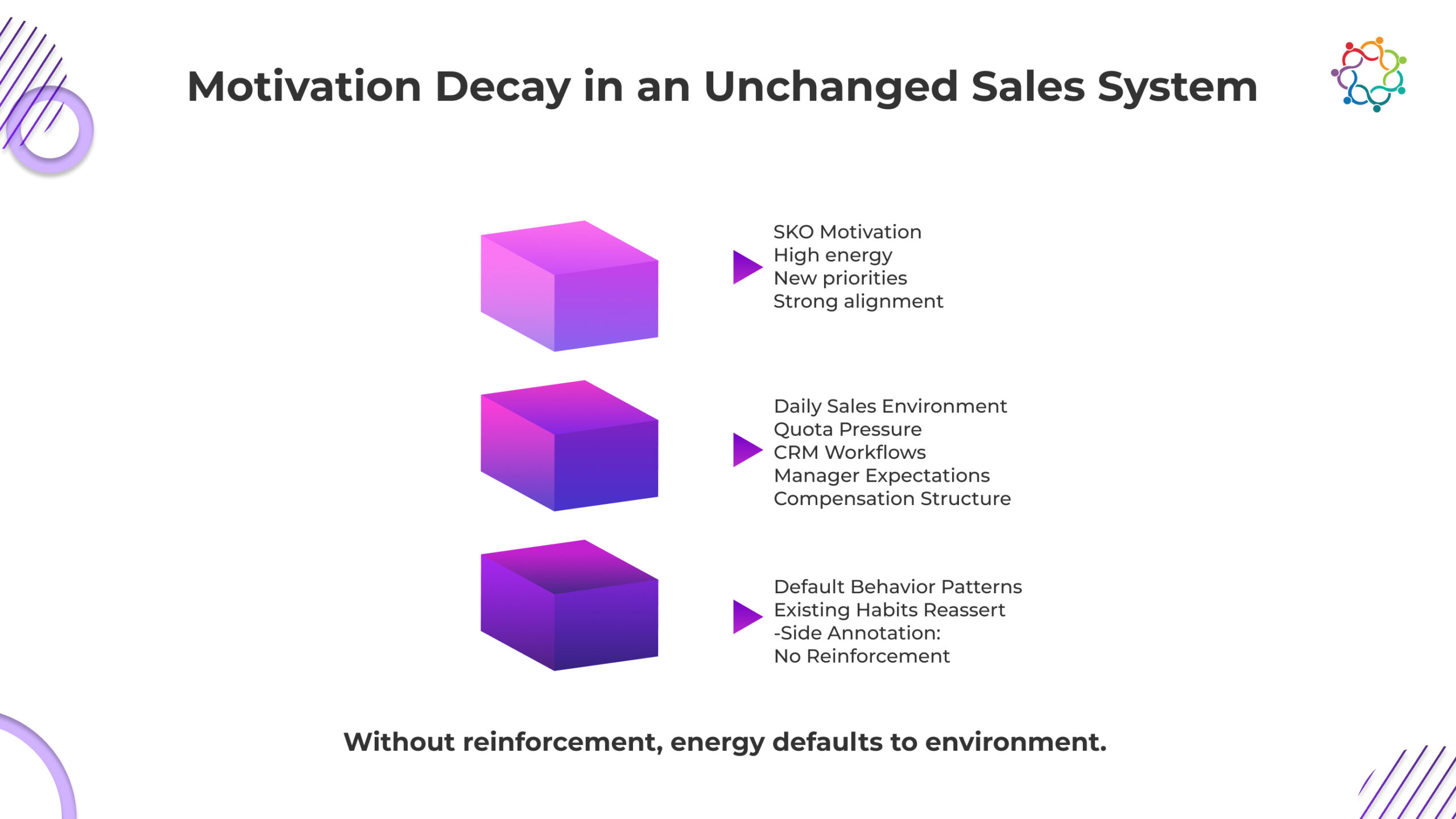
In many educational environments, attendance metrics function as proxies for impact. However, proximity to content is not equivalent to knowledge transfer.
If institutions cannot identify which participants internalized key concepts, where confidence shifted, or whether clinical reasoning evolved, learning impact remains unverified.
This distinction matters. Reporting participation volume without validating educational progression creates a measurement gap.
Attendance supports documentation. Measurable learning progression supports credibility.
Without separating the two, reported educational success may not reflect actual educational influence.

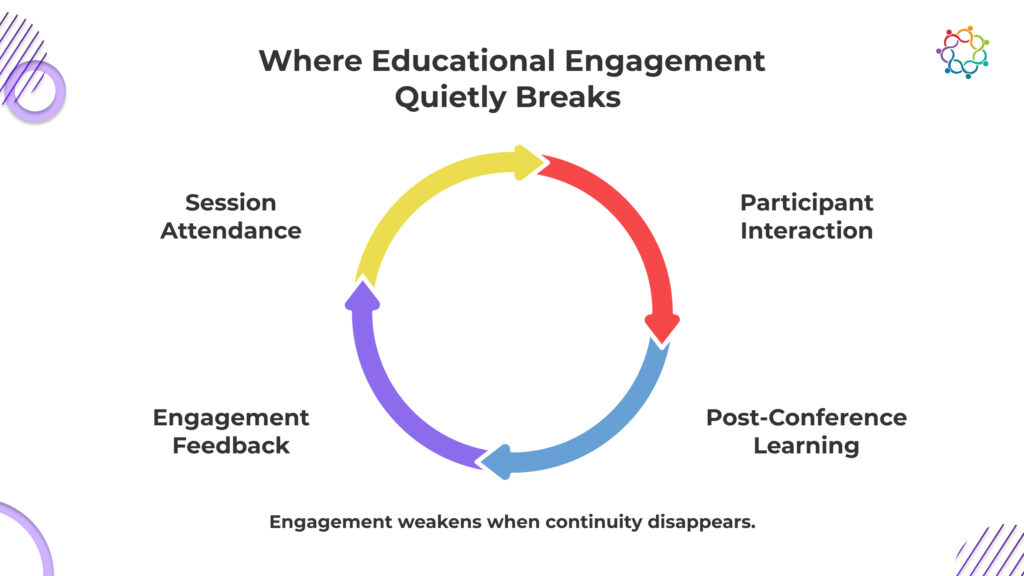
Educational engagement does not collapse instantly. It deteriorates through a sequence of invisible failures. Each stage reduces engagement clarity. Each stage weakens the learning impact.
Participants sit through sessions, but organizers cannot identify who asked questions, who responded to key concepts, or who disengaged midway. Attendance logs flatten every participant into the same category. Active cognitive involvement and passive listening look identical in institutional records.
This removes the ability to isolate where learning actually happened.
Educational leaders are left with session completion data, not learning evidence. Without interaction visibility, educational effectiveness remains an unverified assumption, not a confirmed outcome.
During sessions, participants experience moments of clarity, confusion, and doubt. These moments define learning. Yet most of this feedback is never captured when it happens. Post-event surveys rely on delayed recall, which weakens accuracy. Participants forget specific friction points. Educational leaders receive generalized satisfaction responses instead of precise learning signals.
This prevents faculty and institutions from identifying where education succeeded or failed.
Without real-time feedback integrity, educational evaluation becomes a broad opinion, not precise educational intelligence.
Once the conference ends, participant visibility stops. Institutions do not know whether attendees revisited concepts, applied knowledge in clinical settings, or disengaged entirely. There is no structured mechanism to observe knowledge progression after session completion. Educational influence becomes time-bound to the event itself.
This prevents organizations from linking education to sustained professional impact.
Without post-conference engagement continuity, learning remains an isolated exposure rather than a measurable progression that strengthens clinical competence over time.

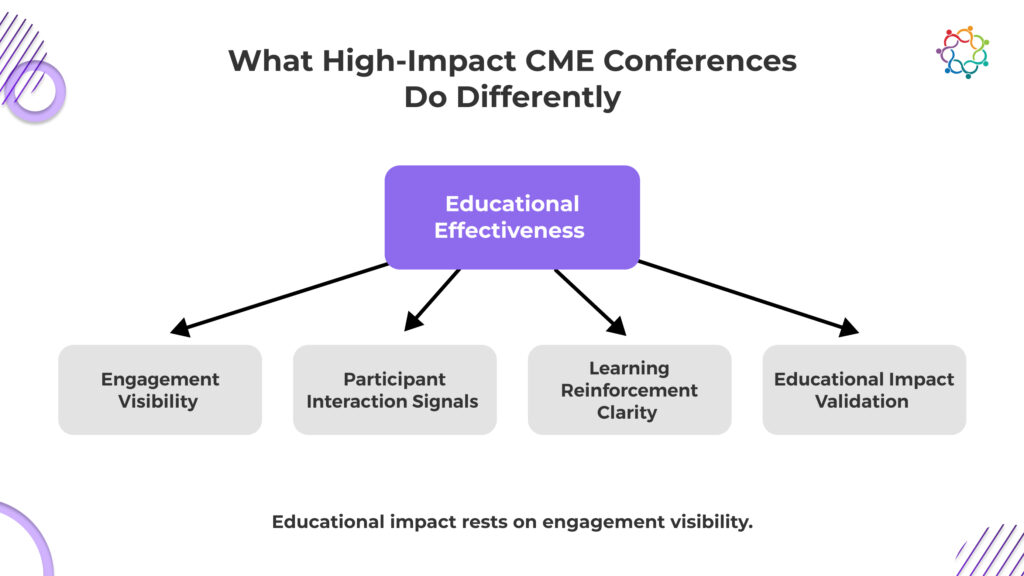
The difference between low-impact and high-impact educational environments is not content quality. It is engagement visibility.
Low-impact environments optimize for:
High-impact environments optimize for:
This structural difference determines educational effectiveness.
Content does not create impact. Engagement does.
Educational value emerges when participants interact with knowledge, not when they are exposed to it. This is where CME conferences either create influence or lose it entirely.
When engagement is visible, educational leaders gain control. They can see learning progression. They can measure educational clarity. They can validate educational effectiveness.
When engagement is invisible, education becomes speculative.
Institutions assume learning occurred. They cannot prove it. This distinction separates procedural education from impactful education.

Most educational programs operate without persistent proof of educational control. Sessions are delivered. The event concludes. Visibility into participant progression diminishes immediately after.
This is not a communications issue. It is an infrastructure limitation.
If education influences clinical thinking, that influence should generate observable signals. Without observable signals, educational impact becomes inferential rather than measurable.
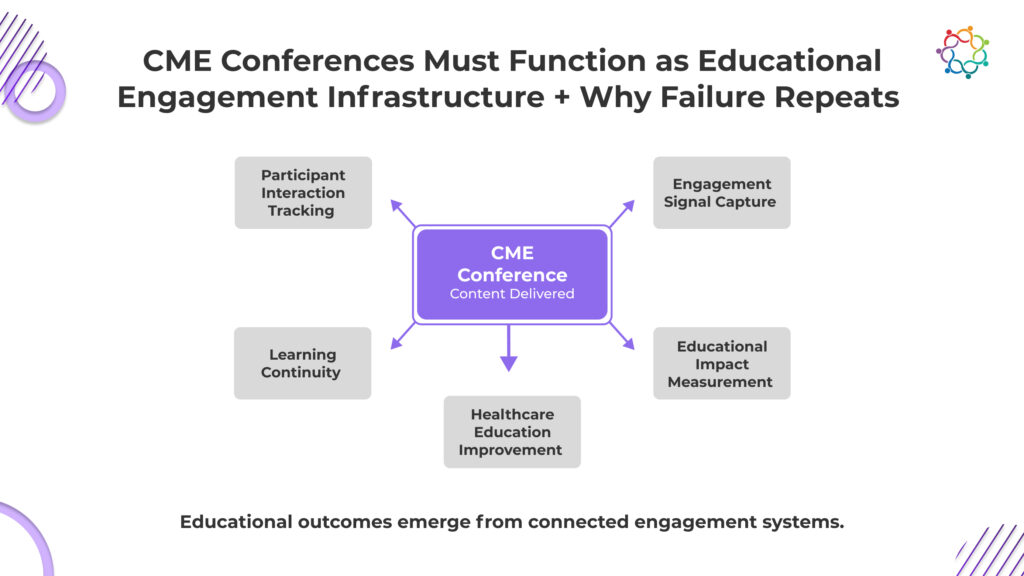
Engagement infrastructure means the event produces structured, traceable learning signals that persist beyond the session itself, signals that can be analyzed, reinforced, and institutionally defended over time.
In practical terms, this requires:
Without these mechanisms, education is delivered but not governed.
Attendance records do not demonstrate comprehension.
Session completion does not demonstrate retention.
Faculty credibility does not demonstrate applied impact.
Only structured engagement evidence does.
When educational impact is questioned – by leadership, accreditation bodies, or institutional stakeholders, defensibility depends on measurable progression, not participation volume.
Interactive learning models and structured signal capture are central to building this kind of engagement architecture. A deeper exploration of how interactive design strengthens CME defensibility can be found in this analysis on Enhancing CME Event Engagement with Interactive Learning.
This problem persists because your systems never demanded anything better.
Educational success is declared the moment attendance thresholds are met and compliance boxes are checked. Once those signals appear, scrutiny stops. No one asks who struggled to understand. No one investigates whether clinical confidence actually improved. The absence of engagement evidence is quietly tolerated because operational completion is easier to defend.
This is where leadership becomes exposed.
You are not facing engagement failure because it is unsolvable. You are facing it because your evaluation standards allow it to exist.
As long as attendance is accepted as proof, engagement will remain invisible. And when engagement remains invisible, learning remains unproven.
This means every future conference will repeat the same pattern. Education will be delivered. Success will be declared. And the one outcome that actually matters, verified learning, will remain the one thing you still cannot prove.
Healthcare institutions exist to influence clinical behavior, not to host educational gatherings. Yet most cannot prove that influence. CME conferences strengthen scientific credibility on the surface, but without engagement, their institutional value remains exposed. Leadership believes education is working because delivery is complete.
But when impact is questioned, belief is not a defensible position. The absence of proof shifts education from a strategic asset to an unverified expense.
You can confirm sessions occurred. You cannot confirm they changed their thinking. This leaves educational outcomes open to doubt when leadership, regulators, or sponsors demand evidence of real impact.
Significant resources fund medical education. Without engagement visibility, you cannot show return in terms of learning progression, making future investment harder to justify with authority.
Education exists to improve decisions. If you cannot track retained knowledge or applied learning, clinical improvement becomes a claim without institutional backing.
Credibility is not built on delivery. It is built on provable influence. The moment you cannot prove learning, your educational leadership stands on completion records, not educational evidence.
Education delivery is not the same as educational impact. Sessions can be scheduled, delivered, and documented. That does not mean learning persisted.
Most institutions can prove attendance. Few can prove progression. That gap is not academic – it is structural risk.
When educational programs are questioned by leadership, accreditation bodies, or stakeholders, attendance records will not demonstrate comprehension. Completion certificates will not demonstrate application.
Only engagement evidence establishes defensible impact.
If a CME conference cannot demonstrate measurable participant engagement, it cannot credibly demonstrate educational effectiveness. At that point, impact becomes an assumption rather than an asset.
Forward-looking institutions are already reframing CME conferences as measurable learning infrastructure. The shift is not about improving content quality. It is about improving visibility into educational progression.
If engagement is invisible, educational authority is vulnerable.
Platforms built for structured engagement capture and longitudinal visibility – such as Samaaro – are enabling institutions to operationalize this shift from event delivery to measurable educational governance.
In most enterprises, training is categorized as support, not strategy. Budgets sit under enablement or customer success. Growth discussions center on acquisition, upsell, and pipeline acceleration. Yet the majority of revenue risk and expansion potential exists after the sale.
Training events rarely appear in growth narratives because they do not create visible spikes in revenue. They operate differently. They stabilize usage, increase confidence, and reinforce value realization over time. That compounding effect influences renewal confidence and expansion readiness more consistently than many front-end initiatives.
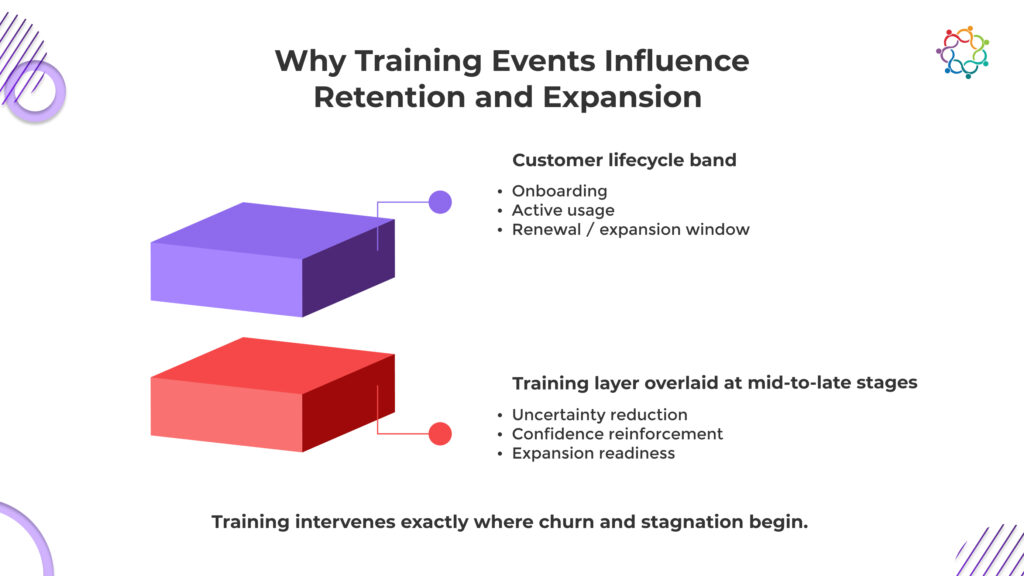
When customers fail to adopt deeply, churn risk increases. When users lack confidence, expansion stalls. Training addresses both conditions at their source by strengthening capability and reducing uncertainty.
The issue is not execution. It is a classification. When training is viewed as a cost center, its influence on retention leverage and sustained product adoption remains invisible.
This blog explains why training events influence growth outcomes more reliably than many acquisition efforts and how learning translates into usage, retention, and long-term expansion.

Retention does not fail because customers are unhappy. It fails because they are uncertain. When users are unsure whether they are extracting full value, renewal becomes a financial risk rather than a logical continuation. That uncertainty rarely begins in the final quarter of a contract. It forms months earlier through shallow adoption and inconsistent usage.
Expansion follows the same pattern. No stakeholder approves additional investment in a product that the team has not fully mastered. Without demonstrated value realization, upsell conversations stall. What looks like budget resistance is often capability hesitation.
This is where structured learning initiatives intervene. They reduce ambiguity, increase confidence, and strengthen usage maturity before renewal or expansion conversations begin. They influence the decision environment long before commercial discussions take place.
If retention and expansion are core growth metrics for your organization, then ignoring the mechanisms that shape user confidence is a strategic blind spot. Growth does not hinge only on selling more. It depends on whether customers feel competent enough to continue and confident enough to expand.

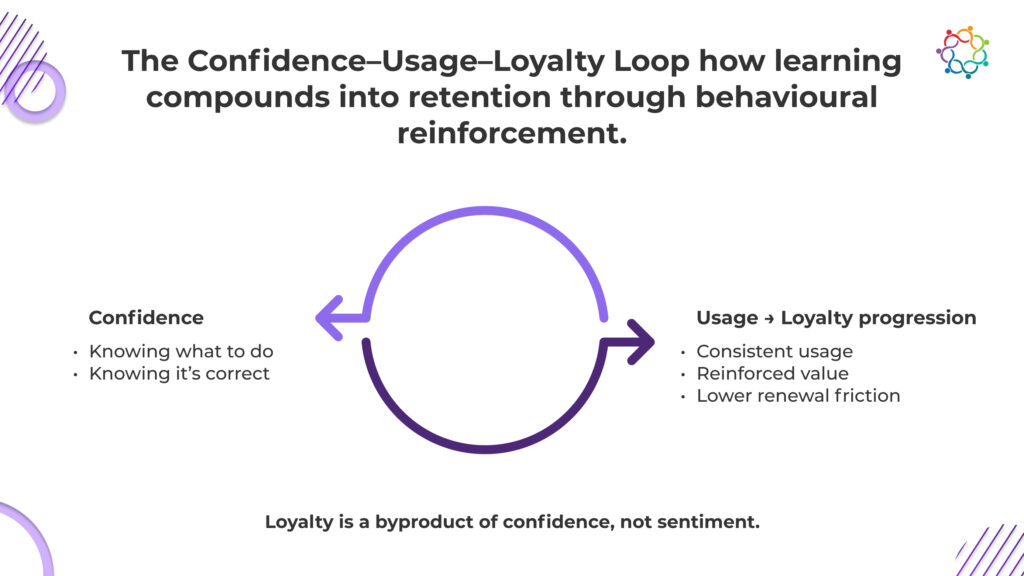
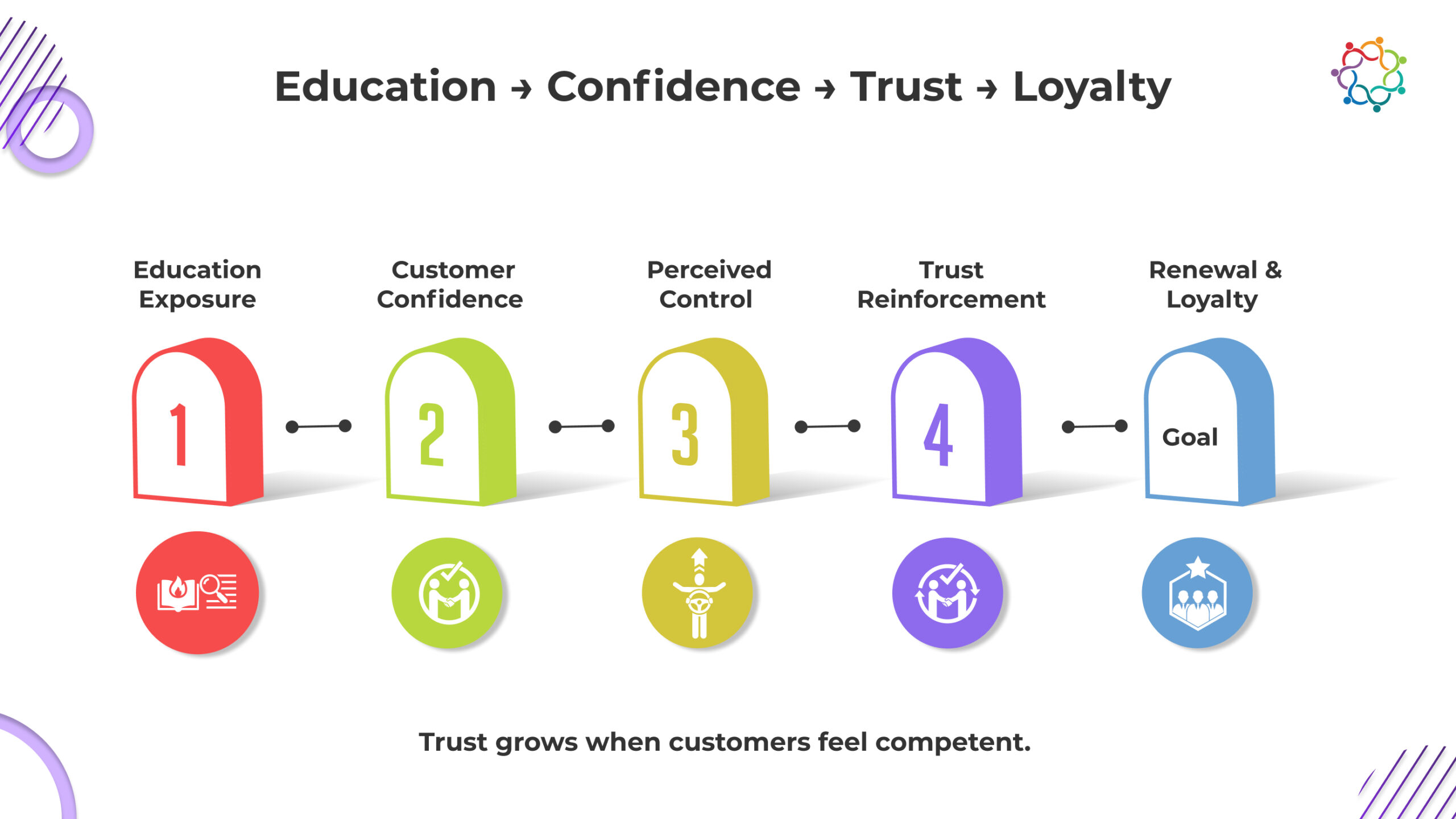
Training’s impact on growth is best understood as a loop where confidence leads to consistent usage, which then reinforces loyalty. This Confidence–Usage–Loyalty Loop is a practical framework for linking enablement efforts to measurable outcomes.
Users often hesitate to fully adopt a product when they are unsure of its correctness or impact. Even minor uncertainties, such as whether a process is being followed correctly, can prevent engagement. This lack of confidence translates into inconsistent or shallow usage, which limits the value realized from the product. Structured training events address this gap by:
Confidence is not an abstract psychological outcome. It can be quantified by behavioural measures, including higher participation in advanced workflows, fewer support enquiries, and increased feature utilisation. Users are unlikely to investigate more sophisticated features without this base, which would impede adoption and growth prospects.
Once users gain confidence, consistent usage becomes the primary mechanism for reinforcing value. Regular engagement with the product allows users to:
Sporadic or inconsistent usage, on the other hand, erodes perceived necessity. A feature that is rarely accessed or incorrectly used appears optional, diminishing the overall product impact. Training events create structured opportunities for consistent engagement, ensuring that the value proposition remains visible and reinforced across teams.
Loyalty in enterprise customers is rarely a matter of affection or brand attachment. It emerges from competence, trust, and the ability to achieve measurable outcomes. Trained users become internal advocates for the product, influencing renewal discussions and supporting expansion decisions.
Key takeaways of this loop:
In this way, training events create growth structurally, ensuring that loyalty emerges from competence rather than marketing sentiment.

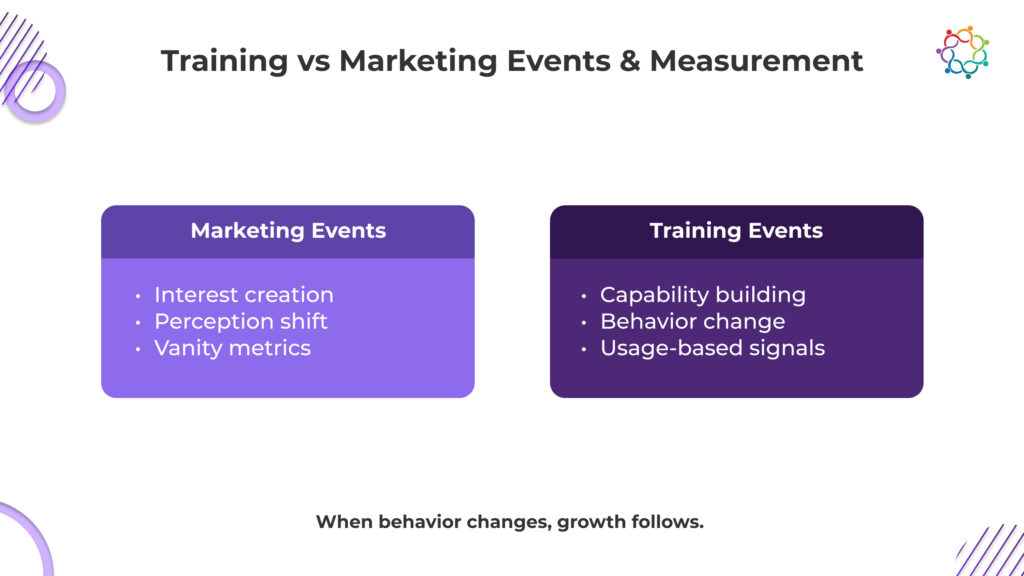
A fundamental misunderstanding that limits investment in training is the tendency to evaluate it with marketing KPIs. Marketing events are designed to create awareness, momentum, and interest. They change perception. Training events, by contrast, create capability and independence. They change behavior.
The critical distinction lies in intent and measurable outcomes:
Businesses constantly underestimate the impact of training when they use marketing assessment frameworks. Positive satisfaction ratings and high attendance are frequently seen as indicators of success, but they don’t account for the compounding impacts of increased confidence and utilisation.
Leaders may align expectations and measure training in a way that accurately reflects its economic importance by being aware of this distinction. It guarantees that enablement initiatives are viewed as a direct contributor to retention and growth results rather than as a support role.
Evaluating training through traditional satisfaction surveys or attendance figures provides limited insight. Leaders must shift focus from vanity indicators to metrics that demonstrate real growth impact.
Many organizations rely on the following metrics:
While these numbers indicate activity, they do not demonstrate whether participants gained confidence, applied new skills, or increased product usage. Measuring presence rather than progress creates an illusion of impact, leading to misallocation of resources.
Metrics that genuinely correlate with growth include:
Rather than emphasising sentiment, these measurements show changes in behaviour. They demonstrate how training promotes adoption, lowers barriers, and helps users accomplish their goals.
Behavioral shift becomes visible when engagement is structured and tracked. In one global training seminar, 95% of attendees completed digital session check-ins and contributed over 600 structured feedback entries. Participation at that depth does not measure attendance; it reveals learning engagement and signal quality that can be tied back to adoption maturity.
Organisations can justify strategic investment and measure the economic benefit of training events by concentrating on these variables.

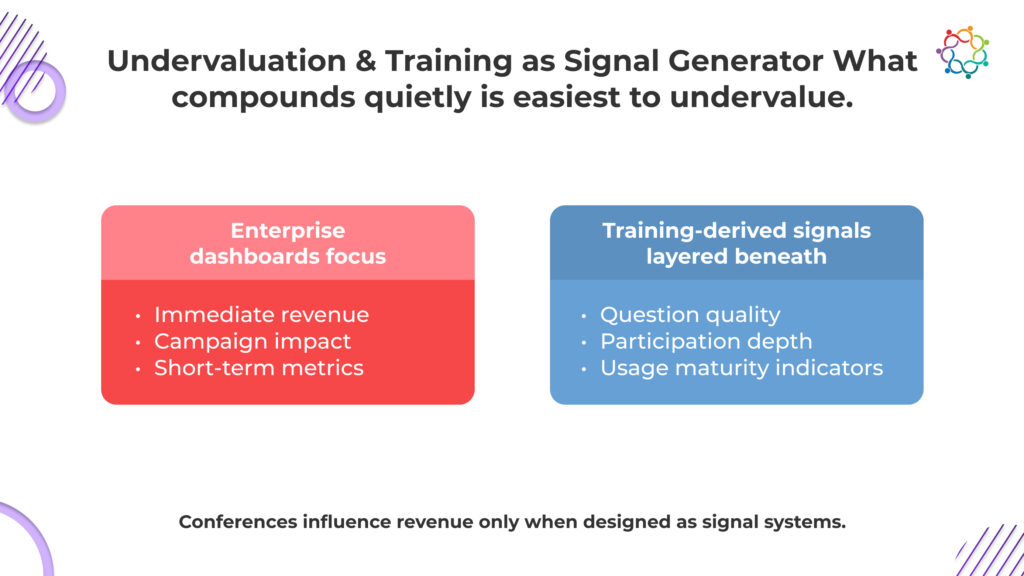
Despite clear evidence of impact, enterprises often undervalue training campaigns due to structural and organizational blind spots.
During budget reviews, the initiatives with delayed visibility are the first to be cut, even when they compound revenue over time. This undervaluation reinforces the misconception that training is discretionary, when in reality it is structural to retention and expansion.
Recognizing the delayed yet compounding nature of training impact is essential. Enterprises that ignore it optimize for immediate optics while weakening long-term growth stability.
Beyond immediate adoption, training events provide unique insights into customer health and behavior. Participation patterns, questions asked, and session engagement serve as reliable signals for account maturity and risk.
In this way, training functions as an intelligence platform. It surfaces some of the cleanest behavioral signals in the entire customer lifecycle, helping leaders proactively manage risk and identify growth opportunities.
Real growth does not only come from winning new customers. It comes from keeping and expanding the ones you already have. That happens when customers clearly understand your product, use it correctly, and see consistent results.
When people feel confident, they use more features. When they use more features, the value becomes obvious. When value is obvious, renewal feels natural, and expansion feels logical.
If you ignore capability building, you create doubt. Doubt slows usage. Slow usage weakens retention.
Companies that compound revenue over time do not only sell effectively. They systematically increase customer capability.
For organizations reassessing how capability building influences retention and expansion, explore how structured Training Events & Seminars contribute to long-term engagement.
If this perspective challenges how your organization currently evaluates training investments, you can continue the conversation here.
Churn is usually explained with easy answers: pricing, feature gaps, competition. These explanations protect internal narratives. But most customers leave not because something fails, but because they never achieve confident, independent usage.
A product can work perfectly and still feel uncertain. When customers do not understand how to extract value, hesitation replaces conviction. Confusion lowers perceived impact before dissatisfaction is voiced. Usage becomes shallow. Advocacy never forms. Renewal becomes risky.
Customers rarely churn in a dramatic moment. They drift when nothing fully clicks.
Retention is not first a product problem. It is a learning problem. If customers never achieve usage maturity, they cannot justify value internally. And if they cannot defend the investment, they will not renew it.
This blog covers why education, not support, determines long-term retention and how structured learning directly influences confidence, trust, and loyalty.

Education is not a content function. It is a confidence engine. Customers do not renew because they were helped quickly. They renew because they feel capable of winning consistently. Confidence lowers perceived risk. Lower risk strengthens trust. Trust stabilizes retention.
When customers understand not just how a feature works but why it matters, value realization accelerates. They shift from dependency to control. Control changes behavior. It increases experimentation, deepens adoption, and strengthens internal alignment. That alignment protects renewals long before procurement discussions begin.
If customers constantly need reassurance, loyalty is fragile. If they understand how to create results independently, loyalty becomes durable. Retention strengthens when customers feel in control, not when they feel supported.

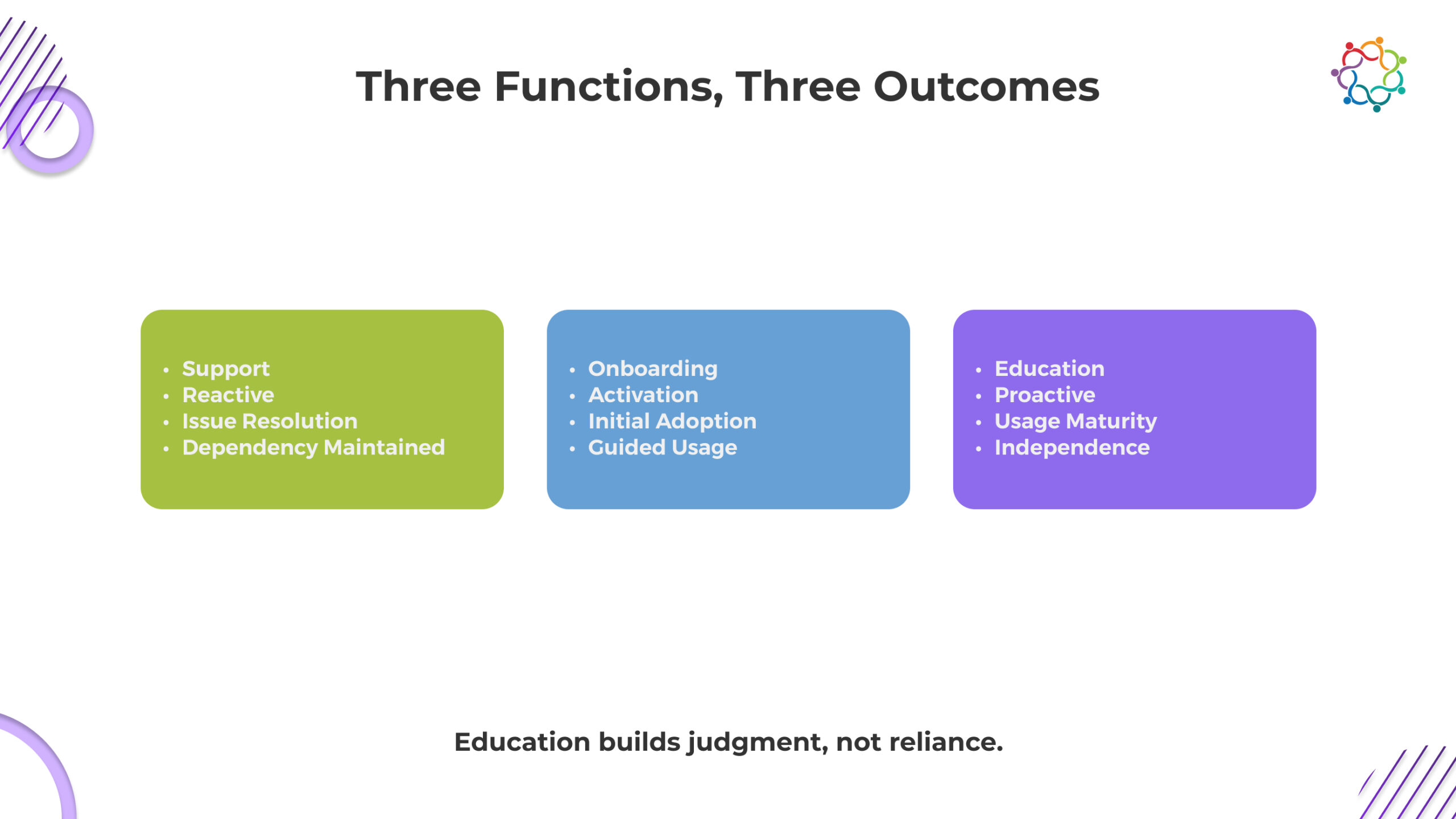
If you blur the line between support, onboarding, and education, you are mismanaging retention. These functions are not interchangeable. Treating them as one bucket guarantees shallow adoption and fragile renewals.
Support is reactive. It activates after friction appears. A ticket is raised. A response is given. The issue is resolved. Resolution restores functionality, not mastery.
Education anticipates confusion before it compounds. It addresses recurring gaps collectively. It upgrades baseline understanding across accounts. If your customers only learn when something breaks, you are training dependency, not confidence. Dependency increases churn sensitivity. Prevention reduces it.
Onboarding moves customers from purchase to first value. It proves the product works. Then it ends.
Education begins where onboarding stops. It deepens usage maturity. It connects features to evolving business scenarios. Without structured reinforcement, adoption plateaus at “good enough.” Good enough does not survive competitive pressure. If learning stops after activation, renewal risk starts increasing.
Support answers how. Education clarifies why and when. That difference defines retention strength.
Customers who understand context make independent decisions. Independent users explore more. Exploration drives deeper value realization. If your customers cannot articulate strategic application, they are not loyal. They are temporary.
Education events exist to create autonomy. If your programs do not build judgment, they are not protecting retention.

Retention is not just about contract continuity. It is about durable alignment between product value and customer belief. Education shapes that alignment.
Educated customers extract value faster. They expand usage across teams. They connect capabilities to measurable outcomes. This accelerates value realization and reinforces retention economics.
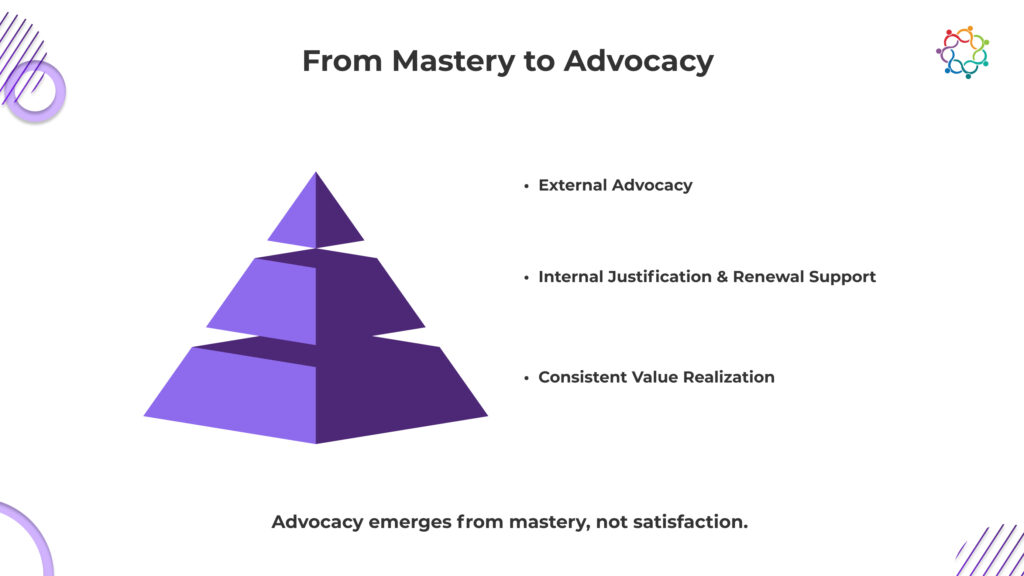
Mastery changes internal conversations. When customers understand a product deeply, they can justify investment decisions. They defend budget allocations. They articulate ROI in their own language.
Education influences advocacy in subtle ways:
Satisfaction is emotional. Mastery is structural.
Advocacy often emerges from competence, not delight. A satisfied customer may still consider alternatives. A master user understands trade-offs. They recognize opportunity cost. They know what would be lost in migration.
This is where customer education events compound impact. They create shared learning communities. They normalize advanced practices. They reinforce trust through transparency and expertise.
Over time, educated customers become internal experts. Internal experts anchor renewal conversations. They reduce procurement friction. They provide social proof inside their organizations.
Retention is reinforced when value is clearly articulated, and education makes that articulation possible.
Without ongoing product education programs, usage stagnates. Stagnation lowers perceived growth potential. When growth potential declines, renewal risk rises.
Retention is sustained by continuous learning, not periodic persuasion.

Attendance metrics are visible. Retention signals are deeper.
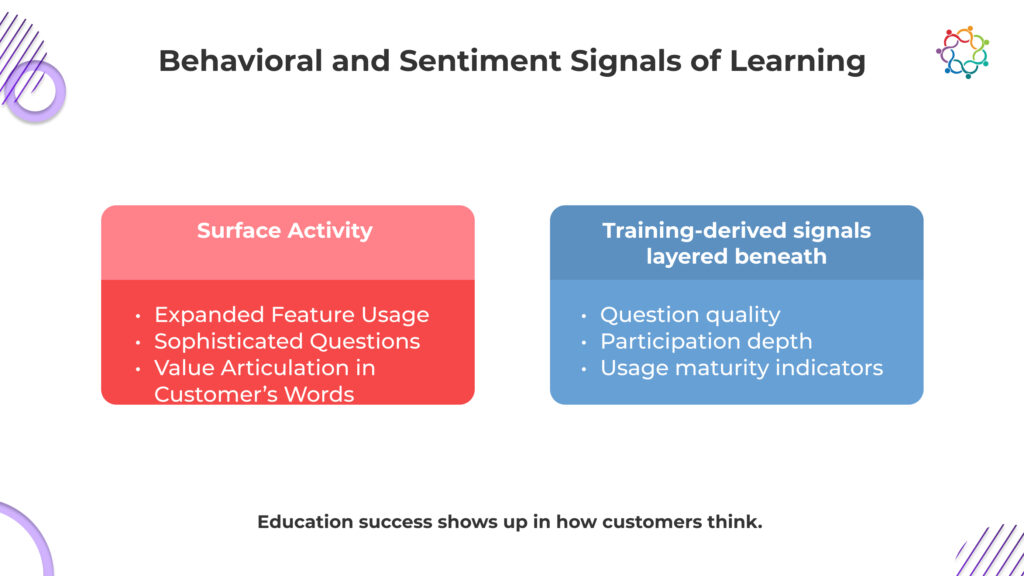
Measuring customer education impact requires behavioral and linguistic analysis. Surface engagement does not prove confidence. Leaders must look for evolution.
Behavior reveals maturity. As customers learn, patterns shift.
These indicators reflect usage maturity and value realization. They signal that learning reinforcement is occurring. Customers are not just consuming content. They are applying it.
Advanced questions demonstrate cognitive progress. When customers challenge assumptions or explore integration depth, they display confidence. Confidence reduces churn risk because it strengthens internal ownership.
Signal quality improves when behavior changes. Retention becomes predictable when adoption depth expands consistently.
Language shifts precede renewal strength. Customers who understand value articulate it clearly.
Listen for evidence:
These signals indicate trust reinforcement and advocacy formation. Education is working when customers teach others. Peer teaching reflects mastery.
Measuring impact requires qualitative attention. Surveys alone are insufficient. Observe how customers think. Observe how they speak. Observe whether they connect the product to business outcomes without prompting.
Education success appears in dialogue quality, confident framing, and proactive engagement. Retention improves when customers internalize value narratives. Education shapes those narratives.
Most teams claim retention is a priority. Few allocate resources to the one lever that systematically protects it. Education is deprioritized not because it lacks impact, but because its impact is misunderstood. If you treat learning as optional, you are choosing preventable churn. The bias is structural, and it is expensive.
Education rarely delivers dramatic quarterly lifts. It compounds quietly through confidence-building and usage maturity. If you prioritize only visible short-term wins, you will consistently underinvest in long-term retention economics. In reactive organizations, short-term spikes often win budget over long-term compounding effects.
Education influences customer success, product adoption, marketing advocacy, and expansion revenue. Because the outcomes are distributed, accountability becomes blurred. When no single team “owns” the upside, no single team fights for the budget. Avoiding ownership does not reduce risk. It increases it.
Measuring customer education impact requires behavioral analysis, not vanity metrics. Reduced churn volatility and stronger renewal confidence appear over time. If your measurement model only rewards immediate attribution, you will miss the structural drivers of loyalty.
Education prevents confusion, stagnation, and silent disengagement. Prevention rarely looks urgent until renewals decline. By then, rebuilding trust is slower and more expensive than sustaining it.
If you are underfunding education events, you are not being efficient. You are deferring risk.

s
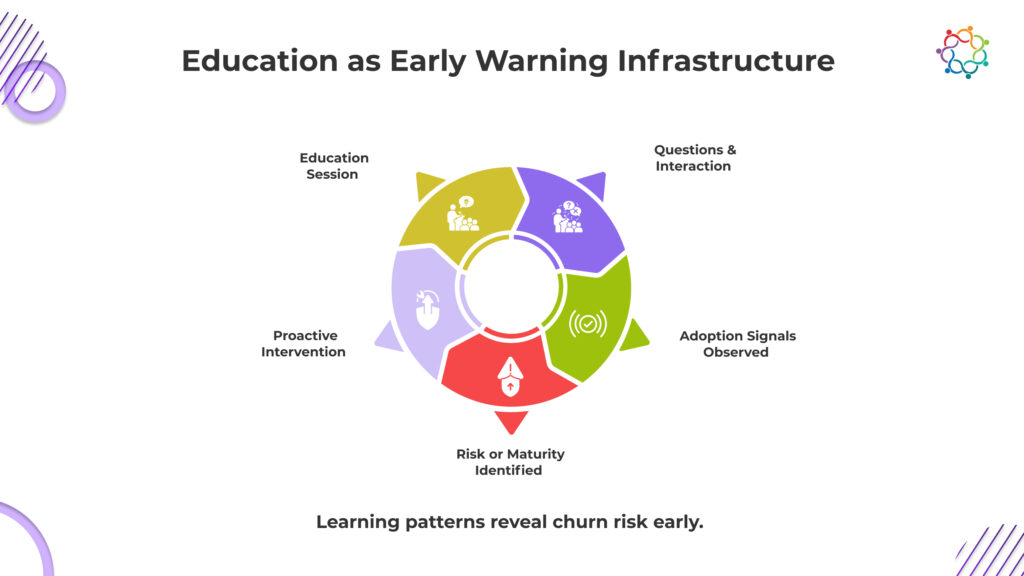
Education is not only about delivery. It is diagnostics.
Every question asked during a session reveals adoption maturity. Basic clarifications signal early-stage understanding. Advanced integration inquiries signal confidence and exploration.
Attendance patterns also reveal risk. Declining participation can indicate disengagement. Sudden inactivity may reflect internal disruption. Consistent engagement suggests embedded value.
Feedback collected during sessions often exposes strategic gaps. Customers articulate friction points candidly in educational settings. This transparency provides early warning long before formal churn signals appear.
Signal quality from engagement is stronger in educational environments because participation is voluntary and intent-driven. Customers who attend want to improve outcomes. Their questions are forward-looking. Their concerns are predictive.
Retention intelligence derived from education is proactive. It enables targeted intervention before risk materializes. It allows customer success leaders to prioritize accounts based on learning velocity rather than only revenue size.
Usage maturity is observable in real time through dialogue depth. Leaders who treat education as insight infrastructure gain clarity that others miss.
Retention is easier to protect when warning signals are visible. Education events make those signals visible.
Retention is not protected by reminders, discounts, or last-minute persuasion. It is protected by understanding. Customers renew when they are confident, capable, and clear about the value they create with your product. That clarity does not happen accidentally. It is built through deliberate education.
If learning slows, usage plateaus. If usage plateaus, renewal weakens. The pattern is predictable.
Customer education events are not optional programming. They are a retention infrastructure. Underinvest here, and churn becomes a matter of time, not surprise, especially for teams that delay formalizing how they approach education strategy.
Field teams execute flawlessly, most of the time. Regional activations and roadshows run on schedule, booths engage the room, and attendance hits target. Then leadership asks about ROI, and the conversation turns defensive.
The problem was never execution. It’s observability. A field event generates real influence through conversations, context, and behavioral signals, and most of that rarely survives the trip from the show floor into a CRM. By the time a pipeline review happens, the influence has diluted, timing gaps blur relevance, and attribution looks weak. Leadership treats the program as optional not because it failed, but because the dashboard never captured what actually happened.
This piece covers exactly where that signal gets lost, and what high-performing teams track instead.
The natural assumption is that better execution means better ROI. A polished booth and flawless logistics should, in theory, drive results. In reality, execution quality mostly improves the experience, not the attribution. A few specific dynamics explain why:
Flawless delivery can’t force revenue attribution on its own. The real challenge was never what happens at the event. It’s what happens after.

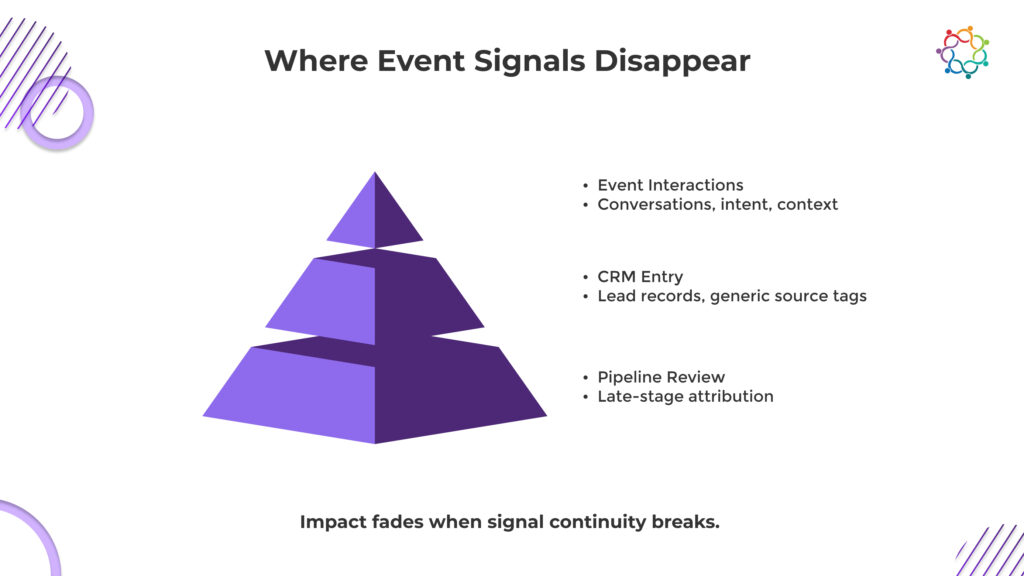
Flawless execution and a skeptical leadership team usually coexist for one reason: the real impact of a field event rarely travels intact from the floor to the pipeline. Conversations, intent, and engagement, the things that actually drive a deal, get flattened into a generic lead or lost outright.
3.1 Field Events Generate Signals, Not Immediate Outcomes
Every conversation, demo, and engagement at an activation produces a behavioral signal: intent, interest, a specific problem surfacing. Those signals point to a future opportunity, they rarely close a deal on the spot. Immediate CRM entry usually strips that nuance down to a generic lead, and whatever impact exists tends to surface later, during a sales conversation or a nurture cycle, not at the moment of capture.
3.2 Signal Loss Between Event and CRM
Once a lead lands in the CRM, context tends to disappear. Notes go generic, urgency fades, and a rich in-person conversation flattens into a numeric entry. A lead captured today might not convert for months, erasing any visible connection back to the original interaction, and that flattened signal makes real influence look intermittent to whoever’s reviewing the pipeline.
3.3 Attribution Happens Too Late
Revenue attribution usually happens at the moment a deal closes, long after the field event that actually influenced it. Traditional attribution models rarely credit an event directly for pipeline creation when the influence was indirect. Field events aren’t ineffective, they’re invisible in the reporting, and that invisibility is exactly what leads leadership to undervalue them.

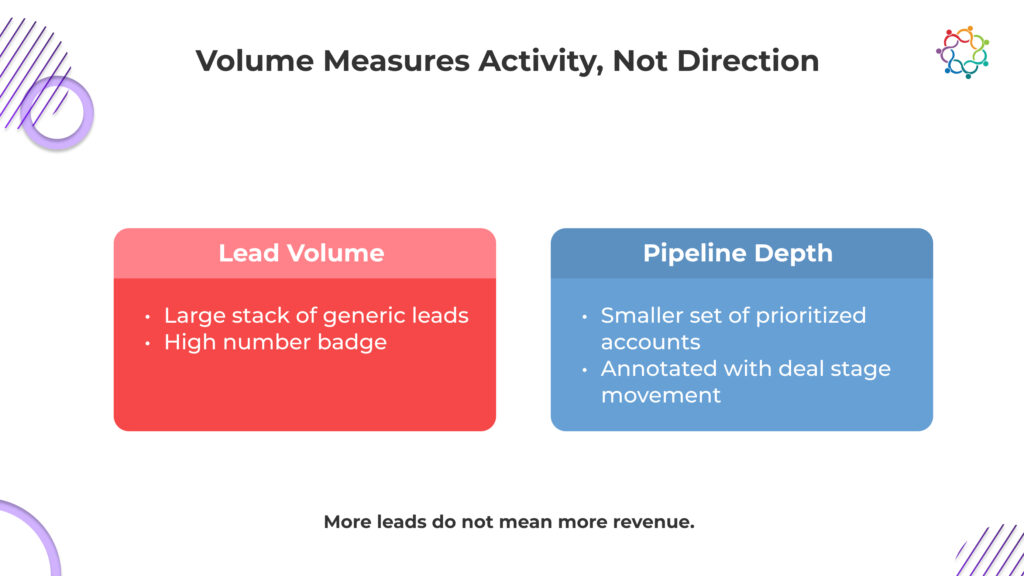
Lead volume is still the most common success metric, and it consistently misrepresents value. Volume shows reach. It says almost nothing about relevance. A flood of low-priority leads can actually erode sales’ trust in the whole program.
Volume-heavy reporting signals to leadership that field events are a checkbox exercise rather than a real revenue input. The critical distinction is simple: volume is activity completed, revenue is strategic influence actually applied.

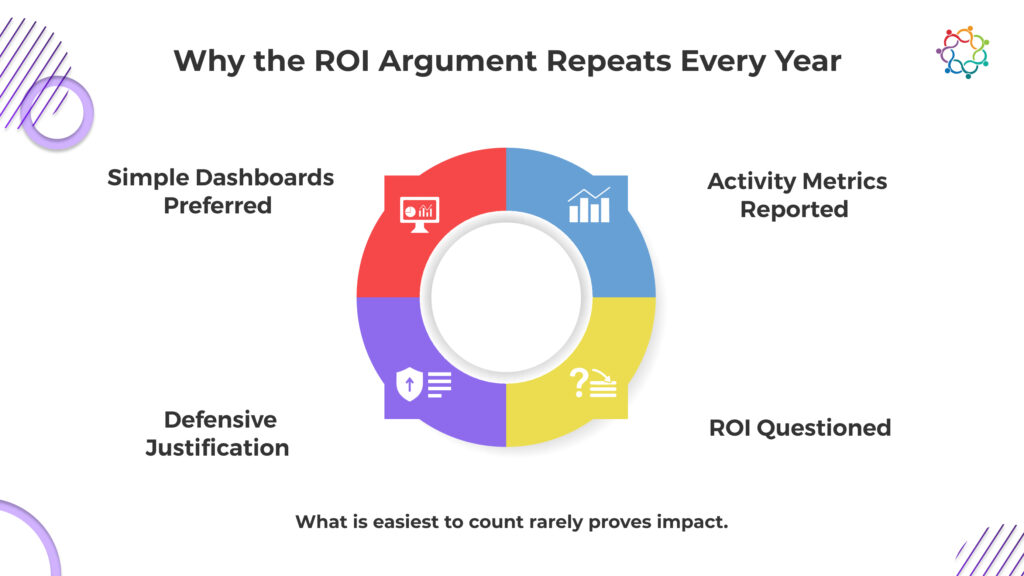
Most teams report what’s easiest to count, not what actually moves revenue. Execution stays visible. Influence doesn’t. Teams that earn real leadership trust track the signals that survive past the event.
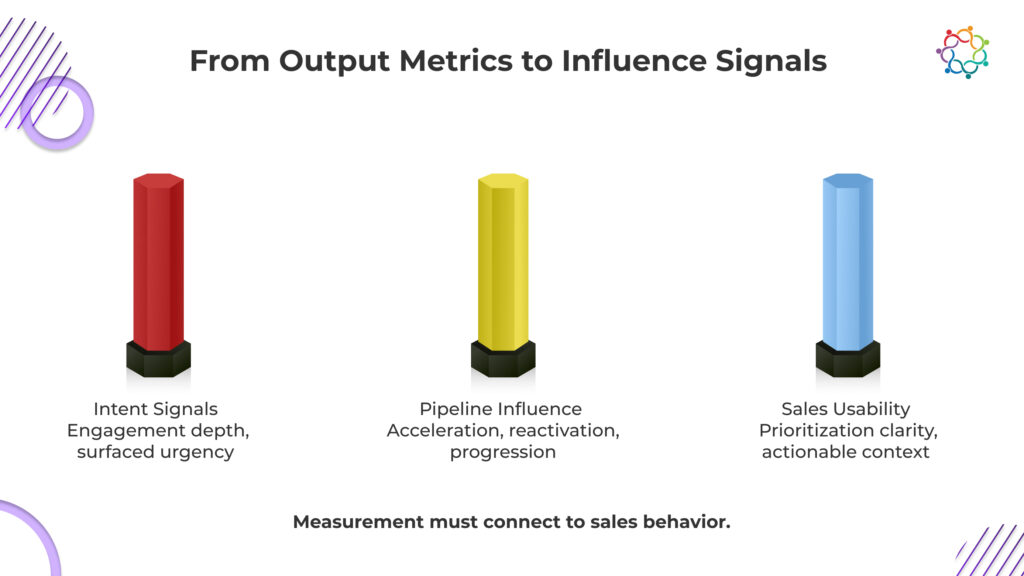
5.1 Intent Signals Over Counts
Badge scans and session attendance aren’t the number that matters. What matters is who engaged deeply, what problem actually surfaced, and where real urgency showed up. Without evidence of that depth, an event stays invisible to leadership no matter how many people walked through it.
5.2 Pipeline Influence, Not Ownership
A field event rarely closes a deal on its own, even though most reports get written as if it should. What high-performing teams track instead is acceleration and reactivation, whether the event actually nudged an opportunity forward. Events are catalysts here, not closers, and the measurement needs to reflect that role honestly.
5.3 Sales Usability of Event Output
If what an event produces doesn’t change how sales prioritizes or follows up, it’s just noise. Real measurement checks whether the intelligence generated actually gets used. Influence that never changes behavior effectively doesn’t exist.

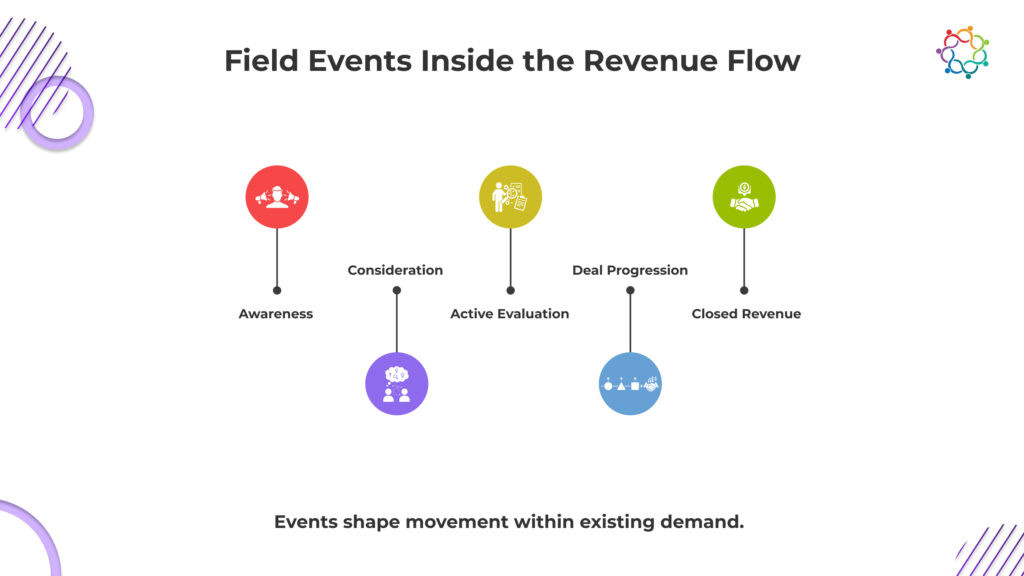
Most field events run in a vacuum, planned and reported as though a deal starts at the booth. It rarely does. Field marketing usually intersects with a buying journey that’s already in motion, influencing a decision rather than starting one from zero.
Ignore that reality in the measurement, and every dashboard makes the program look optional. Leadership sees cost without a clear connection to outcome, and the events end up only as credible as the signal they leave behind in the actual revenue flow.
Field teams execute well and still get questioned, and the reason is structural. Most organizations are built to actively obscure the influence a field event actually has.
The systems and incentives most organizations run on reward what’s easy to measure, not what actually drives revenue. That’s a misaligned metric problem, not a poor execution problem.

Execution alone was never going to resolve the ROI question. A field event generates real influence, and if that signal never survives the trip to sales and the CRM, leadership will keep treating it as optional.
Volume, attendance, and flawless delivery can’t substitute for observable impact. The teams that win this argument track intent, behavioral signals, and pipeline influence, not just activity, and a field event becomes a genuine strategic input only once measurement actually captures what it did.
An event management platform that carries engagement data through to the CRM intact, not flattened into a generic lead, is what actually makes that influence visible.
Book a demo with Samaaro to see what that looks like for your next field program.
1. Why do field marketing events often fail to show measurable ROI despite flawless execution?
Field marketing events fail on measurement, not execution. Without data connecting the event to pipeline, even a flawless event can’t prove ROI, and the budget gets questioned.
2. What is “signal loss” between an event and the CRM system?
Signal loss happens when real buyer signals, conversations, questions, intent cues, never make it into the CRM. They get lost in notebooks, badge scans, and delayed data entry.
3. What is the difference between lead volume and pipeline influence?
Lead volume counts contacts collected. Pipeline influence measures whether those contacts actually moved a real opportunity forward. Volume fills a report. Influence fills a forecast.
4. What are intent signals, and why do they matter more than badge scans?
A demo request, a specific question, an accepted meeting, these show genuine buying interest. A badge scan only proves someone walked past a booth.
5. How can field marketing teams align event measurement with overall revenue motion?
Define shared metrics with sales, sync event data into the CRM quickly, and report on deal influence rather than raw activity. Measurement tied to revenue is what keeps a field program funded.
Product launch events get treated as the ultimate proof of a product’s promise. They’re visually polished, timed carefully, and built to generate applause, social shares, and strong registration numbers. The structural problem is simple: attention alone doesn’t create adoption.
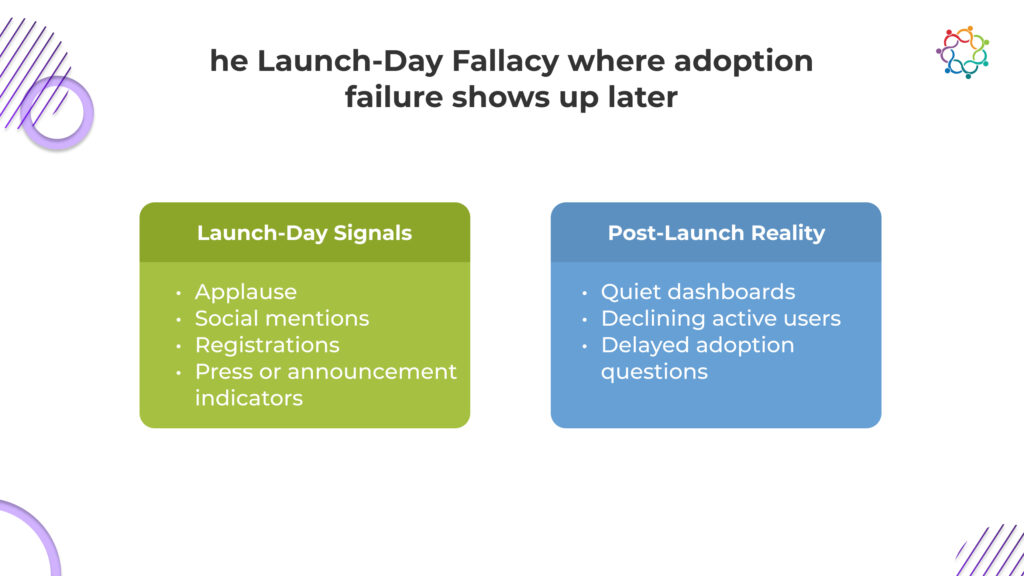
For product marketers and growth leaders, that’s genuinely frustrating. Launch-day applause rarely leads to lasting engagement, and usage often drops sharply once the excitement wears off. The issue isn’t that users fail the product. It’s that the launch fails the users.
This isn’t user apathy. It’s launch design. Attention, messaging, and onboarding get misaligned with how behavior change actually works. A launch event needs to function as the starting point for learning and action, not the peak of the whole effort.

Generating enthusiasm on launch day is surprisingly easy. Almost any product can look revolutionary for a few hours given a well-executed presentation, striking visuals, and solid PR. None of that measures whether anyone will actually use the thing.
The core flaw is assuming visibility equals adoption. Teams treat applause as understanding and awareness as action, but launch events reward immediate attention, not sustained engagement. The chain runs predictably: too much information crammed into too little time reduces what anyone actually retains, weak retention slows down how fast someone gets to a first real use, and that lag is exactly where abandonment sets in.
Most launches succeed as events and fail as adoption systems. The audience leaves excited but without a clear next step, and that’s the moment adoption decay quietly begins.

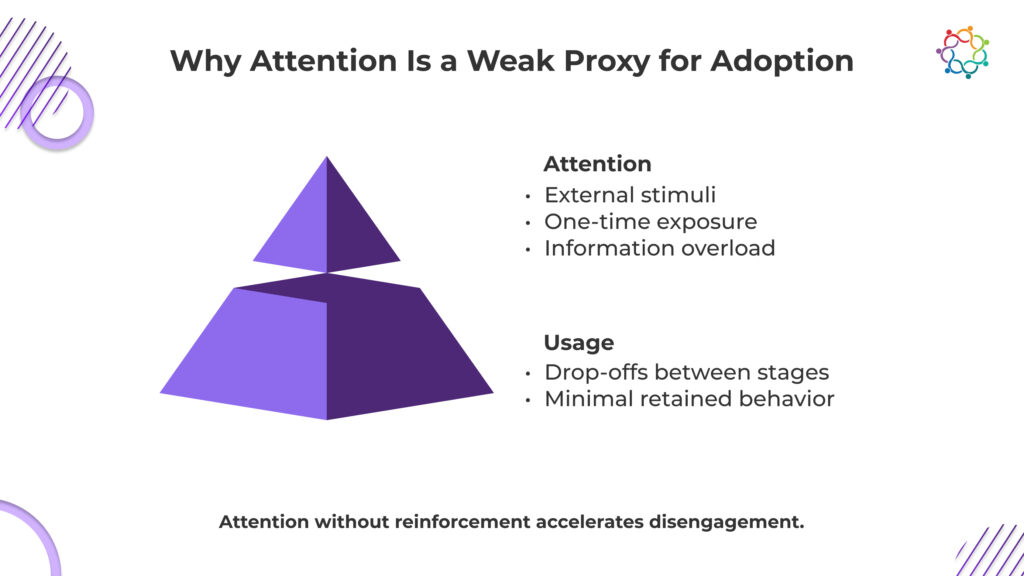
Engagement during a launch doesn’t prove sustained usage. An eye-catching demo gets people to look, listen, and cheer, but none of that guarantees they’ll actually open the product next week. Adoption runs on something different, repeated exposure, real motivation, an actual grasp of the value on offer.
Most launch events cram months of content into a few hours, forcing people to absorb far more than they can hold onto. Attendees leave amazed, not necessarily knowledgeable, and that excitement fades the moment they’re back in their normal routine. Without structured reinforcement afterward, drop-off is close to inevitable.
Attention can’t carry adoption on its own. Real adoption gets earned through guidance and reinforcement, not a single great hour on stage.

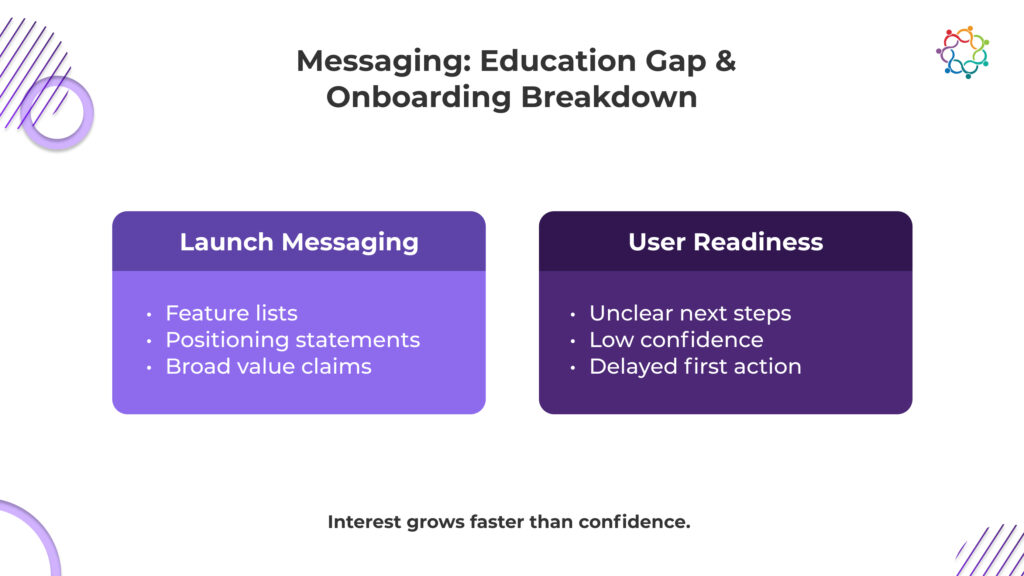
Even well-positioned products struggle after launch because messaging and education get treated as the same thing. They’re not. Messaging creates interest. Education creates the ability to actually use something, and confusing the two is where adoption starts to slow before it’s even begun.
Features Without Context
Launch presentations tend to highlight feature after feature in quick succession. Without knowing when or why to use a given feature, complexity climbs and confidence drops.
Positioning Without Practicality
Strong positioning explains who a product is for and why it matters. It rarely explains how to actually start.
Information Without Retention
Compressing a lot of information into a short session reduces retention on its own, and that weaker retention is exactly what slows someone down once they try to use the product independently.
Interest Without Confidence
Curiosity gets someone to sign up. Confidence is what keeps them using it. Without guided education, early enthusiasm fades into hesitation, and hesitation tends to turn into abandonment.
Adoption only improves once education gets built directly into the launch experience instead of getting pushed to later.
Most launch events prioritize spectacle over readiness. People frequently leave excited but unsure what to do next, and the experience feels disconnected because onboarding usually gets handled separately, often months after the launch itself.
Adoption stays fragile whenever launch and onboarding get split apart like this. Launch events tend to put the reveal ahead of preparation, favoring bold statements over concrete next actions, which leaves people without an obvious way to get value right away. Because onboarding gets treated as reactive instead of proactive, adoption often stalls before it even starts.
That’s not an accident. Adoption has to be deliberately designed. A launch event that ignores onboarding is effectively guaranteeing its own post-event drop-off.

Adoption isn’t a moment of excitement. It’s a behavioral transition, and behavioral transitions don’t happen on stage, they happen through repetition under reduced uncertainty.
A launch event creates awareness and emotional energy. What it doesn’t create is confidence. Once the spotlight fades, users are left with real questions: will this fit into my workflow, what happens if I get stuck. That uncertainty is the actual barrier standing between someone and real adoption.
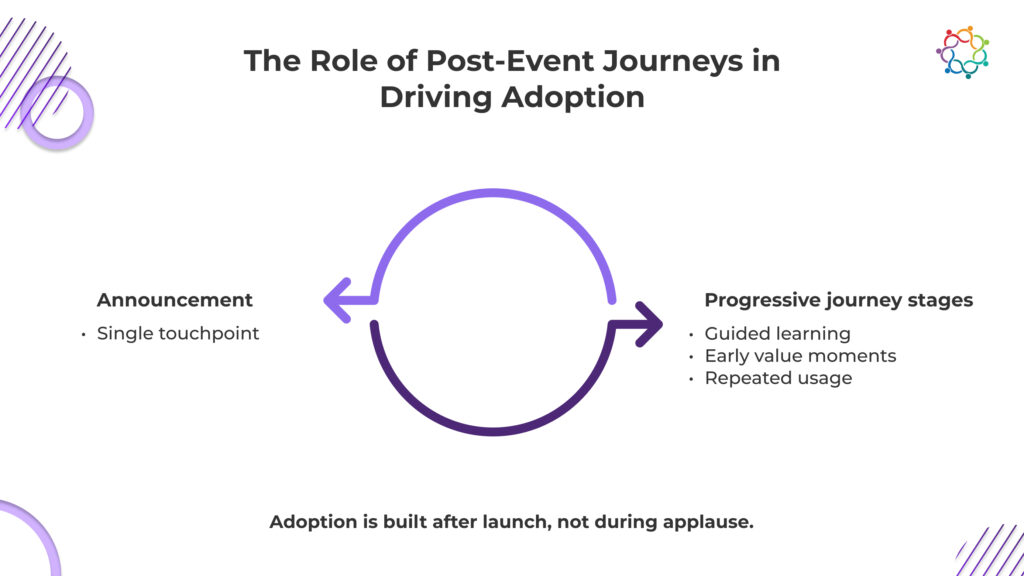
Post-event journeys exist to remove that uncertainty systematically. Spaced reinforcement, follow-up emails, contextual nudges, short webinars, guided in-app prompts, keeps the product present without overwhelming anyone. Each interaction chips away at ambiguity, which makes someone more willing to try something, and trying creates small repetitions that, paired with visible progress, start turning into a habit.
Tracking who activates, who stalls, and where the friction actually sits, especially when that data flows cleanly through your existing integrations instead of sitting in a separate tool, is what lets a team step in before confusion turns into someone quietly walking away.
The uncomfortable truth is that even a high-energy, well-attended launch can’t guarantee adoption on its own. Only a structured, pre-planned post-event journey actually converts awareness into behavior.

Conventional product launches lean heavily on spectacle, real money spent on announcements, visual polish, and a single big moment that rarely gets revisited. That prioritizes attention over behavior, and applause over adoption.
Successful launches take a different approach. Instead of treating the event as a peak, they treat it as the start of a learning process and a behavior shift. The goal is getting people to act, not just impressing them.
Effective launches translate attention directly into first use. The best events read more like the first chapter of onboarding than the conclusion of a campaign.
Marketing gets rewarded immediately. Product gets judged months later. Nobody actually owns the gap in between.
That disconnect isn’t a small oversight, it’s a structural flaw. Celebrating attention without owning what happens after creates exactly the conditions for disengagement. When nobody owns adoption continuity, that outcome is predictable, not surprising.
Launch-day applause is fleeting. Buzz doesn’t equal usage. A launch that doesn’t make first use easier within the first 24 hours has, functionally, failed at adoption, however well the event itself went.
An event management platform that connects launch-day engagement directly to what happens in the weeks after is what makes that continuity actually possible.
Curious what this looks like for your next launch? Book a demo with Samaaro today.
Sales kickoff events are remembered as high points in the revenue calendar. Energy peaks. Leadership clarifies direction. Product and marketing align around a shared narrative. For a few days, the organization feels synchronized and focused.
Then everyone returns to the field.
Within weeks, selling patterns look familiar. Qualification remains inconsistent. Messaging drifts. Forecast variability continues. The intensity of the moment does not translate into sustained execution change.
This is the paradox. The experience feels successful. The behavior does not materially shift.
The issue is not effort, budget, or production quality. It is structural design. Inspiration is treated as transformation. Alignment is mistaken for adoption. Applause is interpreted as progress.
Sales kickoff events rarely fail in the room. They fail in the weeks that follow.
(Read: The Ultimate Guide to Integrating Sales Enablement and Event Marketing)
This blog covers why motivation decays, why execution resists inspiration, and what must structurally change for sales behavior to actually move.

Motivation reliably spikes during the kickoff. The problem is that you expect that spike to survive in an unchanged environment. It will not.
Sales behavior is not shaped by how inspired your team felt for two days. It is shaped by quota pressure, compensation design, CRM workflows, pipeline scrutiny, and manager inspection. If none of those changed after the event, why would behavior change?
Motivation is temporary and context-bound. The context during the event is controlled, focused, and emotionally charged. The context back in the field is chaotic, metric-driven, and unforgiving. When those two environments collide, the operational one wins every time.
Reps do not abandon new priorities because they disagree. They abandon them because the system does not require adoption. Forecast calls still prioritize volume. Managers still coach the old way. Incentives still reward the same behaviors.
If the operating environment remains intact, old patterns will reassert themselves. Energy fades. Habits remain.
If you did not redesign how behavior is reinforced after the event, you did not design change.

Sales kick-off events often blur the line between belief and behavior. Teams leave convinced the strategy is right. That conviction is mistaken for readiness. Agreement is not execution. Until priorities are translated into enforced daily actions, nothing materially changes.
Vision creates belief. It does not create skill. Reps may understand the new direction but remain unclear on what to do differently in live deals.
Key gaps typically include:
Without procedural clarity, sellers default to familiar routines. Alignment without instruction produces confidence, not capability.
Even when new frameworks are introduced, they fade without repetition. Memory weakens. Confidence drops. Quota pressure pushes reps back to proven scripts.
Common failure points:
What is not reinforced is not retained.
Selling behavior follows incentives and inspection. If CRM stages, pipeline reviews, and compensation plans remain unchanged, priorities remain unchanged.
Execution responds to:
If the system does not move, behavior will not move.

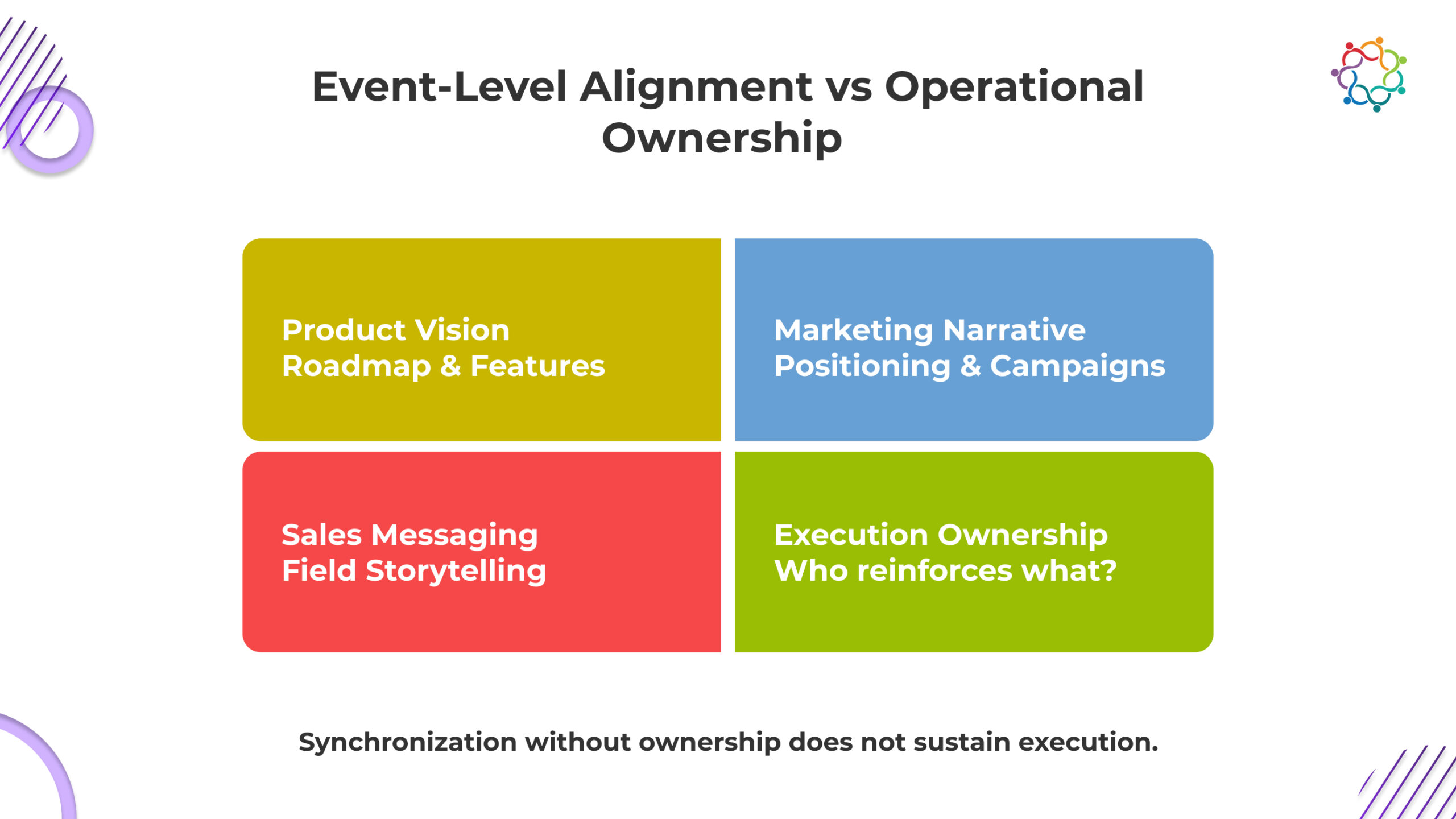
Alignment is frequently declared at the end of the event. Messaging appears unified. Strategy feels shared. Teams leave believing they are synchronized. But alignment inside a ballroom does not guarantee alignment inside a live deal. When cross-functional priorities are not translated into execution ownership, fragmentation resurfaces quickly.
Product roadmaps are often presented in terms of innovation and differentiation. What is missing is direct mapping to customer objections, competitive pressures, and pricing resistance. Without translating vision into field-level conversations, reps struggle to operationalize what they heard.
Marketing introduces refined positioning and value propositions. However, if those narratives are not tested against real buyer pushback, they remain theoretical. Messaging must survive scrutiny in live calls, not just on stage.
Leadership may announce new target segments or deal strategies. If CRM stages, qualification criteria, and compensation models remain unchanged, those priorities lack enforcement. Process must reflect strategy.
True alignment requires ownership beyond presentation. Product, marketing, and sales must co-own reinforcement. Without coordinated follow-through, alignment dissolves at first friction.

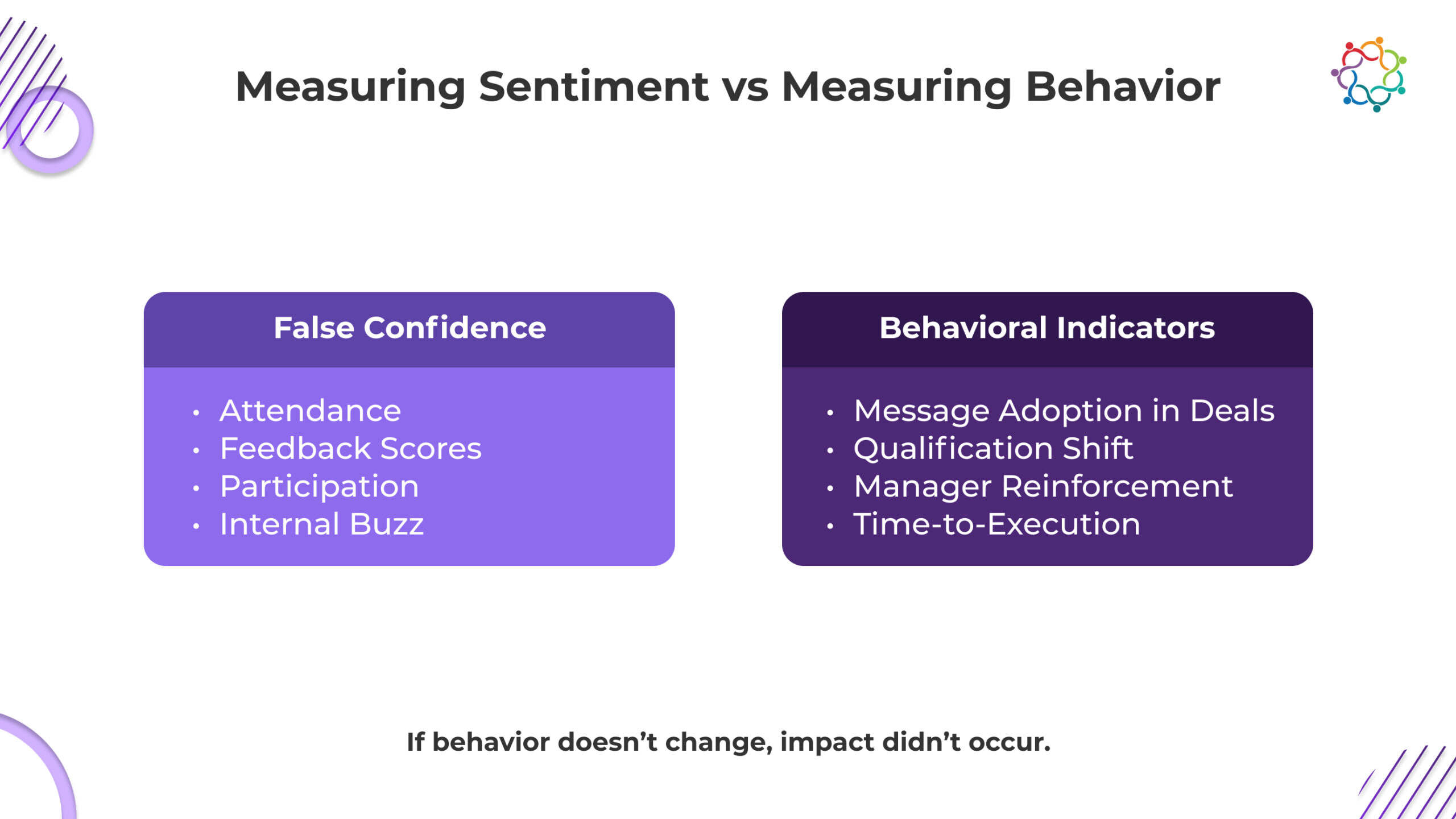
Organizations often measure what is visible during the event rather than what changes afterward. Attendance rates, participation levels, and session feedback scores create a perception of success. They capture sentiment. They do not capture adoption.
High attendance is expected. Positive feedback is common when events are well produced. Internal social sharing generates visible enthusiasm. These indicators feel reassuring because they are immediate and quantifiable.
However, they reflect emotional response, not behavioral shift. A rep can rate a session highly and never apply the content. Satisfaction does not equal implementation.
When leadership reviews these metrics, it reinforces a flawed assumption that energy equates to impact. This is signal versus sentiment confusion. Sentiment is easy to capture. Signal requires behavioral evidence.
If measurement frameworks stop at participation, the organization creates false confidence. The absence of behavior tracking ensures that adoption gaps remain invisible.
If the objective is sales behavior change, measurement must move closer to execution. Are new messaging frameworks appearing in call recordings? Has the opportunity qualification improved in consistency? Are managers reinforcing the new standards during pipeline reviews?
Time to execution after the event is a critical indicator. If new plays take months to appear in live deals, reinforcement is weak. Manager reinforcement consistency is another leading signal. When coaching sessions incorporate new priorities, adoption strengthens.
Changes in opportunity qualification patterns reveal a deeper impact. If teams are targeting different profiles or adjusting deal criteria as instructed, structural alignment may be taking hold.
If selling patterns remain identical, the event did not influence execution.

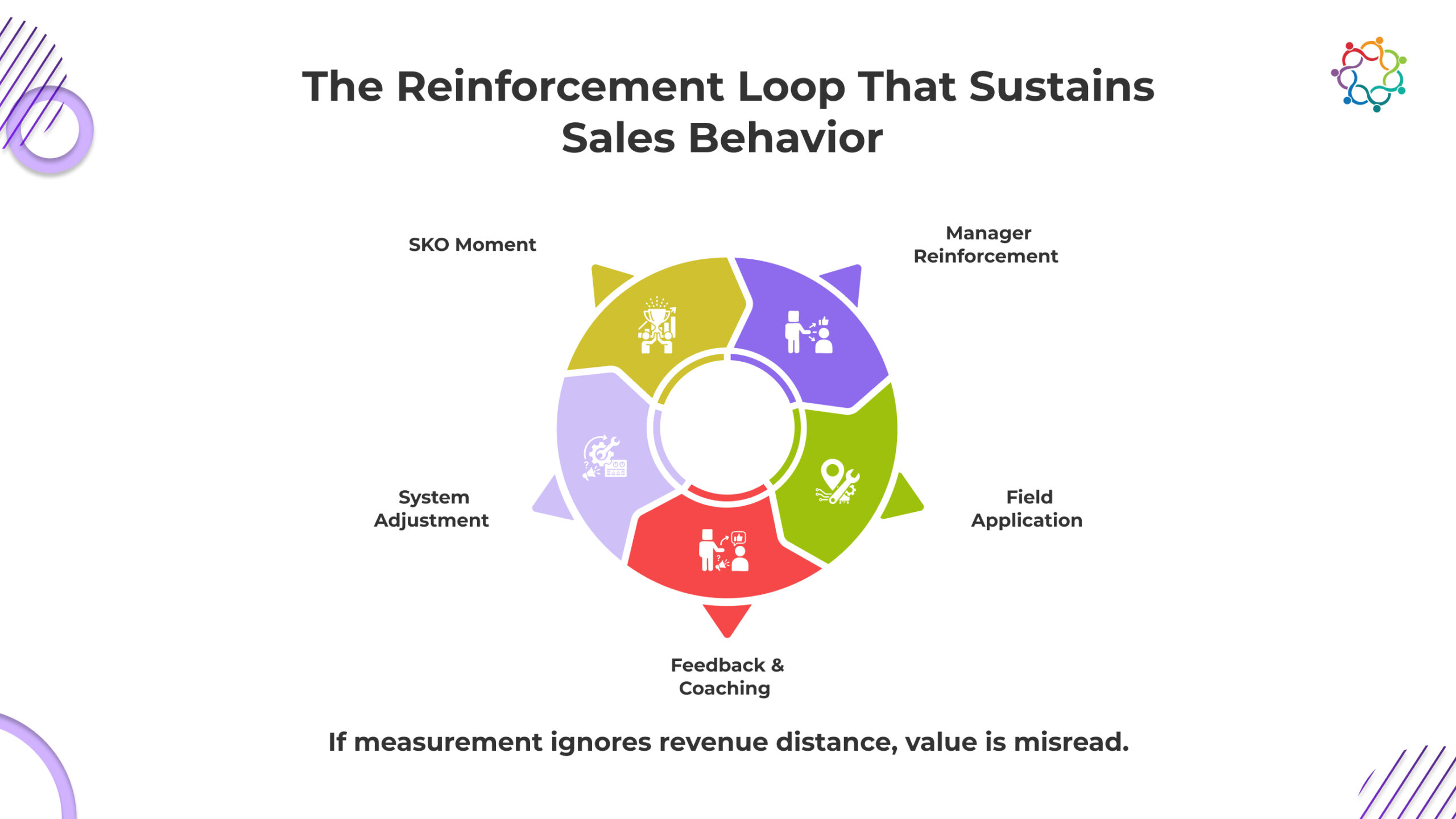
If you treat the kick-off as the peak of effort, you have already guaranteed its decline. Learning does not stabilize because people were attentive. It stabilizes because systems force repetition. Without structured reinforcement, what felt urgent on stage becomes optional in the field within days.
Reps do not ignore new priorities out of defiance. They ignore them because nothing in their daily environment requires adoption. Forecast calls do not reference the new qualification standard. Coaching sessions do not audit the updated messaging. Deal reviews do not penalize old patterns. In that vacuum, the familiar wins.
Post-event learning loops are not supplementary. They are the only mechanism that converts exposure into execution. Repetition inside real deals, manager-enforced feedback, and measurable application checkpoints determine whether behavior shifts. If reinforcement is inconsistent, decay is immediate.
Event excellence cannot compensate for operational neglect. If the weeks after the kick-off look identical to the weeks before it, the outcome will be identical as well.
This problem persists because the organization rewards the wrong outcome. You are measuring how the event felt, not what the field did afterward. As long as morale, attendance, and internal buzz are treated as proof of impact, you will continue mistaking energy for execution.
A high-energy room creates psychological relief. It feels like progress. But morale is not a leading indicator of pipeline quality or forecast accuracy. When you equate excitement with improvement, you avoid asking the harder question: Did selling behavior actually change?
If enablement teams are evaluated on session quality and participation rates, they will optimize for experience. Adoption tracking requires structural follow-through. If no one is accountable for behavioral reinforcement, the decay is inevitable.
Frontline managers shape daily execution. If they are not explicitly measured on reinforcing new priorities, they default to familiar coaching patterns. Without manager accountability, kick-off messaging becomes optional.
After the event ends, ownership becomes diffuse. Sales assumes enablement will follow up. Enablement assumes managers will coach. Leadership assumes alignment already happened. When reinforcement lacks a clear owner, motivation predictably collapses.
Sales kick-off events succeed as moments. They rarely succeed as systems. Energy peaks during the gathering because the context supports it. Behavior persists afterward because systems reinforce it.
If daily workflows, incentives, coaching rhythms, and metrics remain unchanged, selling patterns will remain unchanged. Motivation without reinforcement is temporary. Capability without repetition decays. Alignment without ownership fragments.
Sales leaders, revenue operations heads, and enablement managers must confront a direct question. Did anything structurally change after the event? If the answer is no, then execution will revert.
These events do not fail because they lack ambition. They fail because organizations overestimate the power of inspiration and underestimate the power of systems.
If nothing changes in how reps are coached, measured, and supported, nothing will change in how they sell. And if selling behavior does not change, revenue outcomes will not either.
Energy is easy to generate. Structural behavior change is not.
If nothing changes in how the system reinforces selling behavior, the kick-off changed nothing.
For organizations reassessing how their sales kickoff translates into execution discipline, the conversation can continue here.
Private executive gatherings are often misunderstood because leaders approach them with assumptions shaped by large conferences. The moment an event becomes invite-only, expectations rise. Smaller room. Senior audience. Higher cost. Therefore, a higher visible return.
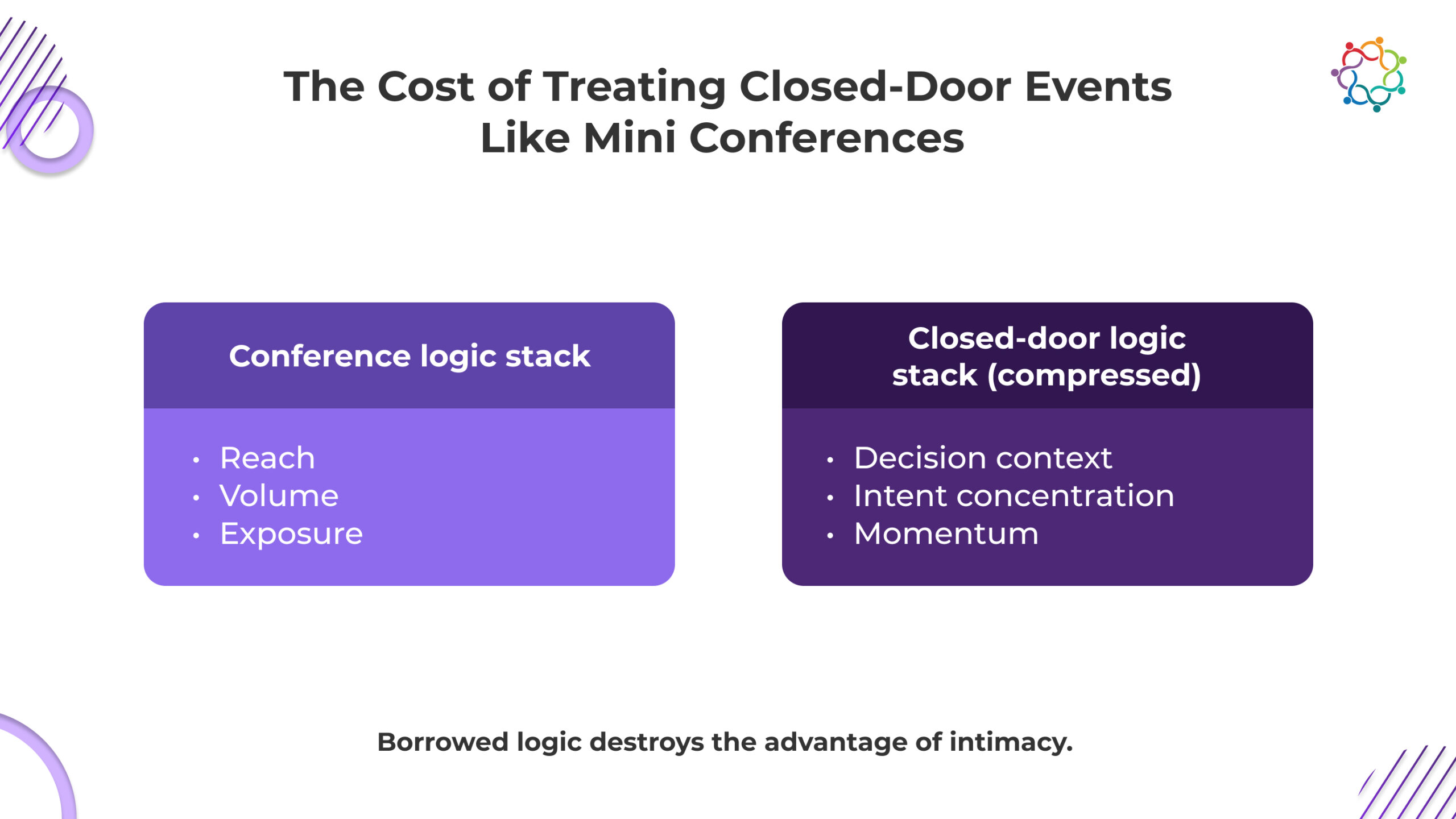
Closed-door events are not smaller conferences. They are a different revenue play. Yet teams apply conference logic to decision-stage environments. That assumption feels rational. It is not. This is not a scale issue. It is a revenue proximity issue.
These formats operate closer to active buying decisions than awareness programs. But they are measured using attendance volume, brand visibility, and post-event buzz. That mismatch distorts outcomes.
Teams expect exposure-stage signals from decision-stage conversations, then question the format when results feel inconsistent. These events fail not because they are small, but because leaders apply the wrong revenue lens.
This blog explains why misclassification quietly undermines deal acceleration.

Many revenue teams undermine closed-door formats by applying conference logic. If scale drives awareness and pipeline, a smaller version should deliver proportionate returns. That assumption does not just miss nuance. It delays deals, wastes senior access, and creates false confidence in pipeline health.
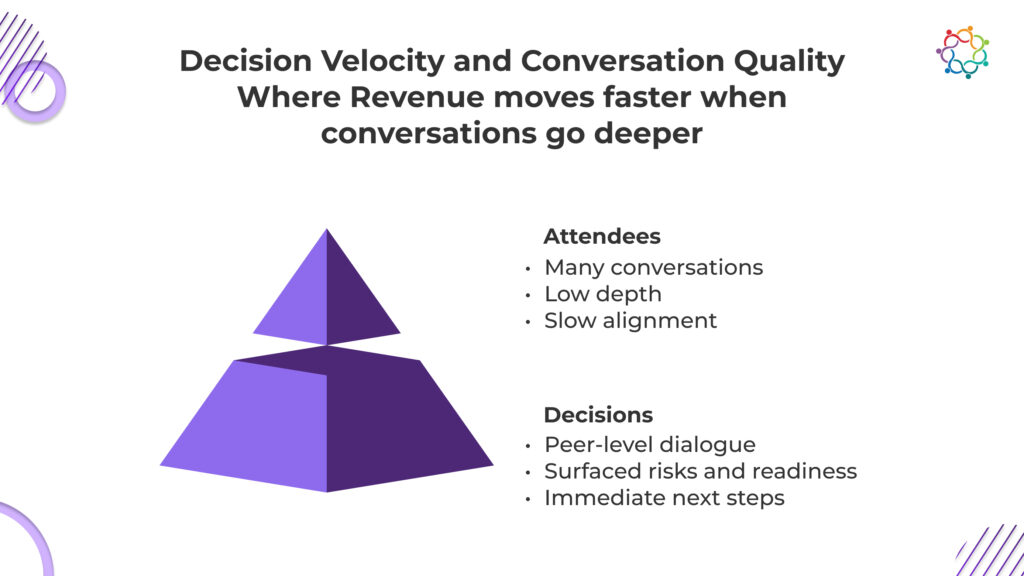
Conferences optimise for reach. These formats optimise for decision compression. Treating them as scaled-down conferences shifts focus to the wrong variables and stalls decision velocity inside active accounts.
Conference strategy rewards audience expansion. In private formats, expanding reach weakens intent concentration. When invitations prioritise impressive titles instead of live buying context, conversation depth collapses. The room looks strong on paper, but lacks commercial density. Senior access is spent without moving a single deal forward.
Large events generate brand lift and social proof. That logic becomes dangerous here. Private executive environments operate near deal acceleration. Measuring visibility instead of decision-stage movement produces misleading success signals. Teams report momentum while opportunities quietly stall.
Conference agendas centre on broad industry themes. In decision-proximate rooms, broad narratives delay urgency. Executives engage when discussions surface real constraints, trade-offs, and internal resistance. When content drifts into generic thought leadership, decision energy drops and active deals slow.
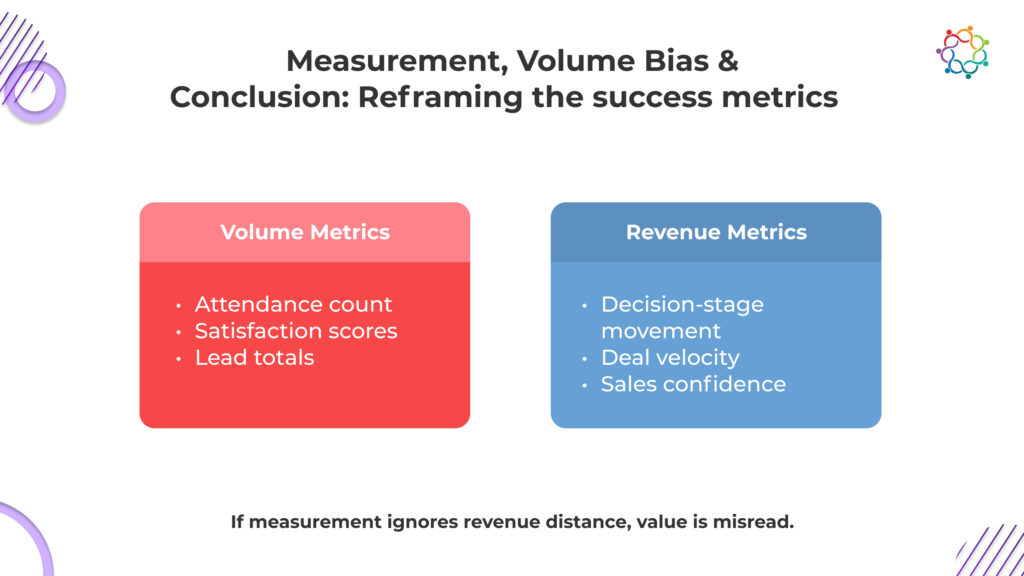
Attendance volume, satisfaction scores, and lead quantity belong to conference dashboards. They do not measure buying committee alignment or shifts in deal velocity. Applying these metrics protects optics while hiding commercial reality. The format appears successful even as the revenue impact weakens.
When conference thinking dominates, intimacy becomes cosmetic. Revenue declines not because the format is flawed, but because it was forced to perform a job it was never built to do.

In revenue-proximate environments, speed is leverage. The primary advantage of private executive gatherings is not exclusivity or seniority. It is compression. When the right decision-makers are placed in a relevant context, alignment happens faster. That speed directly affects pipeline outcomes.
Attendance volume does not indicate commercial impact. Decision velocity does. The true question is whether the event shortens time-to-decision inside active accounts. When evaluated through this lens, smaller rooms frequently outperform larger conferences.
In smaller settings, buying committee dynamics surface naturally. Stakeholders voice constraints, trade-offs, and concerns in real time. This transparency reduces back-channel resistance that typically delays enterprise deals.
Executives move faster when uncertainty decreases. Hearing how peers are solving similar problems reduces perceived risk. This accelerates internal advocacy and strengthens executive conviction.
Decision energy is highest during and immediately after the gathering. When context is preserved, follow-up conversations are sharper and more action-oriented. Momentum does not need to be rebuilt because clarity was already established.
Closed-door formats succeed when they compress uncertainty. When that compression translates into shorter deal cycles, attendance becomes secondary to acceleration.
Most event discussions focus on networking. That framing is insufficient when revenue outcomes are at stake. What matters is not who met whom, but what surfaced during those conversations.
Conversation quality is a measurable revenue variable. Executive-level dialogue reveals readiness, resistance, and risk in ways no form can ever fill. The depth of discussion indicates where accounts actually sit in the buying journey.
High-quality conversations do three things:
Shallow conversations create false positives. They feel productive but generate weak commercial signals. Sales teams lose trust when follow-ups are based on surface-level engagement rather than real buying context.
Pipeline influence comes from what is said and surfaced, not who showed up. When conversations are structured around relevant business tension, they become diagnostic tools. They help teams understand which deals deserve acceleration and which require deeper work.
This is where executive engagement metrics matter. Not attendance counts, but conversation depth, relevance, and decision proximity.
Design is where closed-door events either protect or destroy revenue momentum. Not logistics. Not production quality. Design determines whether decision velocity increases or quietly stalls. Most teams do not have an execution problem. They have a structural one. Three failure patterns consistently surface.
The invite list determines intent concentration. Seniority is not intent. An impressive title does not equal an active decision.
When invitations prioritise prestige over live business tension, signal density collapses. The room looks credible but lacks revenue proximity. Deals do not move because the right buying context was never present.
Agendas are decision environments, whether teams admit it or not. When topics drift toward broad thought leadership, urgency fades.
Executives engage when discussions surface real constraints and trade-offs. When conversation stays theoretical, momentum slows. Active opportunities lose compression instead of gaining clarity.
Post-event engagement often restarts conversations instead of advancing them. Generic outreach erases context and weakens the alignment created in the room.
When follow-up fails to carry forward surfaced risks and implied next steps, velocity drops. Decision energy dissipates.
Every design choice compounds or corrodes momentum. In closed-door formats, there is no neutral ground.

Volume bias is deeply ingrained in event marketing. Bigger audiences feel safer. They produce more data points. But revenue impact is not linear. In fact, it often moves in the opposite direction.
Closed-door events thrive on intent concentration. When audiences are small and relevant, clarity increases. Sales teams trust signals from these environments because they are grounded in real conversations, not inferred interest.
Fewer data points can offer higher clarity because:
Ambiguous engagement erodes sales confidence. Clear signals accelerate action. This is why ten right conversations consistently outperform a hundred unclear ones.
High-intent B2B events do not scale outcomes by adding people. They scale outcomes by removing noise. This is uncomfortable for teams conditioned to equate reach with success. But revenue does not care about comfort. It cares about movement.
Leadership teams that understand this stop asking for volume and start asking for velocity.
Measurement determines whether a closed-door event is treated as a revenue instrument or a marketing expense. These formats appear to underperform not because they lack impact, but because teams measure the wrong outcomes.
Traditional dashboards reward participation and sentiment. Decision-proximate environments demand evidence of commercial movement. If you cannot see deal progression, velocity shifts, or sharper next steps, you are not measuring impact. You are measuring activity.
Frameworks that rethink executive event ROI through a revenue lens, such as How To Host Closed-door Events For CXOs With Measurable ROI, connect conversation depth directly to pipeline movement.
If accounts did not advance to the next stage, hesitation was not reduced. If sales cycles did not compress, uncertainty was not removed. If follow-up conversations lack specificity, alignment did not occur.
If measurement does not reflect proximity to revenue, it misrepresents value. Closed-door environments should be judged by acceleration and clarity, not attendance and applause.
Closed-door formats operate under different economics. They reward precision, context, and speed. When designed and measured correctly, they influence outcomes disproportionately to their size.
They are not awareness plays. They are decision acceleration mechanisms. Their value lies in how effectively they compress time, surface risk, and move deals forward inside active accounts.
If an event does not accelerate decisions, intimacy alone will not save it. Teams that understand this stop chasing scale and start engineering clarity.
If this reframing feels uncomfortable, it is likely because your measurement system rewards optics over acceleration.
For organisations studying how high-intent engagement and contextual follow-up integrate into revenue systems, platforms like Samaaro illustrate how events can function as embedded decision environments rather than standalone marketing moments.
Enterprise conferences sit at the intersection of brand ambition and revenue accountability. CMOs defend them as strategic platforms. Field marketing leaders manage complex logistics and stakeholder expectations. Demand generation teams are expected to translate them into measurable pipeline impact.
Yet the uncomfortable reality remains: most enterprise conference marketing initiatives struggle to clearly demonstrate pipeline influence. Not because they lack scale, attendance, or production quality. But because the structure of how they are designed filters out commercial signal long before revenue discussions begin.
Most enterprise conferences look successful in scale and fail in revenue influence. That contradiction is structural.

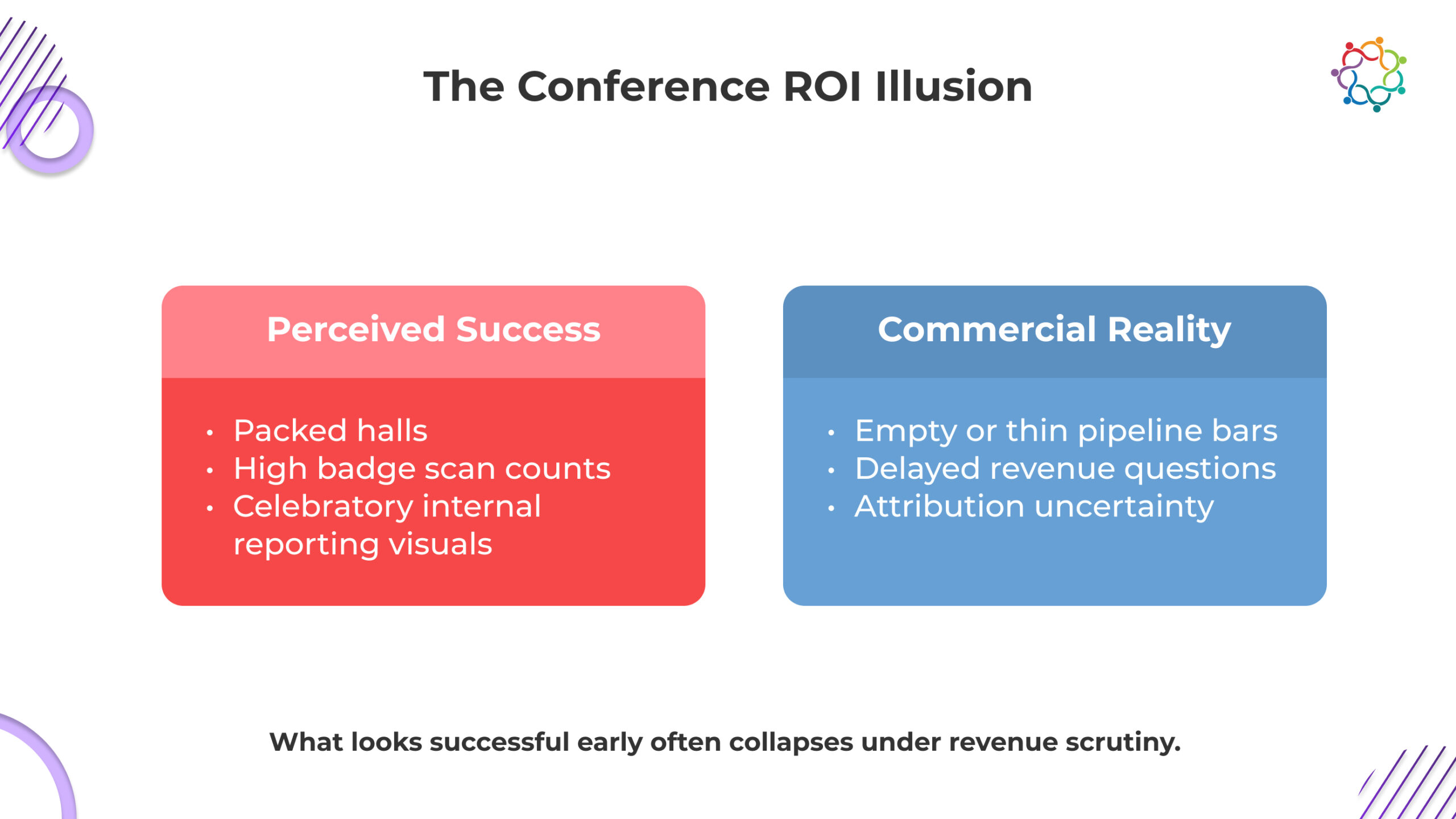
Large conferences often feel successful. Attendance numbers rise. Social engagement spikes. Leadership sees packed rooms and active booths. Internal dashboards glow with metrics that imply momentum. However, conference marketing ROI is often based on exposure signals rather than commercial clarity.
Consider what typically defines success:
These metrics show organizational effort, not pipeline influence. The illusion comes from visible scale, while true intent remains hidden. Only structured detection, deeper prioritization, and intent preservation turn visibility into revenue impact.
By the time leadership asks how the event influenced revenue, the influence window has already narrowed. Attribution ambiguity surfaces. Sales reports uneven follow-up outcomes. Teams rely on broad time-window models to prove a connection. The architecture assumed commercial relevance without engineering it.
Conferences rarely fail due to poor execution. They fail because exposure was prioritized over decision relevance from the start. That is why enterprise conference marketing can feel internally successful yet collapse under revenue scrutiny. Pipeline influence is not recovered after the event. It must be structurally protected before the first invitation is sent.

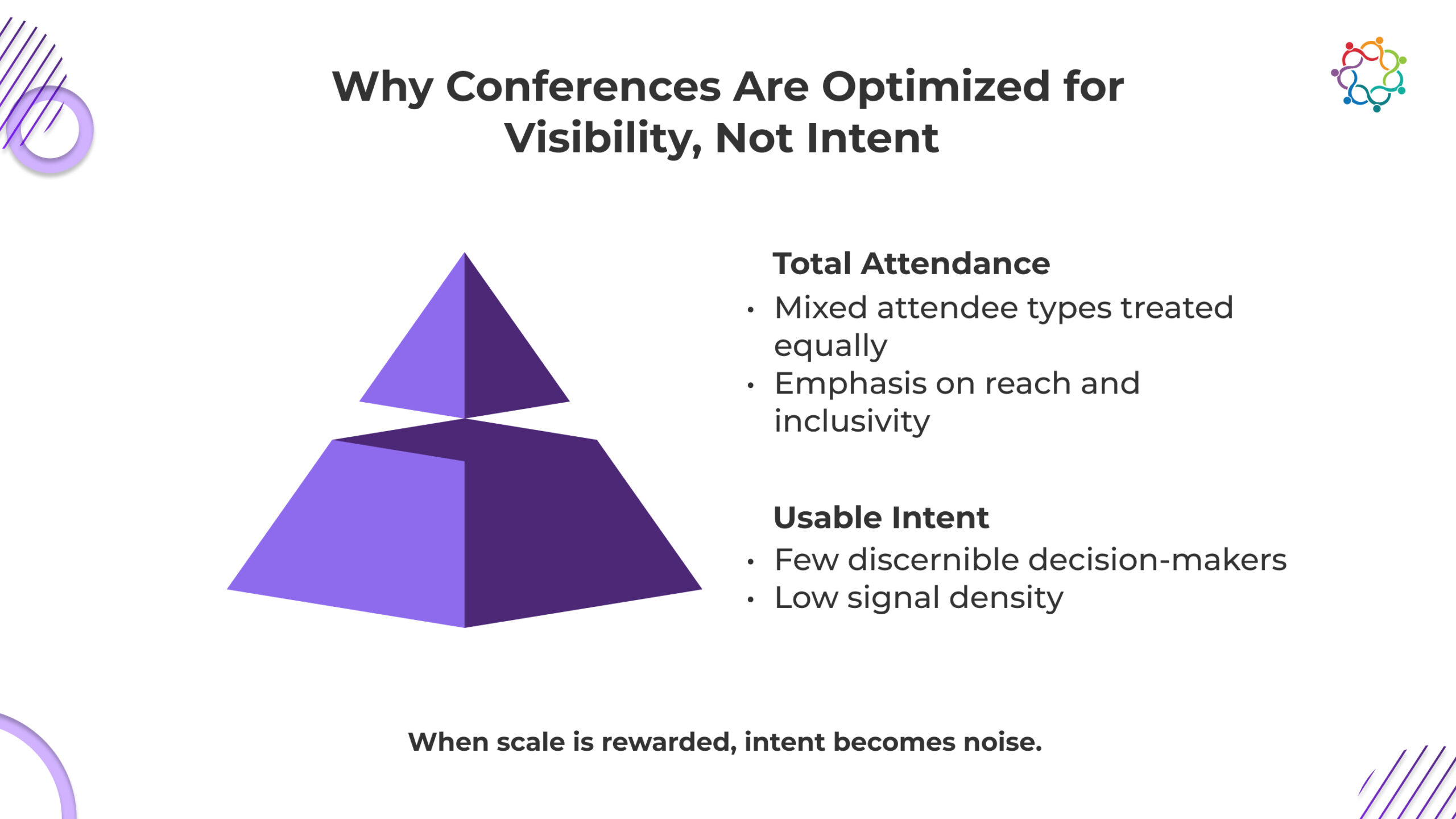
Conferences are not accidentally biased toward scale. They are built that way. Sponsors push for reach. Leadership asks for presence. Marketing reports brand amplification. Bigger audiences are celebrated, funded, and repeated. Intent density rarely appears in the approval deck. That preference shapes design decisions long before the first invitation goes out.
In many demand generation conferences, strategy centers on maximizing participation:
This is rewarded behavior. Larger rooms create easier narratives. Attendance growth signals momentum. Relevance requires exclusion, and exclusion reduces numbers. Most organizations choose scale.
Visibility scales because exposure does not require qualification. Intent does. Intent requires filtering and prioritization, which shrinks dashboards. So they are deprioritized.
When enterprise conference marketing is designed to maximize audience breadth, commercial density declines. Sales receive volume without clarity.
Demand generation teams wrestle with conference attribution challenges. CMOs are asked to explain revenue impact using exposure metrics that were never built to answer that question.
Pipeline visibility is mistaken for pipeline creation. Intent signals do not disappear by accident. They are buried by design. And that design is approved, funded, and repeated. What looks like growth is often signal dilution in disguise.

Most enterprise conferences report success using attendance-driven dashboards. Registration numbers, booth scans, and session turnout create an impression of momentum. However, these metrics rarely withstand leadership scrutiny when the conversation shifts from activity to revenue.
The core issue is not that attendance metrics are wrong. It is that they measure exposure, not intent. Pipeline influence depends on buying signals, decision readiness, and commercial prioritization.
A full venue signals interest in a topic, not intent to purchase. Conferences attract a mix of decision-makers, researchers, students, partners, and competitors. Attendance numbers flatten this distinction. Pipeline influence requires clarity on who is evaluating solutions now versus who is passively exploring.
High lead counts create internal confidence. Yet large volumes often dilute commercial quality. When everyone who interacts with the brand becomes a “lead,” intent density drops. This creates lead inflation, where the database grows but the concentration of revenue-relevant prospects shrinks.
Post-event reporting often relies on time-based attribution windows. If an opportunity is created within a certain period, the conference receives partial credit. But without clear behavioral indicators captured during the event, attribution becomes ambiguous. Leaders question whether the conference influenced the deal or merely coincided with it.
Attendance reflects what already happened. Pipeline influence depends on what happens next. Without structured insight into attendee behavior, follow-up lacks direction. When early intent clarity is missing, the pipeline conversation becomes reactive rather than predictive. That gap is where most enterprise conferences lose their commercial credibility.

Pipeline failure rarely occurs in a single visible moment. It unfolds across a sequence of accepted weaknesses. The conference ends. Applause fades. Volume is reported. And then intent begins to erode inside the system that everyone agreed to use.
After most conferences, marketing transfers leads to sales in bulk. This is not a tooling limitation. It is a design choice. Context from sessions attended, conversations held, and behavioral signals collected is reduced to fields that fit cleanly into CRM. Depth is sacrificed for administrative efficiency.
What sales receive:
What they rarely receive is prioritization clarity. Which accounts showed repeated engagement? Which attendees consumed late-stage product content? Which interactions signaled evaluation urgency? Those answers often exist in fragments, but they are not operationalized.
Everyone knows this gap exists. It persists because the volume has already been counted as success.
When handoff fails, pipeline influence weakens immediately. Manual reconstruction replaces structured prioritization. Speed declines immediately. Friction increases. Speed declines. Intent fades.
In enterprise conference marketing, handoff is treated as an administrative closeout task rather than a strategic bridge. This is where intent either survives or dies. Most organizations accept its erosion as normal.
Once leads enter CRM, prioritization logic determines commercial reality. If conference leads are scored uniformly, high-intent signals disappear inside aggregate volume. Intent density becomes mathematically invisible.
Sales teams respond rationally. They pursue clearer inbound signals or known accounts. Large conference lead lists become background noise unless explicitly weighted.
This is not a sales discipline problem. It is an organizational decision to value quantity over clarity. When prioritization collapses, momentum stalls. Opportunities that could have accelerated remain dormant. Attribution becomes diffuse because the system never elevated what mattered.
The final erosion point is follow-up decay. Generic sequences replace contextual relevance. Messaging ignores session behavior and expressed interest. Response rates fall.
At this stage, attribution ambiguity intensifies. Revenue leadership questions impact. Demand generation struggles to defend its influence. Sales reports are inconsistent.
Pipeline does not fail loudly. It erodes quietly across handoffs, collapsed prioritization, and signal loss. And it erodes in ways the organization has repeatedly tolerated.
If the commercial narrative of enterprise conference marketing collapses after the event, it is not because intent was absent. It is because the system allowed it to disappear and move on once the attendance numbers were shared.

High-performing conferences do not look dramatically different on the surface. They may have similar scale and production value. The difference lies beneath the experience layer.
Poorly performing conferences optimize for:
High-performing conferences optimize for:
This distinction changes the operating model. High-performing conferences do not celebrate total attendance. They measure commercial concentration. They rank engagement by depth and buying relevance instead of treating every badge scan equally. They do not send raw lead lists to sales; rather, they transfer prioritized intelligence.
Conference marketing is designed backward from commercial action. The core question is simple: which accounts move next, and why?
Behavioral signals are structured, not stored. Session participation, repeat engagement, content consumption, and account-level activity are translated into ranked outputs. Sales receives context, not contacts. Demand generation tracks progression, not just response rates.
They consciously sacrifice vanity scale to protect commercial signal. Scale without intent clarity weakens pipeline influence. Signal protection, not spectacle, defines performance.
For conferences to influence the pipeline, they must be designed as part of the revenue system, not as standalone marketing moments. When events operate in isolation, any commercial signal generated on-site weakens once the experience ends.
Treating conferences as pipeline infrastructure shifts the focus from execution excellence to signal continuity. The value of the event is determined not by what happens during the conference, but by how effectively intent survives and travels into demand and sales systems.
In high-performing organizations, conferences function as structured input layers into the broader demand engine. They are designed to feed sales and marketing systems with prioritized intelligence. This means engagement data is captured in a way that directly supports downstream decision-making, rather than existing only as post-event reports.
Most conferences generate intent that disappears at the badge scan. Behavioral indicators such as session depth, repeat engagement, and content interaction are rarely preserved in usable form. Pipeline infrastructure ensures these signals survive the event and remain accessible for prioritization, follow-up, and attribution.
On-site energy creates confidence, but it does not guide action. Revenue impact depends on what the organization learns after the event. Post-event intelligence reveals which accounts progressed, which conversations indicated urgency, and where sales attention should focus. Without this layer, pipeline influence remains theoretical.
Conference data has value only when it informs action. If sales teams cannot use event insights to prioritize accounts and conversations, the data fails its commercial purpose. Pipeline influence emerges when conference intelligence directly shapes what happens next, not when it merely documents what already occurred.
If these weaknesses are visible, why do they persist?
Because the system rewards visibility and rarely punishes weak revenue linkage.
Large conferences signal authority. Full rooms validate spending. Attendance growth fits cleanly into board narratives. Exposure metrics are safe to report and difficult to challenge. Pipeline ambiguity, by contrast, can be explained away. The safer story wins.
Conference marketing ROI is usually defended after the event, when scale has already been celebrated. At that point:
No CMO is penalized for hosting a well-attended conference with unclear pipeline contribution. But a smaller event, even one with high intent density, raises immediate concern. The incentive is unmistakable. Looking successful carries less risk than being commercially precise.
Enterprise conference marketing becomes a reputational asset rather than a revenue system. It generates visibility, social proof, and internal momentum. Revenue linkage is treated as a bonus, not a requirement.
This pattern continues because leadership approves it.
Conferences perform exactly as they are funded and measured to perform. Until intent clarity becomes non-negotiable, scale will continue to overshadow pipeline influence.
Pipeline influence is rarely absent. It is filtered out. When conferences optimize for visibility, intent clarity is traded for attendance growth. When all attendees are treated equally, lead counts rise while commercial density falls. When structured handoff and prioritization are weak, signal decays quietly inside the system.
High-performing conferences operate as revenue infrastructure. They preserve behavioral signals, translate engagement into prioritization, and treat post-event intelligence as the true output. If a conference cannot clarify who matters next, it cannot influence the pipeline.
For teams examining conference lifecycle design more deeply, adjacent perspectives on end-to-end conference architecture expand on this systemic view. A useful reference point is Conference Marketing End-to-End: From Call for Speakers to On-Site Engagement, which explores how structured lifecycle thinking changes outcomes.
For teams rethinking conferences as pipeline infrastructure, this is a conversation worth having. The difference is not in execution polish but in the commercial survivability of data.
Event marketing rarely fails because of weak programming or poor promotion. It fails because attention is scarce. B2B teams continue to celebrate registrations and eventually see attendance fall sharply as the event approaches. Reminders are sent, posts are published, and calendars are blocked, but follow-through still remains unreliable.
The issue is not awareness. It is timing and proximity. Inbox fatigue means event emails are buried under internal threads and automation noise. A further degree of unpredictability is introduced by social platforms, where algorithms determine whether an event message is ever viewed. The choice moment has frequently passed by the time an attendee notices an update.
In 2026, event attendance is increasingly shaped by channels that operate closer to real behavior. People show up when communication feels direct, relevant, and human. This shift is why WhatsApp event marketing is gaining strategic importance. It aligns with how professionals coordinate important commitments, turning intent into action rather than letting attention slip away.

Email and social media remain foundational channels, but their structural limitations are increasingly visible in event contexts. Email is asynchronous by design. Messages arrive alongside dozens of others, are opened hours later, or never at all. Even when opened, they rarely invite immediate action. Social platforms amplify reach but dilute intent. Posts are public, fleeting, and rarely tied to a specific moment of decision.
Several structural constraints explain why these channels underperform for events:
When attendance drops, teams often respond by increasing frequency. This approach treats the problem as executional when it is behavioral. People skip events because the event never crossed their attention at the right moment or felt personally relevant.
These limitations are simply not designed for high-touch, time-sensitive coordination. In long-cycle B2B environments, this gap becomes expensive. Event marketing on WhatsApp begins to surface as a response to this structural mismatch rather than a tactical experiment.

WhatsApp operates in a setting that people already identify with urgency, trust, and genuine conversation, which sets it apart from conventional event marketing methods. Passive consumption and broadcasting are not intended uses for WhatsApp. It is built for response. This difference in behavior explains why WhatsApp performs so differently for event marketing in 2026.
WhatsApp communication begins with explicit consent. When someone opts in, they mentally categorize messages as relevant and personal rather than promotional. This opt-in intimacy changes how messages are received. Event updates feel like coordination, not marketing. This trust-based communication increases read rates and reduces resistance, especially in high-touch B2B environments where relevance matters more than volume.
WhatsApp messages are typically read within minutes, not hours or days. This response velocity matters most close to the event date, when decisions to attend are made. Quick replies allow teams to confirm attendance, resolve doubts, and adjust communication in real time. Email and social media lack this urgency, making them unreliable at decision moments.
WhatsApp keeps all event-related communication in a single, continuous thread. Context is never lost. Logistics, value reminders, and questions build on each other instead of resetting with every message. This conversation continuity reduces confusion and effort for attendees, making follow-through easier and more natural.
Because WhatsApp lives in a high-attention space, messages are rarely ignored. People either respond, ask questions, or act. This makes WhatsApp an attention channel rather than a promotion tool. For event teams, this behavioral pattern is what makes WhatsApp event marketing structurally different from email and social, and increasingly more effective.

Before an event, the most important objective is not promotion but commitment. Registration is a signal of interest, not a guarantee of attendance. WhatsApp allows teams to bridge this gap by shifting communication from reminders to alignment.
Instead of sending passive messages, teams can use two-way confirmation to clarify expectations, answer questions, and reinforce value. This interaction reduces uncertainty, which is a major cause of drop-offs. When attendees can quickly confirm logistics or relevance, their likelihood of showing up increases.
WhatsApp also supports contextual messaging. Rather than generic countdown emails, messages can reference specific sessions, speakers, or outcomes relevant to the attendee.
Key ways WhatsApp supports pre-event follow-through include:
This approach reframes attendance as behavioral alignment rather than marketing pressure. By the time the event begins, attendees who remain engaged are mentally committed, not just registered. This is where WhatsApp event marketing begins to outperform traditional event communication strategies.
(Also Read: How to Maximize Event Registrations with WhatsApp Groups: Tips and Tricks)

Once an event begins, attention becomes even more fragile. Attendees are moving between sessions, conversations, and competing priorities. At this stage, communication must be relevant and smooth. WhatsApp changes live event engagement because it functions as a real-time coordination layer rather than a broadcast channel. This help team supports attendees without pulling them away from the experience.
Teams can use WhatsApp to deliver accurate and timely updates, including reminders for sessions, room changes, or schedule modifications. These gentle reminders cut down on misunderstandings and lost opportunities without overwhelming participants. Messages are viewed and responded to promptly because they arrive in a trusted setting, which increases their involvement without making noise.
Questions and concerns are sometimes left unanswered during events because participants are reluctant to speak in public or are unable to locate the appropriate contact. WhatsApp makes it simpler to exchange comments, highlight problems, and ask questions by facilitating private or small-group communication. Teams are able to resolve conflict before it affects the experience and deepen engagement through this real-time conversation.
WhatsApp gathers feedback during the event, as opposed to after it has already happened. Real-time responses to sessions, presenters, or logistics are available to attendees. Instead of assessing problems after the event, this real-time information enables teams to make changes quickly, increasing engagement and happiness.
WhatsApp works best when it supports the event instead of competing with it. By focusing only on essential communication, it keeps attendees informed without distracting them from sessions or conversations. This balance is what makes WhatsApp effective as a live engagement layer rather than a content feed.
Event marketers often struggle with weak engagement data. Clicks and opens provide limited insight into intent. WhatsApp interactions, however, generate richer behavioral signals that are easier to interpret directionally.
Who responds, how quickly they reply, and what they ask reveal more than passive metrics. Response timing acts as a proxy for urgency or interest. Questions indicate relevance. Silence signals disengagement. These patterns emerge naturally within conversations.
WhatsApp also highlights differences between group and one-to-one engagement. Group interactions reveal collective interests, while private messages surface individual concerns or buying signals. This distinction helps teams prioritize follow-up without relying on complex attribution models.
Important signal types include:
These insights matter because they connect engagement to behavior, not vanity metrics. While WhatsApp does not solve attribution, it provides clarity that email and social media cannot. This signal richness is a core reason why WhatsApp event marketing is gaining strategic relevance in 2026.

Most event communication collapses after the event ends. Attendees receive generic recap emails that summarize sessions but fail to continue the conversation. Social posts highlight photos rather than outcomes. Momentum fades quickly.
WhatsApp supports post-event continuity because the conversation never resets. Follow-ups feel natural rather than intrusive. Teams can reinforce key moments, share relevant resources, and transition into sales or relationship conversations without switching channels.
This continuity reduces friction. Attendees do not need to reorient themselves or search for context. The thread already contains the event journey. This makes follow-up messaging more relevant and timely.
Effective post-event WhatsApp communication focuses on:
By acting as a bridge rather than a blast tool, WhatsApp extends the event’s value beyond the live moment. This sustained engagement is difficult to achieve through traditional event follow-up messaging channels.
Event ROI has always been challenging to prove because outcomes are indirect and delayed. WhatsApp does not magically solve attribution, but it improves clarity by reducing drop-offs between stages.
When engagement happens in a conversational environment, it is easier to observe how attention turns into action. Fewer steps are lost between registration, attendance, and follow-up. This simplifies analysis even if it remains imperfect.
WhatsApp also lowers the cost per meaningful interaction. Instead of spending on repeated broadcast messages, teams invest in fewer, more relevant touchpoints. This efficiency matters in high-touch, long-cycle markets where quality outweighs volume.
ROI becomes clearer through:
This practical clarity strengthens the case for WhatsApp as a primary event engagement channel rather than a supporting tactic.
WhatsApp is not universally effective. Its strength depends on context, audience expectations, and discipline. A realistic assessment builds credibility with senior stakeholders.
WhatsApp excels in events that are high-touch, time-sensitive, and relationship-driven. It underperforms in large, anonymous events where opt-in intimacy is unrealistic. Overuse or aggressive messaging quickly erodes trust.
Key considerations include:
Opt-in discipline is critical. WhatsApp should never feel compulsory or excessive. When used with restraint, it strengthens trust-based communication. When abused, it damages it.
Understanding these boundaries ensures WhatsApp remains effective rather than intrusive.
In 2026, strong event marketing is not about expanding the channel mix. It is about using fewer channels with clearer intent. Audience attention has consolidated around spaces built for response, not broadcast. Channel strategy must reflect how people actually act, not how teams are used to communicating.
Channel choices should be driven by behavior, not habit. Messaging channels outperform broadcast channels when the goal is coordination, commitment, and follow-through.
Communication should align with decision moments. High-attention channels should be reserved for points where attendees choose to register, engage, or show up. Overusing them dilutes impact.
WhatsApp works best with boundaries. Email remains the system of record. Social channels maintain visibility. WhatsApp should be used selectively to drive confirmation, urgency, and real-time engagement, not as a replacement for everything else.
Reducing channels increases trust. When each channel has a defined role, messages feel intentional, are acted on faster, and create less friction for attendees.
Event success follows attention, not exposure. In 2026, attention lives in conversations that feel relevant. Messaging platforms have become central to how people coordinate important activities.
WhatsApp event marketing wins because it aligns with real behavior. It supports attendance follow-through, real-time engagement, and post-event continuity without relying on hype or volume. When used with consent and restraint, it strengthens trust and clarity.
The strategic takeaway is simple. Choose channels where people respond. Design events around attention, not assumptions. Conversations determine outcomes.
(If you’re thinking about how these ideas translate into real-world events, you can explore how teams use Samaaro to plan and run data-driven events.)

Samaaro is an AI-powered event marketing platform that enables marketing teams to turn events into a measurable growth channel by planning, promoting, executing, and measuring their business impact.
Location


© 2026 — Samaaro. All Rights Reserved.