Samaaro + Your CRM: Zero Integration Fee for Annual Sign-Ups Until 30 June, 2025
- 00Days
- 00Hrs
- 00Min
There is an abundance of information available to modern CMOs. Spreadsheets, dashboards, and post-event reports containing registrations, attendance rates, engagement scores, and satisfaction indicators are generated for each event. On paper, visibility has never been higher. Yet in practice, event budgets are still defended reactively, often after questions are raised by finance or leadership. The contradiction is hard to ignore. If marketing leaders have more data than ever, why do decisions still feel uncertain?
The problem is not a lack of reporting. It is a misplaced belief that dashboards naturally lead to better judgment. Most dashboards are designed to describe what happened instead of guiding what should happen next. They excel at summarizing activity but struggle to explain impact. As a result, CMOs are surrounded by numbers while remaining unclear on trade-offs, prioritization, and opportunity costs.
This is where event analytics begins to fail at the executive level. The failure is subtle and systemic, not technical. Dashboards were never meant to answer questions such as which events deserve increased investment, which formats should be retired, or how event strategy should evolve quarter over quarter. Instead, they provide reassurance through volume and visibility.
The dashboard delusion is the assumption that more metrics equal better decisions. In reality, clarity comes from relevance, context, and direction. Until analytics are designed with decision-making as the primary outcome, CMOs will continue to feel informed yet unsupported when it matters most.
Event ROI is usually treated as a measurement problem. It isn’t. It’s a timing problem. Post-event metrics are lagging indicators; they explain what happened, not why it happened. Senior marketers are often evaluated on results that were determined weeks earlier, long before the first attendee walked into a session.

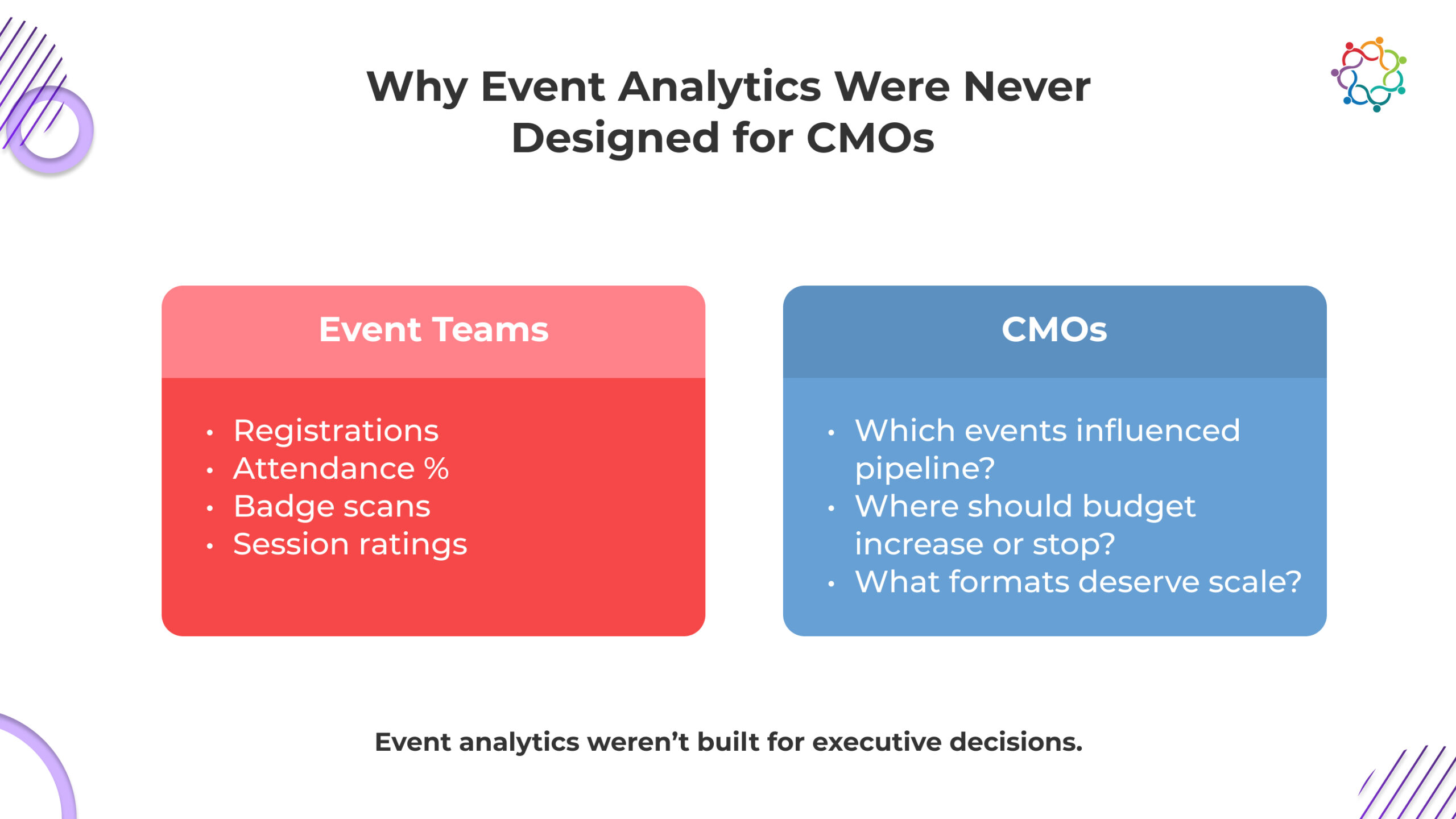
Dashboards feel confusing to executives because they were not built for them in the first place. Most event reports were created to help teams run events day to day, like tracking registrations, attendance, and logistics. They were not meant to help leaders decide where to spend money or what to change next. Because of this, executives often see a lot of numbers but still struggle to make clear decisions.
Event reports typically optimize for the following audiences:
These stakeholders care deeply about completeness, accuracy, and operational efficiency. CMOs care about something very different. Their questions are comparative and forward-looking. They want to understand trade-offs, risk, and return across an entire portfolio of activity.
The result is an audience mismatch. CMOs are handed reports that answer operational questions while they are expected to make strategic decisions. Metrics are presented without interpretation, context, or prioritization. Numbers appear precise but lack relevance to executive choices.
This structural gap is why event analytics often feel busy rather than useful at the leadership level. The data itself is not wrong. It is simply optimized for the wrong layer of the organization. Until analytics are reframed around executive decisions, dashboards will continue to underperform for the people who control budgets.
Data Collection Is Not the Same as Intelligence

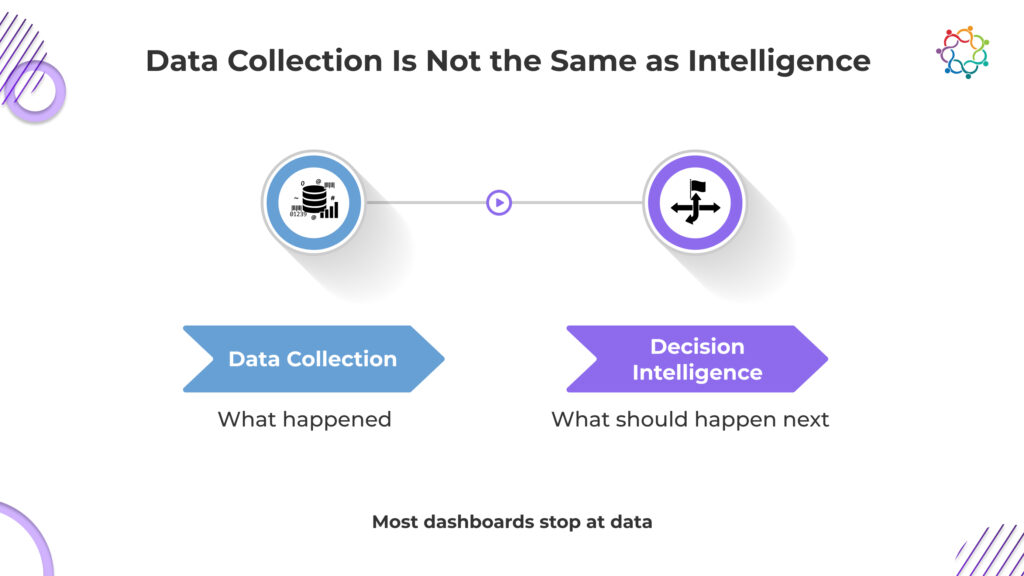
One of the most persistent misunderstandings in marketing measurement is the assumption that collecting more data automatically creates insight. Data collection answers what happened. Intelligence explains what it means and what should change as a result. The difference is not semantic. It is foundational.
Most event reporting stops at description. It tells you how many people registered, how many attended, and how they rated the experience. These metrics are useful, but they are incomplete. They describe activity without diagnosing performance. Intelligence, by contrast, connects activity to outcomes and implications.
Consider the distinction:
This gap is where many event analytics initiatives stall. Teams invest heavily in tracking every interaction but fail to translate that information into executive guidance. Dashboards become repositories of facts rather than engines of decision-making.
The issue is not sophistication. It is intent. Intelligence requires framing data around business questions, such as pipeline influence, audience quality, and marginal return. Without that framing, reports remain descriptive. They tell a story of effort, not effectiveness.
For CMOs, the value of analytics lies in reducing uncertainty. Intelligence shortens decision latency by clarifying what matters now and what can be deprioritized. Data alone cannot do that. Until organizations acknowledge this distinction, analytics will continue to feel comprehensive yet inconclusive.
The 4 Reasons Event Dashboards Fail at Decision-Making

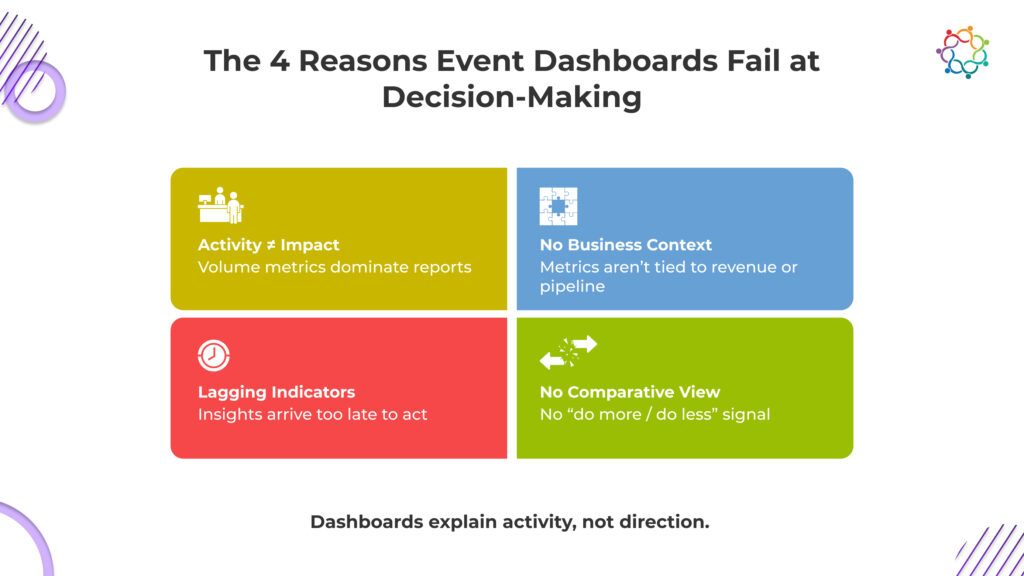
Event dashboards are ineffective because they are not in line with the actual decision-making process, not because they are lacking. The majority of reporting systems are designed to display activity and effort rather than to direct budgetary or prioritizing decisions. CMOs are thus left with a wealth of information but little guidance. The inability of dashboards to transition from reporting to actual decision support can be explained by the following four problems. Even though each issue can appear insignificant on its own, taken as a whole, they produce an impressive-looking but strategically flawed system.
Activity metrics predominate in most event dashboards due to their ease of collection and explanation. Reports are filled with numbers that are visible and instantaneous, such as registrations, attendance, booth scans, and session check-ins. These indicators give teams insight into how well an event went, but they don’t reveal much about whether the event truly advanced corporate objectives.
These dashboards answer the question of execution, not impact. An event can be well attended, well reviewed, and still have no meaningful effect on pipeline or revenue. When dashboards focus mainly on volume, they hide the connection between effort and outcome.
This creates a misleading picture of success. Leaders see rising numbers but cannot tell if those numbers justify continued investment.
Common signs of this problem include:
Without outcome-oriented measures, event analytics stay disconnected from the decisions executives are responsible for making.
Even when dashboards go beyond basic activity, they often fail to place metrics in a meaningful business context. Event performance is shown in isolation, without being tied back to revenue goals, pipeline stages, or cost considerations. This makes it difficult for leaders to judge whether results are good, bad, or simply expensive.
Context is what turns numbers into insight. Without it, comparisons become misleading. A high-performing event may appear successful until its cost is considered. A smaller event may look weak until its conversion quality is examined.
Typical context gaps include:
CMOs need to understand not only what worked, but why it worked and at what price. Without context, dashboards remain static summaries instead of strategic tools that guide allocation decisions.
Event dashboards’ excessive reliance on trailing indicators is one of the main reasons they struggle with decision-making. These analytics, which include post-event surveys, satisfaction scores, and engagement summaries, are only accessible after an event has concluded. Even while these figures might show how attendance felt, they come too late to have a significant impact. Budgets are frequently finalized, and future plans are in motion by the time this data is analyzed.
Lagging indicators describe the past rather than shape the future. They explain what happened but offer little guidance on what should change next. When dashboards treat these signals as primary measures of success, analytics become retrospective instead of directional. Leaders are left evaluating history rather than managing strategy.
Another limitation is that lagging metrics often focus on sentiment instead of outcomes. High satisfaction does not necessarily translate into pipeline progression or revenue influence. This creates a disconnect between perceived success and actual business impact.
Effective event analytics must surface signals early enough to guide decisions, not simply validate them afterward. Without stronger leading indicators, dashboards become reporting artifacts rather than strategic tools, documenting results instead of enabling smarter choices.
One of the biggest weaknesses in event dashboards is the lack of comparison. Events are often reported individually, each with its own set of metrics, but rarely evaluated against one another. This makes it nearly impossible to understand relative performance across formats, regions, or audiences.
Without comparison, there is no prioritization signal.
CMOs cannot see which events consistently outperform others or where returns are declining over time. Trends remain hidden, and decisions are made based on memory or intuition instead of evidence.
Common issues include:
Good decision-making depends on understanding relative value. When dashboards fail to provide that perspective, executives are forced to draw conclusions that analytics should have made obvious.
(Also Read: Decoding Event Analytics: Key Metrics Beyond Attendance)
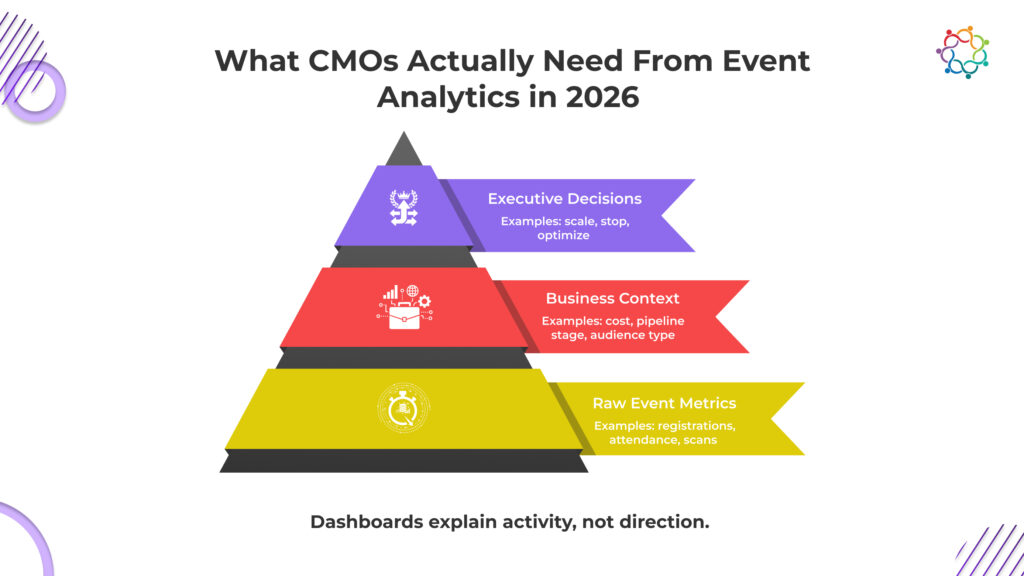
What CMOs Actually Need From Event Analytics in 2026

By 2026, CMOs will not be asking for more dashboards. They are asking for clarity. The volume of data is no longer the constraint. Attention and confidence are. Effective analytics must reduce noise and elevate the signal.
What executives need is a distilled view of performance that aligns with business outcomes. This means fewer metrics, not more. It means reports that answer strategic questions directly instead of inviting interpretation.
CMOs want event analytics that provide:
This shift feels liberating because it reframes analytics as a support system rather than a burden. Instead of defending past spending, leaders can focus on shaping future investment. Outcome-oriented reporting restores trust in measurement by making it actionable.
In this model, dashboards are not abandoned. They are elevated. Their role is to inform decisions, not to document activity. When analytics speaks the language of impact, CMOs can move from justification to leadership.
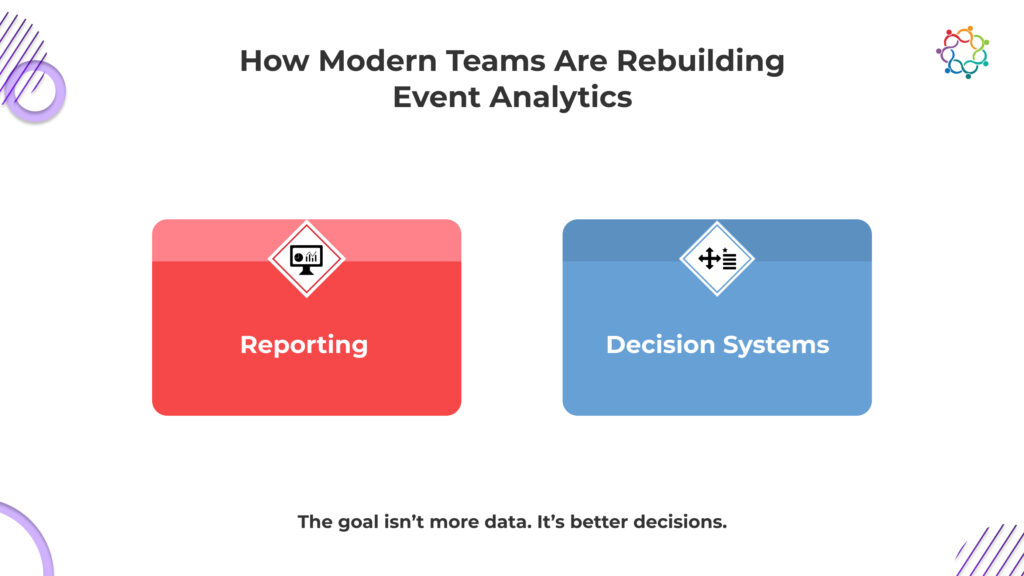
How Modern Teams Are Rebuilding Event Analytics

The transition from reporting to decision support requires a change in mindset. Dashboards are static by design. They present information at a point in time. Decision systems are dynamic. They evolve as questions change and strategy matures.
This shift involves moving from measurement to prioritization. Instead of asking whether an event performed well, leaders ask whether it deserves continued investment. Analytics becomes a mechanism for ranking options rather than summarizing results.
Key changes include:
Conclusion: Analytics That Don’t Drive Decisions Are Just Decoration
Analytics are only useful to senior leaders if they help them make better choices. When reports do not guide decisions, they become something people look at but do not act on. This is the core issue with most event reporting today. The problem is not that teams are missing data. It is that the data is not shaped around the decisions leaders actually need to make.
The majority of dashboards concentrate on outlining past events. They display engagement levels, attendance figures, and post-event comments. Even while this knowledge can be fascinating, a CMO is rarely told what to do next. A summary of activity is not what leaders are searching for. They’re looking for guidance. They want to know which projects are no longer worth the time or money, and where to make greater investments.
In 2026, the real value of event analytics will not be judged by how detailed or complex dashboards are. It will be judged by whether they reduce confusion and make choices easier. Good analytics should help leaders feel confident about trade-offs and future plans. If reporting does not lead to clearer decisions, it is not insight. It is just noise presented as information.
(If you’re thinking about how these ideas translate into real-world events, you can explore how teams use Samaaro to plan and run data-driven events.)
Most conversations about event ROI begin after the event is already over. Teams pore over attendance numbers, engagement scores, survey results, and pipeline attribution, metrics that describe outcomes but cannot change them. By the time ROI is reviewed, it is already locked in.
Event ROI is usually treated as a measurement problem. It isn’t. It’s a timing problem. Post-event metrics are lagging indicators; they explain what happened, not why it happened. Senior marketers are often evaluated on results that were determined weeks earlier, long before the first attendee walked into a session.
This is why pre-event marketing matters more than most teams are willing to admit. It sits upstream of engagement quality, feedback depth, and pipeline influence. When those inputs are weak, no amount of post-event analysis can fix the damage. ROI conversations start too late because the real drivers of ROI are rarely treated as strategic decisions in the first place.

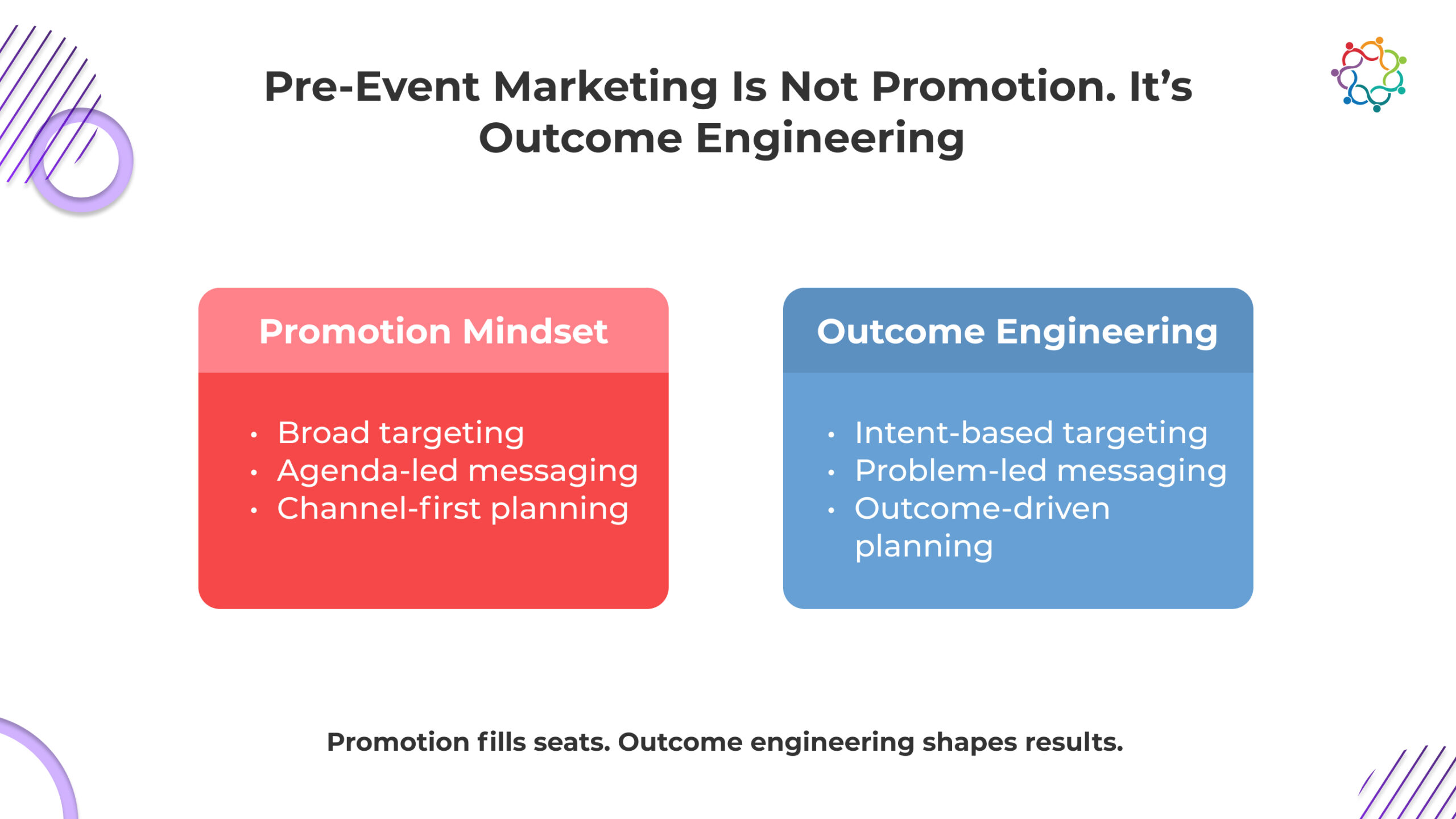
Many teams equate pre-event work with promotion. And the goal becomes driving registrations as efficiently as possible. Promotion focuses on volume. Outcome engineering focuses on intent.
Promotion asks how many people can be convinced to register. Outcome engineering asks who should attend and why their presence matters to the business. This distinction is critical. The quality of attendees determines the quality of engagement, feedback, and follow-up conversations.
Pre-event marketing is the phase where intent is filtered. Decisions about positioning, audience definition, and channel mix determine whether the event attracts decision-makers or not. High attendance numbers can coexist with weak ROI when the audience is misaligned with the event’s purpose.
This is where signal quality becomes more important than volume. A smaller audience with high intent produces clearer engagement metrics and more reliable post-event data. A larger audience with mixed intent produces noise. The difference is rarely visible in registration dashboards, but it becomes obvious when teams attempt to connect events to revenue outcomes.

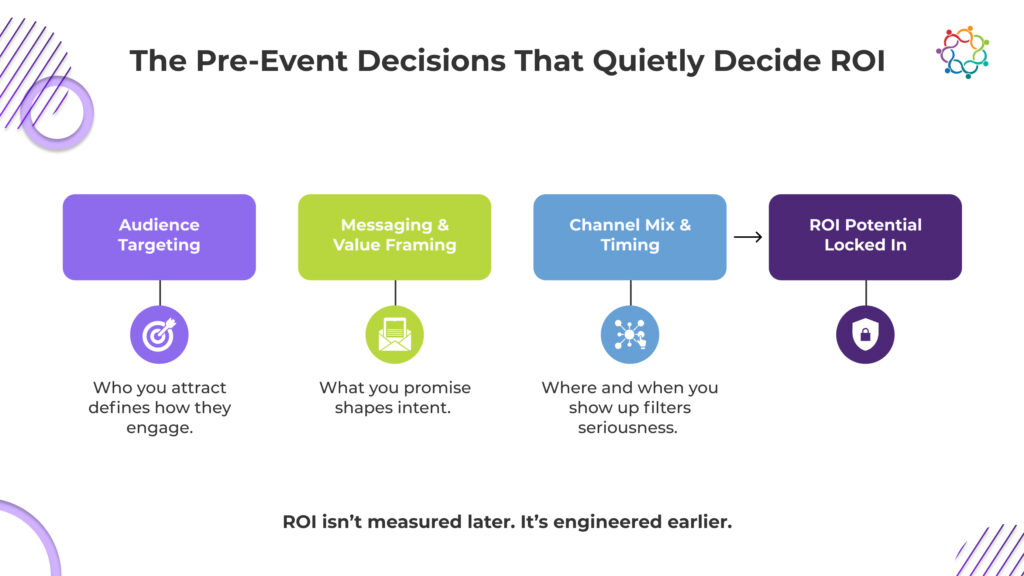
Event ROI rarely hinges on what happens during the event itself. It is shaped by a small set of upstream decisions that determine who shows up, why they attend, and how seriously they engage. These choices are often treated as execution details, but they quietly lock in the ceiling for post-event outcomes. Audience targeting, messaging, and channel strategy act as filters. They decide intent quality long before engagement is measured. When these inputs are weak, ROI erosion is already underway, even if registrations look healthy.
Audience targeting is often optimized for reach, but it quietly defines the quality of every downstream metric. Broad targeting may increase registrations, but it almost always dilutes relevance.
When targeting is too wide, intent density drops. Sessions fill with attendees who have casual interest rather than active problems. Engagement still occurs, but it lacks depth, questions trend generic, polls flatten, and feedback becomes non-specific. These are not engagement failures. They are targeting failures.
Misaligned audiences also distort how ROI is interpreted. Attendees outside buying or influence roles cannot realistically affect pipeline outcomes, yet they are still counted in engagement and attendance metrics. Follow-up conversations stall because intent was never present, and attribution becomes diluted, making events appear less effective than they actually were.
Effective audience targeting prioritizes relevance over volume. It narrows participation to people who can act on what the event delivers, producing clearer engagement signals and more reliable ROI outcomes.
Messaging determines who chooses to attend and with what mindset. It acts as a self-selection mechanism.
Many event invitations lead with speaker names, session titles, and schedules. This framing positions the event as content consumption. Attendees register without a clear expectation of value beyond learning. As a result, engagement remains passive.
When messaging is framed around specific problems, trade-offs, or decisions, it signals that the event is designed for the real audience. Decision-makers respond to relevance. This framing reduces registration volume but increases intent density, which directly affects engagement metrics and post-event follow-up responsiveness. This shift directly affects outcomes.
Value framing does not just influence attendance. It determines whether the event functions as a learning session or a decision catalyst.
Channel mix and timing shape intent, not just reach. They determine who shows up and how seriously they engage. Channels are not neutral distribution pipes; each one attracts a different level of commitment.
Awareness-heavy channels tend to drive curiosity. Relationship-driven channels include email to known accounts, partner outreach, direct sales invites, pull in attendees with context and a reason to care. When all channels are treated as interchangeable, registration volume increases but intent quality does not.
Timing sharpens this difference. Early registrants typically assess relevance before committing. They attend more sessions, engage more consistently, and are easier to follow up with. Late registrants often arrive due to urgency or reminders, not fit. As decision-making compresses, drop-off rises and engagement becomes uneven.
These patterns show up clearly in ROI signals: attendance volatility, inconsistent session participation, and stalled follow-ups. Channel mix and timing don’t just influence who attends. They influence how much intent enters the room, and intent is what ultimately converts engagement into impact.
(Also Read: Pre-Event Engagement Strategies: How to Warm Up Attendees Before Registration Opens)

Want to see how this would work for you?
30 minutes on how Samaaro attributes pipeline back to the campaigns that drove it.
Book a tailored walkthrough →How Pre-Event Inputs Shape Post-Event Outputs

Event ROI is often described as unpredictable, as if outcomes hinge on timing, market mood, or execution luck. In reality, ROI follows structure. It emerges from a chain of decisions that set conditions long before results are measured. What appears uncertain after the event is usually quite deterministic before it. Inputs define the boundaries within which outcomes can occur.
Audience targeting shapes session attendance depth. When attendees share a common context, sessions feel more relevant, discussions become richer, and drop-off rates decline. Broad audiences fragment attention and reduce perceived value.
Messaging influences feedback quality. Problem-led positioning produces feedback that reflects real constraints and priorities. Agenda-led positioning produces generic satisfaction scores that offer little strategic insight. Feedback bias increases when attendees lack a clear reason for attending.
Channels affect follow-up responsiveness. Attendees who register through high-intent channels are more likely to respond to post-event outreach. Those acquired through low-friction channels often disengage once the event ends, weakening the funnel beyond the event itself.
Registration intent shapes pipeline influence. When intent is high, events accelerate existing opportunities or trigger qualified conversations. When intent is low, attribution decay sets in quickly, making impact harder to trace even when activity appears strong.
This is where pre-event marketing functions as strategic infrastructure. It determines whether post-event metrics reflect genuine signal or statistical noise. When inputs are deliberate, outputs become interpretable, comparable, and useful for decision-making. When inputs are weak, post-event data may look complete but cannot be trusted to guide strategy.
Post-event metrics are often treated as the objective truth. In reality, they are heavily context-dependent. Without understanding pre-event decisions, these metrics can mislead.
High-performing teams approach events with a different mindset. They do not chase volume for reassurance or optics. They prioritize intent filtering, even when it means accepting lower registration numbers. This runs against leadership instincts that equate success with scale, but experienced teams value clear signals over crowded rooms.
Events are not treated as standalone campaigns. They are designed backward from business outcomes. The defining question is not how to drive registrations, but who must attend for the event to matter and what decision the event should enable. Everything upstream aligns to that answer.
Pre-event marketing, in this model, is a strategic phase rather than a promotional sprint. Assumptions about audience, intent, and value are made explicit. Trade-offs are chosen deliberately instead of being obscured by vanity metrics. As a result, post-event analysis becomes about learning, not justification. Outcomes can be traced to decisions rather than explained away.
High-ROI teams also recognize that events are decision environments. Attendees arrive to evaluate relevance, credibility, and next steps. The advantage is not better execution on the day. It is earlier, more deliberate thinking about what the event is meant to change.

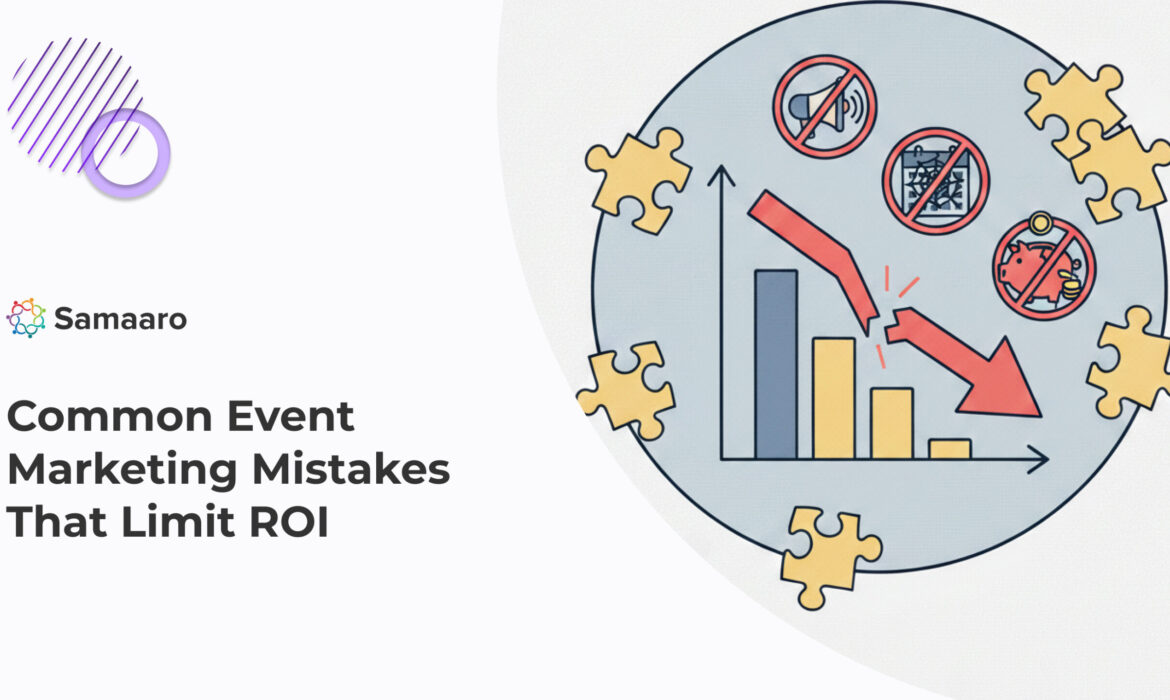
The most persistent breakdown in event ROI does not happen at the execution level. It happens upstream, driven by leadership pressure to prove momentum through registrations. Volume is visible, comparable, and easy to celebrate in reviews. Intent is abstract, slower to surface, and harder to defend when targets are looming. As a result, teams default to what can be shown quickly, even when it undermines long-term outcomes.
This behavior is reinforced by dashboards that prioritize optics over insight. Metrics such as total attendees, email open rates, and click-throughs create the illusion of progress without revealing whether the event is positioned to influence real decisions. When these numbers become the primary indicators of success, teams begin optimizing for what looks good rather than what matters.
At this point, structural mistakes start to compound:
Because the negative consequences surface later, the pattern persists. When ROI falls short, the instinct is to question reporting models or execution quality. Rarely does the conversation move upstream to examine pre-event strategy, even though it quietly set the limits for every downstream result.
Event ROI is often treated as something to diagnose after the event is over. Reports are reviewed, dashboards are questioned, and explanations are prepared. But this framing misses the real issue. ROI is not an after-event problem. It is a lifecycle problem. By the time metrics are analyzed, the most influential decisions have already been made, and they cannot be undone.
Pre-event marketing determines the conditions under which ROI is even possible. It decides who shows up, what level of intent they bring, and whether their engagement can translate into meaningful business outcomes. It shapes signal quality long before surveys are sent or attribution models are applied. Strong pre-event decisions reduce noise, limit feedback bias, and slow attribution decay. Weak ones do the opposite, no matter how polished the event execution may be.
Teams that consistently deliver event marketing ROI do not start with promotion or reporting. They start with outcomes. They work backward to define the audience, the problem framing, and the intent required for the event to matter. Everything upstream is designed with purpose, not urgency.
In 2026, the gap will widen between teams that spend time explaining ROI and teams that rarely need to. The difference will not be better dashboards. It will be earlier, clearer thinking about why the event exists in the first place.
(If you’re thinking about how these ideas translate into real-world events, you can explore how teams use Samaaro to plan and run data-driven events.)
Pre-event marketing affects post-event ROI because the audience you attract is the audience you measure. If pre-event marketing brings in the wrong people (curious browsers, not buyers), no amount of post-event work will recover the ROI. Strong pre-event marketing targets the right firmographic and behavioural segments, sets attendee expectations, and creates intent signals that fuel lead qualification later. ROI is decided before the doors open.
Early promotion is critical because the buyers you most want at your event have full calendars 8 to 12 weeks out. Wait until 3 weeks before and they’re already booked. Early promotion also gives your content time to build organically through speaker amplification, partner sharing, and SEO, which lowers your paid-channel costs as the event approaches.
The channels that work best for pre-event marketing in 2026 are: email to your CRM database (highest ROI), LinkedIn organic and paid (best for B2B reach), WhatsApp for personalised follow-ups, content marketing (blogs, whitepapers, podcasts) for top-of-funnel, partner co-promotion through sponsors and speakers, and PR for credibility. The right mix depends on your audience, but email + LinkedIn + partner is the most common high-performing combination.
Pre-event marketing improves registrations by creating intent before the registration form opens. Build awareness with teaser content, share speaker reveals and agenda previews to create anticipation, offer early-bird pricing to reward fast decisions, segment your outreach by industry and role, and use retargeting to bring back visitors who didn’t convert. The goal is to make registration feel like the natural next step, not a cold ask.
Track these metrics to evaluate pre-event efforts: registrations per channel, cost per registration per channel, time from first touch to registration, registration conversion rate by audience segment, audience quality (firmographic match to your ICP), and downstream attendance rate of pre-event-acquired registrants. The last metric is the truth-teller. High registrations from low-intent audiences look great in week 1 and disappoint on event day.
Audience targeting influences event ROI more than any other factor. An event with 200 perfectly targeted attendees outperforms an event with 2,000 random ones, because pipeline comes from the right people, not the most people. Use firmographic data (industry, company size, role), behavioural signals (engagement with prior content), and CRM context (deal stage, account tier) to target the audiences most likely to convert. Get this right and ROI follows.
Because the audience you attract before the event is the audience you measure after it. Pre-event decisions about who to target and why set the ceiling on engagement, feedback, and pipeline. If you bring in the wrong people, no amount of post-event work recovers the ROI. The blog argues ROI is really a timing problem, decided long before the doors open.
Effective pre-event marketing focuses on intent, not just volume. Define who must attend for the event to matter, then use sharp audience targeting, problem-led messaging, and the right channel mix to attract those decision-makers. A smaller, high-intent audience produces clearer engagement and stronger pipeline than a large, mixed one. Designing backward from business outcomes is what maximizes ROI.
Three upstream decisions act as filters that connect pre-event work to revenue: audience targeting, messaging and value framing, and channel mix and timing. Each one shapes the quality of every later metric. Targeting decides who shows up, messaging decides their mindset, and channels decide their commitment. Get these right and engagement, feedback, and pipeline all improve. Get them wrong and ROI erodes quietly.
It comes down to intent quality. When pre-event targeting and channels bring in high-intent people, they engage more deeply during sessions, give more useful feedback, and respond better to follow-up, which lifts conversion. When the audience is broad and casual, engagement looks busy but shallow and follow-ups stall. The intent you build before the event shapes what converts afterward.
Timing shapes intent, not just reach. The blog stresses promoting early, because the decision-makers you most want have full calendars weeks out. Early registrants tend to assess relevance and engage more consistently, while late ones often arrive on urgency alone and drop off. Activating the right channels at the right time, early enough to build intent, directly protects your ROI.
Through messaging and value framing, which act as a self-selection filter. When your communications lead with specific problems and decisions rather than just speaker names, they attract decision-makers with real intent. That sharper, more relevant messaging may lower raw registration numbers but raises the quality of who attends, which in turn lifts engagement, feedback depth, and post-event ROI.
Track signals that reveal intent quality, not just volume. Watch registrations and cost per registration by channel, time from first touch to registration, conversion rate by audience segment, and how well each segment matches your ideal customer. The truth-teller is the downstream attendance and engagement of pre-event-acquired registrants. High numbers from low-intent audiences look great early and disappoint on the day.
Pre-event lead generation shapes the pipeline ceiling. When early outreach attracts the right accounts and roles, the event accelerates real opportunities and triggers qualified conversations. When it pulls in people outside buying or influence roles, attribution decays fast and the event looks weaker than it was. So the intent of the leads you generate before the event largely determines downstream revenue.
Audience segmentation decides intent density, which the blog calls the real driver of ROI. Targeting too broadly fills sessions with casual interest and dilutes every metric. Narrowing participation to people who can act on what the event delivers, using firmographic and behavioral signals, produces clearer engagement and more reliable pipeline. Relevance over reach is the principle that protects ROI.
Build the framework backward from outcomes. Start by defining who must attend and what decision the event should enable, then align targeting, messaging, and channel mix to that answer. Make your assumptions about audience and intent explicit, and treat pre-event marketing as strategic infrastructure rather than a promotional sprint. When inputs are deliberate, post-event results become traceable, comparable, and genuinely useful.
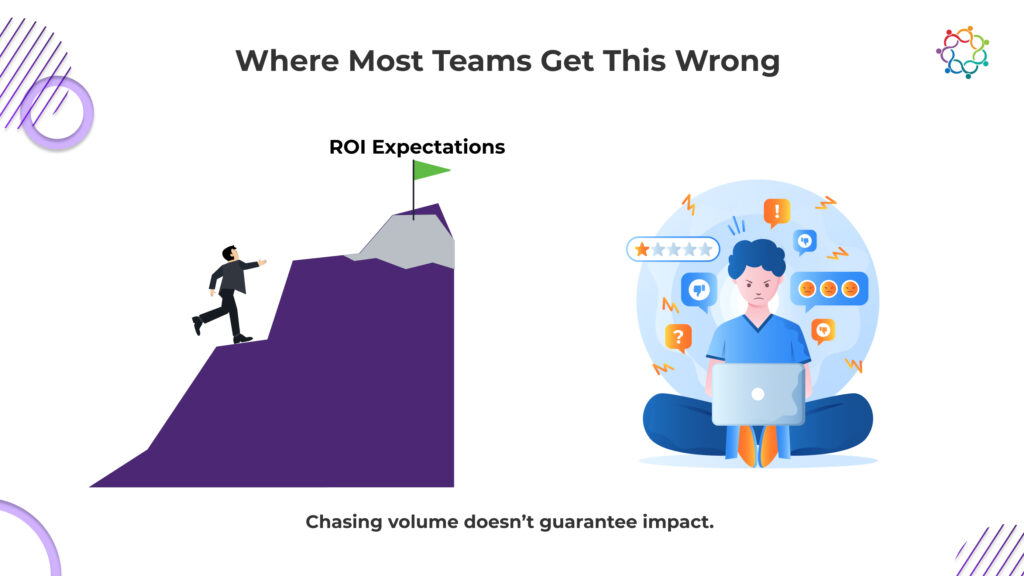
The problem is not effort. It is intent. When evaluation is treated as a task to complete rather than a system to inform future choices, its impact is limited. A large number of post-event reports are archived, mentioned only once in a quarterly review, and never looked at again. They provide a cursory explanation of what transpired, but they don’t go into detail on what changed or what should be done differently going forward.
In 2026, enterprise environments are less forgiving. Budgets are scrutinized, leadership expects clarity, and scale amplifies the cost of weak decisions. Treating post-event evaluation as documentation rather than decision infrastructure is no longer sustainable. Evaluation must move beyond comfort metrics and toward signals that explain behavior, outcomes, and trade-offs. Without that shift, teams will continue to optimize execution while learning very little.

Feedback and evaluation are often used interchangeably, but they serve fundamentally different purposes. Feedback captures how people felt. Evaluation explains what happened, why it happened, and what should change as a result. Confusing the two leads to shallow conclusions and misplaced confidence.
Feedback is subjective by design. It is voluntary, influenced by recency and emotion, and skewed toward extremes. It can highlight obvious issues or confirm basic satisfaction, but it cannot reliably explain performance. Evaluation, by contrast, is a structured discipline that combines multiple signals, contextual understanding, and explicit intent to inform decisions.
At enterprise scale, this distinction matters. Leaders do not need reassurance that an event was enjoyable. They need evidence to guide investment, prioritization, and strategy. Post-event evaluation becomes valuable only when it integrates opinion with behavior, outcomes, and comparison.
A useful way to frame the difference is simple:
Feedback answers how attendees reacted.
Evaluation answers what the organization learned.
When teams rely solely on feedback, they mistake sentiment for signal. A disciplined evaluation approach acknowledges the limits of opinion and deliberately incorporates event performance measurement, engagement patterns, and downstream impact. This is not about abandoning surveys. It is about placing them in their proper, limited role within a broader system.

Feedback mechanisms degrade as scale increases. What works for a single workshop or small event becomes unreliable across dozens of events, regions, and audiences. The failure is structural, not tactical.
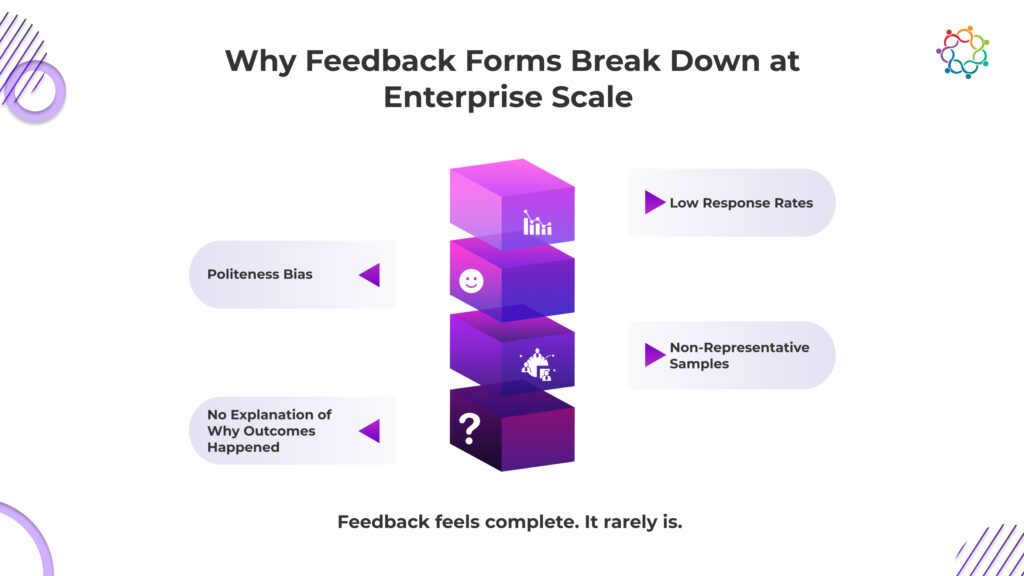
Response rates decline as audiences grow and survey fatigue increases. Those who respond are rarely representative of the full attendee base. Politeness bias further distorts results, especially in B2B contexts where relationships matter. Attendees often provide positive ratings to be courteous, not because the experience delivered value.
More importantly, feedback forms cannot explain causality. They can indicate that satisfaction was high or low, but they cannot reveal why certain outcomes occurred. They do not connect engagement depth to business results. They do not account for differences in audience intent, event objectives, or market context.
As enterprise teams attempt event ROI measurement using survey averages, they encounter false precision. A score of 4.3 out of 5 feels definitive but provides no guidance on what to adjust. This creates a dangerous loop where teams repeat formats that feel successful while ignoring underperforming signals hidden beneath positive sentiment.
At scale, reliance on feedback alone produces noise, not insight. Recognizing this breakdown is the first step toward a more resilient post-event evaluation model that values explanation over reassurance.

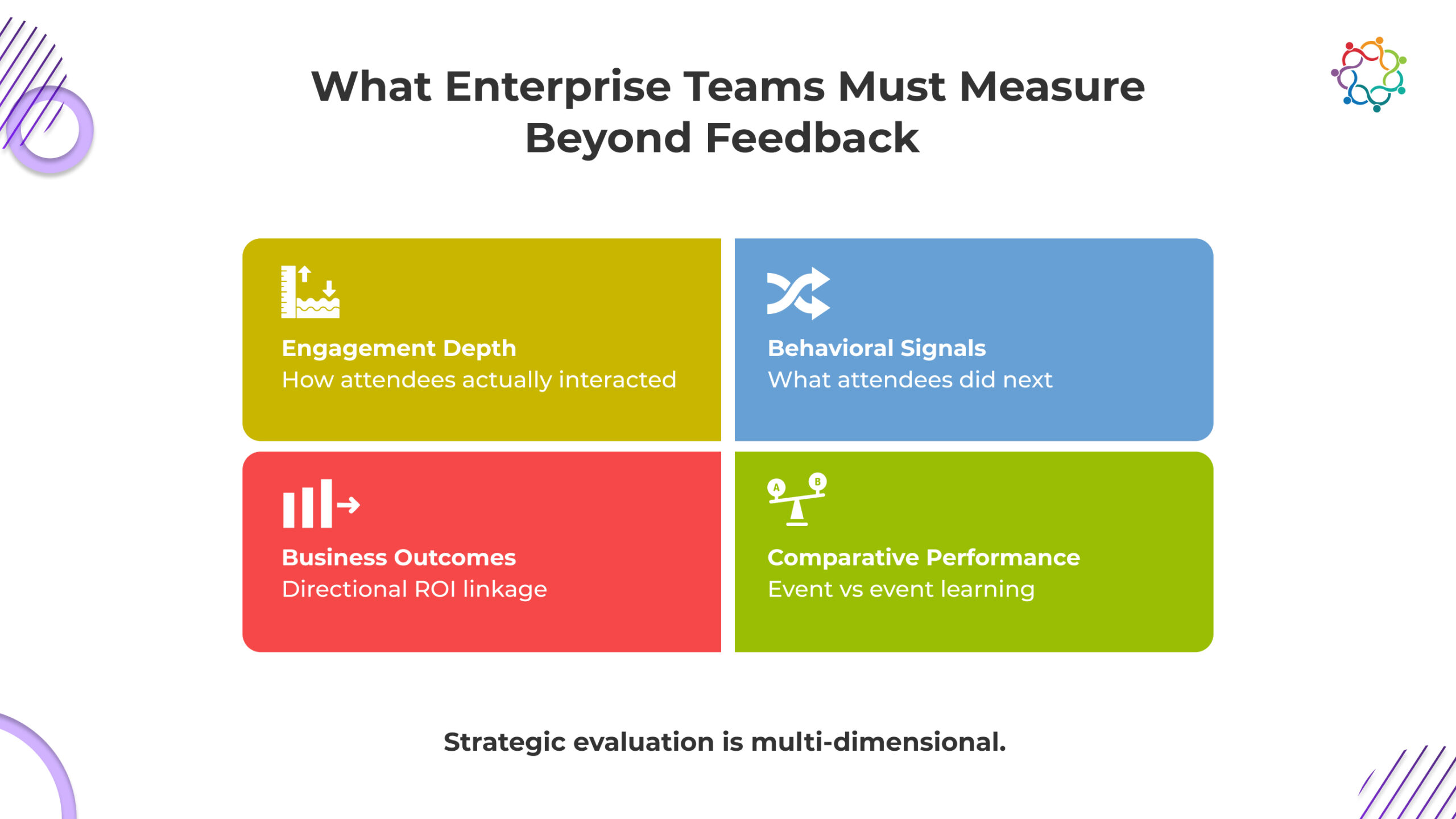
Before diving into specific metrics, it is important to reset how measurement is approached. Moving beyond feedback does not mean adding more numbers or building heavier dashboards. It means identifying signals that explain value. Enterprise teams must measure what reflects attention, intent, and impact across the event lifecycle. These signals should reveal how audiences actually behaved, how that behavior connected to business outcomes, and how performance compares across events.
This section outlines the core dimensions that matter once evaluation shifts from opinion collection to decision support. Each dimension answers a different strategic question, and together they form a complete evaluation system.
Attendance is an entry condition, not a value indicator. Enterprise teams that equate presence with success miss the most important signal: how deeply participants engaged. Engagement depth reveals whether an event held attention, delivered relevance, and justified the time investment.
Depth can be observed through patterns rather than opinions. Session drop-offs show where interest declined. Interaction frequency highlights moments of curiosity or confusion. Time spent indicates whether the content sustained attention beyond obligation.
One effective way to approach this is to look for gradients, not totals:
Compare early versus late session participation.
Identify which segments stayed engaged longest.
Examine interaction intensity across formats.
Engagement depth predicts value because it reflects voluntary behavior. People disengage quietly when content does not resonate. Measuring this behavior provides a more honest assessment than satisfaction scores.
When engagement metrics are treated as event engagement metrics rather than vanity numbers, they help teams refine agendas, formats, and pacing. Over time, these patterns form a baseline for post-event evaluation that focuses on how value was actually consumed.
Behavior is a stronger indicator of intent than stated preference. What attendees do during and after an event reveals what mattered to them. Behavioral signals cut through bias because they require effort.
During events, signals include content downloads, questions asked, polls answered, and meetings requested. After events, follow-up actions such as resource access, demo requests, or continued conversations provide further evidence of impact.
These behaviors should be interpreted collectively, not in isolation. A single download may mean little. A cluster of related actions suggests momentum. Event feedback analysis becomes more credible when anchored in observed behavior.
Behavioral data also bridges the gap between marketing and sales. It shows where interest translated into action without forcing strict attribution. This allows teams to discuss event performance measurement in terms of influence rather than credit.
Incorporating behavioral signals elevates post-event evaluation from retrospective commentary to forward-looking insight. It highlights which experiences moved audiences from passive consumption to active engagement.
Enterprise leaders ultimately care about outcomes, but simplistic attribution models often obscure more than they reveal. The goal is not to prove that an event caused a deal, but to understand how it influenced movement within the business system.
Outcome linkage should focus on direction and proximity. Did targeted accounts progress after engagement? Did sales cycles shorten? Did pipeline velocity change for attendees compared to non-attendees? These questions support event ROI measurement without overpromising precision.
Avoiding attribution jargon helps maintain credibility. Instead of claiming direct revenue impact, frame insights around influence and acceleration. This aligns evaluation with how complex buying decisions actually unfold.
A practical approach includes:
Comparing the pipeline behavior of engaged versus unengaged accounts
Tracking deal stage movement post-event
Observing changes in sales conversations initiated
These linkages transform post-event evaluation into a strategic lens rather than a defensive report. They inform where events contribute meaningfully within a broader go-to-market strategy.
Evaluation without comparison is guesswork. Single-event analysis lacks context. Enterprise teams operate portfolios, not isolated experiences, and evaluation must reflect that reality.
Comparative analysis answers questions that standalone metrics cannot. Which formats outperform others for specific audiences? Which regions show stronger engagement depth? Which objectives consistently underdeliver?
Comparison should be intentional and scoped. Event versus event, format versus format, and audience versus audience comparisons reveal patterns over time. This supports measuring event success as a relative, evolving standard rather than a static benchmark.
One structured comparison per dimension is sufficient. Overloading analysis creates confusion. The objective is to surface differences that warrant decision-making, not to rank everything.
By embedding comparison into post-event evaluation, teams shift from anecdotal learning to portfolio intelligence. This is where evaluation begins to shape strategy rather than validate execution.
(Also Read: What Is Post-Event Evaluation and Why Is It Critical for Enterprise Events?)

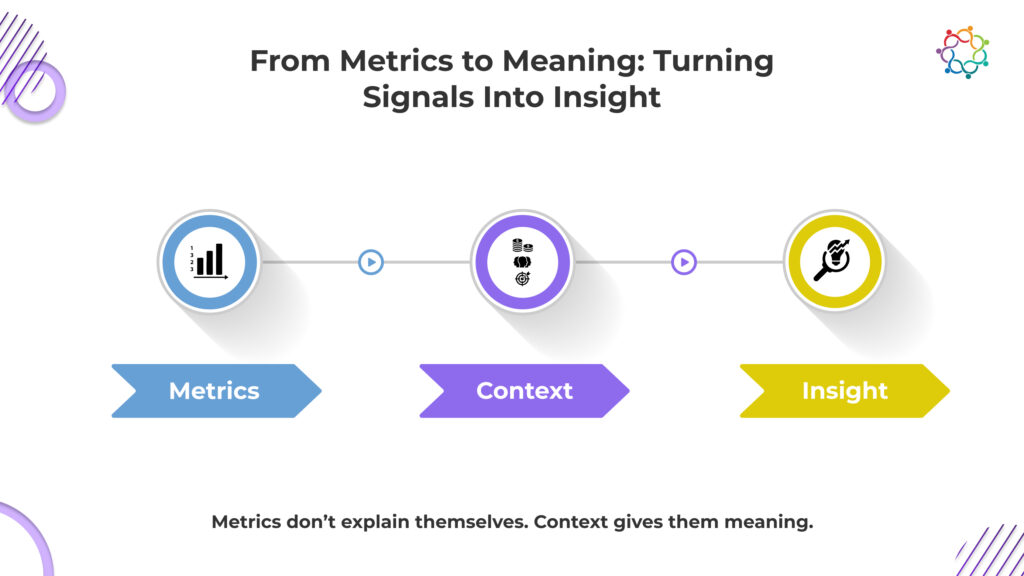
Collecting metrics is easier than interpreting them. Raw data does not explain itself, and without context, even accurate metrics can mislead. Insight emerges only when signals are framed against intent, cost, and constraints.
Contextual interpretation requires asking disciplined questions. What was the objective of this event? Who was the audience? What trade-offs were made in design and spend? Without these anchors, event reporting best practices devolve into dashboards that look impressive but guide nothing.
Meaning is created through synthesis. Engagement depth gains significance when compared to audience expectations. Behavioral signals matter more when aligned with account strategy. Outcome linkage is useful only when viewed alongside investment levels.
Teams should focus on translating observations into implications. An observation states what happened. An implication explains what should change. This step is often skipped, leaving insights trapped in analysis.
Post-event evaluation becomes valuable when it trains teams to think, not just to measure. Metrics are inputs. Insight is the output that influences future decisions.

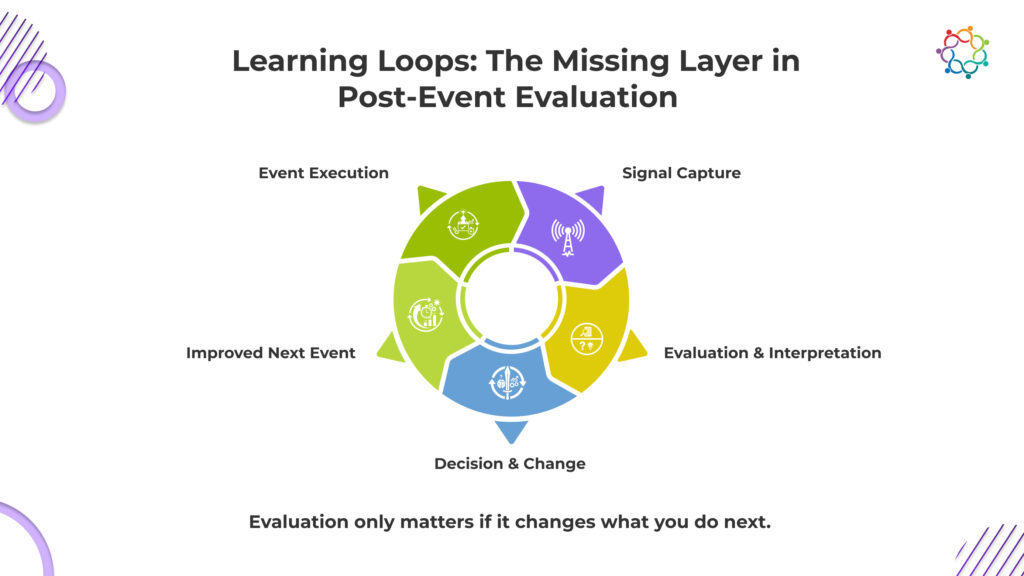
Most insights die in decks because there is no mechanism to carry them forward. Learning loops close that gap. A learning loop connects evaluation to action and then back to evaluation again.
A true learning loop has three properties. It captures insight, assigns ownership, and influences a future decision. Without all three, learning remains theoretical.
Learning loops should explicitly shape:
Targeting choices
Messaging emphasis
Format and experience design
Budget allocation across events
This is where post-event evaluation becomes strategic infrastructure. It ensures that each event contributes to cumulative understanding rather than isolated reporting.
Learning loops also enable continuous improvement. They create memory across teams and time. Instead of repeating assumptions, teams test and refine them. This aligns evaluation with the pace and complexity of enterprise operations.

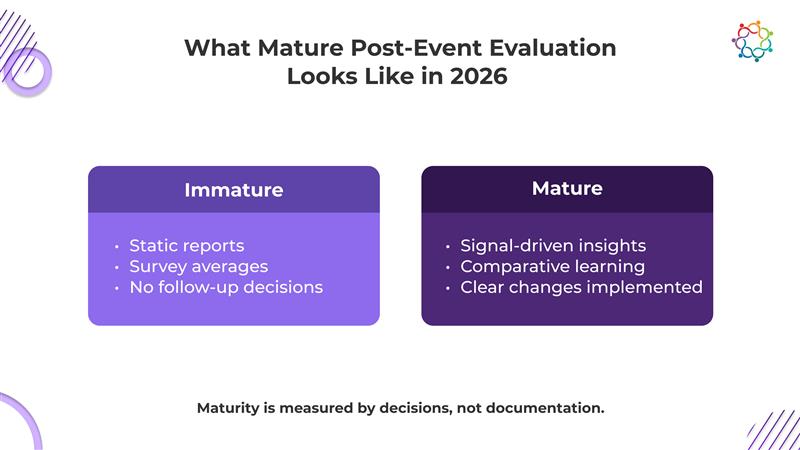
Maturity is not about more data. It is about better judgment. Mature evaluation systems prioritize clarity, relevance, and accountability.
In 2026, advanced teams exhibit consistent traits. They track fewer metrics but understand them deeply. They assign clear ownership for insights and decisions. They view evaluation as a longitudinal process rather than a per-event task.
Characteristics of maturity include:
These teams treat evaluation as a capability, not a report. They invest in thinking as much as in measurement. Post-event evaluation becomes a shared language for learning and improvement across the organization.
Evaluation that does not influence decisions is documentation, not learning. Many enterprise teams invest significant time collecting data after events, yet very little of it shapes what happens next. Activity is reviewed, numbers are acknowledged, and reports are filed away. The appearance of rigor replaces actual improvement. In a climate of tighter budgets and higher executive scrutiny, this gap is no longer harmless. Every evaluation effort must justify itself by improving future choices, not by proving work was done.
This requires a fundamental shift in how evaluation is valued. Surveys and feedback forms still matter, but only within clear limits. They capture sentiment at a moment in time and from a narrow slice of the audience. On their own, they cannot explain behavior, intent, or business impact. Insight comes from observing what people actually do, comparing performance across contexts, and linking engagement to outcomes within the realities of cost, audience, and objectives.
When post-event evaluation is treated as strategic infrastructure, it stops being a closing ritual. It becomes a forward-looking system that informs targeting, experience design, and investment decisions. Evaluation earns its place only when it changes future action. If it does not alter priorities, formats, or resource allocation, it should be questioned, simplified, or replaced.
(If you’re thinking about how these ideas translate into real-world events, you can explore how teams use Samaaro to plan and run data-driven events.)
Attendance only confirms someone showed up. Engagement depth measures how actively they participated: sessions completed, questions asked, meetings booked, and content consumed. Depth predicts pipeline, presence does not.
Compare deal progression speed for engaged accounts against similar non-attending accounts, and report influence rather than claiming full credit. Control comparisons keep attribution honest and credible.
Mature enterprise teams track roughly eight to twelve metrics spanning engagement depth, behavioral signals, business outcomes, and event-over-event comparisons. Enough for insight, few enough to act on.
Use anonymous surveys, pair opinions with behavioral data, and ask specific questions instead of general satisfaction ratings. Behavior reveals what polite survey answers often hide.
Assign every insight an owner, feed findings into the next event’s plan and budget, then verify the changes actually happened. A learning loop only works when it changes decisions.
The majority of organizations do not begin their event journey by searching for an event marketing platform. Teams start with spreadsheets, simple registration systems, calendar invites, and basic CRM interfaces. Plans are made, people show up, and follow-ups are handled manually, but without friction at early scale.
At this stage, everything appears to be under control. There is no obvious need for a new system. Events run, teams stay busy, and leadership sees activity. From the outside, there is little reason to believe more structure is necessary.
The real question is not whether organizations can run events without an Event Marketing Platform. Most can, and many do so successfully for a long time. The more important question is how long that remains true as expectations, scale, and accountability evolve.
Event Marketing Platforms are not day-one tools. They emerge when scale and complexity quietly outgrow the systems that once felt sufficient.
There are clear scenarios where an Event Marketing Platform is not needed.
Organizations running a small number of events each year can often manage comfortably with basic tools. When there is a single event owner, limited stakeholder involvement, and minimal pressure to tie events to revenue outcomes, complexity remains low.
In early or brand-focused programs, events exist primarily to build awareness, foster community, or support thought leadership. Success is measured qualitatively, and expectations are aligned accordingly. Execution matters more than insight, and manual coordination is manageable.
Needing an Event Marketing Platform is not a badge of maturity. It is a response to changing demands. When those demands are absent, adding structure prematurely can create more friction than value.
The inflection point rarely arrives suddenly. It emerges as event programs expand. Growth introduces more events across more regions, formats, and audiences. Additional stakeholders like field teams, sales leaders, revenue operations, and executives, are also involved with different expectations.
At the same time, the role of events begins to shift. What once supported marketing now is marketing. Events move from being supplemental activities to becoming a core channel within the go-to-market strategy.
The critical moment occurs when events begin to influence the pipeline. Even if the tooling remains unchanged, expectations change immediately. Leadership starts by asking outcome-oriented questions. Sales looks for actionable insight. Marketing is asked not just to execute, but to explain.
This shift creates pressure that basic event marketing tools were never designed to absorb.
One of the earliest readiness signals appears when events stop standing alone.
Instead of one-off activations, organizations begin running roadshows, recurring series, regional programs, and global experiences. Events connect across time, audiences, and objectives. What happens at one event influences expectations for the next.
Managing each event individually begins to break down. Teams can still execute logistics, but insight becomes fragmented. Context from previous events is lost, and learning does not compound.
When events relate to each other, they require continuity of understanding, not just repeatable execution. This is often the first moment when organizations realize that treating events as isolated moments no longer reflects how they actually operate.
Signal #2: Leadership Asks Better Questions Than Tools Can Answer
As programs mature, leadership questions become more precise and more difficult to answer.
Which events actually drive momentum? What did we learn about buyer intent from these experiences? Why did one event outperform another, even though attendance looked similar?
Existing systems can produce activity metrics, but they struggle to explain outcomes without heavy interpretation. Answers require stitching together spreadsheets, anecdotal feedback, and manual analysis. Insights depend on who is asked, not on a shared source of truth.
This gap creates discomfort. Teams feel the pressure to justify decisions but lack the structure to do so confidently. The problem is that the questions being asked exceed what execution-focused systems were built to support.
Follow-up is where many event programs quietly lose momentum.
Sales teams receive attendance lists without context. They know who was present, but not why they attended, what engaged them, or how the interaction fits into an ongoing buyer journey. Outreach becomes generic, based on assumptions rather than insight.
Marketing teams struggle to guide next best actions. Without preserved engagement context, follow-up strategies default to broad campaigns instead of informed, personalized motion.
When context is lost, events stop compounding value. Each one resets the relationship rather than building on it. Over time, this inconsistency erodes confidence in events as a reliable growth lever.
This signal is often felt first by sales and revenue teams, even if marketing feels it later.
At scale, reporting becomes unavoidable. Teams begin tracking registrations, attendance, and high-level “influenced pipeline” metrics. These numbers are necessary, but they are not sufficient.
When ROI discussions arise, teams find themselves defending events rather than explaining them. They can show correlation but not contribution. They know events matter but struggle to articulate the impact of events beyond surface metrics.
This creates tension. Leadership wants understanding, not just numbers. Marketing wants recognition but lacks a clear narrative grounded in insight.
The need for an Event Marketing Platform at this stage is not about proving ROI. It is about understanding it and being able to explain what events are actually doing and how they shape buyer behavior over time.
When these signals converge, organizations are no longer just executing events; they are interpreting them.
At this stage, an Event Marketing Platform enables teams to capture intent across the full event lifecycle, from pre-event engagement through post-event behavior. It preserves context that would otherwise be lost and allows learning to accumulate across programs.
Instead of asking whether an event “worked,” teams can understand how it worked, for whom, and why. Insights inform future design, follow-up strategy, and resource allocation.
The platform does not replace execution tools. It complements them by addressing a different need: interpretation. It emerges when understanding becomes as important as delivery.
As organizations scale, CRM systems become more important. They remain the system of record for accounts, opportunities, and revenue outcomes.
The challenge is that CRM systems are not designed to generate event-specific insight on their own. They require structured, contextual signals to be meaningful.
Event Marketing Platforms provide that pre-pipeline intelligence. They translate event behavior into structured insight that CRM systems can use, enriching existing workflows rather than competing with them.
The growing need for a platform reflects the increasing centrality of CRM, not a limitation of it. As revenue systems become more critical, the need for event intelligence that can feed them grows alongside.
The decision point for organizations is rarely framed correctly.
The question is not, “Should we buy an Event Marketing Platform?” That framing assumes a product decision. The more important question is diagnostic.
Do we have a system that can explain how our events shape buyer intent over time?
(Also read: What Is an Event Marketing Platform?)
When the answer becomes unclear or requires excessive manual effort, organizations are often already at the stage where an Event Marketing Platform is needed. Not as a replacement for existing tools, but as the connective layer that allows events to scale with insight, consistency, and confidence.
As organizations grow, events are no longer just about execution or attendance. They are expected to influence demand, pipeline, and buyer decisions. This shift changes what events are responsible for delivering, not just how often they are run. Event Marketing Platforms emerge when teams need a clearer way to understand and manage this change.
As events have become more central to modern marketing strategies, the language around them has become increasingly vague. Most teams assume that any tool used in the context of events qualifies as an “event platform.” Registration systems, event apps, CRMs, and even spreadsheets often get grouped under the same label.
This grouping made sense when events were prima
| Event Marketing Platform |
rily operational exercises. If the goal was to get people registered and checked in, any tool that supported that workflow felt sufficient. Over time, however, events moved closer to revenue conversations. They began to appear in pipeline reviews, account plans, and leadership discussions.
The label expanded, but clarity did not.
Using tools around events is not the same as having an Event Marketing Platform. The difference lies not in how many tools exist, but in whether there is a system designed to understand and compound the value events create.
An Event Marketing Platform is designed to orchestrate events as a marketing channel, capture buyer intent generated through those events, and translate engagement into usable marketing and revenue intelligence.
(Also read: What Is an Event Marketing Platform?)
Its core job is not execution, but turning event interaction into usable marketing and revenue insight. Where logistics-focused systems ensure events happen, an Event Marketing Platform ensures events are understood. It treats events as intentional moments within a broader go-to-market strategy, not as isolated activities to be completed and forgotten.
At its foundation, this category exists to answer questions that execution tools cannot: why people engage, what that engagement signals, and how those signals should influence marketing and revenue decisions.
An Event Marketing Platform is designed around intent creation and interpretation. Logistics may still exist elsewhere, but the platform’s purpose is to make event-driven behavior legible, actionable, and comparable over time.
Most event tools are built to solve narrow, well-defined problems. One tool handles registration. Another support check-in. Another enables attendance. Each is optimized to execute a specific task within a single event.
These tools are effective at what they are designed to do. They help teams run events smoothly and consistently. But they are not designed to preserve context across events or across the buyer journey.
Event Marketing Platforms are built with a different scope in mind. They are designed to connect multiple events over time, understand how those events interact with one another, and support marketing strategy rather than just event execution.
The difference is structural. Tools help events happen. Platforms help events compound.
An Event Marketing Platform assumes that the value of an event is not contained within the event itself, but emerges over time as engagement signals are interpreted, acted upon, and compared across programs.
Events do not begin on the day they occur. They begin the moment someone chooses to engage.
One of the defining capabilities of an Event Marketing Platform is its ability to capture intent before the event takes place. This starts with understanding who the event is for and why different audiences choose to participate.
Pre-event intent capture goes beyond basic registration confirmation. It considers audience segmentation tied to marketing strategy, contextual signals around interest, and behavioral indicators that reveal motivation before attendance.
Someone attending to evaluate a solution carries a different signal than someone attending to learn about an industry trend. Treating both registrations as equal obscures valuable insight.
An Event Marketing Platform is built to preserve this context. It recognizes that understanding why someone shows up is often more important than knowing that they did. This capability ensures that events are anchored in intent from the very beginning.
Attendance is binary. Engagement is not.
Events generate rich, moment-based signals through questions, interactions, sessions attended, and shared experiences. These signals are inherently contextual and often collective, shaped by group dynamics and live interaction.
An Event Marketing Platform must be able to capture both qualitative and quantitative engagement in a way that preserves meaning. This includes session-level context, interaction depth, and behavioral patterns that unfold during the event itself.
Traditional systems often lose this data because they are not designed to handle temporal, experience-driven interactions. They flatten engagement into static records, stripping away nuance and relevance.
Engagement intelligence is a defining capability because it allows teams to distinguish between passive presence and meaningful participation. Without it, events appear successful on the surface but remain opaque in terms of actual buyer interest.
For many teams, events end when attendees leave. For Event Marketing Platforms, that is where their value begins to compound.
Events generate insights that should inform follow-up strategy, shape sales conversations, and influence how future events are designed. Capturing this learning requires structure and continuity.
An Event Marketing Platform enables post-event analysis that goes beyond recap metrics. It supports learning loops across events, allowing teams to identify what resonated, what drove engagement, and what patterns repeat over time.
This capability ensures that signals do not disappear once the event concludes. Instead, they are carried forward, connected to future interactions, and used to refine strategy.
The core idea is continuity. Events are not isolated moments; they are inputs into an ongoing system of learning and improvement.
Event ROI is often reduced to attribution metrics, such as “event-influenced pipeline.” While useful, these metrics are limited. They describe correlation without explaining contribution.
Event Marketing Platforms approach pipeline connection differently. Rather than asking whether an event touched a deal, they focus on how engagement reflects buyer intent and how that intent evolves as opportunities progress.
This capability preserves event context as deals move through pipeline stages. It allows marketing and revenue teams to tell coherent narratives about how events support momentum, accelerate conversations, or reinforce decisions.
The goal is not to produce more reports, but to support revenue understanding. Event-to-pipeline intelligence enables teams to explain impact in ways that align with how deals actually move forward.
Most marketing teams run portfolios of events across regions, formats, and audiences, not isolated one-offs.
A defining capability of an Event Marketing Platform is the ability to provide visibility across this portfolio. This includes comparing events meaningfully, identifying patterns, and understanding which types of experiences consistently create momentum. Without this capability, teams evaluate events in isolation. Success becomes subjective, driven by anecdotal feedback rather than comparative insight.
Event marketing maturity is measured across portfolios, not calendars. Platforms enable teams to move from one-off assessments to strategic understanding, revealing how different events contribute collectively to marketing and revenue goals.
CRM systems remain the system of record for revenue. They house accounts, opportunities, and forecasts. Event Marketing Platforms do not replace this role.
Instead, they act as the system of intent, engagement context, and event intelligence.
An Event Marketing Platform enriches CRM by translating event behavior into structured signals that revenue systems can understand. It provides context that CRM systems are not designed to capture on their own.
This balance is critical. The platform does not attempt to own revenue data or override sales judgment. Its role is to make event-driven insight legible and useful within existing go-to-market systems.
In this way, Event Marketing Platforms complement CRM rather than competing with it.
The defining question for modern teams is no longer, “Do we have event tools?”
It is: “Do we have a system designed to understand what our events are actually doing?”
Event Marketing Platforms exist because events now carry expectations that go beyond execution. As marketing teams are held accountable for impact, they need systems capable of capturing intent, interpreting engagement, and connecting experiences to outcomes.
The distinction is not about tools versus platforms. It is about whether events are merely run or truly understood.
The Problem Everyone Has After An Event
Your event happens. Lots of people show up. Conversations happen. Energy is real.
Then what?
The data goes into some spreadsheet. Sales gets a list. They follow up with some people. Other leads disappear. You have no idea which conversations actually mattered.
Three months later, a deal closes. Did it come from the event? Maybe. You’ll never know for sure.
This happens at almost every company. Events and CRM systems don’t talk. So event impact stays a mystery.
CRM systems are built for one thing: tracking deals.
Accounts. Contacts. Opportunities. Pipeline stages. Everything in a CRM is designed to measure revenue progression.
Events are the opposite. They’re moments. Human conversations. A discussion at a booth. A question during a session. A follow-up coffee chat.
These don’t naturally fit into a CRM structure. So they stay outside.
You upload an attendance list. You write some notes. But that’s not the same as actually connecting the event to the opportunity it might have influenced.
Traditional event tools made this worse. They were built to run the event, not to measure its business impact. Registration management. Scheduling. Logistics. But not revenue tracking.
So events stayed disconnected. Data existed but didn’t mean anything.
Here’s the thing nobody says: just because you have data doesn’t mean it helps.
Two people attend the same keynote. One is actively shopping for a solution. One is just curious about industry trends.
Your attendance list shows both as attendees. That’s useless. It’s noise.
Sales teams don’t want more data. They want better data. Data they can actually act on.
Raw event data is messy. Who attended? Who asked a question? Who visited the booth? That’s not the same as understanding who’s actually interested in buying.
For that, you need context. You need interpretation. You need to know what the interaction actually meant.
Event marketing platforms exist to solve this exact problem.
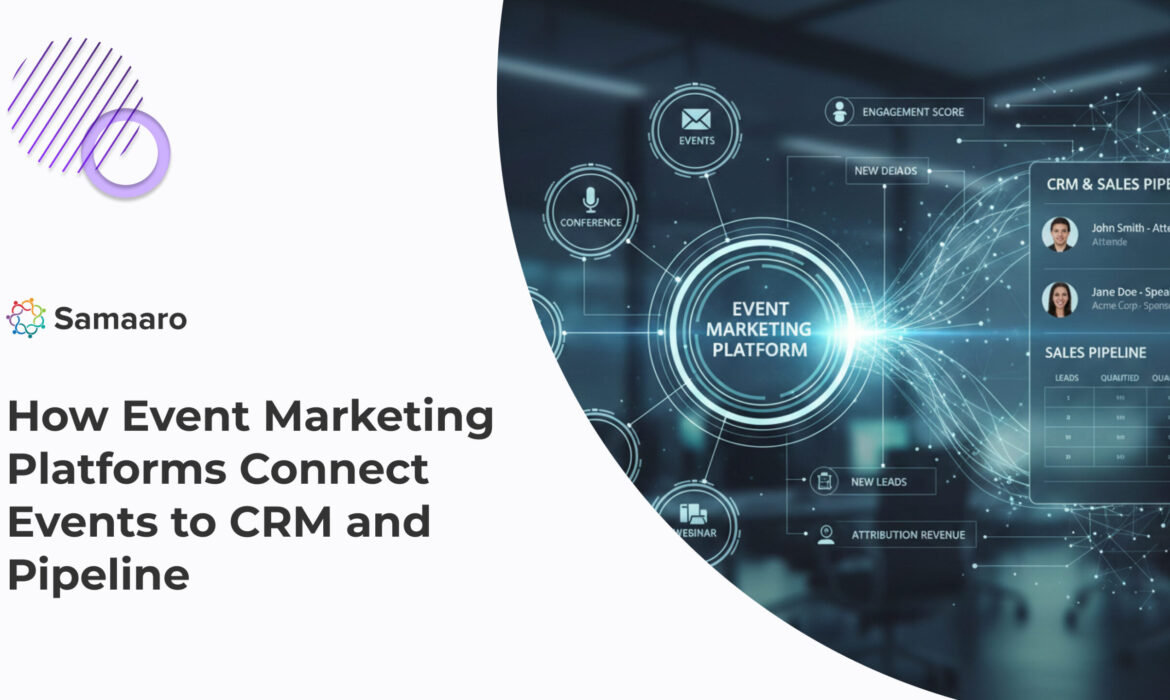
They’re not just event registration tools. They’re built to connect events to your CRM and pipeline systems in a way that actually matters.
Here’s how they think differently:
An event marketing platform sits between your event and your CRM.
Before the event, it captures registrations with context. Which tracks are they interested in? What company? What problem are they trying to solve?
During the event, it captures engagement. Who attended which sessions? Who visited which booths? Who asked questions? Who requested demos?
All of this gets recorded with meaning, not just activity.
After the event, instead of manually uploading a spreadsheet, the platform automatically syncs this data to your CRM. But not raw data. Interpreted data.
So the CRM shows: This contact attended three sessions on our platform capabilities, talked with our founder about timeline, and is now flagged as a high-priority follow-up for Account Executive Sarah.
Sales understands immediately what happened and what to do next.
If you run one event a year, this might feel like overkill.
But if you run monthly events? Quarterly roadshows? Multiple conferences? Then you have a real problem.
Multiple events touch the same accounts. Without visibility, you don’t know which interactions actually moved the needle. You can’t see if events are accelerating deals or just creating noise.
Leadership asks: “How much pipeline did our events generate?” You have no answer except a guess.
At scale, that becomes a massive blind spot. You’re spending money on events but can’t prove the ROI.
This isn’t about automating the entire sales process.
It’s not about flooding your CRM with junk data and hoping AI figures it out.
It’s not about replacing human judgment. Sales reps still decide who to call and what to do.
What it IS about: giving sales reps better information so they can make smarter decisions faster.
Instead of guessing which event attendees are worth calling, they know based on what actually happened at the event.
For small teams running occasional events, this gap is annoying but manageable.
For large organizations running frequent events as a core go-to-market motion, this gap becomes dangerous.
Events only matter if you can prove they matter.
That means tracking them. Understanding them. Connecting them to real business outcomes.
Event marketing platforms exist to close the gap between the energy of an event and the clarity of your CRM.
Q: What’s the difference between just uploading attendance lists and using a real event marketing platform?
A: Uploading an attendance list is just moving names. A real event marketing platform interprets what happened at the event and structures it so your sales team understands context. One is data movement. The other is insight creation.
Q: How do I know if our current event process is creating pipeline impact?
A: If you can’t trace closed deals back to specific events, you don’t know. If you’re guessing at ROI instead of measuring it, you need better visibility. If sales has no context about which event conversations mattered, you’re leaving opportunities on the table.
Q: Should we connect every single event to the CRM?
A: Yes, but focus on the ones that touch important accounts first. Small internal events might not need the same level of tracking as major conferences or customer roundtables. Start where it matters most and expand from there.
Q: What if we have limited tech resources and can’t manage another integration?
A: That’s exactly why event marketing platforms exist. They’re designed to handle the integration work so your team doesn’t have to. The whole point is to make this easier, not harder.
Q: How quickly do we see ROI from connecting events to CRM?
A: You start seeing clearer attribution immediately. But real impact on deal velocity takes a few event cycles. Give it 2-3 events to build a pattern, then you’ll see where it’s working.
Q: If we’re already using a CRM, why do we need an event platform?
A: Your CRM wasn’t built to understand events. It’s built to track deals. An event platform translates event data into signals your CRM can use. Together they’re powerful. Separately, you’re missing the connection.
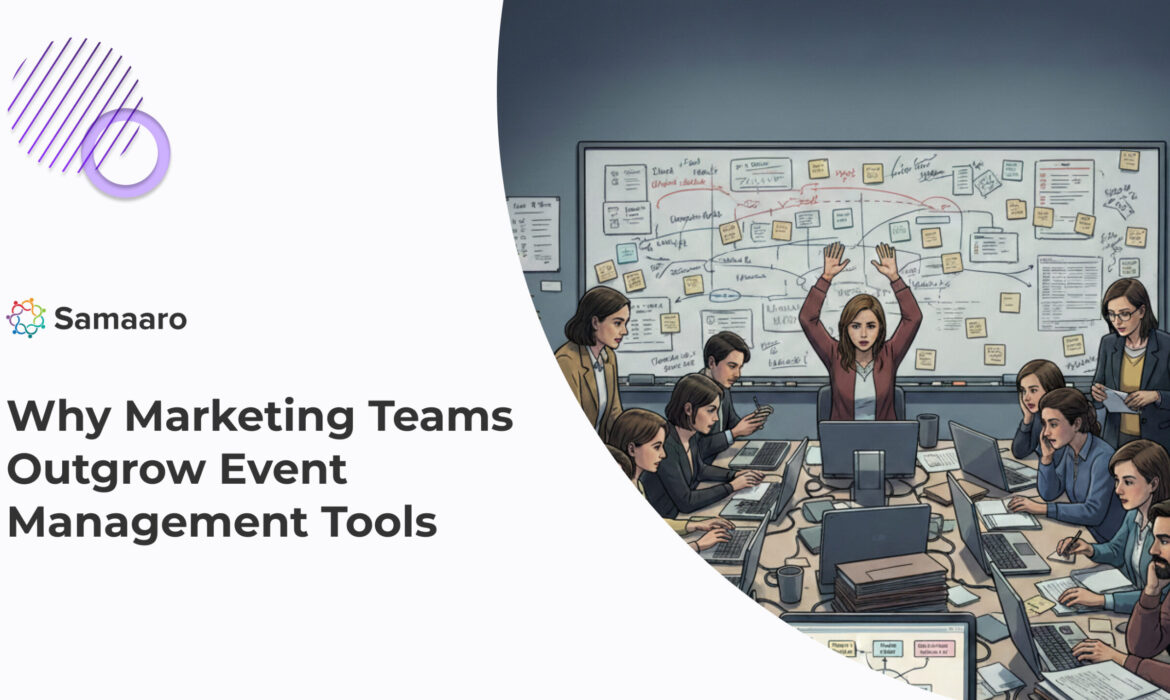
In the early stages of an event program, most marketing teams feel confident in their setup. Events are planned on time. Registrations are tracked. Attendees show up. Everything appears to be working accordingly, but from the outside. At this stage, smooth execution feels like success. If an event runs without visible issues and participation meets expectations, the tool supporting it is doing its job. There is little reason to question whether anything more is needed.
This shift happens when execution success is no longer enough and teams need to understand what events actually contribute.
Over time, however, the questions begin to change. Teams start asking which events actually worked out. They want to know who followed up and what happened after the event ended. Eventually, the most uncomfortable question surfaces, which is: did any of this influence pipeline or revenue at all? When these questions appear, teams often assume something is wrong with their tools. In reality, this moment signals a shift in expectations rather than a failure of execution. What was once “good enough” for running events no longer feels sufficient for understanding their impact.
This tension is not created by poor software choices or bad planning. It emerges naturally as marketing organizations grow and begin asking more of events than smooth delivery alone.
Events multiply over time when marketing teams scale. What may have started as a small, carefully planned program becomes a calendar filled with field events and hosted experiences. As the number of events grows, so do stakeholders, cross-functional involvement, and budget scrutiny.
At the same time, events start to play a different role. First, the objective is straightforward: execute the event effectively. The next inquiry is what the event brought to the company.
Execution remains important, but it is no longer the finish line. Events are now expected to contribute to broader marketing and revenue objectives. They are discussed in pipeline reviews, forecast meetings, and leadership conversations.
This shift does not happen because teams are unhappy with their tools. It happens because organizational maturity changes what success looks like. The same systems that once supported growth start to feel limiting because the job they were hired to do has expanded.
Event management software is designed to make the planning, coordinating, and carrying out of events easier. They were developed to deal with a very particular problem, such as how to handle events consistently without creating operational ambiguity. Teams required organized methods to handle scheduling, registrations, logistics, and on-site execution as events grew more complicated and frequent.
These tools work well in situations when the main difficulty is coordination. They assist teams in delivering consistent experiences across different events, ensure that guests are accounted for, and bring structure to logistics-heavy programs.
They emphasize the operational reliability conceptually. On the day of the event, they assist teams with event setup, attendance flow management, and seamless execution. They offer the assurance that nothing important will be overlooked and that everything will go according to plan.
Event management tools are effective in that regard. They are only optimized for execution rather than long-term marketing impact; they are neither constrained nor defective by design.
The early indications of friction are subtle and simple to ignore.
Frustration can be built because the systems that support teams cannot answer the questions being asked. The gaps between expectations and reality become impossible to ignore. These gaps are structural.
Event management tools are optimized for execution. Their design centers on running events efficiently and reliably. They are not built around revenue journeys, buyer intent, or attribution models.
As marketing teams become more revenue-aligned, the expectations placed on events fundamentally change. Events are no longer treated as isolated activities; they are viewed as touchpoints within longer buyer journeys that stretch across channels and time.
When teams ask event systems to explain pipeline influence or behavioral intent, they are asking those systems to do a job they were never designed for.
This moment creates the need for a different category of technology, one built around outcomes, visibility, and learning rather than execution alone.
An event marketing platform is software that enables marketing teams to plan, promote, run, and measure events as a repeatable growth channel. It combines registrations, communication, engagement, lead capture, CRM integration, and analytics to connect events directly to pipeline and ROI.
(Also read: What Is an Event Marketing Platform?)
This category exists because modern go-to-market teams operate in CRM-driven environments with clear expectations around accountability. Marketing is being assessed based on pipeline contribution, revenue, and growth rather than just activity.
Events are not one-time actions in this sense, but rather linked marketing and income channels. Every interaction that takes place prior to, during, and following an event produces signals that are important for revenue, marketing, and sales operations.
Understanding audience intent before events, recording engagement and behavioral cues during participation, and facilitating post-event attribution, follow-through, and insight are the main goals of event marketing platforms. Their job is to make it clear how events affect consumers over time.
Critically, this category is designed to connect natively with sales, marketing, and RevOps systems. Its purpose is not to run events, but to make events measurable, intelligible, and improvable within the broader growth strategy.
The distinction between event management tools and event marketing platforms is best understood as a difference in mindset.
The definition of success shifts from completion to contribution. Instead of asking whether an event ran smoothly, teams ask what it changed.
The time horizon of value expands. Execution-focused tools deliver value around the event itself, while outcome-focused platforms deliver value over weeks and months as insights compound.
Ownership and accountability also evolve. Events move from being owned solely by operations or field teams to becoming shared assets across marketing, sales, and revenue leadership.
Data plays a different role as well. Rather than serving as a record of attendance, data becomes a source of intelligence that informs prioritization, follow-up, and future strategy.
At the core, event management tools optimize execution. Event marketing platforms optimize impact and learning.
Most teams do not make this shift intentionally at first. It happens when circumstances force the issue.
Events become tied to pipeline or revenue goals. Programs scale across regions or audiences. Sales teams begin expecting actionable insight rather than raw attendance lists.
Leadership starts asking for ROI explanations that go beyond how many people attended. They want to know which events moved deals forward and which ones did not.
These moments signal that the organization has matured. The expectations placed on events now require visibility and intelligence that execution-focused tools alone cannot provide.
Outgrowing event management tools does not mean discarding them. Many mature teams continue using execution-focused tools to support logistics and coordination. What changes is what they expect those tools to deliver.
Execution and impact are separate jobs. One ensures events happen. The other ensures events matter.
As teams mature, they stop expecting a single system to do both. Instead, they recognize that different categories exist to serve different purposes within the event ecosystem.
Outgrowing event management tools is not a failure. It is a signal of marketing maturity.
As teams develop, events are now evaluated on their obvious contribution to growth rather than just how effectively they function. The emergence of event marketing platforms is a result of improved go-to-market tactics, increased revenue accountability, and higher expectations.
The real evolution is not in software. It is in how organizations value events as strategic growth channels that deserve visibility, insight, and continuous improvement.
An event management tool handles logistics: registration, check-in, and schedules. An event marketing platform connects events to pipeline, revenue attribution, and multi-event strategy.
Early warning signs include manual data exports, no attribution reporting, a disconnected CRM, and leadership asking ROI questions your current tool cannot answer.
As programs scale, leadership funds outcomes, not activity. Attendance says nothing about pipeline, revenue, or account progress, so it stops justifying growing event budgets.
Traditional tools were built for execution and never connected to CRM opportunity data. Without that linkage, pipeline and revenue attribution simply cannot exist in them.
Common triggers include revenue targets tied to events, growing event volume, new CMO-level scrutiny, and RevOps efforts to standardize data across the go-to-market stack.
You need event software. You Google it. Twenty tools pop up. They all say they do the same thing. So you pick based on price or user interface.
Then six months later, your boss asks: “What did the event actually contribute to pipeline?” You realize your tool doesn’t track that. You built spreadsheets to fill the gap. Now you’re frustrated.
The problem isn’t your choice. It’s that you didn’t know two different categories existed.
Most buyers confuse these categories. They sound like the same thing. They’re not.
Event Management Software focuses on execution. Registration. Check-in. Logistics. Keeping the event running smoothly. Its job is operational reliability.
Event Marketing Platforms focus on impact. They prove and improve what events contribute to revenue. They connect events to pipeline and sales outcomes.
The confusion happens because both have the word “event” and both touch registration. But they solve different problems.
Event management software handles the operational side. Registrations. Check-in. Attendee data. Email to registrants. Venue logistics. Speaker coordination. Basically, everything needed to make the event happen.
This category emerged because events got complex. More attendees. More logistics. More moving parts. Teams needed reliability. They needed consistency. They needed fewer things falling through the cracks.
The core value is: your event will happen as planned. No chaos. No surprises. Just smooth execution from start to finish.
This is great if you care about operational reliability. Internal company events. Training sessions. Compliance programs. Events where the goal is to get people in the room and deliver content. The software keeps everything organized and running on time.
But if you’re running events to generate leads or move deals forward, this category leaves you hanging. It doesn’t answer business questions. It answers logistics questions. You’ll get reports on who checked in. You won’t get reports on who might become a customer. It’s built for operations teams, not revenue teams.
Event marketing platforms are different. They’re designed to prove that events work.
They handle registration and logistics, sure. But they also capture what people do before, during, and after the event. They track engagement. They identify intent. They sync with CRM. They show pipeline contribution. Everything is connected.
The core value is: your event moved the needle on business goals. You can point to deals influenced. Accounts engaged. Revenue impacted. You know exactly what the event delivered.
This is built for go-to-market teams that treat events as a growth channel. Marketing teams. Sales enablement. Revenue operations. Teams that need visibility into whether their event investment paid off.
Use event marketing and promotion tools to build multi-event programs that generate leads and drive pipeline.
Here’s how to think about it clearly. These two categories solve different problems and measure success differently.
| Metric | Event Marketing Software | Event Marketing Platform |
| Core Question | Did the event run smoothly? | Did the event move the business forward? |
| Success Metric | Event happened as planned. No major issues. | Generated X leads. Y converted to sales. Event paid for itself. |
| Time Horizon | Value happens on event day. | Value compounds over weeks and months as leads move through pipeline. |
| Primary Users | Operations teams. Event planners. Logistics coordinators. | Marketing leaders. Demand generation teams. Revenue operations. Sales enablement. |
| Data Captured | Who registered. Who checked in. What sessions they attended. | All of that, plus engagement quality, buying intent signals, CRM integration, pipeline impact. |
| Success Indicator | Execution quality | Business impact |
One measures execution quality. The other measures business impact. Both are valuable. But they’re solving for different outcomes.
Think about timing too. Event management software delivers value on the day of the event. The event runs smoothly. Attendees check in. Logistics work. Done. Value is immediate and contained to that day.
Event marketing platforms deliver value over time. Attendees register weeks before. They engage with pre-event content. They attend. They get followed up with after. Deals close weeks or months later. The value compounds. That’s the real difference.
Mistake 1: Expecting ROI Questions to Be Answered by Execution Software
You buy event management software. Then leadership asks: “What did this event contribute to pipeline?” Your software doesn’t track that. Now you’re stuck building manual reports with incomplete data. You’re frustrated. The software isn’t broken. You just bought the wrong category.
Mistake 2: Buying for Immediate Needs, Not Future Needs
You have one event coming up in three weeks. You need registration and check-in fast. You buy execution software. It works great. Then you run five events a year. Now you need visibility into pipeline. Now you need to show ROI. Your software doesn’t do that. You should have planned ahead. This mistake costs money and time.
Mistake 3: Assuming All Event Software Solves the Same Problem
They don’t. One is a logistics tool. The other is a revenue tool. Know which problem you’re solving before you buy. This decision determines everything that comes next. It changes what data you collect. It changes who owns the tool. It changes the value you get.
Use event management software if your event isn’t tied to revenue goals. Internal town halls. Training sessions. Compliance programs. One-time events with no follow-up sales process. These are real events but different goals.
If the goal is just getting people in the room and delivering content, execution software is perfect. Don’t overbuild. You’ll waste money on features you don’t need. Keep it simple.
These events still matter. But they matter for different reasons. Education. Culture. Compliance. Not revenue. The software matches the need.
You need an event marketing platform if events are supposed to generate leads or move deals. If leadership holds you accountable for pipeline. If you run multiple events per year and need to see ROI across the program. These are revenue events.
You need it when you can’t answer: “Which event generated the most pipeline?” Without it, that question is impossible to answer with data. You’re guessing.
You also need it if you’re running a multi-event program. One event is one moment. Five events per year is a program. Programs need measurement. Otherwise you’re just running random events hoping one works. But with measurement, you can see what works and do more of it.
Use event management software to understand what each event actually contributes to your business.
Teams evolve as programs grow. Most start with execution-focused buying. Your initial need is to make events happen reliably. That’s execution software. Good choice at that stage. You’re not thinking about ROI yet. You’re thinking about logistics.
As you run more events, awareness grows around what events should be contributing. You start asking questions. Why does one event generate more pipeline than another? What topics draw better prospects? Which channels bring the highest-quality attendees? Leadership starts asking questions. Now you need visibility and measurement.
Over time, teams move from asking “Did the event run well?” to “What did the event achieve?” Eventually, they reach a stage where events are treated as an intelligence source. They inform strategy. They drive decisions. You’re not just running events. You’re using events to understand markets and guide strategy.
The mistake is buying execution-first software and expecting it to evolve. It won’t. You’ll outgrow it. Plan for growth. If you think you’ll ever need pipeline visibility, start with a platform built for that.
This isn’t really about software features. It’s about what you need events to do for the business.
If events are logistics problems, buy logistics software. Simple events. One-off moments. Just get people in the room.
If events are revenue problems, buy a platform that proves ROI. B2B events. Lead generation goals. Revenue accountability. These events need measurement and intelligence.
Most modern companies have revenue problems. They just don’t realize it at purchase time. They think they need registration software. Six months later they realize they need to prove the event worked. Too late to change platforms. Plan ahead.
Can a company use both event management software and an event marketing platform?
Yes, but it creates duplicate work and extra cost. Teams eventually consolidate onto one platform that handles both execution and marketing measurement. Better to choose the right tool upfront.
What signs show a team has outgrown execution-only software?
You’re manually updating CRM. You can’t answer ROI questions. Leadership keeps asking what events contribute. Your tools don’t talk to each other. These are signals it’s time to upgrade.
What questions should procurement ask vendors to reveal their category?
Ask: How do you track pipeline attribution? Does it sync natively with our CRM? Can you measure engagement depth? Do you support multi-event program analytics? Their answers reveal whether they manage logistics or market events.
What’s the risk of switching platforms mid-program?
Data migration gaps. Lost attribution history. Retraining time. It’s messy. Switch between event cycles. Migrate historical data before your next launch. Plan the transition carefully.
Does event volume justify a marketing platform for smaller companies?
If you run several events yearly and they support revenue goals, yes. Marketing-level measurement usually pays for itself. If you only do occasional logistics-only events, maybe not yet.
It’s not hard to find well-run events. Venues are polished. Speakers are prepared. Attendees are registered, checked in, and hosted smoothly. From an execution standpoint, many event teams are doing their jobs exceptionally well.
The gap appears when execution success is expected to explain business impact.
And yet, when questions turn to ROI, the answers often trail off. Impact feels implied rather than proven. Budgets are defended instead of expanded. Events continue, but their value remains strangely fragile.
This gap is rarely caused by a lack of effort. In most cases, it isn’t even caused by poor execution. The issue is strategic. Execution problems are visible and fixable. Strategic mistakes are quieter. They happen before planning decisions are made and after reports are reviewed, affecting results long before anyone realizes something is off.
One of the most common mistakes in event marketing is planning events as standalone activities. A date is chosen, an audience is invited, and once the event concludes, the team moves on to the next one. There’s no real continuity, basic promotion, or follow-up.
When events are treated this way, they create moments rather than momentum. Whatever energy or insight is generated has nowhere to go. The event exists as a spike on a calendar, disconnected from broader go-to-market motions, pipeline strategy, or account journeys. Even strong engagement struggles to translate into impact because it isn’t anchored to anything larger. This limits ROI because its influence has no structure to travel through.
The problem isn’t that events don’t work. It’s that their impact is never given a path forward.
Another quiet limiter of ROI is the instinct to optimize for volume. Registrations are visible. They’re easy to report. They provide reassurance that interest exists. Over time, this leads teams to broaden targeting, loosen qualification, and prioritize scale over fit.
The result is often a crowded room with a diluted signal. When attendance spans too many roles, industries, or intent levels, follow-up becomes harder, not easier. Insights blur. Sales teams struggle to identify who matters most. The event feels successful in aggregate but unclear in consequence.
More attendees don’t automatically mean more value. In many cases, they mean less insight per interaction. ROI suffers not because demand was low, but because relevance was compromised.
Measurement is where many event programs quietly stall. Registrations and attendance dominate post-event reporting, while deeper questions remain unanswered. Engagement is assumed rather than examined. Influence on decisions is inferred rather than explored.
When success is defined narrowly, reporting becomes retrospective rather than instructive. Teams know what happened, but not what it meant. Leadership sees activity but can’t connect it to outcomes. Over time, events become harder to defend because their value isn’t articulated. What isn’t measured thoughtfully can’t be improved, and it certainly can’t be protected during budget conversations.
Uniform follow-up is another subtle but costly mistake. When every attendee receives the same message, the same priority, and the same interpretation, high-intent signals are flattened. Differences in role, account importance, and engagement behavior disappear.
This leaves sales teams guessing. Who should be contacted first? Who was genuinely interested? Who was just browsing? Without differentiation, effort gets spread evenly instead of intelligently. High-potential opportunities wait alongside low-intent ones. ROI erodes not because it wasn’t recognized.
Many event teams technically pass data to sales, but context rarely travels with it. Attendance shows up in systems as a checkbox rather than a narrative. Sales sees who attended, but not how they engaged or why that matters.
When events are positioned as “marketing activity” instead of pipeline input, they lose strategic weight. Sales follow-up becomes generic. Trust in event data weakens. Over time, events are viewed as peripheral rather than integral to revenue conversations. ROI depends on shared understanding. Without it, even strong signals lose their force.
Events only create ROI when their meaning is shared. Passing attendance data without context strips events of their strategic value. ROI depends on the aligned understanding of what happened and why it mattered.
Tooling often becomes a proxy for progress. Better platforms promise better outcomes, and teams adopt features hoping results will follow. But tools only amplify the thinking behind them. When strategy is unclear, better tools simply make the same mistakes more efficiently.
This leads to feature adoption without intention. Metrics are tracked without interpretation. Complexity increases, but clarity doesn’t. ROI remains elusive because the underlying questions were never addressed. Strategy can’t be outsourced. Technology can support decision-making, but it cannot replace thinking.
Perhaps the quietest mistake of all is the absence of reflection. Events conclude, reports are shared, and attention shifts forward. There’s no structured pause to ask what worked, what didn’t, or what should change next time.
Without learning loops, ROI never compounds. Each event starts from roughly the same baseline. Patterns repeat. Mistakes persist because insights were never carried forward. Improvement requires memory. Without it, events remain expensive resets.
ROI compounds through learning, not repetition. Without deliberate reflection, each event resets progress instead of building on it. When teams consistently carry lessons forward, events evolve. Without that discipline, ROI stays flat no matter how many events are run.
High-ROI event marketing doesn’t look louder or larger. It looks clearer. Instead of chasing scale for its own sake, events are designed as connected journeys that build context over time, not isolated moments that peak and disappear.
(Read: What is event marketing)
Each event has a defined role in shaping understanding, confidence, or momentum, rather than simply filling a room. Success is evaluated through behavior and outcomes that focus on how people engage, what questions they ask, and how conversations change afterward.
Alignment with sales and broader go-to-market goals is intentional rather than assumed. Expectations are shared in advance, and signals are interpreted together instead of being handed off in reports. This shared understanding reduces friction and increases follow-through.
Most importantly, learning is continuous. Teams expect some events to underperform and treat those outcomes as insight, not failure. Over time, ROI improves not through more events or bigger audiences, but through sharper focus and clearer intent. Precision compounds where scale often stalls.
Most event ROI isn’t missing. It’s constrained by habits, assumptions, and quiet strategic gaps that shape how events are planned, measured, and interpreted. When these patterns persist, events still function. People attend. Conversations happen. Activity gets recorded. But the full value of those interactions never quite shows up in pipeline discussions or budget conversations. The issue is that the impact of ROI remains partially hidden.
Removing these constraints doesn’t require hosting more events, increasing spend, or pushing teams harder. It requires clearer thinking about what events are meant to influence. When teams examine how events connect to buyer intent, on-the-ground behavior, and post-event decisions, blind spots start to surface. Follow-up becomes more focused. Measurement becomes more honest. Conversations with sales become more grounded.
ROI improves when events are designed, measured, and interpreted as decision-shaping systems rather than isolated activities.
Connect events into journeys: share attendee data across events, sequence follow-up content, and invite people based on their past engagement instead of restarting from zero each time.
Track session depth, questions asked, meetings booked, content downloads, and return visits. These engagement metrics reveal genuine interest that attendance and registration counts completely miss.
Unused features add cost and complexity without outcomes. ROI comes from strategy, measurement, and follow-through, so buy tools that serve your process, not the longest feature list.
A learning loop involves a structured retrospective after each event, documented insights with named owners, and verified changes applied to the next event’s plan and budget.
Warning signs include celebrating attendance counts, no pipeline reporting, skipped post-event reviews, and budgets justified by how busy the team looks rather than what the events produced.
Event marketing reports often look reassuring at first glance. Registration numbers are healthy. Attendance percentages are within expectations. Post-event summaries show growth compared to the last program. On paper, everything appears to be moving in the right direction.
The gap appears when these numbers are expected to explain impact. Registrations and attendance describe activity, not outcomes.
Yet when leadership asks what changed because of the event, the answers tend to soften. Pipeline impact feels implied rather than proven. Sales feedback is mixed. Follow-up conversations don’t reflect the scale suggested by the numbers.
This disconnect is more common than most teams admit. The data exists, but confidence doesn’t. If event success were obvious from registrations and attendance alone, marketing leaders wouldn’t feel the need to defend or reframe their results so often. The tension exists because the numbers being reported describe activity, while the questions being asked are about outcomes.
Registrations and attendance didn’t become dominant metrics by accident. They’re easy to count, easy to compare across events, and easy to explain in executive updates. They also fit neatly into historical expectations. For a long time, simply showing that people showed up was enough to justify investment.
These metrics survived because they offered clarity in environments where events were hard to quantify. They created a sense of control. They made reports feel complete. And because they rarely faced resistance from leadership, they became habitual. Over time, convenience hardened into convention.
The problem is that these metrics were never designed to explain influence. They tell you how many people engaged at the surface level, not whether anything meaningful shifted beneath it.
At the heart of the issue is a conceptual mismatch. Registrations and attendance measure activity. Event marketing exists to influence intent, behavior, and decision-making. These are related, but they are not the same.
Activity answers the question of what happened. Outcomes answer the question of what changed. An event can be busy without being impactful. It can generate high attendance without generating momentum. When teams conflate activity with impact, they end up overestimating success and underexplaining results.
This doesn’t mean activity metrics are useless. It means they’re incomplete. Without context, they create false confidence and shallow insight. What happened is not the same as what mattered.
Measuring event marketing success isn’t about abandoning numbers. It’s about understanding what those numbers represent and what they leave out. At its core, better measurement means understanding how events influence intent, behavior, and downstream decisions.
In practice, this means measurement should clarify which accounts progressed, which sales conversations gained momentum, and where teams should focus next.
This reframing matters because it shifts focus from volume to meaning. It acknowledges that events operate across moments and that their value often emerges over time rather than at check-in. Measurement, in this sense, becomes interpretive rather than extractive. It seeks to explain contribution, not just record presence. This isn’t a call to replace metrics. It’s a call to contextualize them.
When teams move beyond surface-level metrics, they start looking for signals rather than counts. These signals fall into a few broad categories that help explain why an event mattered.
Each category matters because it adds dimension. Together, they tell a more honest story than any single metric can.
Signal-based measurement is uncomfortable by design. These signals are messier, less uniform, and harder to benchmark. They don’t always trend upward. They force teams to confront uneven performance and make trade-offs explicit.
Unlike registrations, these signals can’t always be summarized cleanly. They require interpretation. They expose weak spots. And sometimes they suggest that an event underperformed despite looking successful on paper.
That discomfort is often why teams resist this approach. But clarity often feels worse before it feels better. Honest measurement replaces optimism with insight, and insight is what enables improvement.
When teams optimize for the wrong metrics, the consequences compound quietly. Budgets get allocated to events that look good but don’t move the business. Programs repeat without learning. Sales grows skeptical of event data because it doesn’t match their lived experience.
Over time, events become harder to defend. They’re categorized as soft spend, justified by tradition rather than evidence. Marketing teams spend more energy explaining than improving. Over time, credibility becomes the cost that they end up paying for measuring the wrong things. These outcomes are caused by poor measurement framing.
Mature teams think differently about measurement. They anchor it in intent and behavior rather than vanity. They align marketing and sales around shared definitions of what “good” looks like. They treat post-event analysis as a learning loop, not a performance report.
Most importantly, they’re willing to say when something didn’t work. They understand that underperformance is a data point, not a failure. Measurement becomes a tool for iteration rather than validation. Maturity isn’t about having perfect numbers. It’s about being honest with imperfect ones.
When events are measured through outcomes and signals rather than surface metrics, measurement clarity changes how their impact is understood. Events stop being treated as one-off activities and start being interpreted as inputs into decision-making.
(Read: What is event marketing)
Leaders trust them more because they can trace influence through clearer signals, even when impact is not immediate or linear. The conversation shifts away from whether an event was “worth it” and toward what the measurement revealed about buyer intent, account readiness, or deal momentum.
That clarity reshapes planning and evaluation. Measurement-led insight begins to inform prioritization, sales focus, and future program design, and events are assessed alongside other go-to-market channels using comparable outcome-oriented questions. Not because events behave the same way as other channels, but because their contribution is now explainable. This is what moves events out of the “nice-to-have” category. Not scale or spectacle, but measurement that makes impact visible and defensible.
The most useful question isn’t how many people came. It’s what changed because they did. What shifted in buyer understanding? What moved forward internally? What became clearer for the business? These shifts are subtle, but they’re often the difference between stalled conversations and productive ones.
Internally, events should change things too. They should sharpen sales conversations, not just add names to a list. They should influence prioritization, clarify which accounts deserve focus, and surface insights that don’t show up in dashboards. Sometimes, the most valuable outcome of an event is alignment between marketing and sales.
For the business, clarity is the real win. Clarity about intent. Clarity about momentum. Clarity about where events are helping and where they aren’t. When teams start there, measurement stops being a reporting exercise and becomes a strategic one.
Show side-by-side data proving engaged attendees convert faster and larger than raw registrants. Pilot signal-based scoring on one event and let the conversion results make the argument.
A target account books a sales meeting, requests a demo, or replies to follow-up within 48 hours of attending. These momentum signals show genuine buying interest immediately.
Schedule structured retrospectives, document insights with clear owners, and bake changes into the next event brief. A learning loop is a process with accountability, not a report.
Agree on definitions for qualified lead, engagement threshold, influenced pipeline, and follow-up timelines before the event. Shared definitions prevent post-event arguments about what success meant.
Events start getting judged on pipeline and revenue like every other channel. When signals prove contribution, event budgets get planned around growth targets instead of tradition.

Samaaro is an AI-powered event marketing platform that enables marketing teams to turn events into a measurable growth channel by planning, promoting, executing, and measuring their business impact.
Location


© 2026 — Samaaro. All Rights Reserved.