Samaaro + Your CRM: Zero Integration Fee for Annual Sign-Ups Until 30 June, 2025
- 00Days
- 00Hrs
- 00Min

Key Takeaways (TL;DR)
1
2
3
→
Bottom Line:
Choose sponsorships the way you choose target accounts, by fit rather than by feeling.
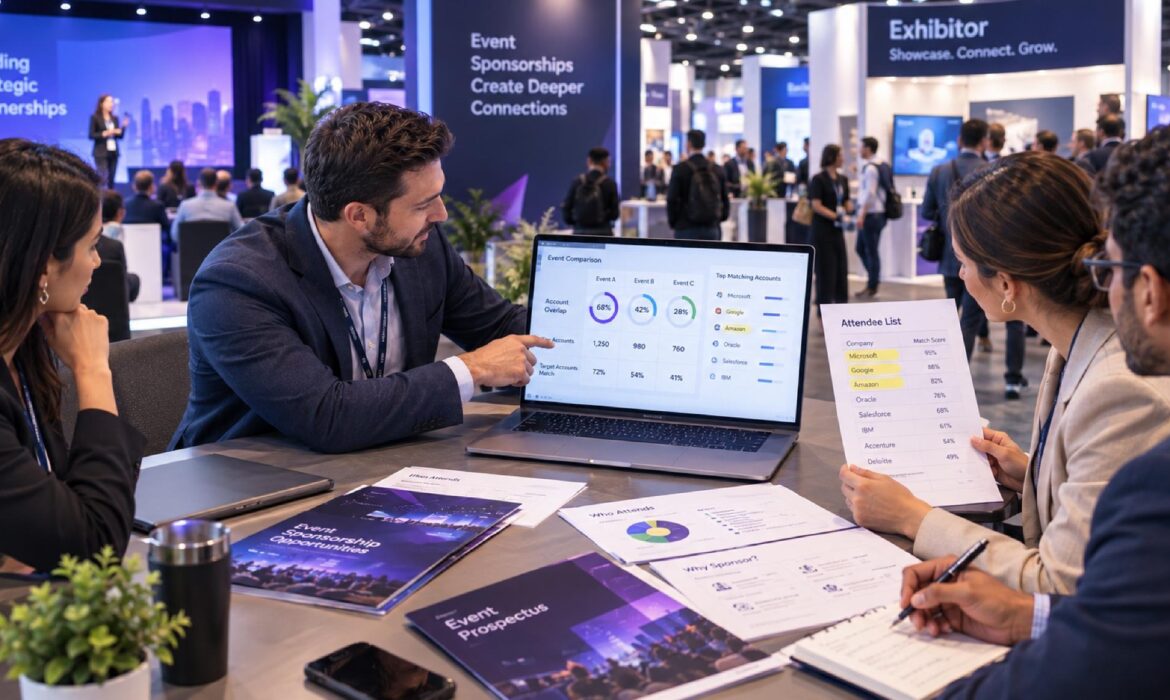
Sponsorship evaluation starts with measuring account overlap: the share of an event’s past attendees who work at companies on your priority list. Fifteen percent is a reasonable floor. Attendance, brand reach and impressions tell you nothing about whether your buyers were in the room.
Every year the question comes up. Which events should we be part of? The conversation runs on opinions. The founder loved that one. Our competitor is there. We always do that show. Nobody brings numbers.
Budget follows whoever speaks loudest, and nobody has a way to defend the choice or kill a renewal that stopped working. The right framework belongs before the signature, and it assumes you already know what a sponsorship agreement actually buys.
Most sponsorship conversations start from the calendar: the Q3 events, the annual trade show, the conference that has been on the list for six years. The better one starts from the audience.
A marketing manager at an enterprise software company sponsored eight events a year for three years. Some worked, some did not, and the pattern stayed invisible until she started asking a different question: how many attendees came from companies she actually cared about. One event drew 2,000 people and looked impressive. Then the breakdown arrived. A hundred and eighty of them, 9 percent, worked at her priority accounts. The rest were a crowd.
The evaluation begins with a list, not an event. Write down the 50 to 100 companies you need to reach this year and the roles that matter. That list is the yardstick everything else gets measured against.
Then find where those people go. Ask your sales team which events come up in calls. Ask your customers what they attend. Pull the breakdowns from events you have sponsored before.
The order is the whole point. Choose the event first and you are looking for a justification. List the buyers first and you are looking for a fit. The first produces sponsorships that feel expensive. The second produces sponsorships that pay.
Ask the organizer for the attendee profile from the past three editions: which companies sent people, which industries, which job titles, in what numbers. Organizers use this data in their own sales material, so it exists.
Overlay your priority list on it. Count how many attendees came from companies you care about. That count, not the headline attendance, is the real size of what you are buying. If 500 of 2,000 attendees came from your 50 priority accounts, that is 25 percent and strong fit. If 90 did, that is 4.5 percent and weak.
Below about 15 percent, most sponsorships stop paying for themselves. That figure is a working threshold rather than an industry standard, and it moves with deal size. A business selling seven-figure contracts can justify a thinner room than one selling subscriptions.
Check seniority as well as logos. If you sell to the C-suite and the room is mostly mid-level, the fit is weaker than the overlap suggests. If you sell to implementers and the room is all decision makers, the budget belongs elsewhere.
Then call last year’s sponsors. Did the meetings happen? Did the leads convert? One conversation with a previous sponsor is worth more than the whole prospectus, and it is the same diligence that belongs in any trade show program before the floor plan is signed.
Tiers are packages of access at different prices. Gold, silver and bronze, or platinum, plus and basic. Higher tiers add stage time, hosted meetings, better placement and more passes. Each one should be judged against what your plan actually needs.
A demand generation lead at a SaaS company inherited a portfolio where half the sponsorships had been renewed at the top tier for three years running. Nobody had checked whether the speaking slot and the hosted meetings were being used. They were not. The budget was buying benefits the team never touched.
Three questions settle the tier. Do we need stage time? If not, skip every tier priced around it. Do we need hosted meetings? If yes, they belong in the contract. Do we need premium placement, or only the data?
Negotiate for the things that produce outcomes: the speaking slot, hosted meetings, attendee data access and content rights. Premium booth placement is worth less than it costs, and logo size is worth nothing. This is not about spending the least, but about spending exactly what the plan needs. Knowing what sits inside a sponsorship package, and what an exhibitor contract leaves out, is what makes that negotiation possible.
Document the criteria once and apply them to every opportunity: account overlap, the seniority ratio, the tier your plan requires, and what last year’s sponsors reported. The same four, every event, every year.
Then the comparison becomes possible. Event A has 22 percent overlap at $50,000. Event B has 8 percent at $30,000. The cheaper event is the more expensive one per relevant attendee, and that is now visible rather than arguable.
This is where the annual debate changes character. The founder loving Event A stops being the argument. The argument becomes that Event A reaches priority companies at nearly three times the rate, so it takes the higher tier and Event B gets cut. Document those criteria and results on paper or in a shared spreadsheet so the comparison survives a change of team.
Saying no gets easier too. When five events land under 15 percent, the reason to drop them is on paper and it is not personal.
Evaluate sponsorships the way you evaluate target accounts: by fit, against a consistent yardstick, with data you can check yourself. Account overlap is the number that matters. Start there, not with the calendar.
Here is the test. If you cannot calculate the account overlap within 48 hours of asking, or it comes back under 15 percent, pass on the event. Running a structured sponsorship evaluation before every renewal keeps the portfolio honest and keeps emotional decisions from staying on life support.
Once you have run your sponsorship evaluation framework, lead capture and ROI measurement become the next step. Talk to Samaaro about how to track lead quality and outcomes across your sponsorship program.
What is a good account overlap for an event sponsorship?
Above 15 percent of past attendees coming from your priority companies is a workable floor for most B2B teams. Below that, the fee buys a room with too few of the right people in it. Deal size moves the line.
How do you get attendee data before you sponsor an event?
Ask the organizer for the profile from the past three editions: companies, industries, job titles and numbers. An organizer who cannot produce it is selling you a guess.
How do you justify sponsorship spend to leadership?
Present the overlap percentage, the seniority breakdown and what previous sponsors reported. The case is fit against cost, compared the same way across every event.
When should you drop a sponsorship you have run for years?
When the overlap falls below your threshold two editions running, or when nobody can name what the top tier produced.

Samaaro is an AI-powered event marketing platform that enables marketing teams to turn events into a measurable growth channel by planning, promoting, executing, and measuring their business impact.
Location


© 2026 — Samaaro. All Rights Reserved.