Samaaro + Your CRM: Zero Integration Fee for Annual Sign-Ups Until 30 June, 2025
- 00Days
- 00Hrs
- 00Min

You run a great event. Hundreds of prospects show up. Your booth is packed. It feels like a success.
Then nothing happens.
The leads sit in a folder. Sales doesn’t follow up. Or they do, but without context. Without the right talking points. Without understanding what each person actually cared about.
The event was a marketing win. But a sales miss.
This happens because most companies treat events and sales as separate functions. Marketing runs the event. Sales waits for leads to appear. They don’t work together.
Here’s the reality: Organizations with defined sales enablement achieve 49% higher win rates. And 47% of event marketers say in-person events deliver the highest ROI. But most companies still run events and sales follow-up in silos.
That’s leaving money on the table.
When sales enablement and event marketing actually work together? Everything changes.
Sales enablement is equipping your sales team with the right content, training, tools, and intelligence to have better conversations and close deals faster.
Event marketing is creating memorable experiences that attract prospects, build relationships, and create buying interest.
Separately, they work fine. Together, they become a revenue engine.
Organizations with strong sales and marketing alignment grow revenue 32% faster and achieve 36% higher customer retention. That’s not marginal improvement. That’s transformational.
But most teams don’t align. They have separate goals. Separate metrics. Separate tools. Separate accountability.
Marketing generates interest and attendees. Sales is supposed to convert them into deals.
But here’s what actually happens:
Marketing focuses on one-to-many. Get lots of people to the event.
Sales focuses on one-to-one. Convert high-value prospects.
These are different mindsets. And without intentional alignment, they create gaps.
Marketing thinks they did their job if 500 people showed up. Sales thinks they did their job if they booked 20 meetings. Nobody’s accountable for deals closed 6 months later.
The prospect falls through the crack.
Before events, sales never tells marketing what they actually need.
During events, sales has no idea what marketing promised the attendees.
After events, marketing has no idea if sales actually followed up.
Integration means information flows both ways. Sales input shapes the event. Marketing supports sales during the event. Sales gives feedback that improves future events.
Stop planning events in isolation. Bring marketing and sales together from day one.
Define shared goals. Not “marketing gets 500 booth visitors.” Not “sales books 20 meetings.” Something like “generate 100 qualified opportunities” or “close $2M in event-sourced pipeline.”
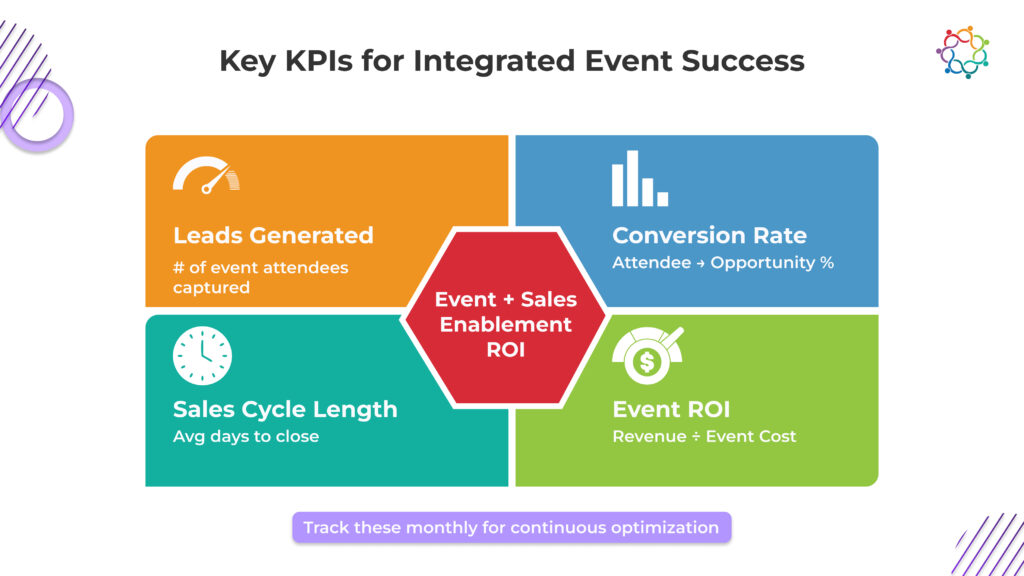
Define shared KPIs. Number of qualified meetings booked. Lead conversion rate. Revenue closed. Both teams own these metrics. Both teams are accountable.
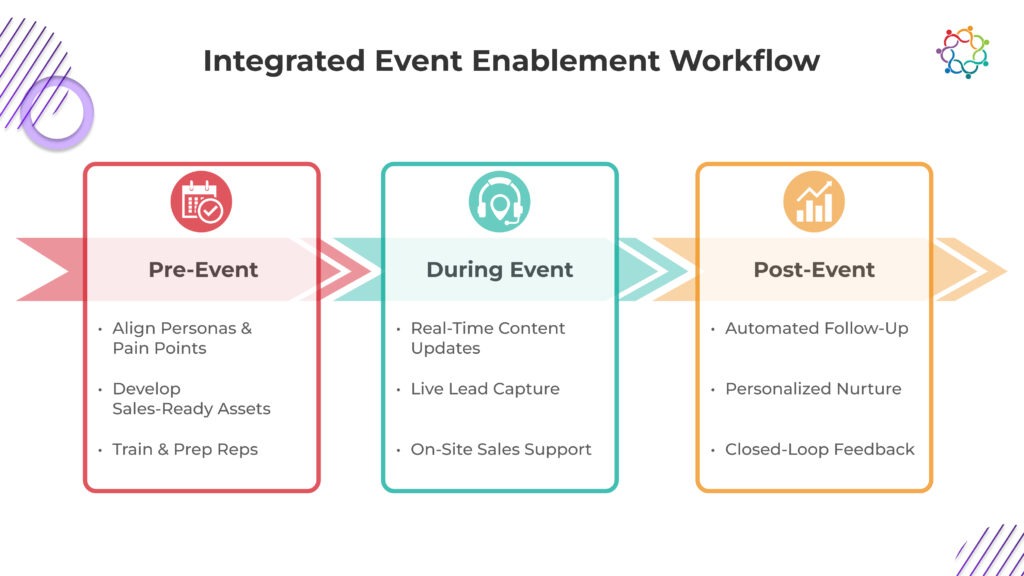
Schedule regular alignment touchpoints. Before the event. During. After.
Align messaging. The keynote theme should be usable in sales conversations. The session topics should address real objections your sales team hears.
Connect your tools. Event registration systems. CRM. Marketing automation. They should talk to each other so data flows automatically, not manually.

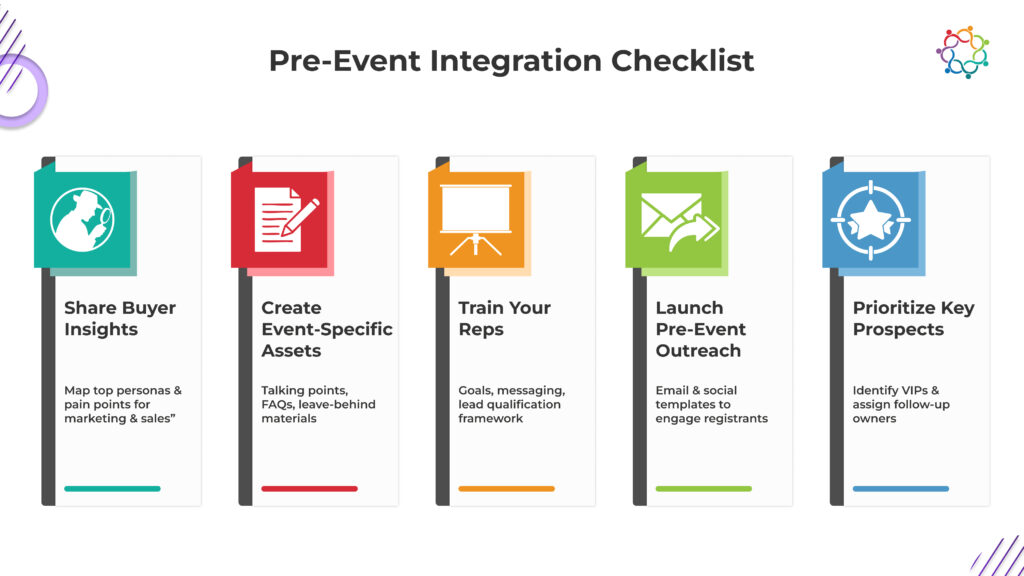
Sales teams are on the front lines. They know what prospects ask about. What objections come up. What pain points actually matter.
Before planning the event, ask sales:
What are the biggest questions prospects ask right now?
What objections do you hear repeatedly?
What topics would actually help you close deals?
What content would make your job easier?
Then design the event around those answers. Your session topics become tools sales can use in conversations.
Generic brochures don’t work. Create custom materials for this specific event.
Talking points. FAQ sheets. Product demos. One-pagers. Quick reference guides.
Everything should be designed so a sales rep can grab it and use it immediately.
Create digital leave-behinds too. Demo videos. Customer success stories. Comparison documents. Things sales can send the next day.
Your sales team should arrive at the event knowing exactly what success looks like.
How many meetings do you want to book? Who are the priority accounts? How do you qualify someone? What’s the ideal conversation flow?
Run a pre-event workshop. Role-play common scenarios. Make sure everyone knows the talking points.
Don’t wait for people to walk up to your booth. Sales should be emailing registered attendees beforehand.
Personalized messages. Specific value. Book meetings in advance.
This changes everything. Instead of hoping people stop by, you’ve already scheduled valuable conversations.

Events change. New information surfaces. A speaker’s perspective shifts. Product news breaks.
Marketing should have a real-time communication channel. Slack. Private Discord. Mobile app. Whatever works.
When something important happens, push it to sales immediately. Everyone’s always current.
Who’s doing demos? Who’s booking meetings? Who’s scanning badges? Who’s taking notes?
Clarity prevents confusion. Nothing slips through.
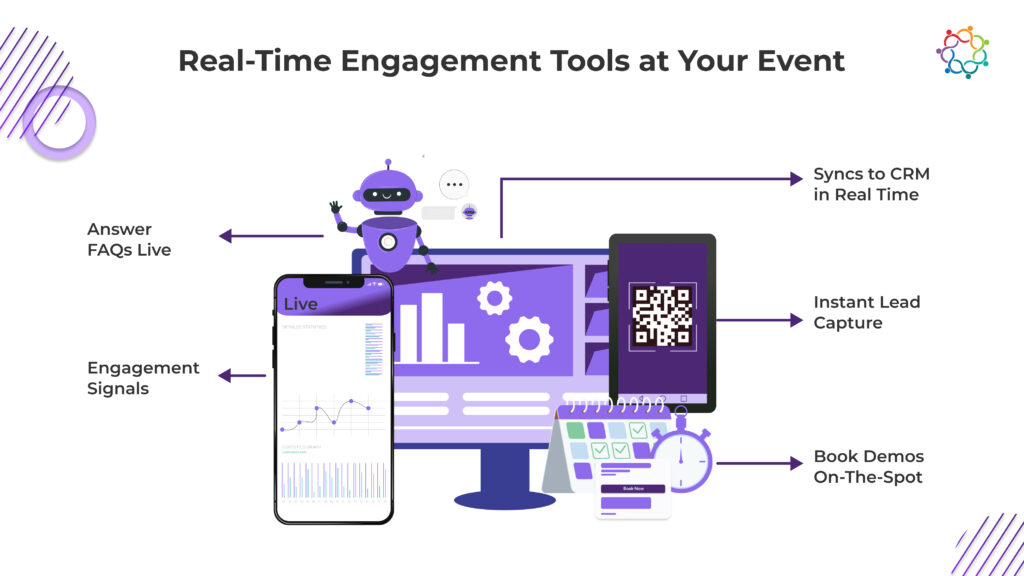
Get rid of business cards. Implement QR code scanning or badge scanning that syncs directly to your CRM.
Every lead captured. Clean data. Instantly in your system.

When sales rep talks to someone who attended a specific session, reference it.
“You were in the keynote about digital procurement. That’s exactly what we help with.”
This positions your team as informed and aligned. It builds credibility.
The first 48 hours matter. A lot.
Leads are warm. Memory is fresh. But competitors are also reaching out.
“Thanks for stopping by” emails don’t work.
Your follow-up should reference something specific:
“Saw you in the session on vendor consolidation. Here’s the resource we discussed.”
“You asked about implementation timeline. Let me send you a case study showing typical deployment.”
This shows you were actually paying attention.
Not everyone’s ready to buy immediately. Build workflows based on what people actually did.
Someone visited your booth? Send product overview content.
Someone attended a specific session? Send deep-dive resources.
Someone requested a demo? Send case studies and ROI calculators.
Automation keeps momentum without overwhelming your sales team.

Immediately after the event, get your sales team together.
What conversations went well? Which personas were most interested? Which talking points actually worked? What objections kept coming up?
This feedback is gold. Use it to improve future events and sales messaging.
You need to measure this. Not just to prove ROI, but to improve next time.
Number of leads generated at the event. But segment them. Booth visitors vs. session attendees vs. demo requests. Different touch points, different quality.
Lead quality. Are these people who fit your ideal customer profile? Do they have budget? Decision-making authority? Actual pain points?
Conversion rates through the funnel. How many event MQLs become SQLs? How many become opportunities? How many close?
Sales cycle length. Do event-sourced leads close faster than other channels? If not, why not?
Revenue sourced from event attendees. Track closed deals that originated at the event. This is the number that matters most.
Sales team satisfaction. Did they feel prepared? Were the materials helpful? Did they get real-time support?
CRM system. Tag event leads appropriately so you can filter and analyze them later.
Marketing automation. Run segmented nurture campaigns. Monitor engagement post-event.
Event management software. Registration, badge scanning, lead capture, session tracking. Everything should integrate with your CRM.
Sales analytics dashboard. Visualize data. See which sessions generate the most SQL conversions. See which content works best.
Fix: Schedule regular syncs before, during, and after events. Short focused meetings work better than long ones.
Use a shared project management tool. Assign clear liaisons from each team.
Fix: Align on shared KPIs from the start. Not “booth visitors.” Not “meetings booked.” Something like “MQL-to-SQL conversion rate” or “average deal size from event leads.”
Both teams own the metric. Both teams are accountable.
Fix: Start with high-impact areas. You don’t need to rebuild everything. Focus on unified messaging and lead capture first.
Make a business case. Show potential ROI. Shorter sales cycles. Better conversion. More pipeline.
Fix: Audit your tech stack. Identify integration gaps. Choose platforms that have native integrations or APIs.
Design a data sync plan. How does attendee data flow from event tools to CRM to sales dashboards?
Fix: Lead with empathy. Show people how integration makes their jobs easier, not harder.
Share early wins. Build momentum.
Involve team members in planning. They feel ownership instead of imposition.
Higher lead quality. Events become more than just top-of-funnel. They generate prospects actually ready to buy.
Faster sales cycles. Shared context. Timely engagement. Sales moves deals forward more efficiently.
Better ROI. Every event touchpoint optimized for conversion.
Team alignment. Sales and marketing moving in sync.
This integration isn’t hypothetical. It’s possible with the right platform.
Samaaro’s event platform brings marketing and sales together. Real-time lead capture. Automated CRM sync. Integration with your marketing automation tools. Dashboard visibility for both teams.
See how automated event communications keep both teams aligned.
You can actually build the unified system described in this guide.
Q: When should sales follow up with event leads?
A: Within 24-48 hours. Interest is hottest then. Personalize based on which sessions they attended and what they asked.
Q: How do you calculate ROI for event marketing?
A: (Revenue attributed to event – Total event cost) / Total event cost x 100. But include influenced pipeline too. Sometimes deals close months later.
Q: What’s a good MQL-to-SQL conversion rate from events?
A: 20-30% is typical for B2B. But track your own trends instead of chasing an industry number.
Q: What if sales doesn’t follow up like they should?
A: Make sure they’re accountable for event follow-up KPIs. Include it in comp plans. Schedule follow-up calls immediately so momentum doesn’t fade.
Q: How do you handle leads that sales says aren’t qualified?
A: Have a predefined qualification framework agreed upon before the event. If there’s disagreement, debrief together to refine criteria for next time.

Samaaro is an AI-powered event marketing platform that enables marketing teams to turn events into a measurable growth channel by planning, promoting, executing, and measuring their business impact.
Location


© 2026 — Samaaro. All Rights Reserved.