Samaaro + Your CRM: Zero Integration Fee for Annual Sign-Ups Until 30 June, 2025
- 00Days
- 00Hrs
- 00Min
Activity Isn’t ROI. Your CFO Knows the Difference.
You’re reviewing your own post-show report from last quarter. Forty-seven slides. 1,140 leads. Eight hundred photos. Three industry awards. The deck is impressive. Now read it back from a CFO’s chair. None of it answers the question the CFO is going to ask: what did this produce in revenue?
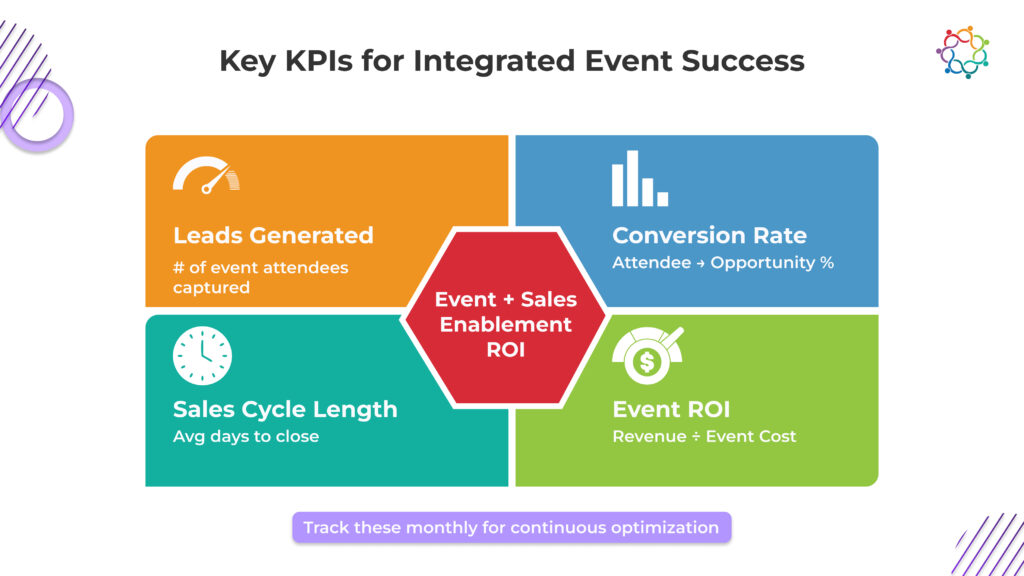
This is the gap between activity reporting and ROI reporting. Knowing how to measure trade show ROI properly means using five metrics that tie booth activity to commercial outcomes: target account meetings booked, qualified opportunities created, influenced pipeline, deal acceleration, and cost-per-meaningful-conversation. The standard metrics (cost-per-lead, badge scans, impressions) measure activity, not revenue contribution.
This guide explains why the common metrics mislead, defines the five that actually defend the investment, and shows how to read them as a system.
Four metrics dominate the standard post-show report. Each is structurally weak when held up to a pipeline review.
Cost-per-lead. Total spend divided by total leads captured, with every lead treated as equivalent. A lead from an ICP-matched senior buyer with an active project is worth orders of magnitude more than a lead from a curious student with a personal Gmail address. Cost-per-lead masks the quality distribution and produces favorable-looking numbers for trade shows that captured lots of low-quality leads.
Total badge scans. Visitor volume, not visitor relevance. A booth that scanned 800 unqualified badges produces less pipeline than one that scanned 200 with conversation context. Volume flatters weak programs and disadvantages selective ones.
Impressions and social reach. Useful for brand teams measuring brand outcomes. Irrelevant for pipeline accountability. Reporting impressions in a pipeline review tells the CFO this isn’t a pipeline channel after all.
Total leads delivered. The headline number marketing teams default to. Says nothing about quality, fit, or commercial outcome. The CFO can’t translate “leads delivered” into ARR, which makes the metric structurally undefendable.
The structural problem is the same across all four: they measure what’s easy to measure, not what determines pipeline. They flatter activity-heavy programs and penalize selective ones. A trade show portfolio managed against these metrics optimizes for the wrong outcomes year over year.
What it measures. The number of pre-booked or on-site meetings held with stakeholders from your defined target account list during the show.
How to calculate. Count meetings (pre-booked plus walk-up qualified) where the attendee is from a CRM-tagged target account, with a minimum 15-minute structured engagement and a defined next step.
Why it matters. Target-account meetings are the highest-correlation early signal for downstream pipeline. ICP-buyer time-on-conversation directly predicts opportunity creation, which makes this the metric that separates well-targeted programs from broadcast ones at the leading-indicator stage.
The pitfall. Counting any conversation as a meeting. A meeting requires 15+ minutes of structured engagement with a clear next step. Coffee-line chitchat doesn’t qualify.
Where to set your own threshold. Calculate the target-account meeting volume your AE team would need to justify the time they’re committing to the show. Use your historical opportunity-to-revenue conversion rate to back-solve from the pipeline target. The threshold lives in your own commercial math, not in an industry average.
What it measures. The number of CRM-defined opportunities created within 30 days of the show, with show attribution.
How to calculate. Filter the CRM for new opportunities created in the 30 days post-show, where the source touch is the trade show. Track this number by show, by territory, and by AE.
Why it matters. Opportunity creation is the first hard commercial signal. A meeting that doesn’t become an opportunity in 30 days rarely becomes one later. This is the metric that exposes weaknesses in at-show qualification or post-show routing, both of which are operationally fixable.
The pitfall. Counting MQLs or SQLs as opportunities. Lead-stage labels are too soft to defend in a pipeline review. Only opportunity-stage records count.
Where to set your own threshold. Calculate your team’s average qualified-conversation to opportunity conversion rate from historical post-event data. The threshold for a given show is the rate applied to the qualified conversations the show produced. Variance from that threshold is the diagnostic.
What it measures. Total pipeline value of opportunities that engaged with the trade show (booth visit, scheduled meeting, content download from a show landing page) at any point in the buying journey, not only as the source touch.
How to calculate. In your CRM or attribution platform, surface all open opportunities where any contact attended the trade show. Sum the pipeline value.
Why it matters. Trade shows often accelerate and influence deals that originated elsewhere. Ignoring this contribution underreports the channel’s value. For enterprise programs, influenced pipeline can dwarf source-attributed pipeline in any given quarter.
The pitfall. Double-counting influenced pipeline alongside source-attributed pipeline. Report both, but in separate columns. They answer different questions.
Where to set your own threshold. Look at the ratio between influenced and source-attributed pipeline for the shows that consistently produce pipeline in your portfolio. The ratio that holds for your strongest shows becomes the threshold for the rest. Below it, the show is either too early-funnel or too narrow in audience to influence existing deals.
What it measures. Stage progression on existing opportunities within 60 days of the show, attributed to the show as a contributing factor.
How to calculate. Identify opportunities where a contact attended the show and the opportunity moved one or more stages forward in the 60 days following. Quantify the accelerated value as time saved multiplied by deal size.
Why it matters. For enterprise B2B with 6 to 18-month sales cycles, acceleration value can exceed source-attributed pipeline value. Trade shows often unlock deals stuck in technical evaluation, procurement review, or executive alignment, because the right buying-committee stakeholders are physically present at the same time.
The pitfall. Ignoring acceleration because it’s harder to measure than source attribution. Hardness to measure doesn’t make it less real. It makes the programs that don’t measure it systematically underfunded.
Where to set your own threshold. Take a sample of stalled enterprise opportunities from the last 12 months. Identify which had a buying-committee contact at a trade show during the stall period. Quantify the acceleration value that resulted. That’s the benchmark for your portfolio, calibrated to your actual deal motion.
What it measures. Total trade show spend divided by the number of meaningful conversations, defined as 5+ minutes with a qualified ICP contact, with a conversation summary captured at the booth.
How to calculate. Total program cost divided by the sum of Hot leads plus Warm leads with 5+ minute interactions. Excludes Cold leads, badge scans without conversation, and unqualified contacts.
Why it matters. Corrects for the volume bias of cost-per-lead. Rewards programs that produce fewer but better conversations. This is the metric that flips selectivity from a penalty into a virtue at the budget review.
The pitfall. Defining meaningful too loosely. The qualifying threshold (5 minutes, ICP fit, conversation summary) must be enforced at capture time. Applying it retroactively contaminates the metric.
Where to set your own threshold. Divide your target customer acquisition cost by the meaningful-conversation-to-opportunity-to-customer rate you’ve observed historically. That’s your defensible ceiling on cost-per-meaningful-conversation. Anything above it indicates overspend on the show floor, under-investment in capture infrastructure, or both.
Each metric on its own is partial. Together, they tell the commercial story.
The five-metric reading. Target account meetings booked is the leading indicator of pre-show targeting quality. Qualified opportunities created is the conversion rate of meetings into commercial pipeline. Influenced pipeline is the mid-cycle and late-cycle contribution beyond source attribution. Deal acceleration is the enterprise-cycle acceleration value, often the largest hidden contribution to channel ROI. Cost-per-meaningful-conversation is the selectivity and operational efficiency check.
The CMO-grade ROI slide. One slide. Five numbers. A verdict. Show name, total spend, the five metrics, and a renew, renegotiate, or walk recommendation. Year-over-year comparison for recurring shows, color-coded against your own thresholds. This is the artifact that answers the question the CFO is actually asking.
Diagnostic logic when a number underperforms. Low meetings booked points to pre-show outreach failure. Low opportunities point to at-show qualification or post-show routing failure. Low-influenced pipeline points to late-funnel show-fit failure, meaning the wrong audience for your stage. Low acceleration points to poor target account selection, meaning the right buyers weren’t in the room. High cost-per-conversation points to overspend on the show floor or under-investment in capture infrastructure.
A modern event marketing platform like Samaaro captures the underlying data at the booth, including conversation summaries, tier assignment, and CRM sync, without which the five-metric scorecard can’t be reported with rigor.
Standard trade show metrics measure activity. The five metrics that survive a CFO review measure revenue contribution. Target account meetings. Qualified opportunities. Influenced pipeline. Deal acceleration. Cost-per-meaningful-conversation.
One slide. Five numbers. A renew, renegotiate, or walk recommendation per show. That’s the trade show ROI scorecard that survives the next CFO review, and the trade show portfolio that survives the next budget cycle.
If your post-show deck still leads with badge scans and impressions, the fastest ROI move isn’t a new measurement framework. It’s rebuilding next quarter’s scorecard around the five numbers that actually map to revenue.
The Show Floor Doesn’t Decide Trade Show ROI
You walk into the trade show on Day 1 already knowing whether it’s going to work. The booth could be the most beautiful in the hall, the demo flawless, the team rehearsed. None of it matters if the wrong people are walking past. Trade show ROI isn’t decided on the show floor. It’s decided four weeks before the show opens, and it’s converted six weeks after the show closes.
Trade show marketing phases break into three: pre-show, at-show, and post-show. The trap is treating them as equally weighted. The pre-show phase decides who shows up at your booth. The at-show phase decides whether those conversations are worth following up. The post-show phase converts intent into pipeline. Each phase has a different goal, a different operational owner, and a different ROI lever. The show floor is the middle act.
This guide walks through each phase as an architectural unit, with the strategic decisions that define it, plus the integration view of how all three compound.
Most trade show budgets concentrate spending on the show floor: booth, AV, freight, on-site staffing, and swag. Pre-show and post-show run on smaller, residual budgets, when they have budgets at all. The pipeline math runs the opposite way. Pre-show and post-show carry the heavier ROI weight, while show-floor execution carries the lighter one. Marketing leaders end up spending the most money on the phase that contributes the least, and the least on the phases that contribute the most.
This isn’t accidental. The show floor looks like the program. Three days of intense activity, photos, energy, and things to point at when the CMO asks how it’s going. Pre-show and post-show are quiet desk work that produces no visible output, which is precisely why they get under-resourced.
There’s a structural reason too. The show floor is the only phase that sits inside external vendor commercial interest. Booth designers, AV vendors, freight handlers, and event production companies aggressively sell into the at-show budget. Pre-show and post-show involve no external vendors and produce no photo opportunities. They are invisible to the parts of the org that approve the budget, which means they lose the budget conversation by default.
Common trap: reviewing trade show spend with the agency that built the booth. The agency’s incentive is to optimize the spending it controls. The marketing leader’s incentive is to optimize the spend that produces ROI. These rarely overlap.
The pre-show phase builds a tiered shortlist of attending accounts and a calendar of pre-booked meetings. Everything else is in service of that single output. Without it, the team is showing up to a show, not running a campaign.
The output. A tiered list of attending accounts cross-referenced against the CRM, segmented into A-list (book a meeting), B-list (drive a booth visit), and C-list (capture if they walk by). A calendar of confirmed meetings with the A-list. A primed audience that walks into the show knowing your booth exists, where it is, and why they should visit. (For the operational sequence behind this output, see our cluster blog Why Trade Show Marketing Investments Rarely Convert to Pipeline.)
The ownership. Demand gen owns the phase, with AE-led outreach on the A-list. Brand and product marketing are consulted on messaging and content drops; they don’t hold decision authority. The political mistake most companies make is letting the events team or the brand team run pre-show. Both will produce activity. Neither will produce a meeting calendar.
The budget share. Pre-show is structurally underfunded because it has no vendor invoices attached. It doesn’t show up on the budget review with the same weight as booth fabrication. A program that wants to win at trade shows funds pre-show as a part of the at-show, not as residual budget left over after the booth invoices clear.
The decision rights. Who’s on the A-list? When outreach starts. What meeting commitments are predefined per account? Which accounts get personal AE outreach versus marketing-led email? These decisions belong inside the pre-show team.
The phase success metric. Pre-booked meeting count walking into Day 1, expressed as a share of high-value time slots filled. Not what the booth visitors expected. Not impressions targeted. Pre-booked meetings, confirmed in the calendar, distributed to the booth team in the morning briefing. The phase either produced that number, or it didn’t.
The at-show phase exists to convert booth traffic into qualified conversations with full context. The booth isn’t the showcase. It’s a qualification factory operating for three days under fluorescent lights.
The output. A roster of qualified conversations tiered Hot, Warm, and Cold, each with a conversation summary, a next-step commitment, and an account reference attached. Pre-booked meetings from Phase 1 executed against per-account conversation goals. Spontaneous walk-ups qualified at the same standard. (For on-floor execution detail behind this output, see the Trade Show Booth Strategy Toolkit.)
The ownership. Sales leads on the floor. AEs and technical sales engineers run qualifying conversations; senior leadership shows up for priority-account meetings. Marketing supports rather than leads, owning capture infrastructure, content distribution, qualification triage, and daily-huddle facilitation. The at-show phase is the only one of the three where sales has the higher operational stake.
The budget share. At-show deserves the largest single allocation of the three because it carries the most concentrated operational cost: booth fabrication, freight, on-site staffing, and AV. But it should still leave meaningful room for pre-show and post-show. A program where the at-show absorbs the entire budget has confused activity for outcome.
The decision rights. The qualification rubric. The escalation paths. The capture infrastructure. The daily-huddle structure. These get set 72 hours before doors open, not improvised during the show. A real-time event marketing platform like Samaaro makes the qualification and capture decisions enforceable rather than aspirational, by syncing every conversation to the CRM the moment it’s logged.
The phase success metric. Qualified conversation count, with each conversation carrying tier, summary, and next step. Not badge scans. Not booth visitors. Conversations the post-show team can actually work.
Phase 3 is where the previous two phases pay off or evaporate. The post-show phase converts captured intent into pipeline before that intent decays. Buyer intent decays fast post-show: the buyer is back to a 400-email inbox, the conversation context is overwritten by the next event and the next internal meeting, and the urgency drops the moment they’re home. Post-show routing speed is the lever that determines whether intent converts before it evaporates.
The output. Hot leads converted to scheduled meetings with the account-owning AE within hours of capture. Warm leads in a tiered nurture sequence themed to the show. Pipeline created within 30 days, with show attribution, ready for forecast inclusion. Pipeline influenced beyond 90 days as captured leads progress through the funnel. (For the operational mechanics behind this output, see the Marketing-to-Sales Lead Handoff guide.)
The ownership. Post-show is the only phase that’s genuinely shared. Marketing builds the routing logic, manages the CRM import, and runs the nurture tracks for Warm and Cold tiers. Sales commits to the speed and cadence on the Hot tier. Both teams sign a written SLA before the show opens. Treat post-show as marketing’s responsibility alone, and the handoff fails by default.
The budget share. Post-show is the phase most often funded as residual. The booth invoices are clear, the team flies home, and the post-show line item is whatever’s left. This is the structural mistake that breaks more programs than any other budget decision. Post-show deserves a peer allocation to pre-show, because the post-show phase converts what the pre-show created.
The decision rights. The routing tiers and thresholds. The follow-up SLA per tier (response time, channel, cadence). The nurture sequence content. The disposition rules: when a lead is declared dead, when it returns to marketing, and when it gets re-engaged at the next show.
The phase success metric. Pipeline created within 30 days with show attribution, and percentage of Hot leads contacted within the SLA. No leads delivered. Not emails sent. Pipeline created and SLA adherence are the only two numbers that matter.
Phase quality multiplies downstream. It doesn’t add.
A pre-show that produces a thin pre-booked meeting calendar doesn’t get fixed by a stellar booth. The booth team converts whatever shows up, which is mostly whoever happens to walk past. An at-show that captures 800 ungraded scans doesn’t get rescued by a perfect post-show routing engine; the routing engine has nothing usable to route. A post-show that delays Hot-lead contact by ten days doesn’t get saved by the quality of the conversations that fed it; the conversations have decayed by the time anyone calls.
A simpler way to see it: imagine each phase as a letter grade. A program with a B+ pre-show, an A at-show, and a C- post-show isn’t a B program. It’s a D program, because the C- collapses everything upstream. The weakest phase sets the ceiling for the entire show, regardless of how strong the other two are.
This is why reallocating budget from the at-show to the other two phases produces such disproportionate returns. The marginal dollar in at-show buys a marginally better booth experience. The marginal dollar in pre-show or post-show buys a step-change in the weakest phase, which raises the ceiling of the whole program.
Common trap: optimizing the strongest phase. Marketing teams instinctively double down on what’s already working, which means at-show gets year-on-year improvement while pre-show and post-show stay flat. Find the failing phase. Fund it. Then check whether the ceiling has moved.
Trade show ROI isn’t decided in the three days under the lights. It’s decided by what happens in the four weeks before and the six weeks after. Pre-show builds the shortlist. At-show captures the intent. Post-show converts it to pipeline. Each phase compounds the next, and the weakest phase sets the ceiling for the whole program.
Pre-show. At-show. Post-show. Treat all three as paid work, or accept that only one of the three is actually doing the job.
If only one phase in your program is getting funded like real work, the fastest ROI move isn’t a better booth. It’s redirecting budget into the phase that’s currently running on residuals.
380 names. No context. The post-show CSV from last quarter’s industry trade show lands in the AE’s inbox on Tuesday morning. He scrolls through. Company. Title. Email. That’s it. No notes on what each person said at the booth. No tier. No next step. He picks 20 names that look right by title and starts dialing. Three days later, he stops. None of them remember the booth conversation. None of them is interested.
This is what broken trade show ROI looks like on the ground. The 380 leads cost the company more than $400,000 to capture. The conversion rate to opportunities will round to zero. The money didn’t disappear. It leaked, in four predictable places, before it ever reached the AE’s screen.
Trade show investments rarely convert to pipeline because of four operational leakage points: pre-show outreach, booth briefing, capture reliability, and post-show handoff. Each loses a meaningful share of the program’s potential, then compounds multiplicatively.
This guide names the four leaks: pre-show outreach, booth briefing, capture reliability, and post-show handoff. Each one drains a meaningful share of the program’s potential pipeline. Together, they collapse a six-figure investment into a four-figure return.
A trade show campaign isn’t one conversion event. It’s four, stacked in sequence. Each stage acts as a filter, passing some portion of the program’s pipeline potential through to the next. The damage isn’t in any single filter. It’s in what happens when four moderately leaky filters compound multiplicatively.
The math is simpler than it looks. Imagine a program where each of four stages loses half its potential value. The output retains 0.5 x 0.5 x 0.5 x 0.5, which is 6.25 percent of the pipeline ceiling. No single stage looks catastrophic, but the program ends with a 94 percent gap between what it could have produced and what it did. That is what trade show pipeline leakage looks like in arithmetic.
This is the optical-illusion problem. Leakage at any single stage rarely registers as “broken.” Each stage feels like a normal trade show. The damage is invisible until the post-show pipeline math runs.
The four stages map to four operational decisions: who you targeted before the show, how the booth team was prepared, what the booth captured during conversations, and what happened to those captures afterward. The previous post in this series, Trade Show Marketing Strategy: Pipeline Over Branding, argued the channel gets miscategorized at budget time. This one argues that even programs classified correctly still leak in four predictable places.
The instinct that breaks programs: looking for one obviously broken stage to fix. Programs almost never have a single broken stage. They have four moderately leaky ones that compound. Fixing one produces marginal improvement. Fixing all four produces an order-of-magnitude improvement.
The most expensive mistake at a trade show happens four weeks before the show opens. It’s the decision not to do anything yet.
The failure mode
The team treats the trade show as a discovery channel, relying on whoever walks past the booth. The registered attendee list, which most major B2B shows release 4 to 6 weeks pre-event, never gets pulled or segmented. No outbound goes out to existing prospects or target accounts who are registered. No meetings are pre-booked. The booth is staffed for ambient interaction only. Senior buyers from priority accounts walk past, never knew the company was exhibiting, and leave the show without a single conversation.
The cost
Pre-booked meetings convert at substantially higher rates than walk-up conversations, for one structural reason: the buyer has committed time and attention to the discussion in advance. A walk-up conversation competes with floor noise, fatigue, and a buyer who’s three booths away from their next meeting. A pre-booked meeting starts with mutual context already established. The pipeline gap between a show with strong pre-show outreach and one without isn’t incremental. It’s the difference between a program that returns its cost and one that doesn’t.
The fix
Pull the attendee list 4 to 6 weeks pre-show. Cross-reference it against the CRM. Segment into A-list (book a meeting), B-list (drive a booth visit), and C-list (capture if they walk by). AE-led personal outreach to the A-list begins 4 weeks pre-show, proposing specific meeting times. Marketing email to the B-list goes out 2 weeks pre-show with the booth number and a reason to stop by. Walk into the show with most high-value time slots already booked.
Common trap: treating the booth as the discovery mechanism. The booth is the venue, not the discovery engine. Discovery happens in the four weeks before the show.
Leak 2 isn’t about who shows up at the booth. It’s about what they were told before they got there.
The failure mode
The booth team isn’t trained for the show. Not in the abstract sense, but literally: no pre-show briefing happened. The team learns the qualification criteria from a one-page handout they read on the plane. The pitch script is whatever the rep said last week. The escalation protocol is improvised when a senior buyer shows up at the booth and the AE who owns the account is across the room. Conversations open with “tell me about your company,” which produces polite small talk and zero qualification.
The cost
A briefed team enters every conversation knowing which target accounts are attending, the three qualifying questions they’re asking, the next step they’re trying to close on, and which conversations escalate immediately. An unbriefed team improvises all four. The conversion gap between the two can double the pipeline output of the same booth traffic.
The fix: the pre-show briefing protocol
A real briefing happens 72 hours before the show opens, not the morning of, and covers four things:
Tell-tale sign: a booth team that can’t recite the three qualifying questions on Day 1 doesn’t have a briefing protocol. They have a handout.
Leak 3 isn’t about whether capture happens. It’s about whether capture holds up after the first 50 leads.
The failure mode
Capture works beautifully for the first morning. The booth is fresh, the network is responsive, the rep has time to write a clean summary, and every Hot lead gets tagged within minutes. By 3 PM on Day 1, the rep has had 40 conversations, the wifi is congested, and the capture app is hanging on every form submission. The rep starts batching for the end of the day. By Day 2 night, capture is happening from a hotel room while the rep tries to remember what 80 prospects said. By Day 3, reps have skipped capture entirely on at least 20 conversations.
The data tells the story. The first 50 leads in the post-show CSV have detailed summaries. The next 250 have a name and a company.
The cost
A lead with a conversation context can be worked. A lead without context goes into the SDR queue and gets a generic email. The conversations that disappeared into degraded capture were often the most expensive to generate, because they happened on Day 2 and Day 3 when fatigue had already filtered out casual visitors. Shows lose their best leads to capture fatigue, not booth quality.
The fix
Capture has to survive Day 2 afternoon, not just Day 1 morning:
Where this hides: in the gap between a CSV that shows 800 captures and one that shows 800 usable captures. The first number gets reported. The second determines whether the show earns its budget.
Leak 4 is where the largest pipeline value either converts or evaporates. Most of it evaporates.
The failure mode
All captured leads dump into the same SDR queue regardless of tier or fit. The Hot lead who said “we have budget approved and we’re picking a vendor in 60 days” gets the same outreach as the trade press attendee who picked up a t-shirt. No SLA on contact speed. Hot leads sit for 8 to 14 days before first touch. Outreach emails are generic, written by someone who wasn’t at the booth, with no reference to the conversation. No reporting tracks which leads were worked, converted, or abandoned. This is why trade show leads don’t close: not because the conversations were bad, but because the handoff broke.
The cost
Buyer intent decays fast after a trade show, and the decay is behavioral, not theoretical. The buyer returns to an inbox with 400 unread messages. The conversation context is overwritten by the next event, the next demo, the next internal meeting. The urgency that felt real on the show floor drops the moment they’re home, because the show was the urgency. A Hot lead contacted within 24 hours reaches a buyer who still remembers the conversation. A Hot lead contacted after Day 7 reaches someone who has moved on.
The fix
Tiered routing logic, written down and enforced:
Watch for this: when post-show is treated as marketing’s responsibility alone, the handoff fails by default. The handoff is shared infrastructure. Marketing builds the routing logic and the SLA. Sales commits to the speed and cadence.
Knowing the four leaks is the easy part. Finding the one killing your program decides what gets fixed first. Run these diagnostics on your last show.
Pre-show outreach. How many of your pre-booked meetings came from outbound to the registered attendee list, as opposed to inbound or existing relationships? If most came from other sources, Leak 1 is active.
Booth briefing. Did your booth team receive a structured pre-show briefing covering qualification, pitch, and escalation in the 72 hours before the show? If the briefing was a handout or a Day 1 morning walkthrough, Leak 2 is active.
Capture reliability. Pull a random 10 leads from your last show. Check how many have a conversation summary, qualification tier, and next step in the CRM. If fewer than half do, or if capture quality dropped between Day 1 and Day 3, Leak 3 is active.
Post-show handoff. Of the Hot leads tagged at your last show, how many were contacted by an AE within 4 hours? If fewer than half were, Leak 4 is active.
Where to start. The leaks compound, but Leak 1 is the highest-leverage fix because it determines the quality of every downstream conversation. Leak 4 is second, because it’s where the largest pipeline value either converts or evaporates. Leaks 2 and 3 amplify the value created by the bookends.
Pre-show outreach builds the shortlist. The briefing protocol turns conversations into qualifications. Capture reliability preserves intent. Routing and SLA convert intent into pipeline.
Four leaks. Four fixes. Run the diagnostic. Pick the one costing your program the most. Close it before the next show, then close the next one. Six months of operational discipline outperforms one bigger booth.
For the next layer of depth, the Trade Show Booth Strategy Toolkit covers on-floor execution, the 30-Point Trade Show Checklist covers operational sequence, and the Marketing-to-Sales Lead Handoff guide covers Leak 4 end-to-end.
Two Channels. One Word. A Costly Confusion.
Your CMO just asked you to consolidate the marketing budget. Field marketing wants $500,000 for regional dinners. Event marketing wants $500,000 for trade show booths. Both are described as “in-person event programs.” Both are owned by similar-sounding functions on the org chart. The CMO assumes one is a duplicate of the other and asks you to pick. The honest answer is they’re not the same program.
Trade show marketing and field marketing are often treated as variants of the same channel. They aren’t. The two formats differ in who organizes the event, who decides who’s in the room, what success looks like, and how each gets measured. They can complement each other in a strong B2B portfolio, but they cannot substitute for each other.
This guide covers the foundational distinction, three operational comparison layers, a decision framework, and the one place the two formats actually meet.
Every operational difference between the two formats traces back to one question: who organized the event?
Trade show marketing is third-party participation. A trade show is organized by an industry body, a trade association, or a commercial event organizer. The vendor participates by paying for booth space, a sponsorship tier, or a speaking slot. The audience is curated by the organizer based on industry interest; the vendor doesn’t choose who attends. Success depends on showing up well inside an event whose rules and audience are not under the vendor’s control.
Field marketing is first-party hosting. The vendor organizes the event. The vendor picks the city, the venue, the format, and the guest list. The audience is built from the CRM and intent data, with every attendee specifically invited. The event is the vendor’s agenda, seating, speakers, talking points, and follow-up logistics. Success depends on the quality of curation and execution under direct control.
This is the trade-off that flows through every downstream comparison. Trade shows trade audience curation for audience scale: thousands of attendees, but most aren’t your ICP. Field marketing trades audience scale for audience precision: small attendance, but every seat is by design. Every other operational difference between the two formats is downstream of this trade-off.
The two formats target different commercial outcomes. Conflating their goals is the most common reason marketing leaders bundle them in budgets that shouldn’t be bundled.
What trade show marketing is built to deliver:
Ideal for mid-tier and higher-volume pipeline goals across multiple verticals.
What field marketing is built to deliver:
Ideal for high-ACV, account-specific pipeline goals where the buyer set is small and known.
A company with a 50-account ABM list cannot replace its field marketing program with trade show participation; the audience filtering doesn’t exist at trade shows. A company building category awareness in a new market cannot replace trade show presence with field marketing; the visibility scale doesn’t exist. Each format is the only solution for its specific commercial outcome.
Common trap: picking one over the other based on per-event cost without examining what each is for. The comparison is not apples-to-apples; the formats produce different outputs with different cost-per-output structures.
The same generic “events” muscle applied to both produces poor outcomes for both. The playbooks diverge at every step.
The trade show playbook is volume-led. Event selection sits at the top: which trade shows to participate in, based on audience overlap with target accounts and category presence goals. Booth design and freight logistics, sponsorship tier negotiation, and speaking-slot acquisition follow. Pre-show outreach targets the registered attendee list to pre-book booth meetings, often before the vendor has any direct CRM relationship with the attendee. On-floor lead capture operates at scale: hundreds of conversations per show, processed through a Hot/Warm/Cold tier on the booth. Field marketing capture, by contrast, is account-led, with every conversation logged against a named account.
The field marketing playbook is account-led. City selection sits at the top, based on ICP density and AE coverage. Venue selection follows: intimate dinners, breakfasts, or executive forums chosen by seniority and conversation goal. Guest list curation is the heart of the program: target accounts, existing customers, and peer references, typically 12 to 60 invitees. Trade show audience-building, by contrast, is curated by the organizer, not by the vendor. Personal AE-led invitation sequencing runs across 4 weeks. Event-night execution centers on small-room conversation with host moderation, neither of which a trade show booth can replicate. Account-by-account follow-up is tied to specific commitments made at the event itself.
The cross-format playbook problem. A trade show playbook applied to field marketing produces over-large guest lists, generic invitations, booth-style execution, and no peer-to-peer trust. A field marketing playbook applied to trade shows produces under-prepared booth presence, no pre-show outreach to non-CRM contacts, and missed scale opportunities. The teams running each format need different skills, different tooling, and different operational rhythm. Pulling one team across both is the structural mistake that breaks both programs at once.
The wrong metrics applied to either format produce misleading reports and worse budget decisions.
Trade show marketing metrics:
Field marketing metrics:
The reporting mistake. Bundling both formats into a single “events” line item produces a weighted average that masks both programs’ actual performance. Trade show pipeline metrics dilute when mixed with field marketing’s narrower account-level metrics. Field marketing’s per-account intensity becomes invisible when reported alongside trade show volume.
The right reporting structure. Two separate scorecards are reported side by side. Each format is evaluated on its own metrics, with cost-per-output calculated relative to that format’s specific goal. A portfolio-level view aggregates both into a single CMO-grade dashboard, but never replaces format-specific reporting.
Marketing leaders need a clear rubric for which format fits which outcome. Two checklists and a decision principle.
Choose trade show marketing when:
Choose field marketing when:
Run both when:
The portfolio doesn’t have a universal split. It typically tilts toward trade shows in earlier-stage companies building category presence, then rebalances toward field marketing as the ABM motion matures and the named-account list crystallizes. The right answer is the one the pipeline strategy requires, not the one the historical org structure suggests.
Common trap: allocating 80 percent or more of the event budget to trade shows because that’s where the muscle exists in the marketing org, even when the pipeline goal is account-specific acceleration. The format follows the goal, not the org chart.
Smart B2B portfolios use both formats. One feeds the other.
The handoff between formats. Trade shows surface intent: an account stops by the booth, has a meaningful conversation, gets tagged Hot. Field marketing converts the intent: the same account gets invited to a regional dinner three weeks later for a deeper conversation under different conditions. The trade show generates the relationship; the field event deepens it. A modern event marketing platform like Samaaro earns its place here by making intent portable from a booth scan to a dinner invitation, with the full conversation context carried across both touchpoints in the CRM.
The customer journey integration. Existing customers attend the user track at a trade show for product updates. The same customers receive an exclusive dinner invitation in their region for an advisory conversation and expansion. Both touchpoints reinforce each other across the customer lifecycle, and a shared data layer between them lets marketing measure the compound effect rather than each event in isolation.
The portfolio principle. A B2B company running only trade shows is over-indexed on volume and under-indexed on depth. A company running only field marketing is over-indexed on depth and under-indexed on category presence. The strongest B2B event portfolios run both, with clear lanes and integrated lead flow between them.
Trade show marketing and field marketing share the word “event” but are distinct channels with distinct goals, playbooks, and metrics. Trade shows are third-party participation built for category presence and pipeline volume. Field marketing is first-party hosting built for account engagement and pipeline acceleration.
Bundle them in a budget, and you’ll cut the wrong one. Separate them, measure each on its own scorecard, and run both for what each actually does.
The strongest portfolios run both formats with clear lanes between them. If you’re rebuilding either side of the program, start by separating the scorecards before separating the budgets.
It’s Q4 planning. Trade shows are line item #3 on the marketing budget. Your VP Brand wants to expand booth presence at three flagship industry shows: a bigger booth, a premium location, and expensive activations. The justification is “category visibility.” Your CFO asks what that visibility produces. You don’t have a defensible answer, because the trade show line item has been classified as a branding investment for three years running. The pipeline math doesn’t exist.
A trade show marketing strategy is the use of industry trade shows and exhibitions as a B2B marketing channel: to engage target accounts, capture buyer intent, and accelerate pipeline. When budgeted as such, it produces measurable pipeline ROI. When budgeted as brand awareness, it becomes one of the most expensive line items in marketing with no defensible scorecard.
This article covers the three roles trade shows play in the pipeline, why brand-budgeting breaks ROI, and what pipeline-channel budgeting actually looks like in practice.
A trade show marketing strategy is participation in industry exhibitions as a structured campaign: pre-show targeting, at-show execution, and post-show follow-up, all designed to produce a qualified pipeline from a concentrated buyer audience.
What it isn’t: a brand-awareness initiative, a sponsorship campaign, or a one-time logo placement opportunity. These are what trade show participation looks like when budgeted incorrectly. The brand outcome is real, but it’s a byproduct of pipeline-focused execution, not the reason the line item exists.
This classification decision matters because every downstream operational decision flows from it. Booth design, staffing rotations, lead capture infrastructure, follow-up cadence, success metrics: each of them inherits its logic from how the program is classified at budget time. Get the classification wrong and the operational stack misfires for a year.
The most common version of this trap is letting the brand team own the trade show participation decision. Brand teams optimize for visibility, recognition, and aesthetic consistency. Pipeline programs optimize for conversation density, conversion velocity, and meeting volume. The two operating models produce fundamentally different booths, different staffing rotations, and different scorecards. The visual outcomes can look similar from across the floor; the revenue outcomes are not even close. That is the heart of the trade show marketing vs brand awareness debate, and it’s settled the moment the CFO asks for pipeline math.
Trade shows do three distinct things for the pipeline. Each is measured differently. Most programs report on only one of them and systematically undercount the channel’s value.
Role 1: Account engagement
The trade show is one of the few B2B moments when target-account stakeholders are physically present, voluntarily, and discoverable. Marketing pre-books meetings with priority accounts before the show; the show is the venue, not the discovery mechanism. A B2B SaaS company exhibiting at SaaStr that pre-books 25 meetings with named target accounts before the doors open is running an ABM activation, not a lead-gen booth.
Measurement: meetings booked with target-account stakeholders, advancement of named opportunities, and expansion conversations with existing customers. This role is invisible to brand-awareness measurement because it produces no impressions or social signal, only meetings.
Role 2: Intent capture
Trade show attendees self-select into an active evaluation window. They paid for a ticket and took time off to walk the floor. That behavior is itself an intent signal that is unobservable in digital channels, where category interest and buying intent are constantly conflated.
Measurement: qualified opportunities created within 30 days of capture, conversation-tier distribution (Hot, Warm, Cold), and source attribution to specific shows. A booth that scans 800 badges and reports 800 leads is running a brand scorecard. A booth that tiers those 800 conversations into 60 Hot, 220 Warm, and 520 Cold, then attributes pipeline against the Hot and Warm tiers within 30 days, is running a pipeline scorecard. This is where most B2B trade show pipeline metrics break down: capture gets treated as volume rather than intent.
Role 3: Accelerated meetings
Existing pipeline opportunities advance faster when in-person conversations replace digital ones. Deals stuck in technical evaluation, procurement review, or executive alignment often unblock at trade shows because the right buying-committee stakeholders are physically present at the same time. Consider a stalled enterprise deal where the procurement lead and the technical evaluator both attend Money 20/20: two stakeholders who could not align over four weeks of Zoom resolve a contract objection over a 20-minute booth conversation.
Measurement: stage progression on existing opportunities within 60 days of show attendance, and time-to-close compression for show-attended deals. This role rarely shows up in trade show ROI reports because it’s measured at the opportunity level, not the lead level.
Watch for this: a program reporting only on new leads will systematically under-report its value by missing the contributions of account engagement and acceleration. The three roles compound. Reporting on one turns the show into a justification fight every budget cycle.
When a trade show line item is classified as brand awareness, four operational decisions get made in near-identical sequence across companies. Each looks reasonable on its own. Together, they hollow out the pipeline output of the show.
Booth design gets optimized for aesthetic consistency, logo prominence, premium materials, and art-directed photography. The booth photographs beautifully. It also funnels visitors away from demo stations and toward brand impressions, because the layout was designed to be seen, not entered. The number of usable conversation surfaces inside the footprint is often half of what a comparable spend could buy.
Staffing defaults to brand managers and marketing communications staff who can articulate positioning crisply. They are the wrong people for the floor. They can describe the product, but they cannot move an opportunity forward in real time, qualify a buying committee, or commit to a follow-up that an AE would honor. Every Hot lead walks out with a brochure instead of a meeting.
Lead capture is run as a badge-scanning exercise. Scans get logged, exported to a CSV, and processed post-event. By the time the file reaches sales, the conversation context is gone, intent has decayed, and the warmest leads have already moved on. This is the operational layer where most companies discover why trade shows fail to deliver pipeline, even when the show itself was a success.
Measurement reports impressions, social reach, total scans, and NPS-style satisfaction surveys. The CFO who reads “470,000 impressions and 12 percent NPS lift” against a $400,000 spend will conclude that this is a brand investment to be re-justified annually, because nothing in the report ties spend to revenue. The metrics you choose to report are the metrics you’ll be measured against.
Tell-tale sign: when the post-show review is owned by the events team and not demand gen, the entire reporting frame defaults to engagement metrics. The pipeline conversation never gets had.
A pipeline-classified trade show program looks fundamentally different across five operational layers. The shifts compound, which means partial adoption produces mixed signals and honest reports of underperformance.
Shift 1: Demand gen owns the budget. The trade show line item moves from brand or events to demand gen, with co-investment from sales for booth staffing. Brand and product marketing stay consulted on creative; pipeline goals own decision authority. Renewal of any specific show becomes a pipeline-threshold conversation, not a political one.
Shift 2: Pre-show outreach is the leading indicator. Pre-show meeting volume, booked with target accounts before the show opens, becomes the primary leading indicator of ROI. Shows with weak pre-show outreach get cut from the portfolio. A 25-meeting target with named accounts is a defensible KPI; a “hope-they-walk-by” booth is not. This is the core of how to budget trade show marketing without falling back on impression logic.
Shift 3: On-floor staffing is sales-led. AEs, technical sales engineers, and senior leadership staff the booth. Marketing supports rather than leads on the floor, owning lead qualification triage, content distribution, and operational support.
Shift 4: Post-show follow-up is auto routed. Hot leads route to AEs within 4 hours. Warm leads enter a tiered nurture. Cold leads return to the marketing database. Real-time CRM integration replaces post-event CSV imports. The capture-to-action lag is the single biggest source of preventable pipeline leak, and a real-time event marketing platform like Samaaro closes that gap by routing booth conversations into sales workflows while buyer intent is still warm.
Shift 5: Measurement is pipeline-first. Brand metrics still get tracked, but on a separate brand scorecard, not bundled with trade show ROI. The trade show CFO-defense slide reports four numbers: pipeline created, pipeline influenced, cost per opportunity, and payback period.
What partial adoption looks like: re-routing the budget to demand gen without changing booth staffing produces brand-managed booths with sales-managed expectations. Changing measurement without changing pre-show outreach produces honest reports of underperformance. The five shifts only work as a set.
Knowing the five shifts is the easy part. Making them happen is a different problem, because trade show ownership is rarely a budget question. It’s a political one. Any marketing leader’s guide to trade shows that skips this layer is missing the actual blocker.
The brand team owns it because they always have. Trade show participation predates demand gen as a discipline in most B2B orgs. Once a function owns a budget line for three cycles, renewal logic becomes inherited, not earned. Reassigning it to demand gen reads internally as a status loss for brand, not an operational decision.
The operational stack is sticky. Even when the CMO agrees the program should be pipeline-classified, the booth vendor reports to the brand, the agency on retainer reports to the brand, and the post-show recap is built by a brand manager who has owned it for years. Reclassifying the budget without rebuilding the stack underneath produces months of friction.
Sales co-investment is the political unlock. Bringing sales in as a co-funder of the booth is the single most effective move. Once sales have dollars in the program, AE staffing, real-time lead routing, and pipeline-tier measurement become non-negotiable because the sales VP now has skin in the scorecard. The classification debate ends the moment funding stops being marketing-only.
The renewal cycle compounds the problem. Every year, a show renews on autopilot under brand budgeting, the pipeline case gets harder to make, because year-over-year reporting is locked to impression metrics. Breaking the cycle takes one renewal in which the program reports on pipeline metrics, even if unflattering. The first honest year is the hardest, and the only one that matters.
Trade shows are a pipeline channel that produces brand value as a byproduct, not the other way around. Account engagement, intent capture, and accelerated meetings: three roles, three measurement layers, all collapsing if the program is budgeted as brand.
The classification decision is the whole game. Reclassify the line item, rebuild the operational stack underneath it, and the pipeline math writes itself. Leave it as a brand line, and you’ll be re-justifying the spend every Q4 for the rest of the program’s life.
If you’re rebuilding the operational layer underneath the line item, start with the Trade Show Booth Strategy Toolkit for booth-side execution, the 30-Point Trade Show Checklist for operational depth, or the Event Sponsorship Measurement Framework for the broader measurement model.
Most Roundtables Are Panels with Snacks
A senior buyer sits down at a dinner labeled “Executive Roundtable.” Fourteen people are at the table. Two industry experts run a 40-minute fireside. Dessert arrives. The buyer drives home thinking it was a useful evening. The host company logs the dinner as a roundtable in its program scorecard. Neither party is wrong about what happened. They are both wrong about what to call it.
An executive roundtable is a facilitated, theme-led discussion among 8 to 15 peer executives, structured so that every participant speaks. It is the most common format of closed-door events, and the most frequently misused. When run correctly, it is one of the highest-trust environments in B2B marketing. When run incorrectly, it is a panel with better catering.
This article covers what a roundtable actually is, when to use it, and how to spot the lookalikes that erode the format.
A working definition has four non-negotiable components.
Small group: 8 to 15 executives. Under 8 and the conversation thins. Over 15, and the room reorients as an audience. The middle of that band is where peer dynamics work best.
Peer-level seniority across the table. A VP at a table of Directors will dominate. A Director at a table of VPs will go quiet. The format breaks in both directions every time.
A single theme that anchors the discussion. One question, framed as a buyer problem, not a vendor category. The theme determines whether the room opens up or rehearses talking points.
A facilitator whose job is to move airtime, not to lecture. No presenter holds the floor for more than five minutes. The output is conversation, not content. Slides are absent or limited to a one-page primer.
The format runs 90 to 120 minutes of structured conversation. Shorter, and it becomes a meet-and-greet. Longer and energy collapses before the most senior voices contribute.
Every design decision (invite list, table size, theme selection, facilitator choice, room layout) flows from these four components. Drop one, and the format converts into something else. The label stays. The output disappears.
A roundtable is too expensive to run without a named outcome attached to a named account. Three operational scenarios justify the format.
Scenario 1: Pre-pipeline trust building with target accounts. The buyer is on the target account list but has no active opportunity. Cold outbound has not landed. The roundtable invitation is the first credible reason to enter the calendar.
Pipeline role: warm a named account into a discovery conversation by establishing peer credibility first. Signal of success: a follow-up meeting is secured within two weeks of the roundtable.
Scenario 2: Mid-pipeline acceleration for stalled deals. Active opportunities exist, but they are stuck. Procurement, security review, or executive alignment is blocking progression. A digital push will not move the needle.
Pipeline role: bring the stalled buyer into a room with peers who have already adopted similar solutions. Peer validation does work; no sales conversation can replicate it. Signal of success: stage progression on the named opportunity within 30 days.
Scenario 3: Customer expansion and reference cultivation. The buyer is an existing customer. Renewal is scheduled. Expansion is possible but not committed.
Pipeline role: position the customer alongside peer buyers in a discussion that frames category maturity. The customer experiences renewed conviction without a sales conversation. Signal of success: expansion conversation opened within 60 days, reference participation agreed within 90 days.
Common trap: running a roundtable when none of these three scenarios is the dominant goal. A roundtable run “to build relationships generally” produces a pleasant evening and no pipeline movement. The format is too expensive to run without a named outcome attached to a named account.
Five operational tells separate a real roundtable from its lookalike. Each maps to a structural flaw in the design.
Tell 1: A speaker holds the floor for more than five minutes. A roundtable has a facilitator, not a presenter. Once any single voice exceeds the five-minute mark, the room reorients into a listening posture, and the conversation does not recover.
Tell 2: More than fifteen people are at the table. Beyond fifteen, two things happen at once. The shy executives stop contributing. The dominant ones repeat themselves. The format converts to a panel by physics, regardless of the agenda.
Tell 3: The theme is the vendor’s product category. A roundtable themed “The Future of ” is a sales pitch with a different page layout. The theme should be a buyer problem the vendor happens to be qualified to facilitate, not a vendor solution dressed up as a discussion topic.
Tell 4: Slides appear. A one-page printed primer is acceptable. A projector is not. The visual presence of a deck shifts the room from peers-in-conversation to attendees-watching-a-talk.
Tell 5: The host company does most of the talking. The host’s airtime should sit under 20 percent of total speaking time. Above that threshold, the format reverts to a sponsored panel, and the trust premium evaporates.
These tells are not stylistic preferences. They are structural. Each one breaks the peer-conversation dynamic that the roundtable format exists to create. A roundtable that violates two or more is producing panel value at roundtable cost.
Once the four non-negotiables hold and the diagnostic tells are avoided, five operational design decisions determine whether the format actually produces.
Rule 1: Curate the table before the theme. The right twelve people will produce a strong conversation on any reasonable theme. The wrong twelve will produce nothing on the best theme ever written. Build the seat-by-seat target list first, and write the theme to fit the room.
Rule 2: Choose a round table with no head. A long rectangular table creates ends, and ends create hierarchy. A genuine round or oval configuration with no obvious head seat keeps the room peer-flat. The physical geometry of the room is the first signal the buyer reads about whether this is a conversation or a presentation.
Rule 3: Send a pre-read primer that asks more than it tells. One page, sent 48 hours before the event. Contents: the theme, three sample questions, and the attendee list (first names and titles). What it should not contain: product positioning, customer stats, vendor framing. The primer’s job is to prime the conversation, not pitch it.
Rule 4: Engineer the opening question. The first 60 seconds set the tone for the full 90 minutes. The opening must be answerable by every seat at the table, specific enough to invite a real answer rather than a corporate one, and pointed at the problem rather than the solution. “What is the hardest thing about in your organization right now?” opens the room. “How do you think about ?” invites silence.
Rule 5: Map every attendee to a named pipeline action before invitations go out. Each seat needs a follow-up owner, a channel, and a defined commercial outcome documented in advance. The marketing-to-sales handoff is a pre-event decision, not a post-event scramble. A modern event marketing platform like Samaaro makes this enforceable across the program, by tying each attendee’s invitation, attendance, and post-event activity into the same CRM record the AE works from.
An executive roundtable is a structural format, not a label. Drop any of its four components, and it reverts to something cheaper that produces less.
Trust building, acceleration, or expansion. One named outcome per attendee. No exceptions.
Twelve peers. One question. One facilitator who barely speaks. A follow-up sheet ready before the invitations go out. That’s the roundtable. Everything else is a dinner.
For the broader format category and the playbook depth behind each rule, the What Are Closed-Door Events anchor page covers the full closed-door format family.
The Dinner Is Not a Smaller Roundtable
A field marketing lead walks into a planning meeting with twenty target accounts and a quarterly budget. The room agrees that a roundtable would be ideal. The calendar makes it impossible. The fallback gets decided in under a minute: “Let’s just do a dinner instead.” The decision sounds pragmatic. It is a category error. The dinner is not the roundtable’s understudy. It is a different format with a different commercial purpose.
Executive dinners are hosted, intimate gatherings of 8 to 12 senior buyers around a meal, with peer conversation as the center of gravity rather than facilitated discussion. The format wins when the strategic goal is relationship depth, not group conversation.
This article covers the mechanics that make the dinner distinct, the strategic moments where it outperforms, and how to design one when it is the right call.
Three behavioral shifts make the dinner format produce what a roundtable cannot.
Relaxed setting changes what gets said. Conversation over food removes the performance pressure of a structured discussion. Senior buyers say things at a dinner table that they will not say across a boardroom. The format unlocks candor that no roundtable agenda can manufacture, because the room is not asking anyone to perform.
Peer pairing replaces group dynamics. At a dinner of ten, no one is speaking to all ten. Each guest is in two or three parallel conversations with the people seated near them. The format trades broadcast for intimacy, and intimacy is what produces a commercial signal at the seniority levels worth hosting.
No agenda pressure shifts the listening posture. When buyers know they will not be asked to contribute to a themed discussion, they listen differently. The vendor is not selling. The peers are not performing. The host learns more about a buyer in two hours of dinner than in two months of email.
The commercial logic: the dinner is a high-trust environment that produces a low-volume but high-value signal. One usable insight per guest is a successful dinner. The format does not scale, and scaling it is what breaks it.
The implication for portfolio design: if the program needs a broad reach, the dinner is the wrong format. If the program needs depth on a small number of named accounts, no other closed-door format produces a comparable signal per dollar.
Three commercial moments make the dinner a better call, even when a roundtable is on the table.
The buyer is the prize, not the conversation. A $4M enterprise deal where the economic buyer has refused four meeting invitations is exactly the moment a roundtable underperforms. The host’s only goal that night is to seat that one buyer next to the right peer customer and let the meal do the work. A roundtable would force the prize account to share airtime with eight others. The dinner allocates the entire evening to the relationship that justifies it.
The relationship is older than the opportunity. Existing customers, lapsed buyers, or long-cycle prospects who have known the host for years. They have heard every version of the pitch and do not need a facilitated discussion to learn something new. A dinner refreshes the relationship in a setting where commercial talk happens organically, because the agenda has not been set. The result usually shows up as a new thread on a product line, a geography, or a use case the host had not previously surfaced.
Cross-account peer introductions are the goal. The host wants two strong customers to meet two high-value prospects, and the introduction itself is the point. A roundtable cannot orchestrate this without engineering it visibly. A dinner accomplishes this through seating. The pitch never happens directly; the prospect references a peer comment from the dinner in their next sales conversation, and that comment moves the deal further than any vendor presentation could.
Common trap: choosing the dinner because the roundtable is logistically harder. The dinner is more expensive per guest, harder to seat well, and produces no group artifact for a post-event recap. Defaulting to it on calendar pressure produces an expensive evening with no commercial output.
The working range is 8 to 12 guests, including the host. Outside this range, the format converts into something else, and the strategic logic collapses.
Below 8: the dinner becomes a small business meeting. Peer dynamics disappear. Every guest knows they are being individually courted, and the relaxed posture that the format depends on never settles in. The intimacy that was supposed to produce candor instead produces wariness.
Above 12: the table physically breaks into separate conversations that the host cannot influence. The far end becomes a different event entirely. The host loses the one signal the format is supposed to produce, which is sustained presence in every conversation thread that matters.
The seating decision is the strategy. Once size is set, the host’s commercial outcome is determined more by who sits next to whom than by any other design choice. The buyer seated next to the right peer leaves with conviction. The same buyer, seated next to a junior vendor representative, leaves with a meal.
The 10-guest sweet spot: three to four buyers, two to three peer customers, one or two senior internal stakeholders, one host. Large enough for conversational variety, small enough for the host to stay present across every thread.
The budget implication: a dinner is not cheaper than a roundtable when run correctly. Same venue cost, fewer guests, higher cost per guest, higher cost per opportunity. The math is justified only when the per-guest commercial value is high.
Four host responsibilities for the format. Delegating any of them breaks the dinner.
Curate the guest mix before the date is locked. The wrong mix on the right date is a failed dinner. The right mix on a worse date is still a strong dinner. Mix discipline is the gating decision.
Personally extend the invitation to every guest. The dinner invitation is the first commercial signal the host sends. A calendared invite from an SDR breaks the format before the evening begins. The senior host invites personally, every time, with a one-line reason that the recipient is being invited specifically. This is the first proof point that the format is what the host claims.
Design the seating chart as a commercial document. The seating chart is the most important artifact in the entire program. Treat it as a sales tool, not a hospitality detail. Map every seat to a commercial outcome the host wants from that pairing. A modern event marketing platform like Samaaro keeps the seating chart, the per-guest outcome, and the follow-up owner on the same CRM record, so the post-dinner handoff doesn’t depend on memory.
Stay in the conversation, not in front of it. The host who stands and gives a welcome speech longer than 90 seconds has converted the dinner into something cheaper. The format works when the host is a participant, not a presenter. The selling is done by the setting, the peer beside the buyer, and the absence of a pitch.
The executive dinner is not a softer roundtable. It is a different format with a different commercial logic, and that logic is what produces the result.
The prize buyer. The older-than-the-opportunity relationship. The cross-account introduction. Three moments, one format that fits all three better than anything else available.
When marketing leaders pick dinner as a substitute, it underperforms. When they pick it because the format itself is the strategy, the evening sells more than any presentation in the same budget cycle.
The dinner is one format in a broader closed-door family, and the roundtable is its closest cousin. The two get confused constantly. They shouldn’t be. Pick the format that fits the commercial moment, not the one the calendar makes easiest.
The CAB Is Not a Quarterly Dinner
Most companies that claim to run a customer advisory board are running a customer dinner with a recurring date on the calendar. The invite list shifts each quarter. The agenda is decided three weeks out. By the third session, the strongest customers stop replying. The marketing leader concludes the format does not work. The format is fine. What failed is that it was never a program.
A customer advisory board is a closed-door program of 8 to 15 strategic customers who meet 2 to 4 times a year under a written charter, with the purpose of shaping the host company’s product roadmap and go-to-market decisions. The format is not a recurring event. Sessions are checkpoints in a longer arc.
This article covers what makes a CAB a program, where it sits next to lookalike formats, and what the charter, cadence, and membership decisions produce.
Three structural elements separate a CAB from every other closed-door format. None of them shows up in a single session. All three are what make the CAB a program.
Persistent membership. The same customers attend every session for the duration of their term. A 12-month or 24-month commitment is standard. Membership is invitation-based and named in advance. The roster is the program, and rotating it casually breaks what the CAB is supposed to produce. Each new member starts at session zero on context; each departing member takes institutional memory with them.
A written charter. The CAB operates against a document that names the program’s purpose, the topics members weigh in on, the decisions the host commits to consult the CAB on before making, and the boundaries of confidentiality. Without a charter, the program drifts toward whatever the next session’s agenda owner finds interesting. A charter is what lets a senior customer take the program seriously enough to clear their calendar twice a year.
Continuity between sessions. Each meeting builds on the last. A decision discussed in Q1 is revisited in Q2 with the data. A roadmap item raised in Q2 is reviewed in Q4 with the build progress. Members experience the program as a continuous influence loop, not three disconnected dinners with the same logo.
The CAB earns its strategic weight from the persistence of all three elements together. A program with members but no charter becomes a customer dinner club. A charter without continuity produces good intentions and no influence. Continuity without persistent membership becomes a rolling focus group.
Three lookalike formats get confused with the CAB in practice. Each confusion creates a distinct failure mode.
Not a customer panel. A panel is a one-time, single-session gathering convened to react to a specific question. It has no membership, no charter, and no continuity. A panel is useful for episodic insight. A CAB is the instrument for ongoing strategic input. Confusing the two leads to over-investing in panels and under-investing in the program that compounds.
Not a focus group. A focus group exists to test a hypothesis that the host already has. The host runs the conversation. The participants are paid or incentivized. The output is a research finding. A CAB inverts every part of this. The members set part of the agenda, the host is in service of their input, and the output is a strategic decision that the host commits to weighing.
Not a user group or community. A user group is an open or semi-open membership organized around a product. Its purpose is community among users. A CAB is small, closed, and organized around strategic decisions the host has not yet made. The two formats can coexist, but they do not substitute for one another. A user group cannot give the host roadmap conviction. A CAB cannot scale to a community.
Common trap: calling a program a CAB to make it sound more important to internal stakeholders. When the structure underneath is a panel or a focus group, members notice within two sessions and disengage. The most damaging form is when product and GTM leaders inside the host begin to treat the program as a real CAB and act on its input, while members treat it as casual conversation and offer surface-level reactions.
Two design decisions carry the heaviest leverage in a CAB program: how often the group meets, and who is in the room.
Cadence: 2 to 4 sessions per year. Each cadence has a different commercial signature.
Two sessions a year is the minimum viable rhythm. Works only when the host is unusually disciplined about pre-session prep and the charter is unambiguous. Below this, continuity collapses, and the influence loop never closes.
Three sessions a year is the standard stable cadence. The shape mirrors most companies’ annual planning cycles. One session shapes annual priorities, the next reviews execution, the third sets up the following year’s questions.
Four sessions a year is the upper limit before extraction sets in. Works only when each session is short (90 minutes max), and the host genuinely uses the input between sessions. Above this, the program turns into work, and the highest-value members are the first to disengage.
Composition: 8 to 15 members from strategic accounts only. Strategic means the customer’s input materially affects product or GTM decisions, not the customer’s revenue. A mid-sized customer with the right buyer persona and deep adoption contributes more than a large customer with shallow usage.
Seniority is set to the decision the CAB advises on. Product roadmap input requires VPs of the buying function. GTM input requires CMOs, CROs, or equivalent. Mixing the two breaks every session.
Member terms run 12 to 24 months with staggered rotation. One-third of the membership turning over each year keeps the program fresh without losing institutional memory.
A CAB does not appear in pipeline reports, and it should not be defended on pipeline grounds. The program earns its line item against two internal decisions a marketing leader could not make as well without it.
Decision 1: Product roadmap conviction. The CAB is the highest-signal forum a product organization has access to. Survey data tells the host what customers say they want. Usage data tells the host what they do. The CAB tells the host why, and which of the two signals to weigh more heavily in any given quarter. A roadmap decision made with CAB input carries the internal conviction that no other input method produces.
Decision 2: GTM positioning and category direction. Where the market is heading is a question no internal team can answer alone. The CAB compresses that answer from a dozen senior buyers into a single afternoon. Positioning shifts, category bets, and messaging direction all benefit. A category move made with CAB validation moves faster internally than the same move made on instinct.
The defensible scorecard. Count the product and GTM decisions in the past 12 months that referenced CAB input. That is the program’s commercial output. A CAB that cannot answer that question in concrete terms is not yet a real program. A modern event marketing platform like Samaaro keeps session content, member contributions, and decision references on the same program record, so the scorecard exists by default rather than as a retrospective scramble.
Persistent membership. A written charter. Continuity between sessions. Three elements that turn a recurring dinner into a program that compounds. Run all three for a year, and the CAB starts producing the kind of strategic input no other forum gives a company. Skip any one, and the program reverts to a customer dinner with a more impressive name.
The CAB is the one closed-door format that runs as a program rather than an event. Roundtables and dinners are single sessions optimized for that night’s outcome. The CAB is a 12-month arc optimized for influence that compounds. Two different operating models, two different budget defenses, two different scorecards.
A Closed RSVP Form Is Not Curation
A growth marketing team launches what it calls an invite-only summit. The landing page has a request-to-attend form that approves 90 percent of submissions. The badge at the door says “Invited Guest.” The 200 attendees include 30 target buyers, 80 vendors, and 90 people who heard about the event from a colleague. By the second coffee break, the target buyers have noticed who is in the room. The host wonders why the follow-up conversion is so weak. The event was never invite-only. It was a conference with a smaller landing page.
An invite-only summit is a 40 to 120-person curated gathering of pre-selected senior buyers and operators, around a tightly defined theme, with attendance controlled at the name level rather than at the form-submission level. Curation is the product.
This article covers what real curation looks like, where the format sits between its two neighbors, and when it earns its place in the pipeline.
Curation is a discipline, not a marketing label. Three operational properties separate a real invite-only summit from a conference with a smaller landing page.
The attendee list is built before the event is announced. The host names the 60 to 100 people the event needs in the room before the venue is booked, the agenda is written, or the marketing site goes live. The list is built from named accounts, named buying committees, and known operators in the category, not from a marketing database query. If the list cannot be built first, the format is wrong.
Acceptance is by selection, not by application. Invitations go out individually. Form submissions are reviewed against the named list and rejected if the name does not fit, regardless of company logo or job title. A summit that accepts most of its inbound requests is running on conference economics dressed in summit language. The curation discipline is in the rejections.
The composition is engineered, not aggregated. A real invite-only summit holds specific ratios across attendee types. Operators outnumber vendors at least three to one. Senior buyers cluster in matched cohorts, not scattered across a hall. Customer references are seated where they will be useful, not where the registration system placed them.
Curation costs more in labor than running a conference of the same size. The labor is the format. Outsourcing the curation to a registration platform is the most common way the format collapses.
The summit lives in the gap between two more familiar formats. Defining it against both is the only way to keep it from collapsing into either.
Against the roundtable scaled up. A roundtable runs with 8 to 15 people because the format depends on facilitated peer conversation around a single table. Beyond that count, the conversation breaks. Hosts who want roundtable-style intimacy at 60 people often run multiple parallel roundtables under one roof and call it a summit. The structure works, but the format is no longer a single event. It is a roundtable program with shared catering.
A real invite-only summit is not the roundtable’s bigger version. It uses curated cohorts, structured content tracks, and time-boxed peer sessions to do work that 8 people around a table cannot.
Against the conference scaled down. A conference is built for breadth: multiple tracks, broad themes, a wide invitation funnel, and revenue from sponsorships. Hosts who want conference logistics without the volume can shrink the conference and cap registration. The structure works, but the format is no longer curated. It is a small conference with stricter admission.
A real invite-only summit runs against a single theme, with a single track in most cases, and rejects sponsorship logic that would dilute the room. The host is paying to have the right 80 people in conversation, not to fill 80 seats efficiently.
The space the summit actually occupies. The format fits the moment where the host needs more reach than a roundtable can deliver, but more depth than a conference can produce. Around 60 to 100 attendees, a single concentrated theme, two days at most, and a curated mix the host has built name by name. Outside this zone, the format converts back into one of its neighbors, and the cost no longer makes sense.
Three commercial moments make the summit the format the strategy actually requires.
Category formation or category move. The host is making a category claim and needs the right 80 buyers and operators to hear it together. Conferences are too noisy for the message to land. Roundtables are too small to create category gravity. The summit produces a room where category narrative becomes peer conviction, and the host benefits commercially from that conviction over the following four to six quarters. The format front-loads conviction across a target segment ahead of an outbound or product cycle.
Multi-account compression. The host has 40 to 80 named target accounts in a region or vertical. Running roundtables for all of them is a 12-month operation. A summit produces compressed access across the same list inside two days, opening multiple buying committees inside a defined window, with the same theme, the same content, and the same peer signal across all of them.
Cross-vertical buyer assembly. The host’s category spans buying functions that rarely sit together. The summit is the format that can credibly put a CFO, a CIO, and a Head of Operations in conversation about the same problem, because the curation is the reason they showed up. The summit surfaces buying committee dynamics that the host cannot see in single-function engagements, and creates cross-functional momentum on accounts where the deal needs more than one champion.
Common trap: running a summit because the budget calendar produced a number that fits the summit price point. The format earns its place against the strategic moment, not against the line item.
The curation process is a sequence, not a checklist. Four steps in order, each gating the next.
Step 1: Build the target list from sales and product input together. The named account list comes from sales. The named operator list comes from product and category research. The two merge into one master curation list before the agenda is touched. This is the most common point at which curation collapses, because marketing builds the list alone and ends up with a database query in disguise.
Step 2: Set ratios before invitations go out. Operators to vendors. Customers to prospects. Senior to mid-level. Cross-vertical balance if relevant. The ratios are decided in advance and held to during the invitation process, even when the easier invites would tip the room out of balance.
Step 3: Personally invite the anchors first. Anchor invitees are the 10 to 15 names whose presence will pull the rest of the list into the room. They are invited individually by a senior host, in advance of the wider list, and their confirmation is the signal to open the rest of the invitations. A summit without anchors confirmed by week one of the invitation cycle is already in trouble.
Step 4: Manage the waitlist as a curation tool. The waitlist is not overflow. It is the second pass at composition. As yeses come in, the host actively pulls from the waitlist to balance the room, not to fill empty seats. A modern event marketing platform like Samaaro keeps the named list, the ratios, the anchor confirmations, and the waitlist on the same program record, so curation discipline survives across the full invitation cycle.
The list is the product. The labor of building it by hand, name by name, with anchors confirmed before the rest of the invitations go out, with ratios held to as the yeses come in, with the waitlist used to balance the room rather than fill it, is the format. Outsource any of that to a registration platform, and what gets built isn’t an invite-only summit. It’s a small conference with stricter admission.
For the broader format category, see the What Are Closed-Door Events anchor page.
A Discussion with Whiteboards Is Not a Workshop
An account team books a strategy workshop with a target buyer. The deck has 24 slides. Two say “Discussion.” One has a whiteboard photo as the background. The buyer arrives expecting to work on something specific to their business. The session opens with a 40-minute company overview. By the time the first exercise lands, the buyer has stopped engaging. The host team logs the session as a workshop. What actually ran was a meeting with sticky notes nearby.
A closed-door workshop is a working session in which the host and a small group of buyers jointly produce an output relevant to the buyer’s business, within a fixed time block. The format is defined by what the room makes together, not by what the host presents.
This article covers what working-not-talking means, the agenda that makes a workshop work, when it beats a roundtable for account depth, and how the host has to behave.
The workshop differs from every other closed-door format on three operating principles. Hold them, and the format produces account intelligence that no conversation-led session can reach. Drop them, and the session reverts to a customer meeting with a longer calendar block.
The buyer is a contributor, not an audience. In every other closed-door format, the buyer’s job is to participate in conversation. In a workshop, the buyer’s job is to produce something. The buyer is drafting, mapping, prioritizing, sketching, or scoring. The posture is active. The output belongs to them and goes home with them, which is why their attention holds in a way it does not hold in a discussion-led format.
The host is an exercise designer, not an expert. The expert posture is the default failure mode of B2B workshops. The host who arrives with the answer produces no signal. The host who arrives with a structured question and helps the buyer answer it produces account intelligence that no other format generates. The host’s expertise lies in the design of the exercise, not the content of the answer.
The output is the agenda, not a follow-up. The session is built backward from a specific artifact that the buyer will walk out with. A prioritized list. A drafted plan. A scored matrix. A mapped flow. The artifact is the reason the format is justified, and the reason the buyer will reference the session in their next internal meeting. Without a named output, the format collapses into discussion regardless of how the room is staged.
A workshop is structured as three movements, not a long meeting agenda. Each has a specific job, and skipping any one breaks the format.
Movement 1: Problem framing (30 to 45 minutes). The opening establishes the specific problem the room will work on. Framing is not a company introduction or a market overview. It is a focused articulation of the question the buyer faces, validated by the buyer in the room before the work begins.
The framing must end with the buyer agreeing on the question. If the room cannot agree on the question, the work in the next movement is wasted. The host’s job is to ask, not to assert. The framing artifact is a single statement that the buyer signs off on.
Movement 2: Group work (60 to 90 minutes). The longest movement. The buyers do the work, in pairs or small clusters if more than four are in the room. The host moves between groups as a facilitator, not a participant.
The exercise is structured tightly. Open-ended exercises produce vague output and lose the room. Constrained exercises with clear instructions and a fixed time produce output that the buyer can defend back to their organization. The constraint is what makes the artifact useful.
This is also where the host learns the most about the account. How the buyers prioritize, what they argue about, where they hesitate, and which language they reach for are commercial signals the host cannot get from any conversation-led format.
Movement 3: Output and commitment (20 to 30 minutes). The closing consolidates the work into the named artifact and locks specific next steps. The buyer commits to what they will do with the output. The host commits to what they will return with.
A workshop that ends with thanks and a photo is a workshop that produced no commercial momentum. The closing commitment is the link between the session and the pipeline movement that justifies the format.
Three account scenarios justify the workshop’s higher design cost and on-day risk. Each is a case where account depth is the goal that no other closed-door format reaches.
A single account that needs to be understood, not engaged. The buyer is committed to a conversation, but the host does not yet understand the account well enough to position effectively. A roundtable produces relational warmth and surface insight. A workshop forces the buyer to articulate their priorities in their own language. The host walks out with a documented view of the buyer’s actual decision logic, which no amount of roundtable conversation produces.
A buying committee that needs to align internally. Multiple stakeholders inside one account hold different views, and the deal is blocked by their misalignment. A roundtable cannot resolve this because it is built on parallel peer conversations across companies. A workshop is exactly the format that can. The host facilitates the committee’s own internal alignment, with the deal as the indirect beneficiary. The artifact the committee produces is what they carry into their next internal meeting.
A strategic customer the host wants to convert into a co-creation partner. An existing customer with strong adoption is a candidate for expansion or for product collaboration. A roundtable treats them as a peer voice among others. A workshop treats them as a working partner on a question that matters to them. The shared output names a future joint initiative, which converts the customer relationship from transactional to programmatic.
Common trap: choosing the workshop because it sounds more substantial than a roundtable. The workshop costs more in design time and risks more on the day. The format is justified only when account depth is what the strategy actually needs.
Three facilitation disciplines determine whether the workshop produces. None can be improvised on the day. All three have to be in place before the calendar invite goes out.
Exercise design happens before the invite. The single most diagnostic question a workshop host can be asked is: What is the buyer going to produce in the second movement, and what does the template look like? A host who cannot answer this in one sentence and one printed page has not yet designed a workshop. They have booked a meeting.
The senior host is in the room and quiet. The buyer reads the host’s seniority as a signal that the session matters. The senior host’s silence during the working movement is what tells the buyer the session is for them. A senior host who narrates or jumps in to demonstrate expertise has converted the workshop back into a meeting. Presence is the contribution. Performance is the failure mode.
The output template is the host’s most important artifact. The blank template the buyers fill in carries more of the workshop’s design intelligence than the slides, the venue, or the catering. A poorly designed template produces vague output regardless of how senior the room is. A well-designed template produces commercially useful artifacts even when the day runs imperfectly. The template is where the format actually lives. A modern event marketing platform like Samaaro keeps the exercise template, the buyer-signed framing statement, and the closing commitments on the same account record, so the artifact survives the post-workshop handoff intact.
Frame the question. Work the question. Lock the output. The buyer leaves with something they wrote themselves, and three weeks later, refers to it in a meeting the host was never invited to. That’s the workshop. Everything shorter than that is a meeting with sticky notes nearby.
For the broader format category, see the What Are Closed-Door Events anchor page. For the comparison with conversation-led formats, see the Executive Roundtables and Customer Advisory Boards pieces in the cluster.

Samaaro is an AI-powered event marketing platform that enables marketing teams to turn events into a measurable growth channel by planning, promoting, executing, and measuring their business impact.
Location


© 2026 — Samaaro. All Rights Reserved.