Samaaro + Your CRM: Zero Integration Fee for Annual Sign-Ups Until 30 June, 2025
- 00Days
- 00Hrs
- 00Min
The majority of organizations do not begin their event journey by searching for an event marketing platform. Teams start with spreadsheets, simple registration systems, calendar invites, and basic CRM interfaces. Plans are made, people show up, and follow-ups are handled manually, but without friction at early scale.
At this stage, everything appears to be under control. There is no obvious need for a new system. Events run, teams stay busy, and leadership sees activity. From the outside, there is little reason to believe more structure is necessary.
The real question is not whether organizations can run events without an Event Marketing Platform. Most can, and many do so successfully for a long time. The more important question is how long that remains true as expectations, scale, and accountability evolve.
Event Marketing Platforms are not day-one tools. They emerge when scale and complexity quietly outgrow the systems that once felt sufficient.
There are clear scenarios where an Event Marketing Platform is not needed.
Organizations running a small number of events each year can often manage comfortably with basic tools. When there is a single event owner, limited stakeholder involvement, and minimal pressure to tie events to revenue outcomes, complexity remains low.
In early or brand-focused programs, events exist primarily to build awareness, foster community, or support thought leadership. Success is measured qualitatively, and expectations are aligned accordingly. Execution matters more than insight, and manual coordination is manageable.
Needing an Event Marketing Platform is not a badge of maturity. It is a response to changing demands. When those demands are absent, adding structure prematurely can create more friction than value.
The inflection point rarely arrives suddenly. It emerges as event programs expand. Growth introduces more events across more regions, formats, and audiences. Additional stakeholders like field teams, sales leaders, revenue operations, and executives, are also involved with different expectations.
At the same time, the role of events begins to shift. What once supported marketing now is marketing. Events move from being supplemental activities to becoming a core channel within the go-to-market strategy.
The critical moment occurs when events begin to influence the pipeline. Even if the tooling remains unchanged, expectations change immediately. Leadership starts by asking outcome-oriented questions. Sales looks for actionable insight. Marketing is asked not just to execute, but to explain.
This shift creates pressure that basic event marketing tools were never designed to absorb.
One of the earliest readiness signals appears when events stop standing alone.
Instead of one-off activations, organizations begin running roadshows, recurring series, regional programs, and global experiences. Events connect across time, audiences, and objectives. What happens at one event influences expectations for the next.
Managing each event individually begins to break down. Teams can still execute logistics, but insight becomes fragmented. Context from previous events is lost, and learning does not compound.
When events relate to each other, they require continuity of understanding, not just repeatable execution. This is often the first moment when organizations realize that treating events as isolated moments no longer reflects how they actually operate.
Signal #2: Leadership Asks Better Questions Than Tools Can Answer
As programs mature, leadership questions become more precise and more difficult to answer.
Which events actually drive momentum? What did we learn about buyer intent from these experiences? Why did one event outperform another, even though attendance looked similar?
Existing systems can produce activity metrics, but they struggle to explain outcomes without heavy interpretation. Answers require stitching together spreadsheets, anecdotal feedback, and manual analysis. Insights depend on who is asked, not on a shared source of truth.
This gap creates discomfort. Teams feel the pressure to justify decisions but lack the structure to do so confidently. The problem is that the questions being asked exceed what execution-focused systems were built to support.
Follow-up is where many event programs quietly lose momentum.
Sales teams receive attendance lists without context. They know who was present, but not why they attended, what engaged them, or how the interaction fits into an ongoing buyer journey. Outreach becomes generic, based on assumptions rather than insight.
Marketing teams struggle to guide next best actions. Without preserved engagement context, follow-up strategies default to broad campaigns instead of informed, personalized motion.
When context is lost, events stop compounding value. Each one resets the relationship rather than building on it. Over time, this inconsistency erodes confidence in events as a reliable growth lever.
This signal is often felt first by sales and revenue teams, even if marketing feels it later.
At scale, reporting becomes unavoidable. Teams begin tracking registrations, attendance, and high-level “influenced pipeline” metrics. These numbers are necessary, but they are not sufficient.
When ROI discussions arise, teams find themselves defending events rather than explaining them. They can show correlation but not contribution. They know events matter but struggle to articulate the impact of events beyond surface metrics.
This creates tension. Leadership wants understanding, not just numbers. Marketing wants recognition but lacks a clear narrative grounded in insight.
The need for an Event Marketing Platform at this stage is not about proving ROI. It is about understanding it and being able to explain what events are actually doing and how they shape buyer behavior over time.
When these signals converge, organizations are no longer just executing events; they are interpreting them.
At this stage, an Event Marketing Platform enables teams to capture intent across the full event lifecycle, from pre-event engagement through post-event behavior. It preserves context that would otherwise be lost and allows learning to accumulate across programs.
Instead of asking whether an event “worked,” teams can understand how it worked, for whom, and why. Insights inform future design, follow-up strategy, and resource allocation.
The platform does not replace execution tools. It complements them by addressing a different need: interpretation. It emerges when understanding becomes as important as delivery.
As organizations scale, CRM systems become more important. They remain the system of record for accounts, opportunities, and revenue outcomes.
The challenge is that CRM systems are not designed to generate event-specific insight on their own. They require structured, contextual signals to be meaningful.
Event Marketing Platforms provide that pre-pipeline intelligence. They translate event behavior into structured insight that CRM systems can use, enriching existing workflows rather than competing with them.
The growing need for a platform reflects the increasing centrality of CRM, not a limitation of it. As revenue systems become more critical, the need for event intelligence that can feed them grows alongside.
The decision point for organizations is rarely framed correctly.
The question is not, “Should we buy an Event Marketing Platform?” That framing assumes a product decision. The more important question is diagnostic.
Do we have a system that can explain how our events shape buyer intent over time?
(Also read: What Is an Event Marketing Platform?)
When the answer becomes unclear or requires excessive manual effort, organizations are often already at the stage where an Event Marketing Platform is needed. Not as a replacement for existing tools, but as the connective layer that allows events to scale with insight, consistency, and confidence.
As organizations grow, events are no longer just about execution or attendance. They are expected to influence demand, pipeline, and buyer decisions. This shift changes what events are responsible for delivering, not just how often they are run. Event Marketing Platforms emerge when teams need a clearer way to understand and manage this change.
As events have become more central to modern marketing strategies, the language around them has become increasingly vague. Most teams assume that any tool used in the context of events qualifies as an “event platform.” Registration systems, event apps, CRMs, and even spreadsheets often get grouped under the same label.
This grouping made sense when events were prima
| Event Marketing Platform |
rily operational exercises. If the goal was to get people registered and checked in, any tool that supported that workflow felt sufficient. Over time, however, events moved closer to revenue conversations. They began to appear in pipeline reviews, account plans, and leadership discussions.
The label expanded, but clarity did not.
Using tools around events is not the same as having an Event Marketing Platform. The difference lies not in how many tools exist, but in whether there is a system designed to understand and compound the value events create.
An Event Marketing Platform is designed to orchestrate events as a marketing channel, capture buyer intent generated through those events, and translate engagement into usable marketing and revenue intelligence.
(Also read: What Is an Event Marketing Platform?)
Its core job is not execution, but turning event interaction into usable marketing and revenue insight. Where logistics-focused systems ensure events happen, an Event Marketing Platform ensures events are understood. It treats events as intentional moments within a broader go-to-market strategy, not as isolated activities to be completed and forgotten.
At its foundation, this category exists to answer questions that execution tools cannot: why people engage, what that engagement signals, and how those signals should influence marketing and revenue decisions.
An Event Marketing Platform is designed around intent creation and interpretation. Logistics may still exist elsewhere, but the platform’s purpose is to make event-driven behavior legible, actionable, and comparable over time.
Most event tools are built to solve narrow, well-defined problems. One tool handles registration. Another support check-in. Another enables attendance. Each is optimized to execute a specific task within a single event.
These tools are effective at what they are designed to do. They help teams run events smoothly and consistently. But they are not designed to preserve context across events or across the buyer journey.
Event Marketing Platforms are built with a different scope in mind. They are designed to connect multiple events over time, understand how those events interact with one another, and support marketing strategy rather than just event execution.
The difference is structural. Tools help events happen. Platforms help events compound.
An Event Marketing Platform assumes that the value of an event is not contained within the event itself, but emerges over time as engagement signals are interpreted, acted upon, and compared across programs.
Events do not begin on the day they occur. They begin the moment someone chooses to engage.
One of the defining capabilities of an Event Marketing Platform is its ability to capture intent before the event takes place. This starts with understanding who the event is for and why different audiences choose to participate.
Pre-event intent capture goes beyond basic registration confirmation. It considers audience segmentation tied to marketing strategy, contextual signals around interest, and behavioral indicators that reveal motivation before attendance.
Someone attending to evaluate a solution carries a different signal than someone attending to learn about an industry trend. Treating both registrations as equal obscures valuable insight.
An Event Marketing Platform is built to preserve this context. It recognizes that understanding why someone shows up is often more important than knowing that they did. This capability ensures that events are anchored in intent from the very beginning.
Attendance is binary. Engagement is not.
Events generate rich, moment-based signals through questions, interactions, sessions attended, and shared experiences. These signals are inherently contextual and often collective, shaped by group dynamics and live interaction.
An Event Marketing Platform must be able to capture both qualitative and quantitative engagement in a way that preserves meaning. This includes session-level context, interaction depth, and behavioral patterns that unfold during the event itself.
Traditional systems often lose this data because they are not designed to handle temporal, experience-driven interactions. They flatten engagement into static records, stripping away nuance and relevance.
Engagement intelligence is a defining capability because it allows teams to distinguish between passive presence and meaningful participation. Without it, events appear successful on the surface but remain opaque in terms of actual buyer interest.
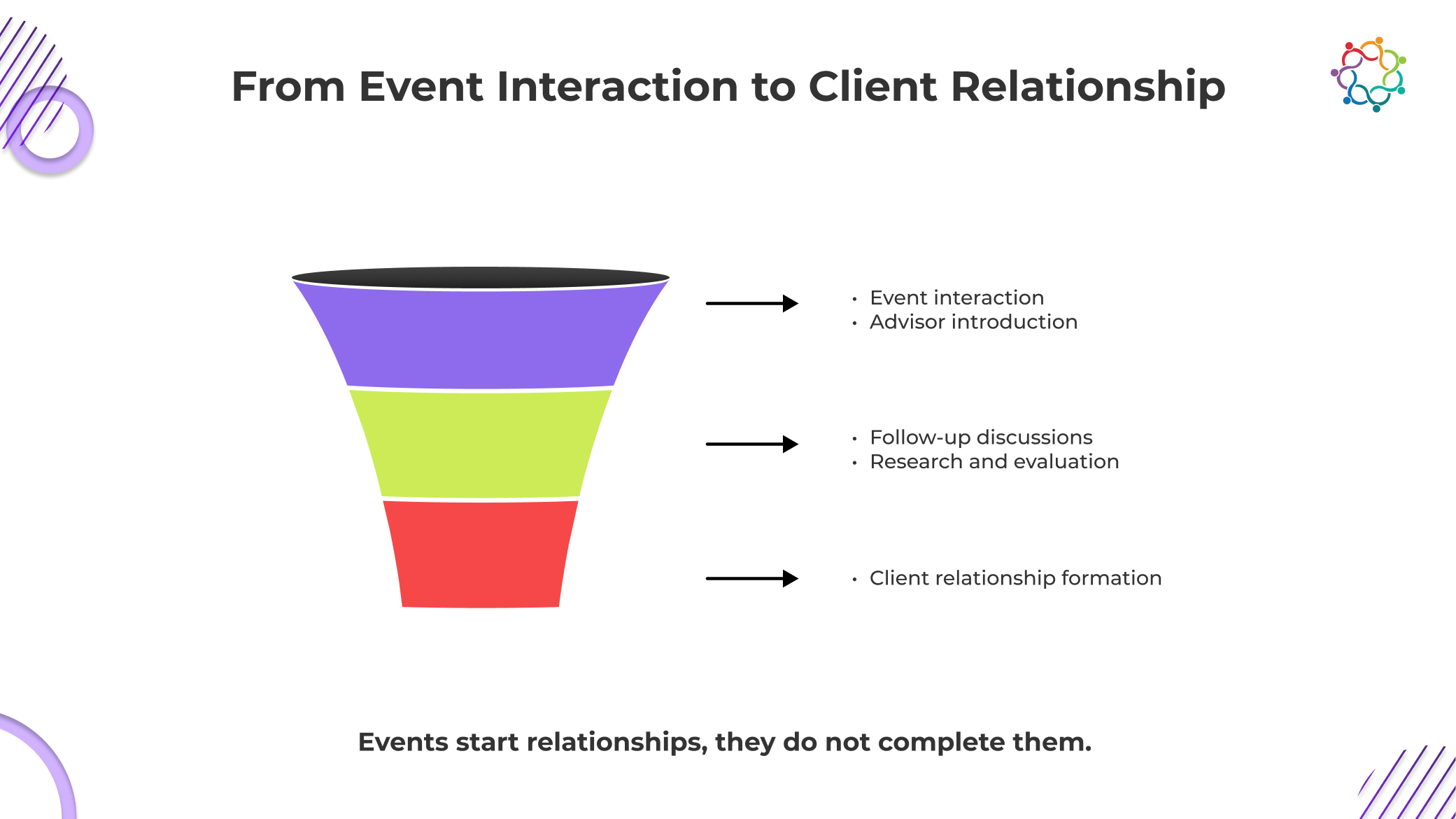
For many teams, events end when attendees leave. For Event Marketing Platforms, that is where their value begins to compound.
Events generate insights that should inform follow-up strategy, shape sales conversations, and influence how future events are designed. Capturing this learning requires structure and continuity.
An Event Marketing Platform enables post-event analysis that goes beyond recap metrics. It supports learning loops across events, allowing teams to identify what resonated, what drove engagement, and what patterns repeat over time.
This capability ensures that signals do not disappear once the event concludes. Instead, they are carried forward, connected to future interactions, and used to refine strategy.
The core idea is continuity. Events are not isolated moments; they are inputs into an ongoing system of learning and improvement.
Event ROI is often reduced to attribution metrics, such as “event-influenced pipeline.” While useful, these metrics are limited. They describe correlation without explaining contribution.
Event Marketing Platforms approach pipeline connection differently. Rather than asking whether an event touched a deal, they focus on how engagement reflects buyer intent and how that intent evolves as opportunities progress.
This capability preserves event context as deals move through pipeline stages. It allows marketing and revenue teams to tell coherent narratives about how events support momentum, accelerate conversations, or reinforce decisions.
The goal is not to produce more reports, but to support revenue understanding. Event-to-pipeline intelligence enables teams to explain impact in ways that align with how deals actually move forward.
Most marketing teams run portfolios of events across regions, formats, and audiences, not isolated one-offs.
A defining capability of an Event Marketing Platform is the ability to provide visibility across this portfolio. This includes comparing events meaningfully, identifying patterns, and understanding which types of experiences consistently create momentum. Without this capability, teams evaluate events in isolation. Success becomes subjective, driven by anecdotal feedback rather than comparative insight.
Event marketing maturity is measured across portfolios, not calendars. Platforms enable teams to move from one-off assessments to strategic understanding, revealing how different events contribute collectively to marketing and revenue goals.
CRM systems remain the system of record for revenue. They house accounts, opportunities, and forecasts. Event Marketing Platforms do not replace this role.
Instead, they act as the system of intent, engagement context, and event intelligence.
An Event Marketing Platform enriches CRM by translating event behavior into structured signals that revenue systems can understand. It provides context that CRM systems are not designed to capture on their own.
This balance is critical. The platform does not attempt to own revenue data or override sales judgment. Its role is to make event-driven insight legible and useful within existing go-to-market systems.
In this way, Event Marketing Platforms complement CRM rather than competing with it.
The defining question for modern teams is no longer, “Do we have event tools?”
It is: “Do we have a system designed to understand what our events are actually doing?”
Event Marketing Platforms exist because events now carry expectations that go beyond execution. As marketing teams are held accountable for impact, they need systems capable of capturing intent, interpreting engagement, and connecting experiences to outcomes.
The distinction is not about tools versus platforms. It is about whether events are merely run or truly understood.
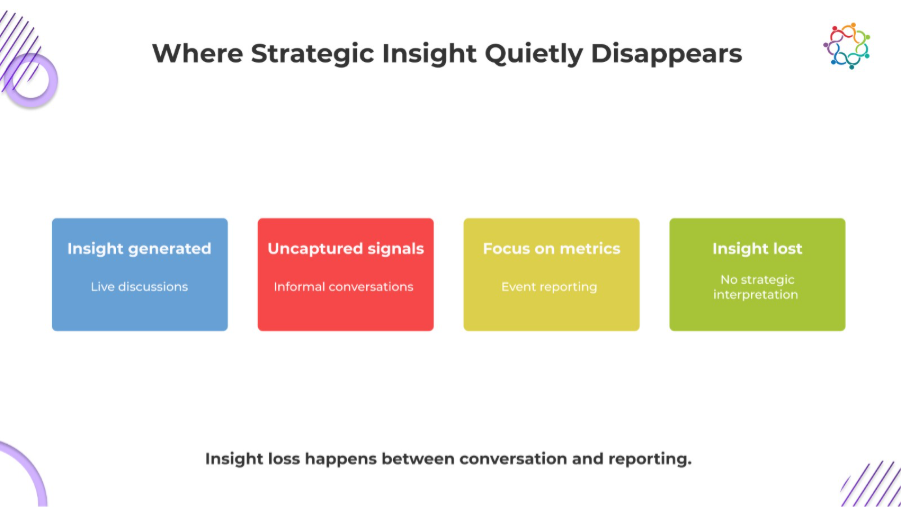
Events are uniquely powerful moments in the marketing mix. They bring people together, spark conversations, and create momentum that is difficult to replicate through other channels. Sales conversations begin. Relationships deepen. Interest feels tangible in a way that dashboards rarely capture. Yet once the event ends, that energy often dissipates into uncertainty.
Marketing teams are left asking what was actually captured, what actions followed, and which interactions truly mattered. Conversations happened, but where did they go? Engagement felt high, but how was it recorded? Momentum was real, but did it translate into anything measurable?
CRM systems promise visibility and structure, yet events rarely plug into them cleanly. Attendance lists are uploaded, notes are scattered, and follow-ups happen unevenly. Over time, the same frustration emerges: plenty of data exists, but clarity does not.
The problem is not that events fail to generate information. It’s that the information they generate lacks structure and meaning once it enters revenue systems. Without interpretation, the impact of events remains anecdotal rather than operational.
This gap exists because events generate human interaction, while CRM systems are designed to process structured revenue signals.
CRM systems are built around durable business objects. Accounts represent companies. Contacts represent people. Opportunities represent potential revenue. Everything in a CRM is designed to support tracking, progression, and forecasting over time.
Events do not naturally fit into this structure. By nature, events are moments. They are experiences that happen at specific points in time, defined by human interaction rather than transactional steps. A conversation at a roundtable, a question asked during a session, or a follow-up discussion after a keynote does not automatically map to an opportunity stage or a pipeline metric.
Without intentional design, events remain peripheral to CRM systems. They exist as activities or notes rather than as meaningful contributors to pipeline understanding. Manual syncs and post-event uploads attempt to bridge this gap, but they rarely solve the underlying issue.
The core challenge is not technical connectivity. It is conceptual. Events do not naturally map to pipeline logic; they must be interpreted before they can become meaningful within revenue systems.
Event management tools were created to solve a different problem. Their primary purpose is to support the planning and execution of events. They help teams manage registrations, coordinate attendees, and ensure events run smoothly. In logistics-heavy environments, they bring order and consistency to complex operational workflows.
Within that context, these tools perform well. They capture who registered, who attended, and whether the event took place as planned. Their focus is on execution reliability rather than downstream business interpretation.
Connecting events to CRM and pipeline outcomes is not their primary job. They were not designed to translate human interaction into revenue signals or to contextualize engagement within buyer journeys.
This limitation is not a flaw. It reflects the environment in which these tools were built, one where running the event successfully was the main objective, and where revenue attribution was handled elsewhere.
The disconnect becomes most visible after the event, when data begins to flow into CRM systems.
Attendance alone does not signal intent. Two people may attend the same event for entirely different reasons. One may be actively evaluating a solution, while the other is casually exploring an industry topic. Treating both interactions as equal creates noise rather than insight.
Engagement quality also varies dramatically. A brief appearance does not carry the same weight as sustained participation, meaningful questions, or post-event conversations. Yet raw data often captures these moments at the same level.
Sales teams do not need longer lists; they need context. They need to understand why an interaction matters, what it suggests about buyer intent, and how it should influence next steps.
When CRM fields fill up without improving understanding, frustration grows. Data volume increases, but decision-making does not improve. This is where many teams realize that simply connecting events to CRM is not enough.
The gap between events and pipeline exists because CRM systems and events operate on fundamentally different logics.
CRM systems require structured signals. They rely on consistent definitions, repeatable logic, and contextual meaning to support forecasting and reporting. Every field exists to answer a specific business question.
Events, by contrast, produce unstructured interactions. They generate behavioral signals that are rich but messy, valuable but ambiguous. These signals are temporal, contextual, and deeply human.
Bridging these two worlds requires more than integration. It requires interpretation.
The challenge is not syncing attendance data into a CRM. The challenge is translating what happened at an event into signals that revenue systems can understand and act on. Without this translation layer, events remain visible but not meaningful.
An event marketing platform is software that enables marketing teams to plan, promote, run, and measure events as a repeatable growth channel. It combines registrations, communication, engagement, lead capture, CRM integration, and analytics to connect events directly to pipeline and ROI.
(Read more: What Is an Event Marketing Platform?)
This category has emerged as marketing teams adopt CRM-centric go-to-market motions and face increasing accountability for pipeline and revenue impact. In this environment, events cannot be treated as isolated moments. They must be understood as contributors within a larger, multi-touch system.
Rather than treating CRM and pipeline as storage destinations for attendance data, an event marketing platform treats them as decision systems. It focuses on interpreting event behavior, structuring engagement in ways sales teams can act on, and enabling teams to learn from events over time instead of resetting insight after each execution.
The defining difference lies in how these platforms approach CRM connection, not as a technical task, but as a strategic one.
The CRM connection, in this model, becomes a way to make events legible to the systems that govern growth.
For some teams, the disconnect between events and the pipeline is an inconvenience. For others, it becomes a strategic risk.
When events are tied directly to opportunity creation or acceleration, unclear attribution creates blind spots. Account-based and sales-led go-to-market motions depend on understanding how multiple interactions influence the same accounts over time.
As event frequency increases, the cost of disconnected data compounds. Multiple events may influence the same deal, yet without interpretation, their collective impact remains invisible.
Leadership questions shift from whether events happened to how they influenced pipeline movement. At this stage, anecdotal answers are no longer sufficient.
At scale, disconnected events do not just reduce clarity; they undermine confidence in event investment.
Connecting events to CRM and pipeline does not mean turning events into lead-generation machines. It is not about flooding CRM systems with low-quality data or reducing complex interactions to simplistic scores. It does not replace CRM ownership, sales judgment, or human decision-making.
Event Marketing Platforms are not designed to automate revenue outcomes. They exist to support better decisions by providing structured insight where there was previously ambiguity.
Their role is to help teams understand what matters, not to dictate what to do.
Events only create pipeline impact when revenue systems can understand them.
Without structure and interpretation, even the most engaging events remain disconnected from the systems that guide growth decisions. Event Marketing Platforms exist to make that connection meaningful to translate moments into measurable contributions.
This evolution reflects a broader shift in modern marketing: from activity to impact, from isolated experiences to connected, accountable growth channels.
As expectations rise, events must do more than generate energy. They must generate clarity.
In the early stages of an event program, most marketing teams feel confident in their setup. Events are planned on time. Registrations are tracked. Attendees show up. Everything appears to be working accordingly, but from the outside. At this stage, smooth execution feels like success. If an event runs without visible issues and participation meets expectations, the tool supporting it is doing its job. There is little reason to question whether anything more is needed.
This shift happens when execution success is no longer enough and teams need to understand what events actually contribute.
Over time, however, the questions begin to change. Teams start asking which events actually worked out. They want to know who followed up and what happened after the event ended. Eventually, the most uncomfortable question surfaces, which is: did any of this influence pipeline or revenue at all? When these questions appear, teams often assume something is wrong with their tools. In reality, this moment signals a shift in expectations rather than a failure of execution. What was once “good enough” for running events no longer feels sufficient for understanding their impact.
This tension is not created by poor software choices or bad planning. It emerges naturally as marketing organizations grow and begin asking more of events than smooth delivery alone.
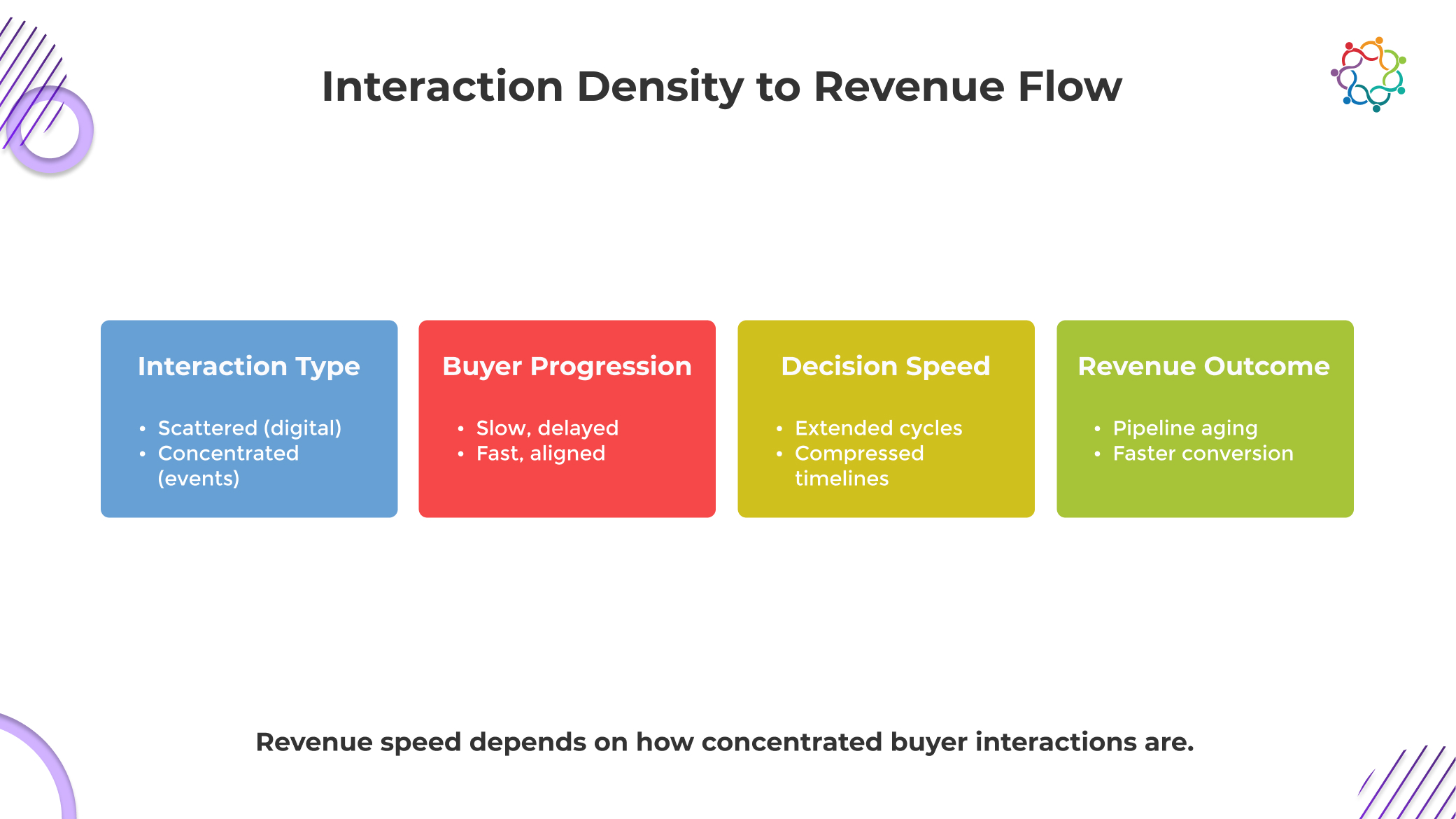
Events multiply over time when marketing teams scale. What may have started as a small, carefully planned program becomes a calendar filled with field events and hosted experiences. As the number of events grows, so do stakeholders, cross-functional involvement, and budget scrutiny.
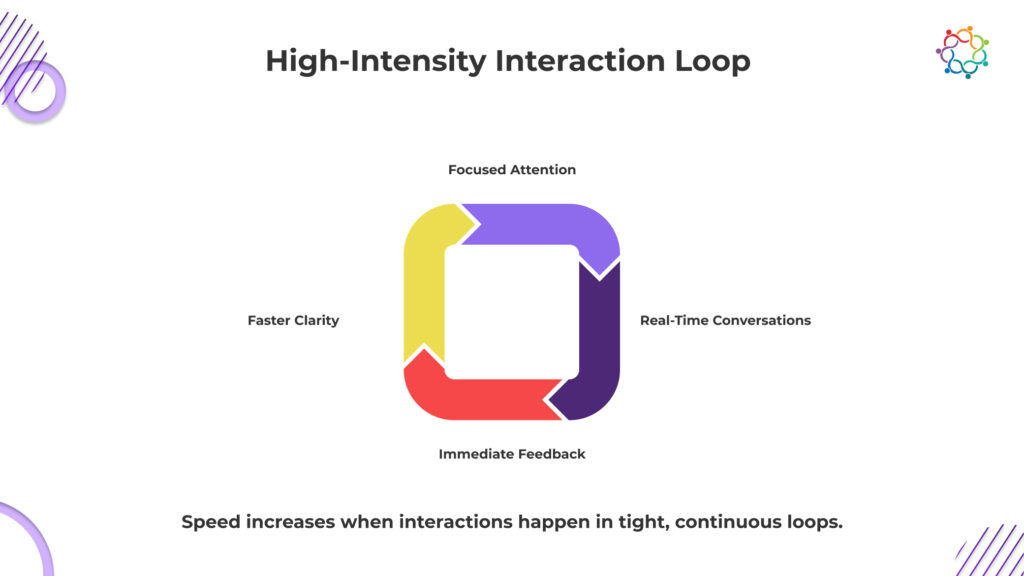
At the same time, events start to play a different role. First, the objective is straightforward: execute the event effectively. The next inquiry is what the event brought to the company.
Execution remains important, but it is no longer the finish line. Events are now expected to contribute to broader marketing and revenue objectives. They are discussed in pipeline reviews, forecast meetings, and leadership conversations.
This shift does not happen because teams are unhappy with their tools. It happens because organizational maturity changes what success looks like. The same systems that once supported growth start to feel limiting because the job they were hired to do has expanded.
Event management software is designed to make the planning, coordinating, and carrying out of events easier. They were developed to deal with a very particular problem, such as how to handle events consistently without creating operational ambiguity. Teams required organized methods to handle scheduling, registrations, logistics, and on-site execution as events grew more complicated and frequent.
These tools work well in situations when the main difficulty is coordination. They assist teams in delivering consistent experiences across different events, ensure that guests are accounted for, and bring structure to logistics-heavy programs.
They emphasize the operational reliability conceptually. On the day of the event, they assist teams with event setup, attendance flow management, and seamless execution. They offer the assurance that nothing important will be overlooked and that everything will go according to plan.
Event management tools are effective in that regard. They are only optimized for execution rather than long-term marketing impact; they are neither constrained nor defective by design.
The early indications of friction are subtle and simple to ignore.
Frustration can be built because the systems that support teams cannot answer the questions being asked. The gaps between expectations and reality become impossible to ignore. These gaps are structural.
Event management tools are optimized for execution. Their design centers on running events efficiently and reliably. They are not built around revenue journeys, buyer intent, or attribution models.
As marketing teams become more revenue-aligned, the expectations placed on events fundamentally change. Events are no longer treated as isolated activities; they are viewed as touchpoints within longer buyer journeys that stretch across channels and time.
When teams ask event systems to explain pipeline influence or behavioral intent, they are asking those systems to do a job they were never designed for.
This moment creates the need for a different category of technology, one built around outcomes, visibility, and learning rather than execution alone.
An event marketing platform is software that enables marketing teams to plan, promote, run, and measure events as a repeatable growth channel. It combines registrations, communication, engagement, lead capture, CRM integration, and analytics to connect events directly to pipeline and ROI.
(Also read: What Is an Event Marketing Platform?)
This category exists because modern go-to-market teams operate in CRM-driven environments with clear expectations around accountability. Marketing is being assessed based on pipeline contribution, revenue, and growth rather than just activity.
Events are not one-time actions in this sense, but rather linked marketing and income channels. Every interaction that takes place prior to, during, and following an event produces signals that are important for revenue, marketing, and sales operations.
Understanding audience intent before events, recording engagement and behavioral cues during participation, and facilitating post-event attribution, follow-through, and insight are the main goals of event marketing platforms. Their job is to make it clear how events affect consumers over time.
Critically, this category is designed to connect natively with sales, marketing, and RevOps systems. Its purpose is not to run events, but to make events measurable, intelligible, and improvable within the broader growth strategy.
The distinction between event management tools and event marketing platforms is best understood as a difference in mindset.
The definition of success shifts from completion to contribution. Instead of asking whether an event ran smoothly, teams ask what it changed.
The time horizon of value expands. Execution-focused tools deliver value around the event itself, while outcome-focused platforms deliver value over weeks and months as insights compound.
Ownership and accountability also evolve. Events move from being owned solely by operations or field teams to becoming shared assets across marketing, sales, and revenue leadership.
Data plays a different role as well. Rather than serving as a record of attendance, data becomes a source of intelligence that informs prioritization, follow-up, and future strategy.
At the core, event management tools optimize execution. Event marketing platforms optimize impact and learning.
Most teams do not make this shift intentionally at first. It happens when circumstances force the issue.
Events become tied to pipeline or revenue goals. Programs scale across regions or audiences. Sales teams begin expecting actionable insight rather than raw attendance lists.
Leadership starts asking for ROI explanations that go beyond how many people attended. They want to know which events moved deals forward and which ones did not.
These moments signal that the organization has matured. The expectations placed on events now require visibility and intelligence that execution-focused tools alone cannot provide.
Outgrowing event management tools does not mean discarding them. Many mature teams continue using execution-focused tools to support logistics and coordination. What changes is what they expect those tools to deliver.
Execution and impact are separate jobs. One ensures events happen. The other ensures events matter.
As teams mature, they stop expecting a single system to do both. Instead, they recognize that different categories exist to serve different purposes within the event ecosystem.
Outgrowing event management tools is not a failure. It is a signal of marketing maturity.
As teams develop, events are now evaluated on their obvious contribution to growth rather than just how effectively they function. The emergence of event marketing platforms is a result of improved go-to-market tactics, increased revenue accountability, and higher expectations.
The real evolution is not in software. It is in how organizations value events as strategic growth channels that deserve visibility, insight, and continuous improvement.
An upcoming event needs to be launched quickly. Most buyers don’t set out to make a bad event technology decision. Registration feels clunky. Reporting is unclear. Leadership wants answers. Someone searches for “event software,” compares a few platforms, and assumes they’re all solving roughly the same problem.
That assumption is where things begin to break down.
The event technology market suffers from persistent category blur. Overlapping terminology makes different tools sound interchangeable. Vendor positioning often stretches across multiple use cases. Comparison pages emphasize feature volume instead of intent. As a result, buyers evaluate execution details before clarifying outcomes.
In practice, most buying journeys begin with operational pain: events are difficult to manage, coordination is cumbersome, or data is scattered. Rarely do teams pause to define what they actually need events to do for the business.
The hidden cost of choosing the wrong category doesn’t show up immediately. Events still happen. People still attend. However, expectations and reality tend to mismatch over time. Teams overbuild processes to compensate. ROI questions remain unanswered. Internal frustration grows because it was never designed for the job it was quietly expected to perform.
Understanding the difference between event marketing platforms and event management software starts with recognizing this root cause: buyers confuse execution needs with impact goals.
Event Management Software is built to run events smoothly by focusing on coordination, reliability, and execution of events from start to finish.
Event Marketing Platforms are built to prove and improve the impact of the events by connecting events to measurable business outcomes over time.
Although this distinction often feels obvious in hindsight, it is the lens most buyers fail to apply early in the evaluation process that leads them to choose tools that solve immediate execution problems but fall short of delivering the visibility and insight they later expect.
Event management software is technology designed to support the planning, coordination, and execution of events.
The original buyer problem this category emerged to solve was operational complexity. As events grew larger and more frequent, teams needed reliable systems to manage logistics, standardize processes, and ensure nothing fell through the cracks.
This category developed in environments where execution quality mattered most. Conferences, trainings, partner programs, and large-scale gatherings created coordination challenges across venues, schedules, registrations, and on-site workflows. The priority was consistency and control.
Conceptually, event management software focuses on making events run predictably. It supports structured setup, coordinated execution, and repeatable operations. The value it delivers is confidence that an event will happen as planned, with fewer errors and less manual overhead.
Its centre of gravity is operational reliability. When events are complex, high-risk, or logistically demanding, this category exists to reduce friction and increase efficiency without introducing unnecessary uncertainty.
An event marketing platform is software that enables marketing teams to plan, promote, run, and measure events as a repeatable growth channel.
It combines registrations, communication, engagement, lead capture, CRM integration, and analytics to connect events directly to pipeline and ROI.
(Read more: What Is an Event Marketing Platform?)
Event marketing platforms often overlap with event management software but are differentiated by their focus on marketing outcomes, attribution, and ROI rather than logistics alone.
This category exists because the environment around events has changed. Modern go-to-market teams operate in revenue-aligned structures, rely on CRM systems for decision-making, and face executive expectations around attribution, learning, and accountability.
In this context, events are no longer treated as isolated moments. They are part of a continuous buyer journey. Every interaction before, during, and after an event generates signals that matter to marketing, sales, and revenue operations.
Event marketing platforms treat events as a data-generating channel rather than a one-day activity. Their conceptual focus spans audience intent before the event, engagement and behavioral signals during participation, and post-event follow-through that connects attendance to pipeline movement and revenue influence.
Critically, this category is designed to operate natively alongside sales, marketing, and RevOps systems. Its purpose is not simply to support execution, but to create visibility, learning, and improvement across the full lifecycle of event-driven growth.
The most useful way to compare these categories is not by capabilities, but by how they think about success.
At their core, these categories optimize for different outcomes. One optimizes execution reliability. The other optimizes business impact and learning.
The most common mistake buyers make is expecting revenue answers from execution-first software.
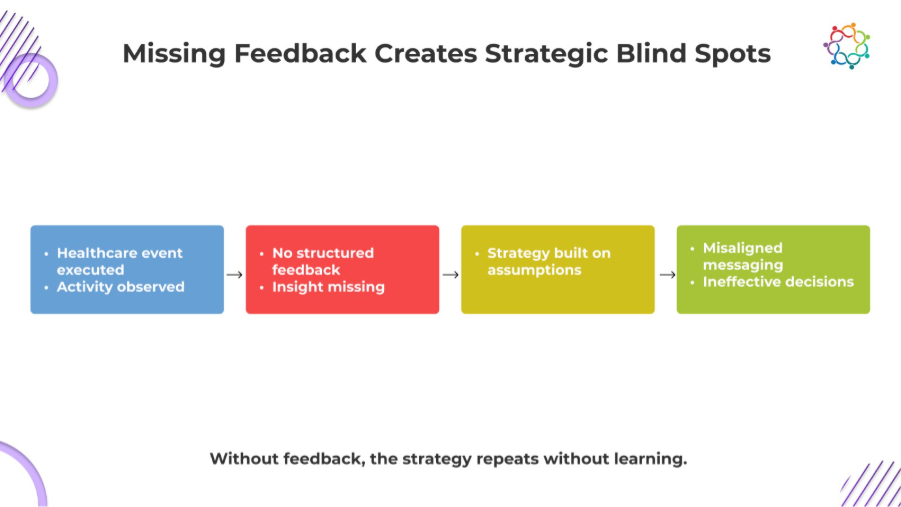
Teams invest in tools designed to manage registrations and logistics, then later ask questions about pipeline influence, sales follow-up, or account engagement. When those answers aren’t available, the gap is filled with manual work.
Attendance becomes the primary success metric, not because it’s meaningful, but because it’s the only visible data point. Spreadsheets multiply. CRM updates are handled manually. Dashboards are stitched together after the fact.
By the time leadership asks, “What did these events actually contribute?”, teams discover that the system they bought was never designed for attribution or insight. The disappointment is due to category misalignment that only becomes obvious after the event is over.
There are many scenarios where event management software is not just sufficient, but ideal.
Internal-facing events, such as town halls or company-wide meetings, prioritize coordination over commercial outcomes. Compliance-driven programs, training sessions, or certification events require precision and consistency, not revenue attribution.
Infrequent or low-stakes events also fall naturally into this category. When events are occasional and not tied to growth metrics, execution-first tools provide clarity without unnecessary complexity.
Events with no expectation of pipeline, revenue, or behavioral insight benefit most from systems designed to reduce logistical burden. In these cases, optimizing for smooth execution is the correct decision.
An event marketing platform becomes necessary when events carry accountability. High-volume or recurring B2B events introduce complexity that extends beyond logistics. Multi-event programs create interconnected touchpoints that influence buyer journeys over time.
When pipeline or revenue responsibility enters the conversation, attendance alone is no longer enough. Leadership begins by asking how events contribute, which audiences they influence, and what actions should follow.
In multi-touch programs, events don’t stand alone. They interact with campaigns, sales outreach, and account strategies. Without visibility across these connections, teams struggle to justify investment or improve performance.
Modern go-to-market teams require insight beyond who showed up. They need to understand intent, engagement, and outcomes to defend budgets and refine strategy. At that point, execution-focused tools reach their natural limit.
Most teams begin with execution-focused buying. Their initial need is to make events happen reliably. As programs scale, awareness grows around what events should be contributing.
Over time, teams move from asking “Did the event run well?” to “What did the event achieve?” Eventually, they reach a stage where events are treated as an intelligence source informing audience strategy, sales prioritization, and revenue planning.
Teams rarely switch categories overnight. They evolve as expectations change. What once solved the problem becomes insufficient as new questions emerge.
Understanding this maturity curve helps buyers avoid frustration. The issue is not that one category failed, but that the requirements outgrew the original intent.
Event management software and event marketing platforms exist for different reasons. Confusion arises when buyers assume execution and impact are the same job. This is not a software comparison problem. It’s a clarity-of-expectations problem.
The right choice depends on how seriously an organization treats events as a growth channel. Teams that view events as moments will prioritize smooth delivery. Teams that view events as levers for revenue, insight, and learning will demand visibility and accountability.
Modern go-to-market organizations are redefining how events connect to pipeline, intelligence, and long-term performance. The most successful buyers start by aligning expectations.
It’s not hard to find well-run events. Venues are polished. Speakers are prepared. Attendees are registered, checked in, and hosted smoothly. From an execution standpoint, many event teams are doing their jobs exceptionally well.
The gap appears when execution success is expected to explain business impact.
And yet, when questions turn to ROI, the answers often trail off. Impact feels implied rather than proven. Budgets are defended instead of expanded. Events continue, but their value remains strangely fragile.
This gap is rarely caused by a lack of effort. In most cases, it isn’t even caused by poor execution. The issue is strategic. Execution problems are visible and fixable. Strategic mistakes are quieter. They happen before planning decisions are made and after reports are reviewed, affecting results long before anyone realizes something is off.
One of the most common mistakes in event marketing is planning events as standalone activities. A date is chosen, an audience is invited, and once the event concludes, the team moves on to the next one. There’s no real continuity, basic promotion, or follow-up.
When events are treated this way, they create moments rather than momentum. Whatever energy or insight is generated has nowhere to go. The event exists as a spike on a calendar, disconnected from broader go-to-market motions, pipeline strategy, or account journeys. Even strong engagement struggles to translate into impact because it isn’t anchored to anything larger. This limits ROI because its influence has no structure to travel through.
The problem isn’t that events don’t work. It’s that their impact is never given a path forward.
Another quiet limiter of ROI is the instinct to optimize for volume. Registrations are visible. They’re easy to report. They provide reassurance that interest exists. Over time, this leads teams to broaden targeting, loosen qualification, and prioritize scale over fit.
The result is often a crowded room with a diluted signal. When attendance spans too many roles, industries, or intent levels, follow-up becomes harder, not easier. Insights blur. Sales teams struggle to identify who matters most. The event feels successful in aggregate but unclear in consequence.
More attendees don’t automatically mean more value. In many cases, they mean less insight per interaction. ROI suffers not because demand was low, but because relevance was compromised.
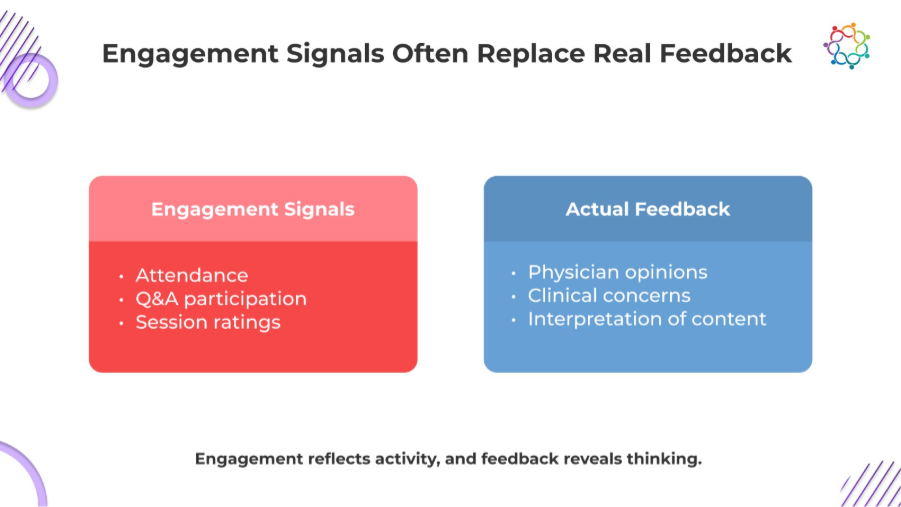
Measurement is where many event programs quietly stall. Registrations and attendance dominate post-event reporting, while deeper questions remain unanswered. Engagement is assumed rather than examined. Influence on decisions is inferred rather than explored.
When success is defined narrowly, reporting becomes retrospective rather than instructive. Teams know what happened, but not what it meant. Leadership sees activity but can’t connect it to outcomes. Over time, events become harder to defend because their value isn’t articulated. What isn’t measured thoughtfully can’t be improved, and it certainly can’t be protected during budget conversations.
Uniform follow-up is another subtle but costly mistake. When every attendee receives the same message, the same priority, and the same interpretation, high-intent signals are flattened. Differences in role, account importance, and engagement behavior disappear.
This leaves sales teams guessing. Who should be contacted first? Who was genuinely interested? Who was just browsing? Without differentiation, effort gets spread evenly instead of intelligently. High-potential opportunities wait alongside low-intent ones. ROI erodes not because it wasn’t recognized.
Many event teams technically pass data to sales, but context rarely travels with it. Attendance shows up in systems as a checkbox rather than a narrative. Sales sees who attended, but not how they engaged or why that matters.
When events are positioned as “marketing activity” instead of pipeline input, they lose strategic weight. Sales follow-up becomes generic. Trust in event data weakens. Over time, events are viewed as peripheral rather than integral to revenue conversations. ROI depends on shared understanding. Without it, even strong signals lose their force.
Events only create ROI when their meaning is shared. Passing attendance data without context strips events of their strategic value. ROI depends on the aligned understanding of what happened and why it mattered.
Tooling often becomes a proxy for progress. Better platforms promise better outcomes, and teams adopt features hoping results will follow. But tools only amplify the thinking behind them. When strategy is unclear, better tools simply make the same mistakes more efficiently.
This leads to feature adoption without intention. Metrics are tracked without interpretation. Complexity increases, but clarity doesn’t. ROI remains elusive because the underlying questions were never addressed. Strategy can’t be outsourced. Technology can support decision-making, but it cannot replace thinking.
Perhaps the quietest mistake of all is the absence of reflection. Events conclude, reports are shared, and attention shifts forward. There’s no structured pause to ask what worked, what didn’t, or what should change next time.
Without learning loops, ROI never compounds. Each event starts from roughly the same baseline. Patterns repeat. Mistakes persist because insights were never carried forward. Improvement requires memory. Without it, events remain expensive resets.
ROI compounds through learning, not repetition. Without deliberate reflection, each event resets progress instead of building on it. When teams consistently carry lessons forward, events evolve. Without that discipline, ROI stays flat no matter how many events are run.
High-ROI event marketing doesn’t look louder or larger. It looks clearer. Instead of chasing scale for its own sake, events are designed as connected journeys that build context over time, not isolated moments that peak and disappear.
(Read: What is event marketing)
Each event has a defined role in shaping understanding, confidence, or momentum, rather than simply filling a room. Success is evaluated through behavior and outcomes that focus on how people engage, what questions they ask, and how conversations change afterward.
Alignment with sales and broader go-to-market goals is intentional rather than assumed. Expectations are shared in advance, and signals are interpreted together instead of being handed off in reports. This shared understanding reduces friction and increases follow-through.
Most importantly, learning is continuous. Teams expect some events to underperform and treat those outcomes as insight, not failure. Over time, ROI improves not through more events or bigger audiences, but through sharper focus and clearer intent. Precision compounds where scale often stalls.
Most event ROI isn’t missing. It’s constrained by habits, assumptions, and quiet strategic gaps that shape how events are planned, measured, and interpreted. When these patterns persist, events still function. People attend. Conversations happen. Activity gets recorded. But the full value of those interactions never quite shows up in pipeline discussions or budget conversations. The issue is that the impact of ROI remains partially hidden.
Removing these constraints doesn’t require hosting more events, increasing spend, or pushing teams harder. It requires clearer thinking about what events are meant to influence. When teams examine how events connect to buyer intent, on-the-ground behavior, and post-event decisions, blind spots start to surface. Follow-up becomes more focused. Measurement becomes more honest. Conversations with sales become more grounded.
ROI improves when events are designed, measured, and interpreted as decision-shaping systems rather than isolated activities.
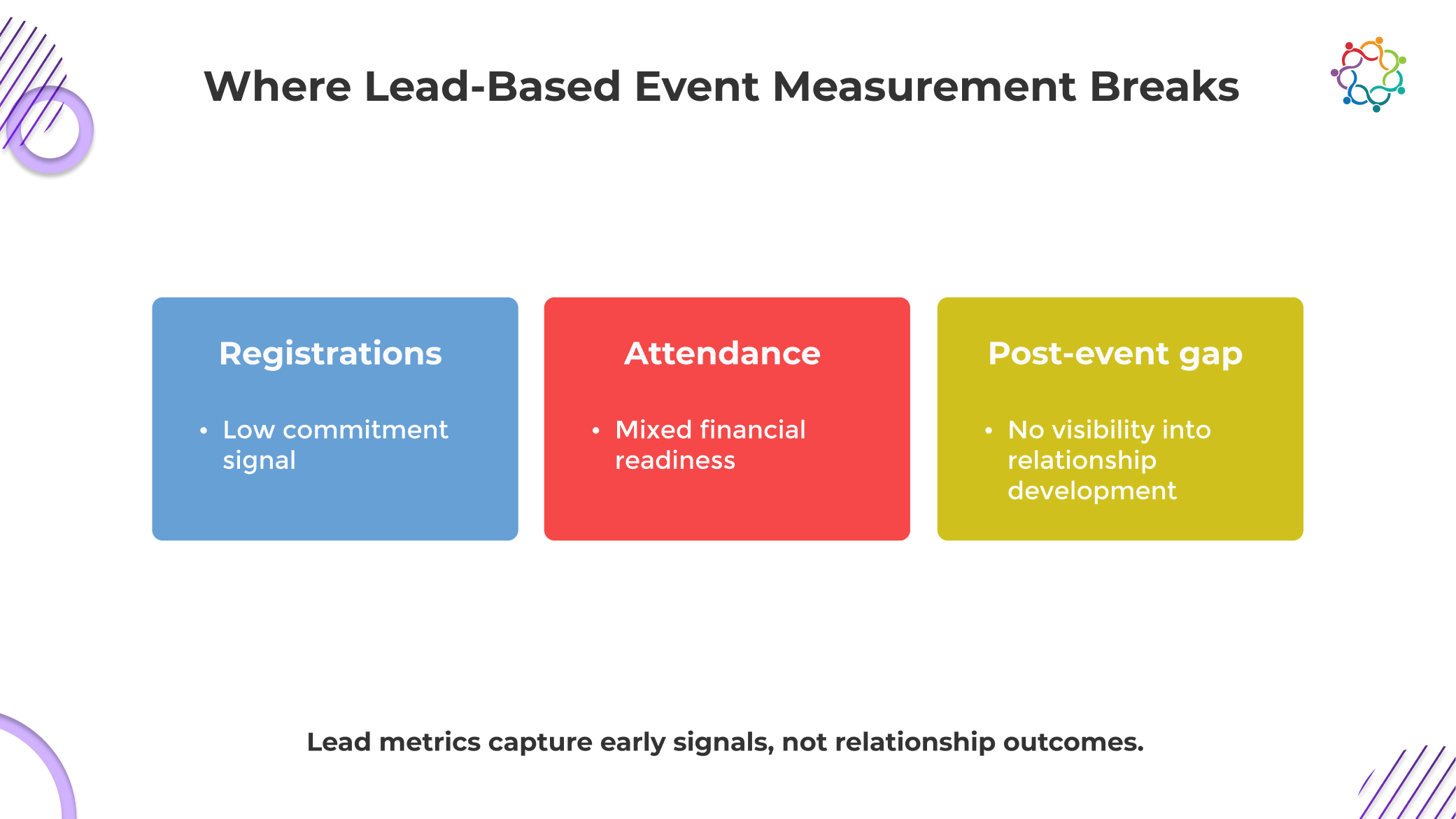
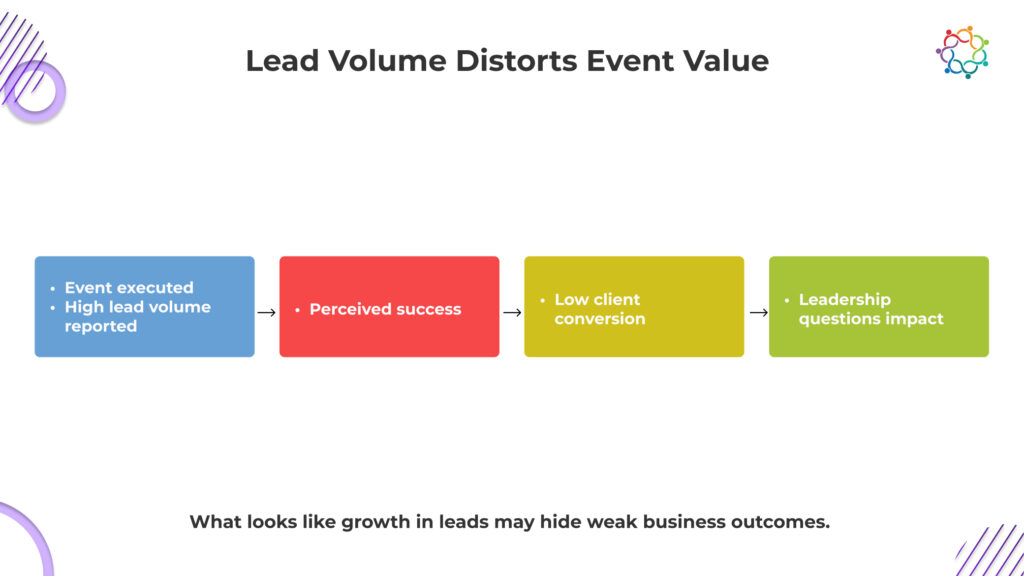
Event marketing reports often look reassuring at first glance. Registration numbers are healthy. Attendance percentages are within expectations. Post-event summaries show growth compared to the last program. On paper, everything appears to be moving in the right direction.
The gap appears when these numbers are expected to explain impact. Registrations and attendance describe activity, not outcomes.
Yet when leadership asks what changed because of the event, the answers tend to soften. Pipeline impact feels implied rather than proven. Sales feedback is mixed. Follow-up conversations don’t reflect the scale suggested by the numbers.
This disconnect is more common than most teams admit. The data exists, but confidence doesn’t. If event success were obvious from registrations and attendance alone, marketing leaders wouldn’t feel the need to defend or reframe their results so often. The tension exists because the numbers being reported describe activity, while the questions being asked are about outcomes.
Registrations and attendance didn’t become dominant metrics by accident. They’re easy to count, easy to compare across events, and easy to explain in executive updates. They also fit neatly into historical expectations. For a long time, simply showing that people showed up was enough to justify investment.
These metrics survived because they offered clarity in environments where events were hard to quantify. They created a sense of control. They made reports feel complete. And because they rarely faced resistance from leadership, they became habitual. Over time, convenience hardened into convention.
The problem is that these metrics were never designed to explain influence. They tell you how many people engaged at the surface level, not whether anything meaningful shifted beneath it.
At the heart of the issue is a conceptual mismatch. Registrations and attendance measure activity. Event marketing exists to influence intent, behavior, and decision-making. These are related, but they are not the same.
Activity answers the question of what happened. Outcomes answer the question of what changed. An event can be busy without being impactful. It can generate high attendance without generating momentum. When teams conflate activity with impact, they end up overestimating success and underexplaining results.
This doesn’t mean activity metrics are useless. It means they’re incomplete. Without context, they create false confidence and shallow insight. What happened is not the same as what mattered.
Measuring event marketing success isn’t about abandoning numbers. It’s about understanding what those numbers represent and what they leave out. At its core, better measurement means understanding how events influence intent, behavior, and downstream decisions.
In practice, this means measurement should clarify which accounts progressed, which sales conversations gained momentum, and where teams should focus next.
This reframing matters because it shifts focus from volume to meaning. It acknowledges that events operate across moments and that their value often emerges over time rather than at check-in. Measurement, in this sense, becomes interpretive rather than extractive. It seeks to explain contribution, not just record presence. This isn’t a call to replace metrics. It’s a call to contextualize them.
When teams move beyond surface-level metrics, they start looking for signals rather than counts. These signals fall into a few broad categories that help explain why an event mattered.
Each category matters because it adds dimension. Together, they tell a more honest story than any single metric can.
Signal-based measurement is uncomfortable by design. These signals are messier, less uniform, and harder to benchmark. They don’t always trend upward. They force teams to confront uneven performance and make trade-offs explicit.
Unlike registrations, these signals can’t always be summarized cleanly. They require interpretation. They expose weak spots. And sometimes they suggest that an event underperformed despite looking successful on paper.
That discomfort is often why teams resist this approach. But clarity often feels worse before it feels better. Honest measurement replaces optimism with insight, and insight is what enables improvement.
When teams optimize for the wrong metrics, the consequences compound quietly. Budgets get allocated to events that look good but don’t move the business. Programs repeat without learning. Sales grows skeptical of event data because it doesn’t match their lived experience.
Over time, events become harder to defend. They’re categorized as soft spend, justified by tradition rather than evidence. Marketing teams spend more energy explaining than improving. Over time, credibility becomes the cost that they end up paying for measuring the wrong things. These outcomes are caused by poor measurement framing.
Mature teams think differently about measurement. They anchor it in intent and behavior rather than vanity. They align marketing and sales around shared definitions of what “good” looks like. They treat post-event analysis as a learning loop, not a performance report.
Most importantly, they’re willing to say when something didn’t work. They understand that underperformance is a data point, not a failure. Measurement becomes a tool for iteration rather than validation. Maturity isn’t about having perfect numbers. It’s about being honest with imperfect ones.
When events are measured through outcomes and signals rather than surface metrics, measurement clarity changes how their impact is understood. Events stop being treated as one-off activities and start being interpreted as inputs into decision-making.
(Read: What is event marketing)
Leaders trust them more because they can trace influence through clearer signals, even when impact is not immediate or linear. The conversation shifts away from whether an event was “worth it” and toward what the measurement revealed about buyer intent, account readiness, or deal momentum.
That clarity reshapes planning and evaluation. Measurement-led insight begins to inform prioritization, sales focus, and future program design, and events are assessed alongside other go-to-market channels using comparable outcome-oriented questions. Not because events behave the same way as other channels, but because their contribution is now explainable. This is what moves events out of the “nice-to-have” category. Not scale or spectacle, but measurement that makes impact visible and defensible.
The most useful question isn’t how many people came. It’s what changed because they did. What shifted in buyer understanding? What moved forward internally? What became clearer for the business? These shifts are subtle, but they’re often the difference between stalled conversations and productive ones.
Internally, events should change things too. They should sharpen sales conversations, not just add names to a list. They should influence prioritization, clarify which accounts deserve focus, and surface insights that don’t show up in dashboards. Sometimes, the most valuable outcome of an event is alignment between marketing and sales.
For the business, clarity is the real win. Clarity about intent. Clarity about momentum. Clarity about where events are helping and where they aren’t. When teams start there, measurement stops being a reporting exercise and becomes a strategic one.

Samaaro is an AI-powered event marketing platform that enables marketing teams to turn events into a measurable growth channel by planning, promoting, executing, and measuring their business impact.
Location


© 2026 — Samaaro. All Rights Reserved.