Samaaro + Your CRM: Zero Integration Fee for Annual Sign-Ups Until 30 June, 2025
- 00Days
- 00Hrs
- 00Min


Key Takeaways (TL;DR)
1
2
3
→
Bottom Line:
The first webinar proves the idea works. A repeatable webinar program is what turns it into a number you can put in a forecast.
One Webinar, Then Three Months of Silence
One webinar lands well, then silence for three months. A series only works when it runs like a program, not a one-off.
Turning a single good webinar into a repeatable program you can forecast from comes down to a specific sequence: a fixed cadence, a consistent format, a promotion motion you reuse each round, and pipeline tracked across the whole series, so a real trend can surface. It doesn’t come from running one better webinar.
Here’s the real problem. A session that performs well and then doesn’t run again for a quarter never becomes a channel. It stays a one-time event that happened to go well, and pipeline from one-time events can only be reported after the fact, when what leadership wants is a number they can plan a quarter around in advance.
What follows is the sequence for building a repeatable webinar program out of that single successful session, in order, so you can see exactly what changes and what stays the same.
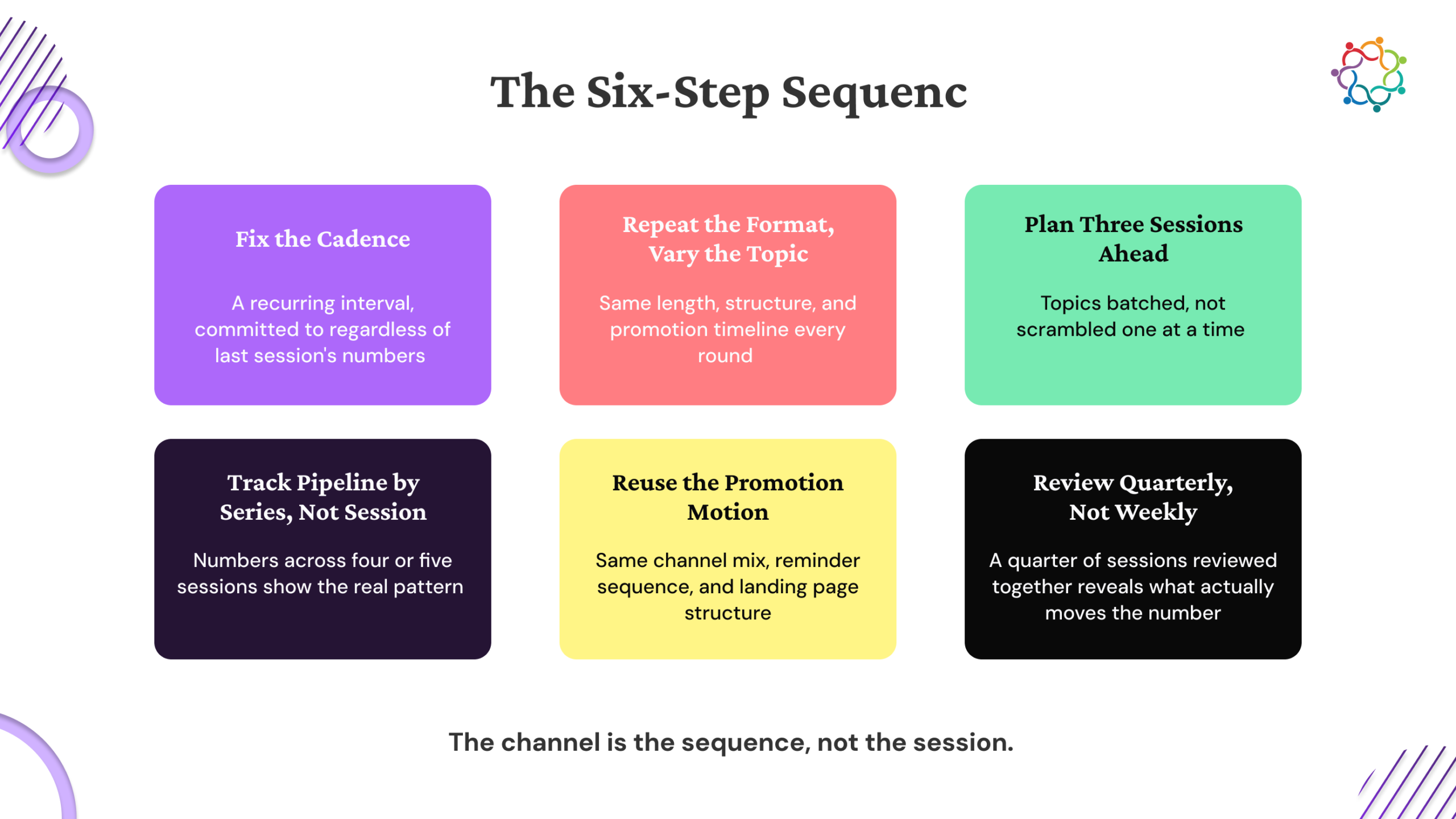
The difference between a webinar that happened and a program you can forecast is rarely talent or budget. It’s a handful of changes to how the next session gets decided and run, in the order they need to happen.
Pick a recurring interval, monthly or every six weeks, and hold it regardless of how the last session performed. An irregular schedule is the single biggest reason a series never turns into a program, because every gap resets the audience’s habit of showing up. Put the next four dates on the calendar before you run the next session.
Keep the same session length, structure, and promotion timeline every round. The team then executes a known process instead of reinventing the format each time, and the audience knows what to expect the moment an invite lands. Familiarity is what makes a series feel like a fixture people hold time for rather than a surprise they weigh each month.
Booking topics and speakers one webinar at a time makes the next one a scramble every month. Mapping three ahead, the way you would plan a whole event calendar, means promotion for the next session can start before the current one has even aired, and no single session ever becomes a last-minute fire drill.
One session’s numbers say very little on their own. The same numbers viewed across four or five sessions in a row show whether the series is producing pipeline steadily or getting lucky now and then, which is the difference between a data point and a trend you can act on.
Same channel mix, same reminder sequence, same landing page structure, refined each round rather than rebuilt from scratch. Promotion effort drops with every session even as consistency climbs, because the team is running a playbook it already knows instead of starting over each time.
A single week’s session tells you little that you can act on. A quarter of sessions reviewed side by side shows which topics, timings, and formats are moving the number, and which ones only felt good in the room on the day.
Common trap: deciding whether to keep going based on the last session alone. One quiet session doesn’t mean the format failed, and one strong session doesn’t prove it works. A program becomes forecastable only once a run of sessions is long enough to show the real pattern, which is exactly why the cadence has to be locked before you start judging results.
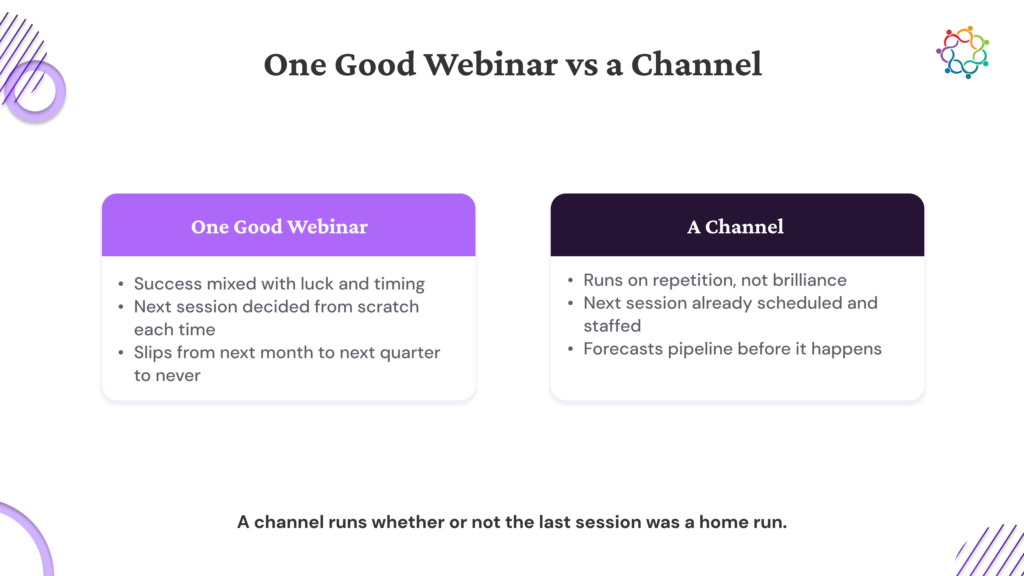
A single webinar’s success is usually a mix of a strong topic, good timing, and a promotion window that happened to land, none of which repeats on its own without a structure holding it in place. The instinct after a good session is to feel the channel is proven. It isn’t yet. What’s proven is that the topic worked once.
Without a fixed cadence, the next session becomes a decision made from scratch every time: when to run it, what to cover and how to promote it. That decision fatigue is usually why the follow-up slips from next month to next quarter to never. A channel, as opposed to an event, runs whether or not the last instance was a home run, and that reliability is where forecastability comes from.
This is the same shift behind treating events as continuous lifecycle programs rather than isolated campaigns: the value compounds across sessions instead of resetting after each one. The honest reframe is that the win now is consistency. A program that shows up reliably every month will out-produce a single spectacular session, because it keeps producing quarter after quarter.
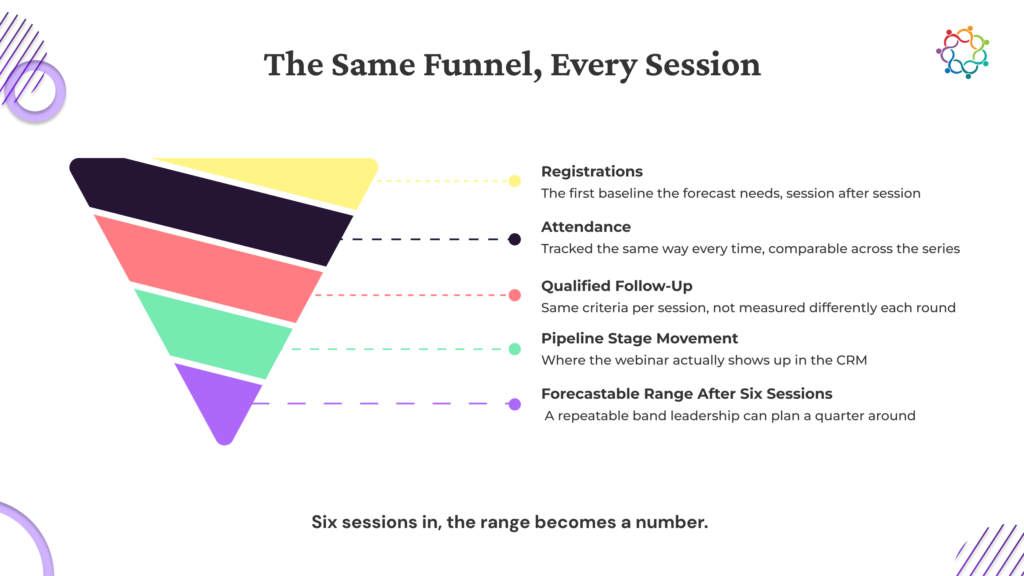
Cadence gets you consistency. Forecastability takes one more thing: numbers that are comparable from one session to the next.
Start with the baseline. A consistent format and cadence produce a steady range of registrants and attendees per session, and that baseline is the first input any forecast needs. Without it, every session is a fresh unknown, and averaging fresh unknowns tells you nothing.
Then track the same funnel stages every single time: registration, attendance, a qualified follow-up, and movement to a pipeline stage. When the stages are measured the same way each round, the numbers across sessions can be compared to each other rather than reinterpreted every quarter. This is where evaluation turns a one-time event into a repeatable, scalable growth engine, and where a quarter of sessions starts to read as a single story instead of six scattered reports nobody can line up.
Give it enough sessions before trusting the average. Three or four gives a rough sense; six or more gives something closer to a number leadership can plan a quarter around. Once a series has run long enough with a consistent structure to show a repeatable range rather than a single data point, it has become a channel, and only then is there a number worth forecasting.
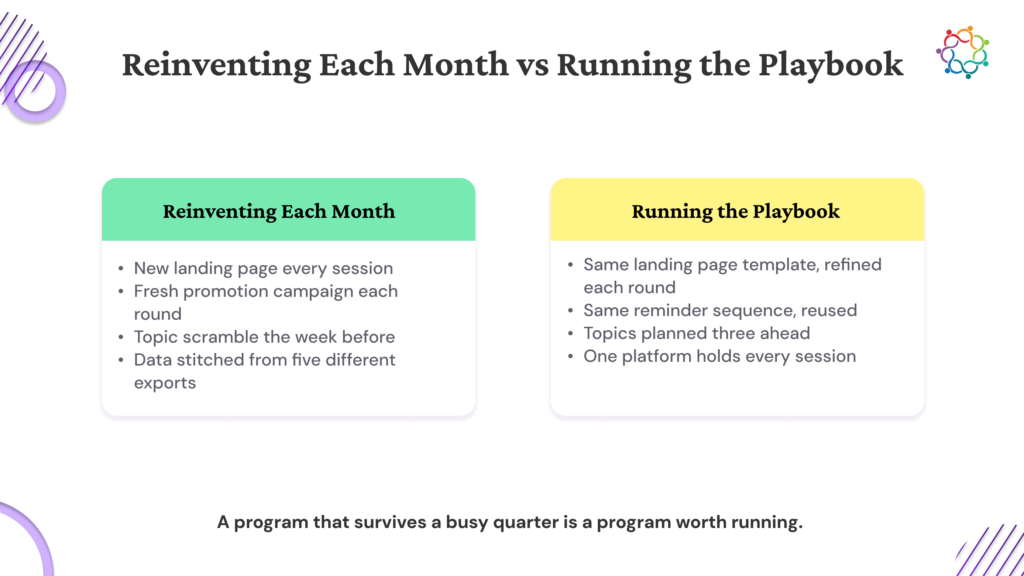
The most common reason a series stalls isn’t a shortage of ideas. It’s the operational weight of running one every month by hand. The fixes are the same repetition that makes the pipeline forecastable, pointed this time at the workload.
A program that requires reinventing the wheel every month gets deprioritized the first time the team gets busy. One that runs on a repeated, lightweight process survives a busy quarter, and surviving a few busy quarters is exactly what a series has to do before it produces a number anyone can forecast from.
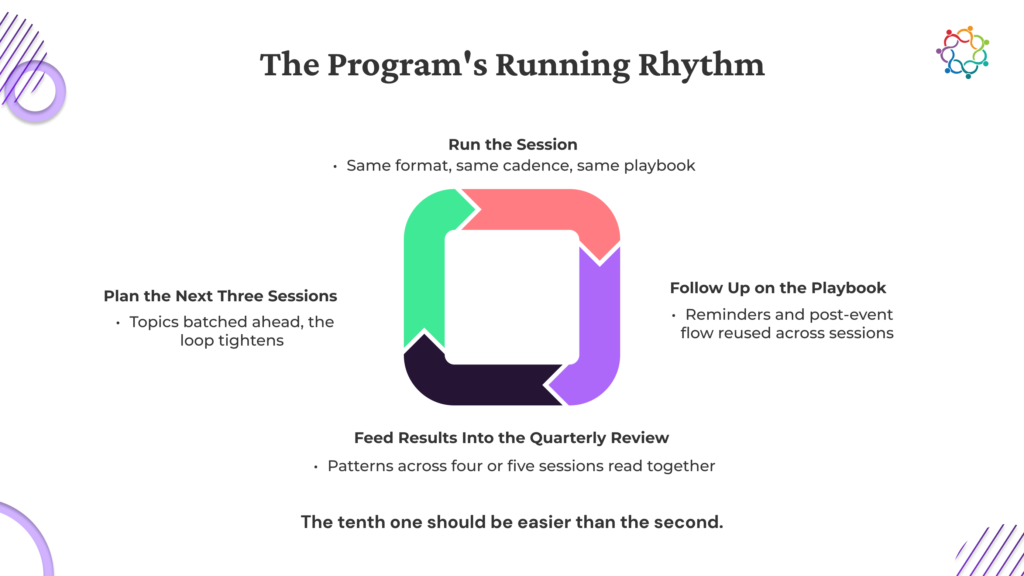
A fixed cadence, a repeated format, topics planned ahead, pipeline tracked across the series, promotion reused rather than rebuilt: that is the whole difference between a webinar that went well and a program you can forecast. The first webinar proved the idea. The program is what proves it every single month, and only the program produces a number worth putting in front of leadership.
So before you plan the next standout session, plan the next four ordinary ones. Consistency is what a forecast is built on, and event marketing software is built to hold the operational side steady across every session: the registration and reminder flows, the reused promotion, and a cadence that never slips. The forecast comes from the pattern a run of sessions produces, not from the tool.
If the operational weight is the part standing between you and session ten, that is exactly what Samaaro is built to carry.
1. How does event manager software help run a recurring webinar program?
Good event manager software holds the cadence, format, and promotion steady across every session, so the team runs one known process instead of rebuilding each month. It keeps registration, reminders, and follow-up in one place, which is what lets a small team run the tenth webinar as easily as the second.
2. Is an event management app enough to run a webinar series?
An event management app helps only if it does more than registration. For a webinar series, you want the same reminder sequence and landing page reused every round rather than rebuilt, running the whole process from sign-up to follow-up, so consistency climbs while effort per session keeps dropping.
3. How does an event planning tool help you plan webinars ahead?
An event planning tool lets you map three sessions ahead instead of booking one webinar at a time. Topics and speakers get planned in batch, so promotion for the next session can start before the current one airs. That forward planning keeps any single webinar from turning into a last-minute scramble.
4. What does event coordinator software do for a webinar program?
Event coordinator software keeps the format consistent, the same length, structure, and promotion timeline every round, so a coordinator runs a playbook they already know instead of reinventing each session. That consistency is what makes an audience block time for the series, and it frees the team to focus on content over setup.
5. Can event organizer software make a webinar series repeatable?
Yes. Event organizer software maps the whole structure, cadence, format, topics, and reused promotion, so the next session isn’t decided from scratch. Running the same process every round is what turns a lucky one-off into a channel, and it gives leadership a steady series to plan around once enough sessions have run.
6. Does a webinar program need an event booking app for registration?
An event booking app handles the sign-up side, letting registrants reserve a seat and get automatic confirmations and reminders. For a recurring webinar, reusing the same booking flow every session means nothing gets rebuilt and fewer people drop off, so more of those who register show up to the session they booked.