Samaaro + Your CRM: Zero Integration Fee for Annual Sign-Ups Until 30 June, 2025
- 00Days
- 00Hrs
- 00Min

Key Takeaways (TL;DR)
1
2
3
→
Bottom Line:
The week gets better, not easier; you lose the admin and inherit the work the role was always supposed to be.
Nothing Was Waiting for Me
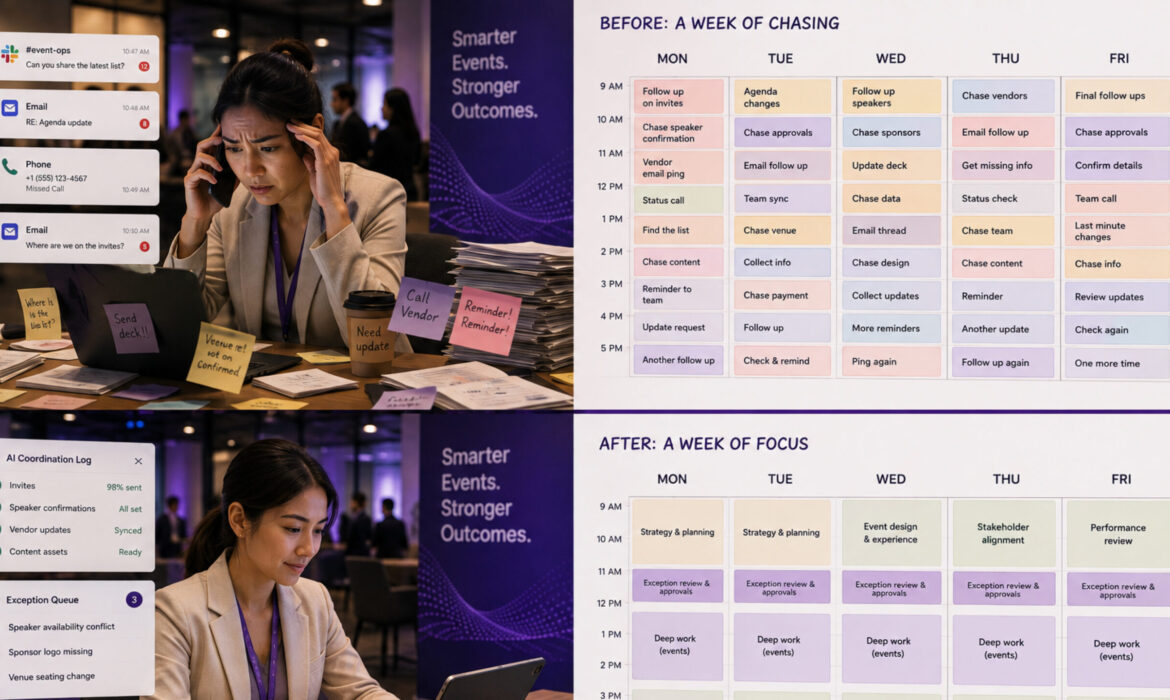
The strange part of the first week was how little there was to start. No list to pull. No reminder to schedule. No half-finished registrations to work through by hand, because they had already been worked through on Tuesday while I was in a different meeting. I opened the laptop expecting a queue and found a log.
What follows is that week as it runs in practice, assembled from how event coordination teams describe the change rather than drawn from any single company’s diary.
AI for event coordination removes the scheduled and repetitive parts of the week: sending the reminder sequence, nudging incomplete registrations, merging duplicate records, and routing captured leads. What replaces them is a log to read, an approval queue to clear, and a set of exceptions the rules did not anticipate. The week does not get shorter. It gets denser, and the density is judgment rather than admin.
The interesting change is not what left. Everything that departed was easy to list. What arrived to fill the space is the part nobody had mentioned.
The reminder sequence runs itself on approved templates. Incomplete registrations get nudged without anyone deciding to. Duplicate records merge before anyone notices them. Captured leads reach their owners while the room is still being cleared. None of these announced themselves. The work simply stopped appearing, which is a stranger experience than being told about it.
The workflow detail for the post-event portion has been published elsewhere, and readers who want it have somewhere to go. This picks up where that piece stops, at the moment the hours came back and they came back full rather than empty.
The log is not a report and it is not read the way a report is read. It is a list of things that already happened, and the job is spotting the two that need a person.
Illustrative log entry from one morning:
Reminder sequence step two, sent to the general registrant list, approved template, two hundred and fourteen recipients. Same step held for approval on the named-accounts list, eleven recipients. Record merged, two entries for one person with different spellings of the employer, flagged for review. Priority invitee flagged, registered three weeks ago with no engagement since, no rule covering it. Lead routed on the territory rule, owner notified. Held for approval, a reply asking to move sessions, wording outside the template set.
Five of those needed nothing. Two needed me. One took four minutes and the other took the rest of the morning, and there was no way to tell which was which from the log itself.
Reading a log is a scanning skill rather than a reviewing skill, and it takes a few cycles to learn where to look. Clearing the approval queue is fast when the templates are settled and slow when they are not. Both are work, both go on the calendar, and neither existed a month earlier. How to monitor event coordination tasks in real time is what an automated event communications system shows you in one view rather than across three tools.
For four days, I checked things that did not need checking. I opened the log to confirm sends that the log had already confirmed. I re-read a template that had not changed since I approved it.
The instinct is correct at first and wrong soon after. Verification in week one is how you learn whether the rules match your judgment, and the same behavior in week six is a tax with no return. The transition is not marked by anything, which is why teams either stop too early or never stop at all.
What actually settled it was not confidence. It was a pattern. After enough cycles, the log’s ordinary shape became familiar enough that the odd entry stood out on its own, and scanning replaced reading.
The thing that helped most was knowing which actions could be undone. Confidence tracked reversibility rather than accuracy, and the tasks that were easiest to trust were the ones where a mistake cost a correction rather than a relationship.
What nobody tells you before the first week is that automating coordination involves more looking than the last week of doing it by hand.
The routine work left and what remained was the set of cases no rule covered. Those cases were always there. They used to be buried under the volume.
The Rule Said Route by Territory
The contact had changed country and the record still showed the old office, so the routing ran correctly and the lead reached the wrong person. When routing rules meet data that’s changed, that’s when exceptions arrive without warning. Correct rule, wrong outcome, and nothing in the log looked unusual. This happens when the source of truth for a data point lives in a conversation someone had rather than in a system, and it is why exceptions are harder than routine work.
The Rule Said Send the Recording to No-Shows
One no-show was a customer midway through a renewal conversation, and a marketing email was the last thing that account needed that week. The rule had no way of knowing, and the person who did know was not in the loop when the automation ran.
The Rule Said Hold Anything to Named Accounts for Approval
A speaker at the event was also a named contact, so their venue directions sat in the approval queue while they were trying to find the building. The rule was correct. The situation was an edge case. And the cost landed on someone who did not write the rule.
Exceptions are harder than the work they replaced because each one requires knowing something the system does not, and because they arrive without a queue or schedule. Automation handles the tactically routine, but it’s the judgment layer that determines whether the coordination succeeds. A week of routine work is tiring. A week of exceptions is demanding.
The work the job was always supposed to be got crowded out by the chasing rather than being absent from it, which is why the tradeoff in AI for event coordination is real. You lose the admin and you inherit the judgment, and the judgment is what the role should have been all along.
The week was better and it was not easier. Anyone describing this change as time saved is describing the wrong benefit, and a coordinator expecting a lighter week will be disappointed by a genuinely better one. The chasing left, the log and the queue arrived, and the exceptions turned out to be the job. To see what the log looks like, how the approval queue works, and what exceptions look like when a rule meets reality, explore event management software in action. Book a platform walkthrough.
1. How does event manager software reshape your event coordination week?
Reminders, nudges, merges, and routing run themselves. What arrives is a log to read, exceptions to handle, and approvals to clear. The chasing leaves. Judgment arrives. Your week gets denser but better, you lose the admin and inherit the work the role should have been.
2. What does event management app show you in the coordination log?
It shows actions that already happened: reminders sent, records merged, leads routed, approvals held. Five entries need nothing. Two need you. Nothing in the log says which is which upfront. You learn to scan and spot odd entries, which differs from reading a report.
3. How does event coordinator software help you recognize exceptions?
Exceptions require knowing something the system doesn’t. A record shows the old office, but the contact moved. A no-show is a customer renewing. A named contact is also a speaker. The rule was right. The situation was unexpected. You catch these because you know context the automation doesn’t have.
4. Why should I use event planning tool to design rules with exceptions in mind?
Design rules knowing they’ll meet edge cases. Route by territory, but an account changes country. Send recordings to no-shows, but one is a customer renewing. Hold named accounts for approval, but a speaker needs directions. Anticipate exceptions before they land in your queue.
5. How does event organizer software distinguish reversible from irreversible actions?
Some actions can be undone: reassign a lead, merge a record, adjust a hold. Some can’t: send a message. Trust the reversible ones faster. A mistake on reversible work costs a correction. A mistake on irreversible work costs a relationship. That’s where confidence lives and grows.
6. When should I use conference management software to identify patterns in your logs?
After enough cycles, the log’s ordinary shape becomes familiar and odd entries stand out. Week one, verify everything. Week six, scanning replaces reading. The transition is not marked, which is why teams stop too early or never stop. Learn what normal looks like first, then trust the exceptions.

Samaaro is an AI-powered event marketing platform that enables marketing teams to turn events into a measurable growth channel by planning, promoting, executing, and measuring their business impact.
Location

© 2026 — Samaaro. All Rights Reserved.