Samaaro + Your CRM: Zero Integration Fee for Annual Sign-Ups Until 30 June, 2025
- 00Days
- 00Hrs
- 00Min

Key Takeaways (TL;DR)
1
2
3
→
Bottom Line:
The questions that end an India evaluation belong to finance, IT and procurement, which is exactly why they get asked last.
The Checklist Global Buying Guides Never Wrote
A global “best event platform” list will tell you about matchmaking and analytics. It will not tell you what actually decides an event management software India shortlist: whether the vendor can raise a GST-compliant invoice, where attendee data sits, or whether anyone answers a ticket at 11am IST.
Indian enterprise buyers evaluate event platforms on four factors that global guides omit: where attendee data is stored and processed, whether support operates during IST business hours, whether the vendor can invoice in INR with a valid GSTIN, and whether the platform handles Indian registration realities such as local payment methods and regional language content.
Most India-based buyers assemble this list themselves, mid-evaluation, usually after a vendor is already shortlisted and one of the four turns out to be a problem.
This page covers what changes when the buyer is in India. What makes an AI capability real, and what makes a platform enterprise-ready, are separate questions covered elsewhere.
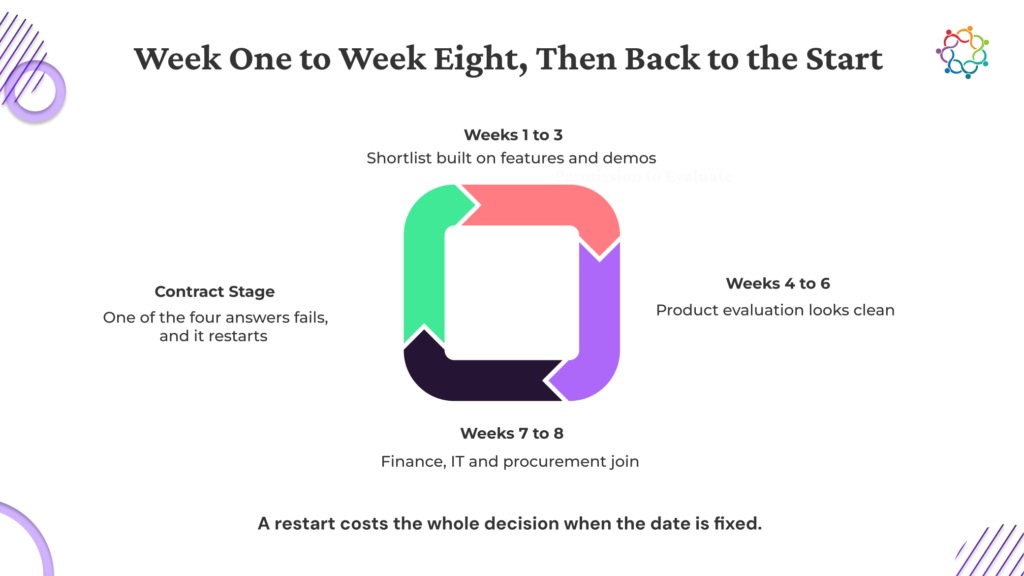
The shortlist gets built on features and demos. Everything runs cleanly for weeks. Then the last fortnight arrives.
Finance asks for the GSTIN and the vendor doesn’t have one. IT asks where data sits and the answer is a region the internal policy doesn’t cover. The first production issue lands at 3pm IST and the reply arrives the next morning. Procurement asks for INR pricing and receives a USD contract with currency exposure nobody budgeted.
The structural reason is simple. These four questions belong to finance, IT and procurement, not to the marketing team running the evaluation, so they get asked last. Global buying guides are written for the marketing evaluator, which is why they cover the first eighty percent of the decision and none of the part that stalls it. Most planning failures downstream of a purchase trace back to a question nobody asked early enough.
An evaluation that reaches contract stage and restarts typically costs another month or two, on our estimate. For a team with a fixed event date, that is the whole decision.
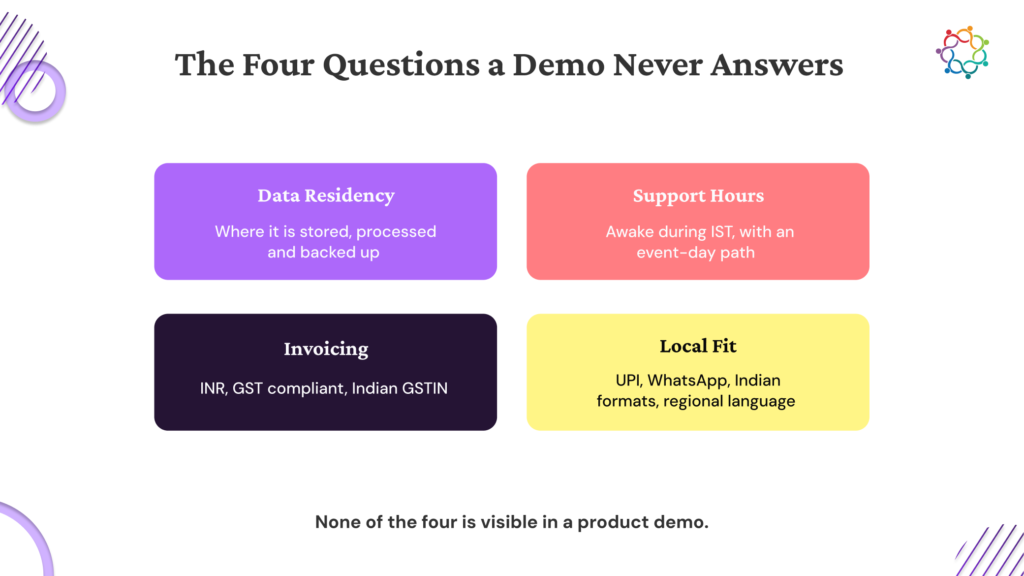
1. Where attendee data is stored and processed. Ask for the hosting region, the sub-processor list and the backup location, in writing. A vendor who answers “the cloud” hasn’t answered. Whether you need data held in India is usually set by your own internal policy and by any sector rules that apply to your business, so settle that internally before you shortlist, then ask vendors to document what they actually do.
2. Whether support is awake during IST business hours. Event support is only useful in real time. A platform with support centered on US or EU hours means the window when your registration page breaks is the window when the vendor’s team is asleep. Ask for support hours in IST, the escalation path during a live event, the guaranteed response time on event day, and whether there is a named contact in India.
3. Whether the vendor can invoice in INR, with GST compliance. An Indian entity buying software needs a GST-compliant invoice from a vendor holding a valid GSTIN, or it handles the purchase as an import of services with the tax treatment and paperwork that follows. Ask which entity issues the invoice, in which currency, and whether the vendor is registered in India. Finance will ask eventually. Asking in week one is cheaper.
4. Whether the platform fits how Indian events run. Local payment methods for paid registration, including UPI and netbanking. Registration forms that accept Indian address and phone formats without breaking validation. WhatsApp as a communication channel, because for many Indian attendee audiences it carries reach that email does not, which makes multi-channel communications a requirement rather than a preference. Regional language content where the audience needs it. These are the default here, not edge cases.
None of these four is visible in a product demo. All four are answerable by email in week one.
Every vendor will answer all four questions. The work is telling a real answer from one shaped like one.
The pattern is consistent across all three. A real answer names something specific: a region, a number, an entity, a time. A shaped answer describes a capability. Reading where event data ends up after the event works the same way, and so does most vendor diligence.
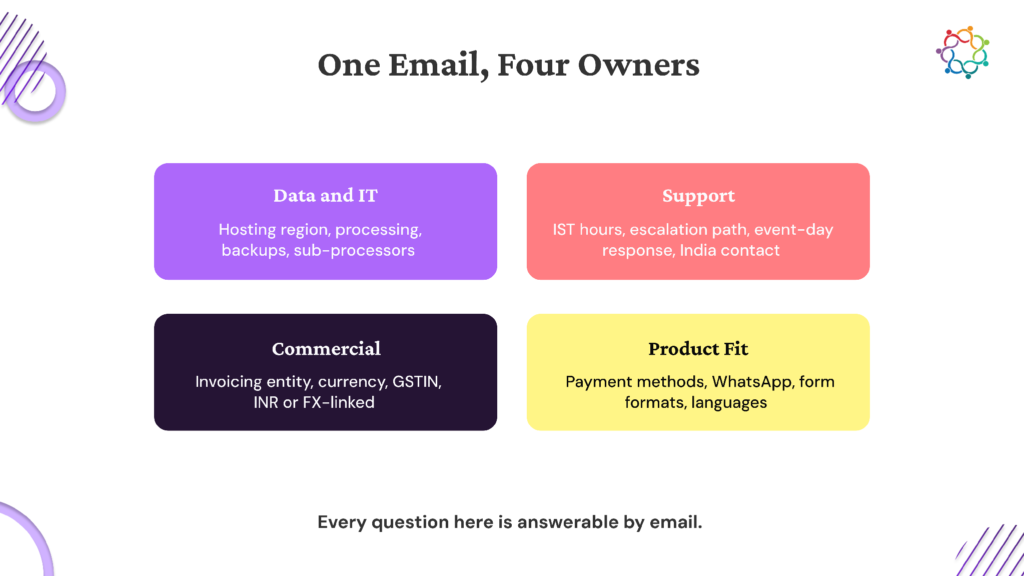
Data and IT. Which region hosts our attendee data? Where is it processed and backed up? Who are your sub-processors and where are they? Can you provide this in writing?
Support. What are your support hours in IST? What is the escalation path during a live event? What is the guaranteed response time on event day? Is there a named contact in India?
Commercial. Which entity issues the invoice? In which currency? Do you hold an Indian GSTIN? Is pricing quoted in INR, and is it fixed or linked to exchange rates?
Product fit. Which payment methods are supported for paid registration? Is WhatsApp available as a communication channel? Do registration forms handle Indian address and phone formats? What regional language support exists? Does check-in work offline when venue connectivity drops?
Send this before the second demo. Every question is answerable by email, and the answers will shorten the evaluation more than another demo will.
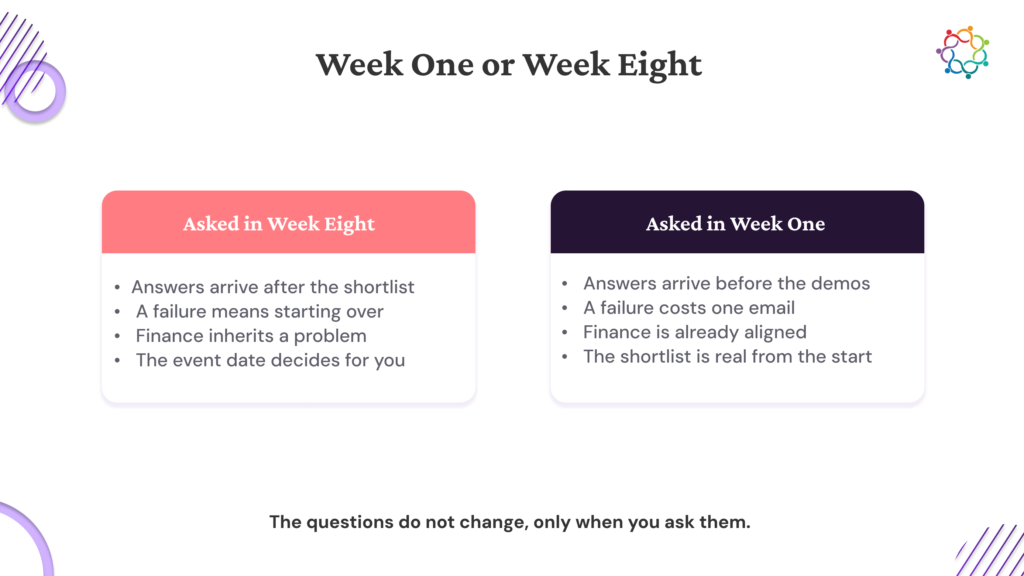
None of the four factors is obscure or hard to answer. They stall evaluations only because they get asked in week eight rather than week one, and they get asked late because the guides shaping the process were written for a buyer somewhere else.
The rule is straightforward. Send the checklist before the second demo, and treat any vendor who cannot answer all four in writing as unshortlistable, however the product demos. That’s not a scoring adjustment, it’s a filter you apply before scoring starts.
Run the same four questions at every event management software India vendor on your list, including the conference management software you’re already considering, and if the answers raise something the checklist doesn’t cover, put it to Samaaro directly.
Does event attendee data have to be stored in India?
Not as a blanket rule under the general framework. Many Indian enterprises require it anyway through internal policy, and specific sectors carry their own rules, so confirm both the law and your own policy before you shortlist.
Do international software vendors charge GST in India?
It depends on whether they hold an Indian GSTIN and which entity issues the invoice. Without one, the buying entity usually handles it as an import of services, which changes the tax treatment and the paperwork.
Can event platforms accept UPI for paid registration?
Some can, many global platforms cannot. It’s a question worth asking in week one rather than discovering during registration setup.
Is WhatsApp a viable event communication channel?
For many Indian attendee audiences it reaches people email does not, which is why teams here run both. Check whether it’s native to the platform or needs a third-party connection.
What support hours should an event platform offer for Indian events?
Cover of IST business hours at minimum, plus a separate event-day escalation path with a committed response time. Standard support hours and event-day support are two different questions.
What should you check before buying event management software in India?
Four things: where attendee data is hosted, whether support covers IST hours, whether the vendor can invoice in INR against a GSTIN, and whether registration handles local payment methods and formats.
Are there India-based event platform vendors?
Yes, and being India-based doesn’t by itself answer the four questions. Ask them of every vendor, local or global.