Samaaro + Your CRM: Zero Integration Fee for Annual Sign-Ups Until 30 June, 2025
- 00Days
- 00Hrs
- 00Min

Key Takeaways (TL;DR)
1
2
3
→
Bottom Line:
Repurposing event content for demand gen turns footage you already own into a quarter of assets, at a fraction of the effort of making them from nothing.
The Drive Nobody Opens
Every event you run leaves hours of footage on a drive nobody opens. Your next quarter of content is already recorded.
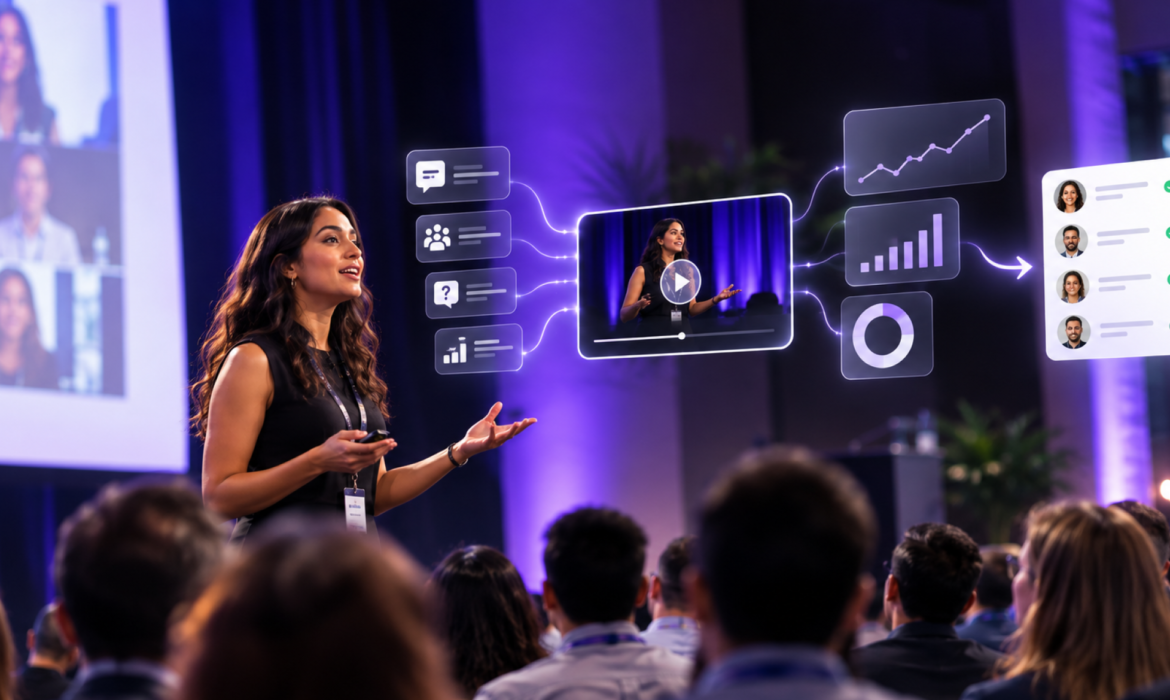
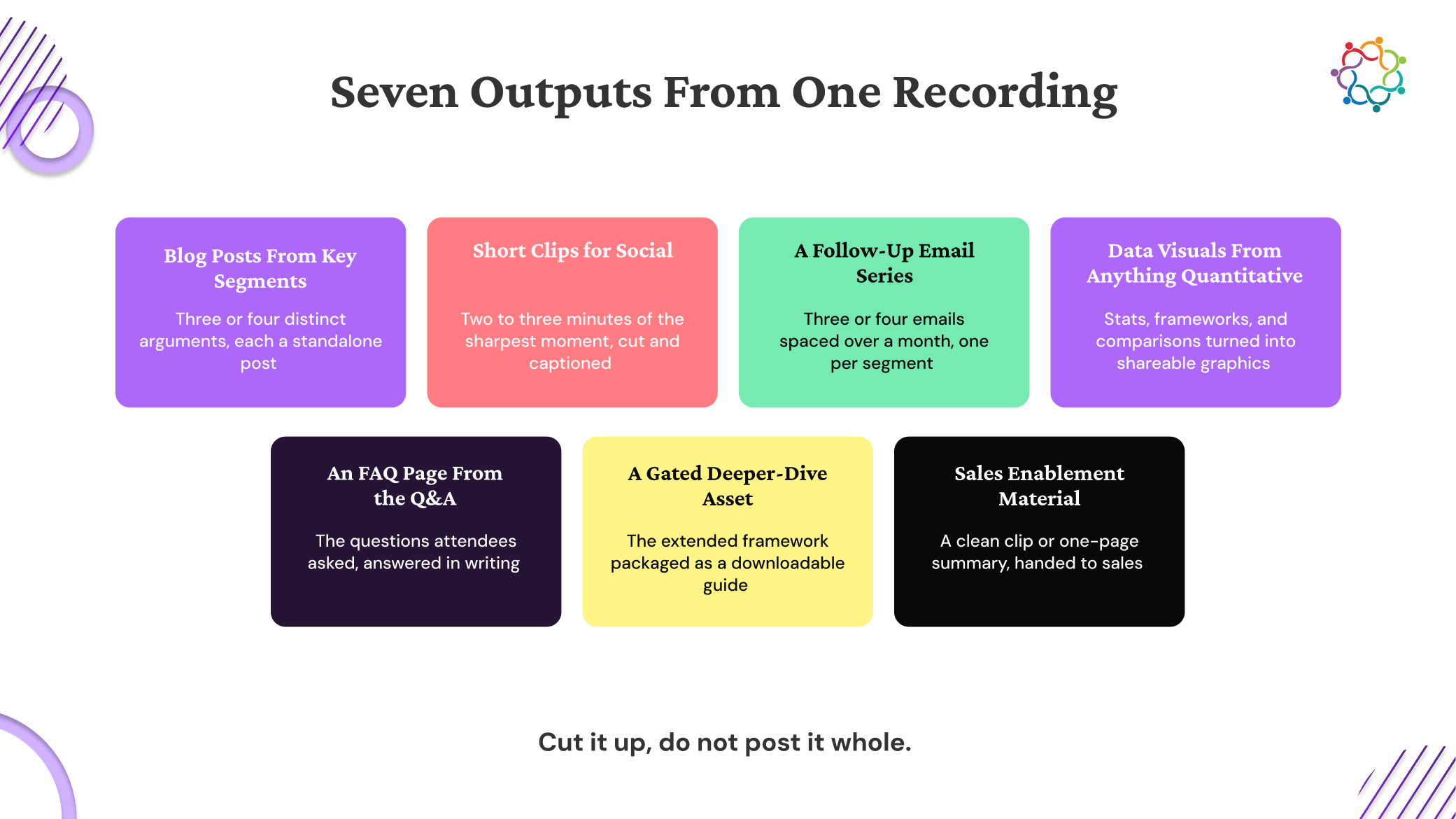
A single event recording can become blog posts, short social clips, a follow-up email series, a set of data visuals, and an FAQ page, all pulled from footage that already exists rather than a content calendar started from scratch. The event already paid for the speaker, the venue, and the production.
The content sitting inside the recording is effectively free, and the only cost left is someone deciding to cut it up.
That’s a rare thing in content marketing: raw material that is already made, already vetted by a live audience, and already yours. Most teams just never open the folder.
Below are the specific ways to turn one recording into a real stretch of content, each one a concrete output you can hand to someone this week.

The trick isn’t producing more. It’s cutting one good recording into its usable parts. Here’s what a single session can become.
Common trap: publishing the full recording once and calling the content plan done. Almost nobody watches a recording end to end. It’s a source to mine, and the value lives in the pieces you pull out of it, so posting the raw file whole captures almost none of what’s there.

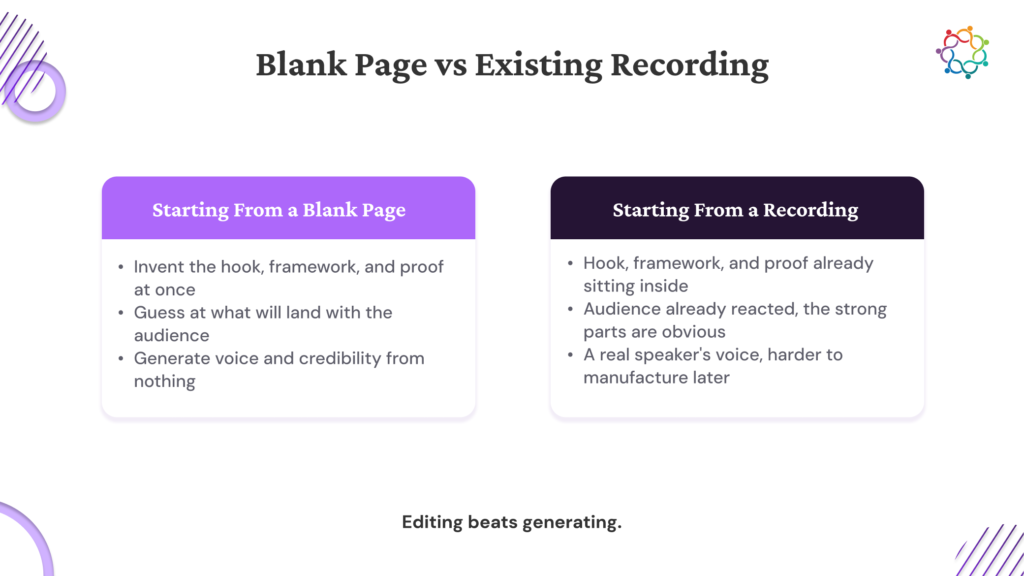
A recorded session has already been through the filtering a blank content brief only guesses at. A speaker prepared it, an audience reacted to it in real time, and the parts that landed are usually obvious from the questions asked and the moments people leaned into. You aren’t inventing what matters; the recording already told you. In effect, the audience did the content research for you, live and for free.
Content written from scratch has to conjure the hook, the framework, and the proof points all at once. A recording already holds all three, sitting there ready to be extracted rather than created. And the credibility of a real expert saying something on camera is hard to manufacture in a blog post written after the fact. Repurposing keeps that voice instead of flattening it into generic prose.
The honest tradeoff is that this isn’t zero effort. Cutting and rewriting still takes real work. But editing material that already exists is a meaningfully smaller lift than generating new material from nothing, and the output usually lands better because it started from something real. That head start shows in the finished piece, which reads with the specificity of something said to a room.

Most teams know repurposing is worth doing and still don’t do it, usually because the extraction step feels like its own production job. It doesn’t have to.

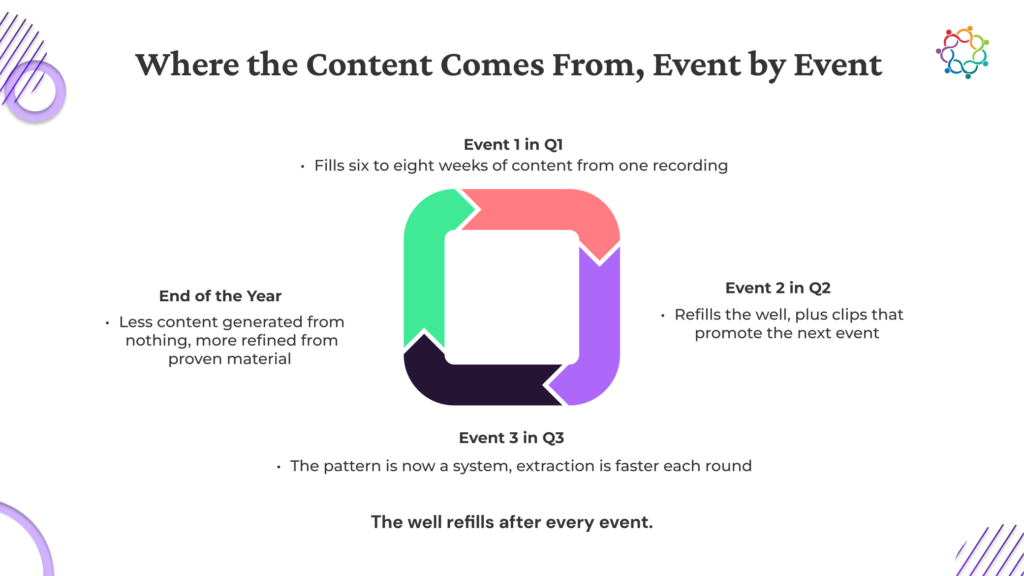
One recording can fill several weeks of a content calendar. A program running multiple events a year has that same well waiting after every single one, compounding with every event you run. Repurposing event content for demand gen stops being a one-off rescue of a single recording and becomes a standing supply line. By the tenth event, the content plan starts from a well that the first nine already filled.
Content built this way also stays tied to the event program itself. Blog posts and clips that reference specific sessions and speakers double as promotion for the next similar event, the way event footage works as a recurring content asset rather than a one-time byproduct.
Over a year, the shift is simple: less time spent generating content from nothing, more time spent refining content that already proved itself with a live audience. That is the quiet compounding most content calendars miss: every event a team runs makes the next quarter of content cheaper to produce than the last.

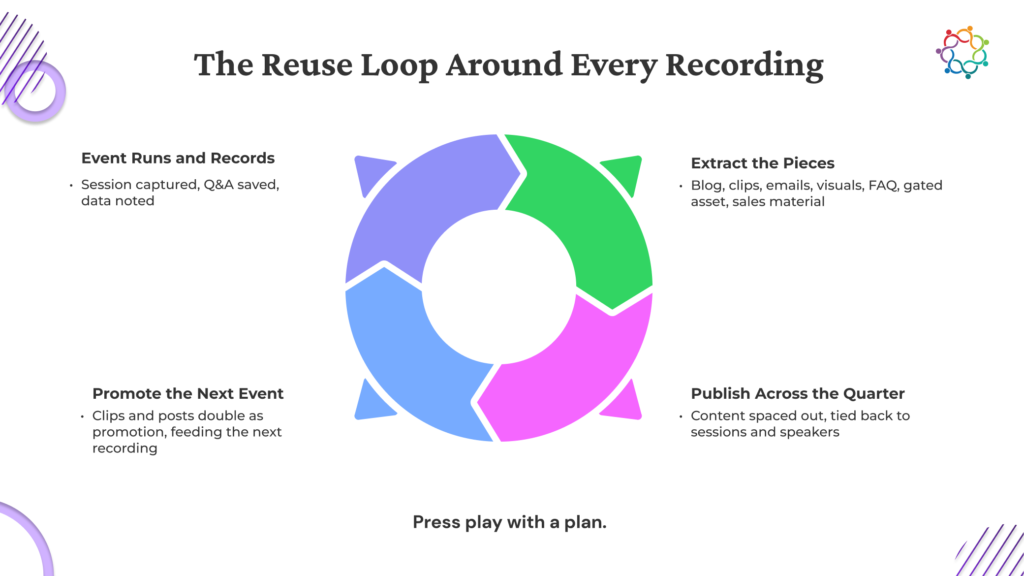
Blog posts, social clips, an email series, data visuals, an FAQ page, a gated asset, and sales material, all pulled from footage already sitting on a drive somewhere. Recordings, session data, and Q&A transcripts usually already live inside the event marketing software you ran the event on, which is the easiest place to start cutting rather than the last place anyone looks.
So open the drive. The footage is already paid for; the only cost left is the hour it takes to press play with a plan and start pulling the pieces out.
If you’d rather have repurposing built into your event process than left as a someday task, that’s a conversation worth having with Samaaro.
1. How does event manager software help you repurpose event recordings?
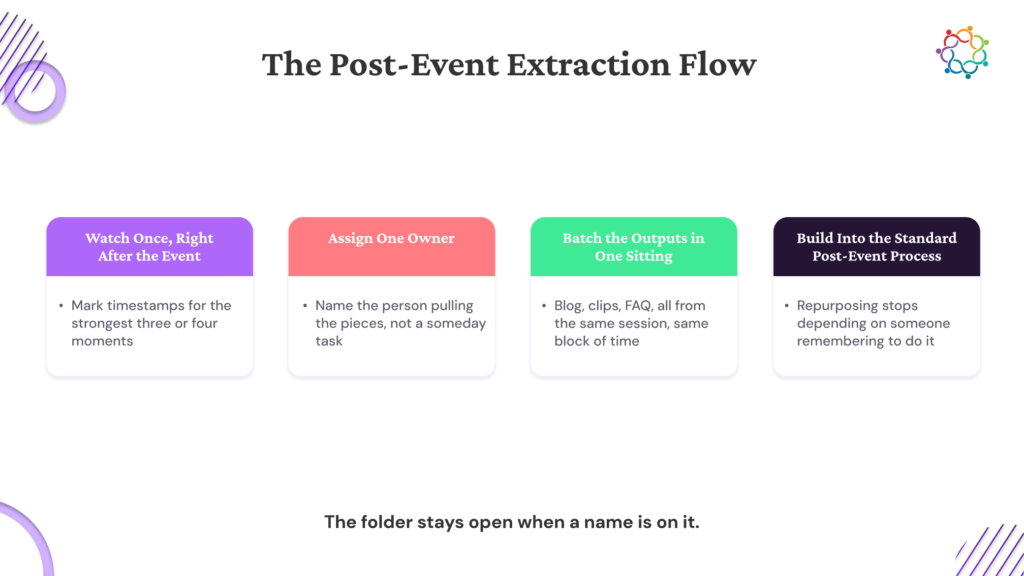
Event manager software keeps every recording and Q&A transcript in one place, so nothing gets lost in folders. You watch a session once, mark the three or four strongest moments, and one person pulls the blog posts, clips, and FAQ from those timestamps. Cutting a whole session’s worth of assets in one sitting gets far easier.
2. Where should event recordings live so they’re easy to repurpose?
Ideally inside the event management app you ran the event on. When recordings, session data, and Q&A sit together rather than scattered across drives, the strongest clips, blog segments, and FAQ questions are quick to find. Repurposing tends to happen when the raw material is one click away, not buried on a drive nobody opens.
3. Can an event planning tool help build a content calendar from event footage?
Yes. A single recording can fill several weeks of a content calendar, and an event planning tool lets you map that out instead of starting from a blank page. By the tenth event, you’re planning around assets that already exist from past sessions, and the repurposed clips and posts double as promotion for the next similar event.
4. How does event coordinator software help get repurposing done?
Event coordinator software makes repurposing a named task rather than a someday intention. The coordinator assigns the timestamps and a due date to one owner, so the folder gets opened after the event. That person batches the blog post, clips, and FAQ from a session together, so the assets ship as a set instead of trickling out over weeks.
5. What should an event management app do with the Q&A from a session?
The live Q&A is a ready-made FAQ, because the questions attendees ask out loud are usually the ones prospects type into search. A good event management app captures those questions cleanly during the session, so you can transcribe and answer them in writing later. That turns one Q&A into evergreen content that earns search traffic for months.
6. Is an event booking app useful for promoting repurposed content?
An event booking app handles registration for the next event, and repurposed clips and posts are what fill the top of that funnel. A sharp two-minute clip or a blog post drawn from a past session gives people a reason to click through and book, so the content you cut from one event helps sell seats to the next.

Samaaro is an AI-powered event marketing platform that enables marketing teams to turn events into a measurable growth channel by planning, promoting, executing, and measuring their business impact.
Location


© 2026 — Samaaro. All Rights Reserved.