Samaaro + Your CRM: Zero Integration Fee for Annual Sign-Ups Until 30 June, 2025
- 00Days
- 00Hrs
- 00Min


Key Takeaways (TL;DR)
1
2
3
→
Bottom Line:
Two hours of preparation buys a fifteen-minute meeting you walk out of with your credibility intact.
An event budget report answers four questions: did we stay on plan, where did the money go, what did it produce, and will you run it again. Have those four ready and the meeting is a report. Build them in the two hours beforehand and it’s a defense.
It’s the Tuesday after your 500-person summit. It went well. Then a calendar invite lands: fifteen minutes with the CFO about the budget.
You have two hours. The spend number is somewhere. Part sits in the registration tool, part in email threads with vendors, one line hangs on a discount you half remember. You build the report in a spreadsheet, and by the time you’re in the room you’re explaining numbers instead of owning them.
Budget defense isn’t about analytics, it’s about readiness.
The pressure is rising. The CMO Survey’s 35th edition, based on 308 marketing leaders at US companies, found that when profits miss expectations 53.1 percent of executives cut costs first, and marketing gets cut 45.4 percent of the time, more than any other category.
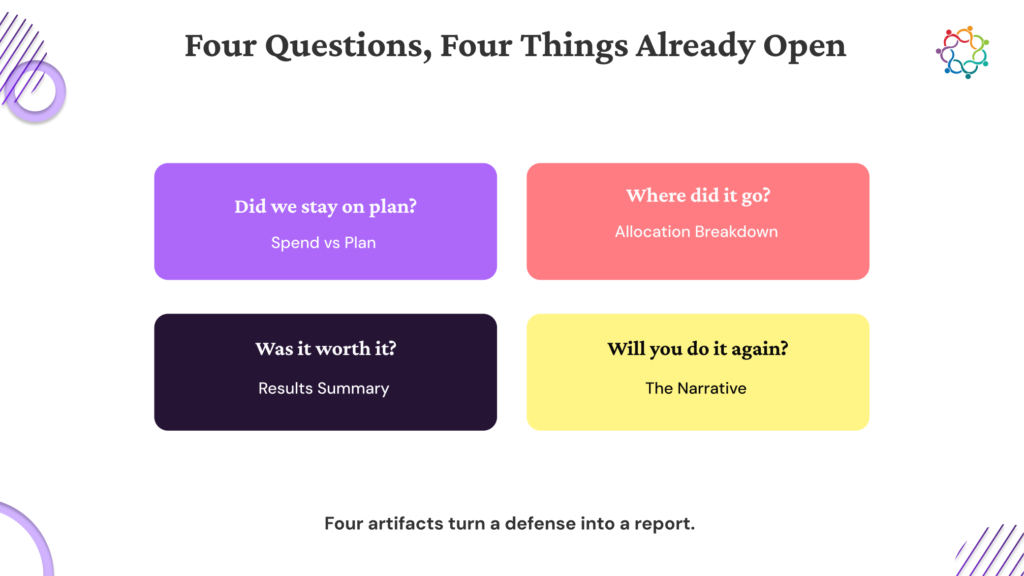
These four cover every question leadership will ask. The figures below are illustrative.
Spend against plan, side by side. One page, two columns, variance visible at a glance.
| Line item | Planned | Actual | Variance |
| Venue | $45,000 | $44,000 | Under $1,000 |
| Catering | $38,000 | $39,000 | Over $1,000 |
| Production and AV | $28,000 | $28,000 | On plan |
| Marketing | $20,000 | $19,000 | Under $1,000 |
| Staffing | $15,000 | $15,000 | On plan |
| Contingency | $4,000 | $2,000 | Under $2,000 |
| Total | $150,000 | $147,000 | Under $3,000 |
Where the money went. Venue at 30 percent, catering at 26, production at 19, each with a reason attached. Not “we spent 45K on venue” but “we spent 45K on venue because that room draws senior attendance.” Be ready to defend anything above 25 percent.
Results tied to spend. Registrations against target, qualified conversations, satisfaction, follow-up requests. Three to five numbers with context, not a dashboard export. “Five hundred registrations, our second-largest to date” lands. A bare figure doesn’t.
The narrative. What you set out to do, what happened, what you’d change. Two minutes, known cold, no script. Most people skip it, and it’s the one leadership listens for, because it says whether you understand the program or just ran it.
Between them: did we stay on plan, where did it go, was it worth it, will you do it again. A structured post-event evaluation makes all four easy to assemble, and the CFO’s event budget question bank covers the follow-up questions this page doesn’t script.
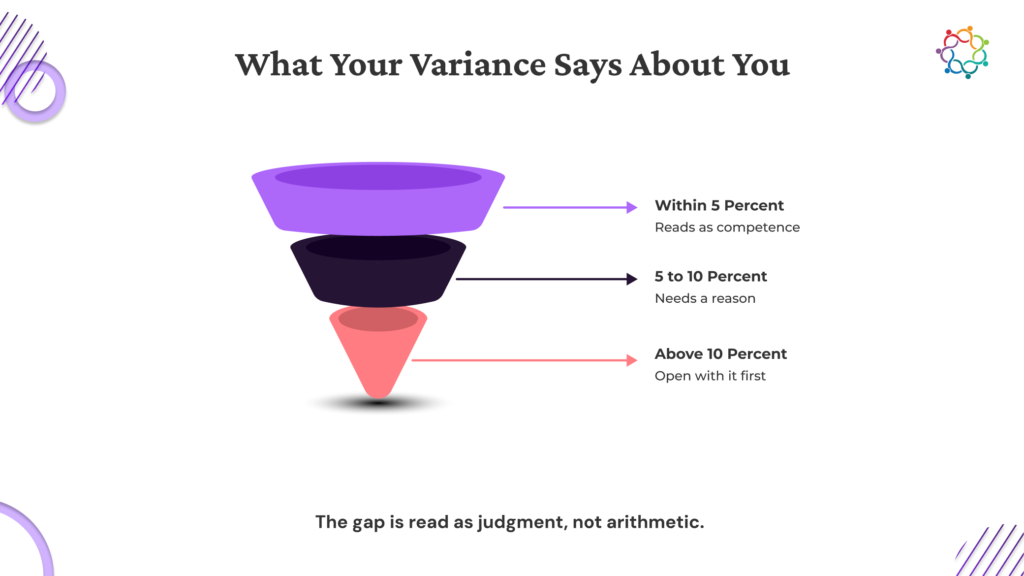
When leadership asks what the event cost, they’re asking whether you knew what you were doing.
Variance is the tell. Inside 5 percent reads as competent planning. Between 5 and 10 percent is fine with a reason, and that reason should be a decision rather than a surprise. Past 10 percent, explain it early, because the worst version is leadership finding it first.
Underspending isn’t automatically good either. Come in 20 percent under and the next question is what you cut. Consistent tracking against plan is what makes these answers available.
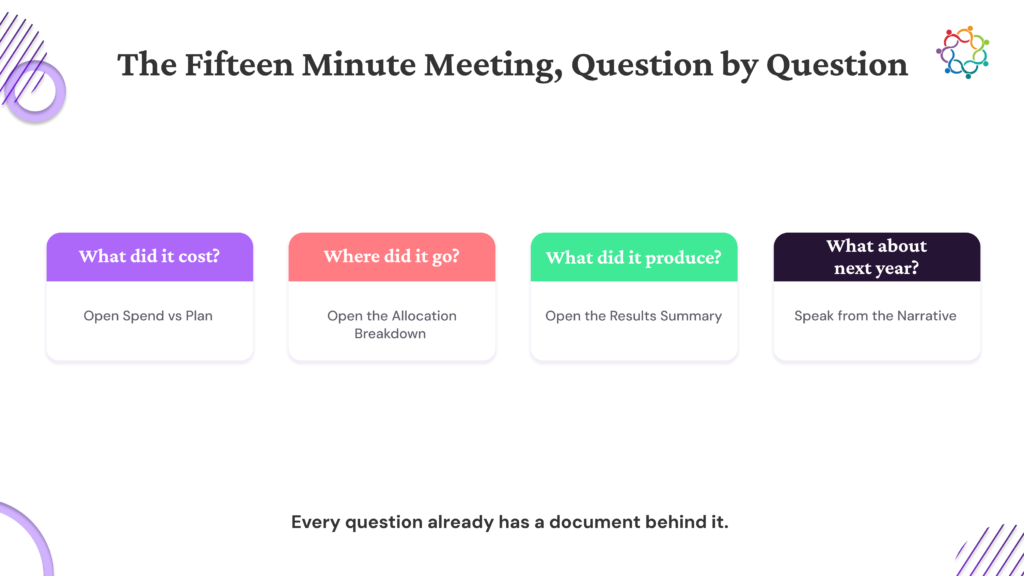
“What did it cost?”
“Planned 150K, actual 147K, 3K under. Here’s the breakdown.” Open the one-pager, then stop talking.
“Where did most of it go?”
“Venue at 30 percent, deliberately. Past events there drew more senior attendance. Catering was second at 26, because last year’s feedback said experience quality was what people remembered.”
“Was it worth it?”
“We targeted 450 registrations and got 500. Twenty-three qualified conversations from the floor, satisfaction at 4.2 out of 5, 45 percent asked for a follow-up.”
“Same approach next year?”
“Mostly. Venue stays, catering stays. Live streaming underperformed, so we’ll move 5K from production into pre-event outreach.”
Four answers, no hesitation. The meeting goes well because the work happened before it.
The results question isn’t asking for a revenue figure. It’s asking whether the event mattered enough to run again.
Quantify what you measured: registrations, satisfaction, downloads, follow-up requests, qualified conversations. Qualify what you can’t: relationships strengthened, feedback that changed a roadmap call. Then name the gaps. “We don’t formally attribute pipeline here, but 23 qualified conversations came out of it and several are progressing” beats a number nobody believes. A clear evaluation method lets you draw that line cleanly.
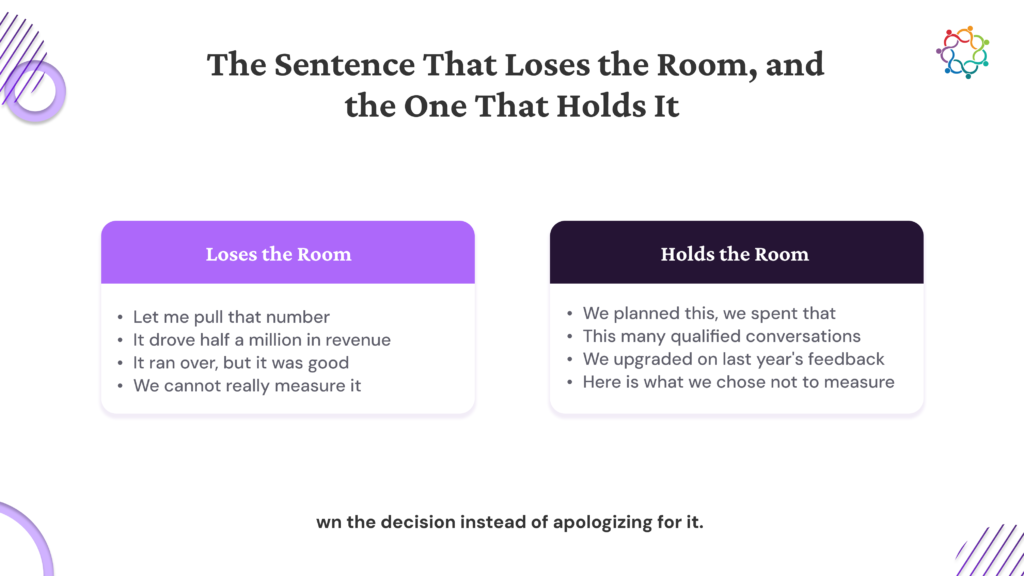
Pulling the number mid-meeting. “Let me find that” tells leadership you haven’t been watching the spend.
Claiming attribution you can’t defend. Say an event drove 500K in revenue and the next question is how you know. If the answer is a guess, you’ve spent credibility you’ll need later.
Apologizing instead of owning it. “Catering ran over, but it was good” is an excuse. “Catering ran 1K over because we upgraded on last year’s feedback, and it’s worth repeating” is a choice.
No link between spend and outcome. If you can’t say what 150K produced, the number is just a cost. Getting event data into the CRM closes that gap.
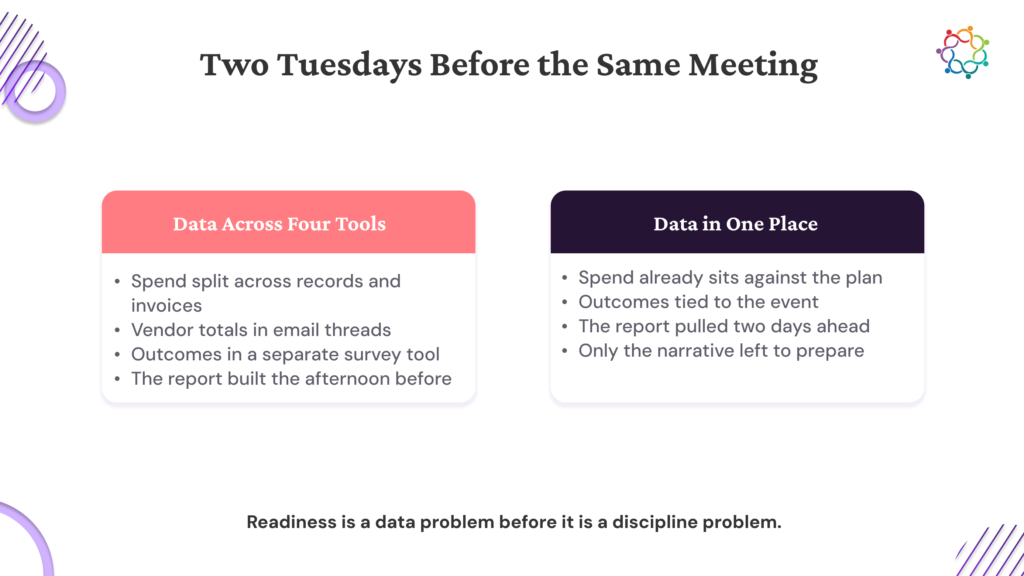
Budget meetings are easy when the data is already assembled.
Across four tools, spend sits in one place, invoices in another, outcomes in a third, registration numbers in a fourth. You stitch them together the afternoon before and walk in half-prepared. Leadership notices.
On one system, you run the report 48 hours out. Spend against plan is there, allocation is visible, outcomes sit beside the money that produced them. That’s the difference between assembling an event budget report and printing one. Not dashboards. Readiness.
Somebody is going to ask what the event cost. That’s fine. The problem is being asked and not knowing.
Two hours of preparation buys a fifteen-minute meeting where you sound like you own the program, because you do. Pull the spend against plan, lay out the allocation, write down the results, rehearse the narrative. If that takes an afternoon every time, the fix is fewer places for numbers to hide. When planned and actual spend sit beside event outcomes in one place, the event budget report stops being something you build and becomes something you run. Worth a conversation with Samaaro before the next review lands.
What is an event budget report?
A four-part summary of what an event cost and what it produced: spend against plan, where the money went, results tied to that spend, and the narrative behind it. Built before the meeting, not during.
When should you prepare an event budget report?
Within two weeks of the event, while invoices are still landing and the detail is fresh. Preparing it after leadership asks is what turns a report into a defense.
How much budget variance is acceptable for an event?
Inside 5 percent reads as solid planning. Between 5 and 10 percent needs a reason, and it should be a decision rather than a surprise. Above 10 percent, explain it before anyone asks.
Can event management software track budgets and results together?
Yes, when spend data and event outcomes sit on one platform. Registrations, attendance, engagement and cost per attendee land together, which makes “was it worth it” answerable without manual reconciliation.
How do I justify event spending without revenue attribution?
Report what you measured and name what you didn’t. Qualified conversations, registrations against target, satisfaction and follow-up requests all hold up. A revenue figure your tracking can’t support costs more than it buys.