Samaaro + Your CRM: Zero Integration Fee for Annual Sign-Ups Until 30 June, 2025
- 00Days
- 00Hrs
- 00Min
Enterprise marketers and CRM managers have transitioned from a technical plug-in to the operational “must-have” of connecting event (or gathering) registration data back into Salesforce, because it makes tracking leads, whether from webinars, conferences or road shows, much easier when the event’s attendee interactions flow into your CRM with Salesforce event integration.
If you do it manually, your organization will be left with fragmented views, delayed follow-ups, and always cleaning spreadsheets to match the reports in Salesforce. If everything is connected, teams can effortlessly follow the campaigns, give buyers tailored experiences, and utilize attributes to create a complete funnel attribution model to analyze ROI from every event. In addition, the emergence of no-code platforms now means that the automation of an integration with your CRM from an event can happen without hesitation, not having to write one line of code.

Step 1: Choose an Event/ Gathering Platform with Native Salesforce Support
The first step is to find a non-profit event platform that has native Salesforce integration out of the box. The most advantageous feature of this option is that it utilizes OAuth-based connectors, availability of APIs, and that it will sync with your Marketing Cloud and Sales Cloud. Some platforms, or event platforms, such as Samaaro, Cvent, and Bizzabo offer native Salesforce support for enterprise level deployments.

Want to see how this would work for you?
30 minutes on how Samaaro syncs registrations and engagement signals directly into Salesforce.
Book a tailored walkthrough →Step 2: Connect Your Salesforce Using Native Reports or integration Panel
When you have selected the right event tool, find the Salesforce integration section in the tool. Sign in with your admin credentials and token to authenticate the connection. Make sure the event platform allows you to configure field-level permissions to limit data privacy and the visibility of sensitive records.
Step 3: Field Mapping (Lead, Contact, Campaign, Custom Objects)
Field mapping is the most likely area to have mistakes, so think it through. Map registration form fields to existing Salesforce fields like Lead Source, Campaign Name, and Custom Tags. Don’t overwrite fields that will get overwritten like Last Activity unless you really need to. Lastly, verify the mappings for phone numbers, job title, and company names will all line up and retain data quality.
Step 4: Test the Integration with Sample Data
Before going live, you will want to test the integration process using sample data. Simulate a person registering for an event. Confirm the lead was created in Salesforce correctly and associated to the event campaign. Lastly, ensure all activity history, source tags, or campaign member statuses are syncing appropriately.
Step 5: Set Automation Rules (Campaign Sync, Lead Assignment, etc.)
This is where the automation starts to happen. Define rules for automatically assigning new leads to owner, adding registrant to specific campaigns, or kicking off a post-event drip campaign. You can also take action using workflows or Process Builder to conduct follow ups on lead records, assign lead scores, and move contact records into nurture tracks based on their engagement scale.

The ability to integrate Salesforce with your event tool can lead to several automation and personalization features.
Some of the most common use-cases include in no particular order:
Samaaro spotlight: Native Salesforce integration without coding
Samaaro makes integrating Salesforce easy with a no-code, OAuth-based connector. With a few clicks, CRM administrators can sync attendee data, create new leads, and include engagement information in real-time.
What makes it different?
For enterprise event marketing teams that are looking for options for no-code CRM integrations that give flexibility, Samaaro is a great solution to help save time and be able to get the most accurate data.

In many cases you have done half the work with the actual integrations – make sure to follow these best practices to ensure your data is clean, compliant, and ready to convert.
You no longer have to plan for custom code or a whole dev team to connect Salesforce to your event workflows! It’s a matter of clicks, not months! Whether it’s syncing leads with your CRM platform of attachment, tracking, attendance, or launching a post event campaign anything that let’s your team work faster, more accurately, and create maximized impact in the pipeline – is better than an event strategy that is not connected to the CRM.
If somehow you figure out how to have your events not connected to your CRM it is time to rethink your even stack. The new generation of tools with simple integration made for Salesforce native, feasible mapping, and real-time sync means your events will not only take your event experiences to the next level – they will create a return on investment (ROI)!
Are you ready to rethink your event stack? Platforms like Samaaro take away the pain
Q1. Can I integrate Salesforce with event tools without technical help?
Yes. Platforms like Samaaro offer guided, no-code integration. You just need admin access to both systems to complete setup.
Q2. How can I make sure there are no duplicates in Salesforce from event registrations?
Use deduplication rules (e.g., based on email or phone number). Map new entries to existing contacts using standard matching logic.
Q3. Is Salesforce Campaign Sync supported for every event tool?
No. Some platforms offer limited campaign sync options. Check for custom object support or built-in campaign member automation.
Q4. How secure is my data during CRM-event sync?
Look for OAuth-based authentication, field-level permission settings, and GDPR-compliant practices. Samaaro, for instance, uses SOC 2–compliant infrastructure.
Integrating Salesforce with an event registration platform turns event data from an isolated record into a pipeline driver. Every registration, attendance, and engagement signal flows into the right Salesforce contact and account in real time, so sales sees who’s hot, marketing attributes pipeline back to events, and finance sees ROI clearly. Without the integration, your event data lives in a vacuum and the ROI question never gets a clear answer.
No-code Salesforce integration works by mapping fields between your event platform and Salesforce through a pre-built connector. You select which event data (registrations, check-ins, sessions, lead scores) flows into which Salesforce objects (Lead, Contact, Campaign, Opportunity), set the sync direction and frequency, and authenticate once. After setup, data flows automatically. Samaaro’s native Salesforce integration handles this without developer involvement.
The data you can sync between Salesforce and event tools includes: registration records, attendance status, session-level engagement, poll and Q&A activity, lead scores, custom form responses, campaign attribution, ticket type, and CRM-side data flowing back like account tier, deal stage, and territory. Two-way sync is what makes the integration valuable. One-way export is just a fancy CSV.
Integration improves lead management by routing event leads to the right rep automatically, scoring them based on engagement (session attendance, booth visits, demo requests), and triggering follow-up workflows in Salesforce the moment they qualify. No more spreadsheets, no more ‘I’ll get to it next week’. Hot leads from an event reach a rep’s inbox within minutes, while engagement is still fresh.
Automating event data flow into CRM saves your team 20 to 40 hours of post-event data cleanup per event, prevents data loss between systems, lets sales follow up while engagement is fresh, gives marketing accurate attribution for pipeline, and creates a single source of truth for campaign ROI. The compounding benefit shows up after your third or fourth event, when the data starts powering audience targeting for the next one.
Before connecting Salesforce and event software, check: which Salesforce edition you have (some integrations need Enterprise+), whether you have admin access to set up the connection, your field-mapping requirements (custom fields included), data deduplication rules, GDPR consent flow, and which user permissions the integration needs. Also confirm the event platform handles two-way sync, not just one-way push. Samaaro’s Salesforce integration is built for enterprise compliance from the start.
Integrating Salesforce turns event registrations from isolated records into useful pipeline data. Every sign-up, check-in, and engagement signal flows straight into the right Salesforce contact and account in real time. Sales sees who is interested, marketing can attribute pipeline to events, and finance sees ROI clearly. Without it, your event data sits in a silo and the ROI question goes unanswered.
Yes. Modern platforms offer no-code, guided integration. You simply map fields between your event tool and Salesforce using a pre-built connector, then authenticate once with admin access to both systems. There is no custom development needed. Samaaro, for example, uses a no-code, secure connector so a CRM admin can set it up in just a few clicks.
You can sync registration records, attendance status, session-level engagement, poll and Q&A activity, lead scores, custom form responses, and campaign attribution. Data can also flow back from Salesforce, like account tier and deal stage. Two-way sync is what makes the integration valuable. A one-way export is really just a fancy spreadsheet that does not update on its own.
Integration routes event leads to the right rep automatically and scores them by engagement, like session attendance or demo requests. Follow-up workflows trigger in Salesforce the moment a lead qualifies. There are no more spreadsheets or delays. Hot leads from your event reach a rep’s inbox within minutes, while their interest is still fresh and easy to act on.
There are five main steps. First, choose an event platform with native Salesforce support. Second, connect and authenticate with your admin credentials. Third, map your form fields to Salesforce fields like Lead Source and Campaign. Fourth, test with sample data to confirm leads create correctly. Fifth, set automation rules for lead assignment, campaign sync, and post-event follow-ups.
In the automation step, you set rules that assign new leads to the right owner automatically. You can also add registrants to specific campaigns and start post-event drip sequences. Using Salesforce workflows or Process Builder, you can score leads and move contacts into nurture tracks based on how they engaged. This removes manual sorting and speeds up your follow-up.
Real-time sync means your Salesforce records update the moment something happens. When attendees check in, their status updates instantly, so sales can follow up while interest is high. There is no lag and no manual export. This gives you accurate, up-to-the-minute data for tracking in-person engagement, prioritizing hot leads, and reporting on event performance without waiting days for spreadsheets.
By automatically adding event attendees to a Salesforce Campaign, you can track their journey alongside your other marketing. Campaign member statuses and custom tags let you see who registered, attended, and engaged. As those contacts become pipeline and revenue, the campaign attributes it back to the event. This gives you a clear, defensible view of your event’s ROI.
The most common challenge is field mapping, where data gets sent to the wrong place, so plan your mapping carefully and avoid overwriting fields. Duplicate records are another, fixed with deduplication rules based on email. Watch for security and consent gaps too. Test with sample data before going live, and check your edition and admin access up front to avoid surprises.
Plan your field mapping in advance and standardize inputs across all event forms. Use deduplication rules based on email or contact ID, which most platforms support natively, so existing contacts get matched rather than duplicated. Only create custom fields when truly needed, since over-customizing makes things harder to manage. Testing with sample data first catches mapping errors before they spread.
As we approach 2025, marketing leaders are feeling more pressure than ever. With smaller budgets and narrowed teams, CMOs are expected to deliver pipeline productivity, brand recognition, and customer engagement – simultaneously!
Events are still one of the most effective activations in the marketing arsenal. They are also among the most expensive. Without pre-planning and efficient execution, you might as well be flushing money down the toilet.
The problem is not only around cost, but waste. Many enterprise teams spend lakhs on events only to find under-leveraged assets, excessive manual work streams, and leads to nowhere.
So the path forward? Start to build a smarter approach that reduces waste and cost before it happens.

Let’s look at the five most common budget-wasting mistakes and how to fix them without expanding your team.
One platform for registration, more email, another for check-in, a CRM, feedback, and perhaps an event app for attendee engagement! Before you know it, your event stack has expanded to a series of logins, hand-synced, and user license fees amassed.
Tool sprawl does not just inflate costs, it breaks the data. Teams waste countless hours piecing together insights from a disconnected event stack which effectively turns reporting on spend accountability into a guessing game.
The problem is even more profound when you consider the duplications built into this approach. There is a possibility that you’ll pay for several tools with overlapping features such as RSVP, reminders, or feedback collection, simply because no one had visibility across the entire stack.
Even in large corporations, it is surprisingly common to see guest management happening in Excel. Teams manually update RSVP lists, confirm attendees via WhatsApp, and then either print or export CSVs to print badges or follow-up emails.
This is not only inefficient, but it is also risky. One unintentional error could lead to a very embarrassing situation on the day of the event. Beyond that, manual processes obviously slow down reporting, slow down follow-ups, and make it more difficult to measure ROI.
If your team is still making phone calls to confirm attendance, or is still checking names manually when attendees arrive at the venue, you are wasting precious hours that could be automated.
You booked the venue, built out a great agenda, and sent 5,000 invites. But on event day, a third of the room is empty, or worse, you have flooded the room with people who are not decision-makers.
This is a result of sending invites to an outdated database list, irrelevant contacts, or broad audiences without segmentation.
The result is high cost per attendee, low conversion, and missed pipeline targets.
It’s not about an increased number of attendees. It’s about having the right attendees. Poor targeting wastes budget and also wastes your sales team’s time (when and if they follow-up post-event).
Your event ends, the team celebrates, and then silence.
Susan is not sending automated thank you emails, there is no lead scoring, no reminders for sales.All of the work invested in the event evaporates before it produces business impact. Without proper post-event strategy, you are simply paying for branding, not pipeline.
This is where ROI goes quietly to die: in the hours and days following the event when the momentum could have turned into meetings, but didn’t.
A good agency can be a tremendous partner, especially when you are executing complicated, labor intensive events, but when internal teams just hand everything over, with no oversight into what is being done, when, or at what cost, you can run afoul of the budget really soon.
You will usually run into duplicated efforts, slow feedback loops, and limited access to data. For a brand that is executing multiple events a year, this model is almost completely unsustainable.
Without a real-time dashboard or internal awareness, you will not only add costs every time you request a change, but also cannot identify nor implement optimizations.

Instead of running six different platforms for registration, RSVP, communications for guests, check-in, feedback, and to sync CRM, use an integrated event platform, like Samaaro.
Consolidating your event stack will automatically reduce subscriptions and manhours for data management. In addition, you will give your marketing teams a single dashboard to track performance in real-time, which lessens their necessary dependence on ops or IT.
Consolidated platforms also mitigate compliance risk, improve the experience for attendees, and enable you to manage everything from a single pane of glass.
Stop manually sending invites one-by-one and confirming guests by hand! You can utilize automation to schedule RSVP emails to trigger automatically, remind attendees based on user actions, and check-in attendees through automatic dynamic QR codes.
For example, Samaaro allows you to see RSVP status in real-time; your team would be able to see who has or hasn’t signed up, it will also follow up automatically without any manual effort at all.
Two teams using an automated RSVP workflow can save up to 70% time and make fewer mistakes on event day.
By connecting your event platform to your CRM, you will target attendees smarter. You could send invites on lead score, industry, or prior engagement, to ensure that every seat is taken by someone worth converting.
Connecting a CRM also enables you to track in real-time who attended, engaged, and what attendees you have to follow up with. No more guessing. You will know what accounts are warming up, and which will require your attention after the event.
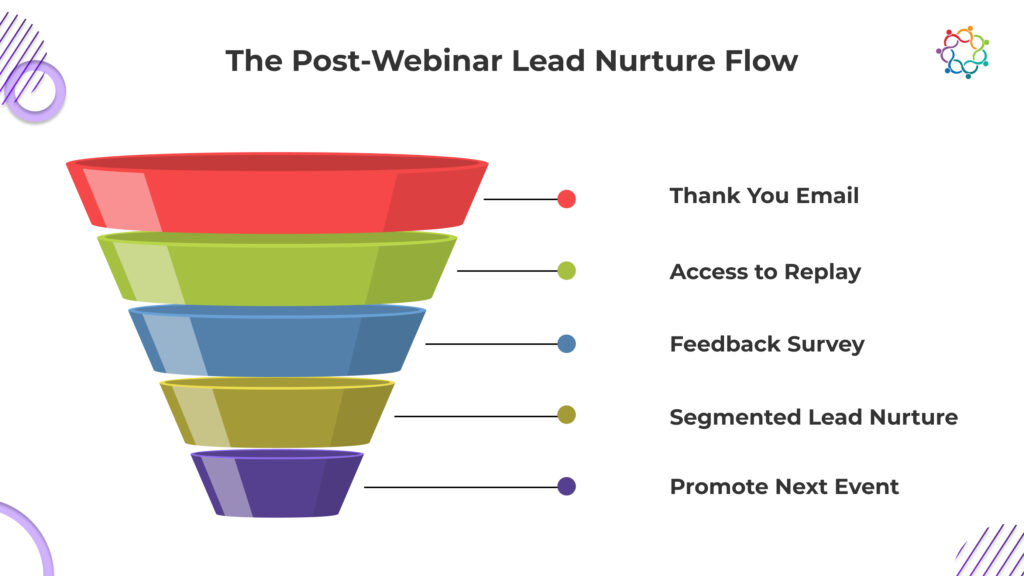
Event follow up doesn’t have to be manual. With some proper tools, you can have things like scheduling thank you emails, assigning leads or accounts to sales, and deploying feedback forms automatically once an attendee starts to check out.
Dashboards will show who engaged with your emails, who completed your surveys, and who dropped out, allowing marketing and sales teams to engage with even more knowledge during or after the event.If you’re unsure how to develop a feedback loop post-event, check out this guide on efficient event marketing budget management, which discusses how automation is key for conversion.
It doesn’t matter if you have an agency or want to monitor things in-house, dashboards matter! The benefit of dashboards is the ability to see real-time data such as budget spend or vendor quality, attendee satisfaction, lead quality, and so on.
When you use something like Samaaro with campaign level reporting you can quickly show ROI to your CFO or leadership team without scouring the web for updates; visibility allows you to prevent scope creep, avoid unnecessary spend on vendors, and generally avoid campaigns that don’t deliver ROI.
If you host reputation events, consider doing more in-house using smart event tech. It will be more cost efficient long-term and allow for change in your operation rhythm.

In most cases budget waste is not about one horrendous error on your part, it’s about hundreds of small inefficiencies. Systems that don’t speak to one another, lists that are not updated, follow-ups that never go out.
But that’s the sweet spot, once you’ve removed these inefficiencies you will be off to the races with your ROI.
Here’s what real teams have seen through fixing their event ops:
In 2025 efficient budget management is not about saving money, it’s about leveraging your tools and dollars in a manner that is beneficial to your corporation. For an enterprise event marketer moving toward less manual work and less spend is everything; it is the difference between the distinction of hosting a successful event or a revenue producing event.
The thoughtful process of auditing your technology stack and workflows in a timely and thorough manner must happen in order to know where the overlaps in your technology are and where you are duplicating work.
After you have undertaken this exercise, consolidating platforms, automating RSVP and check-in processes, and more robust follow-up post-event will expedite both time and money. You also will have real-time dashboards to know how much you are spending per event and other important data related to converting events into leads e.g., attendee satisfaction and quality of leads generated, so you are able to make more informed, more quickly, smarter decisions post event.
So, the best CMOs will not be those that spend the money we currently budget toward event experiences, but the ones that know how to spend the money that leads to the greatest return.
Tool sprawl means using separate tools for registration, email, check-in, and analytics. Overlapping subscriptions, integration costs, and duplicated data quietly drain event marketing budgets.
Manual spreadsheets cause duplicate invites, missed RSVPs, outdated guest lists, and hours of avoidable work. One wrong cell can embarrass your brand with a key account.
CRM integration reveals who is engaged and relevant, so invitations reach people likely to attend. Smarter targeting directly reduces empty seats and wasted event spend.
Teams routinely save dozens of hours per event by automating RSVP tracking, reminders, and check-in. That time goes back into strategy and attendee experience.
Consolidating into one platform cuts subscription costs, removes integration headaches, and creates a single source of truth for reporting across every event.
Trust is the foundation of every property sale, and nothing builds trust like in-person connection. Open houses, launch events, and curated site visits give prospects a tangible experience of a property, helping them envision life in that space. These moments drive higher lead conversion and reinforce brand credibility.
Yet in 2025, managing real estate events at scale using spreadsheets and email chains is no longer effective. With multiple locations, segmented audiences, and tight timelines, traditional processes fall short. That is where event tech enters the picture as the digital backbone for real estate marketing teams. Platforms with built-in RSVP systems, real-time lead capture, and scheduling sales meetings ensure a smoother attendee experience and better ROI.
Effective event tools handle every stage, from gated invites for broker events to seamless on-site check-ins at launch events. They combine site visit scheduling with follow-up automation to ensure no opportunity slips away. For marketing heads and CXOs, adopting the right tech means turning events into scalable revenue engines without operational chaos.

To select the best solution for real estate, evaluate tools that support your unique workflows:
Real estate events are often gated, only brokers, investors, or registered buyers should attend. Tools with advanced RSVP features help segment guests, handle repeat registrants, and prevent no-shows through targeted reminders.
On-site navigation matters. Attendees appreciate seeing a property map, floor plans, and brochures on their phones. Mobile apps also enable live polls, surveys, or direct messaging with a sales rep.
Booking site visits can feel like managing calendars manually. The right tool integrates appointment slots with sales teams and SMS reminders to reduce no-shows and improve flow.
Talk about auto-assigning tokens to the guests when the check-in at the venue and matching them with sales/relationship managers is essential for such a tool.
Capture prospects’ data on-site and sync it directly with CRMs or WhatsApp for instant follow-up. Look for customizable forms that work offline when connectivity is limited.
For multi-location or recurring events, recreating the same emails, RSVP flows, and on-site workflows is inefficient. Leading platforms eliminate this redundancy by allowing teams to replicate entire event setups, saving time and ensuring consistency.
Event platforms with automated email or SMS campaigns post-event ensure every lead receives staged follow-ups, saving marketing operations from manual outreach and improving conversion.
These features address key real estate pain points, reducing no-shows, improving lead quality, and ensuring consistent brand experiences across launch events.
Here are five platforms ideal for real estate teams in 2025:
1. Samaaro
Pros: Tailored to site visits and launch events. Offers RSVP automation for brokers & buyers, omni-channel communication, queue management for on-site operations, and real-time lead capture with CRM integrations.
Best for: Real-estate developers and agencies managing multi-city campaigns.
2. Cvent
Pros: Enterprise-grade data and reporting. Ideal for lead capture at scale.
Cons: limited customization, steep learning curve and relatively expensive cost per registration.
Best for: Established real estate firms with large internal tech teams.
3. VFairs
Pros: Strong customer support and tailored solutions.
Cons: long setup time and overall platform complexity that may challenge new users.
Best For: established real-estate firms with focus on online events.
4. Zoho Backstage
Pros: Good for basic workflows and easy integration with Zoho CRM.
Cons: Limited customisations, not suitable for complex workflows, poor customer support.
Best for: Small real-estate teams looking to get started with event marketing.
5. Hubilo
Pros: Supports both physical and hybrid events with interactive engagement features.
Cons: Pricing may not match needs of small events Poor usability & missing features.
Best for: Brand launch events with both in-person and digital audiences.
These platforms range from enterprise-grade to lightweight tools. Depending on how frequently you host events and how complex your processes are, one of these solutions will align with your goals.

We’ve already mentioned Samaaro in the comparison table. Here’s a deeper look at why it fits real estate teams perfectly:
Developers can set up workflows for property launches, site visits, and broker briefings with automated invitations & reminders via email and WhatsApp. This makes planning faster and less dependent on manual coordination.
Launch an event in London? Clone it across Dubai, Tokyo and New York with a few clicks, updating location-specific details only. This feature is especially helpful for builders with repeat formats across different regions.
Each event page can include the project map, brochure download, site photos, CTA buttons, and contact options, all styled to your brand. No additional design team needed.
Track registrations, check-ins, site visits booked, source channels, and lead quality in real time. You no longer have to wait until the end of the event to understand what’s working.
Samaaro syncs seamlessly with Salesforce, HubSpot, and Dynamic 365. If you don’t use a CRM, the inbuilt guest list manager lets you tag, filter, and follow up with attendees directly from the dashboard.
100+ global brands, including Modon Properties and Property Finder, trust Samaaro to power their real estate launch events, reducing operational costs by 12% while managing over 250,000 guests worldwide.
If you want to explore how Samaaro can power your real estate events end-to-end, check out dedicated solution for real estate.
Samaaro offers RSVP automation, queue management, and CRM-integrated lead capture, making it ideal for real estate developers and agencies managing multi-city campaigns.
Cvent stands out for its enterprise-grade reporting and scalable lead capture capabilities. However, it comes with limited customisation options, a steep learning curve, and a relatively high cost per registration.
VFairs is known for its strong customer support and tailored solutions, but it has a long setup time and platform complexity that may challenge new users.
Zoho Backstage supports basic workflows and integrates easily with Zoho CRM. On the downside, it has limited customisation options, is not suitable for complex workflows, and receives poor customer support.
Hubilo caters to physical and hybrid events with interactive engagement features. That said, its pricing may not align with smaller event needs, and users report poor usability and missing features.

This chart helps you quickly compare your top options across pricing and functionality. For high-frequency, multi-city campaigns, tools like Samaaro offer the right mix of automation and flexibility. For single property showcases, lightweight platforms may suffice.
The real estate industry thrives on high-touch events, site visits, launches, expos that drive leads and build buyer confidence. But for marketing teams, managing these events at scale is often slow, fragmented, and resource heavy. That’s where event tech steps in streamlining operations, reducing manual coordination, and enabling consistent, high-impact engagement across every touchpoint.
Choosing the right platform is not just a tech decision, it’s a strategic one. You’re not just looking for tools, you’re investing in smoother launches, better conversions, and data-driven visibility across the buyer journey.
Start by mapping out your event flow: How often do you host launches? Are site visits a bottleneck? Do you lose track of leads post-event? Then, identify the features that matter most, RSVP automation, mobile check-ins, CRM sync, WhatsApp follow-ups. Match your needs to a platform’s strengths, test it during a mid-scale event, and scale up once you’re confident. Platforms like Samaaro are designed to handle the end-to-end complexity of modern property events. From branded experiences to follow-up automation, it helps real estate brands go from chaos to consistency, and from footfall to booked sales.
In 2025, the brands that win will be the ones that treat events not just as a marketing channel, but as an engine for revenue. Let the tech do the heavy lifting, and let your team focus on selling smarter.
In the past, event success was basically based on foot traffic, registrations and social chatter. Fast forward to 2026, marketing leaders are no longer tasked with just building awareness, they need to show revenue impact, which means you will need to connect event marketing KPIs to commercial metrics.
Modern event strategies require more than a great creative and full house. Smarter data is needed, not just after the fact, but while the event is happening. The point is not to just tabulate who was there, but what they did, and more importantly, how they moved along the funnel. This is the point where you should stop talking vanity metrics and use event performance metrics that enable better strategic decisions, better targeting, and ultimately, better ROI.
With 2026 fast approaching, if you will be planning or measuring events consider these 7 KPIs that truly matter:

1. Attendance Rate (%): Formula: (Actual Attendees ÷ Registrants) × 100
This simple percentage is a direct measurement of how compelling or worthwhile your event was to your intended audience. A low attendance percentage can signal real problems – weak message, weak target, too many invites etc. In 2026, since every registration will represent a real marketing spend investment, this will give a sense for effectiveness in message-to-action commitment.
2. Cost Per Attendee: Formula: Total Event Cost ÷ Attendees
This KPI speaks directly to fiscal responsibility or budget efficiency in context – was the cost per invitee efficient in line with other events/format types. Whether you have do an investor dinner, or a 5-city road show, knowing your cost per attendee, and budgeting relative to the past can keep you in control of your spending and measure benchmarking across formats.
3.Lead Conversion Rate
Formula: (Leads from event ÷ Total attendees) x 100
Among the top event ROI measures, this measures how effectively participants engaged beyond passive attendance and translated to pipeline. If you create a CRM sync, this is where the real attribution begins.
4. Engagement Rate
Instead of a passive headcount, ask: how involved were they? Track metrics below, including but not limited to:
High engagement metrics indicate your event content resonated with the audience. If the numbers are low, this is your signal to revisit your agenda design or channel execution.
5. Net Promoter Score (NPS)
Event post-surveys that ask the question, “How likely are you to recommend this event?” give you a clear, quantifiable measurement of brand development and attendee sentiment. NPS is a great way to get an immediate and powerful sense of long-term brand value and impact.
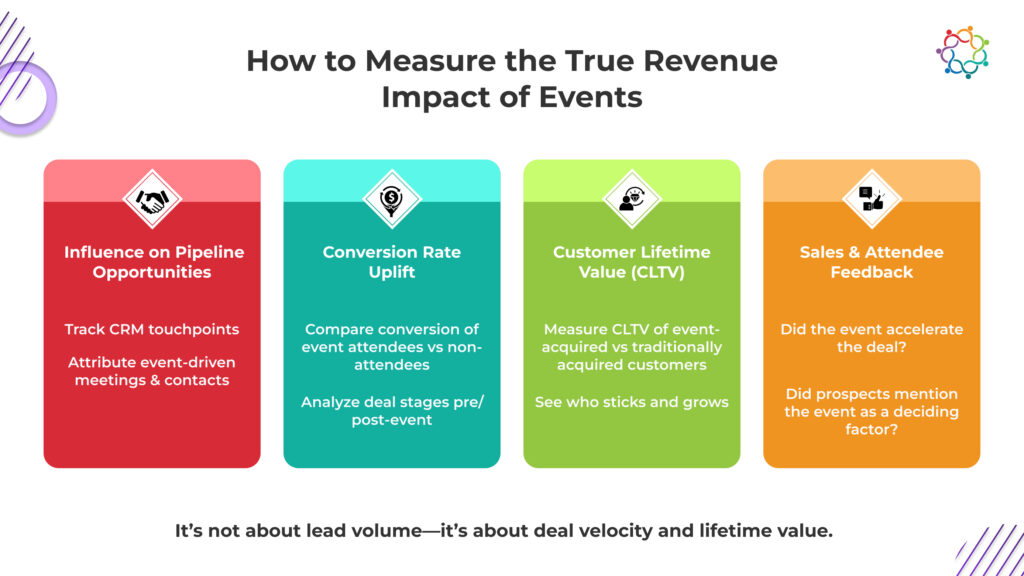
6. Pipeline Influence or Revenue Attribution
This is the holy grail for CMOs. Use your CRM (Customer Relationship Management) tool and event platform integration for any of the three tracking aspects below, including but not limited to:
Tools like Samaaro make it easy to sync these touchpoints into your Salesforce or HubSpot dashboards.
7. Feedback Submission Rate
This one might be overlooked, but how many attendees filled out your feedback forms? No matter how you ask for feedback, this is a measurement of attendee investment to the event.It also indicates how effectively you prompted to encourage post-action events, which is a fundamental component of any event cycle.

Today’s event marketing success relies on utility and seamless tracking from tool to tool. Here’s how the best-performing teams create the configuration required:
CRM Platforms – (Salesforce, HubSpot)
Tracking lead status, revenue influence, and continued nurture post-event is CRUCIAL for event ROI measurement and lead scoring from your event.
Event Tech Platforms – (Samaaro, Cvent)
Provide live dashboards displaying attendance, engagement, check-in status, and session drop-off rates. Some platforms, like Samaaro, take it a step further by integrating directly with marketing automation and feedback tools.
Analytics Suites – (Google Analytics, Mixpanel)
Used for tracking traffic source, conversions from the promotional page, and post-event web actions like demo requests or resource downloads.
Survey Tools – (Typeform, Samaaro Feedback Manager)
Used for tracking NPS, speaker feedback, content rating, etc. The Samaaro Feedback Manager was built for enterprise-level data capturing and dashboard integration.
Unlike most platforms that focus only on pre-event workflows, Samaaro gives equal importance to performance analytics and post-event insights helping you measure success every step of the way. Here’s how Samaaro drives real-time event KPI tracking for your campaigns:
This level of visibility enables event marketers to make data-driven decisions in real time, refine strategies while events are still live, and generate actionable post-event insights that validate every decision with measurable impact.

Tracking event KPIs is not just about reporting, but also about every event becoming progressively smarter. In 2026, marketing teams can’t rely just on gut instinct or guesswork for your post-event insights. Every single touchpoint is there for a reason, every indicator has a story, and every insight can help shape our next big win.
As a reminder, marketers using an event platform like Samaaro for tracking KPIs can much more than a singular event metrics measures, and imaging true clarity from overall impact from KPI, from invite to impact (i.e. deployment of invitation for either demand generation roadshows or investor networking dinners). Real-time dashboard, CRM syncing, audience insights, visuals, etc. are now baseline expectation, not an enhancement or add on.
So why guess when you can just start tracking event performance to get the real measures of success?
The most important event marketing KPIs to track in 2026 are: registration conversion rate, attendance rate, session engagement rate, lead-to-pipeline conversion, cost per qualified lead, NPS, and event-influenced revenue. These seven cover the full funnel from interest to revenue. Avoid stopping at vanity metrics like total registrations or social impressions, because those don’t tell your CFO whether the event was worth running.
Businesses connect attendance metrics with pipeline influence and revenue attribution by syncing every attendee record directly into the CRM. Once registrations, check-ins, session attendance, and engagement scores live in Salesforce or HubSpot, sales can see which deals were touched by which event, and finance can attribute revenue. Without this CRM sync, attendance numbers and pipeline live in separate worlds and the ROI question never gets answered.
For evaluating campaign performance across email, social media, paid ads, and partnerships, the KPIs that matter most are: registrations per channel, cost per registration per channel, channel-to-attendance conversion rate, and pipeline contribution per channel. This lets you compare a $5,000 LinkedIn ad campaign against a free partner co-promotion on equal footing and see which actually built pipeline.
Event marketing KPIs help optimise engagement, lead quality, and conversion at every stage. Before the event, registration KPIs show which segments are converting and which need a nudge. During the event, engagement KPIs like session attendance and poll participation surface high-intent leads in real time. After the event, lead quality and conversion KPIs tell you which attendees became pipeline, so next time you target more people like them.
For corporate and B2B events, the best tools for tracking event marketing KPIs in real time are AI-powered event marketing platforms with built-in dashboards that pull data from registration, on-site, app engagement, and CRM into one view. Samaaro is built for this exact use case, with real-time dashboards, AI insights, and native integrations into Salesforce, HubSpot, Marketo, and Microsoft Dynamics 365.
Event marketers avoid vanity metrics by asking one question of every KPI: does this number help leadership decide whether to invest in the next event? Total impressions don’t. Pipeline influenced does. Cost per lead does. NPS from your target accounts does. Strip your dashboard down to 5 to 7 metrics that connect event spend to business outcomes, and let everything else be supporting detail.
The blog highlights seven KPIs worth tracking in 2026: attendance rate, cost per attendee, lead conversion rate, engagement, NPS, pipeline influence or revenue attribution, and feedback submission rate. Together they cover the full journey from showing up to driving revenue. The key shift is moving past vanity metrics toward numbers that show real business impact.
The most important KPIs connect attendance to revenue. Watch registration and attendance rate, engagement, lead-to-pipeline conversion, cost per lead, NPS, and event-influenced revenue. These tell leadership whether the event was worth running. The blog warns against stopping at vanity metrics like total registrations or social chatter, because those do not answer the ROI question your CFO actually cares about.
They form a connected story across the event journey. Before the event, registration and traffic KPIs show which audiences are converting. During the event, engagement KPIs like session attendance and poll participation surface high-intent leads. After the event, lead quality, conversion, and revenue KPIs prove impact. Tracked together across the lifecycle, they give a complete picture instead of isolated snapshots.
Two core metrics matter here. Attendance rate, which is actual attendees divided by registrants, shows how compelling your event was and flags weak messaging or targeting. Cost per attendee, total cost divided by attendees, shows budget efficiency and lets you benchmark across event formats. Watching both before and during the event keeps your spending and your turnout under control.
Engagement metrics show how involved attendees really were, beyond just showing up, by tracking participation in sessions, polls, and Q&A. High engagement means your content resonated, while low engagement signals you should revisit the agenda. NPS, from asking how likely people are to recommend the event, gives a quick, quantifiable read on satisfaction and long-term brand value.
Lead conversion rate and pipeline influence are the critical post-event KPIs. Lead conversion, leads from the event divided by attendees, shows how well attendance turned into real interest. Pipeline influence and revenue attribution, tracked by syncing event data into your CRM, reveal sourced revenue and influenced deals. These are the numbers that connect the event directly to business outcomes.
Website traffic and registration conversion KPIs show whether your pre-event promotion is working. Using analytics tools, you can track which channels send qualified traffic to your promotional page and how many of those visitors actually register. If traffic is high but conversions are low, your page or offer needs work. These KPIs help you fix pre-event marketing before spend is wasted.
ROI compares what the event cost against the revenue it influenced. By pairing cost per attendee with pipeline and revenue attribution from your CRM, you can show real value for money rather than just activity. This is the metric leadership cares about most, because it proves whether the event was a worthwhile investment and helps justify the budget for the next one.
Feedback submission rate, how many attendees actually filled out your feedback forms, is easy to overlook but revealing. A high rate signals genuine investment in the event and shows you prompted people effectively for post-event action. A low rate suggests weak engagement or poor follow-up. Since collecting feedback is central to improving every event, tracking this rate is genuinely useful.
Real-time tracking turns data into action during the event, not just after it. Live dashboards show registrations, check-ins, engagement heat maps, session attendance, and drop-offs as they happen. So you can spot a fading session, redirect traffic, or adjust messaging on the spot. Instead of waiting for a post-event report, you fix problems while there is still time to matter.
Enterprise event teams managing conferences, summits, roadshows or executive roundtables are finding it harder to handle RSVP’s manually. With big guest lists, different teams and continual changes, keeping things organized takes significant time. RSVP automation lets teams track invitations, responses, reminders, and attendance details in one place, while making the experience seamless for visitors.
It also provides for easy personalization of communication by attendee type, area or funnel stage and visibility of answers to teams. They can see who’s responded, who needs a nudge, and where to focus. The more complicated event programs get, the more that RSVP automation frees marketing and field staff to spend less time monitoring lists and more time making meaningful connections and delivering event outcomes.

Manual RSVP processes break at scale. A 50-person webinar works fine with spreadsheets. A 5,000-person conference? Impossible.
Here’s what breaks: spreadsheet chaos. Your planner manages RSVPs in three different places. Guest list errors. Someone gets invited twice. Someone doesn’t get invited at all. Your CRM doesn’t sync. Marketing doesn’t know who actually said yes. Sales team doesn’t know. Email confirmations go out late or not at all. No one knows the actual headcount until the event starts.
Automated RSVP systems handle this. Confirmations send immediately. Your CRM syncs in real time. Marketing, sales, and operations all see the same data. Reminders go out automatically. Cancellations update everything instantly.

Manual RSVP management creates six major problems.

Here are the platforms actually solving RSVP automation in 2026.
Samaaro
cvent
Eventbrite
RSVPify
Sizzabo

Automated RSVP workflows deliver six concrete benefits.

Samaaro connects the entire RSVP workflow in one platform. Here’s what that looks like.
Ask yourself three questions.
Use Samaaro’s RSVP management system to automate the entire workflow without jumping between five tools.
Expect one to two weeks from setup to live. Create RSVP forms. Configure email templates. Set up CRM sync. Test workflows. Then launch.
Most time comes from CRM integration. One week of that. The rest takes days.
Automation buys you back time. It buys you data accuracy. It improves attendee experience. It makes events run smoothly at scale.
Manual RSVP processes fail at scale. Automated workflows grow with you. A tool that handles 100 registrations handles 10,000 the same way.
Start with your next event. See what automation does. You’ll never go back to spreadsheets.
Ready to automate your RSVP workflow? Learn how Samaaro combines registration, CRM and event logistics in one platform. Book a demo today to observe RSVP automation in action.
Why can’t we just use a spreadsheet for RSVPs?
Spreadsheets work for small events but break at scale. No automatic syncing. Manual updates. Version conflicts. CRM doesn’t connect. Reminders don’t send automatically. At 500+ RSVPs, spreadsheets create chaos.
How long does RSVP automation take to set up?
Most platforms take one to two weeks. Creating forms takes one day. Email templates take two days. CRM sync takes five to seven days. Testing takes two to three days. Then you launch.
Do all RSVP tools integrate with Salesforce and HubSpot?
No. Samaaro has a native integration. cvent has API. Eventbrite does not integrate well with CRM. RSVPify and Sizzabo has simple integrations. Before you decide, know how crucial CRM sync is.
What happens when someone cancels their RSVP?
Automated systems update the dashboard immediately. Your CRM gets notified. Catering counts adjust. Session capacity updates. Seating changes. All automatically. No manual intervention needed.
How do automated systems prevent no-shows?
They send reminders automatically. 48 hours before. 24 hours before. 1 hour before. Email and SMS. They can also use predictive analytics to identify who’s likely to no-show based on past behavior.
Can we customize RSVP workflows for different event types?
Yes. Most tools let you create different forms for different events. Different questions. Different workflows. Different approval steps. You build once. Reuse across events.
The event industry is moving faster than ever. What worked just one or two years ago might already be an afterthought by 2025. Between AI, hyper-personalization, and hybrid event models, marketers can no longer make a living off outdated event promotion methods. If marketers want to see success, they’ll need to cut through the noise by employing strategies that are based on real data, emerging technologies, and audience-first thinking.
In this blog, we look at the most impactful event marketing strategies you’ll need to be aware of in 2025. You’ll learn everything from data-driven event marketing and retargeting best practices to the most practical examples of AI in event marketing and more. You’ll learn practical tools to make the most out of your spending, provide truly awesome attendee experiences, and maximize ROI. Whether you’re doing large-scale conference promotion or virtual event marketing strategies, or small B2B gatherings, you’ll be able to leverage the content in this blog.

No longer are event marketers dependent on only instincts, good feelings, or even vanity metrics like registrants, in 2025, effective marketing strategies incorporate real-time data, predictive analytics, and insight at a company-wide level.
Modern event platforms provide much more than just a report on registrations. Marketers can now determine how many clicks happened in-platform, how many actually attended sessions, how much content was engaged with, and can even see heat maps of attendee behavior when various kinds of events are implemented.
Predictive analytics provided marketers with great insights so they can predict attendance rates, alongside which sessions they may expect to have more attendees show up. When considering attendee engagement, predictive analytics can alert marketers to possible attendee churn risks to allow them to affect programmatic or marketing changes before a problem occurs.
Customer Data Platforms (CDPs) have become a great asset, since through one-ever increasing source of truth for every attendee through the collating of data from CRMs, social media feeds, event apps, and websites, segmentation and personalization become much more effective.

2025 demands more than simple segmentation. With unified data, marketers can create highly individualized attendee journeys, recommending sessions, networking opportunities, and relevant content based on user profiles and real-time behavior.
With dynamic content delivery, email messages, event websites, and apps can dynamically adjust based on the user’s areas of interest. If a registrant shows interest in a keynote speaker, for instance, they may receive their own notifications, articles related to this keynote speaker, and further exclusive meet and greet opportunity messaging.
ROI is no longer just about leads. In 2025, event success is equally measured by Return on Relationships (ROR) tracking attendee satisfaction, brand loyalty, and long-term community engagement.
In 2025, event marketing no longer operates in isolated silos. Today’s buyers and attendees interact with multiple touchpoints before making decisions, from clicking a social ad, attending a webinar, visiting a sponsor booth, reading a blog post, engaging with emails, to finally registering or converting post-event. Traditional attribution models that only credit the “last click” fail to capture the complexity of this journey.
Multi-touch attribution offers a much broader perspective. You can assign value to every significant touch that plays a part in the attendee’s decision and acknowledge that many marketing efforts, across channels and over time, work together cumulatively.
For instance, if a prospect first learned about the event through a LinkedIn post, saw an email follow-up, then encountered remarketing ads – and then ultimately registered the event after a personal invitation, you can credit the entire process!
In 2025, event marketers can fully endorse multi-touch attribution to gain unparalleled transparency and clarity around the true effectiveness of their work. With clarity and transparency comes the ability to allocate budgets effectively, personalize audiences purposefully, and have the marketing, sales, and event operations teams on the same page as they connect to drive conversions (in the short term) and loyalty (in the long term).

Retargeting remains one of the most effective tools in an event marketer’s toolkit, but in 2025, it’s smarter, more segmented, and more omnichannel than ever.
Today’s event marketers segment audiences into much smaller, highly granular audiences instead of embarking on broad retargeting lists. They target visitors who abandoned the registration process, past attendees who have not yet registered for the current year, prospects who viewed only specific speaker profiles, and pricing pages, and even attendees that engaged with only certain sessions or sponsors during a previous event. Marketers can automate retargeting as event registration was triggered with respect to specific behaviors. An example is downloading an event brochure or displaying interest by clicking on pricing information without completing a registration.
AI enables highly customized retargeting ads:
The best event marketing will be occurring in 2025. It will use multiple channels at the same time to let prospects engage with the event wherever they are in the attendee journey. Email retargeting serves these people by sending abandoned registration emails or sending personalized follow-up content based on the user’s previous actions. Social media retargeting accomplishes the same thing using sophisticated advertising tools like Facebook Custom Audiences and LinkedIn Matched Audiences to serve a very hot group of interested followers.
You will continue to see video retargeting as marketers use inviting short videos through ads on platforms like YouTube, TikTok and Instagram Reels to grab people’s attention and spur action. A final retargeting strategy called sequential retargeting, offers a deliberate order/series of ads that tell a story, or build excitement and urgency for marketing events based on the progression leading up to the day of the event. Each interaction will push the prospect closer to registered attendees, and consequently engagement in the future.
With so much personalization, it’s critical to prevent ad fatigue. Frequency capping ensures prospects aren’t bombarded, keeping engagement high and maintaining positive brand sentiment.

AI is no longer a future concept in event promotion, it’s now a daily tool for leading marketers.
Marketers use AI for first-pass drafts of:
AI models trained on brand tone ensure messaging stays consistent across channels.
AI also supports rapid A/B testing by generating multiple variations of copy, allowing marketers to quickly identify which versions resonate with different audience segments.
With AI, marketers can personalize at scale:
Today, marketers are employing a variety of Large Language Models (LLMs), like ChatGPT and Jasper for brainstorming and content creation, as well as summarizing text. As for design, AI tools like Canva AI and Adobe’s AI capabilities enable marketers to develop banners, social images, and presentation slides for events quickly and effectively. When it comes to video, AI-generated promotional videos are possible using avatars, autogenerated scripts, and speech synthesis that can drastically improve the efficiency of the entire production process.

While AI accelerates content creation, human oversight is irreplaceable for creativity, empathy, and strategic alignment. Ethical considerations around data use, bias, and authenticity also require careful governance.
The event marketing strategies that will dominate 2025 and beyond are clear:
But while technology is advancing rapidly, the heart of every successful event remains unchanged: meaningful human connection.
In 2025, event marketing is no longer rule-based, but rather agile, innovative, and precise. The ability of marketers to utilize real-time, predictive data enables them to glean event attendee behavior and adjust their modelling accordingly. AI is developing new levels of personalization and unique relevance for individuals, while omnichannel retargeting keeps the conversation happening on all platforms and devices. Hybrid formats are a mainstay, combining the broader reach of virtual with the intimacy of human interaction in face-to-face or in-person events.
But amid all this, one thing does not change: meaningful human connection is at the heart of a successful event.
Technology is the enabler, but memorable experiences, impactful interactions, and genuine community building are the true drivers of sustained success.
Event marketers who can balance between new technology and the focuses of attendee experience will be able to deliver measurable ROI, cultivate loyalty, and continue to deliver powerful and memorable experiences, so whether you’re experimenting with AI-driven content or refining your retargeting campaigns, it’s important to lean on insights that go beyond hype. This detailed guide on event marketing in 2025 offers a realistic look at what strategies are delivering ROI this year.
In the world of event marketing, bigger is not always better. Micro-events, small-scale gatherings like intimate workshops, networking meetups, or leadership roundtables with 10 to 100 attendees, are emerging as powerful tools for engagement, especially for businesses looking to make a big impact without spending a fortune.
But there is a catch. While micro-events are more affordable than large conferences, they still require sharp planning and tighter budget control to yield high returns. Without a clear budgeting strategy, costs can spiral, and the event’s purpose may be diluted. This is especially important in today’s competitive landscape, where every rupee spent on events needs to show results, whether in the form of leads, brand visibility, or strengthened relationships.
Return on investment (ROI) for micro-events looks different from that of large-scale activations. You’re not chasing thousands of sign-ups. Instead, you’re measuring engagement, lead quality, brand resonance, and conversion potential.
This blog walks you through smart strategies for budgeting for micro-events. From selecting cost-effective venues and catering options to leveraging affordable marketing tactics and entertainment ideas, you will learn how to plan events that pack a punch without draining your budget.
Budgeting for Micro-events requires limited resources to be divided across five key areas: venue, catering, marketing, entertainment, and other costs like permits, décor, or equipment. In larger events, each piece has a dedicated team to manage its allotment, but large team sizes together with the need to multitask in event planning generally mean that micro-events use smaller stands of service, and when you are operating a very lean team, upfront clarity on budgets is paramount.
For small events, ROI isn’t just about ticket sales or footfall. It includes metrics like:
You don’t need thousands in attendance to make a dent. A targeted micro-event that draws 25 decision-makers and converts 10 into sales meetings is a massive success. According to a 2024 Eventbrite study, 65% of micro-event planners prioritize ROI through attendee engagement, not volume.
Most micro-events operate within a budget of ?40,000 to ?4,00,000. This means every line item must justify its value. Cost-efficiency allows you to stretch the impact of your limited funds, scale smarter, and run more events throughout the year without compromising on quality.

You may find that public libraries, coworking spaces, local community centers, or art galleries offer free or low-cost spaces for events. These spaces may also have built-in infrastructure that can help save on the setup costs, such as chairs and AV equipment, and restrooms.
While it may not be free, some local cafés, bookstores, or boutique stores may be open to you hosting your event, and in exchange they receive promotional consideration. A win-win! You have a vibrant backdrop for your event and they receive promotional visibility through you. Just make sure the audience you are trying to attract is in line with their clientele.
Make sure to ask about off-peak rates. You never know what the price will be to rent something. You may have prices 30% or 50% lower to do your event on some weekday morning or afternoon than on the weekend. If you plan to do a series of events, try to create a deal for multiple bookings.
When we have no budget for a venue, go virtual. There are so many choices, like Zoom or Samaaro, that are very low-cost (with built-in engagement tools) platforms that allow you to host interactive online events. Consider hybrid events. A small audience can be present in the venue with a bigger audience connected virtually, which can allow you to have local venue costs that can be competently staffed not putting your event budget into the stratosphere.

Full meals are not always necessary. Light refreshments such as tea, coffee, pastries, or finger foods can create a warm atmosphere without overshooting your budget. Focus on quality over quantity.
Local bakeries, tiffin services, or food trucks offer cost-effective, personalized options. Many are open to creating special packages for events. Plus, you’re supporting small businesses in the process.
Buying snacks or beverages in bulk from wholesale retailers and assembling them yourself is another budget-friendly alternative. Assign team members or volunteers to handle setup and serving.
Reach out to local food brands or beverage companies who may sponsor your catering in exchange for signage, sampling opportunities, or social media mentions.
Example: A women’s entrepreneur circle in Bengaluru served hand-made granola bars from a local startup that sponsored the catering in return for booth space and post-event features.

Leverage free platforms like Instagram, LinkedIn, and WhatsApp. Create event countdowns, behind-the-scenes teasers, speaker intros, and audience shoutouts. Use Stories and Reels to build excitement and post consistently during the lead-up.
For contact lists under 500, free versions of Mailchimp or Sender can help you send professional-looking invites, reminders, and follow-ups. Segment your lists to personalize content.
Tap into hyperlocal platforms like Facebook Groups, LinkedIn communities, and Nextdoor. You can also partner with resident welfare associations, societies, or coworking groups to distribute flyers digitally or in person.
Provide registrants with pre-written social media templates and event hashtags. Run simple contests like “Share this post for a chance to win exclusive merch.”
Example: A solopreneur used a viral “Coffee with Founders” video invite on LinkedIn to bring in 50 attendees for a ?0 marketing spend.

Search for emerging talent, stand-up comedians, acoustic singers, storytellers, or TEDx-style speakers. They charge significantly less than mainstream performers and bring local flavor to your event.
Networking games, peer-to-peer interviews, product demo corners, or icebreaker questions make the event more engaging and are often free to implement.
Playing a pre-recorded keynote or panel discussion during your event allows you to showcase big names without flying them in. Pair this with live Q&A or breakout rooms to maintain interactivity.
Offer small bands, artists, or YouTubers a platform to perform in exchange for visibility. Tag them in your post-event videos and offer professional recordings for their portfolios.
Example: A startup hub in Hyderabad booked an up-and-coming stand-up comic for ?7,000 who brought their own following and spiked attendance by 25%.
Micro-event budgeting does not mean cheap. It means being intentional, tactical, and resourceful with every rupee you spend. When micro-events are done well, a ?25,000 investment could potentially offer connections and conversions that are worth lakhs.
With some creative thinking, like using low- or no-cost locations, simple but memorable catering, community entertainers, and organic social media reach, these events can be both impactful and affordable. The only challenge is knowing how to spend and where to spend.
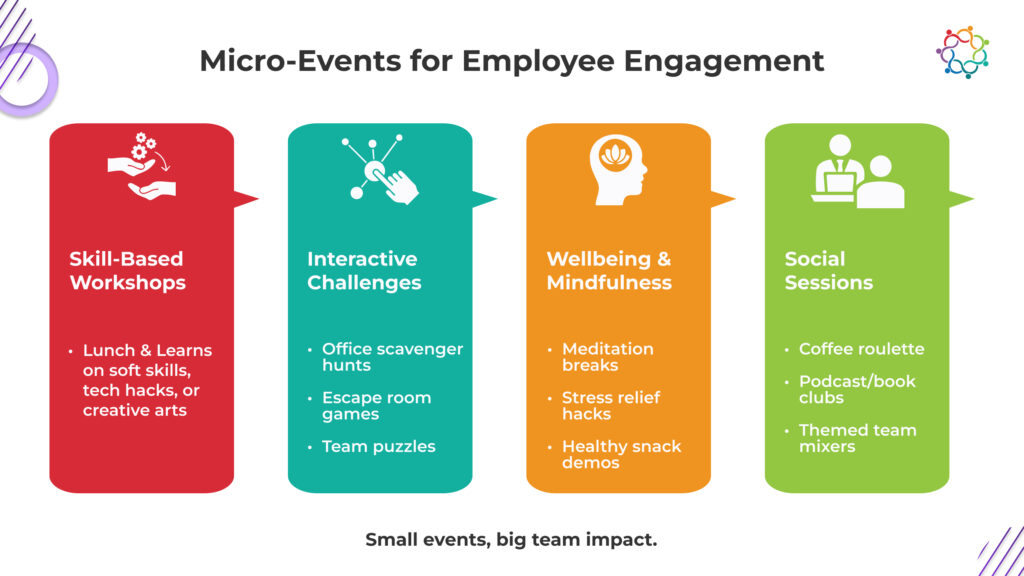
Need ideas to get started? Our post on 20 engaging micro-event formats for corporate teams and leadership in 2025 is packed with actionable formats that balance creativity with cost-efficiency.
Small budget? No problem. With smart planning, your next micro-event could be your most profitable one yet.
MICE tourism, which stands for meetings, incentives, conferences, and exhibitions, is quickly becoming one of the most influential and lucrative global sectors of the travel and hospitality sectors. For destinations with a focus on promoting business tourism, not only do the economies enjoy economic stability, but they typically have a higher quality of infrastructure and also generate greater international awareness or exposure.
In fact, research shows that MICE travellers can spend more than leisure tourists will often stay in higher value accommodation, use multiple services and visit during non-peak peak periods.
Cities such as Singapore and Dubai have shown how a concerted effort that focuses on MICE tourism can transform a city into a global events city. Through long term investment in infrastructure (built environment), memorable branding and the establishment of public-private partnerships, they attracted thousands of delegates every year bringing much needed revenue, employment and brand.
For any destination, large or small, developing a MICE tourism strategy can unlock similar potential. This blog provides a comprehensive guide to help you understand the MICE market, assess infrastructure, forge key partnerships, create targeted marketing campaigns, and deliver high-impact events that encourage repeat visits. Whether your city is just beginning to explore this space or aiming to scale existing efforts, the following steps will help you build a sustainable and high-performing MICE tourism plan.

A successful MICE tourism strategy begins with understanding who your ideal audience is and what kind of events your destination can realistically support. The MICE sector includes a wide range of event formats, corporate board meetings, trade exhibitions, incentive trips, and international congresses, and not all are equally suited to every destination.
Research information from reliable sources such as the International Congress and Convention Association (ICCA) or the Global Association of the Exhibition Industry (UFI). This will help you identify high value sectors like health care, finance, or technology to help guide your strategy related to market demand. For example, if your city is known for health care or has great universities, you would want to see if there is a possibility to focus on bidding for medical conferences.
Research what other destinations, especially similarly sized destinations are doing to attract MICE events, including competition and collaborations. What types of venues do they have, what types of incentive packages do they offer, do they have government support, and do they have an international ranking? You should outline what your competitive advantages are – affordability, culture, location, etc.
MICE planners frequently rely on infrastructure, visa facilitation, safety and sustainability, and technology. Attendees are weighing a mix of functional and experiential needs. Attendees want to meet with others for quality networking, have smooth logistics, enjoy some cultural experiences, and satisfy their curiosity. Destinations strive to meet and exceed expectations for each.

Infrastructure is a cornerstone of any MICE tourism strategy. A destination must be equipped to handle business events efficiently and at scale, offering both functionality and comfort to planners and participants.
Carry out a full inventory of current resources, including convention centres, business hotels and transport systems, and identify the number of meeting rooms, capacity, availability of high-speed internet, language services and accessibility. Don’t forget to assess the infrastructure for hybrid or virtual events, an increasingly present menu of options.
Wherever there are gaps, increase your investment to upgrade to contemporary industry standards, including modular meeting rooms, audio-visual systems, live-streaming capabilities and on-site technical support. In the age of smart tourism, destinations that adopt smart infrastructure are capable of hosting a wider breadth of events.
Make sure visitors arrive seamlessly through airport and rail connections and public transport. Build or add inventory to include every level of accommodation from business friendly budget stays to a luxury five-star experience, again with an eye to flexibility for different delegate profiles.
Sustainable tourism is no longer a fad, and has quickly become an expectation. Work with venues and vendors to incorporate sustainable mechanisms such as digital check-in systems, reusable decorations, locally sourced menus and environmental waste disposal. These go a long way in maximizing chances to be shortlisted for international events.
Example
Dubai upgraded its Dubai World Trade Centre with advanced AV capabilities and obtained sustainability certifications, allowing it to host international exhibitions with tens of thousands of attendees. The investment paid off, with the city becoming a preferred host for global industry expos.

Strong partnerships are at the core of every successful MICE tourism plan. Partnerships create a richer resource base with one shared message for event developers.
Work with local hotels, restaurants, transportation companies, museums, attractions, and even universities to create a bundled MICE offering. A bundle can combine discounted accommodation rates with vibrant local experiences, significantly enhancing the value for potential customers.
Work with some of the global associations like the Meetings Professionals International (MPI), Professional Convention Management Association (PCMA), and ICCA. By engaging with their specific events or supplying their meetings and conferences with a platform, it raises the profile of your destination and adds credibility to your offer.
Lobby your public sector to contribute in terms of permitting access, providing funds for local events, offering subsidies for travel, or helping with regional promotions. When local governments provide public support to MICE initiatives in your destination, it demonstrates to international meeting planners that MICE in your destination is serious business.
Professional Conference Organisers provide experience, networks, and logistics to be able to offer fully-fledged services. They are able to bear a lot of the workload with the partners working with the PCO, apply the local stakeholder, but also ensure international standards are maintained.
Example
Barcelona collaborated with local universities to host academic conferences in life sciences. This positioned the city as a global education and research hub, attracting recurring scientific events and increasing delegate footfall by 35 percent over three years.

Even a MICE-ready destination must have an effective marketing strategy to inform potential event organisers about their offerings.
Build a clear identity that showcases your distinct advantages. For example, you could brand your city as “Ahmedabad: The Heritage Hub for Conferences” or “Kochi: The Sustainable Destination for International Events”. Your MICE brand needs to resonate with international planners and reflect your city’s core strengths.
Use search engine optimised content targeting search terms like “promoting MICE tourism” or “marketing strategies for MICE destinations”. Use stand alone pages, create blogs and maintain fun content via LinkedIn to encourage engagement with planners. Use testimonials, videos, and case studies from past events.
If you can bring top tier planners to your destination, that is a big advantage. Familiarisation trips provide the opportunity for planners to evaluate venues, meet service providers, and evaluate the whole experience–eventually making it easy for them to book.
Demonstrate metrics like numbers of delegates, organiser ROI and revenue to the city. There are success stories for tech summits, trade expositions, or incentive programmes that have showcased value.
Example
Las Vegas created LinkedIn campaigns showcasing its convention infrastructure and even hosted virtual fam trips. Within a year, they saw a 15 percent rise in international event enquiries and secured multiple multi-day bookings.

Want to see how this would work for you?
See how DMOs and CVBs use Samaaro for destination promotion, bid tracking, and group delivery.
Book a tailored walkthrough →The long-term value proposition in implementing your strategy is dependent upon attracting events as well as executing them successfully.
Travel, venue access, AV set-up, and registration should all go according to plan, as well as any emergency intervention; therefore, you will need to appoint a MICE liaison officer to mediate between the organisers and local authorities.
Maximise for business event experiences: Make it worse with local authenticity: Local culture (i.e. cultural shows, local food, local handicrafts/exhibitions), day trips to local heritage attractions or sites. If attendees are geographically immersed, it can amplify attendee satisfaction and event word-of-mouth.
Analyse feedback: Post event surveys will give you data about what was good and what can improve. After the event, you should reach out to organisers so they are encouraged to come back and increase relationship longevity.
Analysing/surveys: total spend, overnight stays, attendee satisfaction surveys, and post event media coverage; we will be able to provide some insight, for our own evaluative strategy use, strategy benchmarking and demonstrate the value we provide and develop for public sector stakeholders.
Example
A leading IT conference held in Goa ended with a gala featuring Goan cuisine and live Konkani music. The experience became a viral talking point, and 95 percent of attendees rated it “excellent” on post-event surveys.
An effective MICE tourism strategy can significantly shape the economic trajectory of a destination. It generates year-round demand, strengthens infrastructure through increased connectivity, drives regional development, and opens the door to global exposure. Whether your city is aiming to host international conferences or local industry expos, success lies in a structured approach, grounded in market research, infrastructure readiness, strong partnerships, focused marketing, and flawless execution.
Begin by targeting regional associations or niche industries where your destination already has a competitive edge. Build credibility through successful smaller-scale events before expanding into national and international territory. For a deeper dive into how to measure and optimize your strategy, explore our comprehensive guide to MICE event ROI.
With the right foundation in place, your destination can emerge as a leading MICE hub, creating jobs, boosting the economy, and putting your region on the global map.
A MICE tourism strategy is a destination-level plan to attract Meetings, Incentives, Conferences, and Exhibitions to your city, region, or country. It typically combines venue and infrastructure development, marketing to corporate planners and association buyers, government incentives, partnerships with hotels and event tech providers, and a long-term plan to position the destination as a top choice for business events.
MICE tourism is important for destinations because business travellers spend significantly more than leisure travellers (often 3 to 5x per trip), drive year-round demand (not just peak season), fill hotel inventory midweek, generate ancillary spend on dining, transport, and tourism, and put the destination on the map for future leisure visits. A single conference of 5,000 attendees can drive tens of millions in local economic impact.
The core elements of a strong MICE strategy are: world-class venue infrastructure (convention centres, hotels, transport links), a dedicated convention bureau, government incentives like subvention funding, marketing to corporate planners and associations, partnerships with destination management companies, a clear value proposition (cost, accessibility, experience, or industry expertise), and measurable KPIs around events won, attendee volume, and economic impact.
Destinations attract more business events by building a dedicated convention bureau, offering financial incentives (venue subsidies, marketing support, attendee transport discounts), investing in unique local experiences planners can build into agendas, showcasing past event success stories, attending industry trade shows like IMEX and IBTM, and forging relationships with association decision-makers years before the bid date.
Partnerships are central to MICE tourism growth because no destination wins business events alone. Convention bureaus partner with hotels, venues, ground transport, event tech providers, security firms, and tourism boards. Government partnerships unlock funding and policy support. Airline partnerships create attendee travel deals. Industry association partnerships open doors to recurring events. The destinations that win consistently are the ones with the strongest local ecosystems.
Success in MICE tourism marketing is measured by: number of bids submitted, win rate, total events hosted per year, attendee volume, average attendee spend, total economic impact, hotel room nights generated, repeat event rate, and brand awareness within the planner community. Track these year over year and benchmark against competing destinations to know whether your strategy is working.
MICE stands for Meetings, Incentives, Conferences, and Exhibitions, and MICE tourism is the business of attracting these events to a city or region. It matters because business travelers tend to spend more than leisure tourists, stay in higher-value hotels, and visit in off-peak periods. For destinations, it brings steady revenue, jobs, better infrastructure, and global exposure.
Start with a full inventory of what you have: convention centers, business hotels, transport links, meeting rooms, internet, language services, and accessibility. Check your readiness for hybrid and virtual events too. Where there are gaps, invest in upgrades like modern AV, live-streaming, and on-site support. Strong, smart infrastructure lets a destination host a wider range of business events.
A strong strategy combines several parts: understanding your target market, assessing and upgrading infrastructure, building partnerships with hotels and associations, creating a clear destination brand, marketing to planners, and delivering excellent on-the-ground experiences. It also needs measurable goals around events won and economic impact. Together these turn a city into a credible, repeat choice for business events.
Match the event type to your strengths and capacity rather than chasing everything. If your city is strong in healthcare or has good universities, target medical or academic conferences. Smaller or newer destinations should start with regional associations and niche industries where they have an edge, build credibility with smaller events, then scale up to larger national and international ones.
Partnerships create a richer, more credible offering. Working with local hotels, restaurants, transport, and attractions lets you bundle discounted packages with local experiences. Industry associations and conference organizers add reach and expertise. Government support unlocks funding and policy backing. No destination wins business events alone, so the strongest local ecosystem usually wins the bid.
Branding gives your destination a clear identity that resonates with international planners. The blog suggests positioning around your core strengths, such as a heritage hub for conferences or a sustainable destination for international events. A focused brand makes you memorable and signals what you do best. That clarity helps planners quickly see why your city fits their event.
Use targeted marketing and relationship-building. Create SEO-friendly content and an active LinkedIn presence aimed at planners, and showcase testimonials, videos, and past success. Arrange familiarization trips so planners can see your venues and experience the destination firsthand, which makes booking easier. Demonstrating clear value, like delegate numbers and ROI, helps win recurring international events over time.
MICE tourism brings strong, lasting economic value. Business travelers spend more than leisure visitors, and events drive demand all year, not just in peak season. They fill hotels midweek and boost spending on dining, transport, and local services. The wider benefits include new jobs, stronger infrastructure, regional development, and global exposure that can attract future visitors too.
Sustainability is now an expectation, not a bonus. Working with venues and vendors on green practices, like digital check-in, reusable decor, locally sourced menus, and proper waste disposal, makes your destination more attractive. Many international events now shortlist hosts partly on their sustainability credentials, so building these practices in improves your chances of winning competitive bids.
Track the numbers that show real impact: bids submitted, win rate, total events hosted per year, attendee volume, average spend, total economic impact, hotel room nights, and repeat-event rate. Also watch brand awareness among planners. Reviewing these year over year, and benchmarking against competing destinations, tells you whether your MICE strategy is actually working.
A lot of field marketing teams fall into the trap of being reactionary; booking venues last-minute, scrambling for speakers, and burning the midnight oil to pull off events. This cycle leads to burnout, misaligned goals, an inconsistent attendee experience, and lack of return on investment.
Strategic marketing separates the field marketing from the chaos. A strategic event calendar that is driven by defined goals, an audience understanding, cross-functionality and a systematic approach allows you to go beyond just a timeline to instituting significant growth in the field.
For a deeper dive into field marketing fundamentals, including real-world examples, templates, and implementation frameworks, check out The Complete Guide to Field Marketing for Impactful Events. This blog builds on those principles with a sharp focus on how to structure a strategic, scalable, and sales-aligned event calendar, you will learn how to develop a full event strategy, align closely with sales, personalize engagement, pick the format that fits, promote purposefully, and manage vendors with precision all to build a stronger field marketing engine that consistently drives ROI.

Every event need’s purpose beyond simply filling seats. Tie your field marketing goals to broader objectives whether it’s generating pipeline, establishing brand authority, growing wallet share, or retaining customers. Frame these goals with SMART objectives, such as “achieve 20% pipeline growth from events this quarter” or “book 30 customer meetings within two months.”
Consider a SaaS company that targets mid-market clients through roundtables. By aligning with sales leadership, they set a goal to drive $500K in qualified pipeline within three months. They delivered three months later they confirmed $520K from just six events. Clear goals guide calendar planning and prioritization.
A competitor in fintech discovered through their SWOT process that they had strong relationships with local banks (strength) but lacked awareness in adjacent regions (opportunity). They then designed a touring customer success roadshow to expand presence, results included 15% YoY growth in new region leads.
Not all event formats deserve equal investment. Allocate 50% of your budget to high-impact engagements (roundtables, dinners), 30% to regional roadshows, and the rest to virtual or hybrid activations for broad reach. Document headcount required and factor in agency support.
For example, one biotech firm learned they needed two dedicated event coordinators and a local agency on retainer to manage 12 annual events across three countries. This early visibility helped avoid coordination failure later.
Pipeline-influenced and closed-won deals are the strongest measures of success, but they finish the story. Marketing-qualified leads (MQLs) and sales-accepted leads (SALs) show mid-funnel traction, while attendee sentiment surveys reveal customer perception. By tracking both hard and soft metrics, your field marketing team builds credibility with leadership and aligns goals across departments.

Field events don’t perform when marketing plans in isolation. Weekly or bi-weekly alignment meetings coordinated through shared dashboards are essential. Keep a living spreadsheet of upcoming events, territory goals, and lead handoff processes accessible to both teams.
One B2B software company practiced weekly field-sales syncs where event registration trends were reviewed. Halfway through a roadshow, they identified low registration in one region sales reps stepped in with targeted outreach, boosting sign-ups by 40%.
Events should reflect territory strategy. Host intimate roundtables in regions with active negotiations. Field marketers can collaborate with account-based marketing (ABM) teams to identify accounts with high propensity and build niche events around them. Aligning KPIs around specific regions ensures buy-in.
Field and sales teams should jointly own event planning. Invite reps to participate in vetting topics, speaker line-ups, and track designs.
One enterprise cybersecurity company included reps in “session ideation jams.” This built relevance, speaker alignment, and credibility.
Equip sales with effective tools: attendee lists, talking points, outreach templates, and lead-capture content. Host pre-event training to coach reps for in-event networking. Afterward, set structured follow-up with service level agreements (e.g., initial contact within 24 hours and detailed outcome reports). This bridges the gap between engagement and momentum making every event contribute to sales velocity.
Use qualitative data to shape personas. Host interviews with current customers to understand challenges, pain points, and language.
Funnel structuring is essential. Use thought-leadership webinars or topical roundtables for early stage, product demos or roadshows for mid-funnel engagement, and VIP dinners or customer advisory councils for deal closure and retention.
For example, a healthcare tech provider saw a 3x increase in adoption when they launched an executive dinner for CFOs as part of a pipeline campaign. It bypassed broad awareness and was targeted at decision-makers with ROI-focused conversations.
If your list includes companies from finance, manufacturing, and retail, design event tracks with relevant insights for each. Even at a single city summit, breakout tracks by vertical or job function can deliver deeper connections and follow-up success.

A financial services firm uses hybrid summits to blend local sponsor-hosted tables with live-streamed keynote sessions balancing reach, sponsorship ROI, and brand control.
Clarify the goal, audience, and resources to pick the right format. A workshop may be more expensive on a per-person basis than a webinar, but if goal is education or qualification, it may deliver greater ROI.
Track cost per opportunity created and cost per closed deal for each format. Use this data to iterate and optimize your calendar.
Start small. Test a local roundtable or breakfast chat. Compare outcomes with prior formats. One SaaS marketer did six pilot events, executive brunches, roadshows, half-day seminars and found executive dinners generated 1.5x more pipeline per event. The return justified the investment.
Effective promotion isn’t just about getting people to register it’s about priming them for attendance.
Your vendors are more than just contractors. They’re brand ambassadors.
Engage them through an RFP that explains goals, audience expectations, and experience to consider. Consider references, visit venues, and audit more than one AV provider.
Once in the execution phase, treat vendors as team members. Share production timelines, rehearsal plans, and what you expect with the attendee flow. Hold a vendor huddle before setup and at some point during the event to triage issues quickly.
After the event, review KPIs and service levels. Ask vendors where they could have improved and share your feedback. Not only will it provide you actionable insights for the next execution, it will nurture the relationship and possibly create vendor buy-in that earns you favorable updates and pricing.
Strategic field marketing is about doing the right events with focus, intention and alignment, not necessarily doing more events. A thoughtfully built field marketing calendar is more than a locking set of plans; it can catalyze your teams to focus on business impact instead of being busy.
If you can anchor your field marketing activities with a clear set of goals, work in close partnership with sales, truly understand your audience and select formats that match both your message and the moment, you are on your way to planning a field event that delivers tangible returns instead of merely good vibes.
The operational backbone is also very important: promotional cadence, pre-event engagement, vendor continuity and measurement cadence. While not usually what marketing strategies are built upon, it’s the combination of these elements that actually make a good strategy actionable in the real world.
The field marketing landscape will continue to change over time given the rise of new technologies, hybrid formats, and changing expectations of buyers, yet one thing will remain: the importance of having a thoughtful and data-informed lens; that will always set you apart.
Start planning with purpose. Your calendar, and your pipeline, will thank you.
When thinking of field marketing, many think of brand ambassadors passing out samples and interacting from a booth for a duration of time. But in the current business environment, field marketing events are multiple steps ahead of the original meaning. Field marketing no longer just means physical presence in an ambient space or a large area, it means personalized, localized interaction intended to create a meaningful engagement to a specific audience.
Unlike online-, wide-net campaigns, field marketing is about targeting and proximity (whether it is at an Executive Dinner, a product demo, or a team kick-off). The point is to create impact in the fields of relationship, pipeline, and brand awareness.

Digital automation and remote engagement have increased significantly, yet nothing replaces a handshake, a laugh in a workshop, or a question answered in person by a product expert. Brace marketing is the structure of field marketing because it creates three things:
1. Trust & Relationship: Face-to-Face (or live virtual experiences) provide humanization to your brand.
2. Memorable: Interactive experiences create sticky content.
3. Insights: Feedback in real time, facial feedback, and company reaction yield far more data than click-through-tracking.
There is so much digital noise nowadays, you can’t beat authentic engagement, and events offer it.
Whether you are bringing decision makers together in a closed-door session or getting distributed teams together over a virtual town hall, proximity matters. Field marketing events are unrivalled in getting your brand in the right connector location – right inside the right audience’s sphere. This could be a pop-up roadshow near the HQ of an important client or a virtual training one click away from every location of your workforce.
Events connect the brand message to brand meaning – brand intent to audience experience.
This guide is your roadmap to making the best of field marketing events: actionable ways to build events that relate to team and organizational goals, ways to identify and capture great events, provide exceptional event experiences, measure impact.
So, let’s examine ways to make field marketing the most impactful tool you have for connection that creates meaningful results.
As business models change and customer journeys become more disconnected, field marketing events give a powerful means of combining touch points and generating meaningful engagement. From fueling B2B growth to reinforcing internal culture – events can no longer be thought of as a “nice to have,” they are a strategic weapon.
In the world of B2B events, decision making is influenced over a period of time – trust, relevance and long-term value need to be established. Field marketing efforts can speed this permanent process in ways that an email or digital ad can’t.

Field marketing is not just outward facing. Many of the most successful companies utilize internal events as a lever to develop a stronger team, share knowledge and build morale.
In short, field marketing events make a measurable impact on both external and internal audiences. They build pipeline, deepen relationships, and help to form more productive and connected organizations. Coming up, winning strategy — how to turn these opportunities into repeatable success.
A successful field marketing event begins with a strong event strategy. Whether you’re targeting external prospects or internal stakeholders, the recipe for success will depend on clarity, intent, and thoughtful execution. In this section we outline the core components that compose high-performing B2B and corporate event strategies.
Without clear goals, even the most well-executed event can miss the mark. The first step in any event strategy is to define what success looks like, and make it measurable.
Understanding your audience is nearly as significant as understanding your message. Audience targeting for events creates the best foundation to create experiences tailored for audience engagement.
There’s no one-size-fits-all when it comes to field marketing events. The format you choose should match your goals, audience, and message.

Even the best logistics fall flat without compelling content. The heart of any effective event strategy lies in designing moments that capture attention, spark interaction, and leave a lasting impression.
Even the most thoughtfully designed event won’t succeed without a solid promotion plan. Driving attendance, and buzz, requires smart, strategic outreach.
Remember: Once the event starts, promotion shouldn’t stop. Providing live social coverage and updates helps ensure participants’ momentum, then amplification post-event can extend your reach while reinforcing your messaging with your audience. All five areas; clear objectives, audience tailored, smart format decision, engaging content and promotion are essential pillars of an event strategy needed to have an impact. Shifting next to ground-level engagement of how we will execute this event strategy and impact to perfection.
Behind every successful field marketing event lies a foundation of rigorous planning, efficient operations, and a relentless focus on execution. Whether you’re running a high-stakes B2B roadshow or an internal company kickoff, operational excellence ensures your strategy is realized without friction.
Great event management begins long before the first guest walks through the door. It’s a discipline that blends structure, creativity, and collaboration.
Your event registration process is often the first real experience attendees have, and it sets the tone for the event to come.
The attendee experience is shaped by a thousand small details. Whether your event is physical, virtual, or hybrid, thoughtful logistics make the difference between operational chaos and a memorable, high-impact experience.
Pro Tip: Assign a dedicated “attendee experience lead” to monitor flow, respond to feedback, and coordinate adjustments on the fly.
Technology is no longer a support function, it’s central to event operations, attendee engagement, and post-event impact. But selecting the right tools depends on your goals, scale, and audience.
Quick Win: Post-event surveys embedded directly into your platform or attendee app help capture insights while they’re still fresh.

You’ve planned, executed, and engaged your audience — now it’s time to measure impact. Without a structured approach to event measurement, even the most well-run field marketing events risk being seen as a cost center rather than a growth engine. The key lies in aligning event KPIs with business objectives and leveraging data to tell a compelling story.
Start by setting measurable goals based on the type of event and its target audience. These metrics will form the foundation of your post-event evaluation.
Capturing data in real-time and consolidating it post-event is essential for calculating event success.
Pro Tip: Tag attendees by segments (job title, region, funnel stage) to reveal which groups delivered the highest ROI.
Events are often just the beginning of the conversation. Timely and personalized post-event actions are what truly drive results.
Field marketers must be able to showcase event ROI in a language that resonates with stakeholders — revenue, retention, engagement, and growth.
Field Marketing Takeaway: Events aren’t one-offs – they’re strategic growth levers. Use data to prove it.
In an increasingly digital world, the value of Field Marketing Events – both in-person or virtually is stronger than ever. Live is the greatest way to create authentic connections and help build trust and is delivered results. But the reality is: successful Field Marketing is not just defined because something happens on the event date; it is the totality of every stage, strategic planning, execution, engagement and post-event analysis.
An effective event strategy considers your entire lifecycle; therefore, every touchpoint is an opportunity to influence outcomes.
To remain competitive, brands will need to think beyond logistics and see how they can optimize events like field marketing events through scalable systems, integrated data and streamlined, ongoing audience insight.
It’s at this intersection when a powerful event management platform becomes necessary – not just for more organization, for your event management, but to elevate your event management. With the right systems in place, you’ll realize that field marketing is more than events but has become a strategic engine for growth.
Budgets vary by region and event mix, but mid-sized B2B companies often invest tens of thousands to a few hundred thousand dollars annually across roadshows, roundtables, and trade shows.
Field marketing brings targeted, regional experiences directly to specific accounts and territories. Trade show marketing rents presence at someone else’s event with less control over audience and experience.
Show pipeline influenced, deal acceleration, and account engagement from field events, then compare cost per qualified lead against your digital campaigns. In-person touchpoints usually win on lead quality.
The biggest failure points are targeting the wrong audience, unclear objectives, weak sales follow-up, and no measurement plan. Great execution cannot save an event aimed at the wrong people.
Field marketing gives ABM its human touchpoint. Regional events engage target account buying committees face to face, deepening relationships and accelerating deals that digital touches alone cannot close.

Samaaro is an AI-powered event marketing platform that enables marketing teams to turn events into a measurable growth channel by planning, promoting, executing, and measuring their business impact.
Location


© 2026 — Samaaro. All Rights Reserved.