Samaaro + Your CRM: Zero Integration Fee for Annual Sign-Ups Until 30 June, 2025
- 00Days
- 00Hrs
- 00Min

Key Takeaways (TL;DR)
1
2
3
→
Bottom Line:
The speed of follow-up decides the temperature of the lead, and the temperature of the lead decides whether it gets worked.
An attendee had a question on Wednesday. You took notes. You think about event follow-up. By Friday afternoon, do you remember the conversation? Do they?
Forrester research shows 47% of high-tech marketers rank post-event follow-up as a top priority. They know it matters. They know it is urgent. They are just slow at it.
Leads are warmest in the first 48 hours after an event. The memory is fresh, the need is top-of-mind, the buying motion is hot. After that, attention disperses and the conversation becomes something that happened last week.
Event marketing automation closes that window by reaching leads while they are still warm.
An attendee leaves the event with three new contacts and two new ideas. Friday morning they still remember. Friday evening, a competitor reaches out. By Monday, the conversation is last week’s news.
You are not the only company at the event. Your competitors are following up too. The fastest follow-up often wins the attention first.
When someone asks your demo team a question at the booth, that is a signal about the problem they are trying to solve right then. Follow up in 48 hours with an answer to that specific question and you meet them where they are. Follow up a week later with generic thanks and you have missed the signal.
Speed does not just feel better; it produces better outcomes. Faster follow-up correlates with higher conversion and shorter sales cycles. The buying signal loses power every day that passes.
How follow-up timing affects event ROI is where this moment becomes a measurable metric.
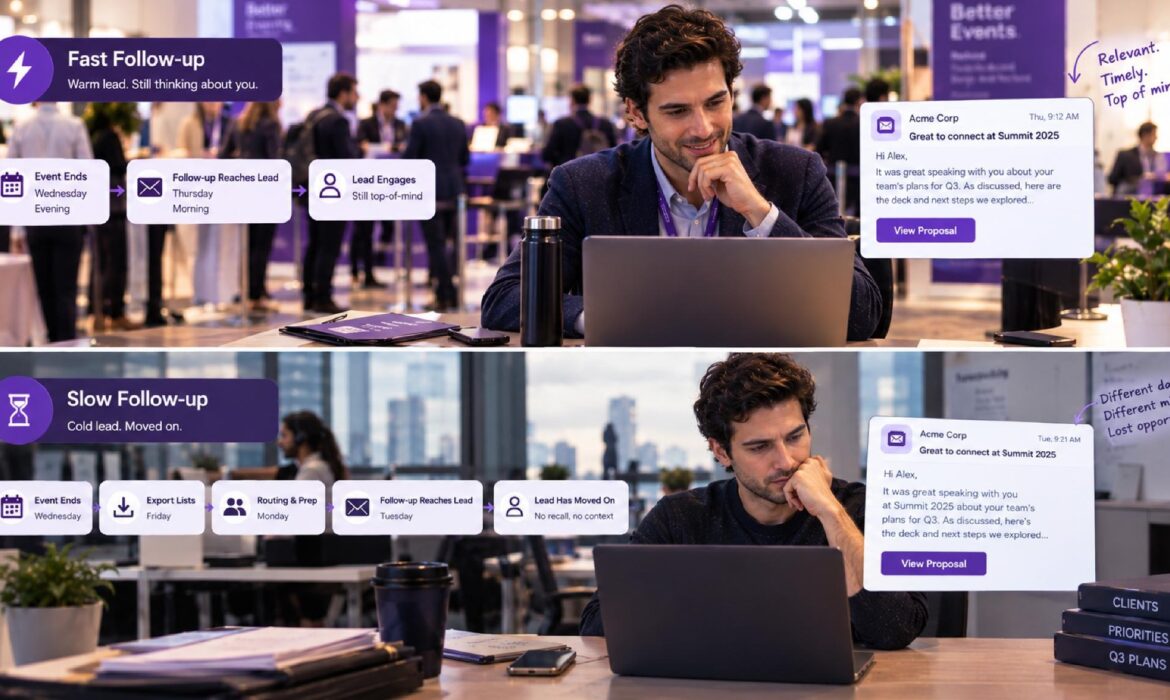
Event ends Wednesday. Export happens Friday because the team was executing the event Wednesday and Thursday. Export on Friday afternoon is the earliest possible.
Exported list is unsorted. Assigning leads to owners takes Saturday evening or Monday morning. Routing finishes Monday. Once routing is done, follow-up copy gets finalized and sent Monday afternoon. Lead arrives to inbox Monday evening or Tuesday morning.
Total latency: Wednesday evening to Tuesday morning is 5 to 6 days. By that point, the conversation is cold.
What gets lost: relevance (the immediate context is forgotten), urgency (other things have happened since Wednesday), response rate (the motivation has dispersed). Marketing sees a follow-up list completed and thinks the job is done. Sales sees a follow-up arriving a week late and stops prioritizing event follow-ups. Neither realizes the delay killed the conversion rate.
A SaaS marketing director implemented same-day follow-up (workflows, not manual). Deal velocity shifted within the first quarter. Event timelines that were previously 2-week pipeline plays became 1-week plays.
With automation, the timeline is different: event ends Wednesday evening. Check-in data uploads automatically. Follow-up workflow triggers immediately. By Thursday morning, segmented follow-ups are hitting inboxes while people are still at their desks.
A 24-hour follow-up referencing the question they asked lands completely differently than a 5-day follow-up with generic thanks. Attendees receive contextual follow-up while relevance is intact. Urgency is still there.
Reply rate increased 40%. Sales picked up pipeline signals 3 days earlier. Reps started actively looking for event follow-up instead of ignoring it.
Automation does not just make follow-up faster; it makes follow-up warm instead of cold. Same-day routing and sends happen through.
48 hours is the goal. It is not a suggestion. It is the window where leads are warm.
What needs to happen: check-in data reaches your system the evening of the event or the morning after. Follow-up segments automatically based on participation (attendees get one message, no-shows get another, booth conversations get a third). Sends schedule automatically the morning after the event. Sales teams then route warm leads to the right owner.
Not about speed for speed’s sake, but speed that reaches leads while they are warm enough to act.
Manual steps anywhere destroy the timeline. If routing requires human review, the window closes. If follow-up copy is written by hand for each segment, the window closes. If sends are scheduled by a person, the window closes.
At scale, 48-hour follow-up is impossible manually. Automation is not optional; it is the only way.
Leads are hot for 48 hours. Manual event follow-up takes 5 to 6 days. The window closes before the follow-up arrives.
Speed beats precision. A fast, contextual event follow-up beats a slow, generic one.
The Forrester data is clear: leads reached in 48 hours are in a different category from leads reached later. Pick which category your events belong in.
To see how automated follow-up closes the window, talk with Samaaro.
How long after an event should you follow up with leads?
Within 48 hours. That is the window where leads are warm, memory is fresh, and buying signals are still active. Follow-up after 5-6 days lands when attention has dispersed.
Why do event leads stop responding after a few days?
Because attention decays. The conversation that was urgent Wednesday becomes background noise by Monday. Competitors who follow up faster get the attention first. Context fades and the buying signal weakens.
Can manual follow-up work if done quickly?
Not at scale. If your event produces 300+ leads, manual export, routing, and send takes 3-5 days minimum. Automation is the only way to reach the 48-hour window at volume.
What is the difference in response rates between 48-hour and 5-day follow-up?
48-hour follow-up typically sees 3x higher response rates than 5-day follow-up. Speed is not just convenience; it directly impacts conversion. Faster follow-up also shortens sales cycles.
What should a 48-hour follow-up say?
Reference the specific conversation or question they asked. If they attended sessions, mention those. If they asked a question at the booth, answer it. Contextual follow-up sent fast beats generic follow-up sent slow every time.

Samaaro is an AI-powered event marketing platform that enables marketing teams to turn events into a measurable growth channel by planning, promoting, executing, and measuring their business impact.
Location


© 2026 — Samaaro. All Rights Reserved.