Samaaro + Your CRM: Zero Integration Fee for Annual Sign-Ups Until 30 June, 2025
- 00Days
- 00Hrs
- 00Min

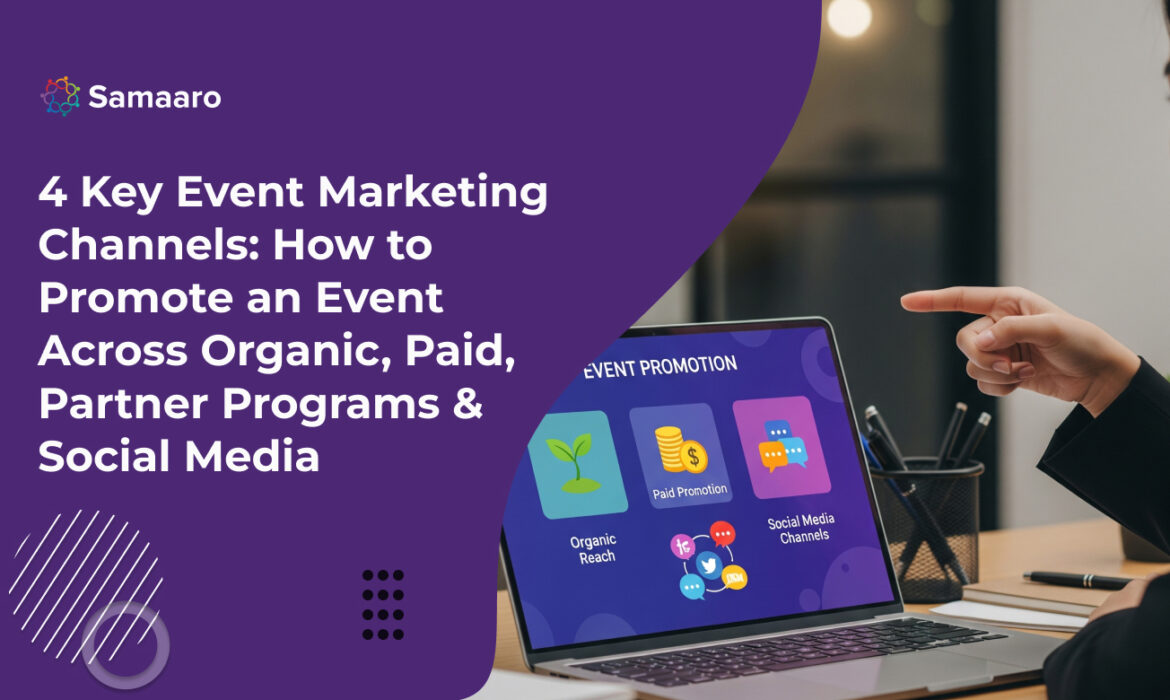
In the current marketing environment, event promotion doesn’t require a “do it all, do it everywhere” mentality. It’s easy to think you can do everything at once: you can run paid ads, post 5 times a day and expect registration to come flooding in; you can send out mass emails and expect attendance. But for organizations and B2B marketers this “spray and pray” method, gets costly, spreads us thin, and can be quite disappointing.
Not all event marketing channels are created equally, some have credibility and longevity, while others offer immediacy and relevance, some allow you to partner strategically with trusted partners, while others allow you to create excitement, and buzz. Successful, smart marketers understand that success is not about using each channel, but building the right combination of the four creative benchmarks:
Each play a specific role in the promotional mix; and when integrated effectively, they help ensure your event gets in front of the right people, in front of them at the right time, and the right way.
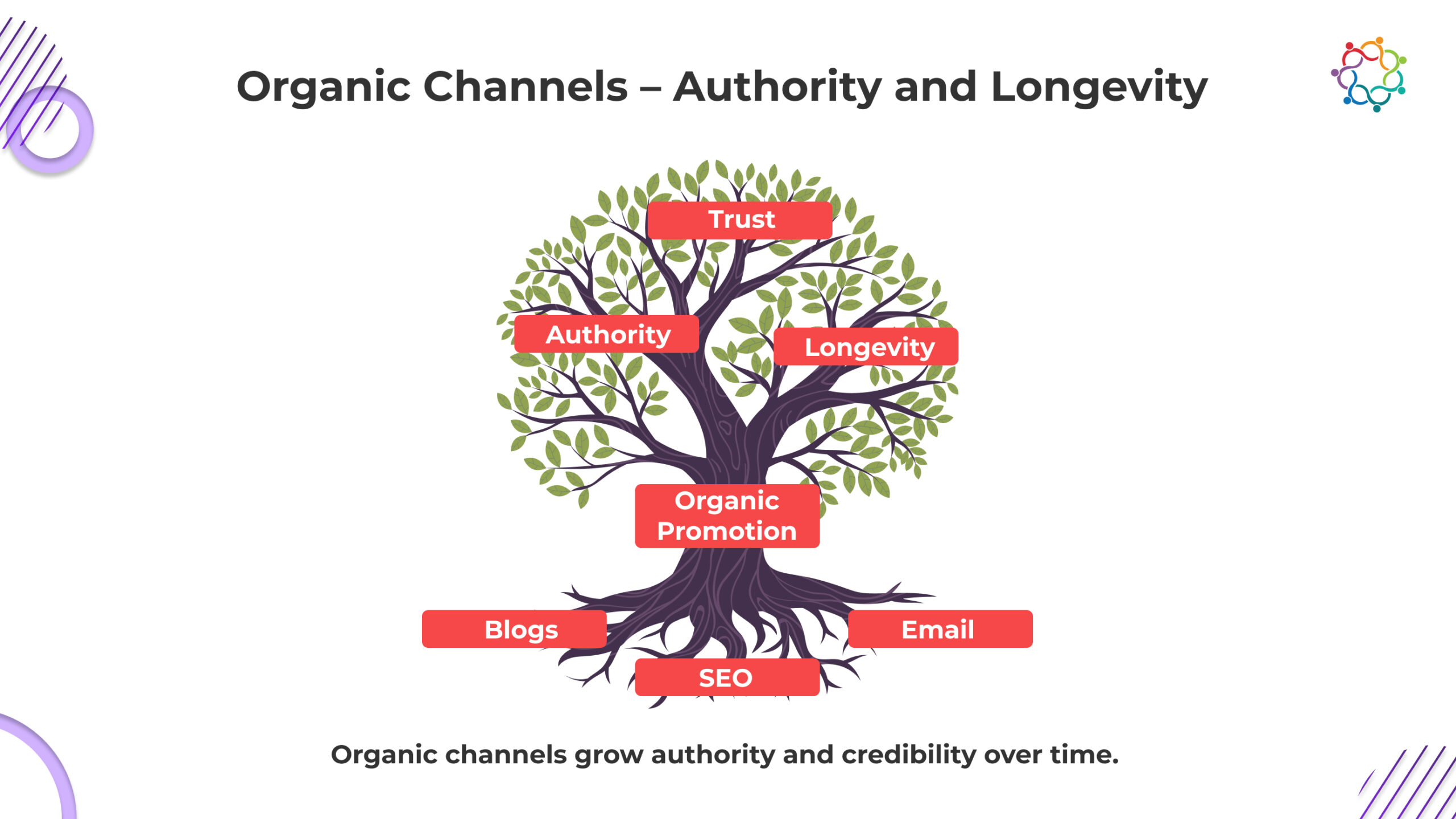
Organic promotion channels act a slow-burn engines. They don’t generate spikes overnight, they build consistent visibility, credibility, and trust from your audience over time.
What It Includes:
Why is it Important:
Example:
A B2B SaaS company created a six-part blog series on the “future of work” trends based on the keynotes of its annual enterprise summit. Before any advertising budget was deployed, the blogs were climbing in Google and attracting near continuous registrations from mid-funnel prospects at no cost to the marketers.
Cautions:
Organic is slow. If you are only three weeks away from an event, organic alone will not get the job done. It must be in play early in the event lifecycle and there should be supporting resource such as paid or social.
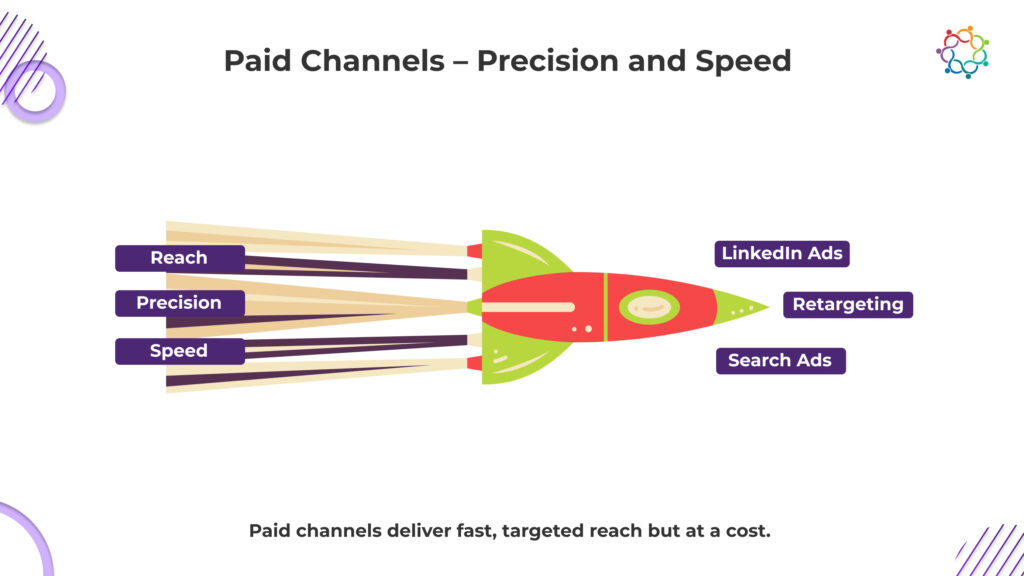
Paid channels are the jet fuel for event marketing. They allow you the hyper-targeting of the right audience and instant bursts of visibility.
What it includes:
Why it is Important:
For example:
A financial services firm promoting a CXO round table that used LinkedIn Sponsored Content with strict filters (India, VP+, BFSI). The promotion delivered a CTR that outperformed less focused campaigns by 40% and produced 150 qualified registrations in 10 days.
Cautions:
Paid is budget pass heavy. If you are not careful with targeting and creative, you can easily waste budgets on vanity impressions. Always identify ROI (cost per qualified registration) versus reach.
In B2B event marketing, partners can sometimes be your best advocates. Sponsors, exhibitors and industry associations all come with their own trust and target audiences and can give your event reach that you simply can’t buy.
What it Gets You:
Why it Matters:
For example,
A global technology brand partnered with a local chamber of commerce to jointly sponsor an enterprise conference. The chamber’s promotional efforts resulted in twice as many registrations, particularly from mid-market companies that the tech brand had never worked with.
Cautions:
Partner promotion takes enablement. Simply asking partners to promote your event is insufficient. You must give them a frictionless way to promote your event using ready-to-use assets (e.g., banners, email templates, social posts).
If “organic” is a long burn and “paid” is like jet fuel, then social media is the amplifier. Social media creates live buzz and conversations prior, during, and after your event, and will continue to nurture community affiliations.
What It Includes
Why It Matters
For Example,
At a global fintech summit, organizers created a branded hashtag that was sponsored and deployed by the sponsors and speakers. The hashtag trended regionally on X and gained 5x organic visibility over the course of the summit because of the deployment of other organic content and website livestream viewership increased as a result.
Cautions:
Social may be distracting if not connected to a strategy. It is easy to get caught up in chasing “likes” and retweets and not connect the content you posted back to registrations or pipeline. Always remember to tightly link engagement metrics with conversion.

Want to see how this would work for you?
See how Samaaro orchestrates organic, paid, partner, and social into one event funnel.
Book a tailored walkthrough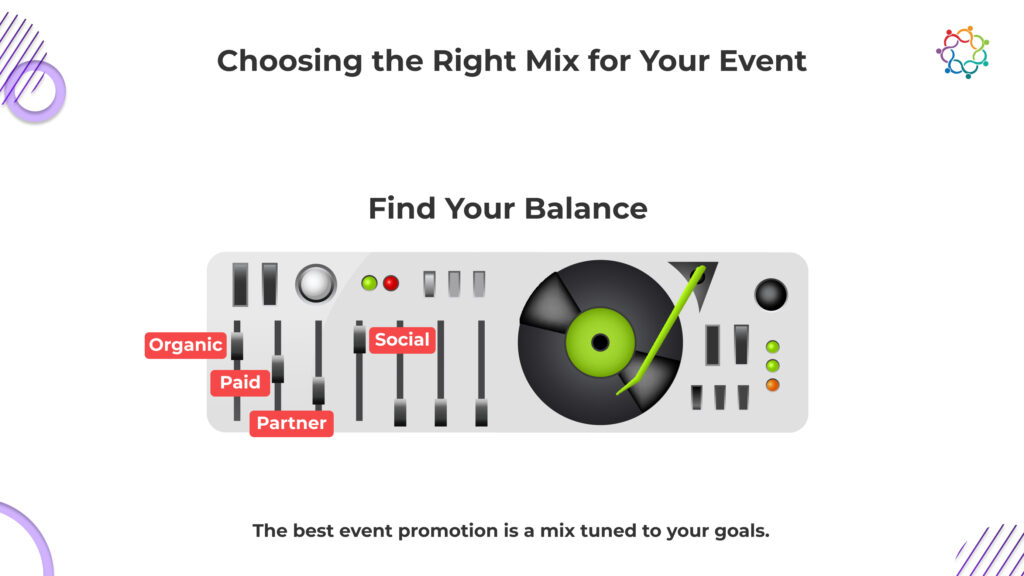
There is no one best channel. The best approach is selecting a good mix of channels based on:
The power relies on the orchestration, all channels playing their meaningful role in the entire promotion timeline.
Managing four pillars simultaneously may become overwhelming for teams. Samaaro makes it easier by using:
Instead of fragmented reporting, Samaaro allows enterprises to plan and report multi-channel campaigns with ease and transparency.
Event promotion is not about being everywhere; it is about being effective. If you can master the four pillars of organic, paid, partner program, and social media; enterprises have the ability to;
The smartest teams are not gambling around with the channel; they are designing a mix that works in unison with each other.
Want to master the 4 pillars of event marketing? Download our Event Promotion white paper or check out Samaaro’s campaign management tools today.
The 4 key event marketing channels are: organic (SEO content, blogs, email nurturing) for sustained awareness, paid (LinkedIn ads, retargeting) for fast targeted visibility, partner (sponsors, speakers, associations) for credibility and extended reach, and social media (LinkedIn, X, Instagram) for community engagement. Each plays a different role. Organic builds long-term authority. Paid accelerates short-term visibility. Partners borrow trust. Social drives community.
Activate organic channels like blogs, SEO, and email nurturing early in the event lifecycle because they compound over time. A blog post takes 6 to 12 weeks to rank on Google. An email nurture sequence needs weeks to warm contacts. Starting these 3 weeks before the event misses the window. Start them 10 to 12 weeks out and they’re delivering registrations throughout the campaign, not just at the end.
Paid channels like LinkedIn ads and retargeting campaigns enable precise targeting because you can narrow audiences by job title, industry, company size, and behaviour. Retargeting in particular converts at 5 to 10x the rate of cold ads, because it reaches people who’ve already shown intent by visiting your landing page. For time-sensitive event promotions in the final 2 to 3 weeks, paid channels are how you scale registrations quickly without waiting for organic to mature.
Enable sponsors, exhibitors, associations, and speaker networks as partner promoters by giving them ready-to-use assets (pre-written posts, branded graphics, unique referral links), setting clear expectations (one post per week leading up), and tracking their contributions in your attribution reports. Most partners want to amplify because event success serves their own goals. The reason most don’t is friction. Remove the friction by making sharing one-click easy.
Use social media channels strategically across phases. Before the event: LinkedIn for thought leadership and speaker reveals, X for live commentary teasers, Instagram for behind-the-scenes prep. During the event: live coverage with branded hashtags across all three. After: highlight reels, attendee quotes, and on-demand session content. Different platforms reach different audiences in different moods, so the content style must adapt to each platform.
Choose your channel mix by event type and audience. Flagship summits need all four channels with budget weighted toward paid LinkedIn and content marketing. Niche executive roundtables need direct outreach, partner referrals, and personal LinkedIn DMs from speakers. Webinars need fast-cycle email and paid social. Don’t apply the same mix to every event. Match channel intensity to the audience size and intent level you need to reach.
The four key channels are organic, paid, partner, and social media. Organic, like blogs, SEO, and email, builds long-term authority. Paid, like LinkedIn ads and retargeting, delivers fast, precise visibility. Partner programs, like sponsors and associations, lend credibility and reach. Social media drives engagement and buzz. Each plays a distinct role, and they work best layered together.
Promote across all four by giving each channel its job. Use organic content to build authority early, paid ads to target the right people quickly, partners to extend your reach through their networks, and social media to create buzz and conversation. The real power is orchestration, where every channel plays its role across the promotion timeline rather than working in isolation.
Organic channels, like blogs, SEO, and email, build credibility and last for months, but they are slow to take effect. Paid channels, like ads and retargeting, are fast and precise but cost money and stop when you stop paying. They work best together: organic builds long-term authority while paid accelerates visibility close to the event. One is the slow burn, the other the jet fuel.
Partners amplify your reach through audiences you do not own. Sponsors and exhibitors can promote to their customer base, industry associations open the door to their members, and speakers share with their followers. An email from a partner to their list often outperforms your own. The catch is enablement: give partners ready-made assets so promoting your event is effortless for them.
The blog highlights LinkedIn, X, and Instagram, each with a different strength. Use LinkedIn for thought leadership and speaker reveals, X for live commentary and trending hashtags, and Instagram for visual storytelling through reels and polls. Match the content style to each platform, and tie engagement back to registrations so social buzz turns into real sign-ups rather than just likes.
Build a balanced mix based on your budget, audience, and event type. A flagship summit may use all four channels, a regional roadshow may lean on paid and partners, and a webinar may use organic, email, and social. Activate organic early, layer in paid and partners, and keep social buzz going throughout. Orchestrating the channels together is what drives consistent attendance.
Maximize organic reach by starting early, since it compounds over time. Publish blog content around your event themes and speakers to earn search traffic, optimize your landing and registration pages for SEO, and run email nurture sequences to warm leads. A well-ranked blog post can keep pulling registrations for months. The key is to activate organic 10 to 12 weeks out, not three.
Paid ads and retargeting drive registrations quickly and precisely. Use LinkedIn ads to target decision-makers by job title, industry, and company, and run retargeting to reach people who already visited your page. Retargeting converts far better than cold ads because it reaches warm prospects. In the final weeks before an event, paid channels are how you scale sign-ups fast.
Track each channel against conversion, not just reach. For organic, watch search traffic and registrations from content. For paid, watch cost per qualified registration and click-through rate. For partners, track registrations from their referral links. For social, tie engagement to sign-ups. Campaign attribution tools show which channel drove registrations and which influenced pipeline, so you can invest where it pays off.
Integrate the channels by orchestrating them around one timeline and one message. Start organic and email early, layer in paid and partner promotion, and keep social buzz going before, during, and after. Use a central dashboard to see performance across all four and attribute results. Consistent messaging across every channel, each playing its role, is what drives maximum, reliable attendance.
When the closing keynote ends and the last booth is packed up, most people think the event is in the rearview mirror. The energy shifts; the team celebrates; the metrics, registration figures, attendance numbers, social chatter, start getting circulated on internal channels. For many organizations, this is where the story ends.
For enterprises, however, the heavy lifting is just beginning.
Events may represent one of the largest line items in an enterprise marketing budget. Between venue, sponsorships, technology, accommodation, and travel, one flagship event can represent crores in investment. Still, event teams too often cannot articulate how those investments translate into measurable business impact.
This is why post event evaluation is not just a box to tick, it’s a necessity. It helps turn an event from a one-time experience into a repeatable, scalable, and strategic growth engine. When done well, an evaluation will provide an enterprise with the perspective to refine targeting, improve execution, and demonstrate ROI back to leadership.
In this blog, we’re going to explain what post-event evaluation entails, why it matters so much for enterprise events, and how to develop evaluation processes that turn a flurry of activity into actionable strategy.
It is tempting to evaluate success based on how busy the venue felt or how many tweets were sent out. For teams that have invested long hours, these energizing moments can feel like validation.
But while these surface-level markers might deliver a short moment of joy, they will never provide insight into whether an event met its business objectives. For instance:
These examples demonstrate a reality: an event can look good but not be strategically good. Post-event evaluations allow enterprises to look at the value not just with the “closing moment” but the longer-term value.
Post-event evaluation is a systematic and data-driven assessment of the outcomes of an event against its intended objectives. It is much more than just a report of what occurred; it is also, an assessment of an understanding of why it occurred and what next steps will be.
This is an important distinction. Reporting is good for ticking boxes. Evaluation develops strategy.
When events are part of enterprise with larger budgets, greater scrutiny of event impacts is critical. There will be no future events if evaluation does not happen. Evaluation is the evidence to provide credibility to event marketing at the boardroom level.
Enterprises usually work on a scale where mistakes are costly, and victories must take place time and time again. For three reasons post-event evaluation becomes essential:
Unlike smaller organizations, enterprises attach themselves where sponsorship support exists, multi-team collaboration events, also known as C-suite engagement events, tend to be very visible. However, without evaluation there is a risk of reputational damage and wasted time.
Businesses are always required to justify their marketing spends. Digital channels like paid advertising and ABM platforms provide instant insights to evaluate ROI. If the evaluation of other forms of marketing provides no actionable, actionable insight, and/or things to improve, they’re likely to be deprioritize by the budget. Evaluation is how events remain competitive to be able to improve.
Businesses do not run single events but conduct programs over several quarters and geographic areas. Your learning from one event must inform the next. Evaluation helps to best ensure the knowledge is not reset every time an event is run.
Example:
In a series of roadshows across APAC, a leading B2B SaaS company experienced strong registration rates leading up to their early roadshows, but high no-show rates. When they reviewed their post-event evaluations, they learnt the timing of their events coincided with regional holidays. By adjusting the timing of a few subsequent events, they reduced their no-show rates by 30%, providing a relevant ROI improvement.
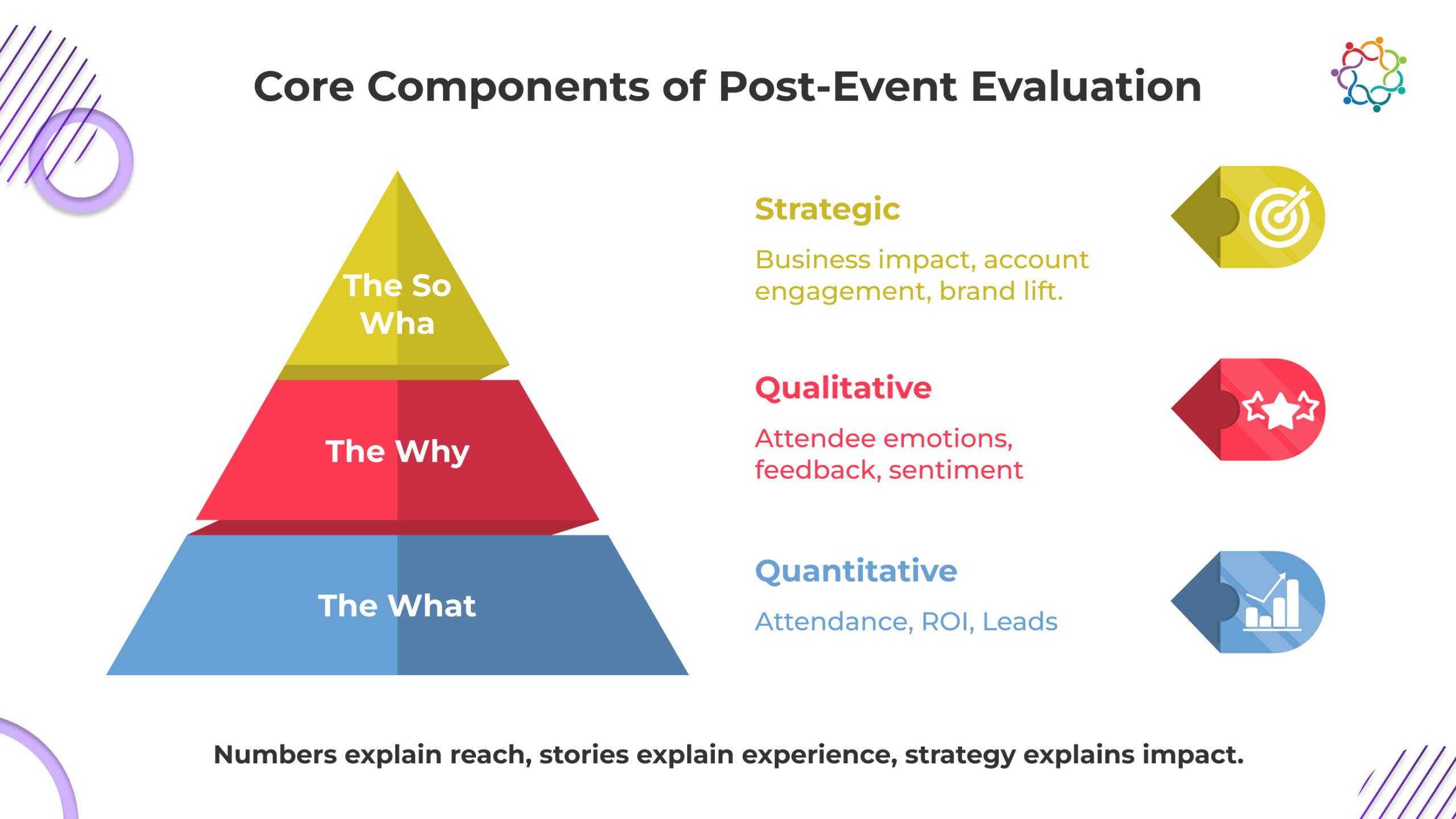
Robust evaluation draws on three types of data: quantitative, qualitative, and strategic. Each adds a layer of clarity enterprises need to form the full picture.
Quantitative data measures scale, efficiency, and outcomes in absolute terms.
Qualitative data captures the emotions, perceptions, and stories that explain attendee behavior.
Strategic data connects event outcomes to enterprise goals.
Together, these three layers prevent enterprises from being misled by vanity metrics. Instead, they build a multi-dimensional narrative of success.
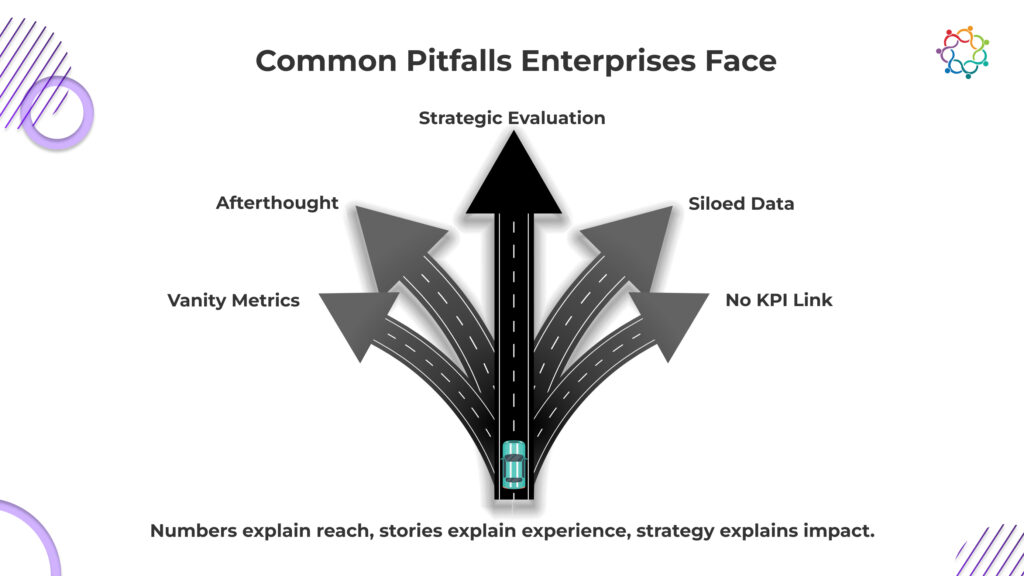
Even sophisticated teams struggle with evaluation. Common pitfalls include:
Want to see how this would work for you?
See how Samaaro generates per-segment post-event reports for finance, marketing, sales, and C-suite.
Book a tailored walkthroughExample: A global consultancy celebrated “strong brand awareness” after an event, citing thousands of impressions on LinkedIn. But without evidence of how impressions translated into leads or deals, the claim carried little weight with executives.
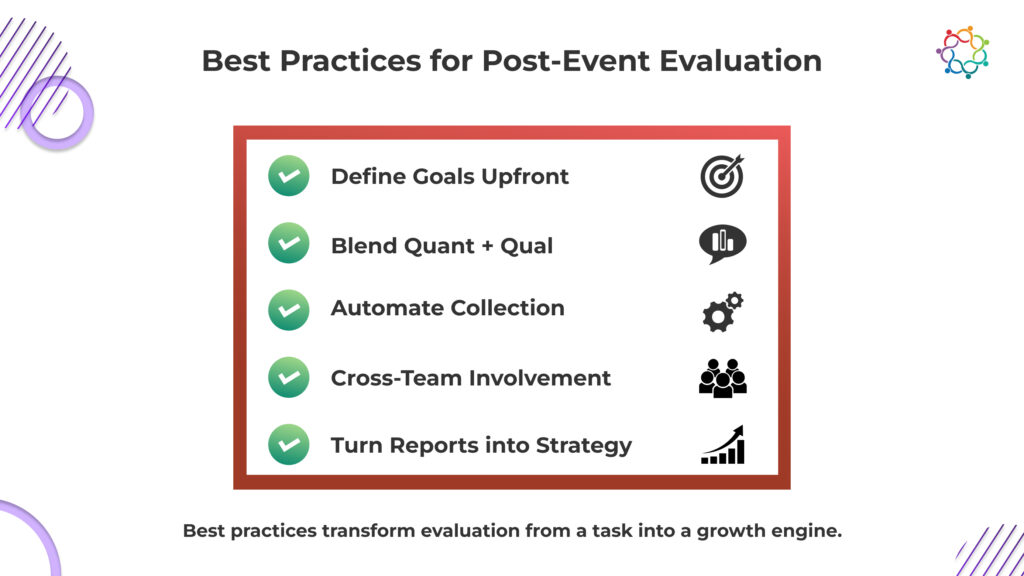
Enterprises that successfully do evaluations have some or all these best practices in common:
KPIs must be determined before sending out the invites. For example: is the event based around building pipeline, building thought leadership, or building deeper relationships with existing clients?
You don’t have to choose between using numbers or stories only. Using both ensures measurement and actioning of insights.
Manual and random statements are time-consuming and prone to error and misinterpretation. Having tools in place through CRM syncing, automating surveys and tracking engagements reduces friction for data collection.
When sales, marketing and operations evaluate post-event together, the insights gathered become richer and potentially more actionable. For example, sales may point out to marketing that they created some leads and prospects from an event, but the leads generated weren’t decision-makers. Operations teams will rarely get that insight through marketing metrics alone.
Your evaluation should not still be tied to your event unless you ended your evaluation with a clear list of recommendations: which channels were most effective, which personas were most engaged, and what needs to be fixed. You will apply these insights to the planning for the n
Samaaro provides the tools enterprises need to streamline evaluation:
For enterprise teams, Samaaro doesn’t just collect numbers, it integrates quant, qual, and strategic insights into a single framework.
Post-event evaluation is not just a task to complete. It should be both the strategic parameter that enables an event to convert from a stand-alone activity to a connector of growth.
While the closing session may signal the end of the event, evaluation begins the impact and at the same time signals the beginning of your next one.
Post-event evaluation is a systematic assessment of an event’s outcomes against the goals you set. It differs from reporting because reporting measures ‘the what’ (how many attended, what they rated) while evaluation measures ‘the so what’ (were they the right people, did the event move pipeline, was the cost justified). Reporting ticks boxes. Evaluation shapes strategy. Both matter, but enterprise teams under-invest in evaluation and over-invest in reporting.
Post-event evaluation is critical for enterprise events because the budget is large enough that leadership wants accountability, and multi-team collaboration means many people need to see the verdict. Without evaluation, marketing celebrates impressions, sales counts leads, and finance asks ‘what did this cost us’. Evaluation reconciles all three perspectives into one defensible answer about whether the event delivered.
The three core components of post-event evaluation are: quantitative data (numbers like attendance, revenue, NPS) that provides objective measurement, qualitative data (open-text feedback, themes, attendee quotes) that explains the why behind the numbers, and strategic data (pipeline influenced, brand lift, account engagement) that connects the event to long-term business outcomes. Quant proves it happened. Qual explains why. Strategic justifies the investment.
The most common pitfalls in enterprise event evaluation are: treating evaluation as an afterthought (only starting when the event ends), overemphasising vanity metrics like total impressions, fragmenting data across teams (marketing, sales, ops each running separate reports), and failing to tie back to KPIs set before the event. Each one weakens credibility. Leadership stops trusting event impact claims when reports lean on impressions without pipeline data.
Enterprises should define goals and KPIs before the event by answering: what is this event’s primary purpose (pipeline, thought leadership, customer retention, brand awareness), what specific KPIs will tell us we succeeded, and who owns each KPI internally. Write the KPIs down before invites go out. Without pre-event goals, evaluation becomes ‘here are some numbers’. With them, evaluation becomes ‘here’s what we promised, here’s what we delivered’.
Cross-team collaboration between sales, marketing, and operations improves evaluation because each team sees a different angle. Marketing knows what worked in promotion. Sales knows which leads were real. Operations knows what broke logistically. When all three contribute to the post-event review, the insights are richer and the next event improves on multiple dimensions. Siloed evaluation produces partial answers and recurring mistakes.
You remember maybe two things from most events you attend.
One of them is usually a speaker.
Good speakers make your event. Bad speakers kill it. There’s no in-between.
The problem is finding them in the first place.
They’re not in a database labeled “great speakers.” They’re scattered across LinkedIn, doing their jobs, building their reputations, occasionally speaking at events. Most of them don’t think of themselves as professional speakers. But they should be the ones you want.
LinkedIn has 900 million people. Your next great speaker is in there. You just need to know how to find them.
Vague speaker searches lead to mediocre speakers.
If your event is about AI, they need to actually work in AI. Not write about it. Not have opinions. Actually built products. Shipped features. Solved real problems.
Credibility comes from doing the work, not talking about it.
Expert doesn’t equal great speaker.
Some brilliant people freeze in front of crowds. Some talk too fast. Some go off on tangents.
Look for people with speaking history. Conference talks. Webinars. Presentations to teams.
They know how to manage a room and keep an audience engaged.
Different events need different speakers.
Keynote energy. Panel discussion expertise. Workshop facilitation. Story-telling skill. Interactive engagement.
Figure out which style you need first. Then search for people who do that.
Generic speakers don’t work.
Your audience is specific humans with specific problems. They need speakers who understand their world, their challenges, their industry.
A speaker who’s been in healthcare for 20 years hits different when you’re running a healthcare event.
LinkedIn’s search is powerful when you know how to use it. Most people don’t.
Don’t search “speaker.” That’s too broad. You’ll get noise.
Search combinations like:
“AI researcher” AND “keynote” AND “healthcare”
“SaaS founder” AND “panel discussion” AND “B2B growth”
“Product director” AND “scaling” AND “conference”
Specificity filters out the weak results fast.
Boolean search uses AND, OR, NOT to combine terms. It’s the difference between finding 50,000 people and finding the right 50.
Here’s how it works:
Example 1 (AI in Product):
(“artificial intelligence” OR “machine learning”) AND (“product lead” OR “VP product”) AND “conference” AND “San Francisco”
This finds product leaders who know AI, have spoken at conferences, and are in SF.
Example 2 (Fintech):
(“fintech” OR “digital banking”) AND (“C-level” OR “chief” OR “executive”) AND (“keynote” OR “speaker”)
This finds executives in fintech with speaking experience.
Example 3 (Eliminate False Positives):
“blockchain” AND “conference” AND NOT “student” AND NOT “academy” AND NOT “university”
This filters out student organizations and keeps real professionals.
While searching, narrow down by:
These filters cut your list from thousands to dozens fast.
LinkedIn groups are conversations. Conversations reveal who actually knows their stuff.
Search for groups like:
“Healthcare Innovation Leaders”
“SaaS Product Managers”
“Marketing Operations Professionals”
“Startup Founders”
Join the ones that match your event topic.
Some people lurk. Some people are always commenting. Always sharing insights. Always asking smart questions.
Those people are your targets. They’re engaged with the topic. Probably good speakers.
When you find someone interesting in a group, go to their profile.
Look at their Featured section. Videos of them speaking?
Look at their Publications. Articles they’ve written?
Look at Recommendations. What do people say about working with them?
This tells you if they’re actually good or just noise.
The search is just half the battle. The outreach is the other half.
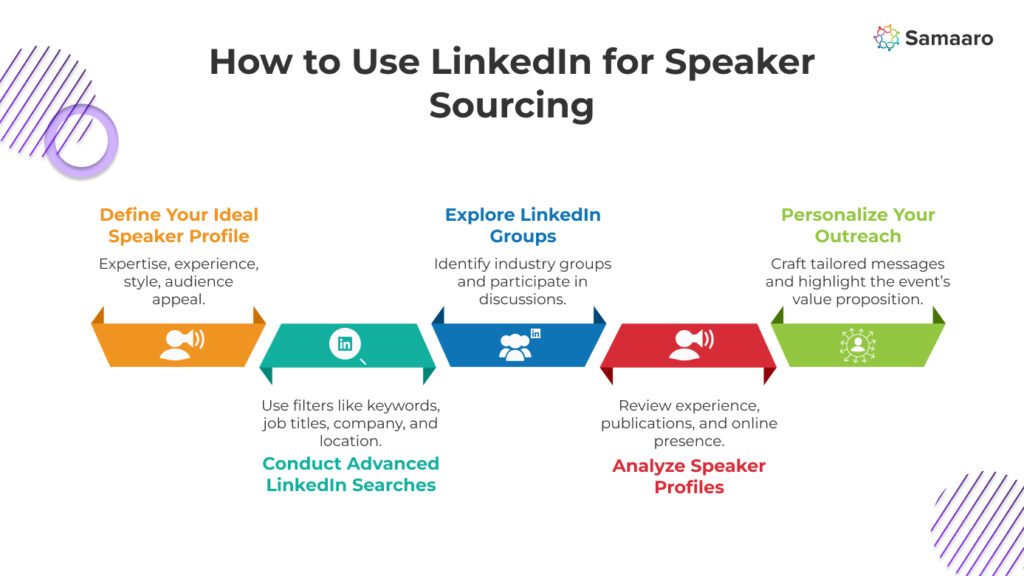
Blast messaging doesn’t work. People can spot a template from a mile away.Write one real message to each person. Specific. Personal. Like you’re actually talking to them.
Example:
“Hey ,
I’ve been reading your posts on . Your piece on nailed something we’ve been wrestling with.
We’re hosting in with about people. Mostly . A lot of CTOs from healthcare companies.
I think your perspective on would be perfect for this crowd. Would you be interested in leading a panel?
Let me know if you want to chat about it.
”
Notice: Short. Specific. Shows you actually know their work.
Why should they care? They’re busy. They have a packed calendar.
Tell them what’s in it for them:
Don’t be coy about logistics.
Some speakers want fees. Some want travel covered. Some want special recording rights.
Just ask. And tell them what you can actually do.
“We cover flights and hotels. You can record and use the video. The audience is 500+ CTOs from Fortune 500 companies. Interested in talking?”
That’s clear. That works.
Lots of people don’t respond to the first message.
Wait a week. Send a simple follow-up.
“Hey , wanted to follow up on my earlier message about . We’d love to have you. Any interest?”
Short. Not pushy. Just persistent.
Spreadsheet. CRM. Doesn’t matter what. But track:
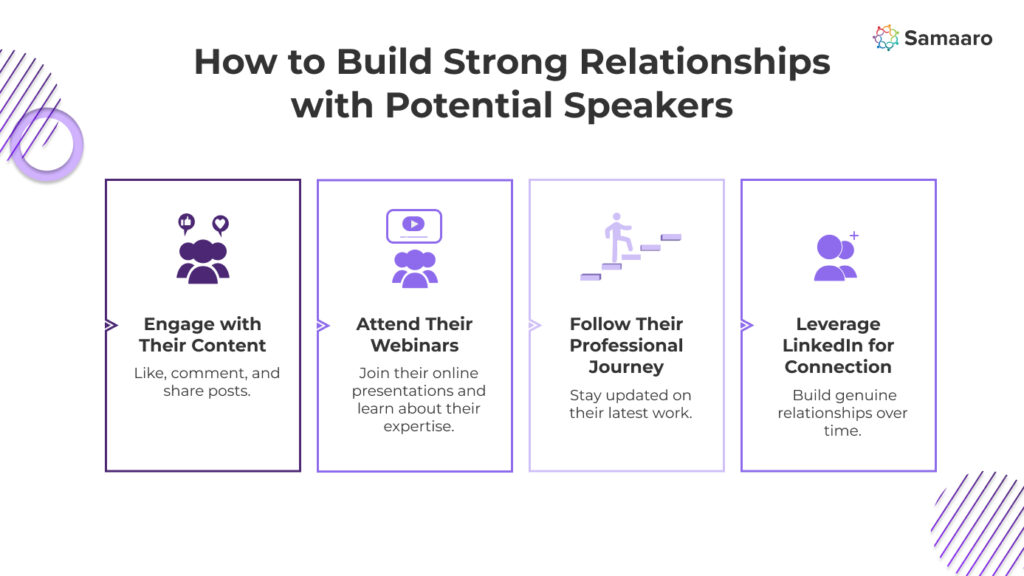
One-off speakers are fine. But building a roster of great speakers you call year after year? That’s the real win.
Follow them. Read their posts. Comment on their articles.
Not generic comments. Thoughtful ones.
“Loved your take on X. Here’s how we’ve approached it…”
Stay on their radar. Show genuine interest in what they’re doing.
If they’re speaking at a webinar. Or leading a workshop. Or presenting at a conference.
Go. Watch. Engage in Q&A.
Then reach out: “Was at your talk on . The thing you said about was exactly what our team needed.”
People remember people who actually show up.
Once they speak at your event, stay connected.
Send them the recording. Share feedback from attendees. Invite them back next year.
Turn it into a relationship. Not a one-time transaction.
Want to see how this would work for you?
See how Samaaro handles speaker discovery, briefing, and on-event coordination, end to end.
Book a tailored walkthroughStart your search 4-6 months before your event.
Good speakers book up fast. The big names are booked years out.
No-shows drop because speakers are actually invested.
Your speakers are better because you picked based on expertise and fit, not availability.
Your attendees get more out of it because they’re hearing from people who actually know the space.
Your brand reputation improves because your speakers are good.
First time you do this, it’s hard. You’re learning the system. You’re writing 50 personalized messages. You’re managing conversations.
Second time? You’re faster. You know what works. You have go-to people.
Third time? You have a process. You have a network. You’re booking speakers in weeks, not months.
LinkedIn is full of potential speakers. The best ones aren’t on speaker directories. They’re in your target industry doing actual work.
You just have to know how to find them and ask.
Ready to take your speaker sourcing to the next level? Platforms like Samaaro can help streamline the process, from personalized outreach to managing speaker relationships. Book a demo or start your free trial to see how we can support your event planning journey!
Q: What Boolean search finds AI speakers in healthcare?
A: Try (“artificial intelligence” OR “machine learning”) AND (“healthcare” OR “medical” OR “pharma”) AND (“speaker” OR “keynote” OR “conference”). This finds people who know AI, work in healthcare, and have speaking experience.
Q: How do I know if someone’s actually a good speaker before reaching out?
A: Check for videos in their Featured section. Read comments on their posts—do people engage or is it crickets? Look for YouTube videos of them speaking. Hunt for recommendations that mention presentation skills. You won’t know 100%, but you can avoid obvious duds.
Q: Should I reach out to someone with zero speaking experience?
A: Only if they’re a real expert and seem comfortable on LinkedIn. If they post regularly, get engagement, respond to comments, they might be fine. But if you’re unsure, stick with people who’ve spoken before. Don’t gamble on a big event.
Q: What do I do if they say no?
A: Say thanks and move on. No offense taken. Some people don’t speak. Some are booked. Some just prefer their day job. There are 900 million other people on LinkedIn.
Q: How many speakers do I need to contact to land one?
A: If you’re specific and writing real messages? Maybe 1 in 3 or 1 in 4 say yes. If you’re blasting form letters to random people? Way worse. If you’re in a tough niche? Even worse. Budget to contact way more people than you actually need.
Did your last event truly succeed, or just have an awesome turnout? This is an important question to think about in our age of event marketing and branding, when tangible results are more important than ever. Days of specifically measuring attendance and showcasing impressive head counts will be over, at least if we want to deliver meaningful results. While total attendance might look good on paper, unless we dive into the metrics of our event, like engagement levels, content values and leads based on quality, we are only getting a small fraction of the event performance data.
The competition in the digital landscape continues to grow, and measuring impact without precision has never felt more needed. We can move away from headcounts and begin using meaningful event analytics to help us generate our own insights. This guide will help illuminate what you should consider as success for events in a data-driven environment and bring clarity to the multitude of numbers that matter. More importantly, you will learn how to make sense of those numbers in relation to each other, and to your event, so you can use your new insights to inform your next event.
Counting registrations of attendees or social media likes as indicators of success is a thing of the past. The “new world” of event metrics creates a must-change environment where we will define success from “vanity metrics” less and from truly actionable metrics that inform strategy, and provide outcomes based on business results.
Anytime someone tells you they had a “large registration count” is great to hear but does not tell you if your attendees felt valued, if the speaker kept the audience engaged, if your content meant something, and if your sponsors met their goals or delivered on those goals. To understand your event’s overall and true performance means to categorize, segment and evaluate the data across several core dimensions.
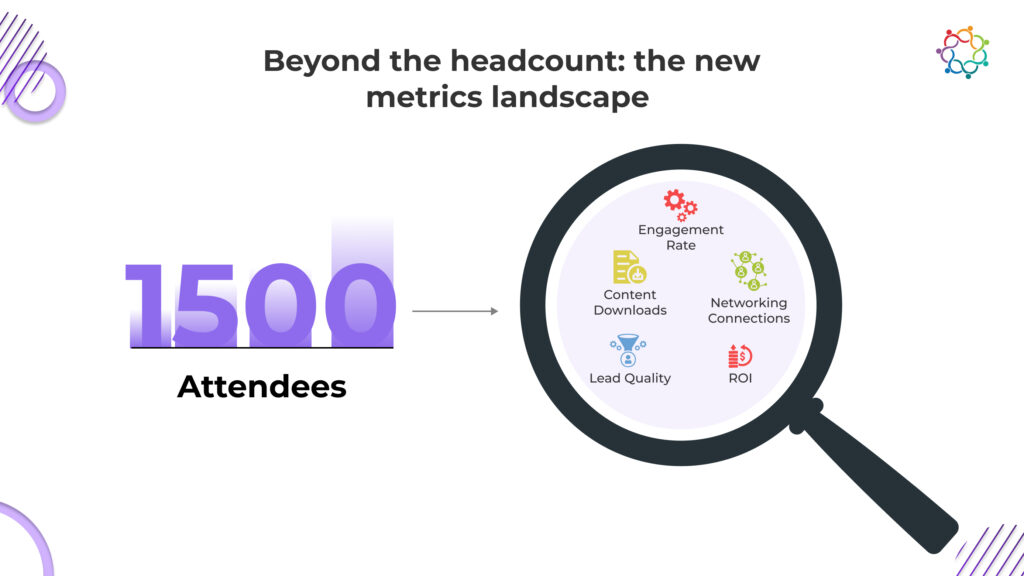
To gain a holistic and meaningful view of your event’s performance, it’s essential to categorize and dissect your data across several crucial dimensions:

When it comes to events, knowing what sessions attendees have participated in before is essential. Simply logging in is no longer enough; you want to understand the level of engagement and quality of the experience. Exploring the data on attendee behaviour is central to understanding and improving the event experience.
To collect this data accurately, you must have solid analytics tools. The native analytics dashboard of your event platform should be your first stop for comprehensive data about what has transpired in your event.
The content you present is often the core value proposition of your event. Effective event analytics allow you to ascertain if that content truly resonated with your audience and delivered on its promise.
Beyond learning, events are powerful catalysts for professional networking and a prime channel for lead generation. Utilizing precise event data to quantify these interactions is fundamental to demonstrating event ROI for both attendees and sponsors.
Collecting vast amounts of event data is only the first step. The true power of event analytics lies in its transformation into actionable insights that drive continuous improvement and future event success. Think of this as a continuous improvement loop, an iterative process that makes each event smarter than the last:

Samaaro is more than just an event platform; it’s a comprehensive partner in decoding event analytics. Our robust platform provides all the event performance data you need and the intuitive tools to transform raw numbers into strategic advantages for your brand.
In the evolving landscape of corporate and community gatherings, relying solely on surface-level metrics is a relic of the past. While most events might look successful on paper based purely on headcount, the question remains: are they truly effective in achieving their deeper objectives?
Embracing a data-driven event planning approach means understanding the intricate web of attendee engagement metrics, pinpointing true event ROI, and making informed decisions that continuously refine and elevate your offerings. Samaaro equips you with the advanced analytics tools to decode every layer of your event’s performance, allowing you to turn raw data into strategic action.
Ready to unlock the full potential of your event data? Discover how Samaaro’s advanced analytics can help your next event drive real results.
A vanity metric looks good but does not guide decisions, like raw registrations. An actionable metric, like session conversion rate, directly tells you what to change next.
Add qualifying questions to registration and booth forms: role, company size, buying timeline, and budget. Score responses against your ideal customer profile to separate quality leads from browsers.
Web analytics like Google Analytics tracks traffic sources and pre-event page behavior. Your event platform dashboard covers in-event engagement. Together they reveal the complete attendee journey.
Choose a small set of metrics per goal and review only those. If a number does not drive a decision or action, drop it from your regular reporting.
Micro-conversions are small steps like content downloads or session joins. Macro conversions are business outcomes like MQLs and booked meetings. Micro-conversions predict and lead to macro results.
In 2025, closed-door CXO events have come to be a growth area of B2B marketing strategy. It’s not about reaching the biggest audience anymore; it’s all about reaching the right people in a more targeted and meaningful approach. Large public events no longer effectively reach C-level executives and senior decision-makers. This has led to an increased demand for invite-only, private CXO events which create a safe space to have genuine conversations and establish relationships for business.
This guide helps to break it all down. We will take you through planning, selecting and using the right tools, and measuring true results. You will learn everything needed to execute successful, private CXO events that lead to genuine impact with a business.
Before planning closed door CXO events, it is important to understand the nature and purpose and to not confuse them with simply being smaller versions of business conferences, which are a different interest as a strategic tool & process with specific purpose and framework for an exclusive environment.
Definition:
Closed-door CXO events are easily identified due to the exclusive and invite only guest list designed for an elite group of c-suite executives or senior decision-makers. Identifying characteristics include:
Invite-only, limited-seat events: Access is limited to a predetermined and curated invite-only guest list to limit capacity for an exclusive experience.
Almost always off record: Events and discussions are almost always conducted under chatham house rule or similar non-disclosure, meaning the content of the event is not for attribution or general release. There must, of course, be an understanding that information can be shared to facilitate open and honest conversation. No press or public awareness: The marketing strategy is ultra-discreet and personalized, rather than broadly promoted, with the priority of confidentiality fully intact for each event’s planning.
These events may be designed in a variety of ways, all to provide opportunities to connect in ways that provide value:
Goals :
The ultimate strategic value of hosting executive roundtables and CXO closed door exclusive events is robustly distinct:
Want to see how this would work for you?
30 minutes on how Samaaro handles invitations, RSVPs, briefings, and follow-up for closed-door.
Book a tailored walkthroughExample:
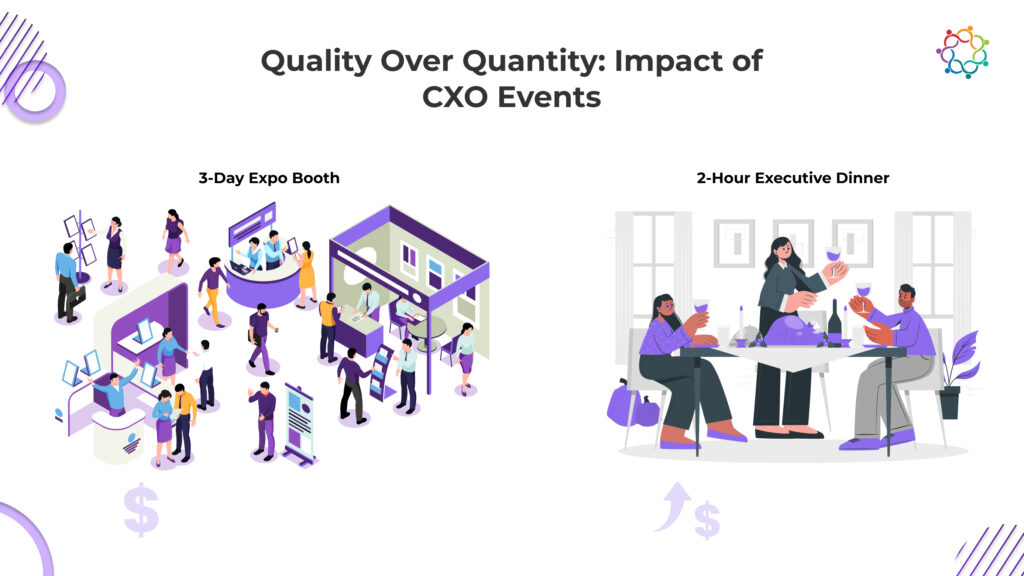
Think about this powerful situation: “A 2-hour dinner for 12 CTOs is likely to drive more revenue impact than a 3-day expo booth.” It demonstrates the concentrated power, but more importantly, the return on investment that’s possible when you spend for ultra-targeted, private events for CXOs. It is essentially a quality over quantity proposition; when executed correctly, the quality of a tightly curated guest list of CXOs will directly affect the ROI of executive events.
The success of a closed-door CXO event is predicated on significantly more in-depth planning, beyond just the standard event checklist. Planning is critical and ensuring every detail from guest selection to privacy parameters, is executed precisely is essential. This will provide you with a high-level, comprehensive planning checklist for an invite-only event.
| Planning step | Action | Pro tip |
| Guest list finalization | Work closely with your sales and leadership teams to identify high-value accounts and target CXOs who are genuinely relevant. | Keep the group size under 20 attendees for optimal engagement and intimate, productive discussions. |
| Invitation flow | Design a highly personalized invitation process. Use dynamic RSVP links to ensure each invite is unique and trackable. Follow up 1:1. | Avoid bulk invites or generic email blasts. Personalization is paramount for building trust with high-value attendees. |
| Confidentiality measures | Implement strict privacy protocols. Include explicit NDA requirements or clear privacy notes within the invite itself. | Add “no recording” reminders or signs onsite to reinforce the off-record nature of discussions. |
| Pre-event briefing | Prepare your internal hosts and speakers thoroughly. Share concise profiles of confirmed attendees to help them tailor conversations. | Use brief sheets summarizing key attendee backgrounds, interests, and potential discussion points. |
| Seating and format | Select a physical layout that fosters open dialogue. A roundtable setup or private dining environment is often ideal. | Ensure the physical layout encourages natural conversation flow and allows all participants to engage easily. |
| Dedicated hosts | Assign a dedicated host for every 4–5 attendees. This ensures personalized attention and active moderation. | Hosts help steer conversations, facilitate introductions, and quietly identify key signals or insights from attendees. |
Bonus tip: As a great added value to the event, have a highly curated, post-event takeaway. This can be in the form of a summary of the key insights gathered from the event, a (limited-release) briefing on the resulting research compiled about the event, or a private link to a thought-leading resource about the topics discussed. This will add great value without being too ‘salesy,’ and will ensure the event was experienced as a more exclusive event. That’s the rigor you need if you’re asking how to easily plan multi-city roadshows for an executive audience.
The success of closed-door CXO events, like everything else in the process, hinges not only on planning; it requires the right technology stack to support the execution, while sustaining the level of privacy necessary to host a closed-door event.
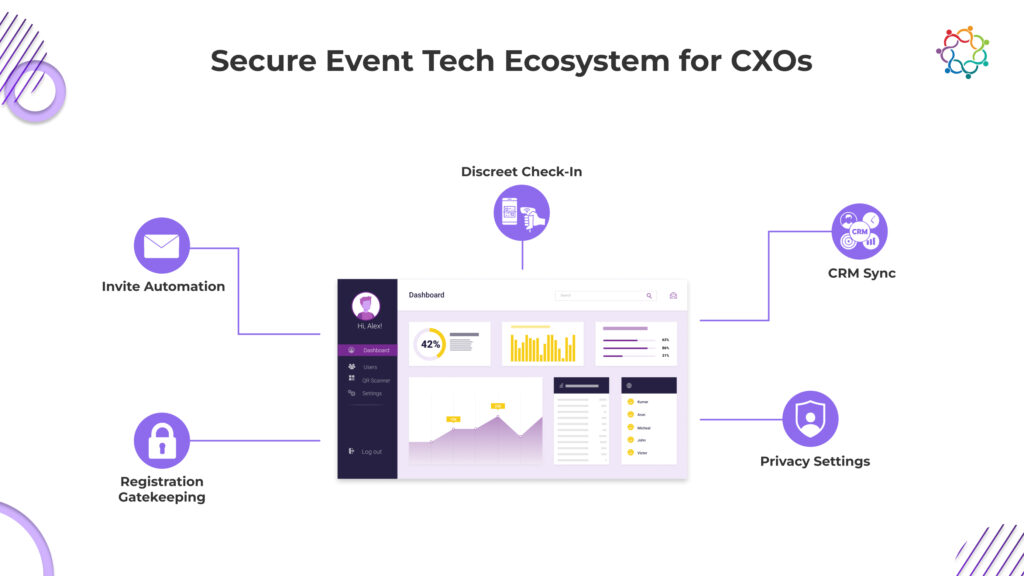
What you need:
A specialized event platform and integrated tools are essential for managing the entire lifecycle of a private CXO event.
| Tool | Function | Example |
| Invite automation | Generate and manage unique, dynamic RSVP links for each invitee, enabling precise tracking and personalized confirmations. | A dedicated invite engine that prevents unauthorized sharing. |
| Registration gatekeeping | Implement approval workflows where registrations are token-based, ensuring only truly invited guests can complete signup. | Prevent open form sign-ups to maintain exclusivity and control over your guest list. |
| QR badge scanning | Facilitate discreet, efficient on-site check-in using QR codes or similar digital methods. | Quietly track attendance without disrupting the high-touch environment. |
| Session feedback | Capture immediate feedback via NPS scores and open-ended insights without intruding on the executive experience. | Collect input discreetly in-app or through direct WhatsApp messages post-session. |
| CRM sync | Automatically push real-time attendance data, engagement signals, and intent scores back into your CRM. | Ensure your contact records are updated automatically, providing sales teams with immediate, actionable intelligence. |
Choosing the right event platform for confidential executive events is paramount to protecting sensitive information and maintaining the trust of your high-value attendees. Look for tools to run closed-door events for CXOs that explicitly offer these security and privacy features.
Attending executive events may seem difficult to measure & conduct deals because they are meant to establish relationships. However, if you use a framework, there are ways to correlate attendance at closed-door CXO events to scenarios that demonstrate value to a business. Learn how to measure & report ROI from Executive CXO roundtables.
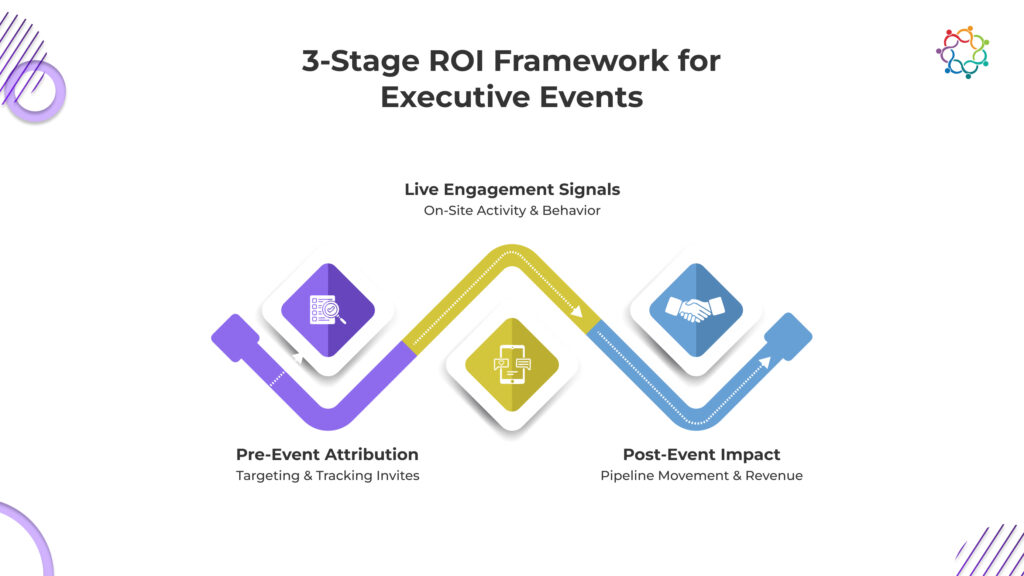
We recommend a 3-stage ROI framework that connects pre-event targeting with live engagement and post-event impact:
Before the event starts, and your CRM tracks the intent and set up with your high-end invitees tribes.
2. Live engagement signals
At the event, you will want to capture subtle but compelling signals of engagement that can be loaded back into your CRM.
Did they check-in? Ask questions? Stay till the end? These small actions send signals about presence and early interest.
This is where the true ROI of executive events becomes evident, as you connect event participation to pipeline movement and revenue.
| KPI | What it shows |
| Rsvp-to-attendance rate | The quality of your invitation process and the true intent level of your invitees. |
| Avg. Session rating | The relevance and delivery impact of your content and speakers. |
| Deal acceleration | Post-event activity in your CRM, indicating faster movement through sales stages. |
| Content opens (post-event) | Continued interest and engagement with shared resources after the event. |
| Referrals or meetings set | Downstream influence and direct sales opportunities generated from event participation. |
By diligently tracking these metrics, you can confidently demonstrate the significant business value derived from your closed-door CXO events.
For organizations serious about hosting high-impact closed-door CXO events with absolute precision and measurable ROI, Samaaro provides the comprehensive platform designed to meet these unique demands. Our toolkit streamlines every aspect of invite-only event planning, ensuring a seamless experience for both organizers and elite attendees.
Samaaro is engineered for the security and exclusivity that confidential event planning demands:
“A global consulting firm used Samaaro to successfully run 8 private roundtables across the APAC region. This strategic approach resulted in 19 new high-value opportunities sourced directly from post-event engagement, clearly demonstrating the platform’s power in converting exclusive interactions into tangible pipelines.”
Samaaro is the event platform for confidential executive events that empowers you to execute flawlessly and measure impact effectively.
Hosting a successful closed-door CXO event is undeniably about precision and privacy. It requires meticulous planning, a discrete approach to technology, and an unwavering focus on delivering value to an elite audience. More importantly, it is about transforming these high-touch interactions into measurable business value.
With the right planning framework and a robust, centralized tech infrastructure, these exclusive experiences can accelerate deals, significantly elevate your brand’s credibility as a thought leader, and build lasting, impactful relationships with the most critical decision-makers.
Want to plan your next executive event with better control and higher ROI? Let’s walk you through Samaaro’s private event toolkit.
Use unique RSVP links with token-based validation and implement an approval flow within your registration system to control access.
Yes, advanced platforms like Samaaro allow you to manage and monitor multi-city private events and executive roundtables all from a single, centralized dashboard.
Aim to follow up within 48 hours. Use CRM workflows tied to attendance triggers to send personalized messages or assign follow-up tasks to sales.
Measure ROI by tracking deal acceleration (pipeline velocity), post-event feedback scores, and continued follow-up engagement compared to a control group of non-attendees.
Keep closed-door CXO events to 15 to 30 executives. That size keeps conversations intimate and engagement high, while larger groups slide into passive listening.
Pick roundtables for peer discussion, leadership dinners for relationship building, fireside chats for thought leadership, and VIP previews for product moments. Match the format to your primary goal.
Use NDAs, no-recording rules, the Chatham House Rule, vetted invite-only registration, and secure guest data handling. Executives speak openly only when privacy is guaranteed.
Pre-event attribution ties invited accounts to existing pipeline before the event. Live engagement signals capture in-the-moment behavior like questions asked, meetings requested, and conversations with your team.
Tag attendee accounts in your CRM, build a matched control group of similar non-attendees, then compare average time-to-close between both groups over the following quarters.
Attendees don’t want generic events anymore. They want experiences built for them.
A CMO doesn’t care about junior developer sessions. An engineer doesn’t care about executive networking. Yet most events throw everyone the same agenda and expect engagement.
That’s the old way. It doesn’t work in 2025.
Personalization isn’t a luxury feature anymore. It’s the baseline. The question isn’t whether to personalize. It’s how to do it for 5,000 people without your team working 24/7.
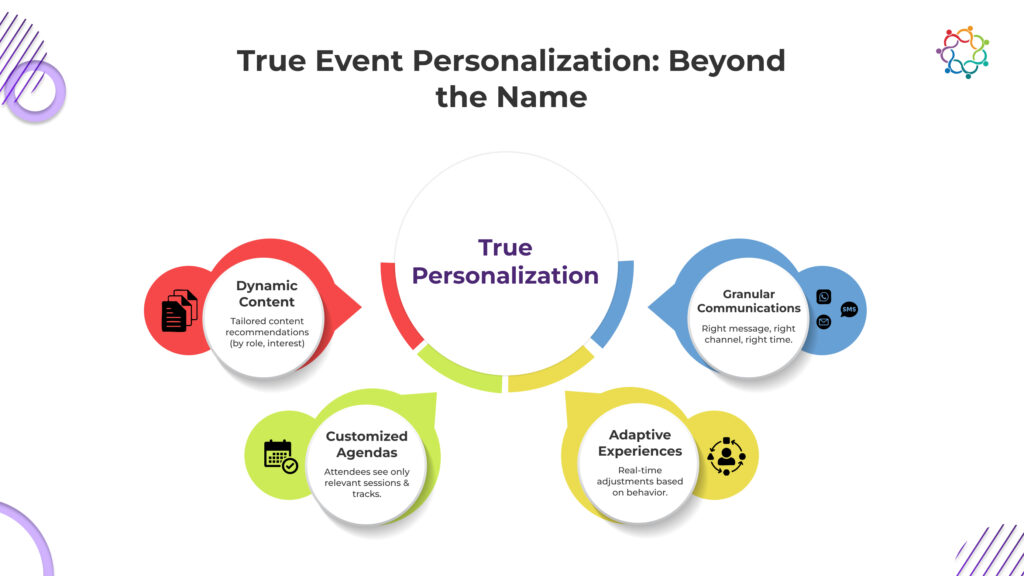
Personalization isn’t adding someone’s first name to an email subject line.
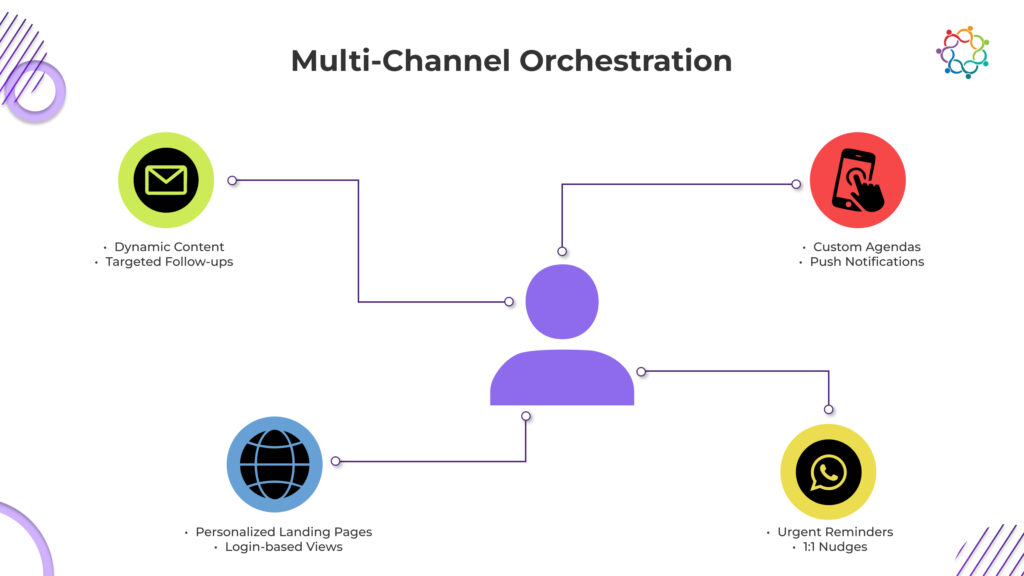
Real personalization means a marketing director sees different sessions than a product manager. They get different networking recommendations. They receive different booth suggestions. The app interface changes based on their role. Every touchpoint feels designed specifically for them.
This happens because your platform knows: their job title, their industry, their stated interests, what sessions they actually attended, which booths they visited, which speakers they engaged with.
That data feeds personalization. Not in batches. In real time.
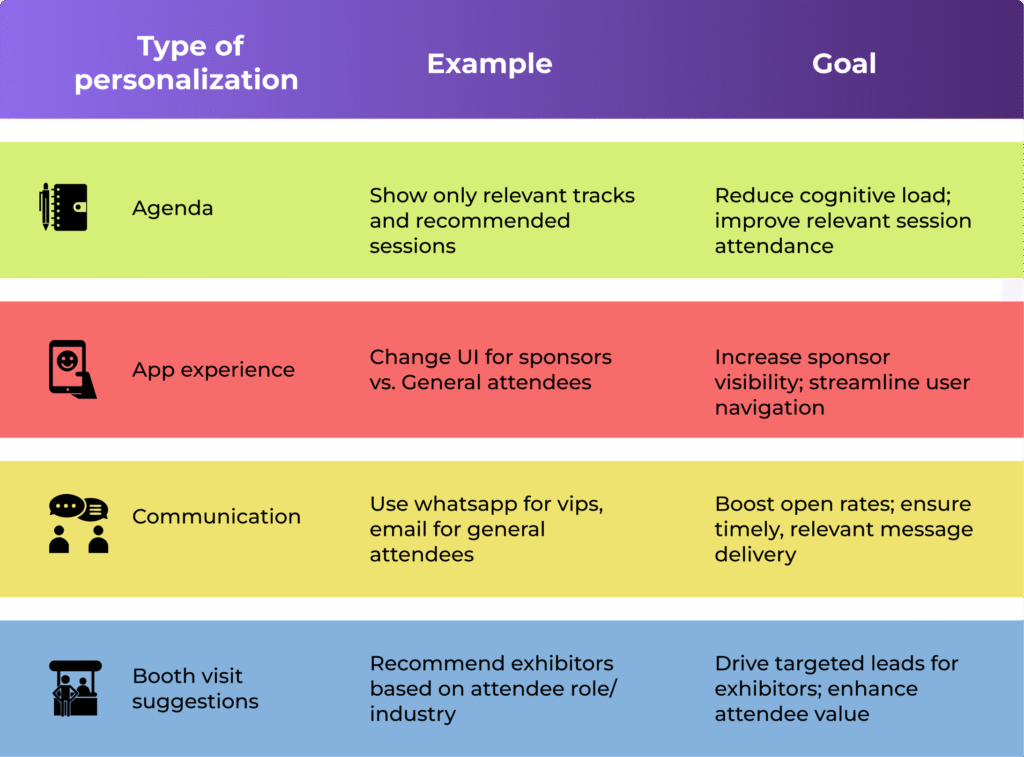
Personalization requires multiple channels working together, not fighting each other.
Email works for pre-event details. A finance director gets an email about compliance sessions. A sales leader gets an email about pipeline-focused sessions. Different people, different content.
Event Apps adapt in real time. Someone saves an AI workshop. The app recommends related sessions. They finish that session. The app suggests a booth visit to an AI vendor. It’s not static. It changes as the event runs.
Event Websites greet people differently based on who they are. A VIP logs in and sees VIP networking events. A general attendee logs in and sees popular sessions. Use Samaaro’s event website capabilities to create login-based personalization that starts before the event even begins.
WhatsApp and SMS deliver urgent, personal messages. A VIP gets a reminder about an exclusive luncheon starting in 10 minutes with directions. General attendees get standard session updates. Different audiences, different urgency levels.

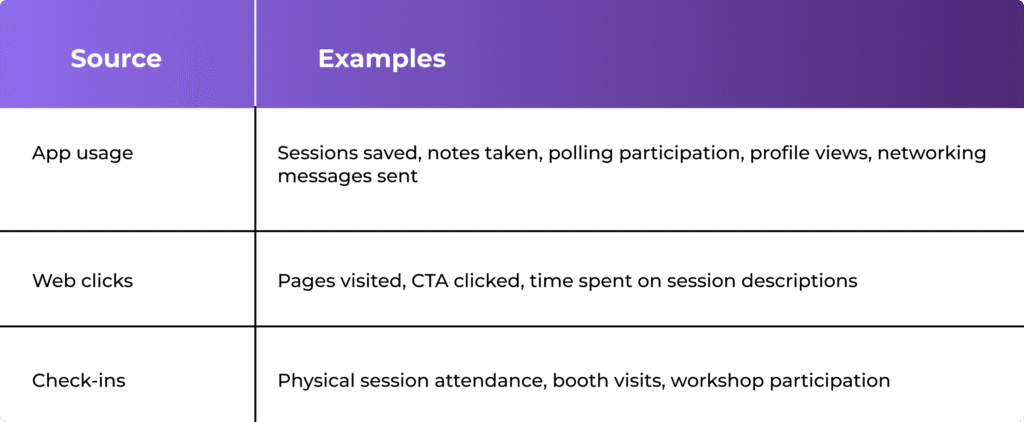
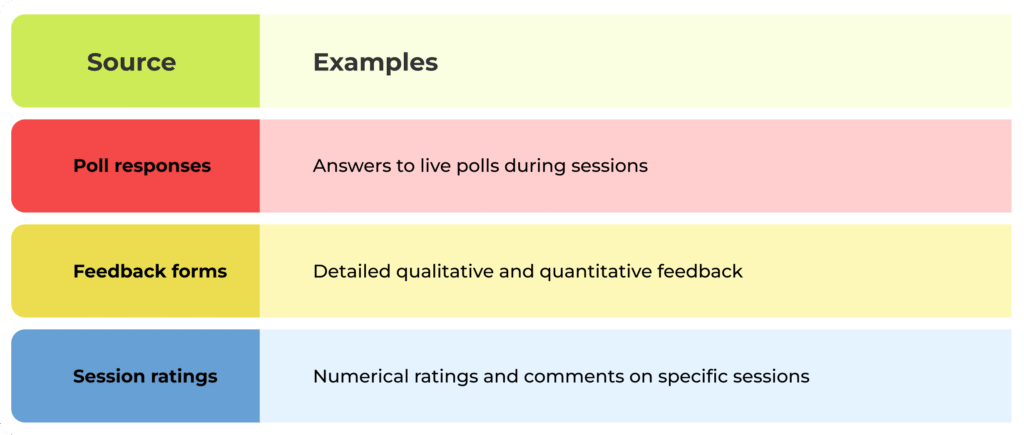
Without data, personalization is guessing. With the right data structure, it’s intelligent.
Pre-event Data comes from registration forms and CRM. Job title. Industry. Past event attendance. What sessions they want to attend. Build attendee personas from this.
Behavioral Data is collected during the event. Which sessions they actually saved. Which booths they visited. How long they stayed in sessions. Which emails they opened. This data is gold because it’s real behavior, not stated preference.
Intent Data tells you motivation. Which sponsors they engaged with. Which demos they requested. Which ratings they gave. Which networking matches they accepted. This reveals what they actually care about.
Here’s where data becomes actionable. Build three attendee personas.
The Networker actively messages people. Schedules 1:1 meetings. Attends networking mixers. Give them curated meeting suggestions and exclusive lounge access.
The Learner saves sessions. Downloads slides. Rates presentations. Give them access to all recordings and a personalized learning path.
The Buyer visits booths. Requests demos. Engages with sponsor content. Give them direct sponsor introductions and follow-up access.
Now you’re not personalizing for 5,000 random people. You’re personalizing for three clear audience types using rules you set once.
Personalization fails when channels contradict each other.
Email recommends Session A. App recommends Session B. Website shows Session C. Now the attendee is confused and none of your personalization worked.
The fix: one attendee profile across all channels. Email references the app agenda. App sends confirmations via WhatsApp. Website shows what’s already saved in the app.
This requires your platform to sync data across email, app, website, and SMS. Samaaro’s event app solution does this automatically so your personalized messages feel coordinated, not chaotic.
At scale, manual personalization is impossible. You need automation.
Set up rules once. AI does the heavy lifting. “If someone saves AI sessions, recommend AI vendors and AI-focused networking groups.” The system executes this for 5,000 people without your team intervening.
Segmentation happens automatically. Pre-event communications go to different audiences. In-app recommendations update as the event runs. Post-event follow-ups tailor to behavior.
Your job is defining the rules. The platform executes them.
Want to see how this would work for you?
30 minutes inside Samaaro: AI-driven journeys, dynamic agendas, and behavior-triggered comms.
Book a tailored walkthroughPersonalized events feel smaller even when they’re massive. A 5,000-person conference feels like it was designed for 500 people specifically for you.
Engagement goes up because people see relevant content. Conversion goes up because follow-ups match actual behavior. Retention goes up because attendees feel understood.
Personalization isn’t a nice-to-have feature. It’s the difference between an event that works and an event that doesn’t.
Start with your event website. Use Samaaro to personalize the pre-event experience based on registration data. Then layer in app personalization and multi-channel messaging during the event.
The platforms exist. The playbooks exist. The only thing missing is execution.Ready to personalize your next event? Schedule a demo today.
What is real event personalization vs just using someone’s name?
Real personalization means the entire event changes based on who someone is. A sales leader sees sales sessions. An engineer sees technical sessions. Different agendas. Different recommendations. Different follow-ups. It’s not just their name. It’s their entire experience feeling customized.
How do apps recommend sessions in real time during an event?
Apps track what attendees do. Which sessions they save. Which ones they attend. Which booths they visit. The app sees this happening and updates recommendations immediately. Someone finishes an AI workshop. The app suggests a related networking group or AI vendor booth. It adapts as the event happens.
What three types of data do we need to collect?
Registration data tells you who people are (job title, company, interests). Behavioral data tells you what they do (which sessions they save, which emails they open, which booths they visit). Intent data tells you what they care about (which sponsors they engage with, which ratings they give, which demos they book).
How do personas like Networker or Learner help us personalize?
Personas let you treat different attendees differently. Networkers get meeting suggestions and lounge access. Learners get recording links and downloaded slides. Buyers get demo offers and sales contact info. You’re not sending the same follow-up to everyone. You’re sending the right follow-up to the right person.
What does cross-channel personalization actually mean?
It means email, app, website, and WhatsApp all know the same things about each person. Email recommends Session A. App shows Session A in their saved agenda. WhatsApp reminds them about Session A. Website displays Session A in their calendar. Everything points the same direction instead of confusing people with contradictory messages.
How do we automate this without hiring more people?
Set rules once. “If someone saves AI sessions, recommend AI vendors.” The platform applies this rule to everyone automatically. You write the rules. AI executes them for thousands of people. Without automation, personalization at scale is impossible.
Mobile apps are no longer a nice-to-have capability, they are the modern event experience. A seamless, easy access to event content, as well as real-time information to the palm of your audiences pocket is what participants expect whether you are managing a 500-person conference, world-class trade show, or internal employee event. Event apps have come a long way from a simple agenda. They are now command centers that provide engagement opportunities, lead generation, connection and networking opportunities, and even analytics for your event. As participant attention spans decrease, so do expectations for personalized event experiences. Executing the right mobile experience will dictate how your attendees move and engage, as well as how they will remember your event. In this blog, we will first discuss the top must-have features in event apps, also some useful extras that should be considered based on the type of event, and finally how you select the right platform based on your needs and the scale of your event.
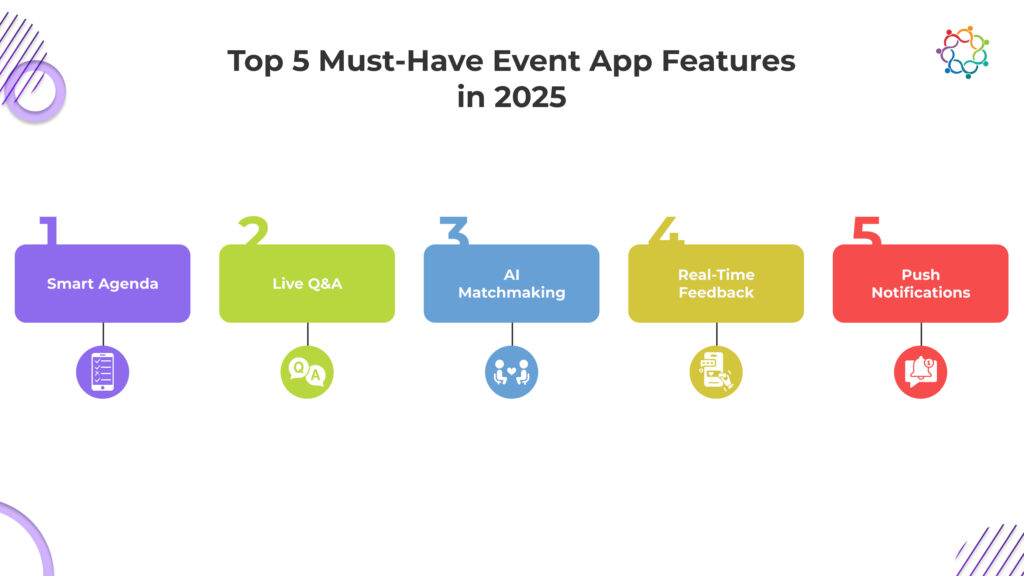
Today’s participants wouldn’t be satisfied with simply the event schedule. They’re looking for active content, contemporary interactions, and meaningful networking that feels informative and current. These five features are considered must-haves in any best-in-class event application:
A static agenda is a relic of the past. Today’s event apps must deliver dynamic scheduling that adapts to each attendee’s needs.
Key Features:
Why It Matters:
Attendees move between tracks and sessions quickly. Personalized agendas reduce confusion, boost on-time attendance, and help users make the most of their day.
Example:
At a multi-track marketing conference, a CMOs persona filters sessions on AI and economic forecasting, adds them to their agenda, and gets notified 10 minutes before each one begins making it easy to stay on track.
Passive listening no longer cuts it. Attendees want to interact, and they want it in the moment.
Key Features:
Why It Matters:
Enabling two-way interaction turns attendees from observers into active participants. This engagement strengthens their connection to the event and keeps content dynamic.
Example:
During a keynote, attendees submit questions via the app. The most upvoted query is addressed live, creating an inclusive atmosphere and stronger connection with the speaker.
Automatic introductions between attendees can significantly enhance networking outcomes.
Key Features:
Why It Matters:
Attendees trust AI when it connects them to peers, they actually want to meet. This increases satisfaction and drives deeper conversations.
Example:
An investor at a startup expo receives suggestions to meet fintech founders based on mutual interest tags. They schedule two 1:1 meetings directly in the app and close a follow-up discussion within weeks, thanks to streamlined match recommendations.
Quality feedback informs improvements, not just later but during the same event cycle.
Key Features:
Why It Matters:
Collecting feedback in real time captures honest reactions and empowers organizers to optimize the experience while the event is still happening.
Example:
Attendees at a workshop rate it 4.8 out of 5 right after completion. Organizers spot a drop in feedback for a lunch session and adjust timing for the next day, increasing later session satisfaction by 18%.
Unpredictability is part of live events. A solid app ensures attendees stay informed and included.
Key Features:
Why It Matters:
Whether there’s a room change, surprise speaker or network mixer, notifications keep attendees engaged and reduce confusion.
Example:
VIP-only meetups are announced via push notifications to select attendees. RSVPs are captured on the spot and organizers coordinate follow-ups—without emails or spreadsheets.
Not every event requires every feature. But depending on your format and goals, these can significantly elevate the attendee experience.
Value: Increases booth visits, app usage, and overall participation
Ideal For: Trade Shows, expos, employee engagement events
Value: Helps monetise the app by offering visibility to sponsors
Ideal For: Conferences, exhibitions
Value: Captures leads directly via the app, no additional hardware needed
Ideal For: Expos and B2B showcases
Value: Reduces confusion and footfall drop-off in large venues
Ideal For: Tradeshows and large-scale events
Value: Increases inclusivity and accessibility for global audiences
Ideal For: International conferences
Note: Always match features to event format and audience. A private roundtable might not need gamification, while a large expo would be incomplete without it.

Instead of forcing every event into a fixed feature set, it lets organizers activate only the modules they want. This means cleaner interfaces for attendees, and cost savings for you.
All information, from engagement metrics to scanned leads, syncs back in real-time with Samaaro’s central dashboard and CRM integrations. This allows teams to handle pre-, during, and post-event workflows in one tool.
Samaaro’s mobile event app scales to your format whether you are having 50 or 5,000 attendees.

Samaaro’s flexibility, CRM readiness, and lead-gen tools make it a strong choice for enterprise and mid-market event teams alike.
Having a great event app is no longer a bonus, it is essential. From registration to session engagement to lead collection, the app shapes the attendee experience and drives your event ROI.
But not all apps are created, or meant, for every format. The secret is to align your technology with the overall event goals of conversion, education, brand impact, etc.
Companies like Samaaro are blazing the trails with their modular, mobile-first, integrated event app that can be used for a variety of formats and budgets. You don’t need to pay for bloated platforms or be stuck with a clunky system. Build your stack. Build your impact.
Ready to see how Samaaro’s event app can power your next conference, roundtable, or launch? Schedule a walkthrough today.
The must-have event app features in 2025 are smart personalized agendas, live Q&A and polling, AI-powered networking and matchmaking, real-time feedback collection, and push notifications.
Live Q&A and polling turn passive listeners into active participants, surface audience insight instantly, and give speakers real-time feedback to keep sessions engaging.
AI matchmaking suggests relevant connections based on role, interests, and behavior, producing more meaningful meetings than random encounters and making networking time genuinely productive.
A modular event app lets you pay for only the features you need. That cuts cost and complexity compared with bloated all-in-one apps full of unused functions.
The app syncs attendee actions, sessions joined, meetings booked, content viewed, into CRM records automatically, powering lead scoring and personalized sales follow-up after the event.

Post-event feedback remains one of the most powerful, yet underutilized, tools in an event marketer’s arsenal. While there’s plenty of data to analyze during and after an event, only a small percentage of event teams actually use that data to drive meaningful improvements.
A recent study found that only 40% of event organizers go beyond asking a Net Promoter Score (NPS) or a basic satisfaction question. As a result, they miss out on deeper insights into what participants were truly thinking and feeling. This surface-level approach overlooks the nuance of attendee engagement and sentiment entirely.
But when feedback is gathered intentionally, distributed strategically, and analyzed for patterns, it becomes a gold mine. A well-executed feedback campaign doesn’t just tell you how attendees felt, it reveals why they felt that way, which sessions had the most impact, and which aspects need improvement before your next event.
In this blog, we’ll explore how to go beyond basic survey tools and unlock the full potential of feedback to elevate your event outcomes.
The Net Promoter Score (NPS) has been a popular way to measure how attendees feel after an event. It gives you a quick idea of overall satisfaction, but it doesn’t tell the full story.
Here are some of its limitations:
To get a full picture, NPS should be combined with more detailed feedback – like session ratings, open comments, speaker reviews, and questions about whether they’ll attend again.
For example, an event might have an overall NPS of 46. But a deeper look could show that 64% of breakout session participants mentioned poor moderation or said the content wasn’t relevant to them. These are the kinds of insights that NPS alone can’t reveal.
It also helps to break down responses by audience type. For example, a CMO and a product manager might react differently to the same session. A strategic keynote might be exciting for the CMO but less useful for the product manager, who prefers hands-on demos. First-time attendees may also rate things differently than repeat participants. When you group feedback this way, you get more useful insights.
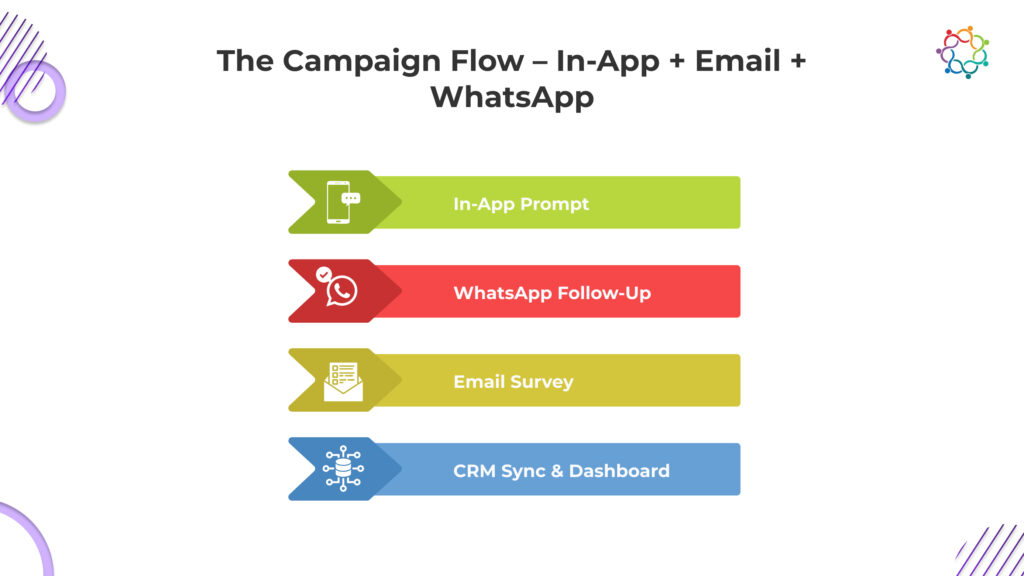
Different attendees respond differently to feedback requests, varying by how and when you ask. That’s why a multi-channel feedback campaign is essential for getting the insights you need.
Here is how an ideal feedback campaign flow can look:
Timing is key. Most feedback comes in during the first 24 hours and drops sharply afterward. After 72 hours, response rates can fall by as much as 60%. Use automation to time your requests perfectly and maximize engagement, ensuring you collect data you can truly act on.
Running a multi-channel campaign requires the right set of tools. Below are the most used tools across different event sizes and needs:
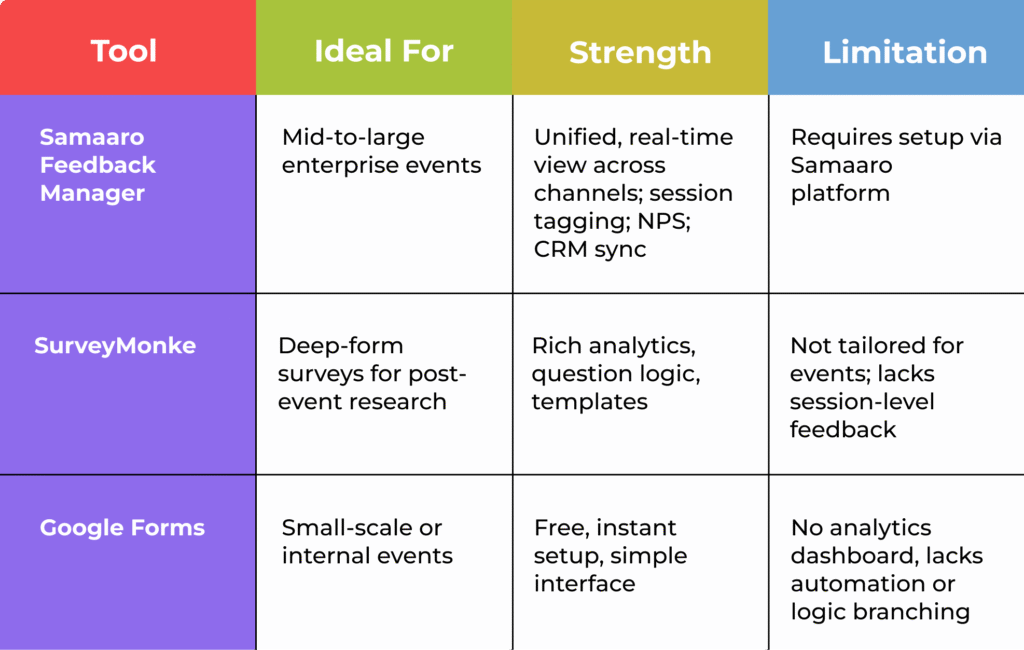
When picking tools, ensure they connect directly to your CRM or event platform. The real power of feedback data comes from linking it back to the attendee’s profile. For example, if an attendee rates a product demo poorly, your sales team needs that information before their next interaction.
Look for tools that:
For teams using Samaaro, the Feedback Manager consolidates session feedback and event level scoring. It immediately exports data, offering optional NPS scores and tagging for all feedback.
Effective feedback is not just about questions; it is about structure. Modular, role aware, and intent based forms offer the best response rates and the most usable insights.
A well-structured form improves submission rates and enables precise data slicing. For example, if all negative feedback comes from first-time attendees, your onboarding or welcome flow might need improvement.
Feedback without follow-through creates distrust. Once you collect data, your team must act swiftly and transparently to build attendee loyalty.
The cycle is simple yet powerfully impactful: Collect, Analyse, Act, Repeat. Closing the loop is what truly transforms raw feedback into a significant competitive advantage for your events.
The most successful event marketing teams use feedback not as a checkbox, but as a compass. When executed well, post-event feedback initiatives empower you to improve the next experience, prove ROI, and boost attendee engagement.
Whether you choose to use in-app surveys, email forms, or WhatsApp messages, feedback should be timely, structured, and ready to act on immediately. NPS is just one part of the puzzle; the true value comes from how you manage form design, segmentation, and analysis.
If you are ready to move beyond basic surveys and create campaigns that generate true insights, Samaaro’s Feedback Manager is designed to streamline the entire feedback lifecycle. It centralizes responses, automates distribution, and simplifies reporting, giving you back time to focus on improvement rather than just collection.
Looking to build feedback flows that do something? Talk to our team to see how Samaaro’s Feedback Manager can make it happen.
NPS gives you one loyalty score but no reasons behind it. It misses session-level insight, logistical issues, and the specific fixes that actually improve your next event.
Send the first survey within 24 hours while the experience is fresh, then follow up with non-responders after two to three days through a different channel.
Beyond satisfaction ratings, include session-level feedback, logistical questions, open-ended comments, future topic interests, and consent for follow-up communication.
A You Said, We Did report shows attendees exactly how their feedback changed the next event. It builds trust and noticeably lifts future survey response rates.
Syncing feedback into your CRM lets sales tailor follow-up by sentiment, flags hot leads who expressed interest, and connects attendee opinions to revenue conversations.
In 2025, events remain one of the most successful and powerful tools in the marketing mix for not only awareness but also building pipeline, partnerships, and loyalty. But the path to a successful event is about more than just the speaker line-up or venue location. From your time planning the event, to your tech stack, to how you engage with attendees, to how you capture ROI has everything to do with the format you choose.
Whether you’re running a conference for 5,000 people or a high-touch executive roundtable, knowing and understanding the nuances of the different formats and how they relate to your goals is essential. This blog will look into the top formats that we expect to trend in 2025, the goals and KPIs you will associate with them, and the event planning stack you will need to help execute them successfully. We will also detail the registration flows, all the way to CRM connectivity, and how Samaaro’s flexible platform can support you across different formats so you can quickly scale without tech headaches.
As B2B and consumer-facing companies continue to optimize their event strategies, some formats are coming forward as the clear winners in conjunction with stage in the funnel and type of audience. Here are the hottest event formats for 2025:
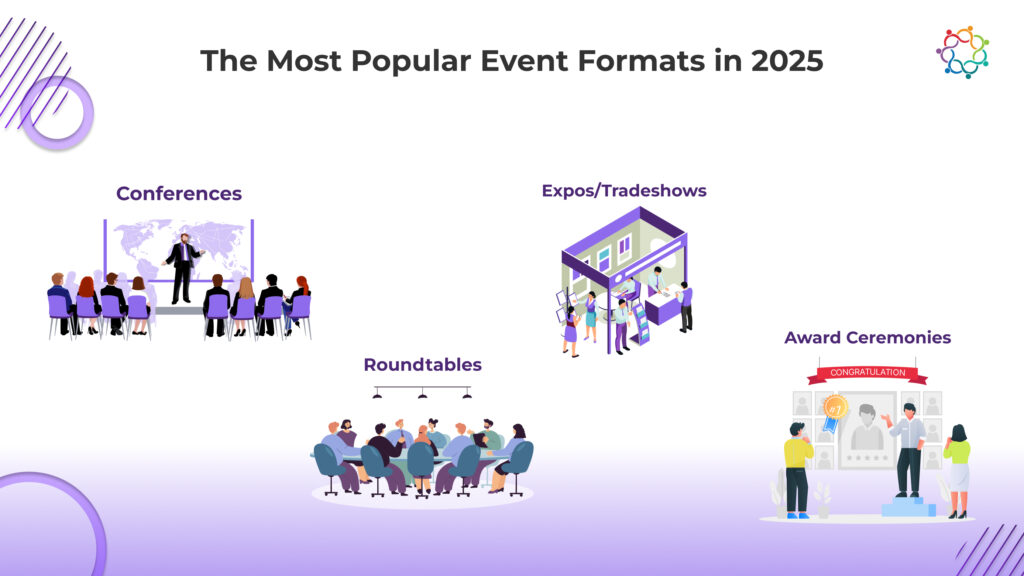
For enterprise brands, conferences remain the premier event format. A tech summit or an annual customer forum, conferences provide the ability to consolidate attention, elevate the brand as a category leader, and produce high-value leads through content and interaction.
Roundtables have become increasingly popular as marketing teams pivot from quantity to quality. These roundtable formats are used for strategic conversations, product validation, and campaigns based on account-based marketing where one-to-one attention is paramount.
Expos remain critical for industries like real estate, manufacturing, and retail. They allow brands to engage high footfall through product displays, walkthroughs, and interactive demo zones.
Award nights offer a powerful mix of storytelling, entertainment, and brand amplification. From internal team appreciation to large-scale industry recognition, this format is as much about emotion as it is about exposure.
Let’s break down what success looks like for each event format, along with the KPIs that matter and the planning nuances that often go overlooked.
Each format brings with it different operational demands. Here’s how the tech stack differs based on format:

Scalability and integration are key across formats. Ensure the tools you pick offer pre-built connectors for your CRM, marketing automation platform, and feedback workflows.

Each stack is designed to minimize setup effort while maximizing visibility and control, particularly valuable for high-frequency marketing teams.
In In a world where your event calendar might feature a product launch this month and a CXO roundtable the next, flexibility isn’t a luxury, it’s a fundamental requirement. Modern marketing teams don’t have the time or bandwidth to onboard a new platform every time the format changes. They need a single, intelligent solution that adapts to different use cases, team sizes, and audience expectations. Flexibility, then, isn’t just about supporting multiple event types, it’s about understanding why formats shift and making those transitions frictionless.
With Samaaro, you can run a closed-door discussion, a mid-sized product launch, or a multi-day expo, all on the same system. Whether it’s advanced RSVP workflows, calendar syncing, QR-based check-ins, booth-level lead capture, or custom seating for an awards night, the platform adjusts to your needs. It’s entirely modular: use what you need, skip what you don’t.
Another key advantage is Samaaro’s unified data architecture. All attendee details, engagement touchpoints, feedback, and CRM syncs are centralized, making reporting easier and enabling smarter personalization for future campaigns. Want to know who checked into multiple sessions, asked questions, and completed the post-event survey? It’s all in one place.
That’s why marketing teams across real estate, IT, consulting, healthcare, and more trust Samaaro to manage their entire event calendar. When formats change, Samaaro doesn’t slow you down, it moves with you.
In 2025, the event format you choose is as strategic as the campaign theme you pick next. It impacts your goals, workflows, team bandwidth—and ultimately, your ROI.
By aligning your event format with the right tech for check-ins, CRM, and engagement, marketing teams can move faster and plan smarter.
Are you ready to map out your 2025 event calendar with the right format-tech fit?
Contact Samaaro today, find a platform that grows with your events, not against them.
The top event formats in 2026 are: large conferences (best for brand awareness and category leadership), executive roundtables (best for ABM and senior pipeline), expos and trade shows (best for lead volume and product launches), webinars and virtual sessions (best for demand generation at scale), customer advisory boards (best for retention and product feedback), and field marketing events (best for region-specific pipeline). Pick formats based on the goal, not on what’s trendy.
KPIs and success metrics differ by event format. Conferences are measured on attendance, brand awareness lift, and pipeline influenced. Roundtables are measured on quality of accounts, executive engagement, and deal acceleration. Expos are measured on lead volume, booth visits, and cost per lead. Award ceremonies are measured on PR coverage, sponsor satisfaction, and customer retention. Using the same KPI dashboard for every format hides what each one actually does well.
Invite-only executive roundtables are gaining popularity over large conferences because they deliver higher-quality engagement per dollar. A 20-person roundtable with the right CMOs and VPs builds more pipeline than a 2,000-person conference where the right people are buried in the crowd. Roundtables are also faster to organise, cheaper to run, and easier to repeat in multiple regions. For B2B teams focused on enterprise pipeline, the math heavily favours intimate formats.
The essential tech stack for any event format includes: flexible registration with approval workflows for closed-door events, QR-based check-in, an event app, automated multi-channel communication, lead capture and qualification, native CRM integration, and a real-time analytics dashboard. The depth varies by format (roundtables don’t need a 2,000-person check-in queue, expos need booth-level lead scanners) but the core stack stays the same.
Real-time lead capture and booth-level gamification improve expo and trade show outcomes by turning passive booth visitors into engaged, qualified leads. Lead scanners capture contact details in seconds. Gamification (QR scavenger hunts, demo points, leaderboards) drives booth traffic. Engagement scoring identifies who’s serious versus who’s just collecting swag. Sales gets a ranked list of qualified leads on the same day, not a CSV file two weeks later.
Marketing teams running multiple event formats need a single flexible platform because separate tools fragment data and force manual reconciliation. With one platform across hosted events, field marketing, and trade shows, every attendee record is connected, every channel attribution is consistent, and every ROI report uses the same definitions. Samaaro is built for exactly this use case: one platform across formats, with shared audience intelligence and reporting.
Roundtables typically deliver the best ROI on limited budgets. They are low cost, highly targeted, and put you in direct conversation with decision-makers who actually convert.
Choose a conference when your launch needs education and thought leadership. Choose an expo when hands-on demos and high lead volume matter more. Match the format to your goal.
Yes. Samaaro manages conferences, roundtables, expos, and award ceremonies on one platform, covering registration, check-in, engagement, and analytics without switching tools between formats.
Track engagement scores, qualified leads, meetings booked, pipeline influenced, and post-event conversions. Attendance tells you who showed up, not whether the event created business value.
Balance formats by goal, budget, and audience. Spread flagship events across quarters, mix intimate roundtables with larger formats, and lock venues and technology early for 2026.
Imagine putting together a field marketing event and you’re hoping for the best. You’ve sold tickets, you’ve planned your email campaigns, and now attendees are coming. But just on the day of the event, audio issues disrupt the presentations, the caterer brings the wrong menu, and a sponsor’s branding is placed incorrectly. Disruptions like these are not just very frustrating nuisances to smooth out.
Event partners, venue partners, vendors, and sponsors, do more than make your event happen as transactional partners. A venue with a good understanding of your target customer, a vendor who is aligned with your event goals, and sponsors who would be willing to actively promote your event, these are the force multipliers that help favorably differentiate the event experience for attendees.
In this blog, we will explore how all the key facets of event partner management can serve to support your event’s sales growth and more importantly time to build trust between partners over time. You’ll learn how clarity in goal setting and communication, reliability, and mutuality help you build increasingly coordinated event partner relationships.
Strong relationships with event partners are important for a few reasons.
Venues create both a physical and emotional context for the event. Their service and facility (on both fronts) help to establish credence. Vendors (audio-visual, caterers, decorators, furniture rentals, etc.) execute to ensure a smooth experience. Sponsors provide funding, awareness, and credibility through an association.
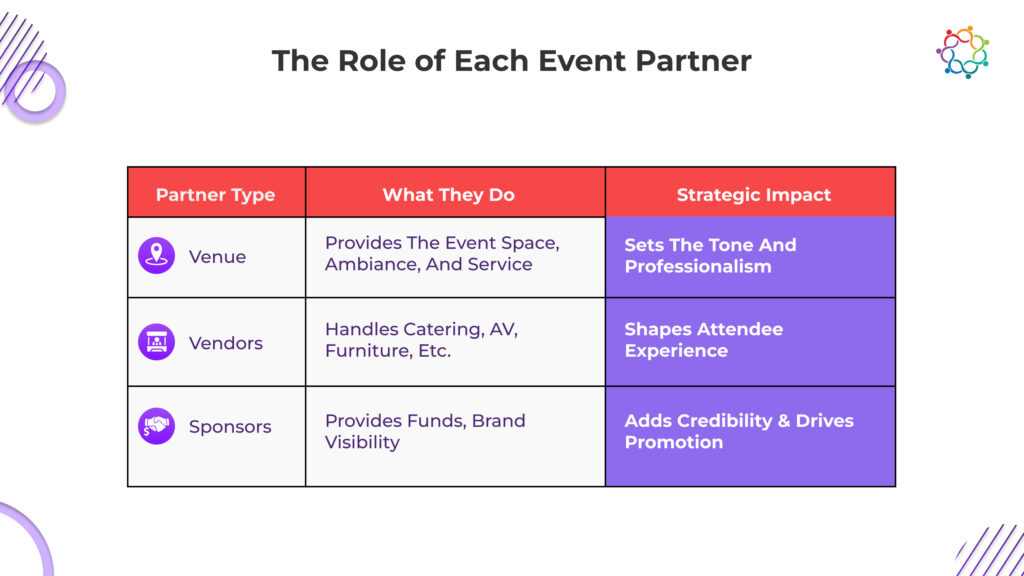
When partners trust your brand, they can become referral engines. If a venue has a positive experience hosting your event, they are more likely to recommend your team to other organizations. Good vendors lead to repeat relationships, cost savings, and accelerated planning cycles. Good sponsors get preferred treatment and exposure, get more exposure and become more likely to renew and/or invest more.
Poor communication results in misalignment. Incomplete contracts result in service gaps and failures. Unreliable vendors result in decreased experience for attendees. Neglected sponsors do not deliver promised value. Cvent’s 2023 study found event planners identified 78 percent consistent execution of their events to strong vendor relationship strategies. Poor partner management correlates directly to sales lost, harm to your brand, and an extended inability to capitalize on future opportunities.
Effective event partner management is more than logistics. Treating partners as allies, as opposed to just hired help, allows your team to work more effectively (and, of course, increases your effect overall).

Strong partnerships require clear processes and intentional relationship building. Below are some practical practices you can start using today for stronger partnerships.
From the start set expectations and maintain clarity. Use tools such as Slack, Asana, or Trello to create shared workflows. Log deadlines, deliverables and responsibilities. Share weekly instructions, including attendee thoughts or changes in the floor plan. Your contracts should clearly outline arrival times, staff support, payment terms, and how to escalate issues. Use a Gantt chart or checklist to remain accountable and discourage misunderstandings.
Understand what each partner finds valuable. A venue is likely looking for bookings year-round. A caterer may want to provide a new menu, or upsell extras. Sponsors will want to see brand visibility or reporting such as number of views on recordings, logo placements on marketing materials, or on-stage mentions.
For instance, provide sponsors the right kind of data on attendees by providing insight into their demographics, or analysis in closed loop analytics that demonstrate success. Consider the working relationship in terms of the mutually beneficial in terms of partnership, and mirror that on the client side to facilitate working partnership similar to client-side offers.
Trust is built naturally through reliability. Keep your word, meet deadlines for yourself and others and be prepared for the obstacles that will arise. For example, provide AV vendors a comprehensive technical run-through schedule, with any contingency plans. When decisions are due, send reminders to your partners.
All of your partners are managing their own resources and showing that you respect their time and capacity will establish trust and ideally prevent some common problems from surfacing during execution.
Generating mutual value helps ensure partners have a vested interest in your success! Depending on the objective, generating mutual value can usually be resolved through co-marketing opportunities. For example, we utilize sponsors in our event emails, event landing pages, and social media posts; however, co-branding and co-hosting sessions is also an option (post-event) with co-branded recaps, blogs, or white papers to highlight both brands.
Human connection facilitates relationships. Send handwritten notes to the individuals page after events and acknowledge their team members. Celebrate milestones for partner companies, like annual reviews or replication of service coverage. Invite partners to partake in “thank you” dinners or invite-only breakfasts hosted in your office. Make sure you celebrate individuals as well as their organizations!
By applying these strategies consistently, you signal collaboration, professionalism, and mutual respect. These steps support an environment where partners are willing to adapt, recommend, and invest in your events.

Building and maintaining successful partnerships is all about care and feeding.
Schedule quarterly check-ins to discuss similar upcoming event calendars, industry trends, or shared objectives. If possible use each call to share metrics like event attendance or sales follow-up outcomes. Don’t wait for an emergency to take action. A scheduled check-in will keep your partnership visible, trusted, and strategic.
Provide formal and informal recognition. Social media shout-outs for partners and vendors over LinkedIn; Testimonials on your website also serve as great ways to elevate partners.
Remember: The more genuine feedback you offer, the better for everyone. Hold a review session after each event or send out an evaluation form that includes questions such as “Were the goals clear?” or “How can we work together better next time?” Honesty combined with thankfulness reflects respect, regardless of the circumstances.
Offer benefits tied to loyalty but with a modern twist. Loyalty programs encourage additional partner investment in your event. Adding opportunities for one-time and repeat partners.
The benefits of loyalty serve to build deeper equity with you and your organization but will also enhance the ease of future planning.
There can be disagreements with any partner. Bring problems to the surface quickly and confidentially. Talk about behaviors instead of blaming.
For example, instead of saying “you did not deliver,” say “the timeline slipped and, as a result, the delivery was delayed“.
Listen to your partner’s concerns and discuss the way forward together. Create a short post-mortem, and document the next steps and circulate. If you handle conflict with a sense of professionalism, you will create a stronger sense of trust in the future, like anything, being “conflict avoidant” is not a good place to be.
Take advantage of customer relationship management (CRM) tools, like HubSpot, Airtable, Salesforce or the like. To keep track of all your interface with and partner feedback or ever-changing notes specific to roles and partner relationships, make it a point to use CRM tools to tag each partner type explicitly, and log both successful events or issues accordingly. In terms of length of responsibility, automating reminders for certain days or key tasks is also useful.
Technology tools create scalable structures and ensure that some level of detail is tracked and nothing is forgotten.
These long-term maintenance worksets will make your team more of a strategic partner versus a vendor, not to mention the ongoing, daily attention you are giving to each partner makes them loyal, referral activity increases, and events are seamless.
Measuring your partnership results helps you decide where to invest and when to optimize.
Keep track of distinct outcomes like venues booked for seven total years. You’ll want measurement as to how many sponsor renewals there are, and while you’re at it measure the amount of increases for any referral-related deals closed. Clearly these will be metrics that show the revenue impact derived from partnerships.
Partner feedback can be received through a survey or informal calls. Find out how clear their experience was, how they feel the working relationship is going and most importantly how satisfied they are with the outcomes of your events. You’ll want to look for free form responses, although you may not be able to put these into hard data, you may find some valuable actionable suggestions.
Very important, relate the outputs of partnership activity to sales results. When you get a big sponsor, and establish a co-branded executive dinner, the referral deals that were SQL’s or closed deals will need to be tracked. This could also be valuable feedback from your principal partners as well. For example, one organization reported a 20 percent increase in event based sales as a formalized sponsorship role with defined outputs introduced, and a revisited working relationship with improved coordination to address needs for call it a lead at the outcome of the event.
The combination of quantitative and qualitative measures give you indicators or ways to improve your approach. A high level satisfaction rate in your partnership activities with an increase in repeat deals tells a positive story, a plateau or lack of growth can be a signal to adjust your strategy.
Event partners aren’t just background support, they’re essential to your event’s credibility, attendee satisfaction, and even your sales funnel. When relationships with venues, vendors, and sponsors are built on trust, shared goals, and mutual value, events become smoother, more impactful, and more scalable.
That’s why event partner management should be a strategic priority, not a logistical afterthought. And that’s exactly what Samaaro empowers you to do. With built-in collaboration workflows, CRM integration, real-time analytics, and automated communication tools, Samaaro helps you manage vendors, sponsors, and venues in one unified platform, so you can move beyond transactional coordination to transformational partnerships.
If you’re ready to build long-term event partner relationships that drive real business impact, it’s time to streamline and strengthen how you work together, with Samaaro as your event operations backbone.
Venues, vendors, and sponsors each play distinct roles. Venues set the tone and physical experience (a premium venue lifts perceived event value). Vendors (catering, AV, production) shape the operational experience, which directly affects attendee satisfaction. Sponsors lend credibility through their logos and bring their own audiences. All three influence whether attendees walk away thinking ‘this is a serious event’ or ‘this felt rushed’. Treat them strategically, not transactionally.
Poor partner communication and incomplete contracts create service gaps because each partner assumes the other will handle critical details. Catering arrives short. AV runs late. Sponsor materials don’t arrive. Attendees notice. The reputation cost shows up in NPS scores and lower next-year attendance. Lost sales opportunities follow because high-value prospects judge your operational competence by how well your event runs. Tight communication and detailed contracts prevent most of this.
Transform transactional vendor relationships into strategic partnerships by understanding what each partner actually wants from the relationship (sponsors want pipeline, vendors want repeat business, venues want premium event association), creating co-marketing opportunities that benefit both sides, and tracking the value you create for them. Partners who feel like collaborators bring extra effort, flexibility, and creativity that transactional vendors don’t.
Build long-term partner loyalty through: quarterly check-ins (not just at contract renewal), formal recognition at events and in marketing content, multi-event loyalty pricing, dedicated relationship managers, professional conflict resolution that prioritises long-term over short-term wins, and visible appreciation. Most partners stick around because the relationship feels mutual. They leave when they feel like a transaction. The retention math heavily favours investing in the relationship.
Track these metrics to measure partner relationship impact: repeat partnership rate (what percentage return next event), referral volume (how many new partners come through existing ones), sponsor retention rate, average sponsor investment growth year over year, and partner-attributed registrations. High retention and growing investment per partner indicate the relationships are working. High churn signals you’re treating partners as transactions, not strategic assets.
Providing sponsors with attendee demographic data and closed-loop analytics helps demonstrate event ROI by showing them exactly who attended their session, who visited their booth, who downloaded their content, and who later became pipeline. Without this, sponsors evaluate ROI on impressions and guesswork. With it, they see specific business value. Sponsor renewal and increased investment follow when ROI is visible and defensible, which is what an integrated event marketing platform delivers.
Look for shared audiences, consistent delivery quality, aligned business goals, and measurable sales impact across multiple events. Partners who invest in your success beyond a single transaction deserve long-term commitment.
Include deliverables, timelines, payment terms, exclusivity clauses, branding rights, data ownership, performance expectations, and cancellation terms. Clear written agreements prevent most disputes before they start.
Transactional vendors get fixed service fees for defined work. Strategic sponsors justify larger investments in co-marketing, activations, and relationship building because they deliver compounding long-term returns.
Offer what money cannot easily buy: a niche, engaged audience, clear ROI reporting, creative activation ideas, and flexible sponsorship tiers. Proof of audience quality beats big production budgets.
A vendor sells you services. A sponsor pays for brand exposure. A strategic partner shares goals, risks, and growth, collaborating across events to drive sales for both sides.