Samaaro + Your CRM: Zero Integration Fee for Annual Sign-Ups Until 30 June, 2025
- 00Days
- 00Hrs
- 00Min

Key Takeaways (TL;DR)
1
2
3
→
Bottom Line:
An RFP that scores handoffs predicts your post-event workload better than any feature matrix.
An event platform RFP template is a structured set of questions sent to event technology vendors, covering what each system does and how data moves between it and everything else in your stack. Most templates get the first half right and skip the second entirely.
You ran procurement properly. Best registration system, best event app, best reporting tool, each chosen on its merits. Then implementation started and none of them moved data to the next without somebody doing it by hand. That somebody is usually you, on the Monday after a 500-person event, exporting three files and matching records that don’t share an identifier. One question predicts this and almost nobody asks it: what happens when this tool needs to talk to the next one?
Handoff capability decides whether the week after your event costs ten hours or two, and whether leads reach sales while they still convert. Hour figures here are operational estimates.

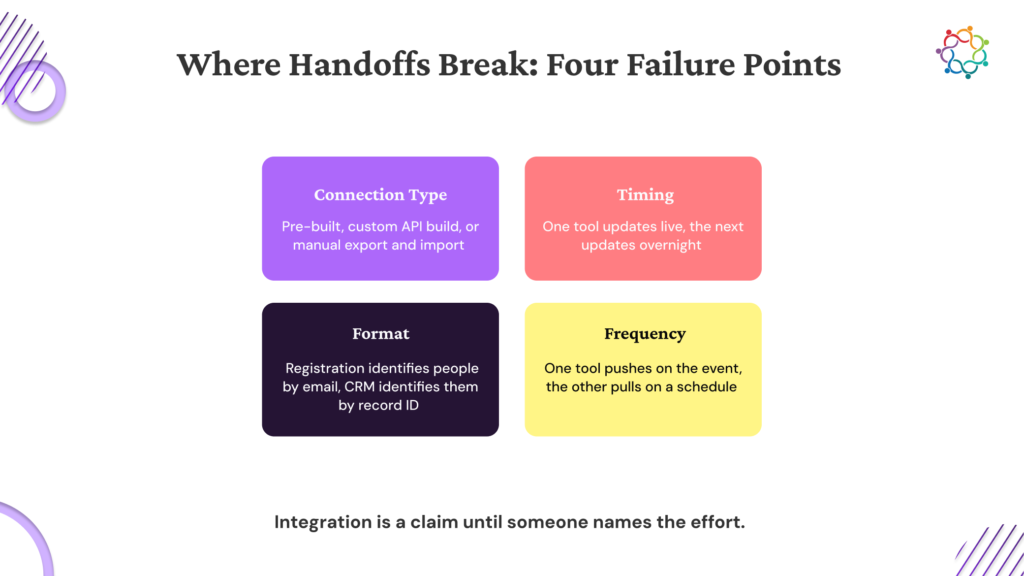
Because “integration” covers three things. Some connections are pre-built and work on day one. Some need custom API work from your engineers. Some are an export, a spreadsheet and an import. Vendors say “we integrate” for all three, so the word carries no information until you make them specify which.
Usually on timing or identity. Registration updates live while session tracking runs nightly, so check-ins don’t appear for twelve hours. Or registration keys records on email, the CRM keys on account ID, nobody built the mapping, and one person becomes two records. Frequency does the rest: one system pushes on change, the other pulls every six hours, and for those six hours two teams hold different facts. Same gap that shows up when event data has to reach the CRM.
For one 500-person event across three tools, budget around ten hours of reconciliation. The labor is the smaller cost. The bigger ones are error risk, where records split and leads get attributed wrong, and timing, because the window when a warm lead still answers is measured in days.
Name each handoff and ask in writing. Not “do you integrate with Salesforce” but “when an attendee checks in, does that reach our CRM without anyone on our side touching it, and is that pre-built or custom?” Questions like connecting registration to Salesforce without code get vague answers unless you force specificity. Put them in a response template so every vendor answers identically.

Feature comparison is how you rule vendors out. Handoff questions are how you choose between the ones left.
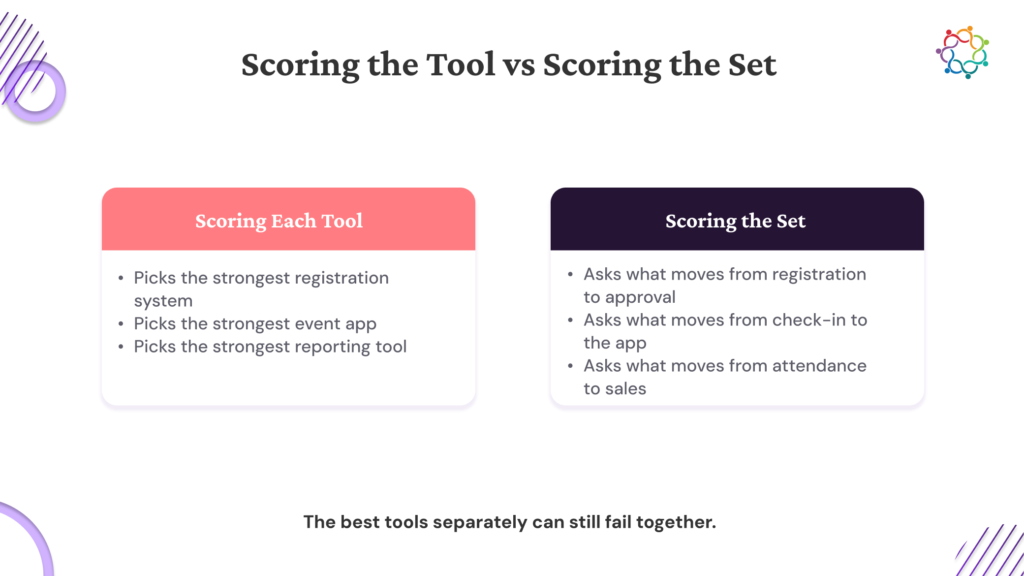
The failure mode is local optimization. Procurement picks the strongest registration tool, then the strongest app, then the strongest reporting layer. Each decision is defensible alone. Nobody scores the set, and six weeks in, the three winners turn out to need a person in the middle.
How common this is shows up outside events entirely. MuleSoft’s 2026 Connectivity Benchmark Report, a survey of 1,050 IT leaders, found IT teams spend an average of 36 percent of their time designing, building and testing custom integrations between systems. That’s the work your event platform RFP template either prevents or commissions. Most planning failures downstream of a purchase trace back to a question nobody asked during procurement.

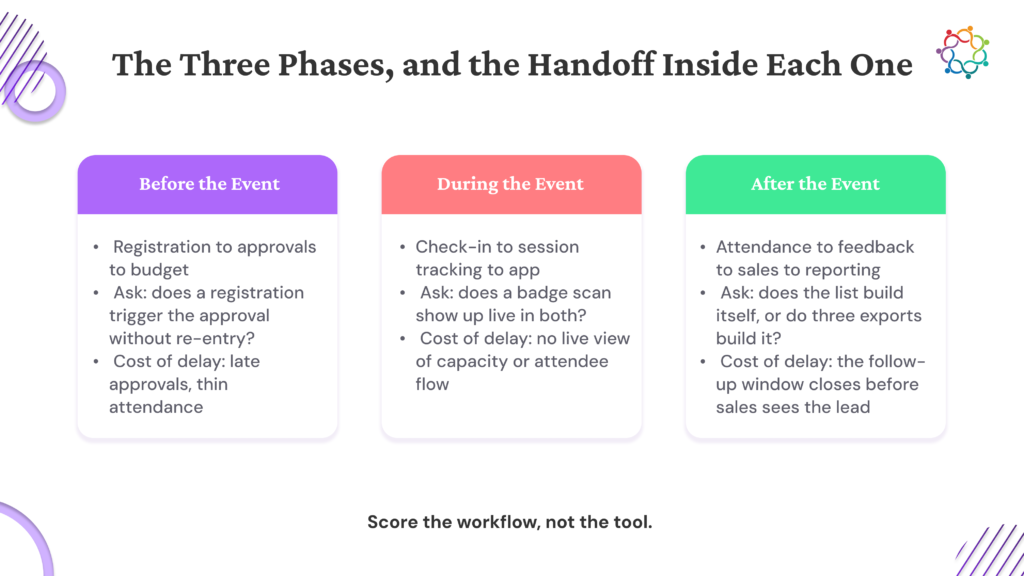
Organise your questions by workflow phase rather than by tool, because that’s how the data travels.
| Phase | What to ask | Why it matters |
| Before | Does a registration trigger the approval step on its own? Can finance see committed spend as registrations land? | Slow approvals push registrations late, and late registrations mean an underfilled room |
| During | When someone checks in, do the app and session tracking reflect it immediately? Can organizers see live capacity? | Real-time data is what lets you move a sponsor or open a second room while it still helps |
| After | Does the system assemble who attended, who responded and who goes to sales? Or is that three exports and a deduplication? | Follow-up decays fast, and every hour of reconciliation is an hour off the window |
| Sustainability | Which handoffs are pre-built, which need IT to build, which need monitoring? | “We integrate” and “we are integrated” are different claims with different costs |
The fourth row is the one teams skip and regret. A connection that works because an engineer maintains it is a running cost, not a feature. Ask what happens when the vendor updates their API, and who fixes it.
On the after row, check whether attendance, survey responses and lead routing land in one place. If they don’t, assembling the post-event report is a manual job every time, and check-in data is usually first to go missing.

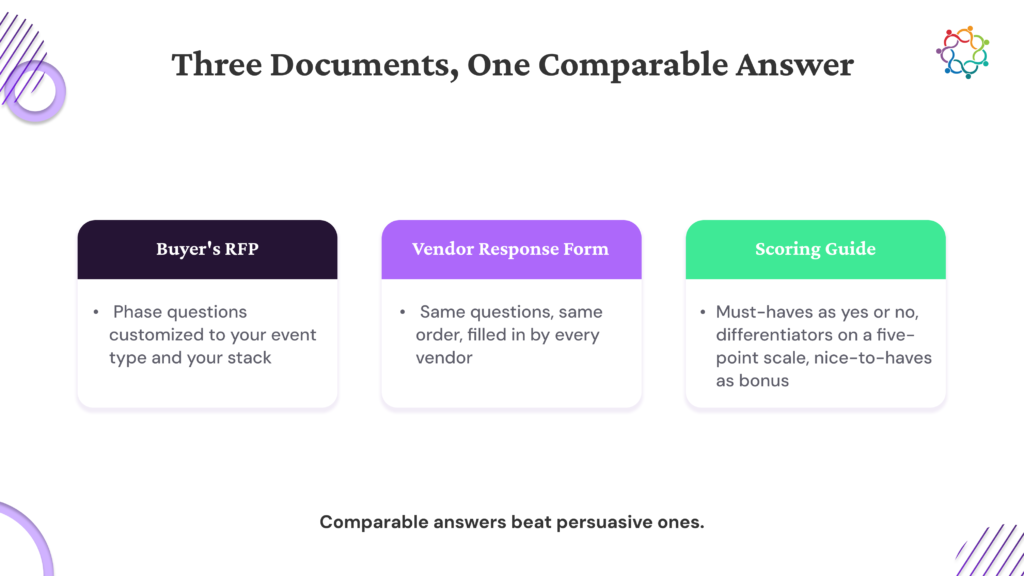
The buyer’s template holds the three-phase questions. Customize them for your stack, add the handoffs specific to you, and name your actual systems rather than describing them generically. Send it with a deadline and one instruction: answer in the response template, same order, no reformatting.
The response template does the real work. When every vendor answers the same question in the same field, you compare directly instead of interpreting three differently shaped proposals. It also closes the escape hatch where a vendor reframes your question into one they’d rather answer.
The scoring guide stays simple. Must-haves are yes or no, and a no ends the conversation. Differentiators score one to five, nice-to-haves are bonus only. Real-time movement between registration and your CRM is a must-have; whether that connection is pre-built or custom is a differentiator; a white-label app is a nice-to-have. Weight them before reading any responses, or the scoring drifts toward whoever wrote the best proposal. Asking what connects natively versus what needs building decides most of the differentiator column.
Customizing takes an afternoon and saves the weeks of debate that follow three incomparable proposals.

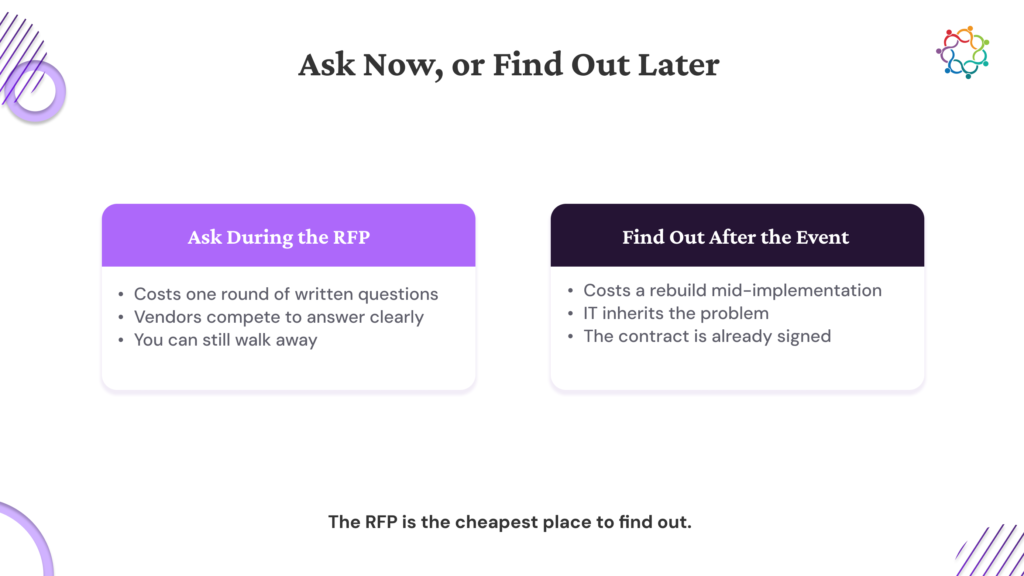
The RFP is where you ask about handoffs. Implementation is where you learn whether the answers were true. The Monday after your first event is too late to find out they weren’t.
Most teams skip these questions because they’ve never had a structure for asking them. That’s not a diligence problem, it’s a template problem, and it’s fixable in an afternoon.
Take the three-phase questions, name your handoffs, and put them in front of every vendor in the same format. If the answers point toward one Samaaro platform holding the whole workflow rather than four connected by hand, the scoring will show it before you sign.
Get the event platform RFP template. The download includes the buyer’s RFP, customisable for your stack, the vendor response form, and the weighted scoring guide.
If a handoff in your stack doesn’t fit the template, put the question to Samaaro directly before the RFP goes out.
What is an event platform RFP template?
A structured set of questions sent to event technology vendors, covering what each system does and how data moves between it and the rest of your stack. The useful ones organize by workflow phase rather than feature category.
What should you ask event platform vendors about integrations?
Name each handoff and ask three things: does data move without manual work, is the connection pre-built or custom, and who maintains it when the API changes. Vague questions get vague answers.
How do you score an event platform RFP?
Weight the criteria before reading any responses. Must-haves are pass or fail, differentiators score on a scale, nice-to-haves are bonus. Scoring afterwards lets the best writer win.
How long should an event platform RFP take?
Give vendors two to three weeks to respond and yourself an afternoon to customize the questions. The customizing is what makes responses comparable, so it’s the step worth the time.
Why do event tools fail to integrate after purchase?
Because “we integrate” was never defined during procurement. The connection turns out to be custom work, or it runs nightly when you needed real time, or the two systems key records on different identifiers.

Samaaro is an AI-powered event marketing platform that enables marketing teams to turn events into a measurable growth channel by planning, promoting, executing, and measuring their business impact.
Location


© 2026 — Samaaro. All Rights Reserved.