Samaaro + Your CRM: Zero Integration Fee for Annual Sign-Ups Until 30 June, 2025
- 00Days
- 00Hrs
- 00Min

Key Takeaways (TL;DR)
1
2
3
→
Bottom Line:
A working event marketing template turns planning from rebuilding into verifying.
Most Planning Templates Get Rebuilt Every Year
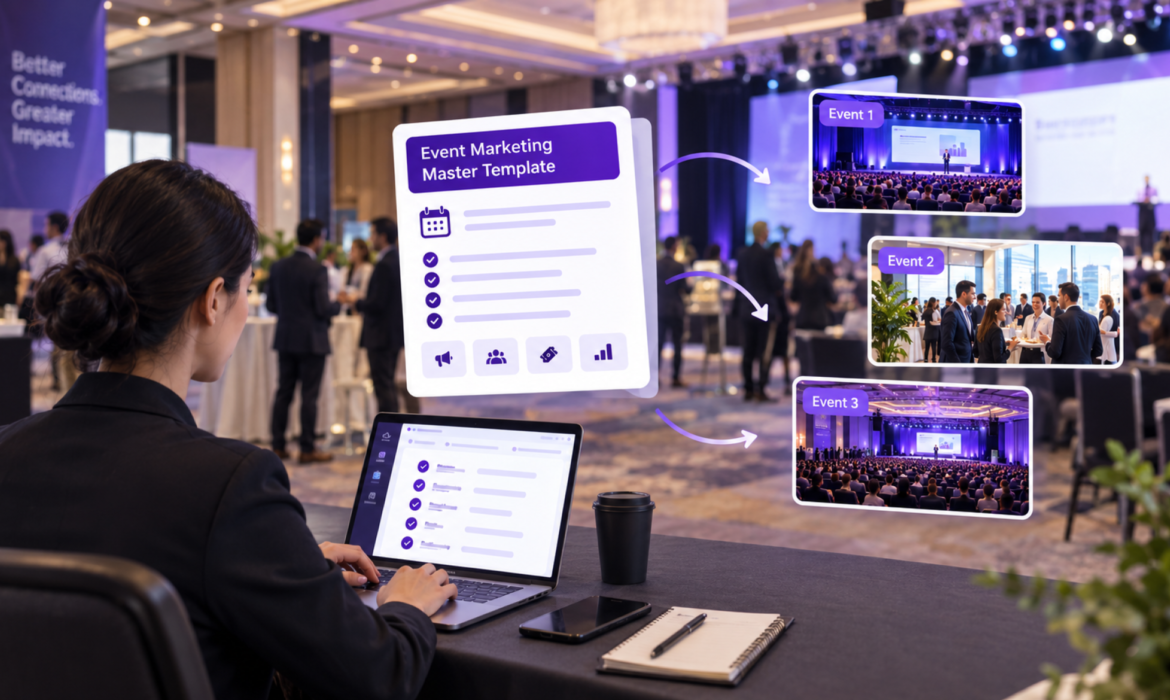
An event marketing template is a reusable planning structure that separates what carries forward between editions of an event from what gets rewritten each cycle. The separation is the whole point. Without it, a template is a blank form you fill in again every year.
Year one, you build the summit plan from nothing. Year two, you start from a blank sheet again, because nobody wrote down which vendors worked or what went wrong. Year three, same thing.
The cost isn’t only time. It’s learning that stays in people’s heads until those people leave, and decisions remade every cycle because nobody recorded why they were made.
The template that saves time isn’t the one with the most tabs. It’s the one that separates what carries forward from what resets. Most planning mistakes repeat because the last edition’s lessons were never written down anywhere findable.
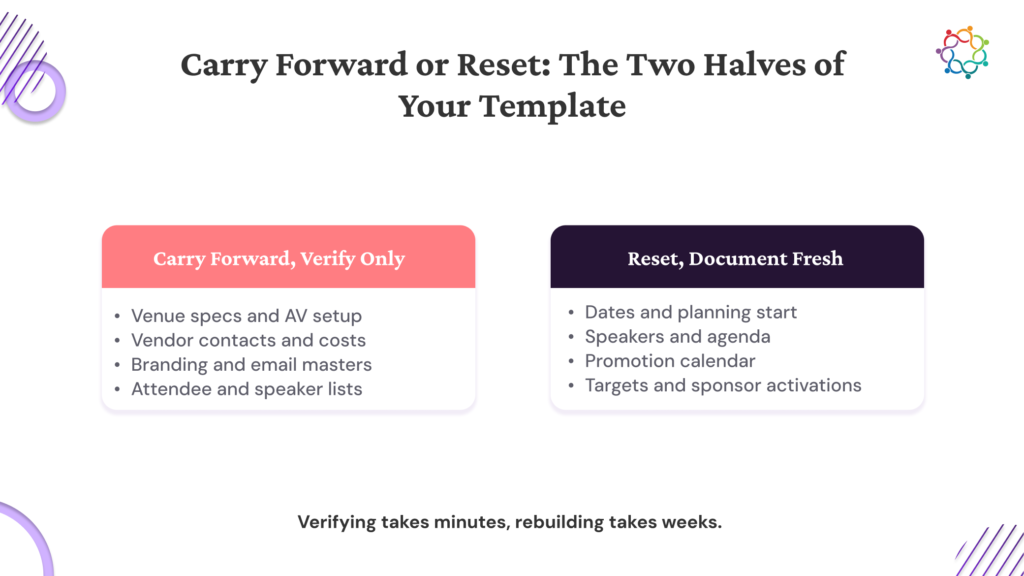
| Carry forward: verify, don’t rebuild | Reset: document fresh each cycle |
| Venue details: capacity by space, layout maps, load-in, AV and electrical specs, parking, WiFi | Dates, and the planning timeline anchored to them |
| Vendor relationships: catering, AV, hotel, transport, with contacts and baseline pricing | Speakers, topics, session order, breakout structure |
| Branding assets: logo files, palette, email and deck masters, social guidelines | Promotion calendar: email schedule, social cadence, paid timing, press dates |
| Contact databases: past attendees, speakers, sponsors, VIPs, media, segmented | Run-of-show for the day itself |
| Budget baselines: planned against actual, line by line, from every previous edition | Attendee targets by segment, industry and seniority |
| Institutional knowledge: what worked, what broke, what attendees complained about | Sponsor tiers, benefits and activation plans |
Checking the left column is current takes minutes. Rebuilding it takes weeks. The right column changes every cycle, but its structure stays identical year to year, so only the contents are new. Once the split is clean, the planning question changes from “what do we build” to “what changed.”
Budget history is the most underrated. Planned against actual, line by line, across editions, is what makes next year’s number defensible instead of a guess. Keeping budget tracking consistent turns three years of events into a forecast, and it’s the only entry finance will ever ask to see.
Documented lessons are the other. That entry prevents more repeated cost than everything above it combined, and it’s the one nobody writes down until they’re mid-rebuild and realizing what’s missing.
The rest is maintenance. Document the venue footprint once and you never re-ask a supplier the same question. Contact databases compound rather than expire, because this year’s attendee becomes next year’s speaker and the year after’s sponsor.
Dates come first, because promotion, speaker availability and registration windows all cascade from them.
Speakers and agenda change, the shape doesn’t. Opening keynote, breakout blocks, closing. The template holds empty cells and you fill them. The promotion calendar works the same way: save-the-date, first wave, early-bird close, final reminder. The sequence carries forward, the dates and messaging don’t.
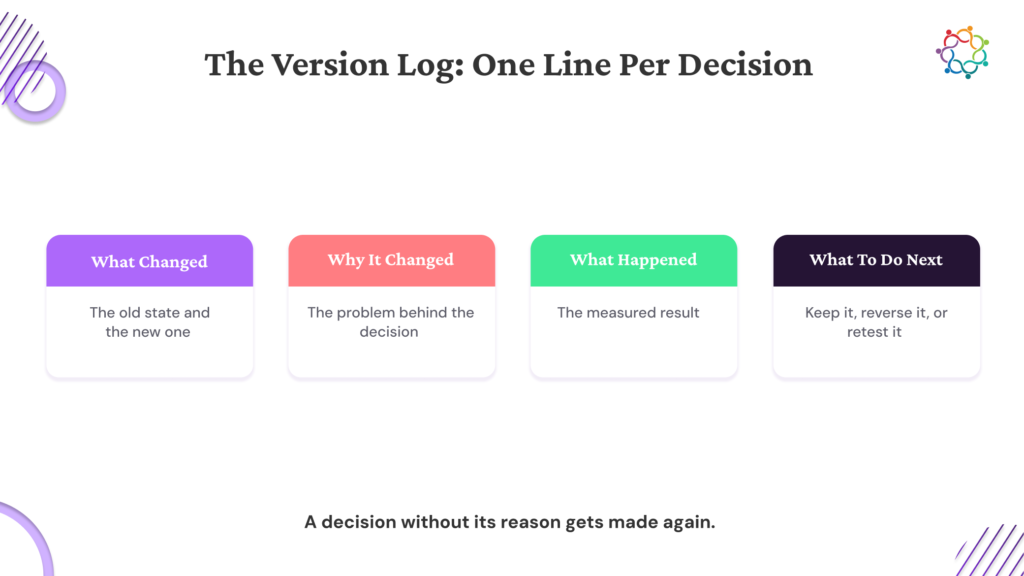
Then the part most teams skip. Keep a version log of what changed, why, and what happened. “Year three moved the keynote to 9:30 because early attendance was thin.” “Year four cut catering hours.” It stops decisions being re-argued and makes patterns visible, like a team that adds a track every year and wonders why mornings feel crowded.
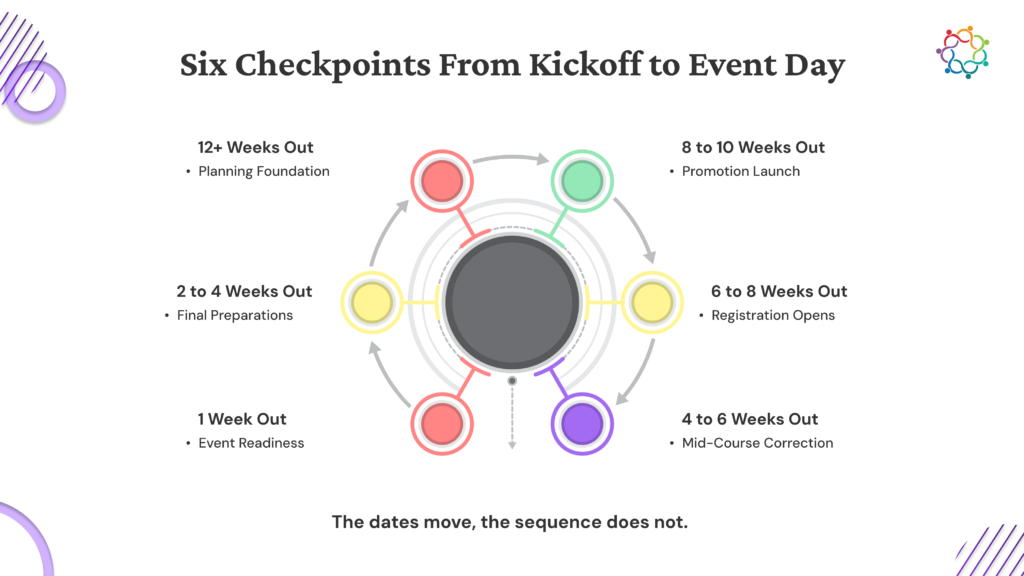
Dates move each cycle. The sequence doesn’t, which is why it belongs in the template.
The template holds the sequence and slides it forward to the new dates: strategy and venue locked first, then speakers and the save-the-date, then registration opening alongside the first promotion wave, then a correction window, then final confirmations and rehearsals. Each step is there because skipping it causes a specific problem later, so mark which steps gate the next and which run in parallel.
For the task-level detail underneath each phase, the 90-day event planning checklist sets out the owners and decision gates in full. The template’s job is different: it records which dates you used last time and what you changed, so the sequence gets faster with each edition rather than rediscovered.
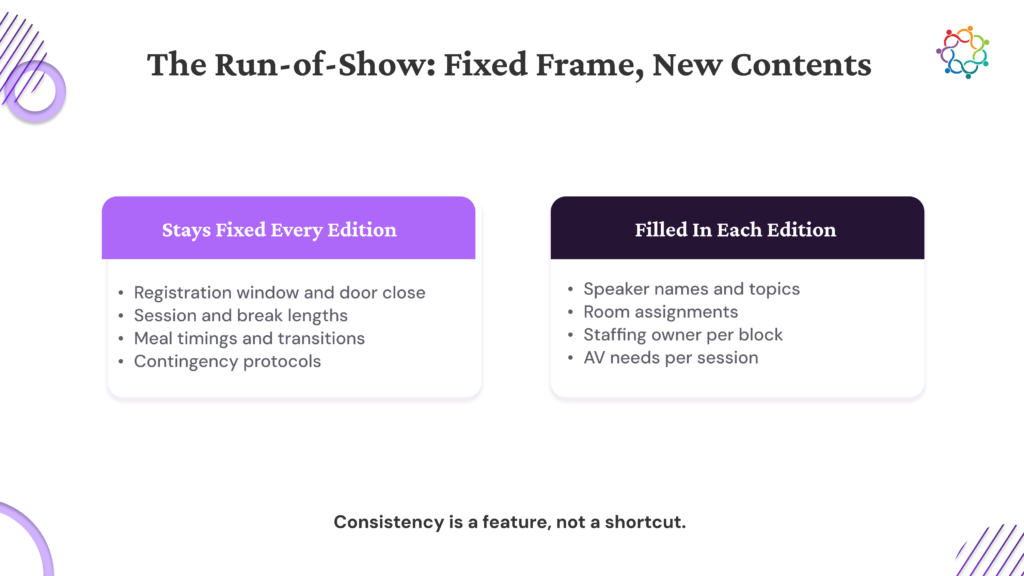
A minute-by-minute schedule for the day. Columns for time, activity, owner, location, AV needs and staffing. Rows in fifteen-minute blocks. Same shell every year.
The timing stays constant: when registration opens, how long sessions run, when breaks and meals fall. That consistency is a feature, because changing it each edition confuses returning attendees and unsettles the team.
The content changes: names, topics, room assignments by expected breakout size, who manages what. Running registration and check-in against a schedule everyone can see is what keeps the day on time.
The shell should also carry contingencies: speaker doesn’t arrive, room overfills, AV fails. Those don’t change either. Writing them once means executing a plan rather than inventing one.
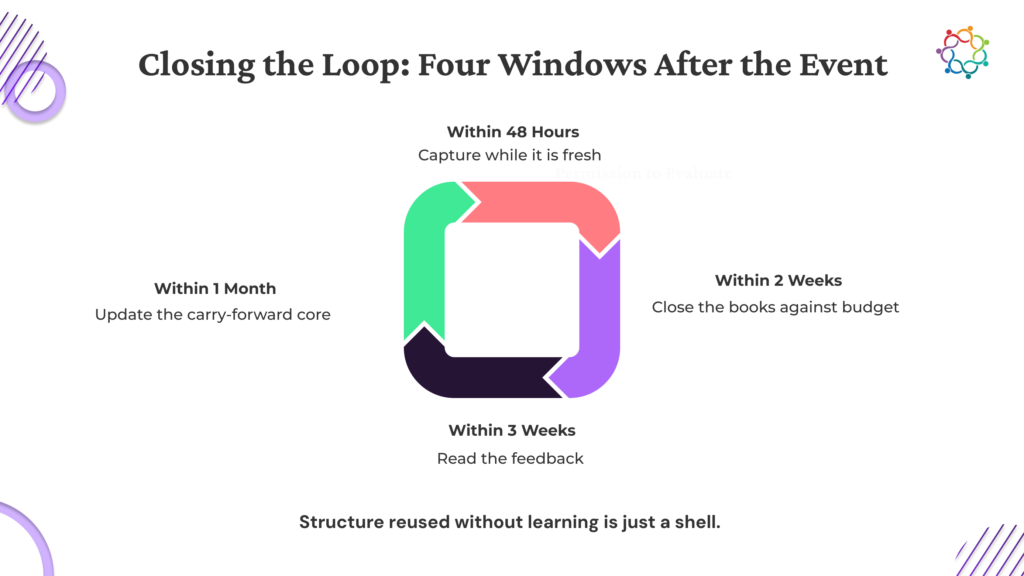
A template without post-event capture reuses structure, not knowledge. This step is what makes the next cycle cheaper.
Within 48 hours, record what worked, what broke, what attendees reacted to and what staff improvised. A structured debrief gets more out of this than a corridor conversation.
Within two weeks, close the finances: reconcile invoices, track actual against budget by line, update the baseline. Within three weeks, work through feedback and write up what it means for next year’s agenda and vendors. Documenting it properly makes it findable twelve months later.
Organizations get this wrong reliably, and the reason is always the same. The team disbands the week after the event, everyone moves to the next thing, and the knowledge leaves with them. Capture has to happen while the event is still fresh, or it doesn’t happen.
A master template doesn’t remove planning work, it removes repeated planning work. You’re not making fewer decisions, you’re making each one once and recording why.
Before the next cycle, split your plan into the two lists, fill the carry-forward core with what you already know, and start a version log even if the first entry is thin. Keeping budget and planning records in one place rather than across four people’s drives is what keeps it usable when someone leaves.
The event marketing template is ready to download. It carries both checklists, the week-by-week timeline, the run-of-show shell, the capture framework and a version log. Fill it once, then update it.
Running a format it doesn’t quite fit, like an awards night or a roadshow series? Ask Samaaro how other teams have adapted it.
What is an event marketing template?
A reusable planning structure covering venue and vendor records, budget baselines, the pre-event timeline, the run-of-show and post-event capture. The useful ones separate what carries forward between editions from what gets rewritten.
What should you carry forward in event planning?
Venue specifications, vendor contacts and pricing, branding assets, attendee and speaker databases, budget baselines, and documented lessons from previous editions. These need verifying rather than rebuilding.
What resets each time you run a recurring event?
Dates, speakers and agenda, the promotion calendar, the run-of-show, attendee targets and sponsor packages. The structure holding them stays identical, which is the point.
How far ahead should you plan a recurring event?
Twelve weeks is a workable floor for a mid-sized event, with promotion opening around eight to ten weeks out and registration by six to eight. Larger formats need longer, but the sequence holds.
What is a version log in event planning?
A record of what changed each edition, why, and what resulted. It stops decisions being re-argued every year and makes multi-year patterns visible.