Samaaro + Your CRM: Zero Integration Fee for Annual Sign-Ups Until 30 June, 2025
- 00Days
- 00Hrs
- 00Min


Three weeks before the event, someone asks who confirmed the AV vendor. Nobody answers. That is not a communication problem. That is a planning problem that started 60 days ago.
The last two weeks before a major event tell you everything about the planning that preceded them. When those weeks feel like a sprint, it is not because the team is not working hard enough. It is because tasks that should have been completed in sequence weeks earlier have all been compressed into the same window as the tasks that actually belong there. The team is working without a timeline, and effort cannot compensate for the missing structure.
Most marketing teams plan events with a to-do list, not a timeline. A to-do list tells you what needs to happen. A 90-day event planning checklist tells you what needs to happen and exactly when, so each phase enables the next instead of creating rework for the one after it.
Six phases. Specific tasks, owners, and decision gates that keep the plan moving toward a clean execution.
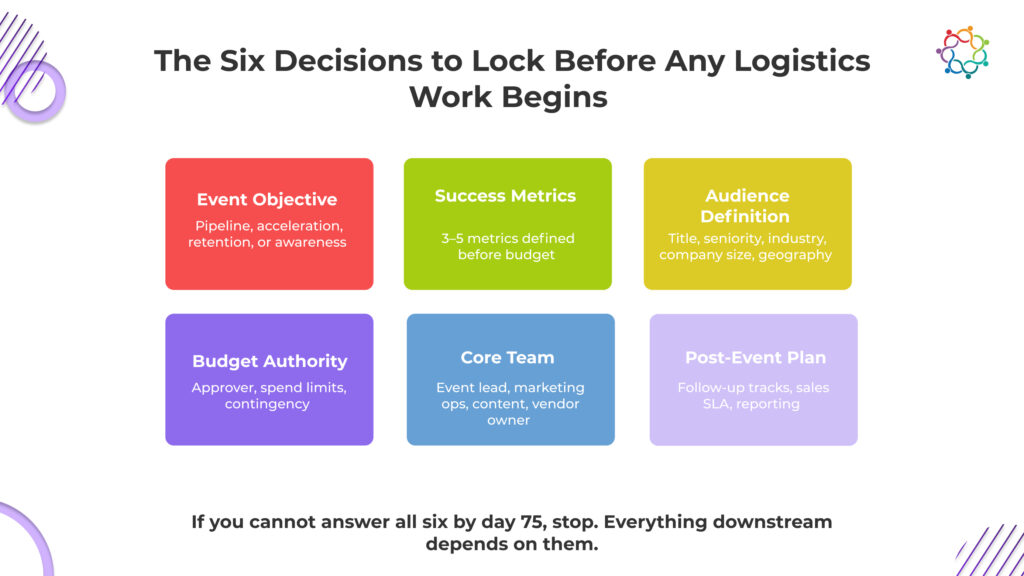
This window is the only phase where every decision is fully reversible at low cost. Venue, format, budget, attendance targets, and team structure are all still open. Teams that use this phase for logistics rather than strategy pay for that error in every phase that follows.
Six decisions must be locked before any logistics work begins:
If all six cannot be answered by day 75, resolve them before moving forward. Everything downstream depends on them.
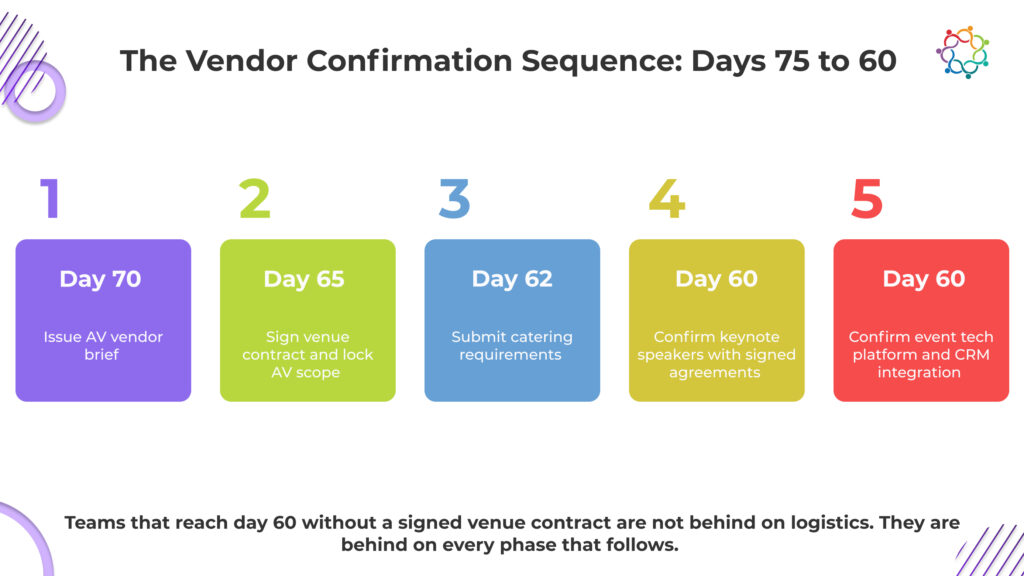
Venue availability, catering minimums, AV schedules, and speaker calendars operate on external timelines that the planning team does not control. Every day of delay reduces optionality and increases cost. The goal of this phase is to eliminate the variables that could derail the event entirely before promotion starts.
Teams that reach day 60 without a signed venue and confirmed AV are not behind on logistics. They are behind on every phase that follows.
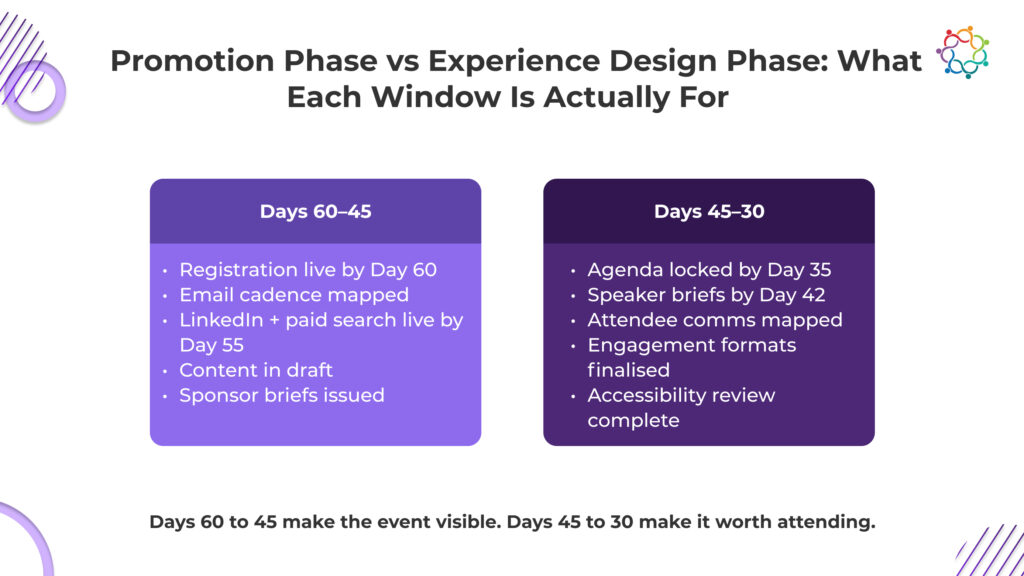
This is where the event becomes visible outside the organisation for the first time. The quality of what launches is a direct output of how cleanly the previous two phases were executed.
By day 45, registration is live, the first two promotional emails are sent, and the content calendar has no blank slots.
By day 45, registration is live, the first two promotional emails are sent, and the content calendar has no blank slots.
This is where the event stops being a logistics project and becomes a designed experience. The agenda is the product. If it is not compelling, attendance drops on the day, regardless of how well the logistics were handled.
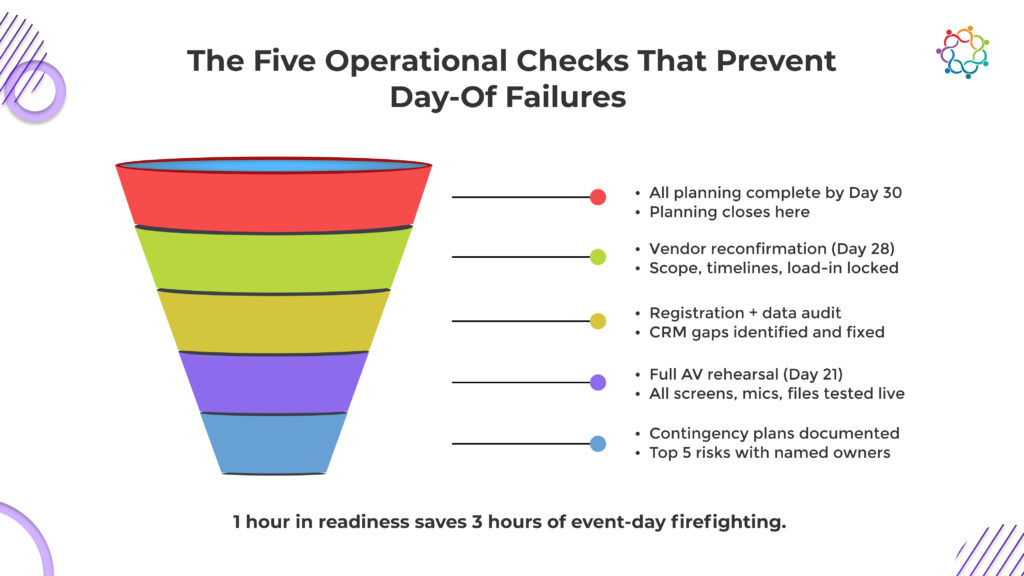
By day 30, planning should be largely complete. This window is for verifying, confirming, and surfacing any gap before it becomes a day-of problem.
Every hour spent on operational readiness between day 30 and day 14 saves three hours of crisis management on event day.
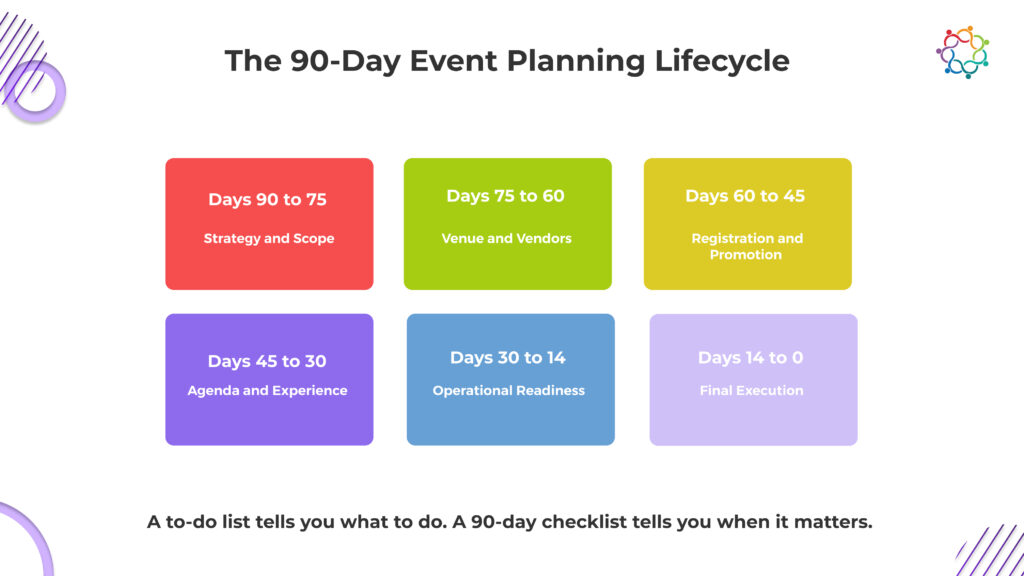
If the previous phases were executed cleanly, this phase should feel like a controlled activation, not a sprint.
When the event opens, the planning work is done.
The teams that run the best events are not the ones with the largest budgets or the most experienced staff. They are the ones who create the most structural clarity, earliest. This checklist does not guarantee a great event. It removes every excuse for a preventable failure.
Look at the next event on the calendar. Count backwards 90 days. If that date has passed and the team is still working from a to-do list, the next six weeks are already written.
Start 90 days out. Arrive at the event day ready. Everything else is detail.
Most teams build this checklist in a spreadsheet for the first time. By the third or fourth flagship event, they find themselves rebuilding it from scratch each time, losing version control, vendor contacts, and whatever the last debrief taught them. That is the point at which the tools they started with stop being enough.
The full 90-Day Event Planning Checklist Template is a multi-tab document covering all planning phases with task-level detail, suggested ownership columns, deadline formulas tied to the event date, and a vendor contact tracker.
If your team is planning more than four major events a year, the spreadsheet version of this checklist stops scaling around event three. Samaaro gives marketing teams a single system for registration, attendee communication, on-site engagement, CRM sync, and post-event reporting so the planning infrastructure from event one carries forward to event ten. See how it works.