Samaaro + Your CRM: Zero Integration Fee for Annual Sign-Ups Until 30 June, 2025
- 00Days
- 00Hrs
- 00Min

Key Takeaways (TL;DR)
1
2
3
→
Bottom Line:
Event email templates save the hours, but the bigger win is nine messages that sound like one brand.
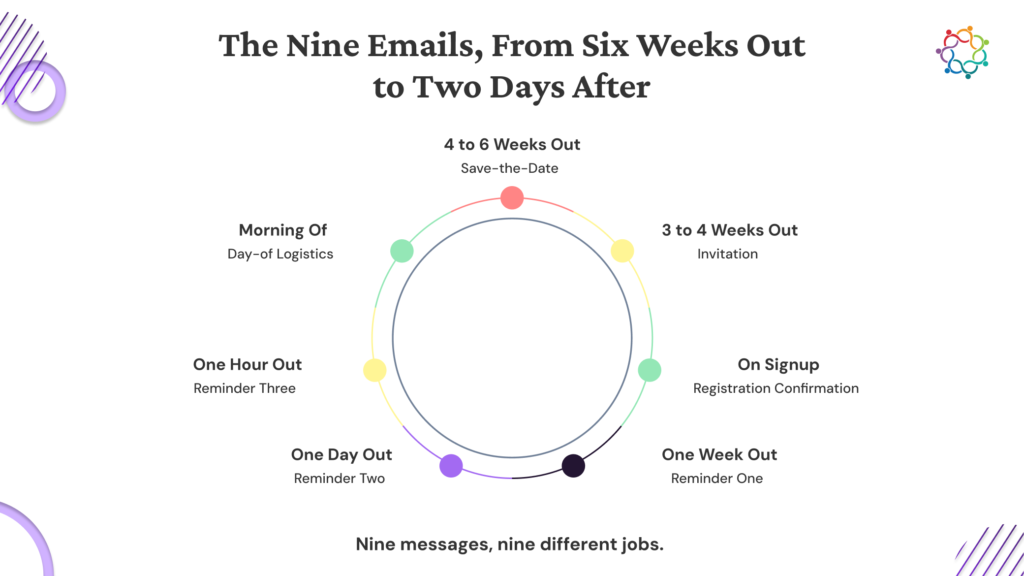
Every Event Needs the Same Nine Messages
Three weeks out you’re writing the save-the-date. Two weeks out, the invitation. The week before, reminders. The night after, thank-yous at eleven o’clock. Same messages, every event, from a blank page each time, because nobody built the event email templates the first time round.
The hours are the obvious cost. The quieter one is inconsistency: nine emails written under pressure by whoever had time, sounding like nine different companies.
The problem isn’t writing good emails. It’s writing them nine times per event with no structure to start from. Anyone who has run a webinar promotion sequence knows the sequence rarely changes. Only the details do.
| When | To whom | Its job | The ask | |
| Save-the-date | 4 to 6 weeks out | Past attendees, warm prospects | Lock the date before details exist | None yet |
| Invitation | 3 to 4 weeks out | Full list | Answer why someone should come | Register |
| Registration confirmation | Immediately on signup | Every registrant | Confirm it worked, set the tone | None |
| Reminder 1 | One week out | Registrants | Remind them why they signed up | Add to calendar |
| Reminder 2 | One day out | Registrants | Switch to logistics | Note the time and place |
| Reminder 3 | One hour out | Registrants | Remove the last obstacle | Click to join |
| Day-of logistics | Morning of | Registrants | Answer how to get in | Show up prepared |
| Speaker and sponsor briefs | 2 to 3 weeks out | Speakers, sponsors | Set deadlines and specs | Send assets by the date |
| Post-event follow-up | Within 24 hours | Attendees | Capitalize while it’s fresh | Take the survey |
| No-show re-engagement | Within 48 hours | Registered, didn’t attend | Offer a way back in | Watch the recording |
Together they cover the journey: awareness, decision, confirmation, momentum, access, stakeholder prep, aftermath. Skip one and something downstream suffers. The order is doing work, so early emails get a decision, middle emails set expectations for people who already said yes, and late emails remove friction. Send them out of sequence and each one lands without the context the previous email was meant to build.
Speaker and sponsor briefs go out separately from anything addressed to attendees, and check-in should be frictionless on arrival or the day-of email was wasted.
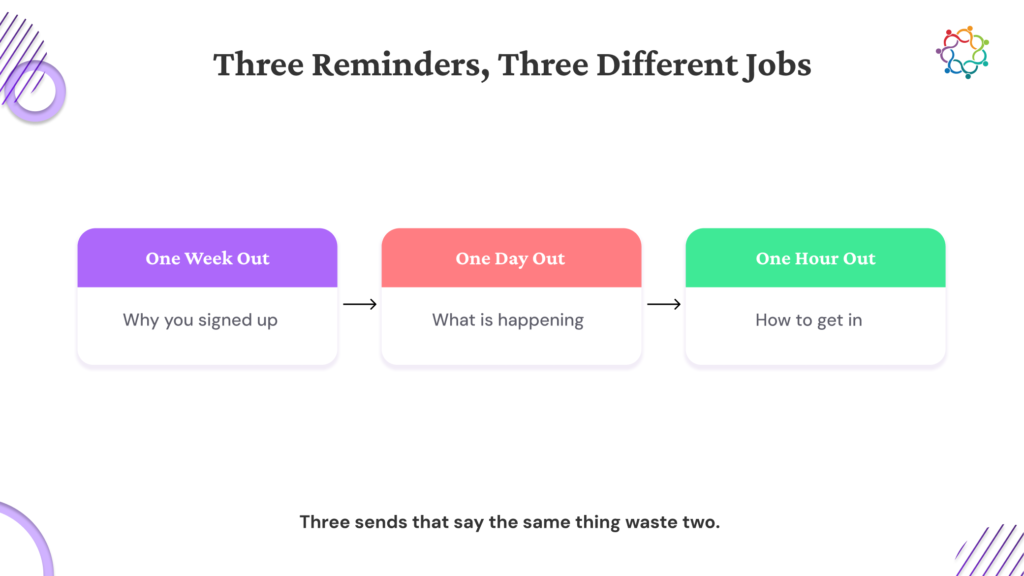
Three emails, three jobs. Treating them as one message sent three times is why reminders get ignored.
The one-week email is about value. Remind people why they registered and what to prepare. Subject lines should say something rather than repeat the event name. The ask is small: add it to the calendar.
The one-day email switches to operations. Timing, location or link, what to bring, who they’ll meet. Send it late afternoon so it sits near the top of the inbox next morning. After this, nobody should need to go looking for anything.
The one-hour email removes the last obstacle. Joining link, tech check, what happens in the first fifteen minutes. One ask, one link. Its whole job is making “I didn’t know how to join” impossible.
Subject: Starting in an hour. Your link is below.
Hi [First name],
[Event name] starts at [time]. Here’s your joining link: [link]
Two things worth doing before you click in. Test your camera and mic now rather than at [time]. And if you want the Q&A to be useful, have your question ready, because we open it in the first fifteen minutes.
First up is [speaker] on [topic]. See you shortly.
[Sender name]
Subject: You missed [event name]. Here’s the recording.
Hi [First name],
You registered for [event name] and didn’t make it, which usually means the day got away from you rather than anything else.
The recording is here: [link]. If you only watch one part, [speaker]’s section on [topic] starts at [timestamp] and it’s the piece people asked most about afterwards.
If the timing was the problem, [next event] runs on [date] and registration is open.
[Sender name]
Both follow the same rules as the other seven. One ask, the link high up, and a reason to act that isn’t just the event’s name.
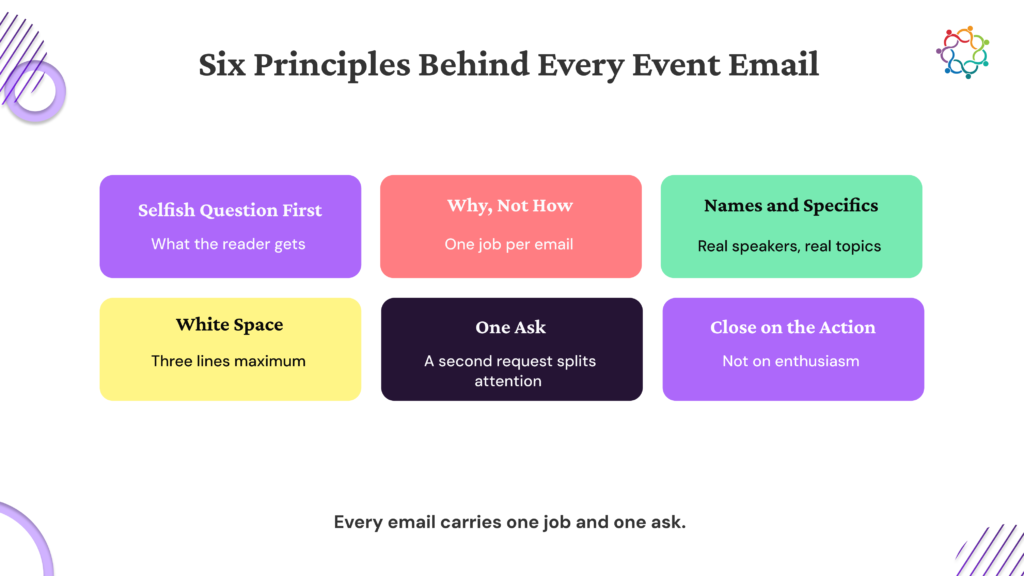
Answer the selfish question first. “We’re hosting an event on Tuesday” doesn’t. “If you’re stuck on X, we’ve built a morning around fixing it” does.
Separate the why from the how. Invitation answers why. Confirmation answers what next. Day-of answers how to get in. Cram all three into one email and none of them land.
Use real names and specifics. Not “an exciting lineup.” The speakers, the topics. Specificity signals you’ve thought about the reader’s time, and it’s the discipline that makes event communications carry the brand rather than dilute it.
Keep it skimmable. Three-line paragraphs, real line breaks, bold on what matters. Dense copy gets deleted.
One ask per email. Save-the-date asks for attention, invitation for registration, the hour-out email for a click. Two asks halve both.
Close with the action, not a flourish. “Register now.” “Join at 9am with this link.” Not just “we can’t wait to see you.” Across every email marketing benchmark set worth reading, click rates sit in low single digits, so a link that isn’t obvious is a link nobody finds.
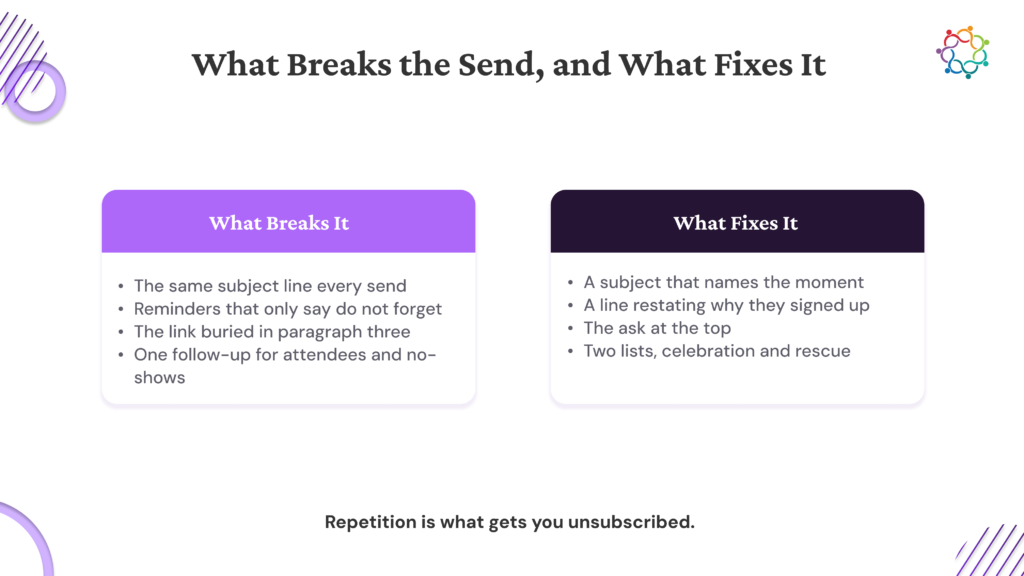
The same subject line five times. “Reminder: X Event” on everything trains people to stop opening. Vary it so each subject says what the email is for.
Assuming they remember why they signed up. They registered six weeks ago and forgot. Lead every reminder with the value, not the date.
Burying the ask. A beautiful email with the link in paragraph three. Readers don’t scroll that far.
Stacking sends. Save-the-date Tuesday, invitation Wednesday, speaker brief Thursday. That’s an unsubscribe.
Copy that fits any event. “Join us to connect with industry leaders” tells nobody anything. Name the topic, the speakers, what they leave with.
Treating no-shows like attendees. A celebratory recap sent to someone who didn’t come reads as careless, and wastes the moment they’re most likely to explain why. That split also makes the post-event report more honest.
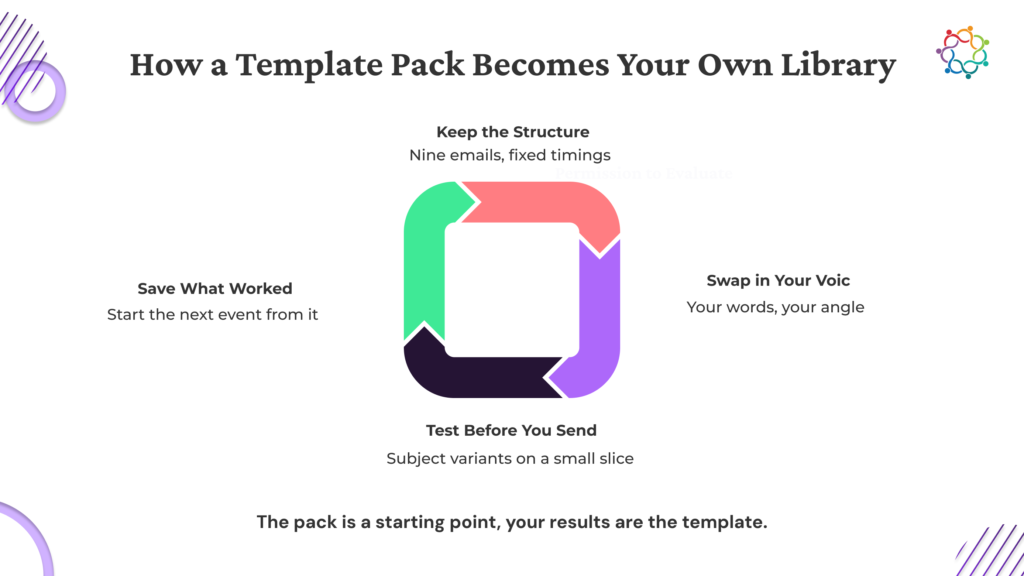
A template gives you structure and a working draft. The voice is yours to put back in.
Keep the sequence and timings, change the register. Formal, dry, warm or blunt all work, as long as it’s consistent across the nine. Then replace placeholder language with how your team really talks. If you’d never write “an outstanding lineup,” don’t.
Add the angle only you have, and put it in the invitation rather than the FAQ. If the invite is going to senior people specifically, five invite templates written for executive RSVPs covers that case in more depth than this page does.
Test two subject lines on a slice of the list first, and after each event save the versions that performed. That’s how event communications stop being a template and start being your library.
Nine emails, every event, in the same order. They’re not magic, they’re structure, and structure is what stops the blank page at eleven o’clock the night before.
The event email templates are ready to download. All nine written and ready to edit, from save-the-date through to no-show re-engagement.
Once the copy is settled, the next question is who sends it and when. Automated event communications handle the scheduling, so the one-hour reminder goes out while you’re on the floor. To talk through the sequence for a specific format, Samaaro’s team can help.
What emails do you need for an event?
Nine: save-the-date, invitation, registration confirmation, three reminders, day-of logistics, speaker and sponsor confirmations, post-event follow-up and a separate no-show email.
When should you send event reminder emails?
One week out for value, one day out for logistics, one hour out for the joining link. Three purposes, which is why they’re three emails rather than one sent three times.
How do you write a good event invitation email?
Answer why someone should attend before explaining what and when. Name the speakers and topic, make the link impossible to miss, keep it to one ask.
What should a post-event follow-up email include?
Thanks, the recording or slides, the survey and one clear next step. Send it within 24 hours, and send no-shows something different.
Are event email templates worth using if you have a brand voice?
Yes. Keep the sequence and timings, rewrite the register in your own language. The structure is the reusable part. The voice is what you add each time.