Samaaro + Your CRM: Zero Integration Fee for Annual Sign-Ups Until 30 June, 2025
- 00Days
- 00Hrs
- 00Min

Key Takeaways (TL;DR)
1
2
3
→
Bottom Line:
The right event platform is scored on what gets retired, not what gets added.
Fewer Tools Beats More Features
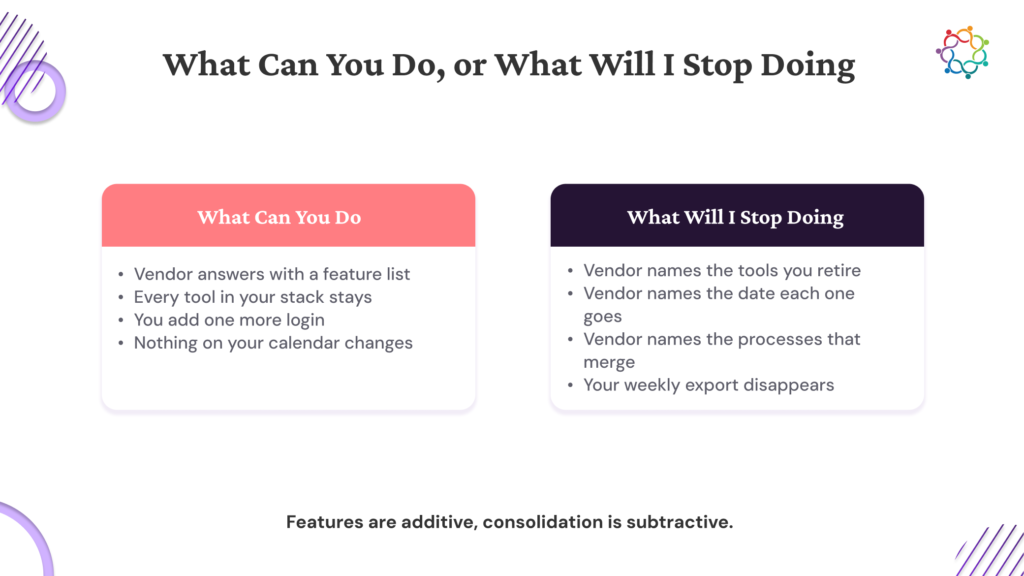
The question an event platform buying guide should answer is what you’ll finally stop doing, not what a platform can do. Feature lists are additive. The problem is subtractive.
Registration in one tool, budget in another, feedback in a third, reporting in a spreadsheet. Each works fine alone. Together they’re a part-time job somebody is doing without it appearing in their job description.
The platform worth buying isn’t the one with the longest feature list, it’s the one that retires the most tools.
Paste this into your evaluation notes verbatim:
“If I pick your platform, what will I finally be able to stop doing? Which specific tools will I retire, and which processes currently split across tools will consolidate?”
Vendor pitches lead with features because features are additive. What you need is the opposite: fewer places to log in, fewer exports, fewer moments where somebody reconciles two lists by hand.
The answer tells you everything. A vendor who says “you’ll retire your registration tool and your survey tool, and here’s the workflow that replaces both” has understood the problem. A vendor who says “we integrate with everything, keep your whole stack” has sold you another integration and called it flexibility.
Write the answer down during the call. Specific is a good sign. Hedged, or redirected into a feature tour, is not.
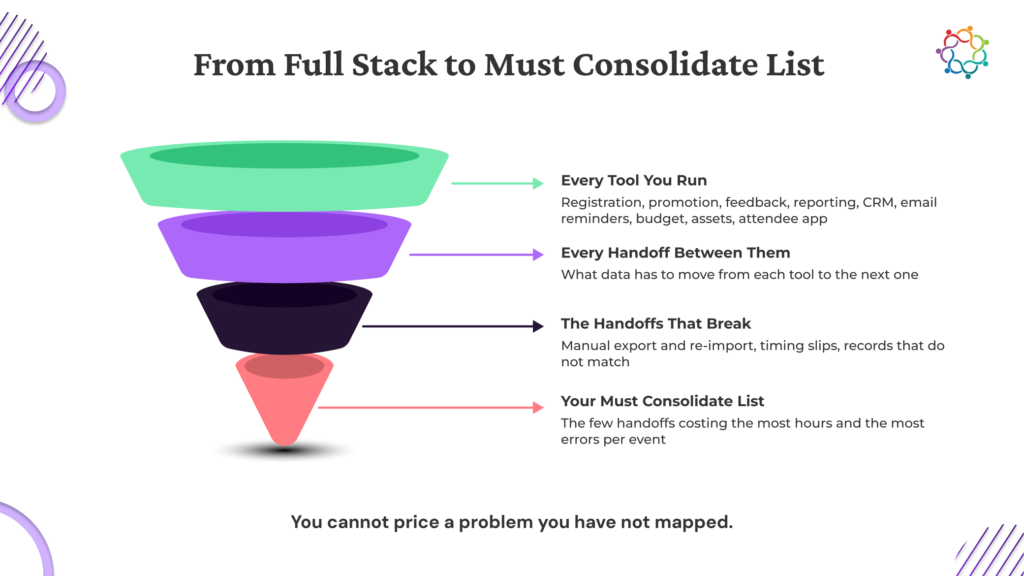
You can’t score consolidation until you know what there is to consolidate.
List every system touching an event: registration, promotion, reminders, feedback, reporting, CRM, budget, assets, the app, session scheduling. Teams commonly find eight or nine. Then, for each, write down what data has to move next, where it breaks, and roughly how many hours per event that costs. Registrations land in one place, approvals in another, somebody exports weekly: two to three hours, high error risk, timing slips.
The expensive handoffs are your must-consolidate list, and your business case, because finance won’t fund a platform until the current setup has a price. Getting registration data into one place is usually first, and most planning failures trace back to a handoff nobody mapped.
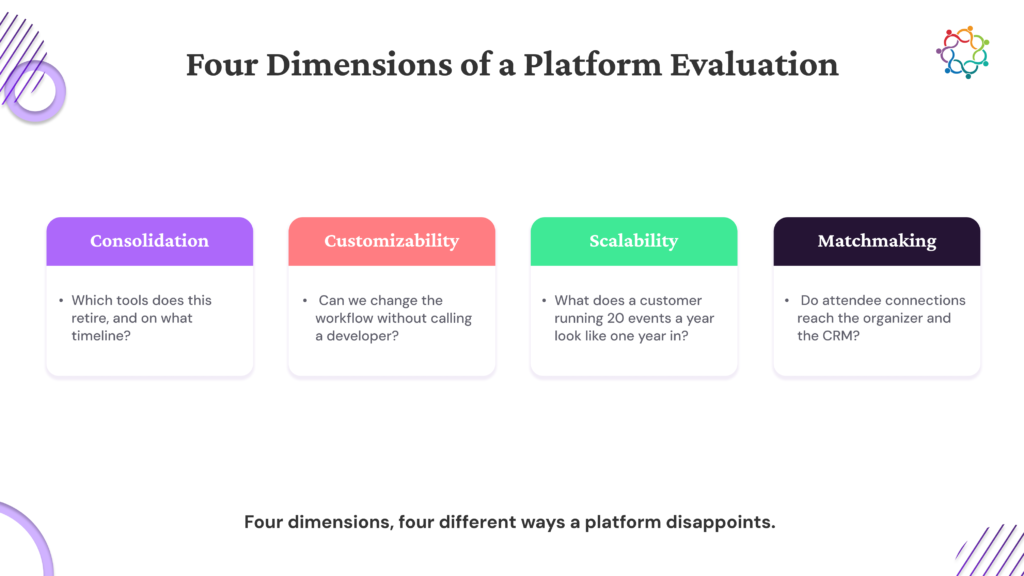
| Dimension | What to ask | A good answer sounds like | The red flag |
| Consolidation | Which of my tools does this replace? Show me the registration, feedback and CRM workflow, not the feature page. | “You’ll retire these two, and here is the workflow that replaces both.” | “We integrate with everything, so keep your whole stack.” |
| Customizability | What can I change without a developer: field names, approval sequence, report layouts? | “Configuration, not custom build. Your admin does it in the interface.” | “That’s a custom ask,” with no cost or timeline attached. |
| Scalability | Show me a customer running twenty-plus events a year. Did they retire more tools or add more connections? | A named reference, and pricing that stays predictable as volume grows. | Costs that only surface at volume, and only after you ask twice. |
| Matchmaking | Can attendees find each other by interest, industry or role? Does that data reach the CRM? | Core to the platform, and connection data writes back as fields. | An add-on, self-serve only, and the data stays in the app. |
A platform that consolidates 60 percent and leaves you managing the rest may not reduce your workload at all, which is why event data reaches the CRM needs a specific answer rather than a yes.
A prepared demo shows the happy path. Ask for the other one.
Bring your most awkward process and have them run it live. Ask to see an integration working in real time rather than on a slide. Ask what happens when data arrives wrong and someone corrects it.
Three tells. If they can’t show it live, it isn’t ready. If the answer is “we can do that, it’s a custom ask,” get cost and timeline in the same breath. If a hard question gets answered with a different feature, there’s no answer.
Leave with five things documented: your workflow demonstrated, an integration running live, a timeline, the cost of customization, and who fixes a broken connection. What’s pre-built versus built is the distinction to pin down before anyone signs.
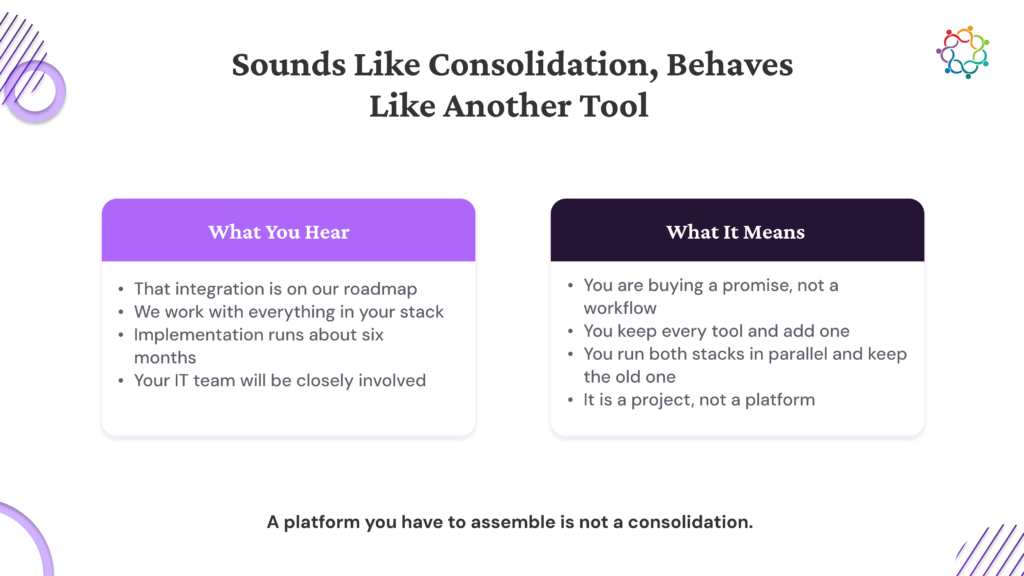
Integration with your systems is “on the roadmap.” You’re buying a plan. Implementation stalls, the old tool survives, nothing gets retired.
They promise to work alongside everything you own. Not consolidation. Management overhead described as flexibility.
Implementation runs past four months. You’ll run both stacks in parallel, and by month three the familiar one wins.
Every answer is a feature. A vendor who can’t name what you’ll retire hasn’t understood what you’re buying.
Integrations or core features are priced separately. Spend another $50,000 on connections and you’ve added a platform, not removed one.
Your IT team needs to be heavily involved. Translation: a project, not a product. Ask whether connecting to your CRM needs code before believing the timeline.
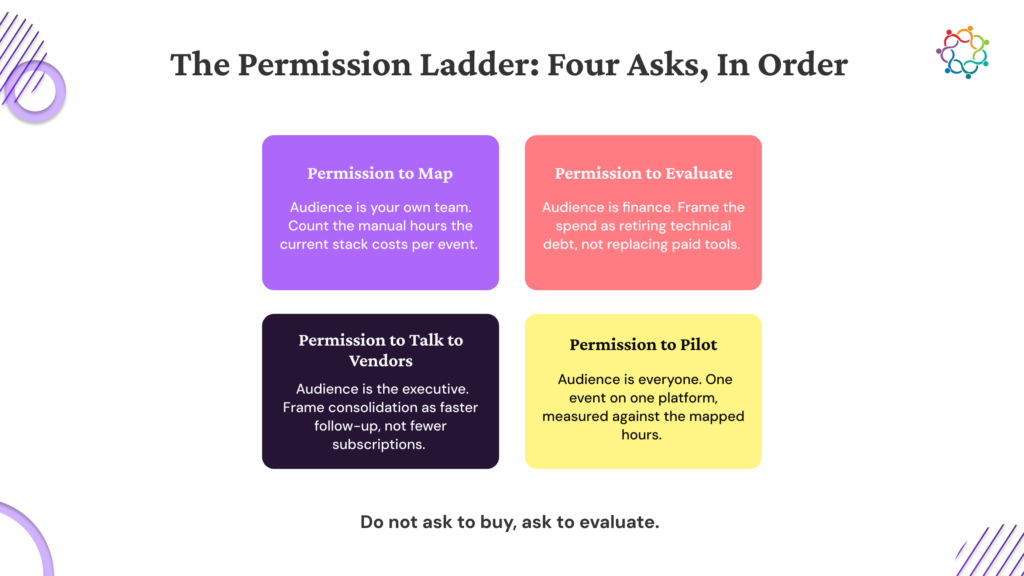
Finding the platform is the easy half. Getting it approved is the other one.
Finance sees existing tools as spend already committed, so a new platform sounds like writing that off. Reframe it as retiring technical debt: the current stack costs more than its subscriptions once you multiply hours per event by event count. With executives, lead with speed rather than savings, because every hour data sits in an export is an hour a warm lead isn’t contacted.
Expect more than one meeting. The CMO Survey’s 35th edition, based on 308 US marketing leaders, rates the marketing and finance partnership at 4.5 out of 7 for building a business case for marketing spend, with fewer than half reporting the two work together on growth. So don’t ask to buy. Ask to evaluate, then to talk to vendors, then to pilot. Each step is a smaller yes, and an event marketing platform built around consolidation is easier to defend once the mapping is on paper.
The platform you want is the one that lets you switch things off. Not the one that does everything, the one that consolidates what’s costing you. Most platforms get evaluated on features because features are what vendors lead with. Mapping your handoffs, asking what you’ll retire, and watching what a vendor avoids gets a better answer in less time.
Get the event platform buying guide. It includes the stack-mapping worksheet, evaluation questions for all four dimensions, the walkthrough checklist, the red flags, and talking points for finance and leadership.
If your stack has a handoff the worksheet doesn’t cover, put it to Samaaro directly before you brief vendors.
What is an event platform buying guide?
An evaluation framework for choosing event technology: what to map before you look, what to ask vendors, what to watch in a demo, and how to make the case internally. The useful ones score consolidation, not features.
How do you choose an event marketing platform?
Map your handoffs and their cost first, then score vendors on how many disappear. Features rule vendors out. Consolidation picks between the ones left.
What should you ask during an event platform demo?
Have them run your most complex workflow live, show an integration working in real time, and explain what happens when data needs correcting. Anything they can’t demonstrate live isn’t ready.
What are the red flags when choosing an event platform?
Integration that’s on the roadmap, a promise to work alongside every tool you own, implementation past four months, core features priced separately, and any answer that’s a feature instead of a retirement.
How do you get budget approved for an event platform?
Price the current setup in hours, not subscriptions, then ask for permission to evaluate rather than to buy. Smaller asks build the case faster.