Samaaro + Your CRM: Zero Integration Fee for Annual Sign-Ups Until 30 June, 2025
- 00Days
- 00Hrs
- 00Min


Key Takeaways (TL;DR)
1
2
3
→
Bottom Line:
For an IT services firm chasing named accounts, the right room does what two years of email couldn’t: get the buying committee in front of you.
You can’t email a buying committee into a room. You can invite one.
You’ve been chasing the same twenty enterprise logos for two years. A room, not another email, is what finally gets you in.
For IT services firms and systems integrators, the hardest part of enterprise selling isn’t the pitch. It’s getting in front of the people who decide, when those people never open a cold email and the deal touches a dozen stakeholders. Forrester’s State of Business Buying, 2026 puts the average B2B purchase at 13 internal stakeholders plus nine external influencers, and that number climbs for the complex, strategic deals IT services firms live on. You’re not selling to a person. You’re trying to move a crowd, and a crowd doesn’t reply to a sequence.
An event changes the geometry. A well-built room gets several of those stakeholders in one place, in a setting where a real conversation can happen, which is something outbound structurally can’t do.
What follows is how IT services firms use events to break into named accounts: the formats that work, why a room succeeds where email stalls, how to build the invite list, and what to do after everyone goes home.
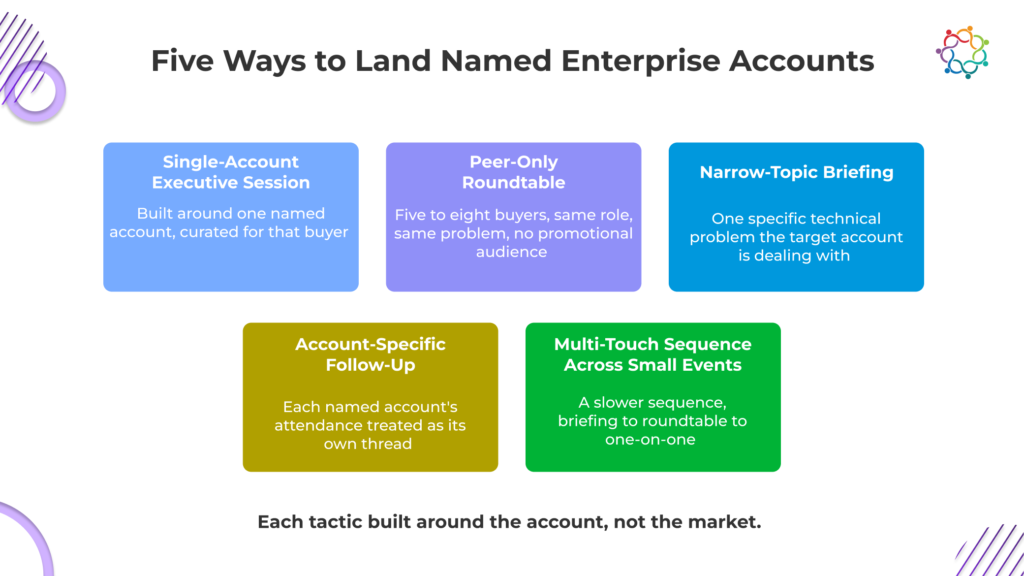
The firms that break into hard accounts don’t run one kind of event. They pick the format to the situation. Five recur.
A closed-door roundtable or briefing built around one target account’s specific problem, with several stakeholders from that account invited together. It’s the fastest way to get more than one member of the buying committee into the same conversation, the way a well-run closed-door executive session is built to. One room can do what a dozen separate calls can’t.
A small session for six to eight senior people from different target accounts in the same industry, where the draw is peer conversation rather than a pitch. Named accounts show up for a room full of peers they can’t easily assemble on their own, and your firm is the one who convened it. The convening is the value: a CIO will clear an afternoon to compare notes with four peers wrestling the same migration, when they would never take the same meeting billed as a sales call.
A deep session on a specific problem the account is known to be facing, a cloud migration, a compliance deadline, a security overhaul, framed as expertise-sharing. This is how you reach the architects and security leads who delete sales emails unread but will give an hour to genuine technical depth.
The event becomes the reason for the first real one-to-one. A conversation that started over coffee at your roundtable earns the follow-up meeting that eighteen months of outbound couldn’t, and the connections made in the room are the ones worth chasing. One mid-size systems integrator had emailed the same banking technology lead for a year and a half with nothing; a single security roundtable, and a seat next to two of his peers, got the meeting the following week.
The event anchors a whole account motion rather than standing alone: a personalized invite, the room itself, and a tailored follow-up, so the account experiences a coordinated sequence instead of a single disconnected touch. In practice that might be a technical briefing in one quarter, a peer dinner the next, and a one-to-one review after that, each touch earning the next.
Common trap: running these as thinly disguised sales pitches. The moment a roundtable feels like a vendor presentation, the senior people you wanted stop coming, and the ones who came once don’t come back. The value has to be real, peer conversation, genuine expertise, a problem worth an evening, or the room empties and the invitations stop working.
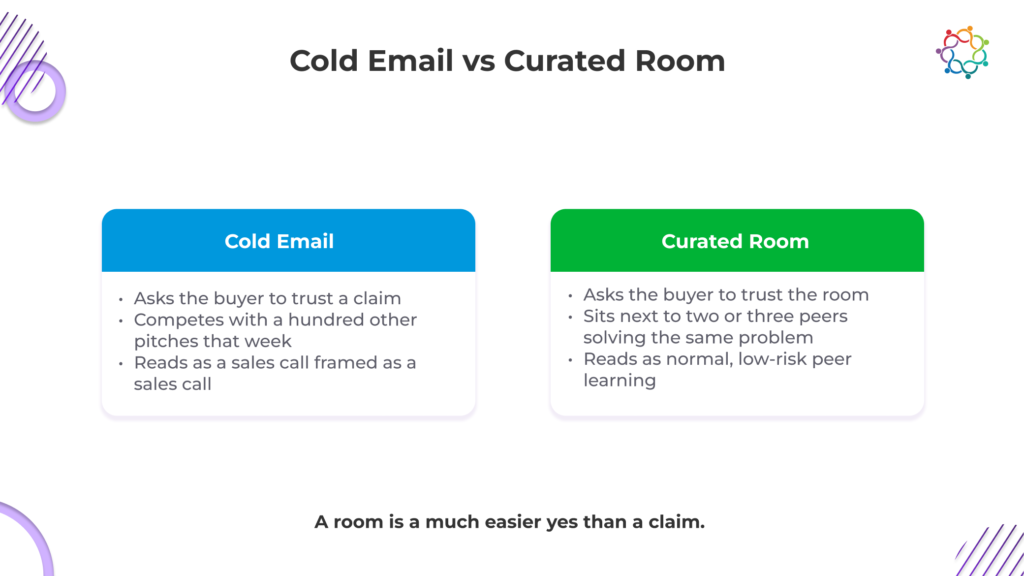
Enterprise deals are long and crowded. They run months, sometimes more than a year, and they’re won or lost in conversations inside the buyer’s organization that a vendor never sees. Outbound email works against all of that: it reaches one inbox at a time, it’s easy to ignore, and it can’t build agreement among people who need to hear the same thing together.
A room does the opposite. It puts several stakeholders in front of the same conversation at once, it earns attention because someone chose to show up, and it builds the kind of trust that moves complex deals, the sort that comes from ninety minutes in person rather than a well-written follow-up. This is also where the handoff from marketing to sales matters most: the room creates the signal, and someone has to act on it while it’s warm.
Peer proof does the rest. A senior buyer takes a peer’s experience more seriously than any vendor deck, and a well-built room is full of the peers they’d otherwise never get time with. That’s a draw email can’t manufacture.
None of this closes a six to eighteen month enterprise cycle on its own, and it isn’t meant to. What a room does is move a named account from unresponsive to a first real conversation, which is almost always the hardest step in the whole cycle.
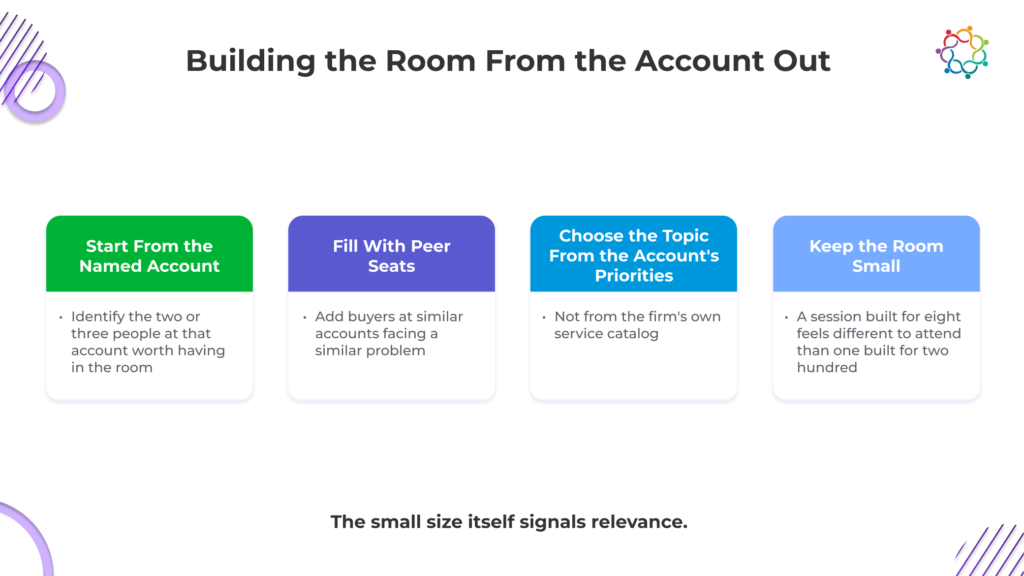
The invite list is where these events are won or lost, long before the doors open. Four principles keep it focused.
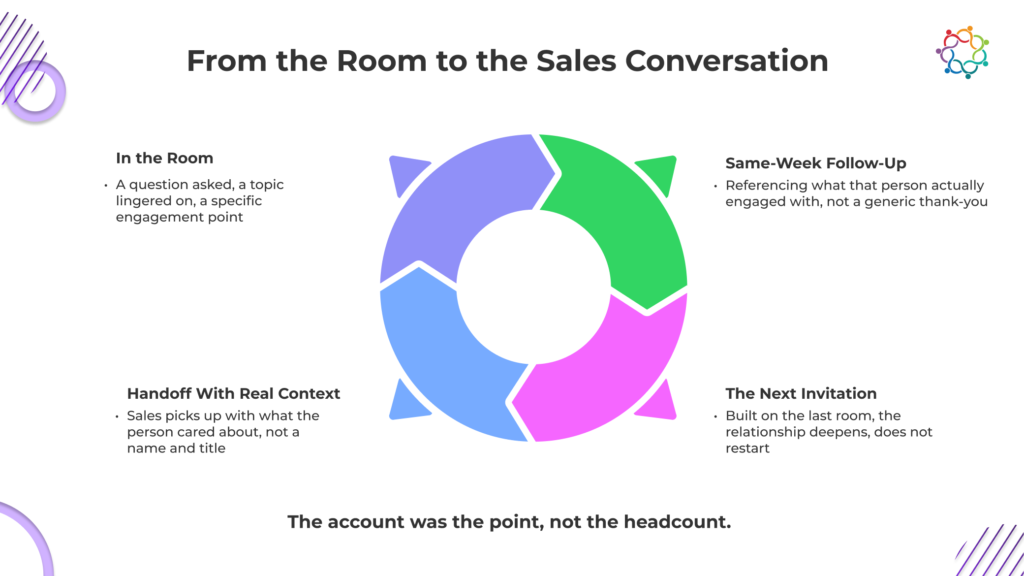
The room is only the opening. What happens in the days after decides whether it becomes a deal. Route the conversations to sales while they’re still warm, and make sure every stakeholder who showed up is tied back to the account record in the CRM, so the next touch knows exactly who was in the room and what they cared about. The follow-up should reference what that person did in the room, a question they pushed on, a session they stayed late for, rather than a generic thank-you that could have gone to anyone on the list.
Then there’s the reporting problem every IT services firm knows well: the deal won’t close for months, so you can’t point to revenue yet. The move is to report influence instead, which accounts moved forward, which stakeholders engaged, which rooms produced meetings, the way a good event recap does before the deal has closed. Treat each event as one instrumented step in a long account motion, and it stops reading as a cost nobody can justify and starts reading as a stage you can track toward a close. And a named account’s attendance is a thread that runs across events: if this logo showed up once, the next invitation should build on that and pick up where the room left off.
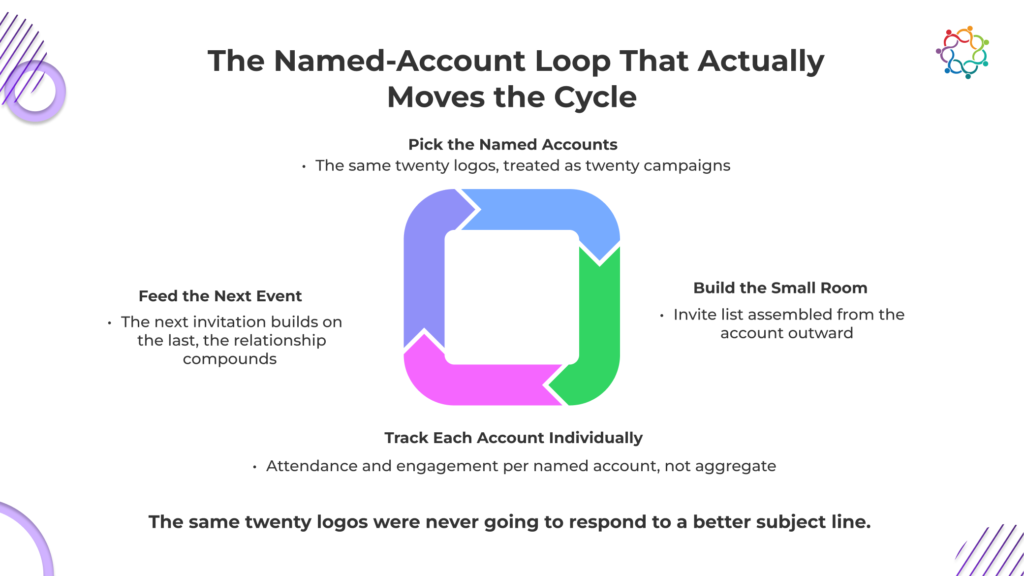
The twenty logos you’ve been chasing have one thing in common: they aren’t going to answer an email. They’ll answer a room, a roundtable that gets three of the right people talking, a briefing that reaches the technical buyer who ignored your outreach, a follow-up that finally earns the meeting. Run on an event marketing platform that connects each conversation back to the account, that motion becomes something you can build, measure, and repeat at will.
So pick one account off that list and design the room around it, the people, the problem, the reason they’d give up an evening. If you want a hand building and running it, bring in the Samaaro team to help scope it.