Samaaro + Your CRM: Zero Integration Fee for Annual Sign-Ups Until 30 June, 2025
- 00Days
- 00Hrs
- 00Min

Key Takeaways (TL;DR)
1
2
3
→
Bottom Line:
The best event communication plans connect every message, every channel, and every attendee through one coordinated workflow.
The Send That Feels Like a Plan
A team spends two days on one invitation email. The subject line gets tested, the design is clean, and the agenda is perfect. It goes out to the full list, and the calendar says the event communication is handled. Three weeks later, the room is half full, and nobody can point to a single thing that happened between the send and the day itself. Nothing happened. That was the problem. One well-made email isn’t an event communication plan. It’s a single moment of contact in a place that needed a whole sequence.
An event communication plan is the coordinated set of messages you send across the stages of an event, matched to what different attendees actually need, so the right message reaches the right person at the right moment. Email alone isn’t enough to push an event forward because it just touches one moment, one channel, one version of your audience. This article discusses what a plan is, the two axes it must cover, the way it looks across the event lifecycle, and the structure that holds it all together.
Here is the plain version. The entire set of messages that direct an attendee from the initial invitation to the last follow-up is known as an event communication plan. These messages are coordinated so that each one has a specific purpose and doesn’t conflict with or overshadow another. It covers the days leading up to the day, the day itself, and the days following. It carries different content at each step. And it speaks to different people in different ways.
Four things give that definition its edges. A plan spans time, so it covers far more than one announcement. A plan carries different messages, because an invitation, a reminder, a room change, and a recap are four separate jobs, not one. A plan speaks to different people, because a first-time registrant and a returning VIP don’t need the same thing from you. And a plan is coordinated, so the messages know about each other, and nobody gets nudged to confirm a session they already confirmed.
A send is a single point of contact. A plan is the sequence built around the attendee, and the rest of this piece is about how that sequence gets built.
So why can’t one email do the job? Start with timing. An email reaches people on the day it lands, not on the day they need reminding, and attendance gets decided in the gap between those two dates. A single send sits at one end of that gap and hopes.
Then there’s the channel. The inbox is crowded and slow. That makes it the right place for details like an agenda or a speaker list, and the wrong place for a room change or a starting-soon nudge that someone needs to see in the next ten minutes.
And there’s the audience. A blast can’t tell a registrant who hasn’t confirmed apart from one who already added the event to their calendar, so it either under-serves the first person or over-messages the second. Everyone gets the same words, whether the words fit them or not.
Put those together and the pattern is clear. The single send handles the easy part, the announcement, and leaves the parts that actually move attendance, the reminders and the day-of guidance, completely uncovered.
A real plan is organized across two axes at once, and covering only one of them is the most common mistake teams make.
The first axis is moments. Communication runs before, during, and after the event, and each phase has its own job. Before the event, you’re filling the room with invitations, confirmations, and reminders. During the event, you’re guiding people with live updates and prompts. After the event, you’re following up with recaps and next steps. A plan that only fires before the event leaves the attendee stranded the moment they walk in.
The second axis is personas. The same moment means different things to different people. A first-time attendee needs wayfinding and a bit of reassurance. A returning VIP needs the executive track and the shortcut past the queue. A registrant who hasn’t confirmed needs a nudge that a confirmed guest should never receive. Ignore this axis and you send everyone the same thing, which quietly annoys half your list.
Now put the two axes together. A plan is the grid where moments meet personas. Every cell is a message with a job: the reminder for the unconfirmed registrant the week before, the wayfinding text for the first-timer on the morning of, the tailored recap for the VIP the next day. Fill the grid and the sequence builds momentum. Leave cells empty and your attendees feel the gaps, even if they can’t name them.
It helps to walk one event through that grid at a high level.
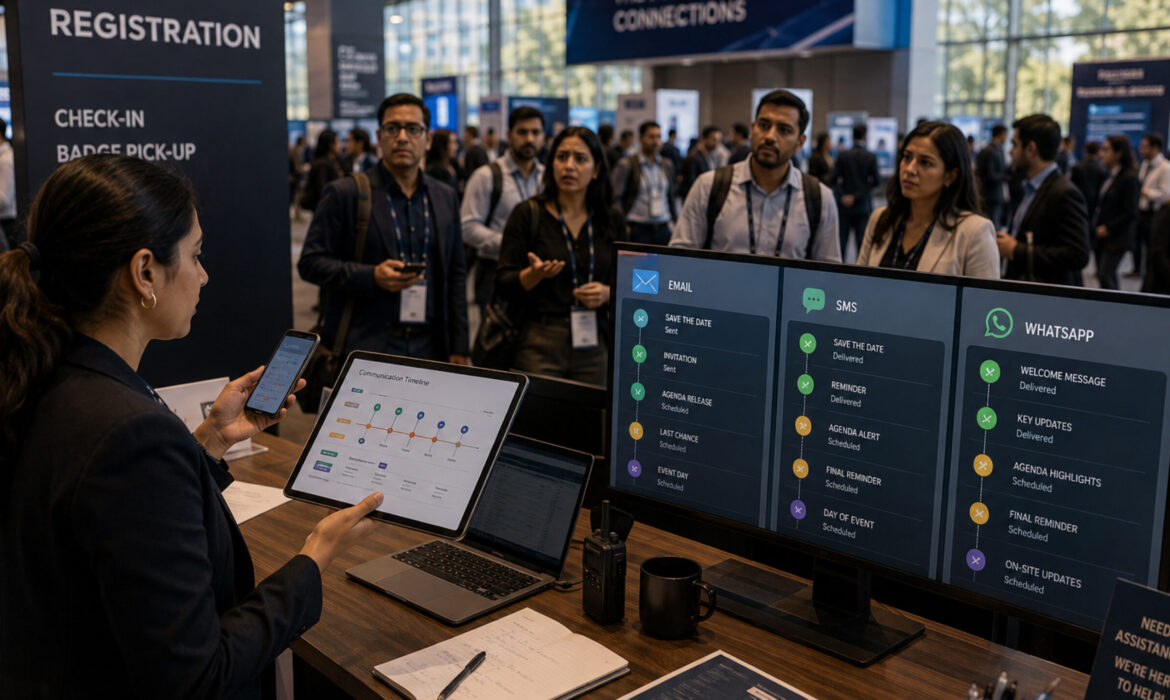
Three weeks out, an invitation email carries the speaker roster and the agenda. The moment someone registers, an instant confirmation goes out with a calendar link, locking in the date before they close the tab. In the days before, a short reminder sequence covers the moments that decide whether people actually show up. On the morning of the event, a quick message carries parking and check-in details. When a session is about to start, a prompt moves guests from the lobby into the room. And the next day, a follow-up delivers the recording and a next step matched to what each person actually did.
The point isn’t the exact schedule. It’s that every stage is covered and every message has a clear reason to exist.
Two parts of this deserve their own treatment, and they get it elsewhere in this series. How many reminders to send, and exactly when, is a subject on its own. So is the question of which channel should carry each message. Here, the job is simpler: to see that a coordinated sequence exists, and that every stage in it has real work to do.
A plan only holds together if every message shares one view of each attendee. This is the difference between a plan on paper and a plan that actually runs.
When each channel lives in its own separate tool, the same person quietly splits into several strangers: one in the email list, one in the text list, one in the event app. The messages stop knowing about each other. The reminder can’t tell who has already confirmed. The follow-up can’t tell who attended. And the coordination the plan promised falls apart the moment it meets a real audience.
The fix is one attendee record that every message reads from and writes to. Registration starts the record. Confirmation, check-in, and session activity keep it current. Because every touch updates the same record, a reminder can skip the people who already confirmed, and a follow-up can reference the exact session someone sat through.
This is why coordinated communication is a systems question before it’s a writing question. The copy still matters. But it’s the shared record that lets the copy behave like a plan instead of a pile of unrelated sends. In practice, that’s why teams end up running email, SMS, WhatsApp, push, and on-site touchpoints from a single platform on one attendee record, rather than stitching separate tools together and hoping they agree with each other.
A few failure modes show up again and again. If you’re auditing your own plan, look for these four.
Each of these traces back to the same root cause: messages that don’t share a plan or a record.
Here is the whole thing in one line. A full room comes from a coordinated sequence, built across the moments that decide attendance and the people who make up your audience.
A plan spans before, during, and after. It speaks differently to different personas. And it runs on one shared record.
There’s a quick way to tell a plan from a send. Ask yourself what happens to an attendee on the day before your event, and on the day after. When the honest answer is nothing, what you’re looking at is an announcement dressed up as a plan.
If you want the full picture this piece sits inside, it’s worth understanding multichannel event communication as a whole, from the channels each message rides to the way they hand the story from one touch to the next.
Ready to turn a pile of sends into one coordinated plan? Book a demo with the Samaaro team to see how to run a communication sequence on one attendee record.