Samaaro + Your CRM: Zero Integration Fee for Annual Sign-Ups Until 30 June, 2025
- 00Days
- 00Hrs
- 00Min

Key Takeaways (TL;DR)
1
2
3
→
Bottom Line:
The right message on the wrong channel still fails. Match every event message to the channel built for that moment.
The Room Changed and Nobody Knew
The room changed an hour before the opening keynote. Registration moved to Hall B, the keynote moved to Hall A, and the team did what teams do: they sent an email.
It was accurate. It was well formatted. And it was sitting unread in two hundred inboxes while attendees walked into the wrong room.
Nobody missed the update because the information was wrong. They missed it because it arrived on a channel built for things that can wait, at a moment when nothing could wait.
Choosing event communication channels isn’t about using every channel you have. It’s about matching each message to the channel whose weight fits it.
Email, WhatsApp, and SMS each carry a different amount of information and a different level of intrusiveness. The right channel for any message comes down to two things: how urgently it needs to be seen, and how much it needs to say.
A registration confirmation, a parking note, and a last-minute room change are three completely different jobs. Treating them all the same way is what costs you attendance and trust.
This piece assumes you already treat event communication as a coordinated plan across moments and personas, not as a single send. Why that reframe matters lives in the companion blog on building an event communication plan.
Here, the question is narrower: once you have a plan, which channel carries which message?
The answer depends on something most teams overlook. The channel isn’t a neutral pipe.
Each channel changes how a message actually lands. Three things decide that change:
Intrusiveness: How hard the channel is to ignore. Email is easy to ignore. SMS is hard to ignore. WhatsApp sits close to SMS.
Capacity: How much the channel can carry. Email holds details, formatting, and links. SMS holds one sentence. WhatsApp sits in between and adds back-and-forth.
Permission: Whether the recipient accepts that kind of message on that channel. A confirmation is welcome almost anywhere. A promotion is not.
Matching a message to a channel means matching the message’s urgency and length to the channel whose weight fits it. Get that match wrong and a correct message still fails.
The hub page explains what each channel is. This section profiles what each channel does to a message, which is what lets you actually choose.
Two questions decide the channel for almost any event message. They’re straightforward enough to apply to anything you’re about to send.
First: How quickly must this be seen?
If the answer is within minutes, the message needs a high-intrusiveness channel like SMS or WhatsApp. If it can wait hours or days, email is fine and usually better.
Second: How much does it need to say?
If it’s a single sentence or a short instruction, SMS or WhatsApp can carry it. If it needs an agenda, a link, formatting, or an attachment, it belongs on email.
Plot those two answers together and the pattern is clear.
High urgency and low information goes to SMS or WhatsApp. Low urgency and high information goes to email. High urgency and high information is the awkward case: lead with a short alert on SMS or WhatsApp and put the detail in an email that alert points to.
Then apply one overlay before you send: Does the recipient expect and permit this channel for this kind of message?
Transactional messages like confirmations and urgent updates are widely accepted. Promotional messages are not. Pushing them into SMS or WhatsApp is where trust breaks.
Here’s where the framework meets reality.
Email carries it. It’s expected, it’s the record, and it often includes a ticket or calendar file that people search for later. A short SMS or WhatsApp receipt can follow for instant reassurance, but the email is the artifact.
Email leads. Agenda, venue, parking, dress code, and joining links are reference materials the attendee returns to. Email holds detail without truncation; SMS would cut the agenda to nothing. A short nudge on SMS or WhatsApp can point to the full details as the date approaches.
The nudge belongs on a high-visibility channel: SMS or WhatsApp. Its whole job is to be seen, and email is too easy to ignore. A detailed reminder carrying the agenda can stay on email. How many reminders to send and exactly when is a cadence question, not a channel question.
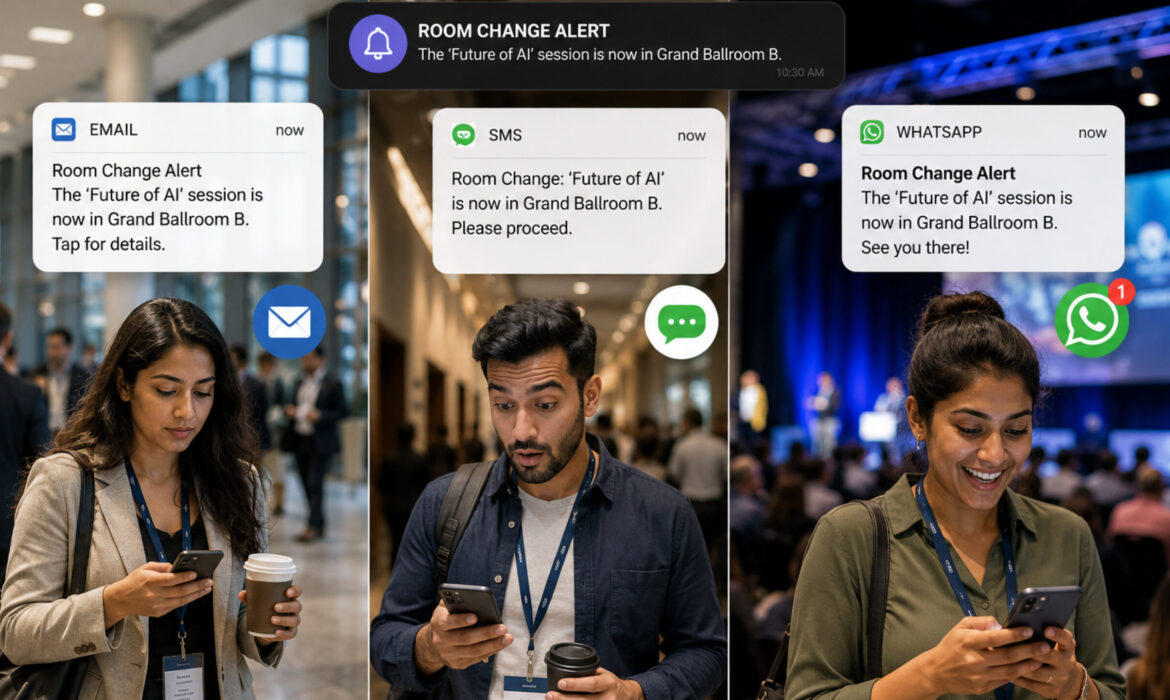
SMS or WhatsApp, always. No exception. A room change, a delay, or a gate change must be seen within minutes. Email is too slow and too easily buried. This is the clearest case where channel weight decides whether the attendee shows up.
Email is the default. Invitations, speaker announcements, and content teasers are persuasive, not time-critical. Email gives them space and lets people ignore them without friction. Promotional messages on WhatsApp carry their own permission rules covered in the dedicated WhatsApp blog.
Email. Thank-you notes, recordings, and resources are detailed and non-urgent. They belong in the record, where people can find them later. Feedback requests land best through email with a link.
There are two versions of this mistake, and they cost you differently.
The email-for-everything default:
Everything goes by email, including the urgent day-of update that needed to be seen in minutes. The messages that most need to be seen are exactly the ones email handles worst. The room change sits unread while the promotional newsletter, which could have waited, took the same unread slot.
The blast-everything default:
Every channel fires the same message at once. A routine confirmation arrives as an intrusive SMS, a WhatsApp ping, and an email all at once. Using a high-intrusiveness channel for a low-urgency message is the fastest way to opt-outs. People tolerate SMS and WhatsApp for things that matter and resent them for things that don’t.
Both versions have the same root cause: you picked the channel because it was the channel you always reach for, not because it fit the message.
The correction is simple. Match the channel to the moment. Pick the channel because it fits what you’re sending, not because it’s the tool you’re comfortable with.
Choosing event communication channels isn’t a technology question. It’s the discipline of matching each message to the channel whose weight fits it.
Email for details or anything that can wait. SMS for short, time-critical messages. WhatsApp for the messages people have agreed to receive there. Let urgency and information load decide the split.
Take the messages from your last event and ask one question of each: Did I choose this channel because it fit the message, or because it was the channel I default to? The messages where the honest answer is the second one are the ones that cost you.
For the full picture, circle back to the multichannel event communication definition to see how channels fit into the coordinated plan. For WhatsApp permission and the reminder sequence, those are covered in the dedicated blogs in this series.
Ready to put the right message on the right channel? See how Samaaro runs email, SMS, and WhatsApp from one attendee record.