Samaaro + Your CRM: Zero Integration Fee for Annual Sign-Ups Until 30 June, 2025
- 00Days
- 00Hrs
- 00Min

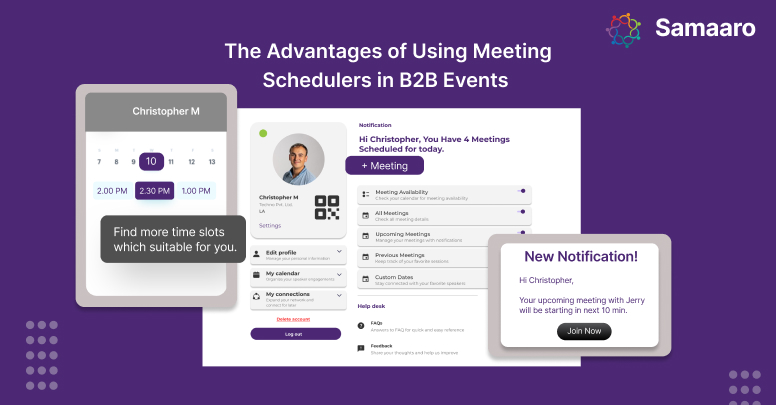
B2B events exist to build real connections. Industry leaders and decision-makers show up to network, not just browse a booth. But making those connections actually happen takes more than putting people in the same room. Someone has to coordinate who meets whom, and when. Do that badly and even a well-attended event produces a room full of missed conversations.
That’s the job a meeting scheduler does. Built into an event app, it organizes meetings, sessions, and networking around what attendees actually want. Get scheduling right and it shapes the whole experience. Get it wrong and the event’s ROI takes the hit. The sections below walk through what usually goes wrong with manual scheduling, and what actually changes once it’s automated.
A. Slow, Error-Prone Methods
Spreadsheets, emails, and phone calls are still how a lot of B2B events get scheduled. Organizers have to juggle overlapping calendars, avoid double-booking a room, and handle last-minute changes by hand. It’s slow. It’s also where mistakes creep in, and a mistake here means a missed connection or a frustrated attendee. Double-booking a key decision-maker into two meetings at once is the kind of error that’s easy to make by hand and hard to walk back once it happens.
B. Missed Opportunities
Manual scheduling drops the ball more often than people realize. A conflict means an attendee misses the right meeting or the right session entirely. Long wait times between poorly coordinated slots leave people disengaged. Both eat directly into the value an event is supposed to deliver, the specific reason a company paid to send someone there in the first place. Multiply that across a few hundred attendees and the lost value adds up fast, even if no single mistake looks that serious on its own.
C. Weak Follow-Up
The connections made during an event only matter if they turn into something afterward. Traditional scheduling tools rarely build in a real follow-up mechanism. Without one, a promising conversation quietly goes cold instead of turning into a partnership. Nobody remembers to send the calendar invite three weeks later, and the momentum from the event is gone by then anyway. The conversation that felt promising in the moment ends up as a business card sitting in a drawer.
D. Manual Coordination
In a traditional setup, one team carries the entire coordination load. That gets overwhelming fast at a large event. Juggling schedules, fielding special requests, and adjusting on the fly all fall on the same few people, and something usually slips. The bigger the event, the more this workload scales in a way that manual tools were never built to handle, until eventually the team is just reacting to problems instead of running the schedule.
A. A Streamlined Process
A meeting scheduler automates the coordination that used to eat hours of manual work. Built into event management software, it matches attendees based on preferences, availability, and business goals, without someone manually cross-checking a spreadsheet. What used to take a full-time coordinator days to sort out happens automatically in the background.
B. A Better Attendee Experience
Attendees get to choose the sessions and meetings that actually matter to them. That control changes the day. Instead of wondering whether an interaction is worth the wait, people know exactly where they need to be and why. That certainty alone cuts down on the frustration that usually builds over a long event day.
C. Stronger Event ROI
Precise matchmaking leads to more meaningful conversations, and more meaningful conversations lead to real partnerships. That impact doesn’t stop when the event ends. A well-matched meeting can turn into a deal months later, long after the badge from the event has been thrown away.
D. Real Data to Act On
Every scheduled meeting generates data: what attendees preferred, which sessions drew interest, what feedback came back afterward. That data gives organizers something concrete to work from when planning the next event, rather than a vague sense of how things went. Knowing which meeting types actually got booked, and which sat empty, shapes the agenda for the next event far better than guesswork does. A pattern that repeats across two or three events is worth acting on, not just noting and forgetting.
E. Confirmed Meetings, Not Maybes
A “maybe” meeting is worth far less than a confirmed one. Traditional scheduling leaves a lot of interest sitting in that gray zone, expressed but never locked in. A meeting scheduler turns that interest into an actual commitment on the calendar, which is what drives real attendance and real ROI. A confirmed slot on someone’s calendar is far more likely to actually happen than an informal “let’s try to connect” mentioned in passing.
Scheduling shapes whether a B2B event actually delivers, or just looks busy on the surface. A tool that automates the coordination, and matches people with real intent, changes what attendees walk away with. It’s the difference between a stack of business cards and a calendar full of meetings that actually turn into something. Samaaro’s networking tools are built around exactly this problem, matching, scheduling, and follow-up handled in one place instead of scattered across email threads and spreadsheets.
Curious what this looks like for your next event? Book a demo with Samaaro today.