Samaaro + Your CRM: Zero Integration Fee for Annual Sign-Ups Until 30 June, 2025
- 00Days
- 00Hrs
- 00Min

Key Takeaways (TL;DR)
1
2
3
→
Bottom Line:
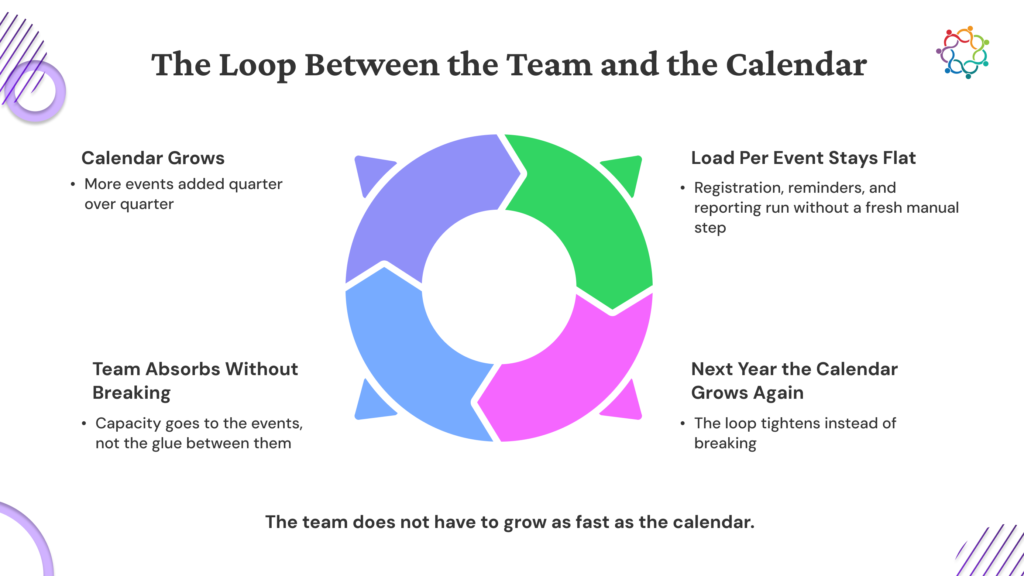
Scaling an event program operationally is about removing the manual steps that multiply with every event, so the calendar can grow while the team stays roughly the same size.
The tasks don’t get harder at fifty events. There are just fifty times as many of them.
Five events a year, your team can muscle through. Fifty will break them, unless the work stops living across a dozen disconnected tools.
What breaks at scale is the work between the events, not the events themselves: exporting a list from one tool to paste into another, reconciling attendance across spreadsheets, rebuilding the same report from scratch every time. A small team can absorb that work five times a year. It cannot absorb it fifty times.
Here’s the part that catches teams out. The individual tasks don’t change at fifty events; there are just fifty times as many of them to do, and manual work multiplied by ten is where teams break, long before the events themselves get any more complex. Most teams don’t outgrow their tools because the events have changed. They outgrow them because the volume did.
What follows is a direct, task-by-task look at running events by hand against running them from one place, at the exact point where the difference shows up.

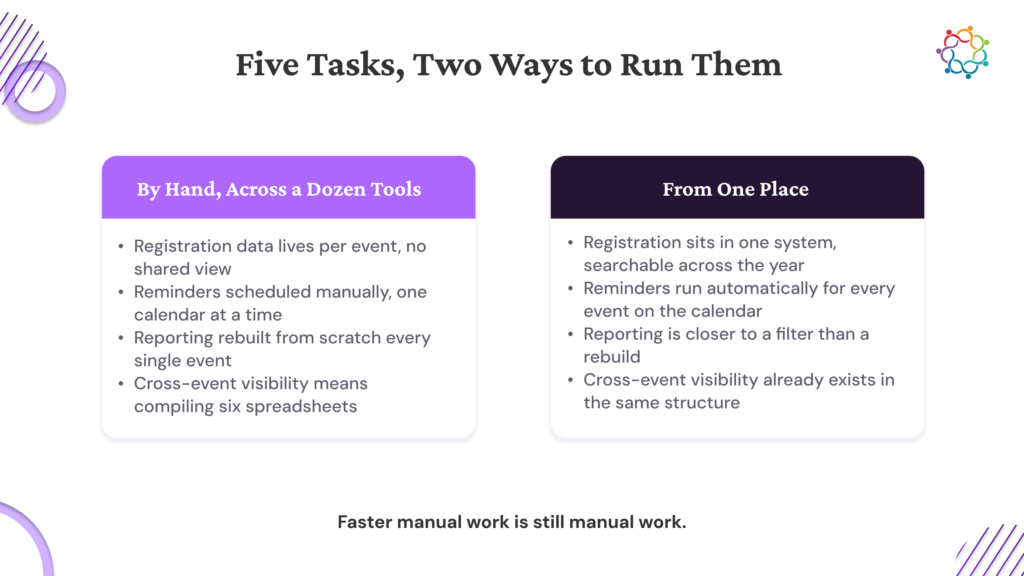
Same tasks, two very different cost curves. Here is where each one behaves differently once the event count climbs. On paper, the two columns do the same jobs; in practice, they scale in opposite directions.
| Task | Running it by hand | Running it from one place |
| Registration data | Each event’s signups live in whatever form or sheet was used that time, with no shared view. Comparing this event to the last one means opening files and reconciling them by hand, usually the week you least have time for it. | Every event’s registrations sit in the same system, searchable and comparable across the whole calendar without opening a single spreadsheet. |
| Reminders and follow-up | Someone schedules and sends reminders per event. The work grows in a straight line with event count until it quietly eats a full week of someone’s time, and the reminder that slips is often the one that would have saved a no-show. | One reminder sequence runs automatically for every event on the calendar, whether it’s the fifth event or the fiftieth. |
| Reporting | Each event’s numbers get pulled from wherever they live and rebuilt into a report from scratch, a job that gets slower as events pile up, not faster, because there are simply more of them. | The numbers already sit in a comparable format, so building a report is closer to applying a filter than starting a rebuild. |
| Cross-event visibility | Knowing whether this quarter’s events beat last quarter’s means compiling five or six separate spreadsheets by hand before you can even see the trend. | The comparison already exists, because every event’s data lives in the same structure from the start. |
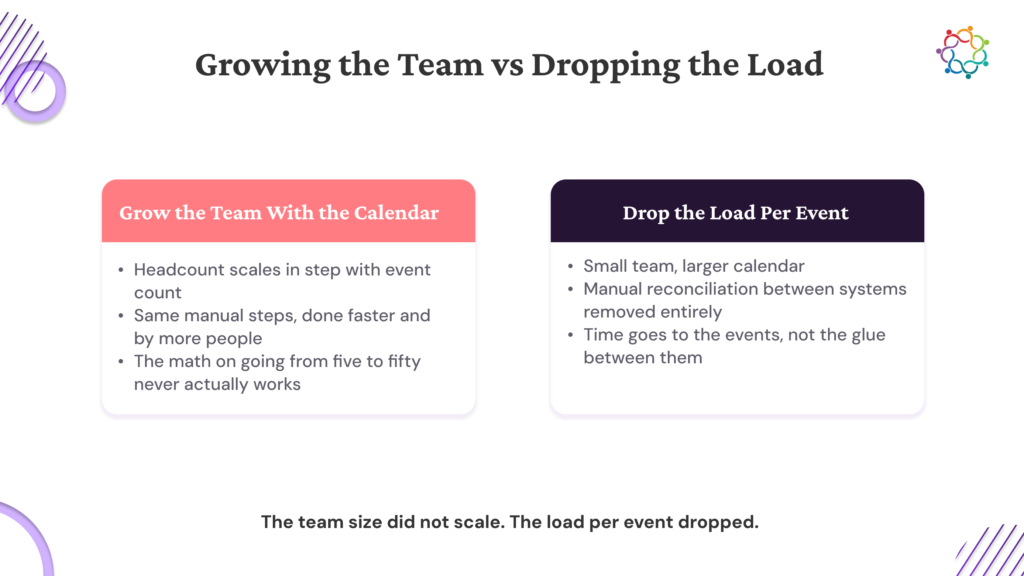
| Team capacity | Each new event adds a fixed slice of manual work no matter how efficient the team gets, so headcount has to grow roughly in step with the event count, which is the exact line item leadership notices first. | Most of the added work per event is the event itself, not the admin around it, so the team absorbs more events without growing in step. |
Read down the left column and it reads like a team at capacity. Read down the right and it’s the same team with room to add more events. The jobs are identical; only their location has changed.
Common trap: assuming the fix at scale is working faster or hiring more people to do the same manual steps. Faster manual work is still manual work, and it still multiplies with every event you add. The fix is removing the steps that don’t need to exist per event, not doing them quicker.

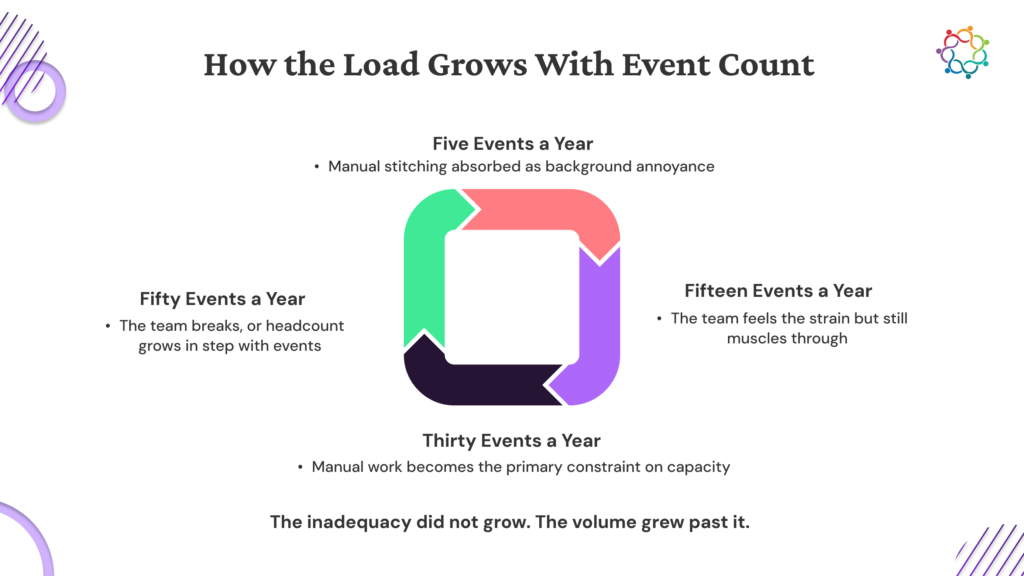
At five events a year, the manual stitching is a background annoyance. There’s enough slack in the team’s week to absorb it, so nobody logs it as a real cost, and the tools feel perfectly fine, which is exactly why nobody flags them for replacement.
The same steps at fifty events aren’t ten times more annoying. They become the ceiling on how many events the team can run at all, because the slack that hid the cost at five events is long gone. This is the real danger in tool sprawl: the stack that felt adequate at low volume never stopped being inadequate. The volume simply grew past the point where the inadequacy stayed invisible.
The practical implication is timing. Fixing this once the team is already running fifty events under strain is far harder than fixing it at fifteen or twenty, while the strain is still building and easy to see. The best moment to consolidate is before the volume forces the issue. Teams that wait tend to end up consolidating in the middle of their busiest quarter, the worst possible time to change how anything runs. The ones that move early do it calmly, on their own schedule, while the stakes are still low.

This isn’t hypothetical. A 20-person team running more than 200 in-person events a year, and the only reason that math works is that the tasks in the table above stopped needing a manual step per event.
The shift that made it possible was structural: removing the reconciliation between systems entirely, so the same small team’s time went to the events themselves instead of the glue between them. In practice, that looks like a single dashboard showing every event’s registration, engagement, and feedback data without anyone stitching reports together by hand, and communication setups that get reused across events instead of rebuilt from zero each time. The same booth layouts, the same reminder flows, the same reporting views, all reused rather than recreated for every event on the list.
The number worth remembering: the team size didn’t scale with the event count. The operational load per event dropped instead. That is the only way going from five to fifty works, and it’s why the fix is structural rather than a matter of trying harder. No amount of overtime turns a dozen disconnected tools into a system; consolidation is the one move that changes the shape of the work instead of the hours poured into it.

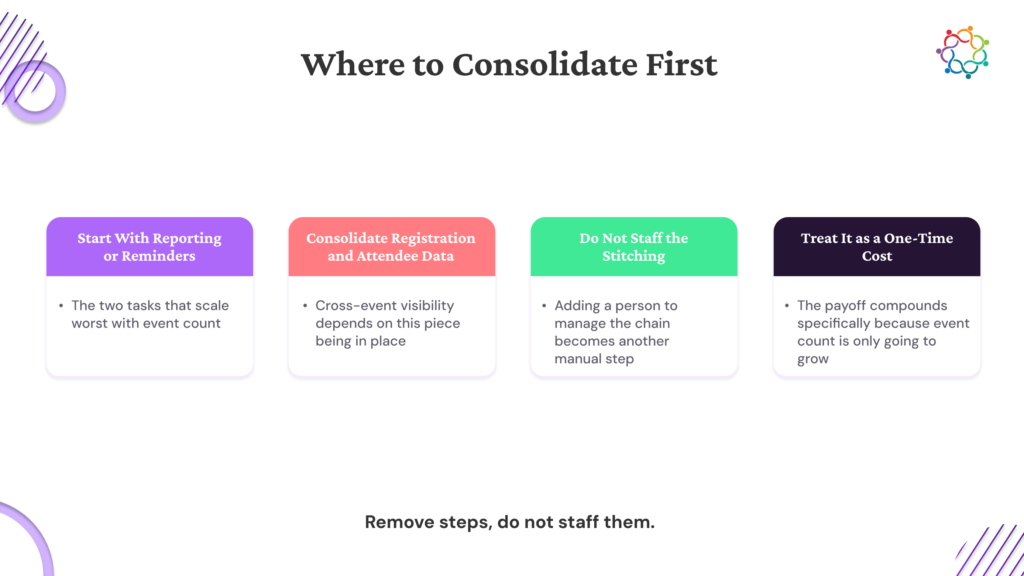
Consolidating everything at once isn’t realistic. Start where the payoff is highest.

Registration, reminders, reporting, cross-event visibility: each one either multiplies manual work per event or it doesn’t, depending entirely on whether it lives in one place or a dozen. That single fact decides whether scaling an event program feels exciting or terrifying.
At fifty events, the breaking point is the twelve tools standing between one event and the next. Consolidating registration, reminders, and reporting into event management software is the difference between a calendar that outgrows the team and one the same team can keep running. Close that gap and a growing calendar stops being a threat to anyone’s sanity.
So before the calendar doubles again, look at which tasks still take a manual step per event and start closing that gap. If you want a second read on where consolidating pays off first, Samaaro can map your stack against your calendar.
1. How does event management software help a team scale from 5 to 50 events?
Event management software removes the manual stitching between tools. Instead of exporting registrations from one place, pasting into another, and rebuilding reports from scratch fifty times, the data lives in one system. That drops the operational load per event rather than the team size, which is how a small team runs many more events without breaking.
2. Is it better to hire more people or buy an event management app to run more events?
Hiring adds people to the same manual steps; it doesn’t remove them. You’re still reconciling spreadsheets and rebuilding reports, just with more hands. An event management app removes those steps instead, so reminders and reporting stop eating hours per event and the team absorbs more events without growing in step.
3. What can an event planning tool do that a dozen separate tools can’t?
An event planning tool keeps registration, reminders, and reporting in one structure instead of scattered across a dozen places. Comparing this quarter’s events to last quarter’s stops being a hunt across five spreadsheets, because the data already lines up. Cross-event visibility becomes a filter you apply rather than a manual reconciliation job.
4. How does event coordinator software cut the work that overwhelms teams at scale?
Event coordinator software runs one reminder sequence automatically for every event on the calendar, whether it’s the fifth or the fiftieth, so a coordinator isn’t scheduling them by hand each time. Reporting builds from data that’s already comparable rather than being rebuilt from scratch, so the week that vanishes into admin at five events doesn’t multiply at fifty.
5. When should you consolidate onto event manager software, before or after scaling?
Before. At five events, the manual stitching hides in the slack of the week; at fifty, it becomes the ceiling. The moment to move onto event manager software is around fifteen or twenty events, while the strain is still easy to see, so you consolidate calmly on your own schedule instead of mid-crisis in your busiest quarter.
6. Can a small team really run hundreds of events on one event booking app?
Yes, when the operational load per event drops rather than the headcount rising. A 20-person team can run 200-plus events a year because setups get reused, an event booking app handles registration and confirmations the same way every time, and reminder flows and reporting views are recycled rather than rebuilt. Scale comes from removing per-event work, not adding people.

Samaaro is an AI-powered event marketing platform that enables marketing teams to turn events into a measurable growth channel by planning, promoting, executing, and measuring their business impact.
Location


© 2026 — Samaaro. All Rights Reserved.