Samaaro + Your CRM: Zero Integration Fee for Annual Sign-Ups Until 30 June, 2025
- 00Days
- 00Hrs
- 00Min


Key Takeaways (TL;DR)
1
2
3
→
Bottom Line:
The day after should be the day you call your best leads, not rebuild a spreadsheet.
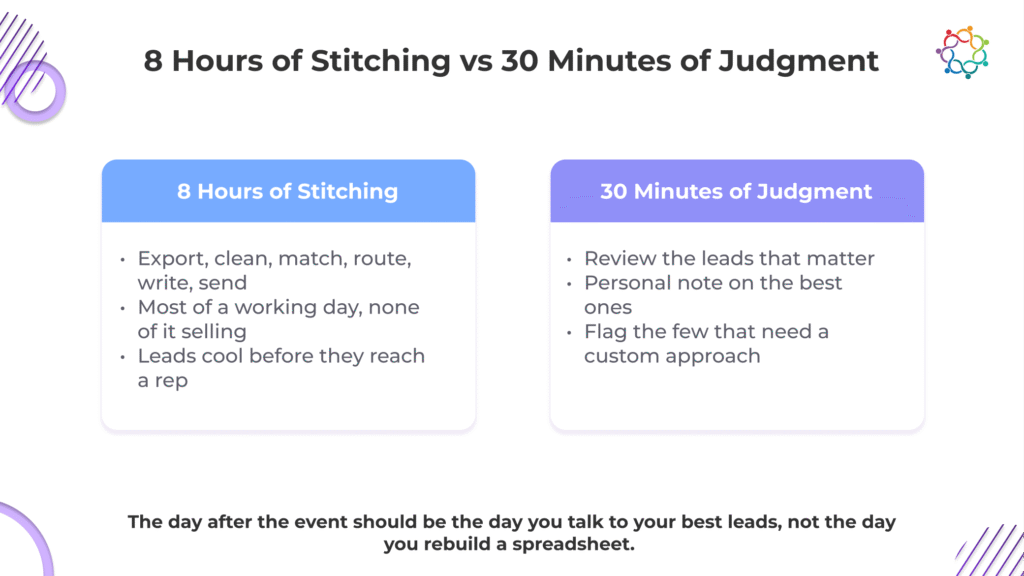
The event went well. Good conversations, a full scanner, a stack of leads. Then the day after, you sit down to do something with them, and the real work begins. Export the scans, clean the list, match it to the CRM, work out who owns which account, write the follow-up, and send it. By the time a lead reaches a rep, most of a working day has gone, and the leads have already started cooling. None of that was selling. All of it was stitching.
Here is the good news: you can take a post-event follow-up from most of a working day to under thirty minutes. You do not get there by working faster. You get there by removing the manual steps, because almost the entire window today is stitching, exporting, cleaning, matching, and routing, rather than reaching the lead. When capture is digital, the data syncs and matches itself, routing runs on rules, and the first follow-up triggers from pre-built sequences, the hours collapse, and the only human job left is a short review of the leads that matter.
This guide shows where the time goes today, hour by hour, then walks the workflow that compresses it, one step at a time.
Post-event follow-up is the handoff between a good conversation and a real opportunity, and a slow handoff is exactly where the event pipeline leaks out of the funnel. The money was spent to start conversations on the floor. The lag is where those conversations quietly die before sales ever act on them.
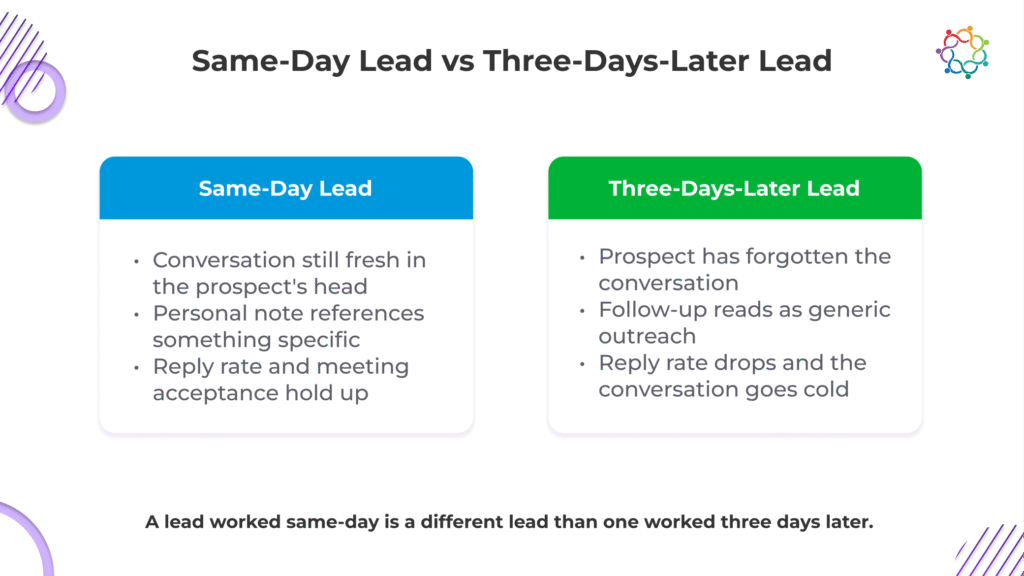
The reason is decay. Interest fades fast after an event, so a lead worked the same day is a different lead from one worked three days later, when the person has forgotten the conversation and moved on. The numbers on response speed are stark. CallPage’s analysis of lead response data found conversion rates falling from around 20 percent when a lead is worked within the hour to roughly 5 percent within a day, and about 2 percent after that. The curve is the same shape for an event lead: every hour, the follow-up sits in a queue, and conversion is draining away.
This is why the lag does more damage than losing a few individual leads. It undermines the whole event’s budget, because the budget bought conversations, and the conversations were supposed to become pipeline. Speed on the follow-up is the difference between an event that produces pipeline and one that produces a spreadsheet.
It is tempting to blame sales for not working the leads. But the problem sits upstream of sales, in the handoff itself. The leads reach the reps late and are messy. Done right, the post-event lead handoff to sales is instant. Fix the handoff, and the “sales didn’t follow up” complaint usually disappears with it. For how follow-up fits the rest of the field-marketing motion, see our B2B Field Marketing Playbook.
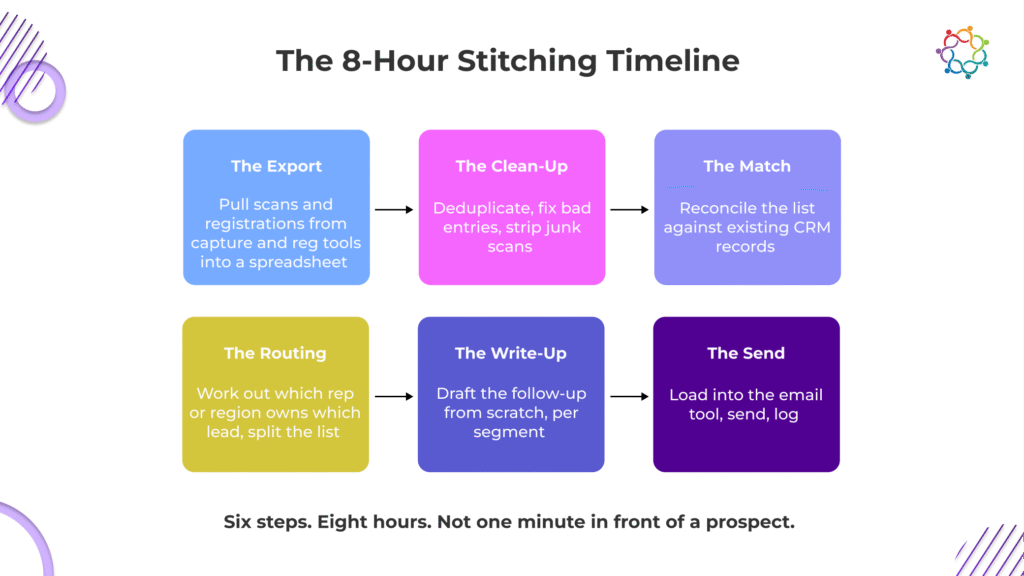
The follow-up window feels like “just doing the work,” so the time inside it is invisible. Laid out hour by hour, almost all of it is manual stitching, and barely any of it reaches the lead. Here is the day, walked through. The hours are a realistic, illustrative picture rather than a measured benchmark, but anyone who has run a booth will recognize the shape:
Add it up, and it is most of a day, and not one minute of it was spent in front of a prospect. This is not an abstraction. As one field marketing lead at a B2B software company described their own cycle: “3, 4 hours to get the report. The next day, leads are assigned. Sometimes 6, 8 hours, even a day.” That is where the eight hours in the title come from.
Every block in that list is a tool-to-tool handoff done by hand. If you have ever wondered why post-event lead follow-up takes so long, that is the whole answer: the data is scattered across separate tools and moving it between them is manual. It is tempting to file all of this under unavoidable event admin. It feels like the job. But it is the symptom of disconnected tools, and almost all of it can be removed rather than sped up.
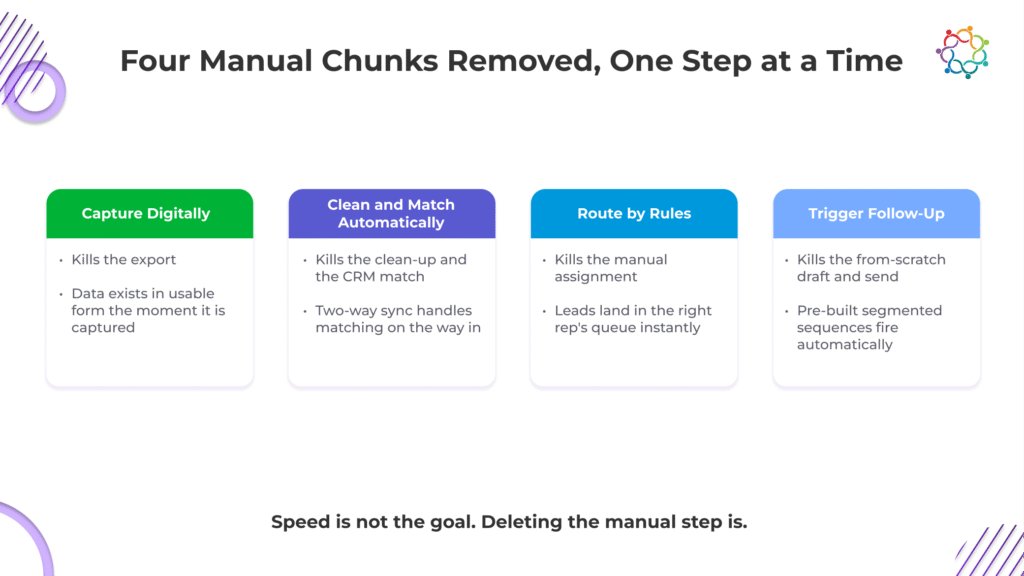
The chunk this removes is the export, the first and often largest block in that timeline. When you evaluate field marketing software, the first thing to check is whether it captures leads on the floor without typing. This step is what that capture buys you the morning after, and it is the first move in how to follow up with trade show leads faster.
The new way is simple: capture leads digitally on-site, so they are already in the system the moment they are taken. No scanner app to export from, no business cards to transcribe, no separate file to pull. The data exists in usable form from the second of capture, which means the first thing you used to do the next morning, getting the data out of the capture tool, is no longer a task.
What makes it work is native digital capture that writes straight to the platform, rather than a standalone scanner you reconcile later. The distinction is the whole point. If the lead lands as a real record at the booth, there is nothing to export, because the export was only ever the job of moving data from a disconnected tool into one you actually work in.
One thing to watch: capture has to be both digital and connected. A digital scanner that still hands you a CSV at the end of the day has only relocated the export. The block is still there, and you are still pulling data out before you can use it. The test is whether a captured lead is a live record in your system in real time, with no file in between.
The chunks this removes are the two quiet time-eaters from the timeline: the clean-up and the CRM match. What decides this one is the two-way CRM connection, which is exactly why integration depth is worth checking before you buy. This step is what a real two-way sync does for you on the day after.
As leads enter, they are deduplicated, validated, and matched to existing CRM records automatically, so you are not hand-reconciling a spreadsheet against the CRM at all. A lead who is already a contact gets recognized as that contact. A junk scan gets caught. A duplicate gets merged. All of it happens on the way in.
What makes it work is data flowing into the CRM through a connected, two-way sync that handles matching as it lands, rather than a one-time import you have to clean first. That is the difference between a tool that technically connects and one that does the reconciliation for you. The two blocks that used to eat the most invisible time, cleaning and matching, now happen without you touching them, which is the heart of automating post-event follow-up.
One thing to watch: this only works if the integration is genuine and two-way. A one-way export still leaves you cleaning by hand, which is the single most common reason a follow-up that looked automated still takes a day. So when you evaluate, do not take “integrates with Salesforce” at face value. Ask to see the matching happen on the way in.
The chunk this removes is the manual assignment, the part where someone splits the list by territory and emails each rep their share. What matters is how fast a lead crosses into a rep’s hands; this step is the routing that makes “same day” actually happen
Leads route to the right rep automatically, by territory, segment, or account owner, so no one is dividing a spreadsheet and forwarding rows. A lead captured and matched in the morning is already sitting in the correct rep’s queue by the time that rep opens their inbox.
What makes it work is routing rules set once and applied to every event after. You sit down with sales one time, map the coverage, name who owns which territory and segment, and from then on, assignment is instant and consistent, which is a large part of how you reduce post-event follow-up time. No one re-decides it per event.
The effect is that leads land in the right queue the moment they are captured and matched, instead of waiting for a person to get to the splitting task.
One thing to watch: the rules have to reflect your real sales coverage, or they route leads to the wrong place fast and at scale. Set them up carefully with sales the first time, check them once, and they run untouched for every event after that.
Writing and sending the follow-up from scratch for each part is the final piece that this eliminates. Every lead receives a timely, pertinent first message from a first-touch follow-up that is automatically triggered from pre-built sequences segregated by the lead’s identity, saving you the trouble of writing it for each individual. Depending on what you run, that trigger may come from the platform itself or via a linked marketing tool.
So where do the thirty minutes go? Not into admin. The human job that remains is the high-value part, and it is short:
That is minutes of judgment rather than hours of admin. The window collapses to a short review pass, and the accounts where sales genuinely benefit from a human touch on top of the templated first message. That is what a same-day event lead follow-up looks like in practice.
One thing to watch: the templates must be genuinely useful. A generic blast that ignores who the lead is does more harm than the delay it replaced, because a fast, irrelevant message still reads as spam. Segment the sequences so the automated touch is relevant on its own and reserve your thirty minutes for the accounts worth personalizing.
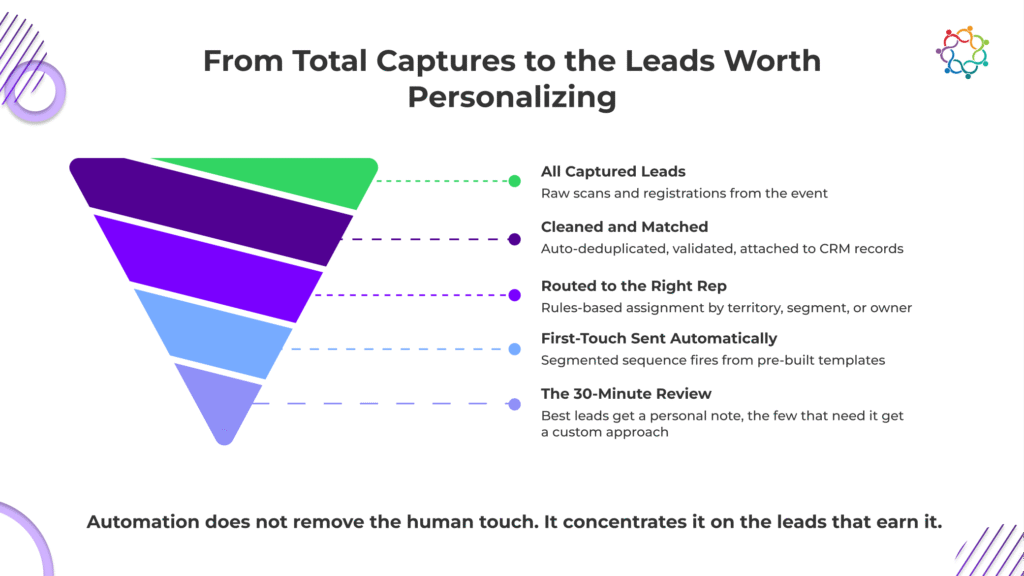
The eight hours were never the work itself. They were the cost of scattered tools, and the workflow above removes that cost one step at a time. Digital capture, automatic clean-and-match, rules-based routing, and a triggered first touch take the manual steps out, and what is left is thirty minutes of judgment. From there, the single-event recap is how you turn the event into a story for leadership.
The day after the event should be the day you talk to your best leads, not the day you rebuild a spreadsheet. Follow-up only takes eight hours when the work is manual. Take the manual out, and there is barely a window left to compress.
To see the whole thing run end to end, from a booth scan to a follow-up in the rep’s hands, book a 30-minute walkthrough.