Samaaro + Your CRM: Zero Integration Fee for Annual Sign-Ups Until 30 June, 2025
- 00Days
- 00Hrs
- 00Min

1
2
3
→
Bottom Line:
Field marketing fails when teams treat events as standalone projects instead of running the full six-stage system as one workflow.
Your team just spent six weeks and $60K on a flagship-city field event. 47 people showed up. The AE collected business cards in a fishbowl. Three weeks later, marketing can’t tell sales which leads were hot, and the program will run again in the next city next month.
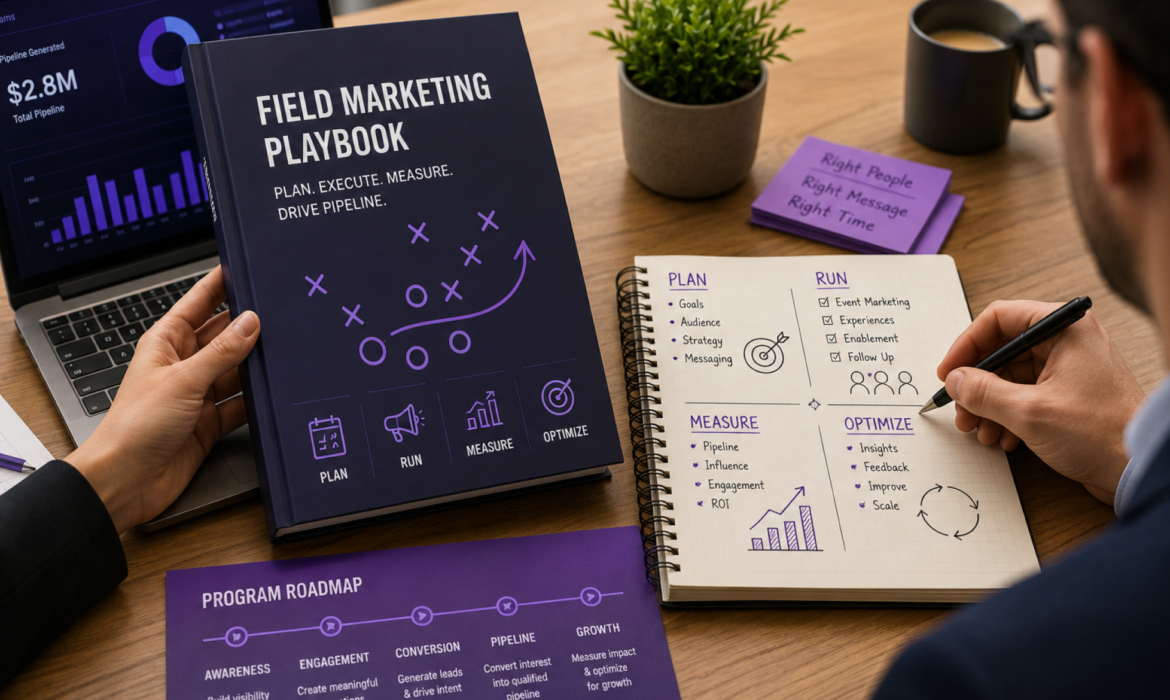
A B2B field marketing playbook is the operating system that turns a one-off event into a repeatable pipeline engine covering audience selection, city and venue strategy, pre-event nurture, execution, lead capture, and post-event follow-up as a single connected workflow. This is that playbook, in six stages, end to end.
Below: the full framework, the traps that quietly kill ROI, and the full B2B Field Marketing Playbook PDF with the operating toolkit your team can deploy at the next event.

B2B field marketing is the in-person, geo-targeted demand generation function that runs programs in the buyer’s city to compress sales cycles for accounts already in the pipeline or in fit. It’s a marketing function with a sales-acceleration mandate.
It’s worth distinguishing from adjacent motions. Trade shows are different; you’re a tenant at someone else’s program, and the audience belongs to the organizer. ABM dinners are a single tactic, often a useful one, but not a program; a program is repeatable across cities and quarters. Virtual webinars carry no physical execution and no commute commitment from the buyer, which makes the psychology of attendance fundamentally different.
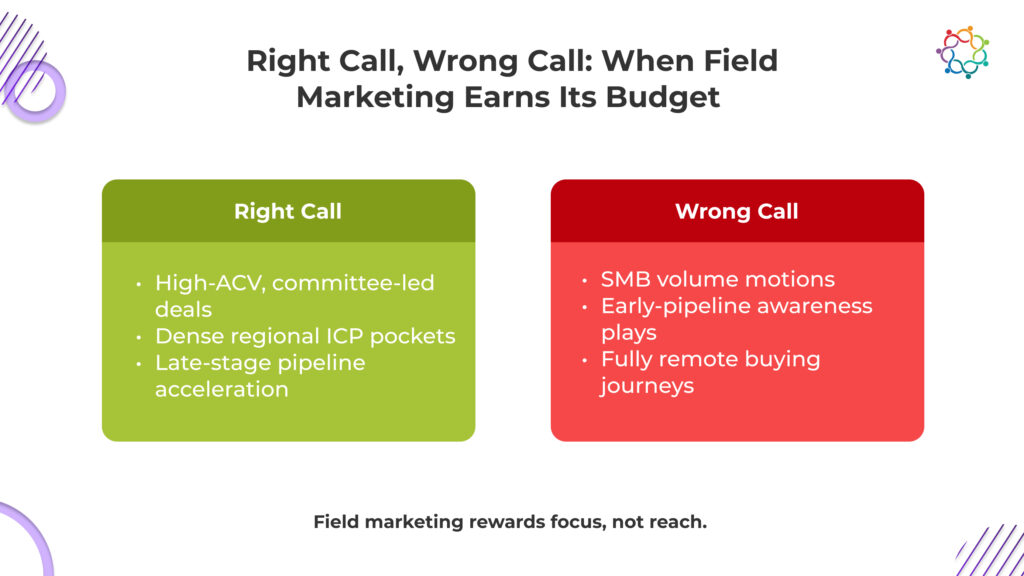
When field marketing is the right call:
When it’s the wrong call: high-volume SMB motions where unit economics don’t support per-attendee cost, early-pipeline awareness plays better served by content and paid, and fully remote buying journeys where the buyer never leaves their desk.
The rest of this article is structured around the six stages every field marketing program runs through, from list-building to attribution.

Audience selection is the first and most leveraged decision in any field marketing program. Get this stage wrong, and no amount of venue polish, speaker quality, or follow-up cadence will recover the ROI.
Build the list before you book the venue.
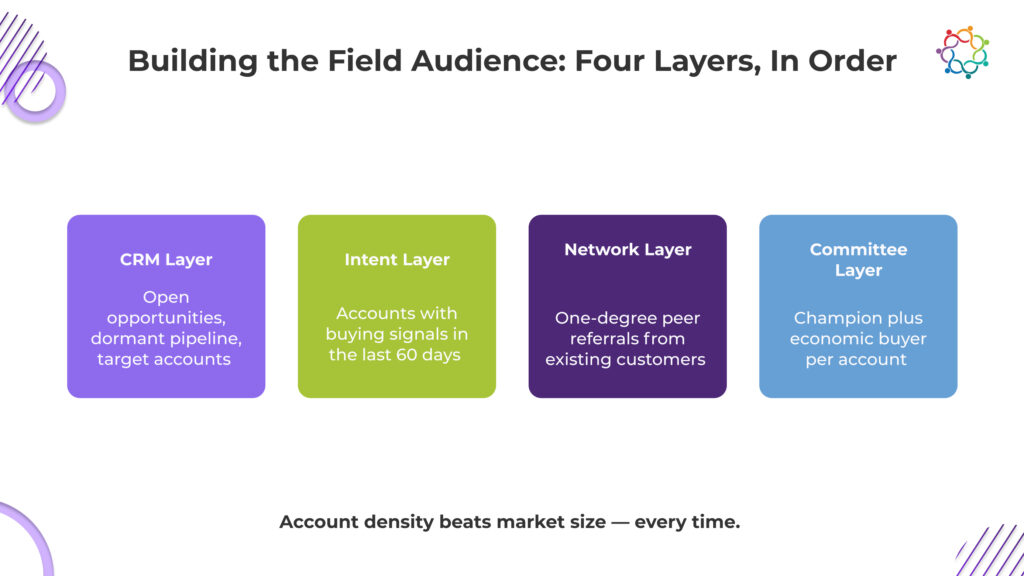
The sequence matters. Pull the target list before you sign a venue contract. The list determines the city, the venue size, and the program format, not the other way around. Three sources to layer:
Qualify by buying committee, not just title.
Single-attendee invites underperform. The goal is two to three named contacts from the same account, a champion plus an economic buyer, or a champion bringing a skeptic. Weight the list toward decision-influencers who can move a deal, not end-users who’ll enjoy the dinner but can’t sign anything.
Common trap: city population over ICP density.
A tier-2 city with 40 ICP accounts will outperform a metro with 400 if your program is built around the dense pocket. Account density beats market size every time. Run regional event marketing where your ICP concentration is highest, not where the team enjoys traveling.
The output of this stage:
The logistics decisions in this stage are quiet, but they’re the ones that determine whether you have the right people in the right room with the right amount of time to actually talk.
City selection logic.
Map ICP density to your sales team’s coverage; never run a city your AEs can’t follow up in. A program that generates 12 hot leads in a region where you have no field rep is a program that generates 12 cold leads ninety days later. Sequence cities to compound learnings: start in the city your team knows best, refine the program based on the data, and then expand. Three programs run well in the same city beat one program run badly across three.
Venue selection logic.
Match the venue to the program goal:
Avoid the hotel-ballroom default. Atmosphere drives conversation quality more than capacity does. A private dining room in a respected restaurant outperforms a sterile conference suite at the same headcount, every time.
Common trap: venue convenient for the team, not the buyer.
A 6 PM event in a part of the city that requires an hour in traffic from the buyer’s office will gut your show-up rate, no matter how good the program is. Optimize for the buyer’s commute, not yours. If the venue is twenty minutes from the highest concentration of ICP offices, you’re already winning.
Timing logic.
Tuesday through Thursday, 6:30 to 9:00 PM local time, is the consensus zone across most B2B markets. Avoid the week before and the week after major industry conferences in the same city, where your audience is either prepping or recovering, and either way, they’re not coming.

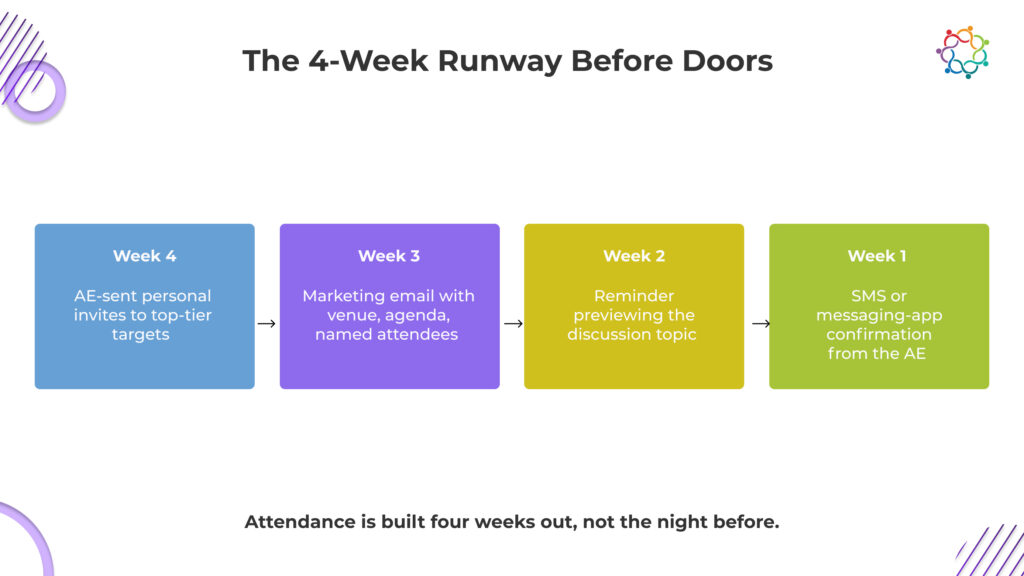
Pre-event nurture is the quiet stage that determines whether RSVPs convert into actual attendance. The work happens in the four weeks between the confirmed venue and doors-open.
The four-week sequence.
48 hours before doors: Personal SMS or messaging-app confirmation from the AE for every confirmed attendee. This is the touch that prevents day-of no-shows. A two-line message from a named rep beats a calendar-system reminder every time.
24 hours before doors: Internal team briefing. AEs review the attendee list and map a conversation goal per account: discovery, demo agreement, exec intro, contract movement. Marketing distributes the talk track, the agenda, and the leave-behind asset. Everyone walks in knowing what the program is supposed to accomplish for each named guest.
Channel mix that actually works.
In rough order of conversion impact: AE-sent personal invite > marketing email > LinkedIn DM > calendar add > SMS confirmation. Stack channels for hot accounts. Use a single channel for warm fill where personal time isn’t justified.
Common trap: generic save-the-date emails.
Field events live or die on perceived exclusivity. The moment your invite reads like a webinar promo sent from no-reply@, branded header image, hero CTA, your acceptance rate halves. Invitations that look like personal correspondence convert; invitations that look like campaigns don’t.

Execution is where most playbooks go thin. The plan stops at “host the event.” Here’s what the team actually does, hour by hour.
The 90 minutes before doors.
AEs arrive ahead of guests with name tags pre-printed and the seating plan finalized. Final tech check on AV, lead capture tooling, and any demo stations. Ten-minute team huddle: confirm conversation goals per priority account, surface any last-minute changes, and lock the seating plan around buying-committee logic. Guests start arriving inside the next hour, and you don’t get a second chance to set the room.
During the program.
Assign one AE per priority account. The AE owns the conversation; marketing supports by managing the room, working second-tier accounts, and freeing AEs from logistics so they can stay locked into the relationship work.
Keep the speaker portion under 25 minutes. The program exists to enable conversation, not to deliver a webinar with napkins. If the agenda starts to drift past 25 minutes, cut speaker content; never cut conversation time.
Common trap: cocktail party, not pipeline acceleration.
The atmosphere should feel relaxed; the underlying intent should be ruthlessly intentional. Every conversation has a goal discovery, demo agreement, exec intro, or contract movement, and every AE should know what that goal is for the accounts they’re working with. Field events that feel like networking mixers and nothing more are field events that don’t generate pipeline.
The last 15 minutes.
AEs lock the next step in person, not “I’ll follow up tomorrow.” A specific calendar invite, sent from the AE’s phone before the guest leaves the venue, is the gold standard. The goal is to leave the room with a confirmed meeting on the calendar, not a soft commitment that has to be re-earned in a follow-up email three days later.

If lead capture is sloppy, every other stage of the program is wasted. The conversation that mattered won’t be remembered. The next-step commitment won’t be honored. The pipeline won’t materialize.
What to capture, beyond the badge.
The badge data tells you who showed up. The conversation summary tells you what to do about it. The last two are where the program either generates a pipeline or doesn’t.
The tooling stack.
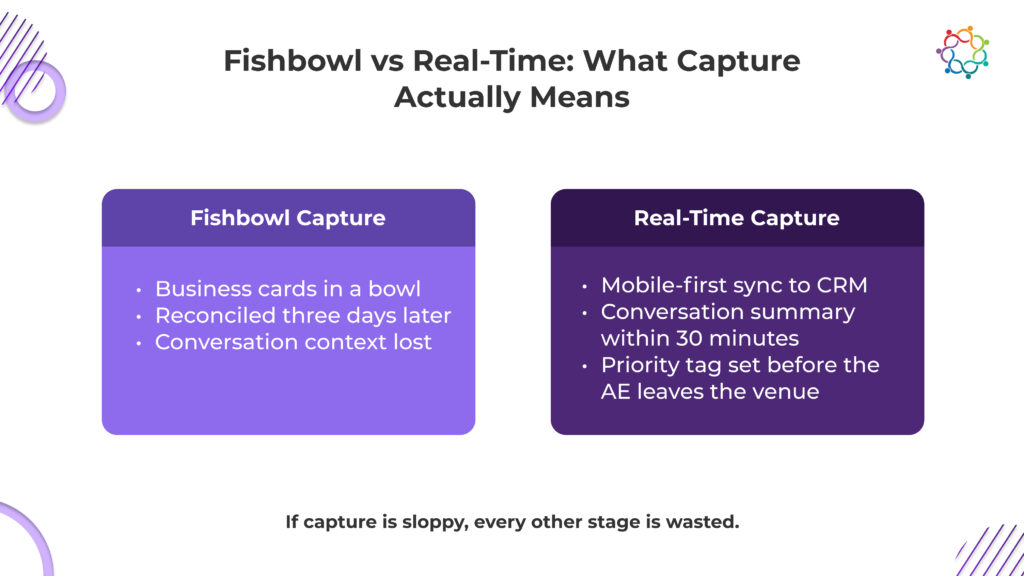
A mobile-first lead capture app synced to CRM in real time, not Google Forms, not a paper sheet, not a spreadsheet to be reconciled tomorrow. A pre-built field event template in the CRM with custom fields for venue, program, conversation summary, and priority tag. Automatic Slack notification to sales ops the moment a Hot lead is tagged, so warm hand-offs happen the same night, not the next quarter.
This is the operational layer Samaaro is built for real-time lead capture, native CRM sync into Salesforce, HubSpot, Microsoft Dynamics, or Zoho, and structured conversation data flowing into the same dashboards your CMO uses for every other channel.
Common trap: paper or fishbowl capture.
Capturing leads on paper or in a business-card fishbowl and reconciling them three days later guarantees decay. By the time the data is clean, the prospect has gone cold, and the AE has forgotten the conversation. Real-time capture is non-negotiable.

The post-event stage is where most teams under-resource. This is where the program either generates a pipeline or doesn’t, and where measurement either earns the next budget cycle or kills it.
The 48-hour rule.
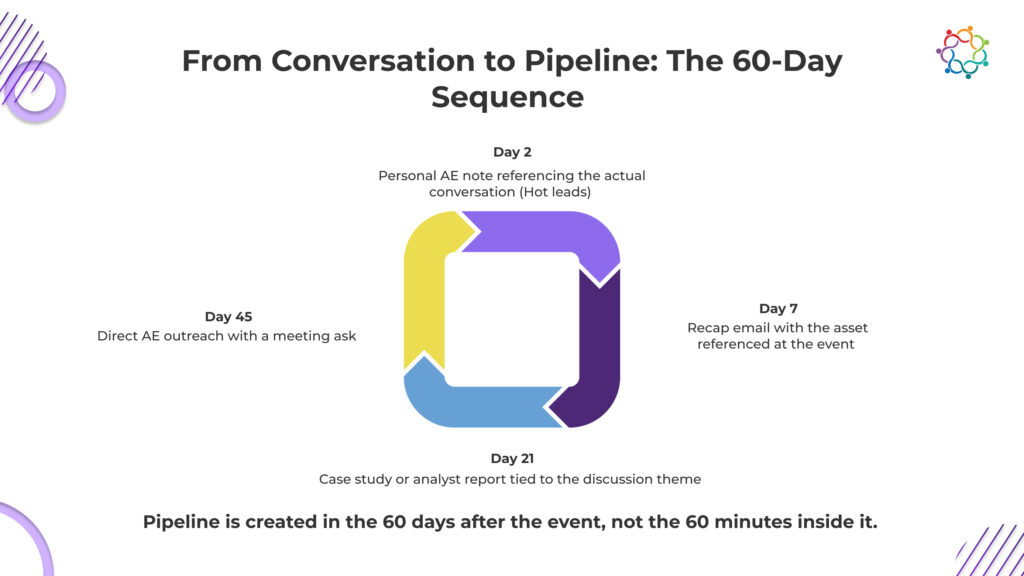
Multi-touch follow-up over 60 days.
Internal debrief within five business days.
Pull the team together while the program is still fresh. Review attendance versus RSVP rate, broken out by AE and by account tier. Pipeline created within 30 days, attributed to the program. Cost per qualified meeting and cost per opportunity. The debrief is what turns a one-off event into institutional knowledge.
The reporting and ROI layer.
Pick an attribution model and stick with it. First-touch credits new-account creation. Last-touch credits stage progression. Weighted multi-touch splits credit across the buyer’s journey. Tie program spend to opportunities created within 90 days, then track those opportunities to closed-won at six and twelve months for full event ROI visibility.
Report pipeline influenced, pipeline created, and program ROI in the same dashboard that the CMO sees for every other channel. Field marketing has to defend its budget on the same terms as paid and content, or it won’t get one next year.
Field marketing is a system. Six stages, each compounding on the last, the audience determines the room, the room determines the conversation, the conversation determines the capture, the capture determines the follow-up, and the follow-up determines whether the next program gets funded. A field event is just a venue. The playbook is what makes it a program.
Everything above, expanded into the full B2B Field Marketing Playbook PDF: the 6-stage framework, maturity self-assessment, target list builder, venue scorecard, 4-week nurture sequence, day-of run sheet, lead capture worksheet, and 60-day follow-up map. [Download the Playbook →] First name, work email, company size, role.
If your team runs more than four field events a year and the post-event reconciliation still takes longer than the events themselves, the playbook is not the bottleneck; the capture layer is. That is what Samaaro replaces.

Samaaro is an AI-powered event marketing platform that enables marketing teams to turn events into a measurable growth channel by planning, promoting, executing, and measuring their business impact.
Location


© 2026 — Samaaro. All Rights Reserved.