Samaaro + Your CRM: Zero Integration Fee for Annual Sign-Ups Until 30 June, 2025
- 00Days
- 00Hrs
- 00Min

1
2
3
→
Bottom Line:
Event ROI lives or dies in the handoff. The teams that win pipeline build it as a system, not a recurring fight.
Marketing comes back from the trade show with 300 scanned badges, drops a CSV into the CRM, and forwards the import receipt to the VP Sales with a triumphant Slack message. Three weeks later, four meetings have been booked. The next planning meeting is a marketing-vs-sales bloodbath. Marketing thinks sales didn’t work on the leads. Sales thinks marketing handed over 300 lanyard-grabbers. Both are partially right.
The marketing-to-sales lead handoff is the single most common failure point in B2B event ROI. It is almost never a motivation problem. It is a process problem with five fixes: qualification at the booth, scoring that routes leads to the right rep, a written SLA both sides agree to, the context the rep actually needs, and reporting that holds both teams accountable.
This is that framework, end to end, applied to the post-event window where most pipeline goes to die. Each fix solves a specific structural failure: a missing tier tag, a misrouted lead, an unenforced SLA, a context-free CRM record, or a dashboard nobody shares. Fix the structure, and the handoff stops being a recurring fight.

The handoff fails because of structural gaps, not because either team is failing the other.
The volume mismatch.
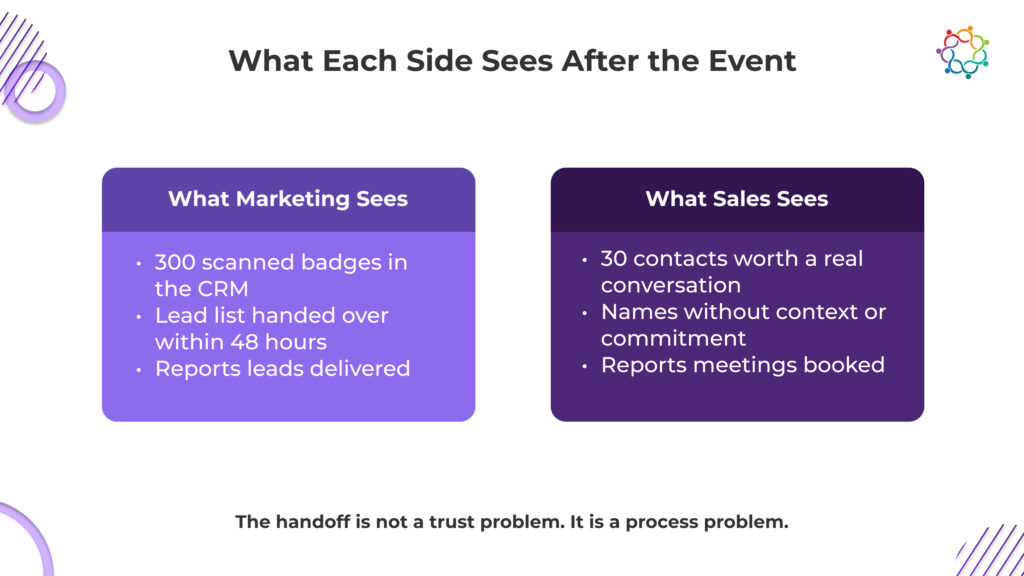
300 scans look like 300 leads to marketing and like 30 leads to sales. Both are right, depending on the definition. Marketing counts capture. Sales counts qualified opportunities. The same number tells two stories.
The context gap.
A name and an email together don’t make a lead. They make a contact. A lead is a contact plus the conversation that happened, the intent signal, and the next-step commitment. When marketing delivers contacts and calls them leads, sales receives volume without context.
The SLA gap.
Most teams operate without a written agreement about who owns the lead, on what timeline, with what definition of “follow-up.” Without an SLA, both “the leads weren’t worked” and “the leads weren’t workable” are defensible, and neither side can prove the other wrong.
The reporting asymmetry.
Marketing reports leads delivered. Sales reports meetings booked. The gap between the two numbers becomes the political problem at the next QBR.
Common trap: treating the handoff as a trust issue.
Alignment workshops do not fix what structure causes. A team with great alignment and bad process produces the same handoff failures as a team with bad alignment. Process problems get fixed by structure, not by relationships.
Qualification has to happen at the moment of conversation, not after the event when reps reverse-engineer interest from a name and a job title. Title-based qualification is guesswork. A conversation-based qualification is data.
The three-tier qualification rubric.
The rep makes the tier call before the visitor leaves the booth. The call gets attached to the badge scan inside the lead capture app, never reconciled later in a spreadsheet.
What gets captured in real time.
The capture infrastructure that makes this possible.
A mobile lead capture app with custom fields for tier, summary, and next step. Synced to the CRM in real time so the AE who will work the lead sees the conversation context the same day. Hot leads trigger an automatic Slack alert to sales ops the moment they are tagged.
This is the operational layer Samaaro is built for: real-time tiering, native CRM sync into Salesforce, HubSpot, Microsoft Dynamics, or Zoho, and conversation context flowing into the lead record before sales opens the CRM the next morning.
Common trap: scanning every badge and qualifying later.
Volume is not the best metric. A booth that scans 800 badges and “qualifies” them by parsing job titles two days later produces handoff fights. A booth that scans 200 badges and tiers them in real time produces meetings booked.

Scoring without routing is just a slide in a deck. Routing is what determines whether a Hot lead lands with the right AE on the right day, or in an SDR queue that never gets worked.
The two-axis scoring model.
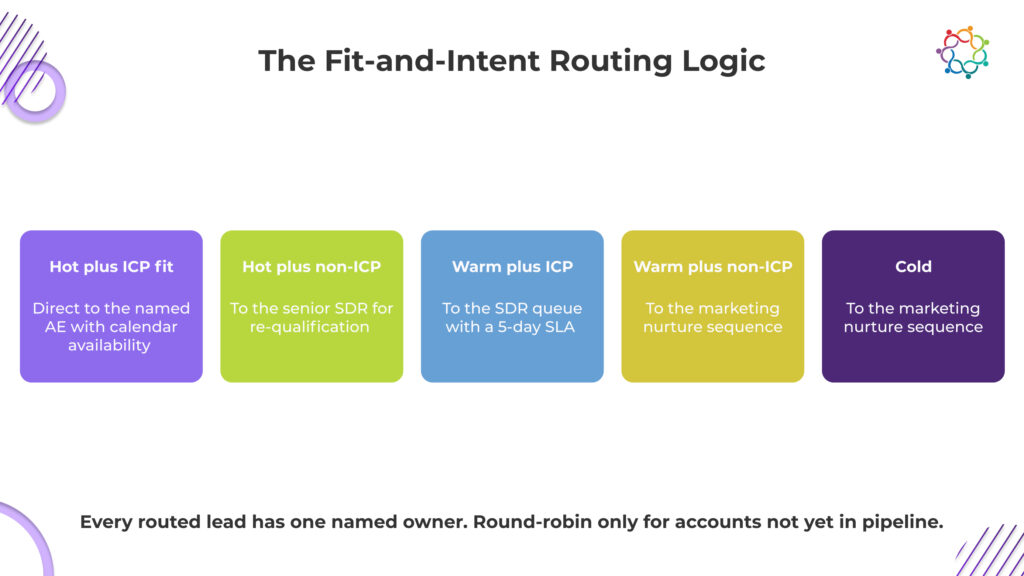
The combined score determines the routing path. High fit plus high intent goes directly to an AE. Low fit plus low intent goes back to marketing nurture. The four quadrants in between have specific routing rules.
The routing logic that works.
The named-owner principle.
Every routed lead has a single named owner. Not a team alias. Not a generic SDR queue. Routing rules in the CRM auto-assign based on territory, vertical, or named account list. Round-robin routing applies to unowned accounts only, never to accounts already in the pipeline.
The named-owner rule is what prevents the “I thought someone else was working that” failure mode that quietly buries Hot leads within a week of capture.
Common trap: one SDR queue for everything.
Routing all event leads into the same SDR queue regardless of tier or fit means the Hot lead with an active project gets the same treatment as the Cold tire-kicker. Both sit in the queue for eleven days. The Hot Lead’s window closes before the SDR ever calls. Differentiated routing is the entire point of scoring.

An SLA that both teams agree to, written, time-bound, measurable, is what makes the handoff defensible at every QBR going forward. Without one, both sides operate on assumptions, and assumptions disagree at the worst possible moment.
The four SLA dimensions.
What marketing commits to in the SLA.
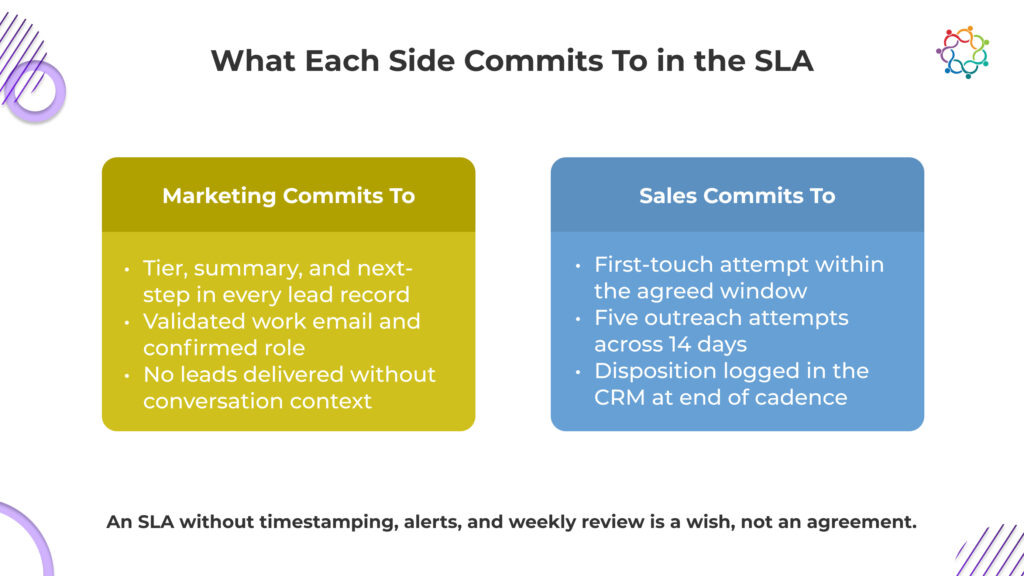
Every lead arrives with a tier, a conversation summary, and a next-step commitment in the CRM. No leads delivered without conversation context. No leads delivered with bad contact data: work email validated, role confirmed.
What sales commits to in the SLA.
First-touch attempt within the agreed window, with timestamp logged. Full attempt cadence is completed before any lead is marked “no response.” Disposition entered in the CRM at the end of cadence: meeting booked, disqualified, or recycled to nurture.
The escalation path.
Hot leads not contacted within four hours trigger an automatic alert to the sales manager. Patterns of SLA misses by territory or rep get reviewed weekly, not quarterly. The discipline is in the weekly cadence, not the quarterly report.
Common trap: SLAs that exist on paper.
An SLA without CRM-level timestamping, automatic alerts, and weekly review is a wish, not an agreement. The infrastructure underneath the SLA is what determines whether it changes behavior. A signed document on a shared drive does nothing for the Hot lead sitting unworked at hour six.

The single biggest determinant of whether an event lead converts is whether the rep can pick up the phone with a specific context. Generic event attribution does not convert. Conversation-specific context does.
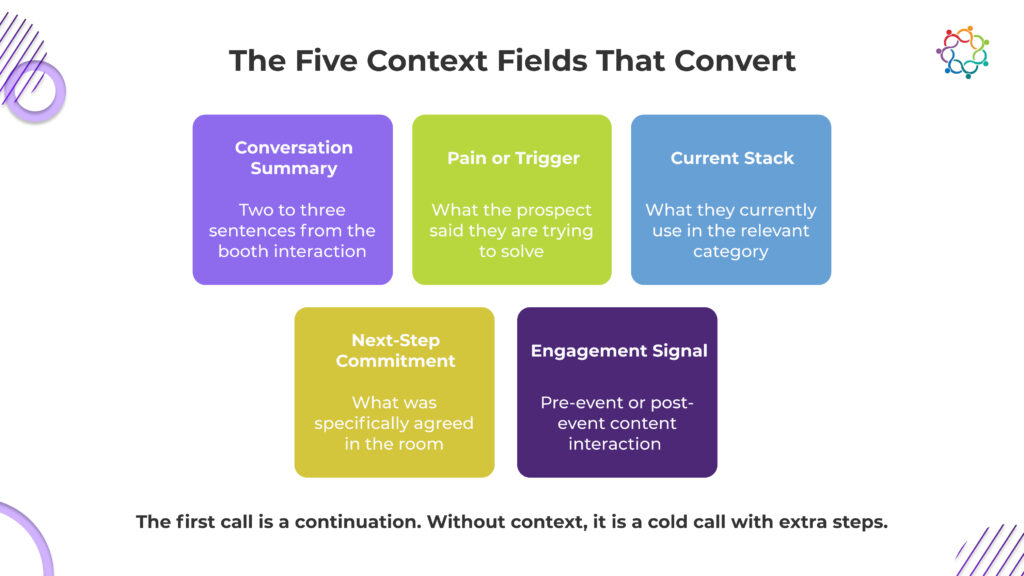
The five context fields every event lead needs.
Why does this beat every other context field?
A rep with these five fields can open the call with: “You mentioned at the booth that your team is struggling to consolidate three tools. I have a 15-minute walkthrough that maps directly to that.”
A rep without them opens with: “I noticed you visited our booth at the show last week, wanted to see if you’d like to learn more.”
The first call is a continuation of a conversation already in motion. The second is a cold call with extra steps.
The format rule.
Context goes in the CRM activity log, attached to the lead record. Not in a separate document. Not in a Slack thread. Not in a marketing email that the rep has to dig up. Every rep sees the context the moment they open the lead record, with no extra clicks.
Common trap: assuming the rep will figure out the context.
A title and a company name are not context. Context is the entire mechanism that converts the follow-up call into a meeting. Without it, even good reps make cold calls. With it, average reps book meetings.

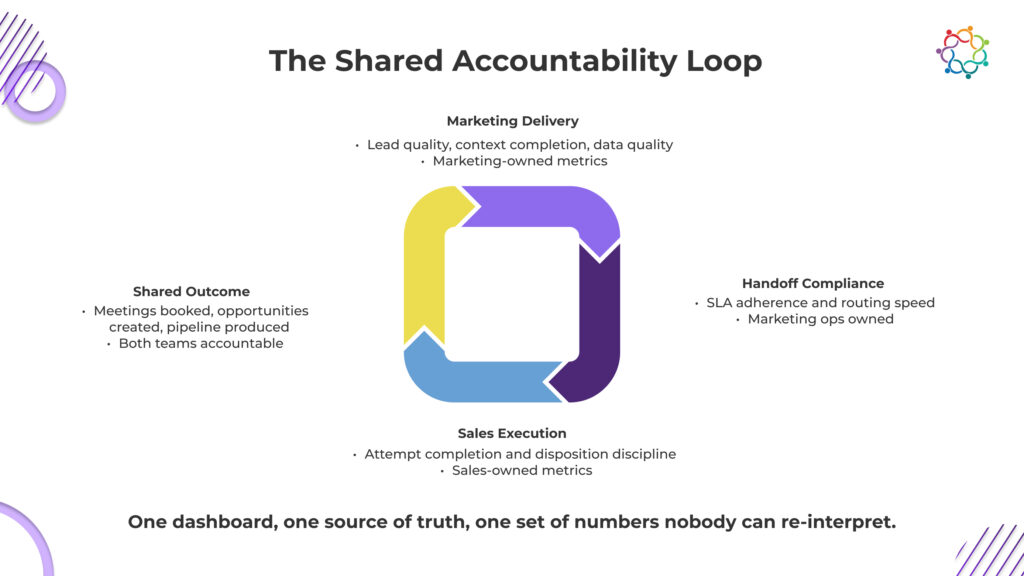
The reporting layer is what makes the handoff a measurable system instead of a recurring fight. Without shared reporting, the marketing-sales gap becomes a political problem. With it, the gap becomes a data point both sides can act on.
The full-funnel reporting view.
The shared dashboard principle.
One dashboard. One source of truth. Visible to both marketing and sales leadership. Updated daily during the active follow-up window, which is the first thirty days post-event. Rep-level performance anonymized to support coaching, not punishment.
The accountability mechanic.
Marketing is accountable for lead quality, context completion, and data quality. Sales is accountable for SLA compliance, attempt completion, and disposition discipline. Both are accountable for the shared outcomes: meetings booked, opportunities created, and pipeline produced.
The split matters. Marketing cannot be held accountable for the sales conversion of a lead with bad context. Sales cannot be held accountable for a lead delivered with a generic title and no conversation summary.
The QBR slide that ends the fight.
One slide. Four numbers: leads delivered, leads worked, meetings booked, pipeline created. A trend line across the last four events. A clearly attributed gap when a number underperforms: marketing’s gap, sales’ gap, or shared.
Common trap: separate dashboards owned by separate teams.
When marketing reports leads delivered in one system, and sales reports meetings booked in another, the two numbers never reconcile, because nobody is accountable for the gap between them. A shared dashboard, owned by marketing ops, is what makes the handoff a measurable system.
The marketing-to-sales handoff is not a trust problem. It is a process problem with five fixable stages. Qualify at the booth. Score for routing. Write an SLA that both sides commit to. Deliver real context to the rep. Report against shared metrics.
Every event a team runs has a handoff. The teams that win the pipeline didn’t fix the handoff once. They built it as a system that survives every event after.
If your team is running more than four events a year and the post-event Slack channel still has the same marketing-vs-sales fight every quarter, the gap usually sits in the handoff infrastructure, not in either team. Samaaro is built for the capture-to-CRM workflow that closes it.

Samaaro is an AI-powered event marketing platform that enables marketing teams to turn events into a measurable growth channel by planning, promoting, executing, and measuring their business impact.
Location


© 2026 — Samaaro. All Rights Reserved.