Samaaro + Your CRM: Zero Integration Fee for Annual Sign-Ups Until 30 June, 2025
- 00Days
- 00Hrs
- 00Min


Key Takeaways (TL;DR)
1
2
3
→
Bottom Line:
An event tech stack is only valuable if it connects event interactions to pipeline outcomes without manual effort.
A mid-market SaaS company runs 12 events a year. Their event tech stack includes a registration platform, a check-in app, a networking tool, a survey platform, an email automation layer, and an analytics dashboard. Annual cost: roughly $80,000.
After their flagship conference last quarter, the CMO asks: “Which of the 300 attendees were from our target accounts, and how many entered the pipeline within 60 days?”
Nobody can answer. Not because the data does not exist. Because it is scattered across six tools that do not talk to each other. The registration platform has the account data. The check-in app has the attendance records. The engagement scores are in the analytics dashboard. The survey responses are in a separate tool entirely. Pulling a unified answer would take three manual exports, a spreadsheet, and two hours of someone’s time, by which point the question has already moved on.
This is the event tech paradox. Capability increases, but clarity does not. Every tool was added to solve a real gap. But the stack was never designed as a system. It was assembled as a collection. The result is high operational coverage and near-zero revenue visibility.
The issue is not that teams buy the wrong tools. It is that they evaluate tools against the wrong criteria entirely.
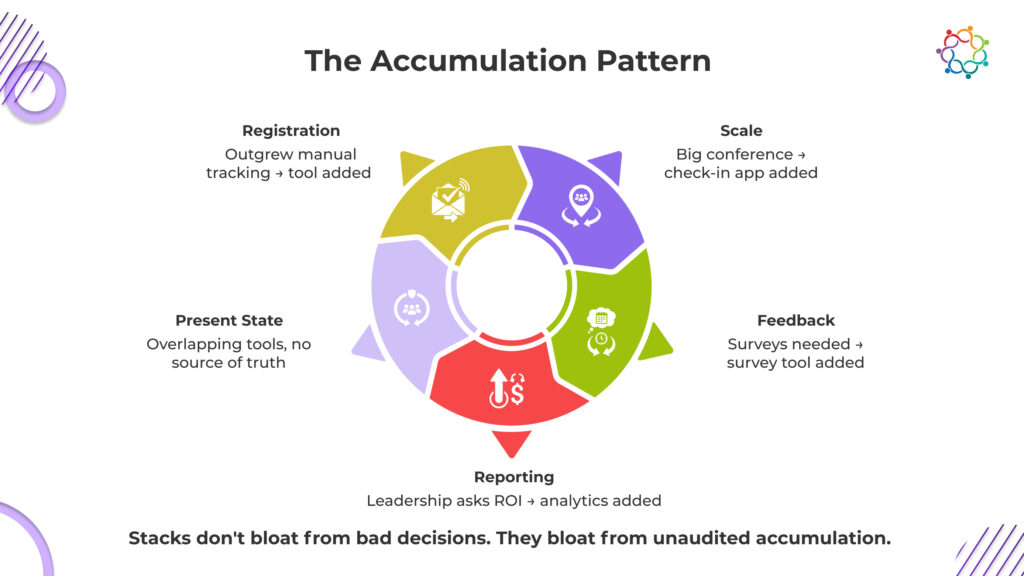
Stack bloat does not happen because marketing ops teams are careless. It happens because every tool makes sense at the moment of purchase.
The registration tool gets bought when the team outgrows a manual process. The check-in app gets added for a large conference with complex logistics. The survey tool comes in when post-event feedback needs to scale. The analytics layer gets layered on when leadership starts asking ROI questions. Each decision is individually justified, individually approved, and individually forgotten once the event it was purchased for is over.
What nobody asks: does the fifth tool make the second one redundant? Does the analytics layer just re-visualize data that the registration platform already captures? Does the check-in app produce engagement data that overlaps with what the networking tool tracks?
The financial cost is visible on a procurement spreadsheet. The operational cost is less visible but far more damaging:
That last point is the one that matters most. The entire point of the stack is to produce a clear picture of who attended, how they engaged, and what to do with them next. When data is split across six systems, that picture never assembles cleanly enough to act on.
Stacks do not bloat because of bad decisions. They bloat because of unaudited accumulation, and most teams never stop to audit.
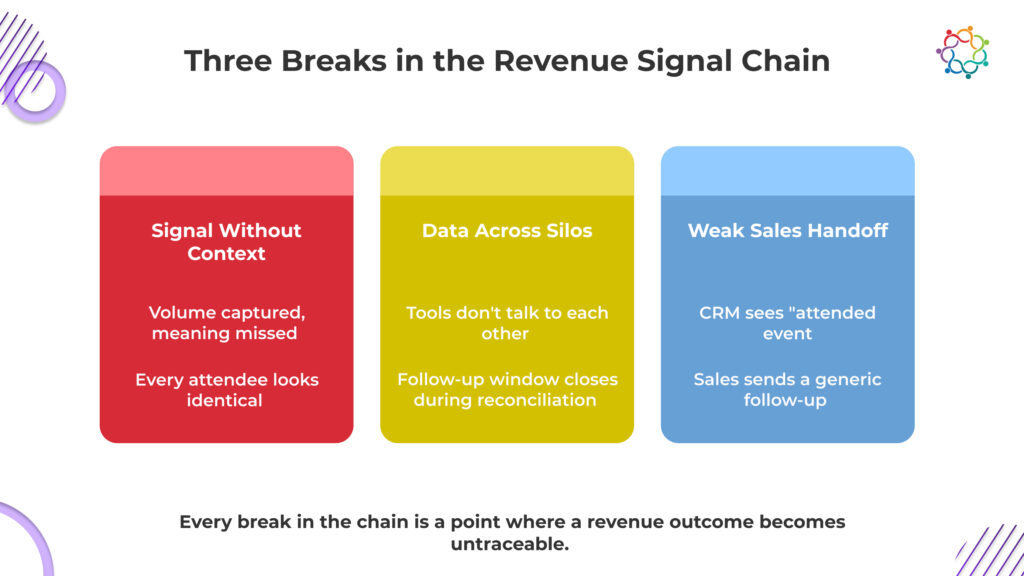
Even well-intentioned stacks fail in predictable ways. The breaks are not random. They happen at the same three points across almost every B2B event operation.
Most stacks record volume. A badge scan at a booth tells you someone walked past. It does not tell you they spent twelve minutes asking about your enterprise API integration. When signal capture lacks qualitative context, every attendee looks identical in the CRM. Sales receives a list where someone who attended three sessions and asked about pricing is scored the same as someone who checked in, attended one keynote, and left at lunch. The score says “medium engagement” for both. The pipeline value is not remotely the same.
Registration data sits in one tool. Engagement data sits in another. Post-event survey responses sit in a third. Reconciling them means manual CSV exports, a spreadsheet that someone has to maintain, and a lag of two to five days before a unified view exists. The 48-hour window where event leads are warmest closes while the data is still being stitched together by hand.
Even when data is unified, most stacks lack a mechanism to translate event engagement into actionable CRM fields. A sales rep sees “attended conference” as a lead source. They do not see “attended three sessions on data security, raised compliance questions twice, and spent fifteen minutes with the solutions engineer.” Without that context, outreach is generic. Generic outreach produces generic results.
The revenue visibility gap is not a pipeline problem. It is a data architecture problem that shows up as a pipeline problem.
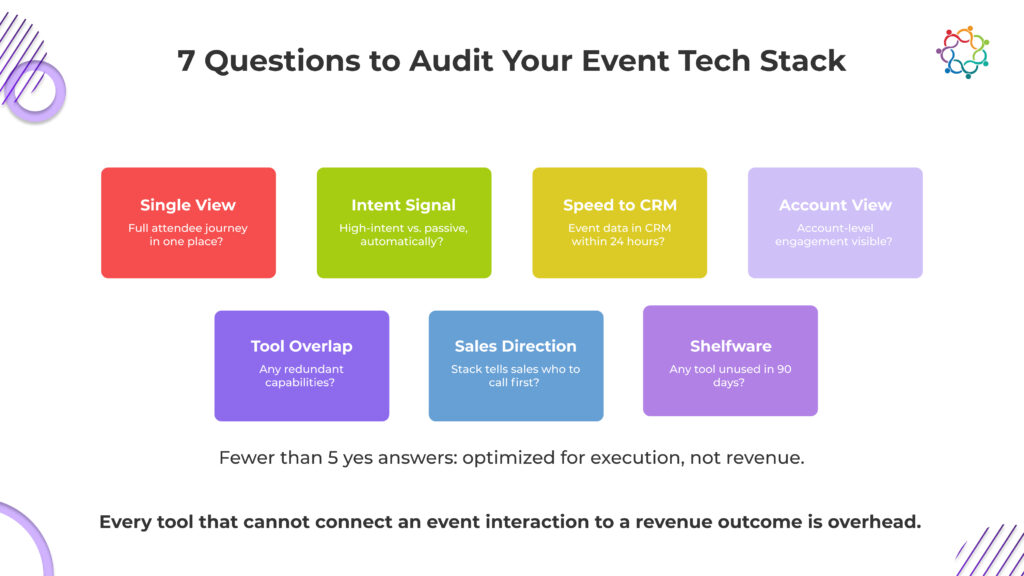
Before renewing a contract or adding another tool, run every layer of your current event tech stack through these questions. If fewer than five get a clear yes, the stack is optimised for execution, not revenue.
The goal is not minimalism. It is accountability. Every tool that cannot answer yes to at least one of these questions is overhead, not investment.
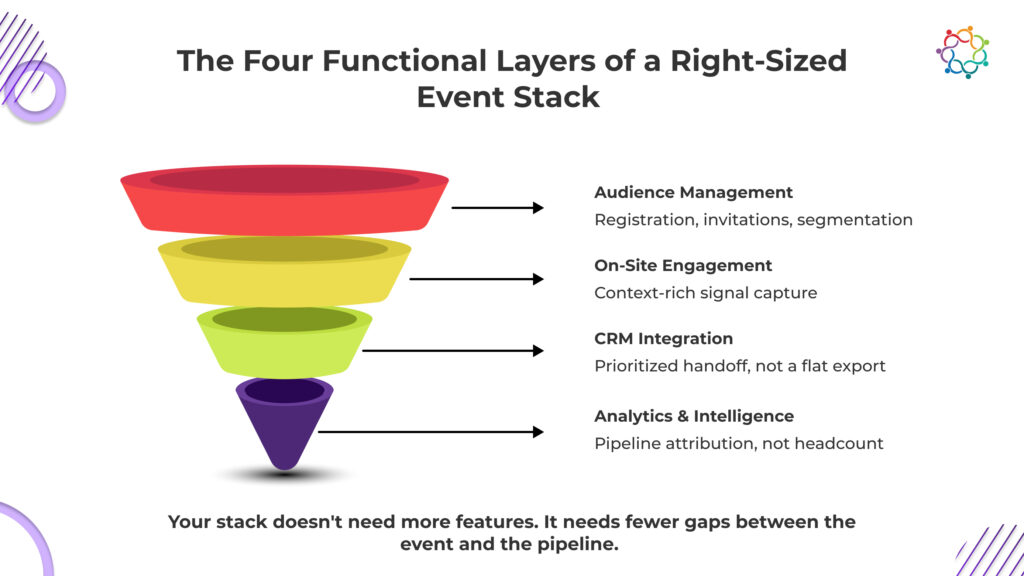
A right-sized event tech stack does four things and does them well. It does not need to do forty things adequately.
One system owns the attendee relationship from first invitation through post-event communication. Registration, segmentation, and pre-event nurture all live here. The requirement is not feature depth. It is this layer that produces clean, structured data that every other layer can use.
Check-in, session tracking, lead capture, networking, and feedback all belong in this layer. The non-negotiable requirement is context-rich signal capture. Volume metrics alone produce flat CRM records. This layer needs to distinguish a stakeholder in active evaluation from someone who attended because the session was on the way to lunch.
Event data flows into the CRM with full context attached. Not “attended event” but “attended these sessions, engaged at this depth, asked these specific questions, and represents this target account.” Sales receives a prioritised and contextualised handoff, not a CSV with a thousand rows and no explanation.
This layer answers whether events are moving the pipeline, not just whether people showed up. Cross-event reporting, ROI measurement, and attendee behaviour trends belong here. If this layer only produces attendance charts, it is not analytics. It is documentation.
Some teams accomplish all four layers with two tools. Others need four. The number is irrelevant. What matters is that data flows across layers without manual reconciliation and that each layer contributes to one question: what should happen next?
Every time a tool is added to the event tech stack, one question is worth asking before anything else: Does this make it easier to connect an event interaction to a revenue outcome?
If yes, it earns its place. If the honest answer is “it makes the event run more smoothly,” but it does not improve revenue visibility, it is an operational convenience. Operational conveniences are not inherently bad. But they should not be confused with strategic infrastructure, and they should not consume budget that could improve intelligence.
Your stack does not need more features. It needs fewer gaps between what happens at the event and what shows up in the pipeline.
Samaaro unifies audience management, on-site signal capture, CRM integration, and post-event analytics into a single connected system, so event data flows into the pipeline without manual exports, silos, or two-hour spreadsheet reconciliations. Talk to our team.