Samaaro + Your CRM: Zero Integration Fee for Annual Sign-Ups Until 30 June, 2025
- 00Days
- 00Hrs
- 00Min

1
2
3
→
Bottom Line:
A booth without a strategy across all three phases is just expensive furniture, not a pipeline engine.
You spent $50K on the booth. 600 badges scanned. Three weeks later, your AE has worked exactly four of those leads, and the other 596 are sitting in a CSV nobody has touched. Finance wants to know why trade shows are still in the budget.
This is what most B2B trade show programs look like under the hood. The booth got built. The badges got scanned. But the conversation never converted, and the line item gets harder to defend every fiscal year.
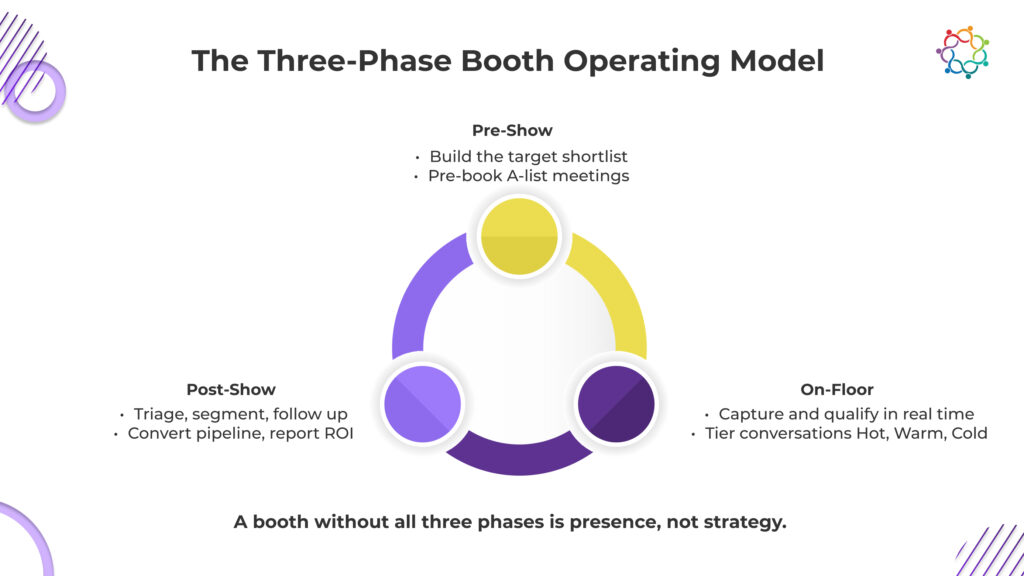
A trade show booth strategy is the operating system that turns badge scans into pipeline. It runs across three phases (pre-show, on-floor, post-show) and unless you have designed for all three, you do not have a strategy. You have a presence.
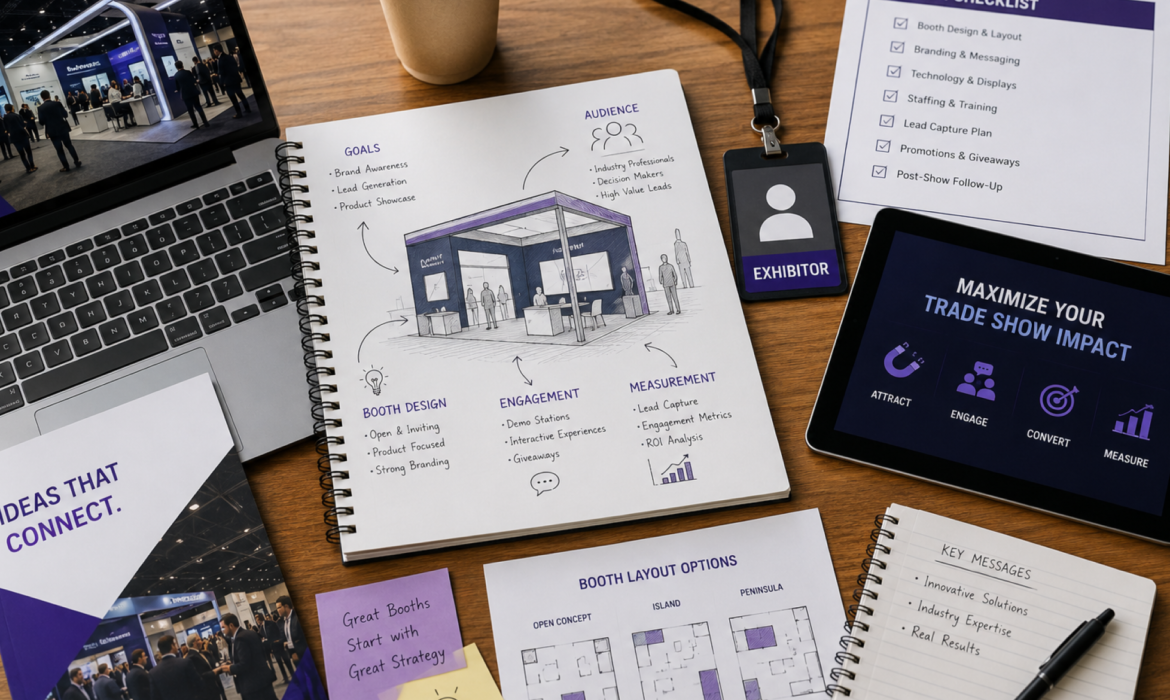
This article is the strategic framework: design, pre-show outreach, on-floor qualification, post-show segmentation, and ROI reporting. Plus a downloadable toolkit (a strategy PDF and a print-ready 30-point booth checklist) your team can carry into the next show. For the broader B2B field marketing operating system this booth program sits inside, see Samaaro’s B2B Field Marketing Playbook.

Most booths produce a fraction of the pipeline they could because the team treated the show as a three-day event instead of a six-week program. The booth went up on Tuesday, came down on Thursday, and the rest of the work (the work that actually drives ROI) was treated as cleanup.
A high-performing trade show booth strategy runs as a three-phase program.
Pre-show creates the shortlist. Outreach, segmentation, and booked meetings happen in the four to six weeks before the show. By the time the booth opens, the high-value time slots should already be on the calendar.
On-floor captures and qualifies. The booth is where conversations happen at compressed speed, where reps tier each visitor in real time, and where the badge scan gets paired with a conversation summary that makes follow-up specific.
Post-show converts. Triage, segmentation, and a tiered follow-up cadence determine whether the captured data becomes pipeline or sits in a CSV nobody opens.
Four levers plus a measurement framework determine output across all three phases: booth design, pre-show outreach, on-floor qualification, post-show follow-up, and ROI reporting. Each one compounds the next. A great booth without outreach gets ignored. Strong outreach without floor qualification produces noise. A clean qualification without follow-up produces lost pipeline.
The rest of this article walks through each lever in the order it shows up in the lifecycle.

Booth design is not an aesthetic exercise. It is a conversion architecture. Every layout decision either invites a conversation or blocks one.
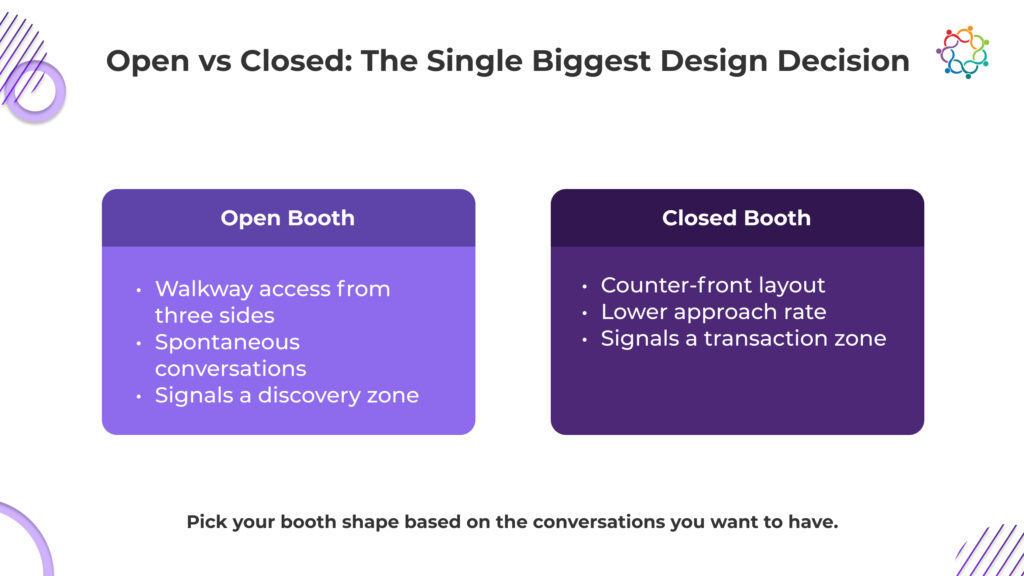
Open vs. closed booth logic.
Open booths (no front counter, walkway access from three sides) tend to drive significantly more spontaneous conversations than counter-fronted layouts. In our experience, the gap is large enough to make this the single biggest design decision a team makes for any given show.
Closed booths (counter-front, branded back-wall only) signal “transaction zone” and discourage approach. They work for ticketed handouts and giveaways, not for pipeline conversations.
Pick based on the goal. Open layout for awareness shows and volume capture. Semi-closed with demo pods for high-intent qualification at vertical or category-specific shows.
The first-impression rule.
Visitors decide whether to engage in seconds, not minutes. The booth has to answer one question visually: what problem do you solve, for whom?
Headline messaging at eye level, in six words or fewer. The logo is prominent but never the primary visual element. The headline does the work of getting a visitor to slow down. The logo only confirms who is doing the work.
Common trap: art direction over the visitor’s eye path.
A beautifully art-directed booth that buries the value proposition behind brand minimalism will lose to a louder, uglier booth with a clear headline every single time. Beauty without clarity is decoration. Optimize for the visitor’s eye path first, the brand team’s aesthetic standards second.
Functional zones every booth needs.
Approach zone: the first three feet of the booth. Open, low friction, hosted by a rep whose only job is to make the first thirty seconds easy.
Conversation zone: tall tables or low seating where reps can hold a four-minute pitch without standing in the walkway.
Demo zone: tablets or screens running offline demos at eye level. Never reliant on show-floor Wi-Fi.
Capture zone: a lead capture station that is visible but never blocks the entrance. Visible enough to direct flow, never positioned where it gates the approach.
For the full operational checklist that maps every zone to a pre-show, on-floor, and post-show task list, the 30-point checklist is the working companion to this strategy doc.

Pre-show outreach is the phase that separates booths producing pipeline from booths producing footfall. The shortlist is built here, the high-value meetings are booked here, and the day-one conversations are pre-loaded here.
The shortlist is built.
When the show organizer offers a registered attendee list, pull it four to six weeks pre-event. Some organizers share it, many do not, and sponsor tier, GDPR, or CCPA constraints, and the organizer’s own business model all factor in. When the list is not available, build the shortlist from your CRM, the show’s published speaker and exhibitor lists, and LinkedIn searches against the event hashtag.
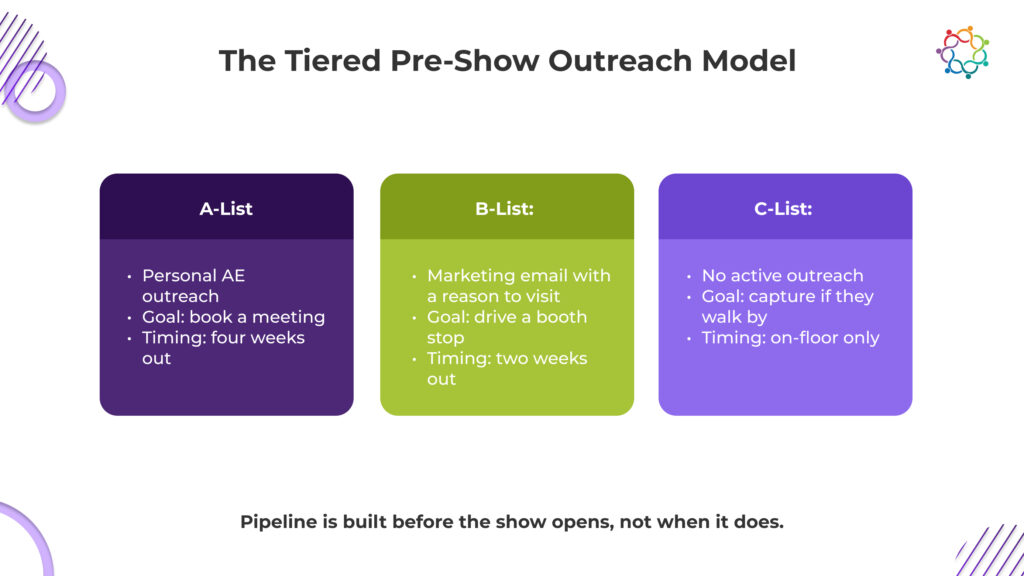
Cross-reference against your CRM: open opportunities, dormant pipeline, named target accounts. Tier the matches:
The outreach sequence.
Four weeks out: AE-led personal email or LinkedIn message to A-list contacts proposing a booth meeting at a specific time slot.
Two weeks out: marketing email to B-list with the booth number, what is worth seeing, and one specific reason to stop by (a demo, exclusive content, a curated gift).
One week out: calendar invites confirmed for A-list meetings. Reminder email to all RSVPs.
The day before: SMS or LinkedIn message with the booth number and exact time.
The full mechanics of running the outreach sequence sit inside Samaaro’s B2B Field Marketing Playbook. The principles below are trade-show-specific.
Common trap: one generic email to the entire database.
Sending the same “come visit booth #B47” blast to every contact in the database produces near-zero conversion. The A-list needs a personal ask. The B-list needs a reason. The C-list does not need an email at all. Pre-show outreach without segmentation is just noise with the show’s name on it.
The booked-meeting target.
The best-run booth programs walk into the show floor with the majority of their high-value time slots already on the calendar. Cold walk-ups are a bonus. Pre-booked meetings are pipeline.

The booth is where capture and qualification happen as a single workflow at compressed speed. Reps do not get a buffer to review later. Tiering happens in real time, before the next visitor walks up.
The qualification rubric.
The rubric is the same one used for field marketing programs, applied at booth speed. The rep makes the tier call before the conversation ends, and the call gets attached to the badge scan inside the lead capture app, never reconciled later.
Qualification questions baked into the conversation: project timing, current stack, decision committee. Three precise discovery questions inside the first 90 seconds: what are you trying to solve right now, what are you currently using, and who else is involved in the decision.
The booth-speed challenge.
A field event gives an AE fifteen to twenty minutes per conversation. A trade show booth gives four to six. The qualification rubric has to work at that compressed pace, which means scripting the discovery questions in advance and rehearsing them with the booth team before doors open.
The badge-scan to CRM workflow.
Mobile lead capture app synced to the CRM in real time. Not paper. Not a fishbowl. Not Excel.
Custom fields pre-built in the CRM for: show name, booth-rep owner, conversation summary, tier, and next step. Hot leads trigger an automatic Slack notification to sales ops the moment they are tagged. Warm leads route to a marketing nurture sequence on capture. Cold leads land in the database with show attribution but no immediate workflow.
This is the operational layer Samaaro is built for: real-time lead capture at booth speed, native CRM sync into Salesforce, HubSpot, Microsoft Dynamics, or Zoho, and the conversation context flowing into the same dashboards the CMO uses for every other channel.
Common trap: scanning every badge that walks past.
Volume is not the best metric. A booth that scans 800 unqualified badges produces less pipeline than a booth that scans 200 qualified ones, because the follow-up team drowns, and the real conversations get buried inside the noise. Quality of conversation, not quantity of scans, is what the on-floor team should be measured on.
The conversation summary.
Two to three sentences captured live or within thirty minutes of the conversation ending. Includes what they are trying to solve, what they currently use, and what the next step is. This single field is what makes the post-show email specific instead of generic. It is what determines whether the follow-up gets opened or deleted.

Post-show is where captured leads either become pipeline or sit in a CSV. The standard post-show framework runs on three tracks: a 48-hour personal AE follow-up for Hot leads, a multi-touch nurture sequence for Warm leads, and show-attribution tagging for Cold leads that return to the marketing database. The same three tracks apply to trade shows, but the volume and data-quality realities of a trade show floor make the motion meaningfully different. What follows is what is unique to running this framework at trade-show scale.
What is different about the trade-show post-show?
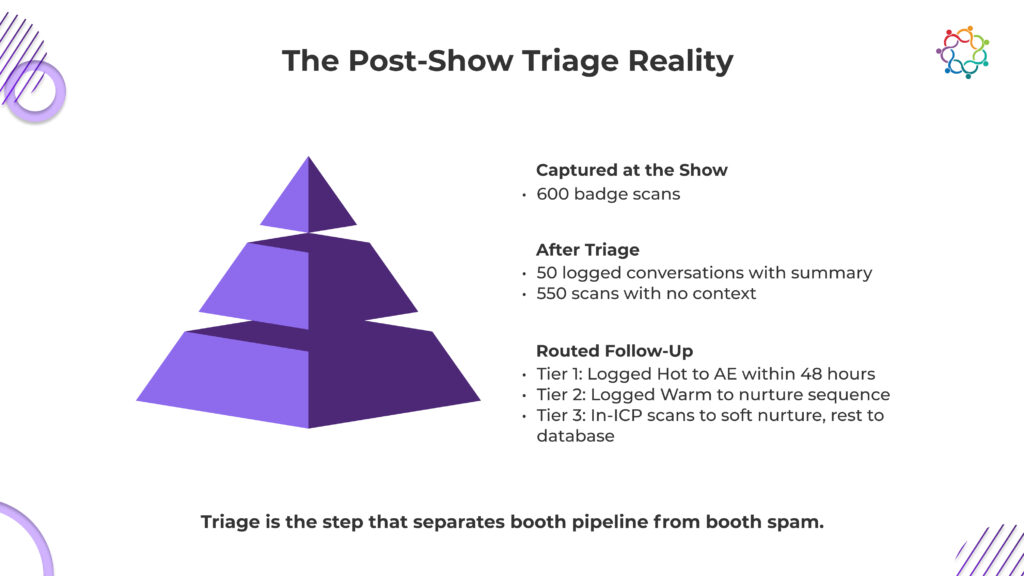
Volume asymmetry. A field event yields 40 conversations, all of them logged. A trade show yields 600 scans, of which maybe 50 have a real conversation summary attached. The other 550 are badges-on-paper with no context.
The triage problem. Before the standard 48-hour rule can run, the team has to separate the fifty logged conversations from the five hundred and fifty that are not. The first post-show day is spent on triage, not on emails.
Lower-quality scan data. Badge data alone (name, company, title, email) without a conversation summary produces a generic follow-up that converts poorly. The fix is a one-pass enrichment within twenty-four hours: booth-rep attribution where possible, ICP scoring everywhere else.
Trade-show-specific segmentation rules.
Common trap: one email to all six hundred contacts.
Generic “thanks for visiting our booth” blasts sent to unsegmented lists produce an unsubscribe spike, not pipeline. The triage step is what separates the booth pipeline from the booth spam.

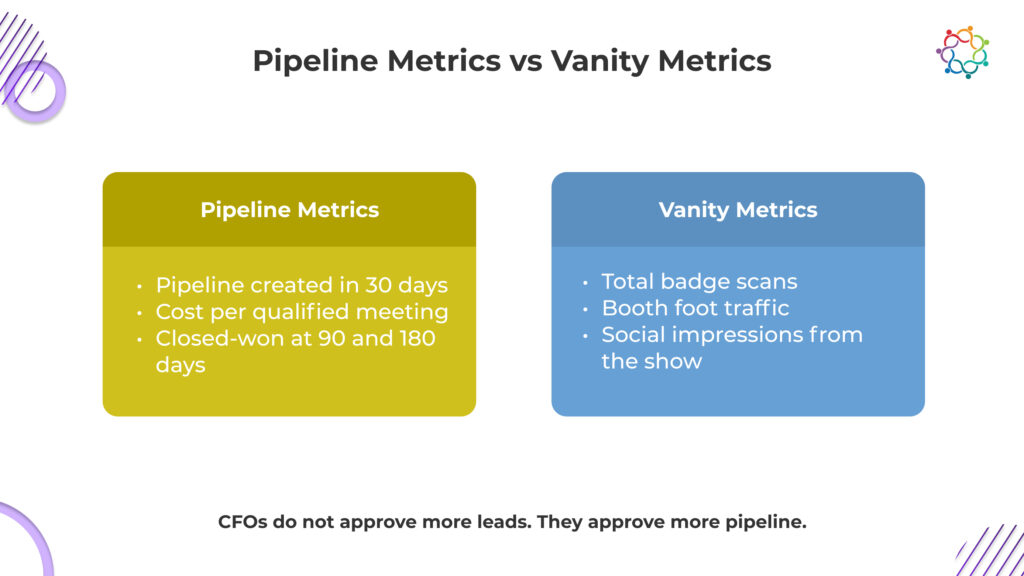
Trade show ROI reporting is what defends the line item in next year’s budget conversation. CFOs do not approve more leads. They approve more pipeline.
The metrics that matter.
The metrics that do not matter.
Common trap: reporting “leads generated” without pipeline attribution.
Lead counts are how booth investments lose budget defense the next year. The number on the slide should be opportunities created, pipeline value, and revenue attribution, not the raw scan count. A booth program that produced 600 scans and no opportunities is a budget cut. A booth program that produced 200 scans and twelve opportunities is a budget increase.
The reporting cadence.
All metrics are reported in the same dashboard that the CMO sees for every other channel. Trade show spend has to defend itself on the same terms as paid and content, or it does not survive the next planning cycle.
A trade show booth is a system. Pre-show builds the shortlist. On-floor captures and qualifies at compressed speed. Post-show triages, segments, and converts. The booth is the easiest part to spend money on and the hardest part to get right. The toolkit below is what gets it right.
Everything above, expanded into the full Trade Show Booth Strategy Toolkit PDF: the 3-phase system, pre-show outreach sequence, A/B/C list worksheet, booth design principles, on-floor qualification rubric, the print-ready 30-point booth checklist, the Booth-Day Kit, post-show triage workflow, and ROI reporting skeleton. [Download the Toolkit →] First name, work email, company size, role.
If your team runs more than three trade shows a year, the post-show triage tends to eat the window where the conversation is still warm. Samaaro is built for the capture-to-CRM workflow that closes it.

Samaaro is an AI-powered event marketing platform that enables marketing teams to turn events into a measurable growth channel by planning, promoting, executing, and measuring their business impact.
Location


© 2026 — Samaaro. All Rights Reserved.