Samaaro + Your CRM: Zero Integration Fee for Annual Sign-Ups Until 30 June, 2025
- 00Days
- 00Hrs
- 00Min

Key Takeaways (TL;DR)
1
2
3
→
Bottom Line:
Every attendee can get the version of attention that used to be reserved for a handful of VIPs.
Two Thousand People, One Feeling
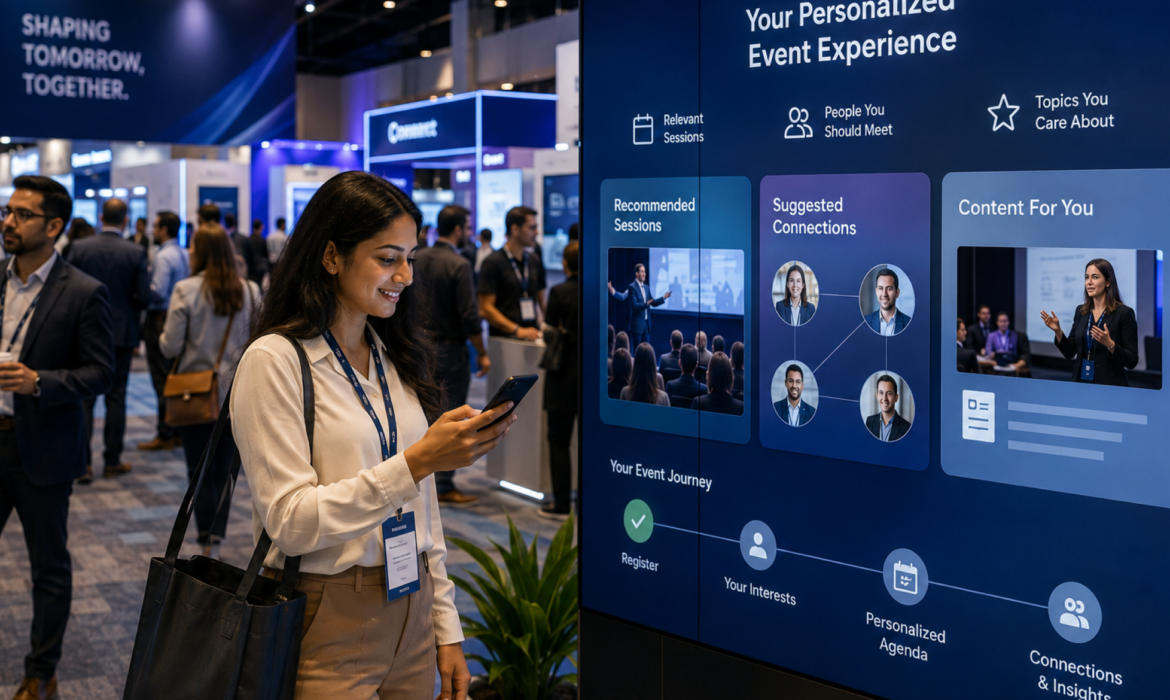
Two thousand people walk in, and each one should feel like the day was planned around them. AI is finally making that possible at that size.
The agenda someone sees, the people they get introduced to, the content that reaches them before and after, the follow-up that lands a week later, each of these can now shape around the individual instead of the whole room.
For years, personalization meant a name merged into an email. Now it means the experience itself changing shape around each person, at a size that used to make that impossible without an army of staff. That’s a real shift, and it’s worth looking at closely.
What follows is the specific ways AI does this across the attendee journey, one at a time, with what each looks like in practice.
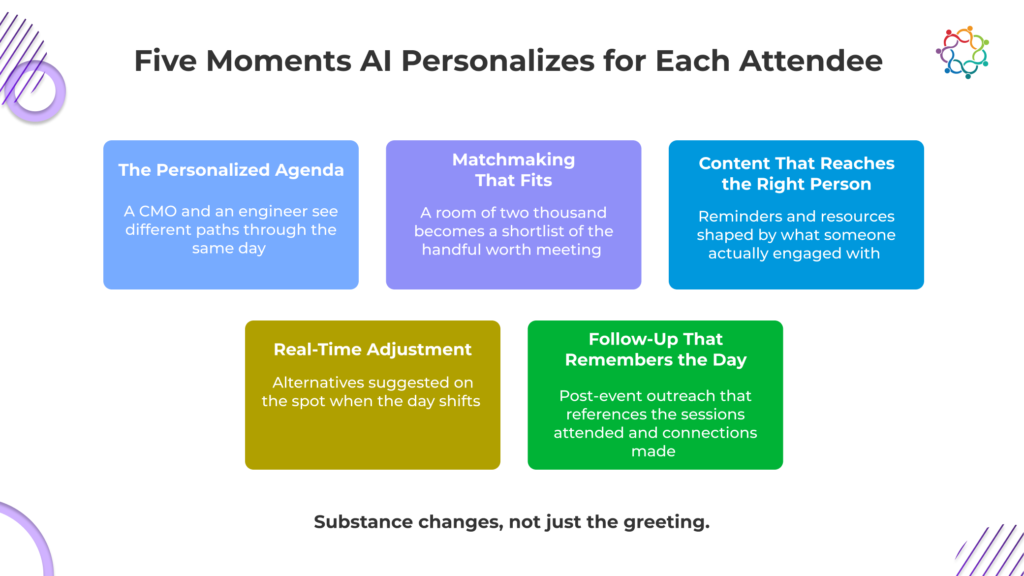
AI shows up in a handful of specific moments across the day. Here’s where each one changes what an attendee experiences.
The personalized agenda.
Instead of one schedule for everyone, AI builds a suggested agenda per attendee from their stated interests and role, so a CMO and a product engineer at the same conference see two different paths through the same day. The engineer’s app surfaces the three technical deep-dives; the CMO’s leads with growth and forecasting. That single change is often the first thing an attendee notices, before a single session has started. This is the difference between a smart, personalized agenda and a fifty-session PDF everyone has to sort through alone.
Matchmaking that fits.
AI reads role, industry, and interest to suggest who someone should meet, turning a room of two thousand strangers into a short, relevant list of the handful worth a conversation. An investor gets pointed toward four fintech founders who match their thesis, instead of a badge-scanning free-for-all and a stack of cards they’ll never follow up on.
Content that reaches the right person.
Session reminders, resource recommendations, and follow-up material get tailored to what someone engaged with, rather than blasted identically to the full list. The deck from the compliance session goes to the people who sat in it, and the “sorry we missed you” goes only to the people who missed it, not the whole database.
Real-time adjustment during the day.
If someone’s chosen sessions run long or a room fills up, AI can suggest an alternative on the spot, personalization that responds to what’s happening on the day, not just what was planned weeks earlier. The keynote hall hits capacity, and a hundred people get a quiet nudge toward the overflow room with the same talk streaming, before frustration sets in.
Follow-up that remembers the day.
Post-event outreach that references the sessions someone attended and the connections they made, rather than a generic thank-you that reads the same for all two thousand recipients. “You asked about SOC 2 in the security track and met our solutions lead” lands in a way that “thanks for coming” never will, because it proves someone was paying attention.
There’s a shortcut worth avoiding: personalizing only the greeting. A first name dropped into an otherwise identical message, while the agenda, the recommendations, and the follow-up stay the same for everyone, is a mail merge wearing a costume. Every moment above changes the substance of the experience, which is the part an attendee feels. The tell is simple: if you deleted the first name, would the message still read as written for that person? If not, it’s the costume.
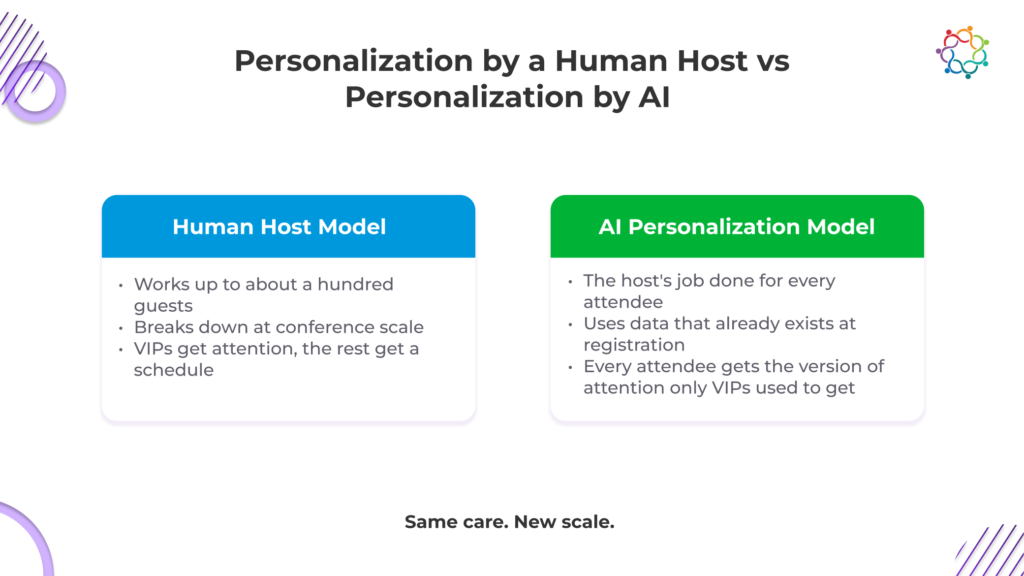
Personalizing an event isn’t new. A host at a small dinner or an intimate roundtable has always done it, tracking who’s who, remembering what each guest cares about and making the right introductions. That approach just breaks down completely past a hundred people, let alone two thousand.
What AI changes is the scale, not the idea. It does the tracking and matching a good host used to do from memory, across a room no team could manage by hand, and without adding headcount to do it. This is the same move toward predictive, AI-assisted personalization that has been reshaping event marketing across the whole lifecycle.
It’s worth being honest about the limit. This isn’t magic. It works because the underlying data, registration details, stated interests, and session choices already exist, and AI is doing the matching rather than inventing the insight from nothing. Feed it nothing and it personalizes nothing. The teams that get the most from it are the ones capturing clean data at registration and in the app, so the AI has something real to work with rather than guessing from a half-empty profile.
Which is the real change? Personalizing for two thousand people used to mean picking a few VIPs to treat specially. Now it can mean every attendee gets a version of that same attention, without anyone drawing up a VIP list at all.
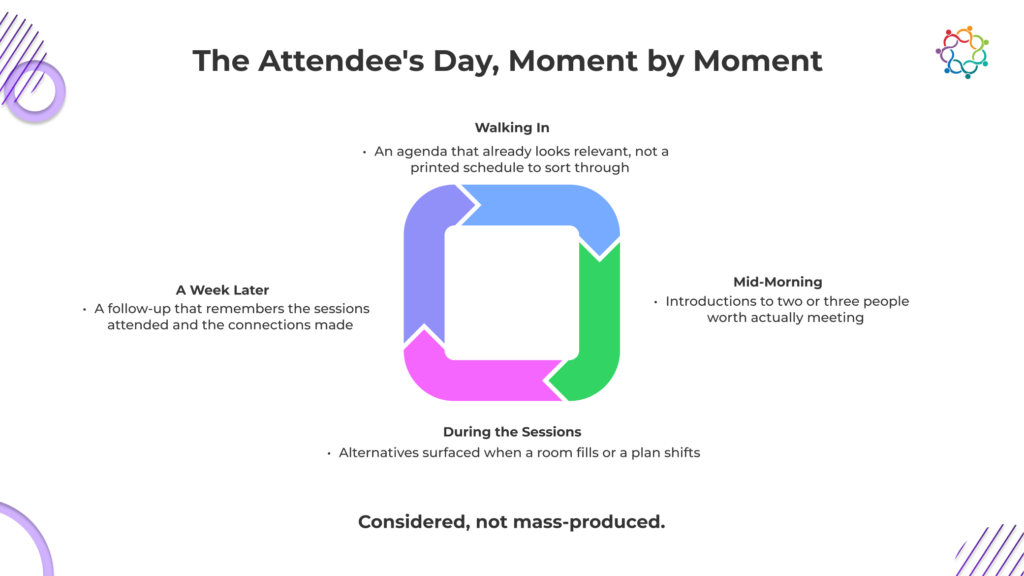
Strip away the mechanics and think about the day from a seat in the room.
You walk in and your agenda already looks relevant, not a generic printed schedule with fifty sessions to sort through on your own. Midway through, you get introduced to two or three people worth meeting, instead of wandering a hall of two thousand strangers hoping to fall into a useful conversation.
The software suggests an afternoon session based on a poll you completed in the morning, and when the room you selected fills up, a notice directs you to the better-suited session next door in time to attend. At a booth, the interaction begins three steps in rather than at hello because the person scanning your badge already knows you attended the in-depth discussion of their product. And instead of a generic thank-you that could have been sent to anyone, a follow-up arrives a week later that distinctly recalls the sessions you attended and who you met.
None of these moments is dramatic on its own. Together, they add up to an event that felt considered rather than mass-produced, even at a size where mass production used to be the only option. That feeling, that someone thought about your day in particular, is what turns a one-time attendee into someone who clears their calendar for next year.
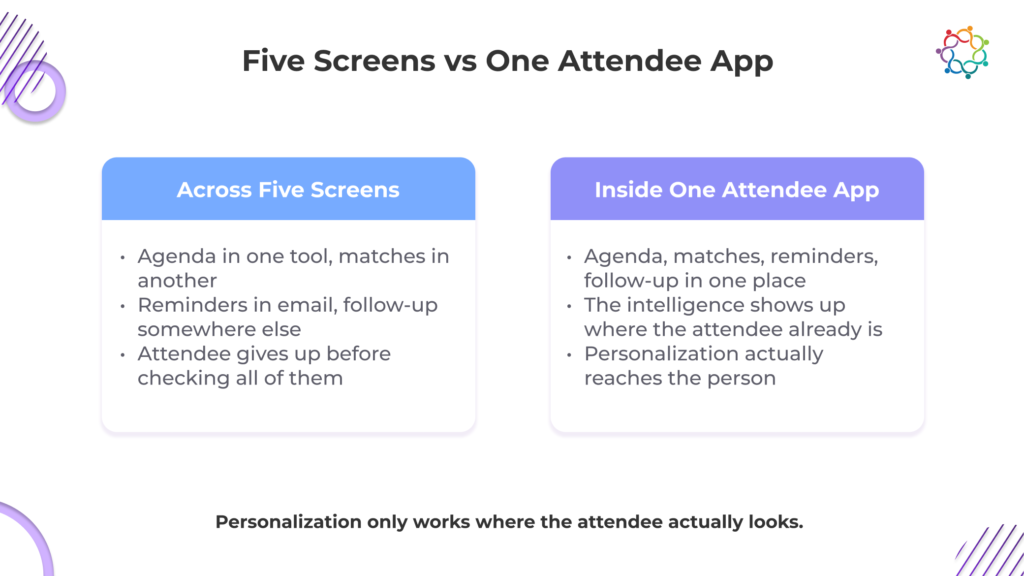
Almost every moment above happens in the same place, which is worth being concrete about.
The intelligence matters only when it shows up where the attendee is already looking. That’s what turns a clever algorithm into a better afternoon, and it’s why the app, not the model, is where this lands for the person in the room, and why the strongest setups build the day around a single event-app hub rather than a patchwork of tools. The best version of it is close to invisible: the attendee never thinks about the AI at all, and just notices, all day, that the event seems to know what they came for.
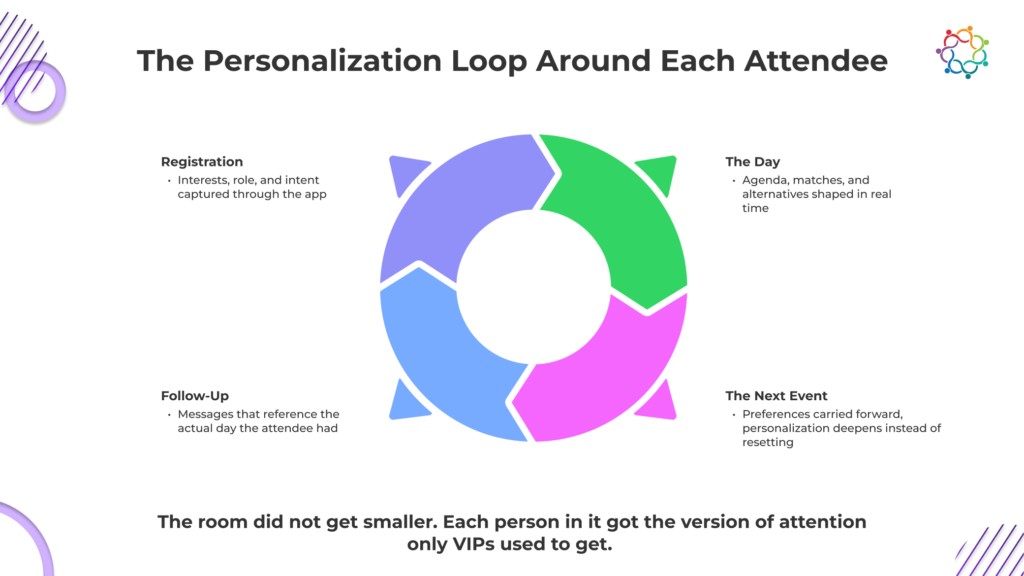
The agenda, the matches, the content, the follow-up, all shaped around the individual instead of the room. That’s what AI makes possible now, a capability that simply didn’t exist at this size before.
A great event with two thousand people makes every single one of them feel like the person it was planned for. AI is what finally delivers that to the whole room at once, without the room having to get smaller. The technology is impressive; the feeling it creates is the point. A room can be enormous and still feel personal, as long as every person in it is treated like the one who matters most.
Want to see an event that seems to know what each person came for? See how it comes together.