Samaaro + Your CRM: Zero Integration Fee for Annual Sign-Ups Until 30 June, 2025
- 00Days
- 00Hrs
- 00Min

In the field of event marketing, “post-event analysis” and “post-event evaluation” are often misconstrued as having the same meaning. This blend of two words often means reports that are very data heavy (lots of numeric results) but are also light on insights that can be turned into actions (i.e., there is a lot of detail but not much meaning). In the end, Leadership has a dashboard of data and little idea as what actions they should follow through post-event.
Analysis and evaluation represent two different but related steps in the overall event performance measurement process. One gives the facts and the other the tactical direction as a follow up. By understanding this important difference, you can transform your post-event reporting from a mere summary of what happened to an actionable approach for continuous improvement.
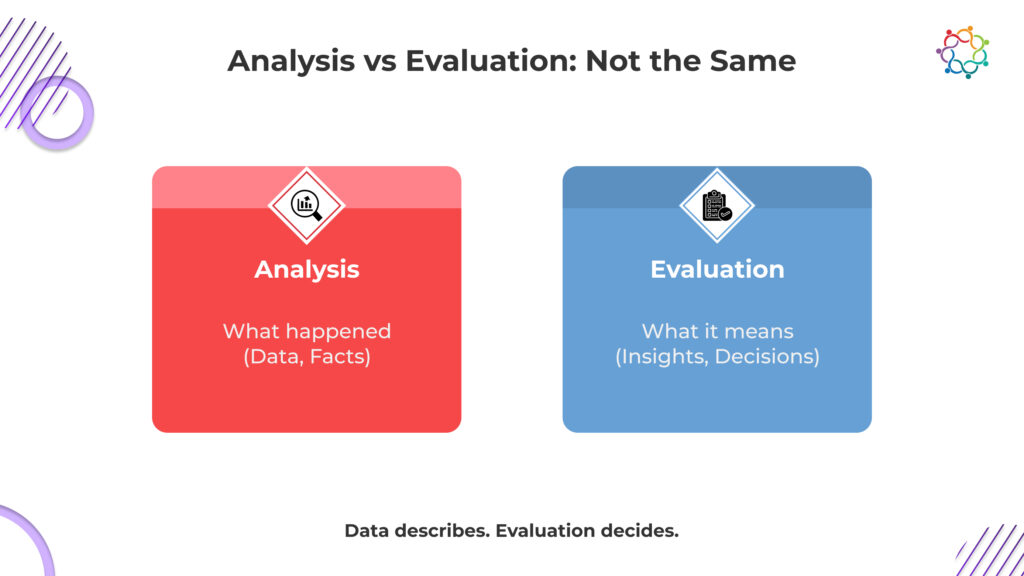
Post-event analysis is when you examine and compile the raw data on your performance. It is a factual and objective examination of what action was taken and the resulting outcomes from an event. This is the phase where you will obtain all relevant measurable outputs and put them together in a report.
Post-event evaluation is the step in the process where you take the data from your analysis and evaluate it against your prior expectations, goals, or targets (whatever you called them). It is the evaluative part of the process where you will draw conclusions and provide an actionable level of recommendations based on the data and information you collected; it takes raw data and then provides meaning and direction.

The difference between these two processes can be summarized in a powerful but simple way:
Think about it this way: an event reporting framework begins with analysis and ends with evaluation.
For example;
Analysis gives you the diagnosis; evaluation gives you the treatment plan. You can’t have a decent treatment plan without a proper diagnosis, and a diagnosis without a treatment plan is useless.

Want to see how this would work for you?
See how Samaaro generates analysis dashboards and evaluation reports from the same data.
Book a tailored walkthrough →The performance measurement for events is not fully complete without both evaluation and analysis.
Combining evaluation and analysis creates a true feedback loop. The analysis provides the evidence and the evaluation uses this evidence to support decisions in the event strategy and provides an organizational justification for celebrating event success.
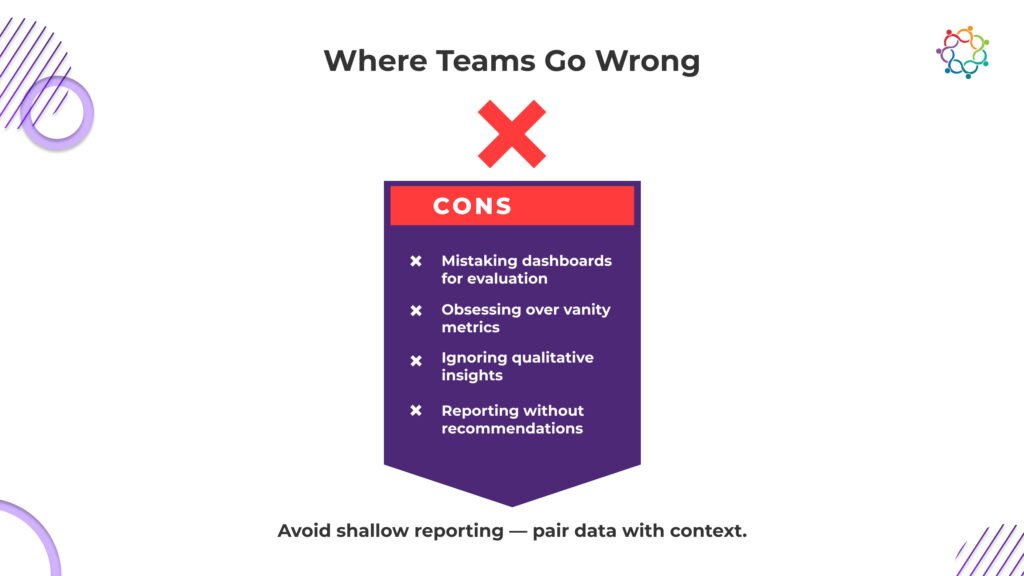
Common Mistakes Teams Make

Even when teams are clear on the difference, they still fail to synthesize complete evaluation components. The most common observations include:

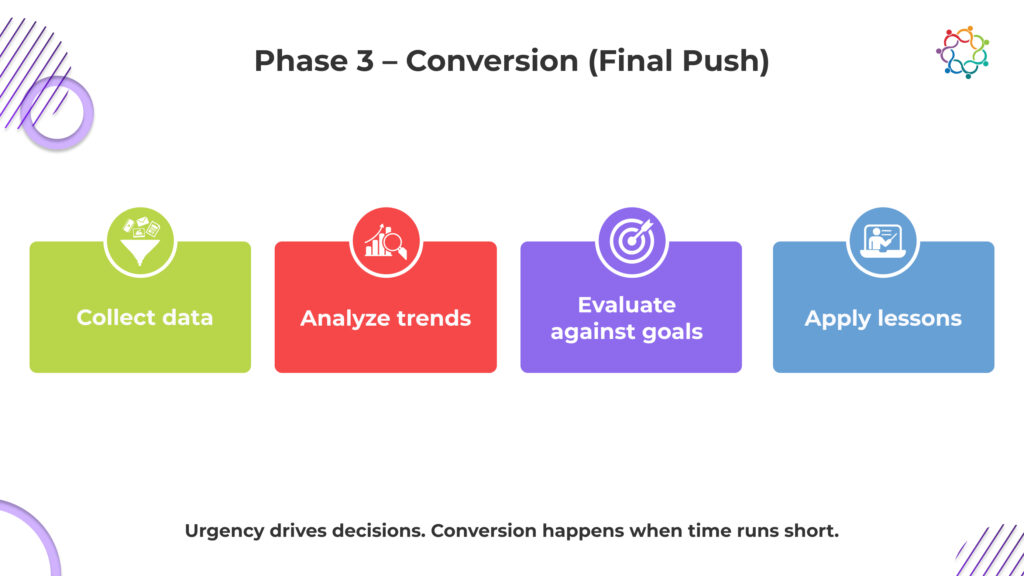
Here is a simple four-step model to assist your team in growing their capacity to better understand best practice for event analysis and post-event evaluations:
Samaaro is designed to effectively connect analysis to evaluation, allowing you to measure your event results in the best way possible.
At the end of the day, the numbers provide a narrative, but evaluation tells that narrative’s moral. The best event teams do not end with “this happened,” but rather ask, “what does this mean, and what should we do now?” Analysis and evaluation help provide unique leverage not only to demonstrate the value of your event but also to improve every event you host.
Want to master analysis and evaluation? Download our Post-Event Evaluation white paper or have a look at how Samaaro works both methods together to show a clear path from analysis to evaluation.
Post-event analysis is the data-collection step: pulling raw numbers like registrations, attendance rate, CTR, and NPS into one report. Post-event evaluation is the interpretive step: comparing those numbers against your original goals and deciding what they mean and what to change. Analysis tells you what happened. Evaluation tells you why and what to do next. You need both, but most teams stop at analysis.
Post-event evaluation is important because it turns event data into strategy. Without evaluation, leadership sees a dashboard of numbers but doesn’t know whether to invest in another event, change the format, or shift budget elsewhere. Evaluation answers the questions that matter: did the right audience attend, did the event move pipeline, and what should we do differently next time.
A complete post-event analysis should include: total registrations, attendance rate, no-show rate, session attendance, engagement scores (polls, Q&A, networking), NPS and satisfaction ratings, leads captured, leads qualified, pipeline influenced, revenue attributed, social media reach, and cost per registration. Group them into three buckets: reach, engagement, and business impact. The third bucket is the one executives care about most.
Post-event evaluation should run in three phases: immediately after the event (operational debrief with the team, within 48 hours), short-term (within 2 weeks, once survey responses and engagement data are in), and long-term (90 days post-event, once pipeline and revenue attribution is clear). One evaluation right after the event misses the strategic outcomes that take weeks to surface.
Post-event analysis connects to ROI when attendance and engagement data are linked to CRM pipeline. The chain is: registrations to attendance, attendance to engagement, engagement to lead quality, lead quality to opportunities, opportunities to closed revenue. If your analysis stops at ‘how many people came’, ROI stays a guess. If it tracks every attendee through to pipeline, ROI becomes a number you can defend in a board meeting.
The key outcomes of a strong post-event review are: a clear verdict on whether the event hit its goals, a documented list of what worked and what didn’t, specific actions for the next event, ROI defended with attribution data, and institutional knowledge captured so future teams don’t start from scratch. A weak review produces a PDF nobody reads. A strong one becomes the playbook for the next event.

Samaaro is an AI-powered event marketing platform that enables marketing teams to turn events into a measurable growth channel by planning, promoting, executing, and measuring their business impact.
Location


© 2026 — Samaaro. All Rights Reserved.