Samaaro + Your CRM: Zero Integration Fee for Annual Sign-Ups Until 30 June, 2025
- 00Days
- 00Hrs
- 00Min

You remember maybe two things from most events you attend.
One of them is usually a speaker.
Good speakers make your event. Bad speakers kill it. There’s no in-between.
The problem is finding them in the first place.
They’re not in a database labeled “great speakers.” They’re scattered across LinkedIn, doing their jobs, building their reputations, occasionally speaking at events. Most of them don’t think of themselves as professional speakers. But they should be the ones you want.
LinkedIn has 900 million people. Your next great speaker is in there. You just need to know how to find them.
Vague speaker searches lead to mediocre speakers.
If your event is about AI, they need to actually work in AI. Not write about it. Not have opinions. Actually built products. Shipped features. Solved real problems.
Credibility comes from doing the work, not talking about it.
Expert doesn’t equal great speaker.
Some brilliant people freeze in front of crowds. Some talk too fast. Some go off on tangents.
Look for people with speaking history. Conference talks. Webinars. Presentations to teams.
They know how to manage a room and keep an audience engaged.
Different events need different speakers.
Keynote energy. Panel discussion expertise. Workshop facilitation. Story-telling skill. Interactive engagement.
Figure out which style you need first. Then search for people who do that.
Generic speakers don’t work.
Your audience is specific humans with specific problems. They need speakers who understand their world, their challenges, their industry.
A speaker who’s been in healthcare for 20 years hits different when you’re running a healthcare event.
LinkedIn’s search is powerful when you know how to use it. Most people don’t.
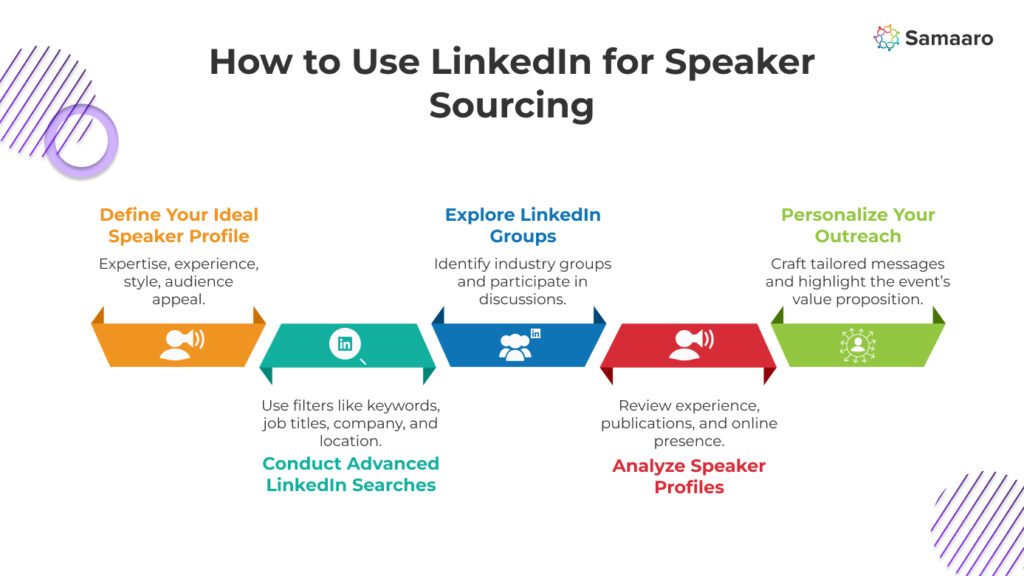
Don’t search “speaker.” That’s too broad. You’ll get noise.
Search combinations like:
“AI researcher” AND “keynote” AND “healthcare”
“SaaS founder” AND “panel discussion” AND “B2B growth”
“Product director” AND “scaling” AND “conference”
Specificity filters out the weak results fast.
Boolean search uses AND, OR, NOT to combine terms. It’s the difference between finding 50,000 people and finding the right 50.
Here’s how it works:
Example 1 (AI in Product):
(“artificial intelligence” OR “machine learning”) AND (“product lead” OR “VP product”) AND “conference” AND “San Francisco”
This finds product leaders who know AI, have spoken at conferences, and are in SF.
Example 2 (Fintech):
(“fintech” OR “digital banking”) AND (“C-level” OR “chief” OR “executive”) AND (“keynote” OR “speaker”)
This finds executives in fintech with speaking experience.
Example 3 (Eliminate False Positives):
“blockchain” AND “conference” AND NOT “student” AND NOT “academy” AND NOT “university”
This filters out student organizations and keeps real professionals.
While searching, narrow down by:
These filters cut your list from thousands to dozens fast.
LinkedIn groups are conversations. Conversations reveal who actually knows their stuff.
Search for groups like:
“Healthcare Innovation Leaders”
“SaaS Product Managers”
“Marketing Operations Professionals”
“Startup Founders”
Join the ones that match your event topic.
Some people lurk. Some people are always commenting. Always sharing insights. Always asking smart questions.
Those people are your targets. They’re engaged with the topic. Probably good speakers.
When you find someone interesting in a group, go to their profile.
Look at their Featured section. Videos of them speaking?
Look at their Publications. Articles they’ve written?
Look at Recommendations. What do people say about working with them?
This tells you if they’re actually good or just noise.
The search is just half the battle. The outreach is the other half.

Blast messaging doesn’t work. People can spot a template from a mile away.Write one real message to each person. Specific. Personal. Like you’re actually talking to them.
Example:
“Hey [Name],
I’ve been reading your posts on [specific topic]. Your piece on [specific insight] nailed something we’ve been wrestling with.
We’re hosting [Event Name] in [month] with about [number] people. Mostly [type of people]. A lot of CTOs from healthcare companies.
I think your perspective on [topic] would be perfect for this crowd. Would you be interested in leading a panel?
Let me know if you want to chat about it.
[Your name]”
Notice: Short. Specific. Shows you actually know their work.
Why should they care? They’re busy. They have a packed calendar.
Tell them what’s in it for them:
Don’t be coy about logistics.
Some speakers want fees. Some want travel covered. Some want special recording rights.
Just ask. And tell them what you can actually do.
“We cover flights and hotels. You can record and use the video. The audience is 500+ CTOs from Fortune 500 companies. Interested in talking?”
That’s clear. That works.
Lots of people don’t respond to the first message.
Wait a week. Send a simple follow-up.
“Hey [Name], wanted to follow up on my earlier message about [Event]. We’d love to have you. Any interest?”
Short. Not pushy. Just persistent.
Spreadsheet. CRM. Doesn’t matter what. But track:

One-off speakers are fine. But building a roster of great speakers you call year after year? That’s the real win.
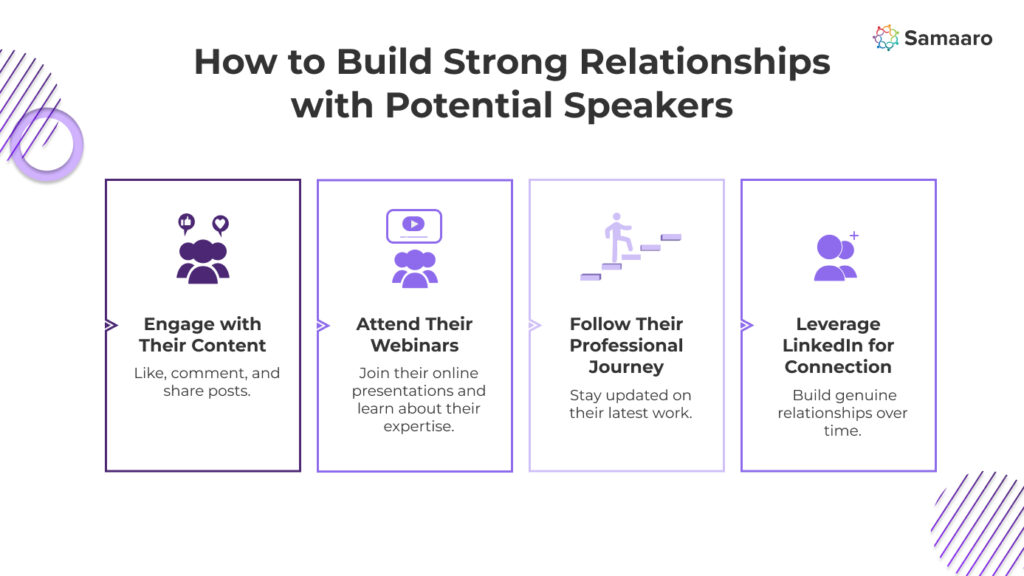
Follow them. Read their posts. Comment on their articles.
Not generic comments. Thoughtful ones.
“Loved your take on X. Here’s how we’ve approached it…”
Stay on their radar. Show genuine interest in what they’re doing.
If they’re speaking at a webinar. Or leading a workshop. Or presenting at a conference.
Go. Watch. Engage in Q&A.
Then reach out: “Was at your talk on [topic]. The thing you said about [insight] was exactly what our team needed.”
People remember people who actually show up.
Once they speak at your event, stay connected.
Send them the recording. Share feedback from attendees. Invite them back next year.
Turn it into a relationship. Not a one-time transaction.

Want to see how this would work for you?
See how Samaaro handles speaker discovery, briefing, and on-event coordination, end to end.
Book a tailored walkthrough →Start your search 4-6 months before your event.
Good speakers book up fast. The big names are booked years out.
No-shows drop because speakers are actually invested.
Your speakers are better because you picked based on expertise and fit, not availability.
Your attendees get more out of it because they’re hearing from people who actually know the space.
Your brand reputation improves because your speakers are good.
First time you do this, it’s hard. You’re learning the system. You’re writing 50 personalized messages. You’re managing conversations.
Second time? You’re faster. You know what works. You have go-to people.
Third time? You have a process. You have a network. You’re booking speakers in weeks, not months.
LinkedIn is full of potential speakers. The best ones aren’t on speaker directories. They’re in your target industry doing actual work.
You just have to know how to find them and ask.
Ready to take your speaker sourcing to the next level? Platforms like Samaaro can help streamline the process, from personalized outreach to managing speaker relationships. Book a demo or start your free trial to see how we can support your event planning journey!
Q: What Boolean search finds AI speakers in healthcare?
A: Try (“artificial intelligence” OR “machine learning”) AND (“healthcare” OR “medical” OR “pharma”) AND (“speaker” OR “keynote” OR “conference”). This finds people who know AI, work in healthcare, and have speaking experience.
Q: How do I know if someone’s actually a good speaker before reaching out?
A: Check for videos in their Featured section. Read comments on their posts—do people engage or is it crickets? Look for YouTube videos of them speaking. Hunt for recommendations that mention presentation skills. You won’t know 100%, but you can avoid obvious duds.
Q: Should I reach out to someone with zero speaking experience?
A: Only if they’re a real expert and seem comfortable on LinkedIn. If they post regularly, get engagement, respond to comments, they might be fine. But if you’re unsure, stick with people who’ve spoken before. Don’t gamble on a big event.
Q: What do I do if they say no?
A: Say thanks and move on. No offense taken. Some people don’t speak. Some are booked. Some just prefer their day job. There are 900 million other people on LinkedIn.
Q: How many speakers do I need to contact to land one?
A: If you’re specific and writing real messages? Maybe 1 in 3 or 1 in 4 say yes. If you’re blasting form letters to random people? Way worse. If you’re in a tough niche? Even worse. Budget to contact way more people than you actually need.

Samaaro is an AI-powered event marketing platform that enables marketing teams to turn events into a measurable growth channel by planning, promoting, executing, and measuring their business impact.
Location


© 2026 — Samaaro. All Rights Reserved.