Samaaro + Your CRM: Zero Integration Fee for Annual Sign-Ups Until 30 June, 2025
- 00Days
- 00Hrs
- 00Min


Key Takeaways (TL;DR)
1
2
3
→
Bottom Line:
Events drive visibility, but without sustained validation and alignment, interest rarely converts into actual product usage.
B2B tech events aren’t underperforming. They’re doing exactly what they’re designed to do, generating attention, engagement, and product curiosity at scale. The problem is what happens after.
Companies build high-impact spaces where a product can be shown off clearly at product launches, developer events, and SaaS user conferences. People see the benefits, talk about them, and leave believing the product is genuinely worth using. From the event’s own perspective, that’s a success.
Product metrics tell a different story. Trials don’t rise proportionally. Onboarding stays flat. That gap isn’t accidental. It exists because interest keeps getting mistaken for adoption. This piece looks at why B2B tech events consistently generate product interest without translating it into actual usage.
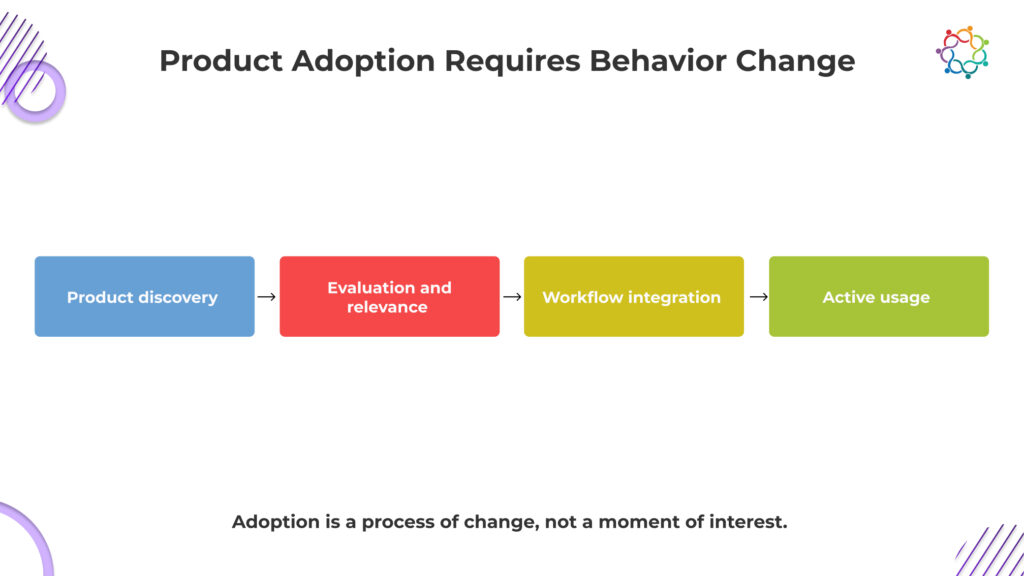
Product adoption isn’t a continuation of interest. It’s a shift in behavior that introduces friction, risk, and internal dependency, and that’s exactly where most assumptions about event impact fall apart.
A critical gap sits in who attends versus who decides. The person exploring a product at a developer event is often not the one responsible for implementation or budget. Even genuine interest still has to survive translation into internal alignment across teams that were never part of the original experience. Engineering checks feasibility. IT checks risk. Leadership checks long-term value. What felt simple during the demo turns layered and uncertain the moment it has to clear all three.
That’s why adoption slows down. Interest is immediate. Adoption gets negotiated, validated, and often delayed long enough to lose whatever momentum it started with.
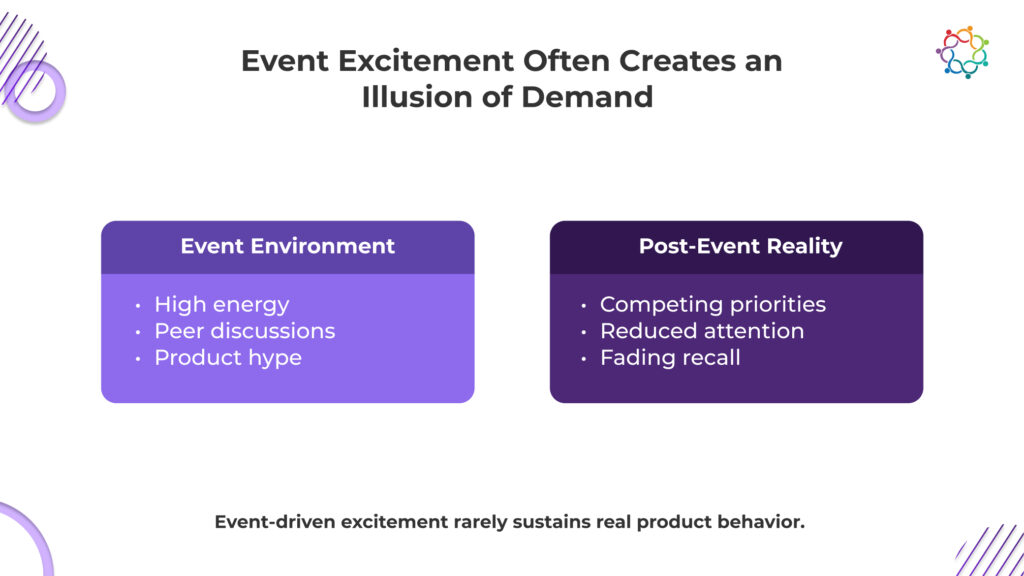
Event environments don’t just amplify interest, they manufacture confidence around demand that’s never actually been tested. Inside a B2B tech event, attendees operate in a low-risk, high-stimulation setting where curiosity is encouraged and commitment isn’t required. That behavior is conditional, and it exists only inside the event’s own context. The moment that context disappears, the signal disappears with it.
The deeper problem isn’t that interest fades, it’s that teams treat this temporary enthusiasm as proof of real market pull. Pipeline assumptions get built on it. Forecasts shift because of it. This demand has never actually faced friction, never run into a budget freeze, never had to compete against a tool a team already relies on. It isn’t early demand. It’s noise that happens to sound like demand.
Until interest survives outside the room it was created in, it shouldn’t get treated as proof of anything.
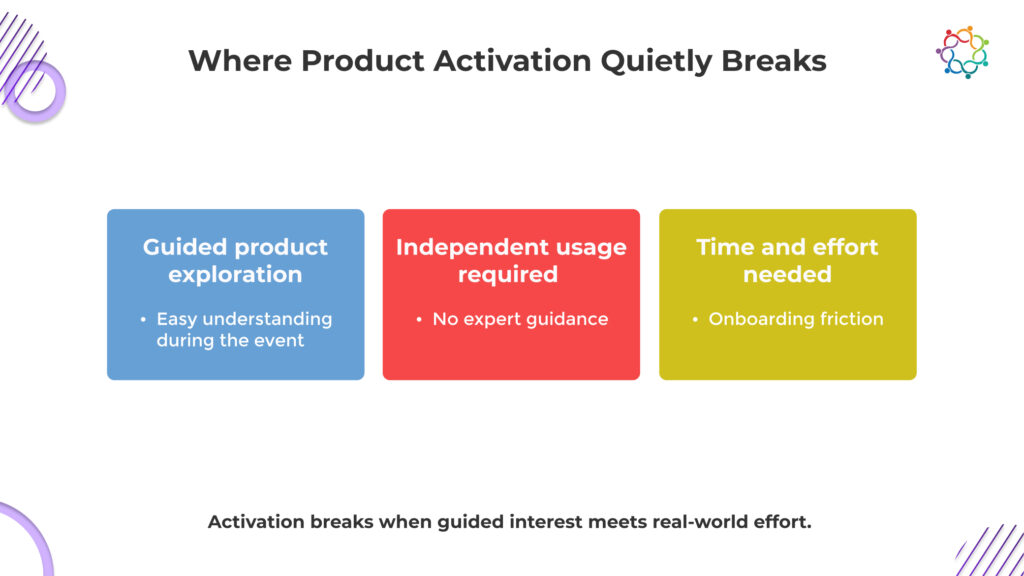
The breakdown doesn’t happen at the point of interest. It happens in the transition from a controlled experience to an uncontrolled one, and that’s exactly where momentum starts to come apart.
4.1 Product Exploration Happens in the Event Environment
During an event, the product shows up in its most optimized form, guided interactions, contextualized features, complexity deliberately stripped out. Once that environment disappears, a user faces the product alone. What felt intuitive in a live demo now requires independent navigation, and without guidance, uncertainty creeps in before real usage ever gets a chance to start.
4.2 Adoption Requires Organizational Alignment
Individual interest is rarely enough in a B2B environment. Most products need validation across teams that were never in the room for the event itself. Engineering evaluates feasibility, IT examines risk, leadership questions value, and each layer adds friction the event never exposed. Initial momentum quietly wears down as the product moves through scrutiny it was never actually tested against.
4.3 Activation Competes With Operational Reality
Even where alignment is possible, activation still depends on available time and priority. Starting a trial takes focused effort that competes directly with whatever’s already on someone’s plate. Without an immediate reason to act, the product gets deprioritized, and that’s where most activation attempts quietly stall out.
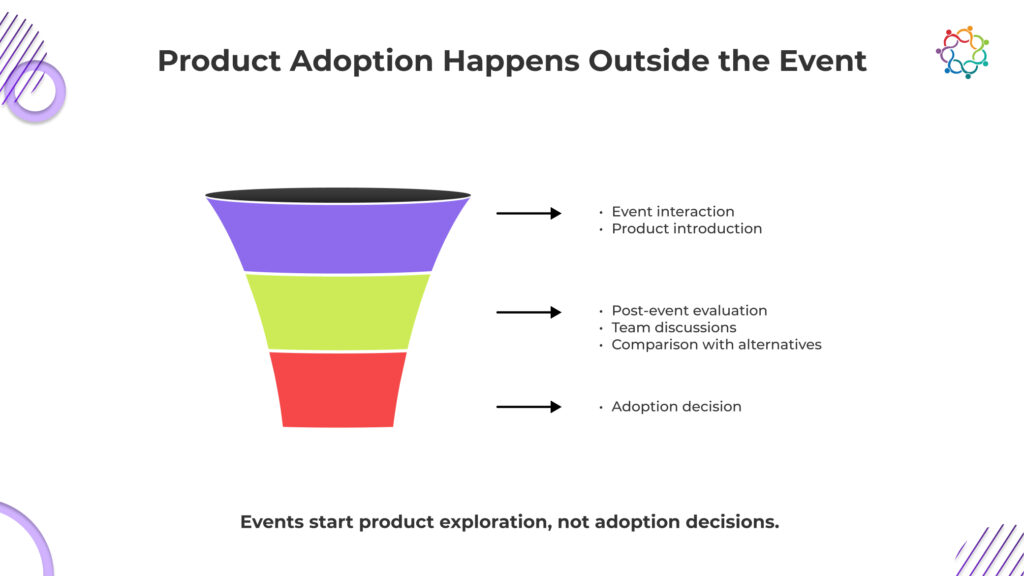
The assumption that adoption gets decided during the event itself is the core mistake here. Events create exposure, not commitment. The real decision-making starts once attendees are back in their own environment, evaluating the product under actual working conditions.
In that phase, someone revisits the product with no guide standing next to them, comparing it against whatever they already use and judging whether it genuinely fits their workflow. That evaluation is slower and far more critical than anything that happened on the show floor, and it’s exactly where most event-driven interest quietly disappears. The product now has to compete against entrenched tools, existing processes, and plain organizational inertia.
This part is genuinely hard to see. Engagement during the event gets tracked closely, badge scans, session attendance, booth visits. What happens afterward, in someone’s actual inbox and calendar, almost never gets measured with the same rigor. That gap is exactly why engagement data can look strong while adoption stays flat. A clean view of what actually counts as ROI has to include this post-event window, not stop at the exit survey.
The problem isn’t that engagement signals are weak. It’s that they’re easy to collect and even easier to believe. Demo interactions, session attendance, product discussions, all of it creates a visible layer of activity that feels like real progress.
Teams keep misreading these signals because they’re available immediately, while genuine adoption data arrives late, fragmented, and hard to attribute cleanly. There’s a structural incentive at play too. Marketing success usually gets measured by participation and interaction, not downstream usage, which quietly biases the whole system toward signals that report quickly and look good. Engagement gets treated as a leading indicator of adoption even without consistent evidence that the two are actually connected. The result is a system optimized for what’s visible rather than what’s real.
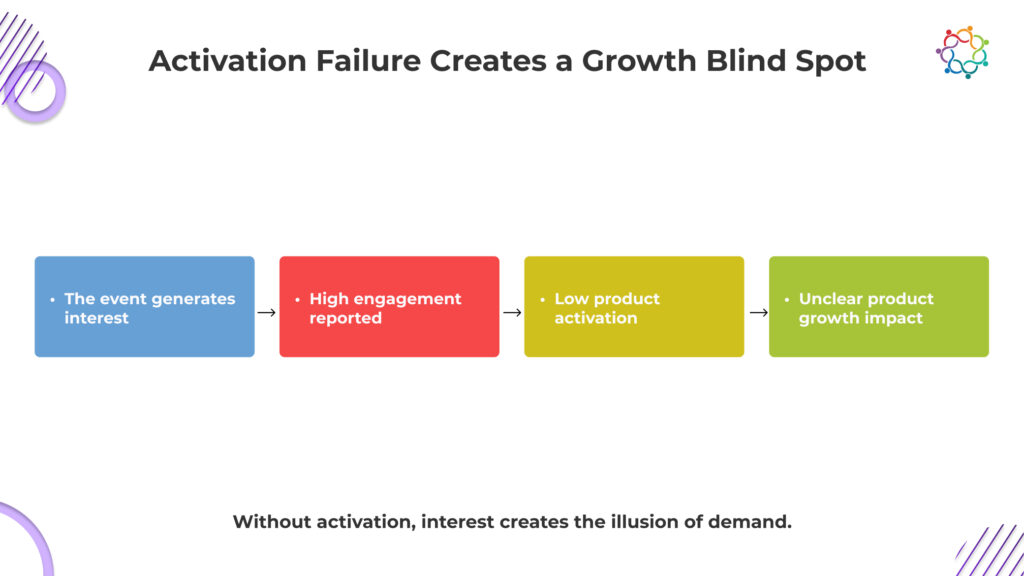
If interest doesn’t translate into usage, then the fault is one of misperception, not visibility. Teams think the growth signals are positive, but the actual product behavior is another story.
Warped Demand Signals
Event engagement looks like demand; without activation behind it, that appearance is unconfirmed. Teams mistake visibility for traction, making decisions on perception instead of what the usage data truly shows.
Inflated CAC with No Real Users
These events cost real money, and when adoption doesn’t follow, client acquisition cost slowly rises. What keeps that spend honest is a clear event budget that is related to real utilization, not just registrations.
Incorrect GTM Decisions
Strong engagement numbers lead teams to put on additional events. The go-to-market approach favors visibility channels that do not drive sustainable product growth, without signal-to-adoption linkage.
Internal Reporting Disconnect
Marketing reports success through engagement numbers while product teams see stagnant usage sitting right next to it. That disconnect creates real confusion at the leadership level about what’s actually driving performance.
None of this is accidental. It gets reinforced every time interest gets measured without any accountability to adoption.
Event momentum feels powerful, but it’s structurally short-lived. It’s built on concentrated attention, not sustained intent, and once the event ends, that intensity scatters into an environment where attention is already fragmented and priorities are already set.
What most teams underestimate is that adoption isn’t triggered by exposure, it’s earned through continued relevance. A product has to keep proving it deserves space inside a system that’s already functioning without it, and that proof doesn’t happen during the event. It happens in the weeks after, under real pressure and real competing alternatives.
Momentum doesn’t survive without reinforcement, and events, by design, don’t provide that continuity. Capturing intent early through something as simple as structured RSVP data on role and decision authority at least gives that follow-through a fighting chance. Without it, the product gets remembered, not adopted.
B2B tech events don’t fail because they lack attention. They fail because attention gets mistaken for adoption. The room feels like demand, but the product never actually enters a real workflow. The people who engage are often not the ones who decide or use it.
This isn’t a visibility problem. It’s a translation failure between interest and action. Interest fills a room. Adoption changes behavior. Only one of those actually scales a product.
An event management platform built to track what happens after the badge scan, not just during it, is a real starting point for closing that gap.
Curious what this looks like for your next event? Book a demo with Samaaro today.