Samaaro + Your CRM: Zero Integration Fee for Annual Sign-Ups Until 30 June, 2025
- 00Days
- 00Hrs
- 00Min


Key Takeaways (TL;DR)
1
2
3
→
Bottom Line:
Events provide pipeline entrance, but if there are no systems to sustain momentum, velocity falls and revenue doesn’t happen.
B2B events create a sharp spike in momentum. Conversations start fast, meetings stack up, and buyers look genuinely engaged. For a short window, the pipeline looks like it’s moving.
Call it the Pipeline Velocity Illusion: activity spikes during an event, and that activity gets mistaken for actual deal progression.
It doesn’t hold. The spike comes from a temporary environment, concentrated attention, few distractions, buyers who are available because the whole setting was built to make them available. The moment the event ends, that advantage disappears. Buyers go back to competing priorities, slower decisions, and more scrutiny. Conversations that felt urgent lose their edge fast. Deals that looked close start to stall.
Events are genuinely good at getting something into the pipeline. They were never built to keep it moving once it’s in there.
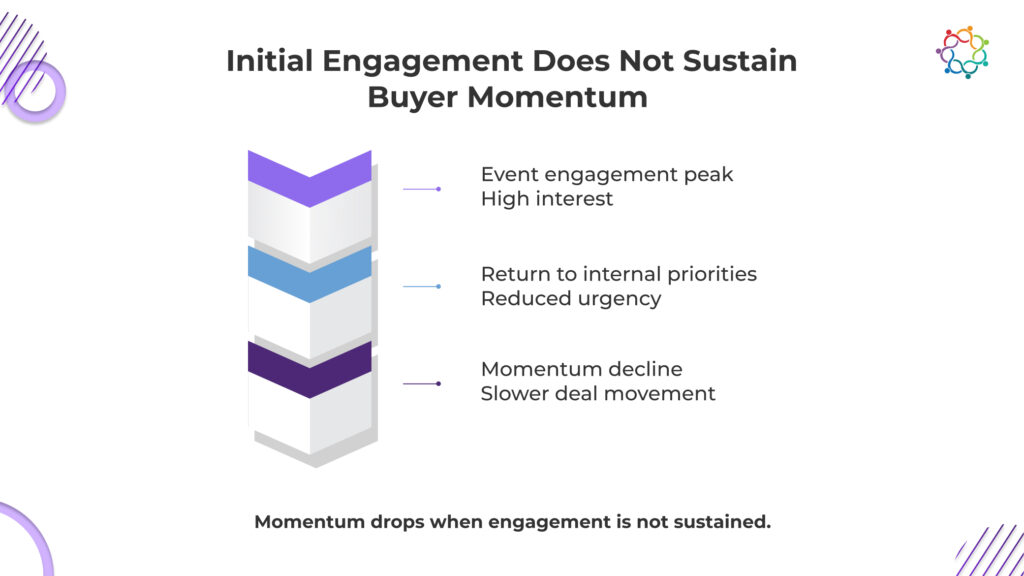
The urgency an event creates isn’t real. It’s situational.
At an event, buyers sit in a different mental space. They’re exploring, open to a conversation, willing to entertain an idea without any pressure to commit. That looks like intent. It isn’t anchored to anything a real decision actually depends on.
Once the event ends, that same buyer walks back into an environment built around risk and accountability. Decisions stop being exploratory. Every conversation now has to survive internal scrutiny. That’s exactly where momentum falls apart.
Events compress attention into a short window. Real deal velocity needs sustained attention over a much longer one. That gap is exactly where pipeline movement breaks down.
What looks like strong engagement at an event is often just temporary accessibility. Buyers are available because the room made them available. That availability gets mistaken for intent, and intent only becomes real once someone commits to moving something forward inside their own organization, which rarely happens at the speed an event conversation suggests.
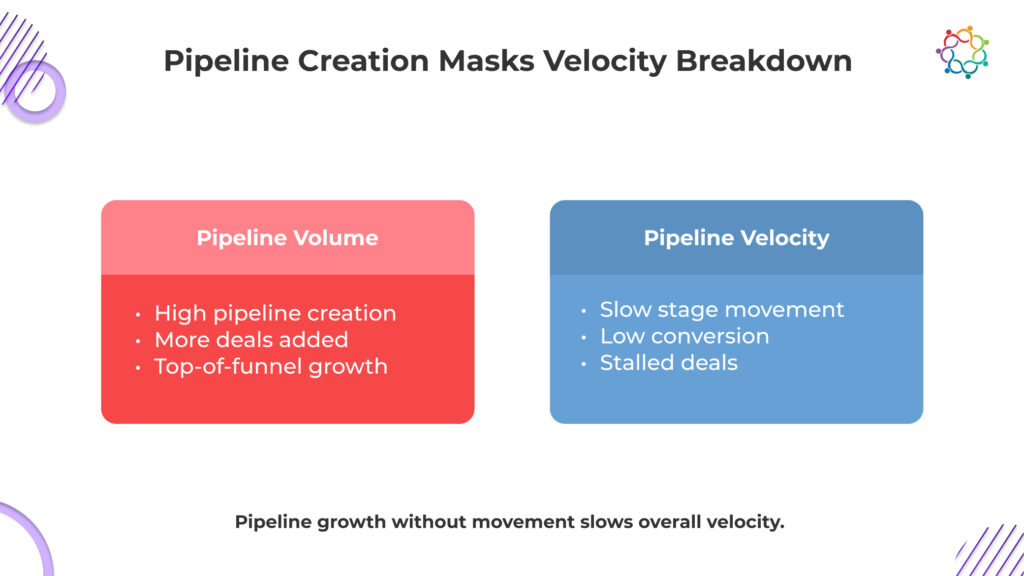
Events are reliably good at filling the top of the funnel. New deals show up fast, early-stage opportunities climb, and the numbers look like clear progress.
That growth often hides the actual problem. Volume goes up while movement doesn’t. Deals created at an event tend to stall in the early stages, and that drag slows the whole funnel down, not just the new deals.
This is where the Pipeline Velocity Illusion actually shows up: more activity, no more progression. Teams see a bigger pipeline and assume momentum is building. What’s actually happening is the pipeline getting heavier, not faster.
As deals pile up without moving, sales cycles stretch, conversion rates flatten, and aging deals accumulate. The system looks busy. It’s struggling to move anything forward. Pipeline growth without velocity doesn’t strengthen performance, it just hides where deals are actually breaking and delays the fix.
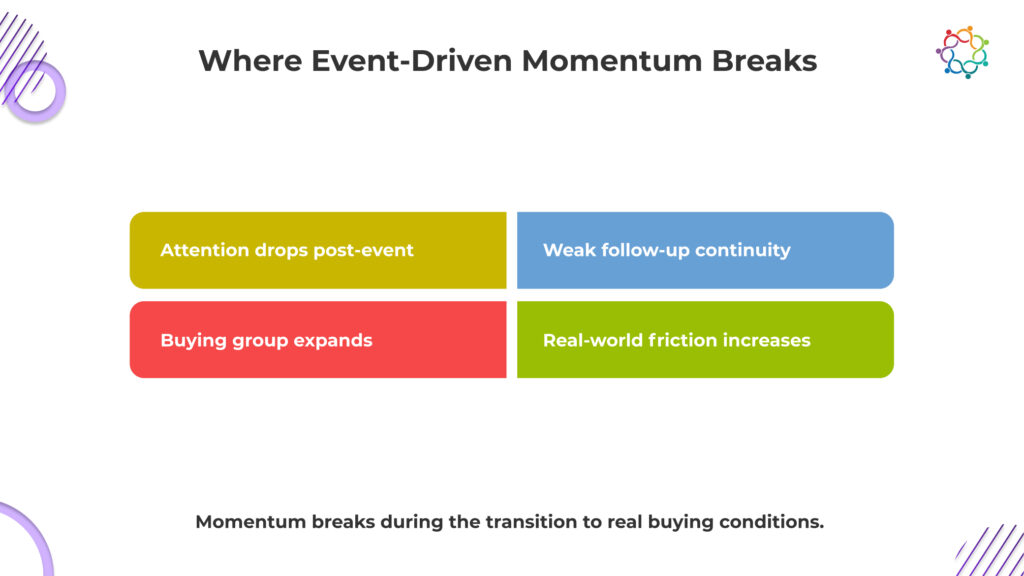
Momentum doesn’t fade randomly. It breaks at specific points where the event environment collides with how real buying actually works.
4.1 Buyer Behavior Shifts Immediately
At the event, risk feels low and conversations stay exploratory. Back inside their own company, the same buyer faces real scrutiny, lower risk tolerance, and internal resistance to what looked like a strong opportunity a week earlier.
4.2 Sales Conversations Lose Continuity Pressure
Event interactions run back-to-back, with immediate follow-up baked in. After the event, that continuity disappears. Engagement fragments, and without sustained contact, the conversation drifts.
4.3 Buying Groups Expand and Slow Everything Down
An event conversation usually involves one or two people. A real decision involves a lot more. Every additional stakeholder brings a new objection, a new concern, and a new delay.
4.4 Simplified Event Conversations Collapse Under Real-World Friction
This is the part most teams underestimate. Events simplify reality, focusing on value and high-level fit. Real deals bring the complexity back.
What looked like a clear path forward turns uncertain fast. This isn’t a follow-up failure. It’s a structural mismatch between how conversations happen at an event and how decisions actually get made inside an organization. Velocity doesn’t break during the event. It breaks the moment a simplified conversation runs into real buying conditions.
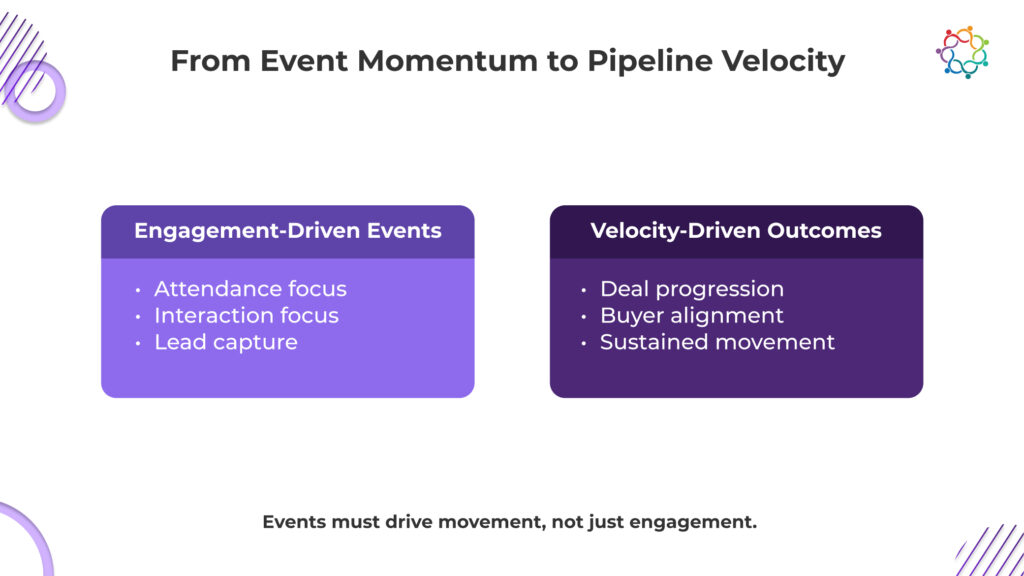
Most B2B tech events are built to generate activity, attendance, engagement, lead capture. That drives pipeline entry. It does nothing for how those deals actually move afterward.
The shift needed here is real: judge an event by whether it actually advances a deal, not just whether it created one. Deals should move closer to a decision, not just show up in the funnel.
An event aligned with progression does something specific: it aligns stakeholders, clarifies decision criteria, and reduces friction inside deals that are already active. Skip that shift, and events keep producing the same pattern, strong engagement during the event, followed by very little movement after it. The point of an event was never to start more conversations. It’s to make sure the ones already happening keep moving inside the buyer’s real environment.
Momentum from an event can’t sustain itself. What happens right after the event is what actually decides whether it holds. Without continuity, buyer engagement resets instead of building.
During the event, conversations run concentrated and continuous. After it, that continuity breaks. Context gets lost, interactions fragment, and urgency fades fast. Sales teams end up re-establishing context instead of building on what was already there.
Systems built for post-event follow-through, not a single moment of engagement, are what actually sustain velocity. Every interaction needs to move a deal forward, not restart the conversation from scratch. Skip that, and deals drift back into early-stage behavior: interest fades, timelines stretch, and the whole pipeline slows down. Events start the movement. Whether that movement survives depends entirely on what happens after, through consistent, connected contact, not another one-off touchpoint.
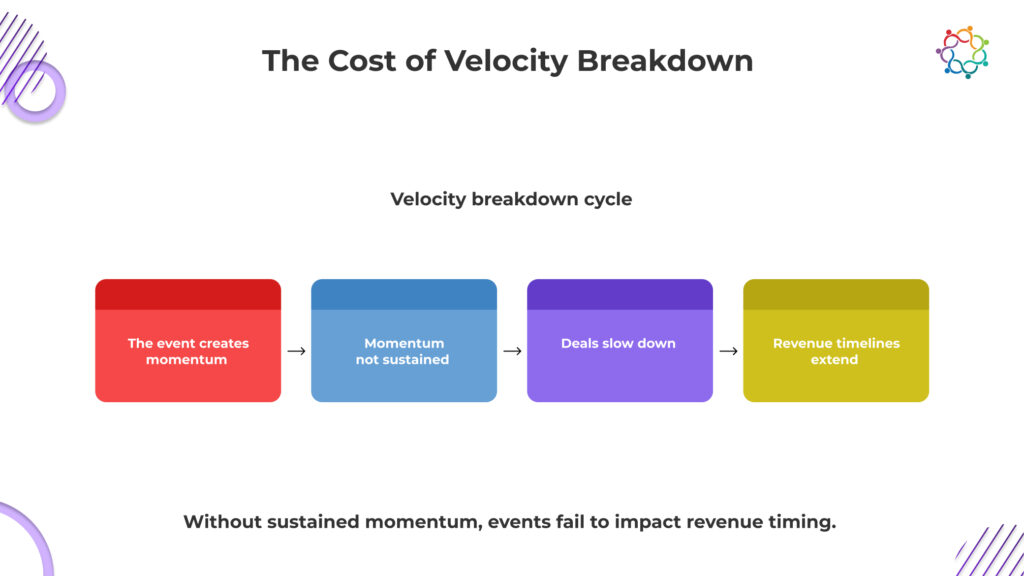
When event-driven momentum breaks, the damage isn’t limited to individual deals. It shows up across the whole revenue picture.
Sales cycles stretch as deals sit longer in early stages. Conversion rates drop as initial interest fades before a decision ever gets made. Pipeline aging climbs, making it harder to keep deal quality up.
Forecasting gets less reliable too. Stalled deals sit in the pipeline distorting projections, and leadership loses a clear view of what’s actually going to close and when. Pipeline bloat grows as more deals enter than actually progress, and sales teams spend more time managing dead weight than advancing anything live. That drags down efficiency and quietly raises acquisition costs.
Organizations keep investing in events expecting acceleration. Without sustained velocity behind it, revenue timelines just keep sliding. Event success without deal movement doesn’t drive growth, it just adds pressure across the whole revenue system.
Despite all of this, most teams still measure event success by engagement. The reason is simple: engagement is easy to capture.
Attendance, session participation, meetings booked, leads generated, all visible, immediate, easy to report on. Velocity is harder. It means tracking deal progression over time, across multiple stakeholders, through a genuinely complex sales cycle.
That creates a real structural bias: teams optimize for what they can report quickly, not what actually drives the outcome. Structured feedback collected right after the event, tied to what actually happened in each conversation, is one of the few ways to start closing that gap instead of defaulting to whatever number is easiest to pull. Events end up designed to maximize visibility and activity, not progression. When success gets defined by engagement, velocity breakdown isn’t a surprise. It’s the expected result.
Events matter in B2B marketing. They create visibility, start conversations, and get deals into the pipeline. None of that guarantees revenue actually moves.
Pipeline velocity depends on what happens after the event, not the event itself. Without something sustaining that momentum, deals slow, buyers disengage, and timelines stretch. The real issue was never that events fail to create momentum. It’s that the momentum rarely survives contact with real buying conditions.
Events compress attention. Real decisions expand complexity. The Pipeline Velocity Illusion is exactly what makes that gap easy to miss, activity rises, progression doesn’t follow. Until that gets addressed with an actual system, not just a stronger event, the same pattern repeats: a spike in engagement, a drop in velocity, a growing pipeline that never quite moves.
Event management software built to carry momentum past the event itself, not just capture it during, is what closes that gap.
Curious what this looks like for your next event? Book a demo with Samaaro today.