Samaaro + Your CRM: Zero Integration Fee for Annual Sign-Ups Until 30 June, 2025
- 00Days
- 00Hrs
- 00Min

Key Takeaways (TL;DR)
1
2
3
→
Bottom Line:
Events built for the B2B buying committee are designed so the people who never entered the room still hear the message, which is where stalled deals quietly restart.
The deal stalls in a room you were never in.
The person standing at your event is rarely the only one deciding. If the rest of the committee never hears from you, the deal stalls in a room you were never in.
Events built for the B2B buying committee do one thing differently: they build specific ways for the people who never attended to still get the message. A leave-behind made for internal sharing. Content the attendee can forward without having to translate it. A second touch aimed at the stakeholders who weren’t in the room. Follow-up that speaks to different roles in their own terms.
Most events are designed as if one attendee will accurately relay everything that mattered to three or four colleagues back at the office. That internal relay almost never happens completely, and the gap is exactly where promising deals go quiet.
What follows is how to design an event so the whole committee hears it, even the seats that stayed empty.

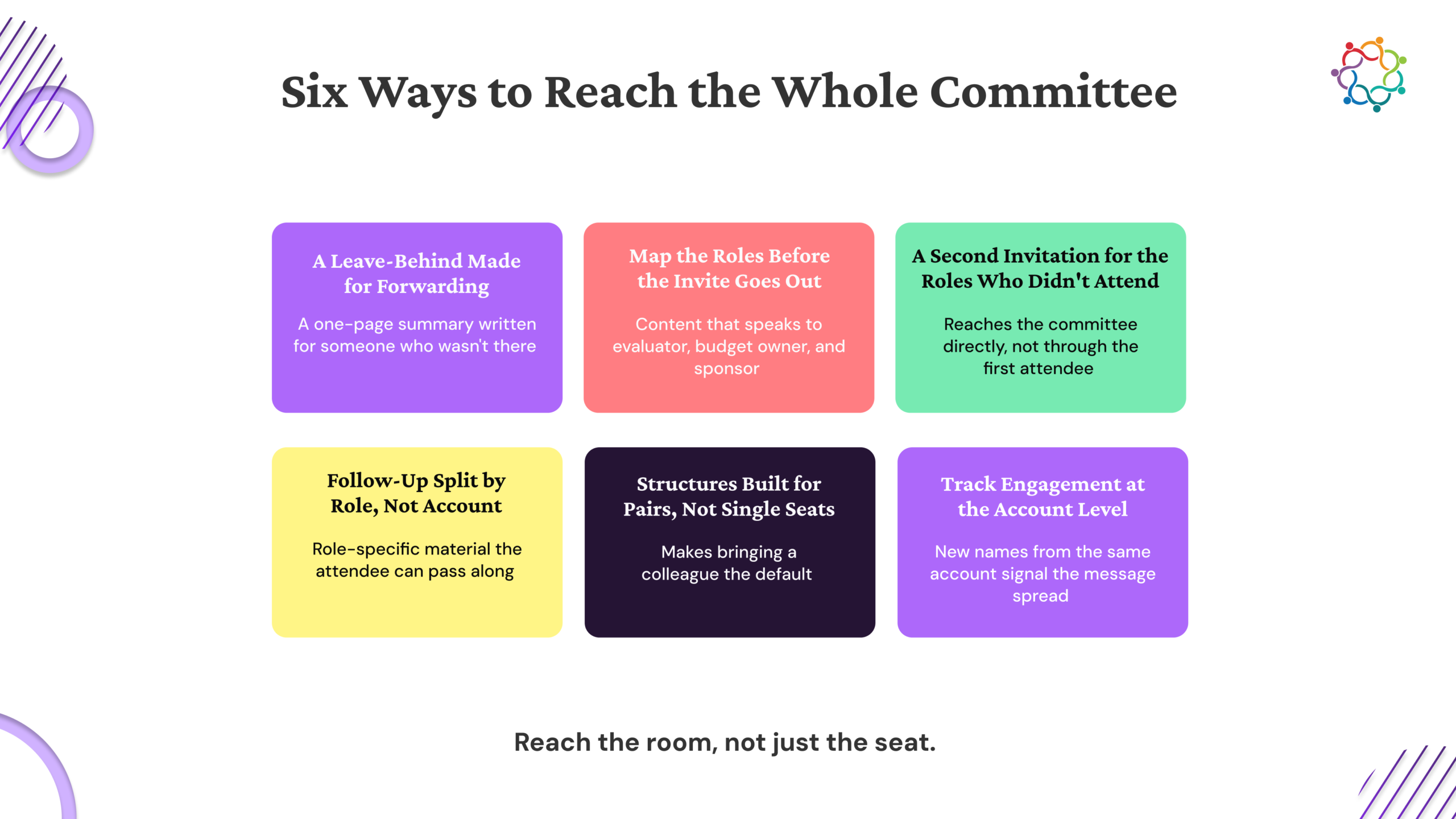
Each of these is a design choice that extends the event’s reach past the single person who walked in.
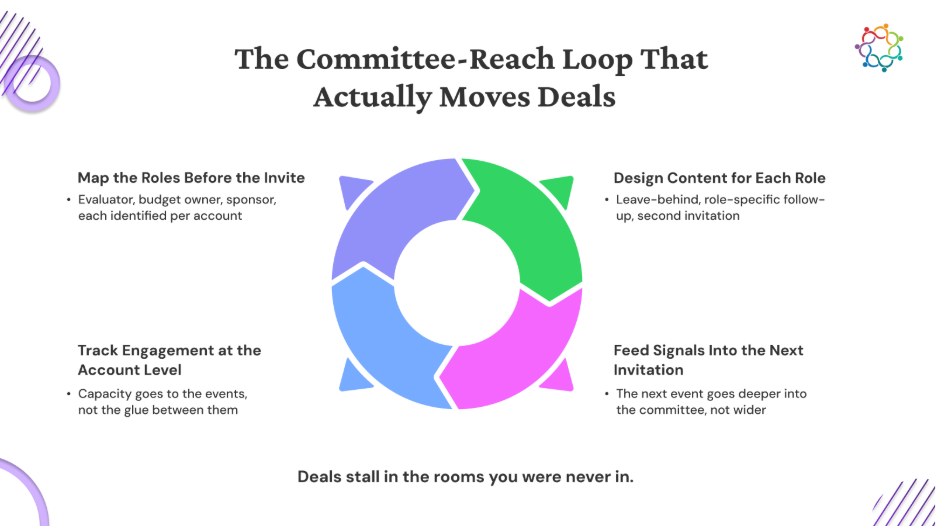
1. Build a leave-behind made for forwarding.
A one-page summary written for someone who wasn’t there: plain language, no inside references, so the attendee can hand it off instead of reconstructing the whole event from memory. The test is whether a colleague who skipped it could read the page and get the point without a follow-up call.
2. Map the roles before the invite goes out.
A technical evaluator, a budget owner, and an executive sponsor usually all touch a decision like this, which is part of what makes selling to a buying committee its own discipline. Design content that speaks to each of those roles, including the ones who didn’t send anyone this time. The evaluator cares about integration and security, the budget owner about cost and risk, the sponsor about the outcome. One message rarely covers all three.
3. Send a second invitation to the roles who didn’t attend.
If your attendee was the technical evaluator, a shorter session built for the budget owner reaches the committee directly, sent as its own targeted invite rather than left to the first attendee to pass on. A budget owner is far likelier to accept a 30-minute session framed around cost and risk than to sit through a technical deep-dive the evaluator already saw.
4. Split follow-up by role, not by account.
A single generic email to the one attendee misses the three other people whose confidence also has to be built. Role-specific follow-up the attendee can forward reaches those people even without a live introduction, and it speaks to what each of them weighs when the decision comes.
5. Give the attendee a reason to bring someone.
Build the format for pairs or small groups instead of single seats, so bringing a colleague becomes the default rather than something the attendee has to think about arranging on their own. Two people from the same account in the room beat one, because half the internal conversation has already happened by the time they leave.
6. Track engagement at the account level.
Watch whether new names from the same account start engaging with follow-up after the event. That’s how you see whether the message is spreading through the committee or stopping with the one person who showed up. If the same name is the only one engaging a month later, the message never left that person’s inbox.
Common trap: treating the single attendee as a fully briefed internal advocate. Even an enthusiastic attendee rarely re-explains a whole event accurately to three colleagues, days later, from memory, against everything else on their plate. The message has to reach the rest of the committee on its own.

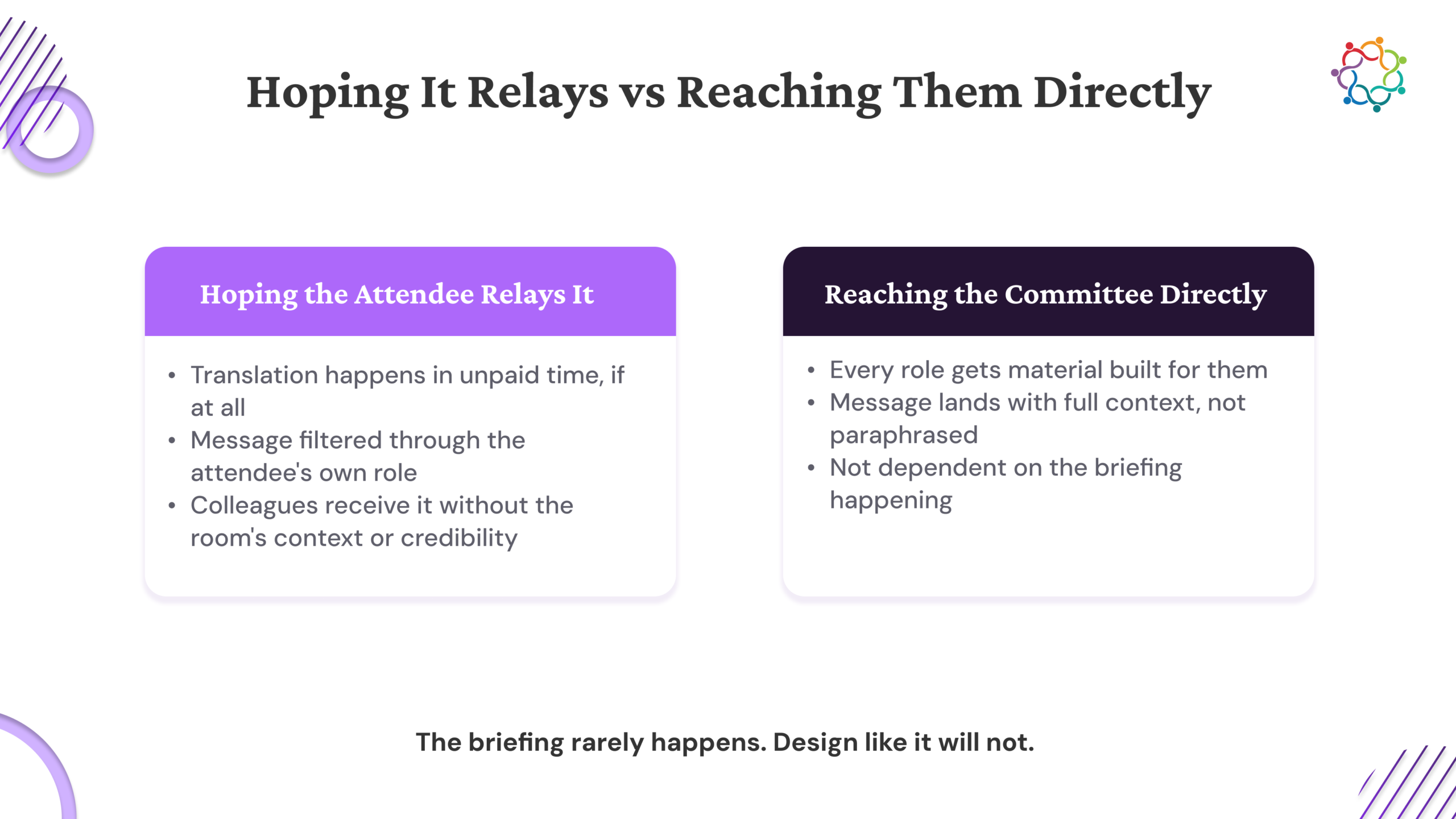
Relying on the attendee to carry the message inward fails for reasons that have nothing to do with how much they liked the event.
Internal translation is unpaid, informal work. The moment the attendee is back at their desk, it competes with everything else on their plate, and it’s rarely the first thing they get to. What they do relay is filtered through their own role: a technical evaluator passes along the technical parts cleanly and the budget case poorly, because the budget case isn’t what they were listening for. And the colleagues receiving that secondhand version get none of the context, tone, or credibility the live room supplied. A paraphrased recap carries a fraction of the weight the event itself did.
This is the same gap behind why invite-only events so often feel successful and still don’t move the deal: the room works, and then the message stops with the person who was in it. The honest reframe is that the goal is reaching the rest of the committee directly, by design, so the deal never has to depend on a briefing that was always unlikely to happen.

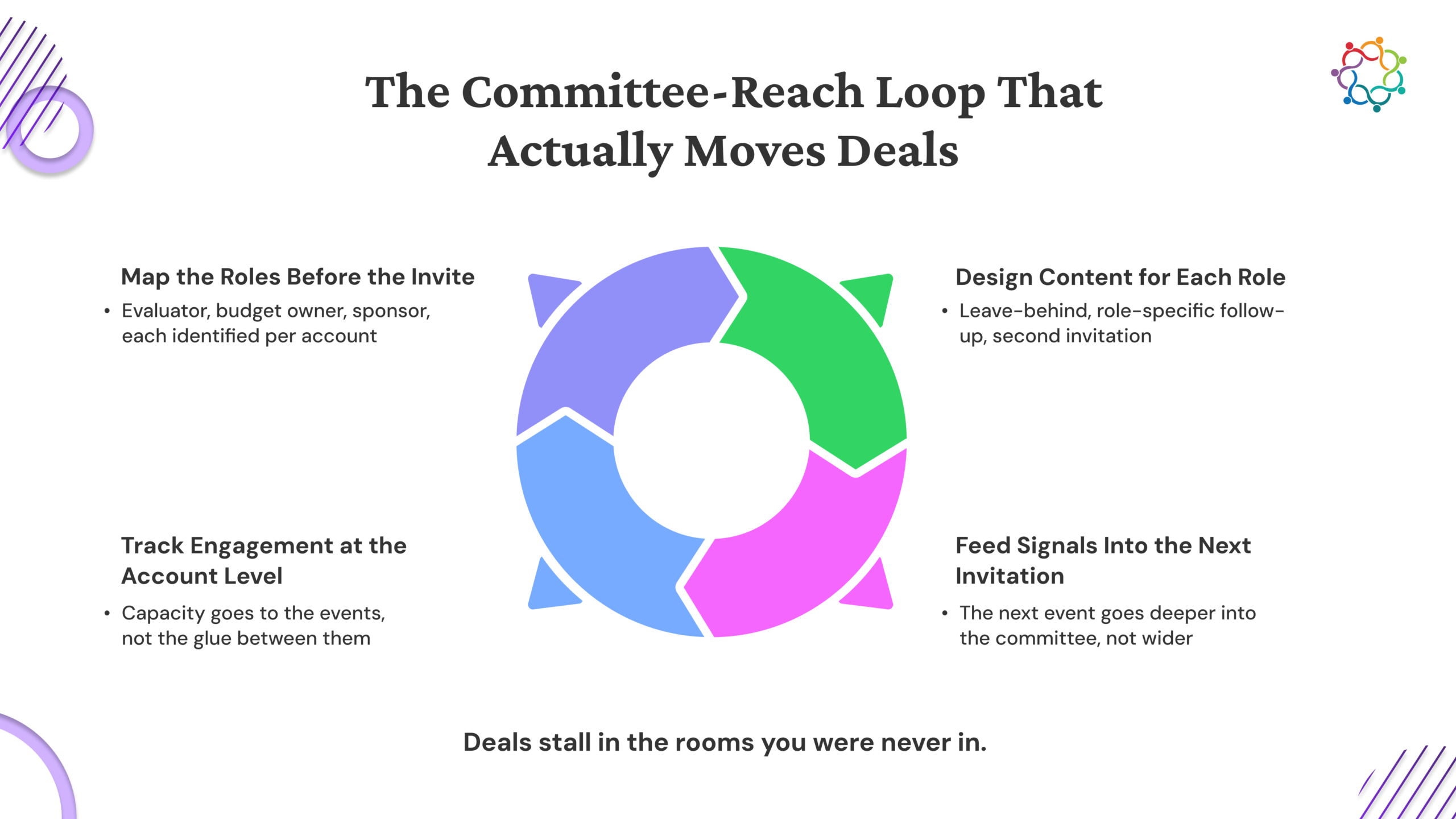
Here’s how the pieces fit on a real account.
A technical evaluator from a target account attends a session and leaves with a one-page summary built for forwarding. A few days later, a follow-up email arrives with content aimed at a budget owner’s typical concerns, easy for the evaluator to pass along without writing anything themselves. A couple of weeks after that, a short, separate invitation goes out to the budget-owner role at that same account, giving that stakeholder a direct reason to engage without needing the evaluator to broker an introduction.
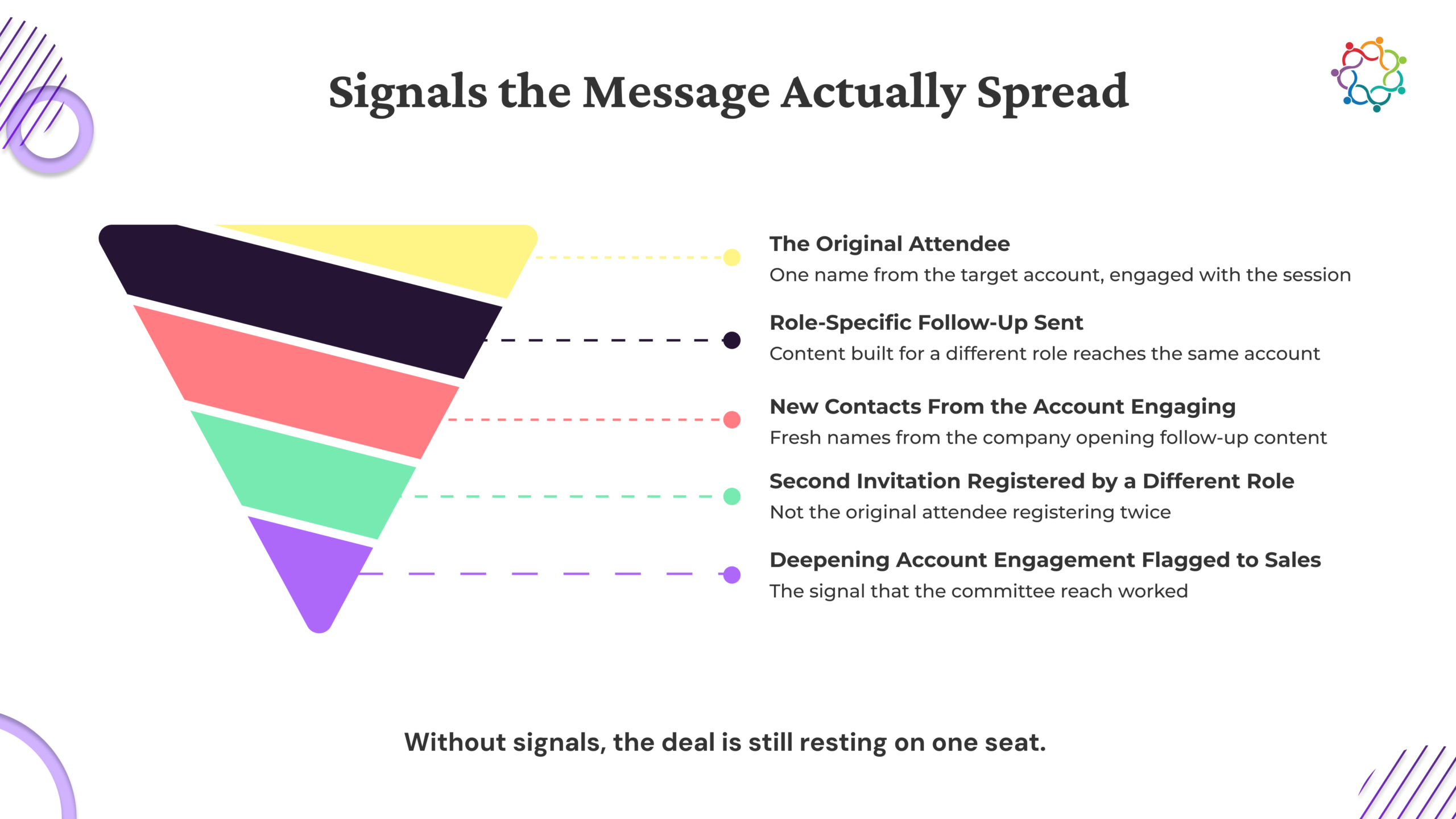
Then the signal you’re watching for appears: a second name from the same company starts opening follow-up content. The message reached past the original seat, and that’s worth flagging to sales as the account showing deepening committee engagement. It’s the same multi-role motion behind how services firms use events to break into named enterprise accounts: design for the committee, and a single event turns into movement across the account.
None of this took a bigger event or a different sales pitch. The same event and the same follow-up sequence did the work, once they were built with more than one role in mind from the start.

Design changes are worth only as much as the evidence that they reached the committee. Three signals tell you whether they did. Each one is about who moved because of the event, the only measure that matters here.
Without signals like these, there’s no way to know whether the committee-reach design worked or whether the deal is still resting entirely on one attendee’s shoulders. That account-level view is also what tells sales when to move, the same handoff logic behind bridging the gap between marketing and sales at enterprise events. A second engaged stakeholder is often the cue that the account is ready for a real sales conversation.

A forwardable leave-behind, role-mapped content, a second invitation for the people who didn’t attend, and account-level tracking to confirm it landed: together they turn a single filled seat into reach across the whole committee.
A deal like this stalls for one structural reason. The event was designed to reach one person, while the decision is made by a group that has never heard from you directly. Design for the whole committee, and the message stops depending on a secondhand retelling. Tracking which roles from an account engage with which follow-up, and reaching them directly, is the kind of account-level visibility an event marketing platform is built to provide.
So map the room before you send the next invite, and build every piece of follow-up for the people who won’t be there. To see which roles from a target account engage after an event, Samaaro can show you.
1. How does event manager software help you reach the whole buying committee?
Event manager software tracks engagement by role and account, not just the person who showed up. You can see a technical evaluator attend and a budget owner from the same account open role-specific follow-up later. That visibility tells you the message spread past one seat, so the deal isn’t left resting on the attendee to relay everything from memory.
2. What role does an event management app play in reaching a buying committee?
An event management app sends role-specific follow-up without waiting for the attendee to explain the event to three colleagues from memory. Content goes to the budget owner and the executive sponsor directly, each framed for what they care about. The attendee can forward it easily, or never has to pass it on at all.
3. Can an event planning tool help design an event for multiple stakeholders?
Yes. An event planning tool lets you map the roles before the invite goes out, technical evaluator, budget owner, executive sponsor, and build content that speaks to each. You can also plan a second, shorter session aimed at the people who didn’t attend the first, so one event reaches several stakeholders instead of just the seat that got filled.
4. How does event coordinator software split follow-up by role instead of by account?
Event coordinator software lets your coordinator send targeted follow-up to the technical, budget, and sponsor roles rather than one generic email to the attendee. Each message speaks to what matters for that decision-maker, and the attendee can forward the budget-owner email easily, reaching someone who would never sit through the technical deep-dive they saw.
5. What does event organizer software do for forwardable leave-behinds?
Event organizer software helps you build a one-page summary in plain language, no inside references, so the attendee can hand it off without reconstructing the whole event from memory. A colleague who skipped the session gets the point without a follow-up call, which means the message reaches the committee even if the attendee gets busy.
6. Is an event booking app useful for a second, role-specific invitation?
An event booking app makes the second invitation its own event, so a budget owner registers directly rather than being relayed by the first attendee. A shorter session framed around cost and risk gets its own sign-up from a different person at the account, which is a clear signal the committee, not just one seat, is engaging.

Samaaro is an AI-powered event marketing platform that enables marketing teams to turn events into a measurable growth channel by planning, promoting, executing, and measuring their business impact.
Location


© 2026 — Samaaro. All Rights Reserved.