Samaaro + Your CRM: Zero Integration Fee for Annual Sign-Ups Until 30 June, 2025
- 00Days
- 00Hrs
- 00Min

1
2
3
→
Bottom Line:
If a wrong registration makes a promise untrue, shut the door; if not, leave it open and ask better questions.
Two Doors, Two Different Jobs
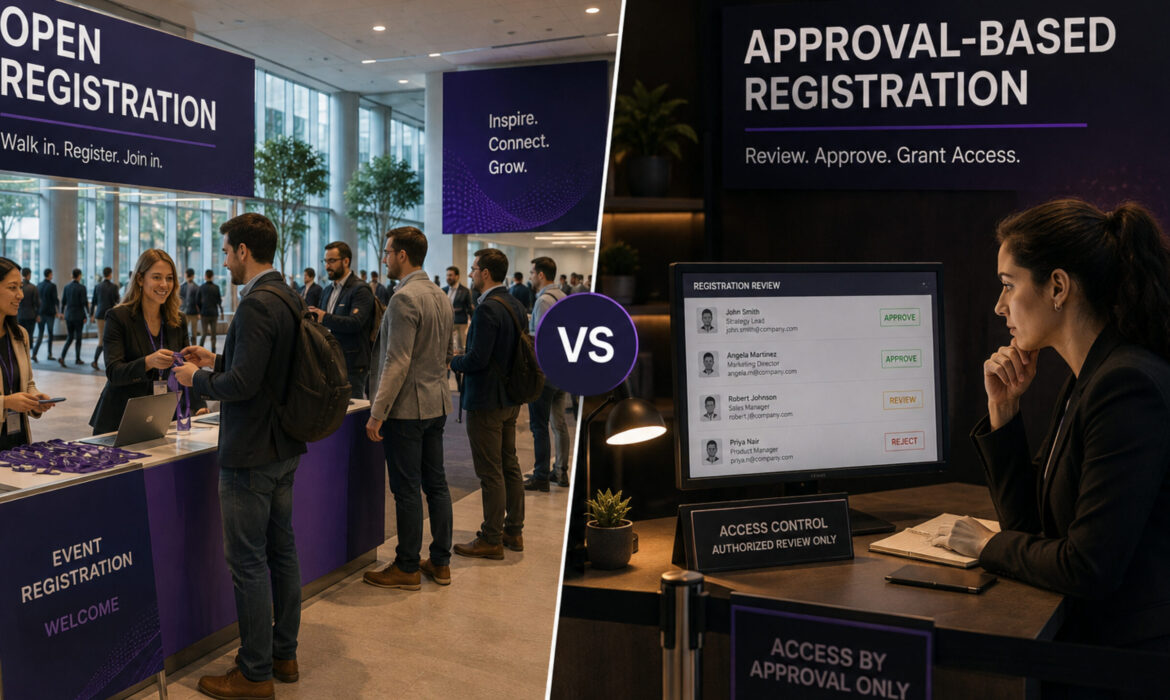
Open registration lets anyone in and tells you who came afterward. Approval-based registration decides who comes and makes somebody responsible for each decision. Both are correct. Which one is correct for a given event depends on a question most teams skip, which is whether the makeup of the room is the thing being promised or just the thing being hoped for.
Approval based event registration earns its place when the composition of the room is part of what was sold, to sponsors, to speakers, or to the attendees themselves, and when a named person has the capacity to review every request within hours. Open event registration earns its place when a filter already exists elsewhere, in the price, the format, the topic, or a known audience. Where neither is true, qualifying questions on an open form give most teams what they were reaching for.
The real question is what each one requires from the team to work.
The two models answer different questions, not different levels of selectivity on one scale. Open registration asks how many people we can serve. Approval asks who this is for.
The axis that matters is whether the composition of the room is a promise or a preference. When sponsors were sold a room of senior buyers, when a speaker agreed on the strength of who would be listening, or when attendees accepted because of who else would be there, composition is a commitment and a wrong registration breaks it. Where composition is merely preferred, gating imposes a real cost against no enforceable benefit.
Teams get this wrong in one specific direction. Gating feels like rigor. It takes one meeting, signals seriousness to everyone watching, and produces no visible cost until much later. That’s how teams end up with an approval queue nobody has time to work.
Which is why the rest of this compares the two on what they require rather than on what they promise. For the format-level version of that argument, invite-only customer events run on composition by design, and the door policy follows from the format rather than the other way round.
Six dimensions decide this in practice, and none of them appear in a feature comparison. They are the operational ones: where the effort sits, what each model costs you, what it needs before it works, and how each one fails.
| Optimizes for | Who is in the room | Who can reach the room |
| Where the work sits | An internal reviewer, on every request | The registrant, once |
| Main cost | Speed, and referral reach | Control over composition |
| Right when | The makeup of the room was promised | A filter already exists in price, format, or topic |
| Fails by | Bulk approvals under deadline | A room that does not match the plan |
| Needs to work | A named reviewer with capacity and a written standard | An honest answer about what the real filter is |
One row decides most cases, and it is where the work sits. Approval moves effort from the registrant to your team, permanently and on every single request. That makes it a staffing decision wearing the costume of a settings decision. The question of who reviews each request needs an answer with a name in it before you switch the model on.
Friction lands hardest on the people the gate exists to protect. A senior person who fills in a form and hits a pending screen frequently does not come back to check whether it cleared. Gated event registration is therefore least effective on precisely the segment it was built for, which is the first uncomfortable thing about it.
Somebody has to review, and it is usually the person with the least room in their week. Approval is a recurring operational commitment that arrives disguised as a configuration choice, and nobody costs it out at the point of decision.
That produces the failure that matters most. Under deadline, a backed-up queue gets cleared in a single pass because the event is on Thursday. The team now carries the delay and the drop-off with none of the filtering, which is the worst available outcome and the most common one.
Gating also breaks forwarding. An attendee passing an invitation to the right colleague is often the highest-quality route to the right people you have. Approval converts a warm handoff into a pending request the recipient never asked for. Understanding how registration approval affects sign-ups means counting that lost route too.
And rejection carries a cost nobody measures. The people turned away may be customers, prospects, or partners, and no team keeps a record of what a decline costs them six months later. Gating alone rarely delivers what was expected because of these hidden gaps. The post-event picture sets out what happened in more detail.
None of this means approval is wrong. It means approval is a commitment, and a commitment nobody staffed is worse than no commitment at all.
The choice was never two options. Naming the third resolves most of the arguments teams have about the first two.
Open registration. Choose it when the filter already exists somewhere else: a paid ticket, a genuinely technical agenda, an inconvenient format, or an audience already known to you. The requirement is to name that filter out loud. A team that cannot say what its filter is has no plan for the room.
Open with qualifying questions. Choose it when you need to know who is coming without needing to control it, which covers most B2B events. This is how to screen event registrations without approval: a few event registration form questions on company, role, and reason for attending give you composition visibility during the campaign at no cost to speed. The requirement is that somebody reads them weekly.
Approval-based. Choose it when a wrong registration makes something you promised untrue. The requirement is a named reviewer, real capacity in their week, a written standard they can apply without escalating, and a turnaround measured in hours rather than days.
The middle option, in practice. Qualifying fields are only useful if the registration form and the campaign view sit together, which is what an event registration platform does with them. Questions collected into a spreadsheet nobody opens are friction with no return.
The middle option is underused because it produces no feeling of rigor. Nothing visible is kept out, so nothing visible feels decided. It also happens to be the right answer more often than either of the other two.
Both models work, and both fail for the same reason: nobody decided what the room was for before deciding who could enter it. Approval moves the work onto your team and buys control. Open moves it onto the registrant and buys speed. Qualifying questions buy visibility without moving much of anything.
So ask one question before you touch the settings. If the wrong person registers, does something you promised become untrue? If yes, gate the door and staff the review properly. If no, leave it open and ask better questions. Attendance quality is what decides which model fits. To see approval workflows, qualifying fields, and open sign-up running in one place, request a walkthrough.
1. How does event manager software help you choose between approval and open registration?
Approval based event registration earns its place when the composition of the room is part of what you promised. If the makeup doesn’t match what was sold to sponsors or speakers, gate it and staff the review properly. If it doesn’t matter, leave it open and ask better questions on the form.
2. What does event management app reveal about approval workflow costs?
Approval-based workflows move work onto a named reviewer for every request. Without real capacity and a written standard, you’ll bulk-clear the queue under deadline. You get the delay with none of the filtering, the worst outcome and the most common one.
3. How does conference attendance tracking give you composition visibility without approval?
Qualifying questions on a registration form show you who’s coming as the campaign runs. You don’t need approval gatekeeping to track composition. Ask company, role, and reason for attending, then read the responses weekly. That’s visibility without the staffing cost.
4. When should event booking app help you assign the approval workflow?
Approval-based registration is a staffing decision wearing a settings choice. You need a named person with real capacity to review requests within hours. Without capacity assigned upfront, the queue gets bulk-cleared under deadline and you lose the benefit. Someone owns it or it fails.
5. Why does event coordinator software matter for handling registration approvals?
Approval needs a named person to review requests within hours. That’s a staffing decision, not a settings choice. If you don’t have real capacity assigned, you’ll bulk-clear the queue under deadline and lose the filtering benefit. The coordinator owns the review process.
6. How does event organizer software help you decide when to gate registrations?
Open registration works when a filter already exists: a paid ticket, a technical agenda, or an inconvenient format. Name that filter explicitly. If you can’t say what it is, you’ve got no plan for the room. That’s when you need approval-based controls instead.