Samaaro + Your CRM: Zero Integration Fee for Annual Sign-Ups Until 30 June, 2025
- 00Days
- 00Hrs
- 00Min


Key Takeaways (TL;DR)
1
2
3
→
Bottom Line:
The stack is an accretion, one reasonable tool at a time, that no one ever connected.
When you ask a B2B marketer how they manage their events, the truth is that they rarely use just one tool. Pardot, Marketo, Salesforce, MS Dynamics, Gmail, Slack, WhatsApp, BigQuery, Excel, and in at least one case a paper notebook, all of these came up across the nine conversations. A CRM here, a marketing automation platform there, messaging apps, a data warehouse, a spreadsheet, and a notebook, all of which are unrelated to one another, make up the actual B2B event marketing tech stack in 2026.
That was the through-line across all nine in-depth conversations. No one named a single system for running events. They named six, eight and ten tools, and then described themselves as the thing holding the whole arrangement together. The stack was always plural, and a person was always what held it together.
This piece is the honest reveal of that stack: what is actually on it, why the parts were never built to work together, and what that does to the people running events. The tools are real and came straight from the conversations. The pattern is reported as what these nine marketers described, a sample, not a survey of the whole market. By the end, the shape of the problem should be hard to unsee.
A quick word on where this comes from, because the method matters for how much weight to put on it. The list is drawn from nine in-depth conversations with B2B marketers about how they actually run events, the same dataset behind the broader 2026 benchmark study.
This is what they told us. We asked how events really get run, they named the tools and walked through the workflows, and we are reporting the tools that came up and the patterns that repeated across the conversations. Those patterns are reported as patterns across nine people, not as percentages of all B2B marketers. Nine in-depth conversations are a sample, and a small one, so nothing here is a market statistic.
The tools are real. The people and the companies are not named, and no particular stack is tied to anyone identifiable. What the list captures is the lived event tech stack, the tools marketers actually reach for when no one is watching and there is an event to get out the door. That picture tends to be more honest than any vendor category diagram, because it is what people do rather than what they would put on a slide.
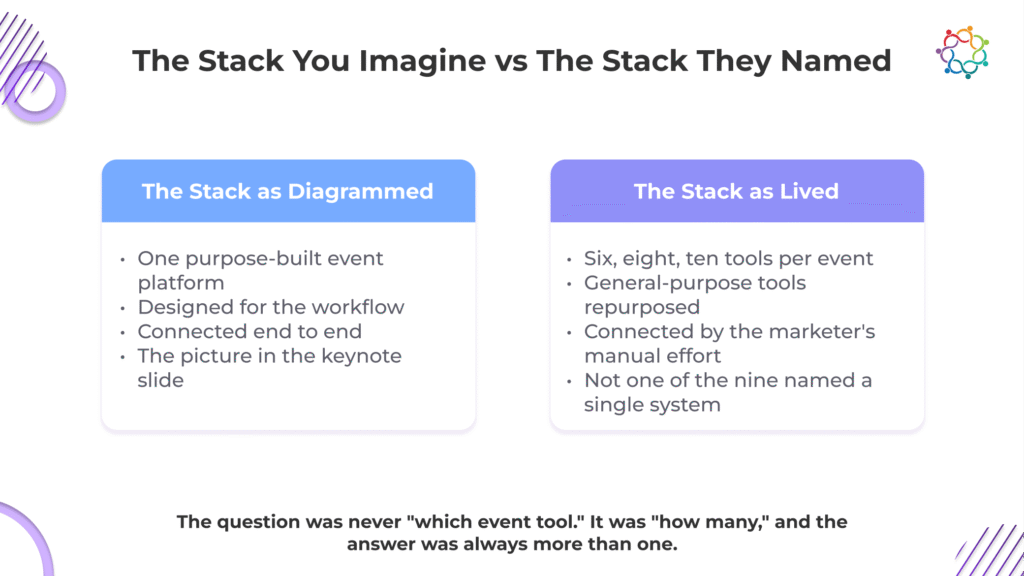
Start with the most basic finding, because it reframes everything after it: not one of the nine named a single system for running events. Every single person named a pile. Several tools, each doing one slice of the job, assembled fresh for each event.
That is the first thing to see. An event tech stack, in practice, is a handful of separate tools rather than one product. The lists ran long. People named their CRM, then their marketing automation platform, then the email tool, then the messaging apps the team coordinated on, and finally the spreadsheet where the real tracking occurred, and they were rarely finished there. No one had to stop and count, because the tools were simply the ones they touched at every event.
You can run the same exercise on your own setup. Count what it actually takes to run one event: registration, lead capture, the CRM, the email tool, the chat channel, and the spreadsheet. Most teams are past five before they have thought hard about it, and the number climbs once you add the tool for badges, the one for surveys, and the one for the booth. What varied across the nine was which tools they named, while the plurality itself never did. Some leaned on Salesforce, others on Dynamics; some lived in Pardot, others in Marketo. The names changed from one marketer to the next, but the length of the list did not.
This is why the starting point is so basic. Before you can pick a tool, you have to see that the stack is plural by default, many disconnected tools rather than one. The operative question across the nine was always how many, and the answer was always more than one.
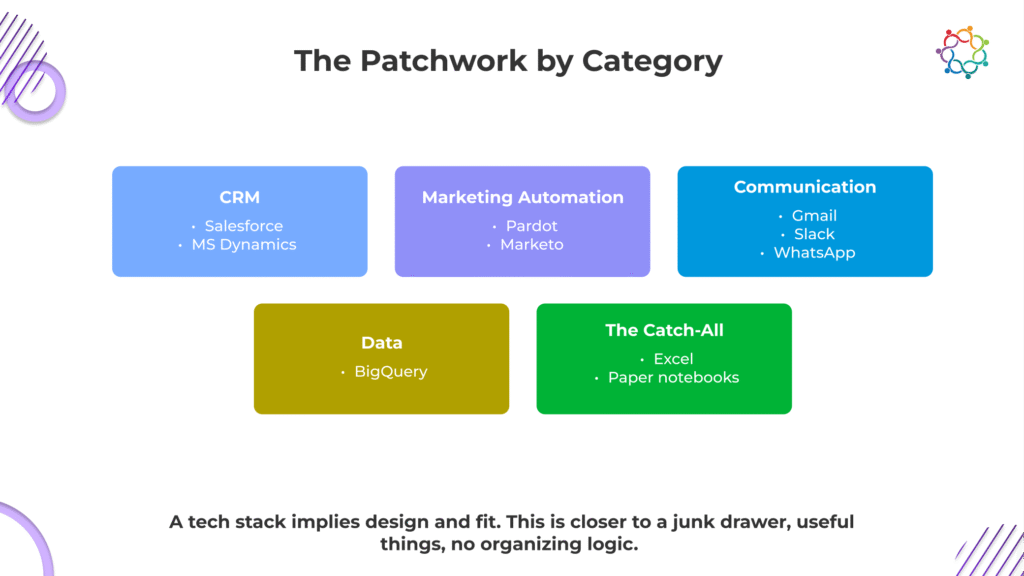
Look at what is actually on the list and a second finding appears: these are general-purpose tools from different categories, pressed into event service. They make a patchwork, assembled from whatever was already in the building.
Grouped by what they were actually built for, the named tools fall out like this:
The insight is in that grouping. Not one of these tools was built to run an event. Each was built for a different job and then repurposed, which is exactly why the stack feels improvised. It feels that way because it is. A tech stack, as a phrase, implies design and fit, components chosen to work together. What the nine described is closer to a junk drawer: a collection of genuinely useful things, with no organizing logic connecting them, each kept because it earns its place at some moment.
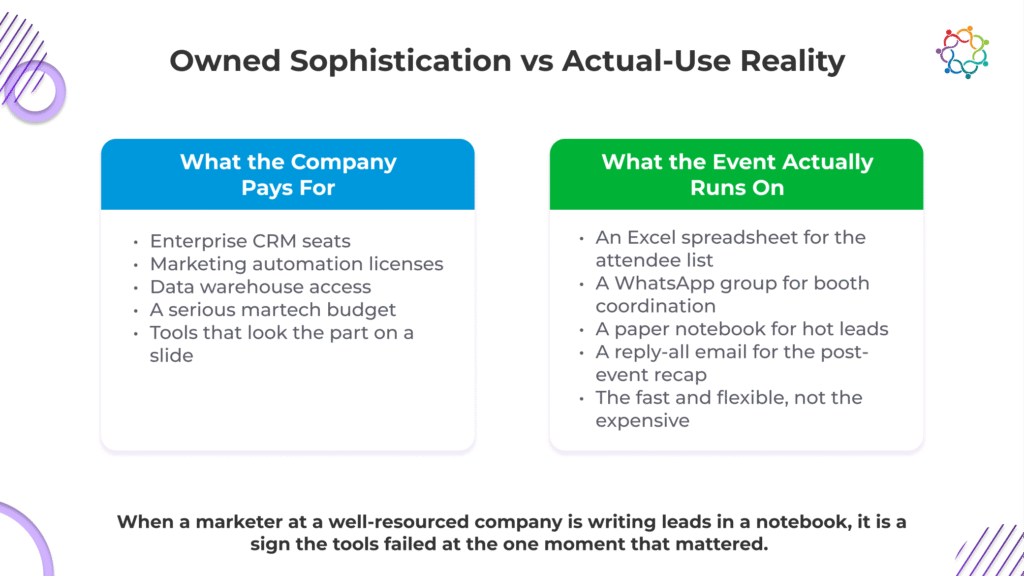
The third finding is the one that stays with you. The work that actually decides whether an event produces anything, the attendee list, the lead tracking, and the coordination of who follows up with whom, very often lives outside the expensive martech entirely. It lives in Excel, in WhatsApp threads, and in at least one case, a paper notebook.
Sit with the gap that opens up there. These are sophisticated companies with real tooling budgets, the kind that license Salesforce and Marketo and a data warehouse. And yet, when the event is actually happening, the work falls back to a spreadsheet and a handwritten list. The sophistication a company owns and the simplicity it actually uses on event day are miles apart, and the distance between them is the finding.
It happens for an understandable reason. The expensive tools were built for steady-state marketing, long campaigns, clean records and planned sends. They were not built for the event-day reality of fast capture at a booth, on-the-floor coordination, and the messy middle where plans meet a live room. So people reach for what is fast and flexible, and nothing is faster than a spreadsheet or a notebook.
Since the paper notebook isn’t a joke, it’s a detail worth considering. When a marketer at a well-resourced company is manually entering leads in a notebook, it means that every tool the company buys has failed when a real lead was in front of them. Multiply that moment across a year of events, and the notebook starts to look less like an oddity and more like the system.
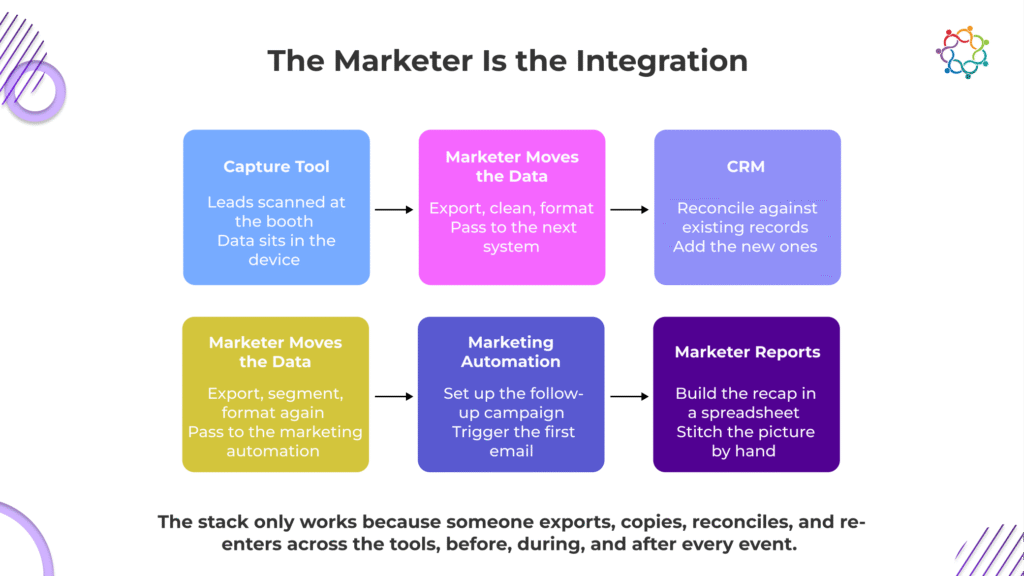
The fourth finding is the one that turns all of this from a list into a problem: across the whole patchwork, the tools do not talk to each other. There is no automatic flow from one to the next. So the flow is a person, and the person is whoever owns the event.
That is what holds the stack together. It works only because someone is moving the data by hand, around every event:
None of that movement is automated, so a human does all of it, every event. That is the real problem, and it is worth being precise about. The trouble is less the number of tools than the fact that the tools are disconnected, so the cost gets paid in manual hours and lost data every single time. A stack of ten tools that talked to each other would be fine. A stack of three that does not is a tax.
If you have ever exported a list out of one tool to upload it into another after an event, you have done this job. You have been the connective tissue that the software was missing. Every one of the nine had, without exception. And the cost compounds. It is the same lost afternoon after every event, all year, scaling with the calendar while the team stays the same size.
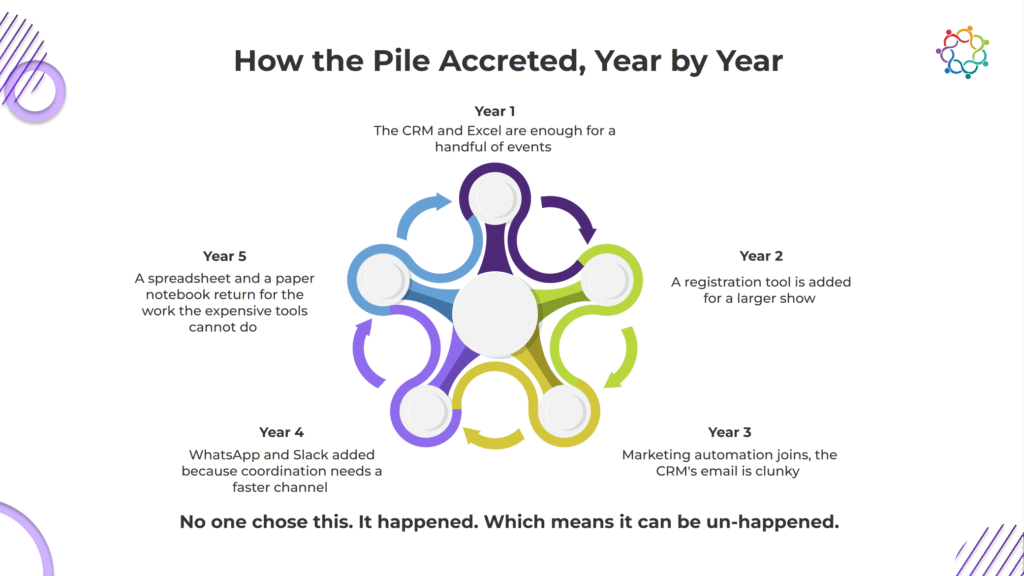
Put the four findings together and a single shape emerges, and it explains why the stack is the way it is. This is an accretion. Tool by tool, year by year, each one arrived to solve one local problem and never left, and the whole thing was assembled over time rather than by design. That is why it has no organizing logic: it was never organized. Each addition, on its own, was a reasonable call. The registration tool solved a registration problem; the spreadsheet solved a tracking problem. Accretion is what you get when a series of reasonable local decisions pile up over the years, with no one accountable for how they fit together.
This matters because of what it implies. Nobody chose this arrangement on purpose, which means nobody is stuck with it either. The fragmentation is the predictable result of years of adding tools and never consolidating them, which also means that what accretes can be undone. The way out is fewer tools that actually connect, rather than a longer list of better ones bolted onto the same pile.
That is as far as this piece goes, because seeing the pile clearly is its own step. What the stack looks like is the question here. What it costs, where the leads disappear, and what the disconnection does to the numbers a team reports, all of that sits in the broader research this is drawn from, and the wider view of how field marketing actually runs sits in the B2B Field Marketing Playbook.
The real event tech stack is a disconnected patchwork that the marketer holds together by hand, and that is where the fragmentation problem begins. Pardot is fine. Salesforce is fine. The spreadsheet is fine, in its place. None of them, on its own, was the misstep.
The problem was never the tools. It was that none of them were ever introduced to each other, so the person running events became the wiring, and seeing the pile for what it is is the first step out of it.
This stack is one finding from a larger study. The full 2026 B2B Event Marketing Benchmark Report covers what teams spend, what they lose, and why the proof goes missing. Download the report and see the full picture. This is only the first piece.
See what running your events on one platform looks like, at your volume. Book a walkthrough.