Samaaro + Your CRM: Zero Integration Fee for Annual Sign-Ups Until 30 June, 2025
- 00Days
- 00Hrs
- 00Min

Key Takeaways (TL;DR)
1
2
3
→
Bottom Line:
One signal is noise, two is a pattern, three means the room has already changed.
Why Drift Is Hard to See
Every step toward the wrong room is a good decision under real pressure. Registrations are behind, so a channel gets added. A contact declines, a colleague is offered. Each is defensible; the sum is not.
A registration count moves one direction and reads as progress regardless of who sits behind it, so the watched number is the one least able to show drift.
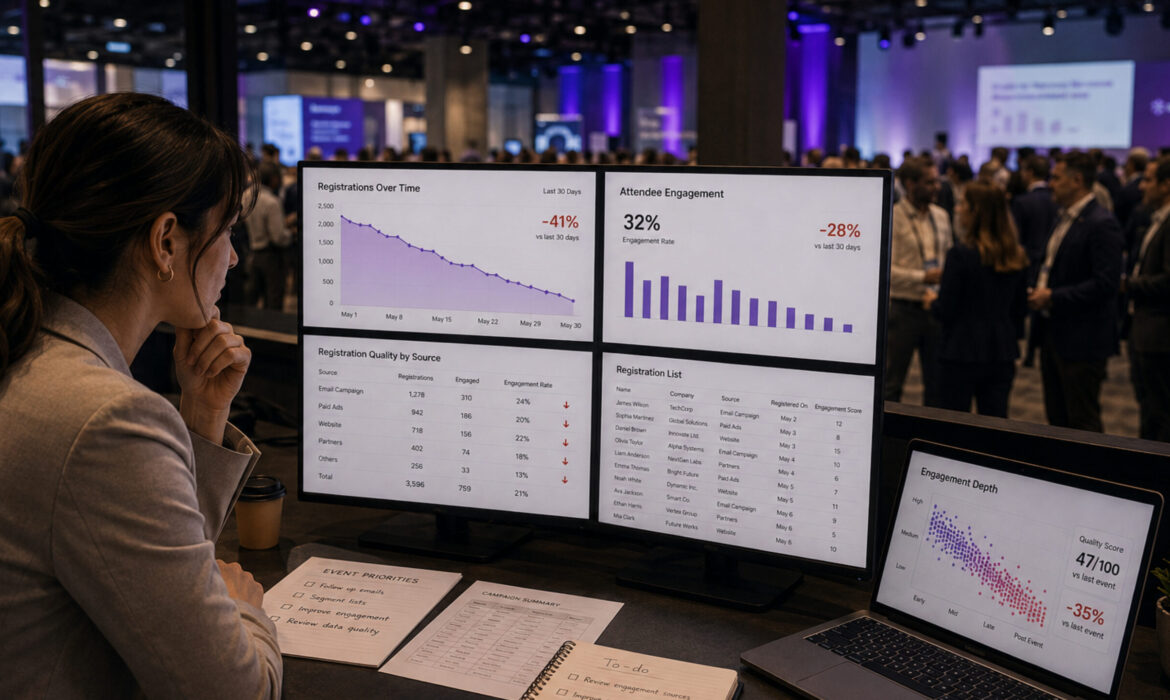
A demand generation manager watched a count climb for three weeks. Nothing changed until someone sorted by company and saw most priority accounts had nobody registered. The data showed it all along. The view did not.
Event audience targeting needs a different instrument than the dashboard already holds.
These three live in numbers you already have. Each is a ratio rather than a count, and none of them can be read without the named list sitting alongside the registration report as a comparison set.
Registrations are up week over week and the share from priority accounts is unchanged. The campaign is working on somebody, and it is not the people the event was built for. This is the signal that matters most and the one almost nobody has on a dashboard, because it needs the list to exist as a fixed reference from the start of the campaign.
Look at the shape of the whole list rather than any single name. When the average seniority of registrants drifts downward, the agenda, the invitation, or the sender is being read differently than intended. Seniority drift surfaces here, at registration, weeks before anyone walks into a room.
Forwarded invitations and shared links are healthy in small numbers and diagnostic in large ones. A rising proportion means the invitation is traveling further than the list, so the room is being assembled by whoever passed it along rather than by anyone on your team.
Reading any of the three takes a report you have already run, viewed against a list you already have. Monitoring event registrations against a target list is a matter of which two columns sit next to each other, and an event registration platform that holds both makes the comparison a glance rather than an export.
The second group needs no report at all, which makes it the earliest warning available and the easiest to talk past.
The update is a total. The weekly campaign check-in reports how many people have registered rather than how much of the list is covered. The number is accurate and it answers a question nobody asked. Once it becomes the standing update, the other question stops getting raised, and the room drifts into a meeting where everyone is looking at something true.
A channel gets added to close a gap. Coverage is short, so the reach gets widened. This is the moment drift stops being an accident and becomes the plan, because a broad channel cannot reach the specific people who were missing. The problem is the mismatch between the fix and the gap rather than the channel itself, which is why the decision belongs inside event marketing and promotion planning, where the list is visible next to the channel mix.
Sales stops joining the planning calls. Attendance on the sales side is a live read on whether the room still looks like their accounts. When it drops off, it usually drops for a reason someone could articulate if asked, and asking takes five minutes.
Correcting each signal as it appears is obvious and weak. By the time correction happens, deadline pressure softens the bar. Decide the rules while nothing is at stake.
Five things to settle before the campaign opens:
Both responses are defensible. Arguing between them is far cheaper in a planning meeting than in week five, which is the whole reason event audience targeting benefits from being written down before anyone needs it.
None of the six is a verdict on its own, and none of them requires a report you do not already have. Three sit in the data and three sit in the conversation, and the conversation ones show up first.
So use the count. One signal is noise and worth noting. Two is a pattern and worth a question. Three at the same time means the room has already changed, and the only decision left is whether to say so now or read it in the recap. To see coverage and registration data sitting in one view while there is still time to act, take a walkthrough of the platform.
1. How does event manager software help you spot drift early?
It shows named-account coverage next to your registration total. Registrations climb while priority accounts stay flat. That’s drift, and the data tells you weeks before the room changes. Without this view, you’re watching a number that hides what’s actually happening.
2. What drift signal should I watch on my event management app?
Seniority drift. When titles registering sit below the ones you invited, the agenda or sender is being read differently than intended. This shows up in data weeks before the event. Check average seniority of registrants regularly. If it slides down, adjust now.
3. How does conference attendance tracking reveal outside-the-list sign-ups?
Forwarded invitations and shared links are healthy in small numbers. When they grow as a share of your total, the room is assembling itself through whoever passed it along, not through your team. You’re losing control of audience composition.
4. Why should I use event planning tool to set coverage thresholds before the campaign?
Decide your rules while nothing is at stake. What coverage counts as on track for your event. How often you check it. Who decides if drift has happened. Once the campaign opens, pressure softens the bar. Written rules hold firm.
5. How does event organizer software help you keep the named list alongside registration data?
It puts both in one view so you’re not exporting and comparing manually. The list stays fixed from day one. Registrations land against it weekly. You see exactly which priority accounts are covered and which aren’t. Drift becomes obvious.
6. When should event coordinator software trigger a coverage check?
Weekly, on a fixed cadence that doesn’t move when news is bad. One signal is noise. Two is a pattern. Three means the room has already changed. Check consistently so you catch it at two, not five.