Samaaro + Your CRM: Zero Integration Fee for Annual Sign-Ups Until 30 June, 2025
- 00Days
- 00Hrs
- 00Min

Key Takeaways (TL;DR)
1
2
3
→
Bottom Line:
Ask what it may send without you and whose name appears in the log before switching anything on.
One of Them Can Press Send
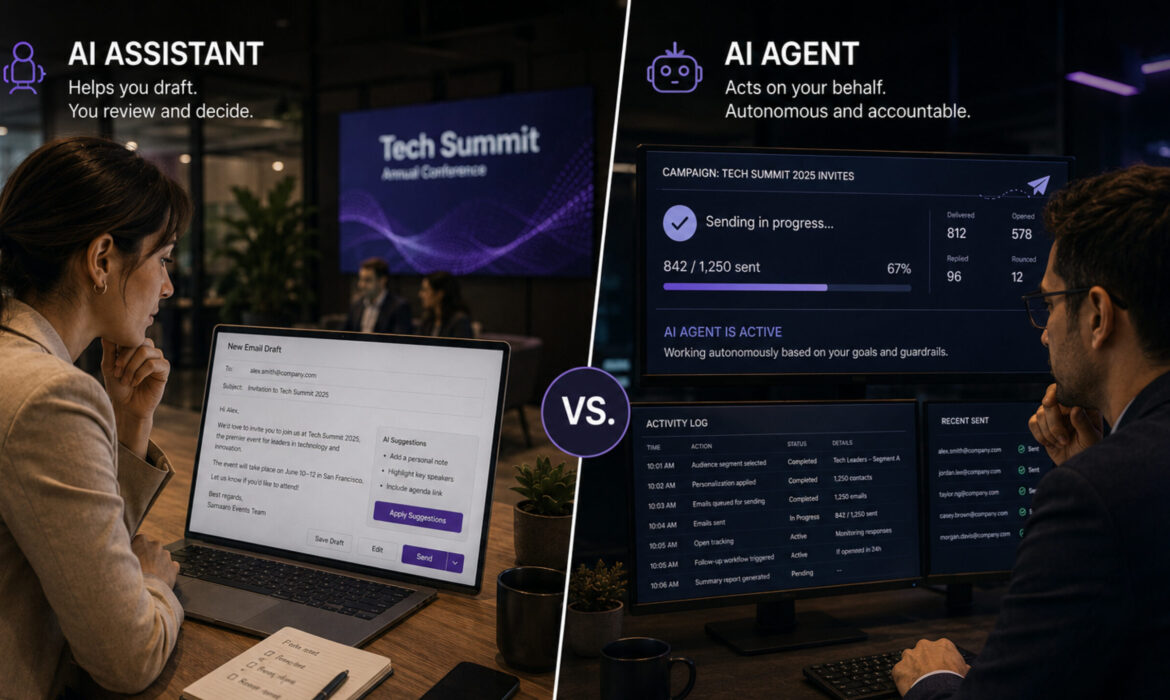
An AI assistant writes the message. An AI agent sends it. Everything people argue about when comparing AI agent vs AI assistant: how capable each one is, how advanced, how close to the future. All of that sits downstream of that one sentence. And the sentence is not really about AI. It is about who answers for something that went out under your name while you were in another meeting.
So, when do you need an AI agent rather than an AI assistant? When the work repeats often enough that reviewing every step costs more than the step itself, and when your team can name who is accountable for an action taken without a human reading it first. Until that second condition has an answer, an assistant does more of the job with none of the exposure.
The real question is what each one requires from the team to work.
An AI assistant answers when asked, and its output is words. An agent pursues a goal across several steps, and its output is completed actions inside your tools. That is correct, it is settled, and anyone who wants the full version has somewhere to go.
The problem is how the two get arranged. They are usually presented as a progression, with the assistant as the starting point and the agent as the destination, which makes the move between them look like an upgrade decision. Upgrades are about capability and budget. This is neither of those things.
What the progression framing hides is easy to state. An assistant at its most capable still produces a draft that a person reads before anything happens. An agent at its least capable already acts. The gap between those two states is permanent. No amount of improvement carries an assistant across it. A better assistant is a better drafting tool. It remains a drafting tool.
Which explains why adoption paths differ. An AI assistant takes an afternoon and one person’s decision. An agent requires a conversation with multiple people. Not because of cost, but because of accountability. For the practical side of getting more out of the drafting half, the AI event marketing toolkit covers prompts and workflows in full.
One task, held fixed, run three ways. A senior invitee registered three weeks ago and has gone quiet, and somebody needs to reach out before the event. Watch what changes at each stage, and specifically who owns the outcome.
You notice while scanning the list on Thursday. You decide it’s worth a personal note rather than a template. You write it, you send it, and if the wording lands badly, it’s your wording. Five steps, all of them yours, and the ownership question never arises because the answer is obvious.
You still notice on Thursday. You ask for a draft, get three versions back, pick one and change two lines because the second paragraph is too eager. Then you send it. Faster, and the ownership question still never comes up, because a person reads every word before it leaves the building.
The agent notices on Tuesday, which is earlier than you would have. It selects an approved template, sends it, logs the action, and tells you afterward. Two things changed at once. The work happened sooner and probably better, and for the first time, nobody read that message before the invitee did.
What moved across those three is not quality and not speed. It is the point at which a human sits in the loop. In the first two, the review happens before the action. In the third, it happens after. Reviewing something that has already gone out is a different activity. One that deserves a different name and a different owner. That is how to tell if a tool is an agent or an assistant, and it holds regardless of what the product page calls it. Inside event management software, the same distinction decides which settings need a conversation before anyone touches them.
Who is responsible when an AI agent sends the wrong message? Whoever approved the rule that allowed it. That’s why the rule needs a named owner before the agent is switched on, not after the first mistake goes out.
Four things appear at that boundary and never appear before it. A log, because an action nobody reads has to be readable later. A named reviewer, because a log with no reader is a record of things nobody checked. A rollback path, because some actions can be corrected and knowing which ones in advance is the difference between an incident and an inconvenience. And an owner, because each of the first three needs somebody whose job it is.
None of these are AI problems. They are the obligations that attach to any system able to act on your behalf, and event teams have met them before in payment approvals and venue access without ever calling it governance.
One team turned on automated sending and found that nobody had agreed on who would answer for a message they hadn’t read. The question got asked for the first time three days later, with a message already in a senior contact’s inbox and a rule nobody could remember approving. Nothing about the technology failed. The question had simply never been raised, which is the pattern that runs through most AI adoption failures on the implementation side.
The asymmetry is what decides the choice. An assistant asks for nothing but your attention. An agent asks for a decision about responsibility, and that decision is cheap to make in advance and expensive to make in retrospect.
The useful preparation is not a maturity assessment. It is making sure four questions have named answers before anything gets switched on.
Each of those takes a few minutes to answer before adoption and consumes a week if it surfaces unanswered afterward.
Both words are marketing terms, both get applied loosely, and the label on the box is a poor guide to what you are being sold. One produces drafts and asks for your attention. The other produces actions and asks for your accountability.
So drop the vocabulary. One drafts, one acts. In the next vendor conversation, ask which of those two things it does, then ask whose name appears in the log when it does it. If nobody can answer the second question, the first answer doesn’t matter much. Understand how AI is changing sales conversations at events and what each tool actually does.
To see where those lines get drawn across registration, communications, and routing in one place, book a walkthrough.
1. How does event manager software help you distinguish between AI agents and AI assistants?
Event manager software shows the distinction through permissions. Agents send without you reading first; assistants require approval. Check: can the tool act independently? If yes, it’s an agent needing a log, reviewer, and named owner.
2. What does event management app do when an AI agent acts without human review?
Event management app logs every action: what went out, to whom, when, why. A log nobody reads doesn’t control anything. Someone must review it weekly with their name assigned. That person owns accountability for what the agent did.
3. Why does conference attendance tracking need AI agent oversight?
Conference attendance tracking with AI agents requires oversight because automated attendance updates affect downstream reporting, follow-up routing, and sponsor reporting. A named reviewer must verify data integrity weekly. This prevents cascading errors from bad attendance data into all downstream systems.
4. How does event coordinator software distinguish agent actions from assistant drafts?
Event coordinator software distinguishes them by showing who owns each action. Assistants produce drafts for coordinator approval. Agents send independently, generating logs that require coordinator review. Ask: can it act in the coordinator’s name without reading approval first?
5. What should event organizer software never let an AI agent do alone?
Event organizer software should never let agents send to named accounts without coordinator review, delete records, commit budget, or change pricing without approval. These are irreversible actions. Decide in advance: which actions need human eyes before they reach the audience?
6. How does conference management software handle AI agent accountability?
Conference management software handles accountability by requiring: a log of all actions, a named reviewer reading it weekly, a rollback path for reversible actions, and an owner for each decision. Without all four, governance fails and accountability disappears.