Samaaro + Your CRM: Zero Integration Fee for Annual Sign-Ups Until 30 June, 2025
- 00Days
- 00Hrs
- 00Min

Key Takeaways (TL;DR)
1
2
3
→
Bottom Line:
The best reminder strategy sends fewer, smarter messages that reach the right attendee at the right moment.
More Reminders, Fewer Attendees
Worried about a soft turnout, a team does the obvious thing: sends more reminders.
Another email today. A text tomorrow. One more in the morning. Each one is a little more anxious than the last. The logic feels right, more nudges, more attendance.
The result is the opposite. Opt-outs climb. Opens fall. The people who were coming anyway feel nagged.
The question teams ask, “How many event reminders should we send?” has the wrong shape.
The answer isn’t a number you turn up until it works. It’s a sequence, spaced and segmented, that respects the attendee while it fills the room.
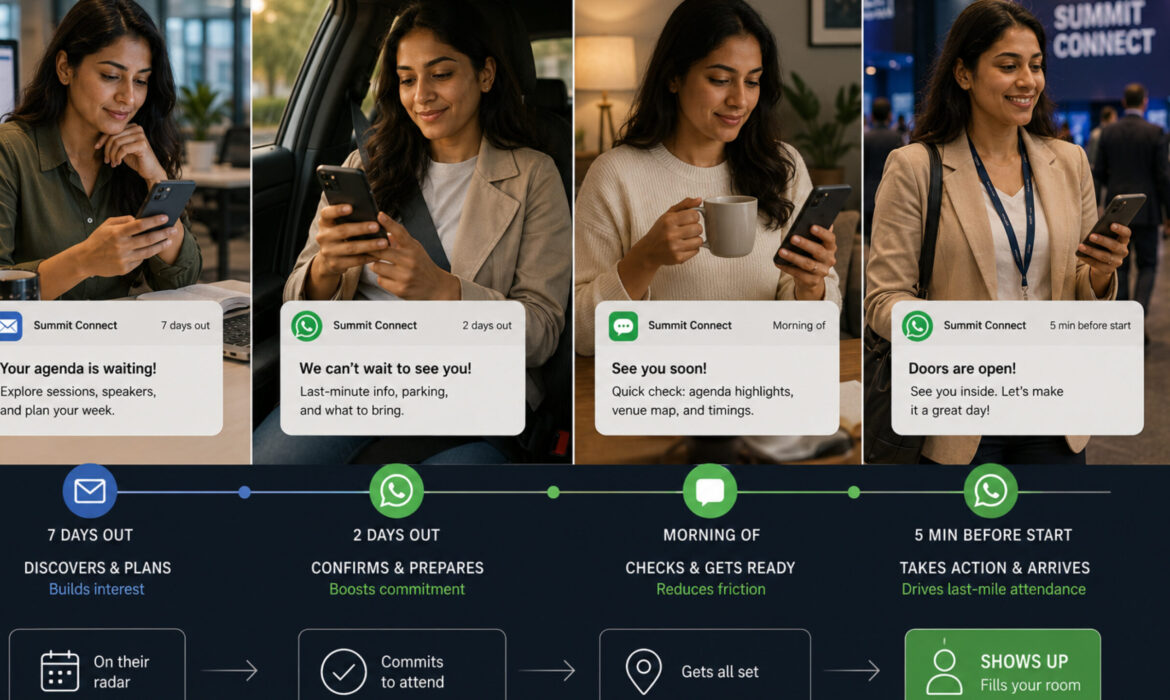
There’s no single right number because reminders are a sequence tied to moments that decide attendance, not a volume dial. A common working pattern runs from about a week out to close to start time, with the exact shape adjusted to the event and the audience.
This piece walks through why a sequence beats a number, the core cadence, what each reminder should carry, how to segment without overwhelming people, and the warning signs that you’ve gone too far.
The instinct to pick a number (three reminders, five reminders) misunderstands what a reminder is for.
A reminder isn’t a repeated ask. It’s a well-timed prompt at a moment when attendance is actually in doubt.
Those moments are predictable. People forget between registering and the event. Calendars fill. The day arrives and life competes. A reminder earns its place when it lands at one of those moments and does a job, not when it simply adds another impression.
The right frame is a sequence: a small set of touches, each mapped to a moment that matters, each carrying something the last one didn’t.
Get the sequence right and two or three reminders can outperform six, because each one is welcome and useful rather than repetitive.
Here’s a dependable starting pattern to adapt for your event.
| Timing | Moment | Job | Content |
| Week out | Registration sinks in | Build anticipation and value | Agenda, speaker highlights, what to prepare |
| Final days | Wavering registrants decide | Remove friction | Timing, location or link, what to bring |
| Day of | Committed person arrives | Pure logistics | When, where, how to get in |
| Hour before | Last-minute distractions | Clear action | Starting soon, join here, doors open |
The shape flexes with the event type. A webinar might lean on the day-of and hour-before touches. A flagship conference spreads the sequence over weeks. The principle holds: each touch sits at a moment that decides attendance.
A week out is when registration begins to feel real. The final days are when wavering registrants make their call. The day is pure logistics. The hour before catches the distracted.
Present this pattern as a guide to adapt, not a formula you copy exactly. What works for a 50-person lunch differs from what works for a 5,000-person conference.
The fastest way to make a good sequence feel like spam is to send the same message four times.
Each reminder needs its own job and its own content.
The week-out touch adds value and builds anticipation. Lead with the agenda or a speaker highlight, something that makes people want to attend.
The final-day touch removes friction with practical detail. Give timing, location, or link, and what to bring. This is where the wavering person decides to actually show.
The day-of touch is pure logistics, short and scannable. When, where, and how to get in. Nothing else.
The hour-before touch is a single clear action: join here, starting soon, doors are open. One thing to do.
Two rules hold across all of them. Give each message one job, so the reader knows at a glance what it wants. And make each touch carry something new: a detail, a reason, or a next step, so no reminder is a straight copy of the one before.
When every touch adds something, the sequence reads as helpful attention. When they repeat, it reads as nagging, and the opt-out is the reader’s only way to make it stop.
The way to send fewer messages without losing attendance isn’t to cut the sequence for everyone.
It’s to send each message only to the people who actually need it.
Done this way, a single well-timed reminder reaches only the segment for whom it’s relevant. The total messages any one person receives stays low even when the overall plan is rich.
This is the difference between a plan that feels attentive and one that feels like a blast.
The requirement underneath: segmentation only works if every channel reads from one shared attendee record. The plan needs to know who confirmed, who engaged, who opted out, and who already checked in.
Cadence and channel are two different decisions, and they work together.
The week-out and final-day touches, which carry detail, usually belong in an email. The day-of and hour-before touches, which must be seen fast, are where a text earns its place.
WhatsApp can carry confirmations and conversational nudges within its own rules.
The short version: the closer a reminder sits to the moment it protects, the more it leans toward an interrupting channel like SMS. The further out and more detailed it is, the more it leans toward email.
That’s the summary. Which channel carries which message in full, and how to run WhatsApp specifically, are their own subjects. Both are covered in depth in the dedicated blogs.
The plan itself will tell you when it has tipped from attentive to annoying, if you watch the right signals.
Rising opt-outs and unsubscribes across the sequence are the clearest sign a touch is unwelcome. Falling open and reply rates as the sequence goes on suggest fatigue setting in.
A spike in mutes or blocks on WhatsApp is the sharpest warning of all, because that channel tolerates the least.
When you see these signals, the fix is rarely to cut one message at random. It’s usually to tighten segmentation, so fewer people get each touch. And to check that every reminder still has a distinct job.
Over-messaging is almost always a targeting problem wearing the costume of a volume problem.
Filling a room isn’t about sending more reminders. It’s about sending the right ones at the moments that decide attendance, to only the people who need them.
A sequence tied to moments. One job per touch. Segmented by behavior. On the channel that fits.
Look at any reminder in your sequence and ask: who doesn’t need this?
If the answer is nobody, your segmentation is doing the work. If the answer is half your list, that reminder is where your opt-outs are coming from.
For the full picture on which channels carry which reminders, and the WhatsApp-specific rules for the touches that land there, those are covered in the channel-selection and WhatsApp blogs in this series.
Ready to build a reminder sequence that fills the room without wearing out your audience? Talk to the Samaaro team about scheduling and segmenting reminders from one attendee record.