Samaaro + Your CRM: Zero Integration Fee for Annual Sign-Ups Until 30 June, 2025
- 00Days
- 00Hrs
- 00Min

Key Takeaways (TL;DR)
1
2
3
→
Bottom Line:
Treat WhatsApp as a trusted service channel, not another marketing inbox, and attendees will keep it open instead of muting it.
The Channel Teams Treat Like Email
A marketer sees the open rate on WhatsApp, far higher than email, and reaches an easy conclusion: send more here.
So the event updates start flowing, one after another. The same promotional tone that fills an inbox now buzzes in a personal chat app. Within a week, the mutes begin, then the blocks, and the channel that looked like a gift turns into a liability.
This is the trap with WhatsApp for events. The very thing that makes it powerful, that people actually read it, is the thing teams destroy by treating it like another email list.
There are four key components to using WhatsApp effectively for events. Before sending a message, get express consent. The majority of messages should be transactional and helpful rather than advertising. Observe Meta’s regulations, which vary per nation. Additionally, keep the frequency low because WhatsApp penalizes excessive use more quickly than any other platform.
This blog explains the differences between WhatsApp and email, how permission functions, the distinction between transactional and promotional lines, the one Meta rule that B2B teams need to understand, and what constitutes excellent cadence.
Email is a public square. It’s an inbox built to hold marketing, so an unwanted email is deleted and forgotten.
WhatsApp is a living room. It’s where people talk to family and close colleagues, so an unwanted message there feels like an intrusion, not a nuisance.
That difference changes all the rules.
The same message that’s fine in an inbox can feel like a violation in a chat thread. Attention on WhatsApp is higher precisely because the space is more personal, and that attention is a loan, not a right.
WhatsApp rewards restraint and relevance, and it punishes volume and promotion harder and faster than email ever does. Every rule that follows, permission, message type, and cadence, comes from respecting the space you’re borrowing.
On WhatsApp, permission isn’t a courtesy. It’s the condition of using the channel at all.
People must opt in knowingly, and the opt-in should be specific. They’re agreeing to receive event updates on WhatsApp, not signing up for a general marketing relationship.
How to get it cleanly: offer WhatsApp as a choice at registration. Tell people exactly what they’ll receive and roughly how often. Make opting out as easy as opting in.
A one-line footer that lets someone reply to stop is both a compliance signal and a trust signal. It says you respect their choice.
Why it matters beyond politeness: WhatsApp watches engagement and complaints closely. A list built without real consent generates the blocks and negative signals that damage your ability to reach anyone. Clean permission is what keeps the channel usable over time.
The most important line on WhatsApp is the one between transactional and promotional messages.
Meta calls them utility and marketing templates, and the distinction is simple but powerful.
| What it is | Helps attendee with something they’re already doing | Persuades attendee to take action |
| Examples | Confirmation, calendar link, check-in reminder, room change, badge delivery | Register now, don’t miss this, speaker announcement with CTA |
| Works on WhatsApp? | Yes. No restrictions. People want these. | Limited. Meta paused these to US numbers from April 1, 2025. |
| What to do | Send these on WhatsApp. People welcome them. | Send these on email or SMS instead. |
The working rule for events: keep the overwhelming majority of WhatsApp messages transactional. Let the invitation and any promotion live mostly in email. Reserve WhatsApp for the confirmations, reminders, and day-of guidance that the attendee is glad to receive.
A channel that only ever helps is a channel people keep open.
One Meta policy shapes any WhatsApp plan that touches United States attendees.
Starting April 1, 2025, Meta paused the ability to send WhatsApp marketing-category template messages to United States phone numbers. Utility and authentication messages still work. Replies inside the customer service window still work. But promotional templates to United States numbers aren’t delivered.
Marketing messages to numbers outside the United States are unaffected.
The practical takeaway: for United States audiences, WhatsApp is a transactional and conversational channel. The promotional lift comes from SMS or email instead. For international audiences, WhatsApp can carry more.
One more documented limit: Meta caps how many marketing-category messages a single person receives per day across all brands combined. So even where marketing templates are allowed, a heavy send can simply fail to arrive.
Utility messages aren’t capped this way. Restraint isn’t only good manners here. It’s how you stay deliverable.
WhatsApp cadence is governed by one idea: every message must earn its buzz.
Because the channel is personal and high-attention, the tolerance for volume is low. One message too many costs more here than three too many by email.
Practical restraint looks like this:
Give each message one clear job. Space messages out. Never send two in a day unless the second is a genuine time-sensitive update. Vary the content so each touch adds something new. Keep a single call to action per message. Always leave a way to opt out.
For events specifically, this usually means a confirmation, a small number of well-timed reminders, and day-of guidance. No more.
The exact number of reminders and where they sit in the run-up to the event is its own subject. That lives in depth in the reminder cadence blog. Here, the principle is simple: WhatsApp users know you have other channels. Use them.
Picture a B2B summit run on WhatsApp the right way.
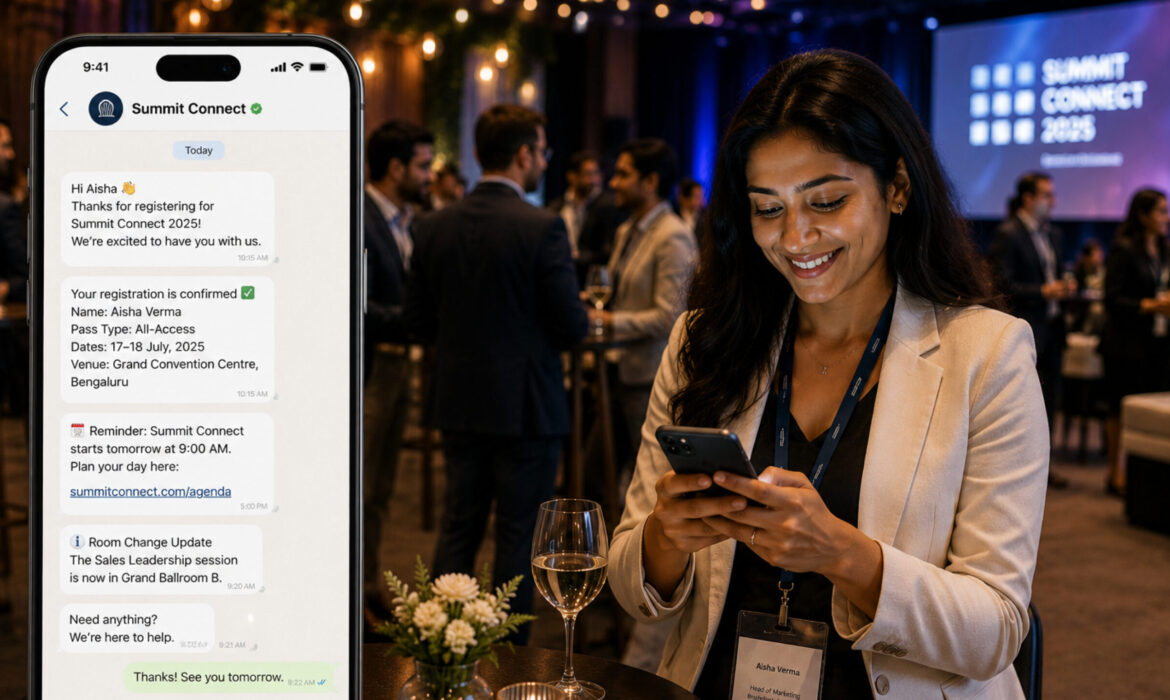
At registration, the attendee opts in and gets an instant confirmation with a calendar link. This is a transactional message they welcome.
In the days before, one short reminder lands. Useful, not pushy.
On the morning of the event, a single message carries parking and check-in details.
During the event, the attendee can reply with a question and get a real answer inside the service window. This is the two-way strength that email cannot match.
Afterward, a brief thank-you with the recording. Then silence until there’s a genuine reason to return.
Every message helped. None sold hard. The channel stayed open because it was never abused.
Which messages should go to email or SMS instead of WhatsApp? That’s covered in the channel-selection blog. The point here is that WhatsApp isn’t a bigger list. It’s a more trusted space.
WhatsApp isn’t a bigger email list. It’s a more personal space that rewards usefulness and punishes volume. The teams that win on it are the ones that treat every message as a favor asked, not a right claimed.
Permission first. Mostly transactional. Within Meta’s country rules. Sparing on cadence.
Before any WhatsApp message, ask one question: Would the attendee thank me for this or mute me for it? If you’re not sure it’s thanks, it belongs in email.
For the full picture on how WhatsApp fits into your channel mix, and the reminder sequence that decides how often messages land overall, those are covered in the dedicated blogs in this series.
Ready to use WhatsApp the right way? Schedule a conversation with the Samaaro team about running it alongside SMS and email from one attendee record.