Samaaro + Your CRM: Zero Integration Fee for Annual Sign-Ups Until 30 June, 2025
- 00Days
- 00Hrs
- 00Min


Say Out Loud Where Your Program Stands
Most event teams can’t say out loud where their program really stands. Ask a room of marketers how mature their event function is and you’ll get a shrug, a hedge, or a number that’s a stage too generous. Nobody’s lying; the yardstick just isn’t shared, so everyone measures against a different mark.
Here’s the honest version. Event marketing maturity moves through four stages: ad hoc, repeatable but siloed, managed and measured, and optimized and revenue-linked. Most teams sit a rung lower than they’d guess, because a busy calendar feels like maturity even when the process under it is improvised.
This piece lays the four stages out plainly, shows what each looks like on a normal Tuesday, and ends with a self-scoring assessment that places your team and hands back what to fix first, in order.
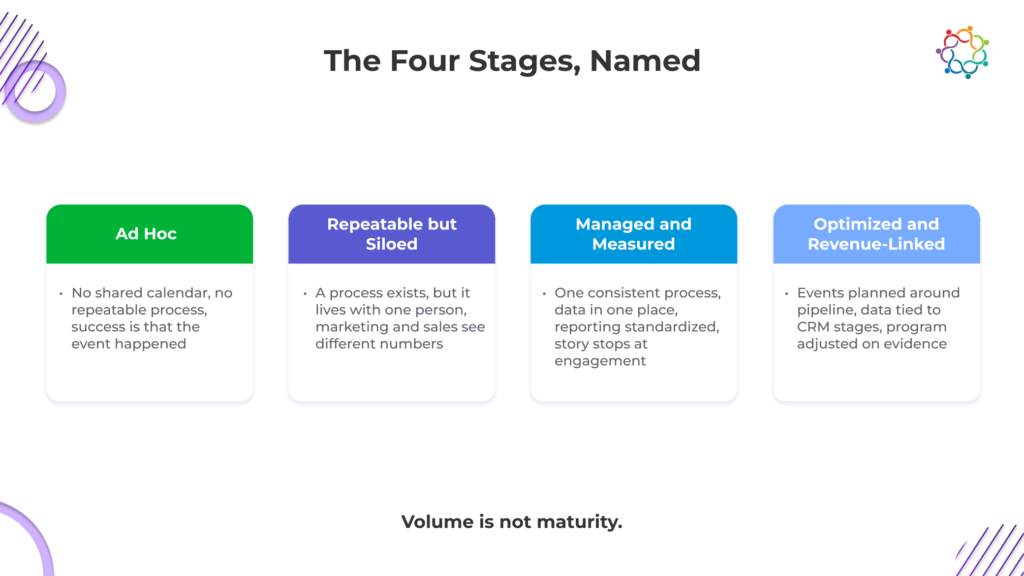
Every event program sits in one of four stages. The trick is being honest about which one.
Common trap: assuming a busy events calendar means a mature program. Volume isn’t maturity. A team running twelve ad hoc events a year is still stage one, because the stage is set by process and measurement, whatever the event count.
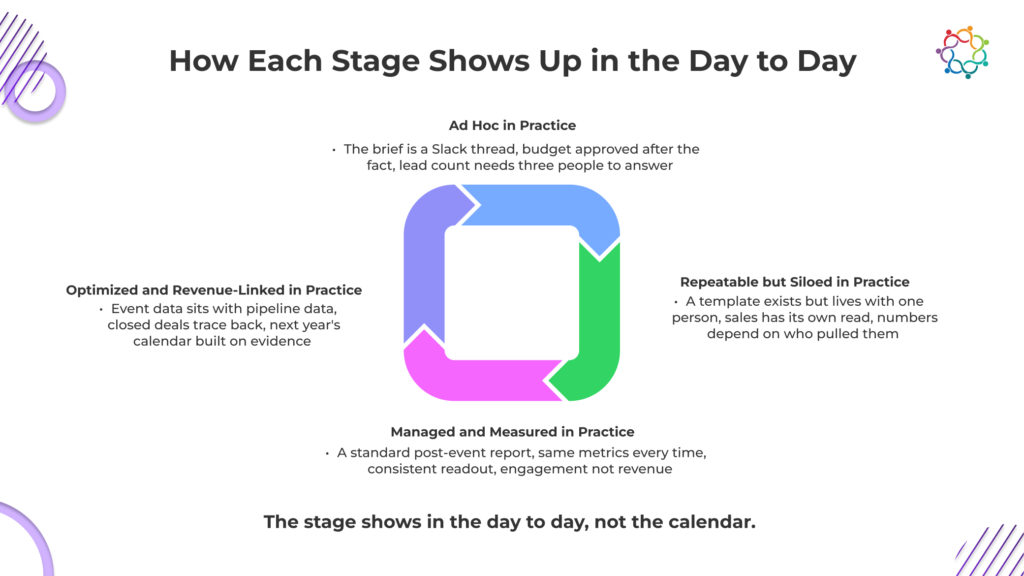
On paper, the stages sound distinct. In practice, each one has tells.
Read those four back and you’ll feel a pull toward one of them. That pull is the honest answer, and it’s rarely the flattering one.
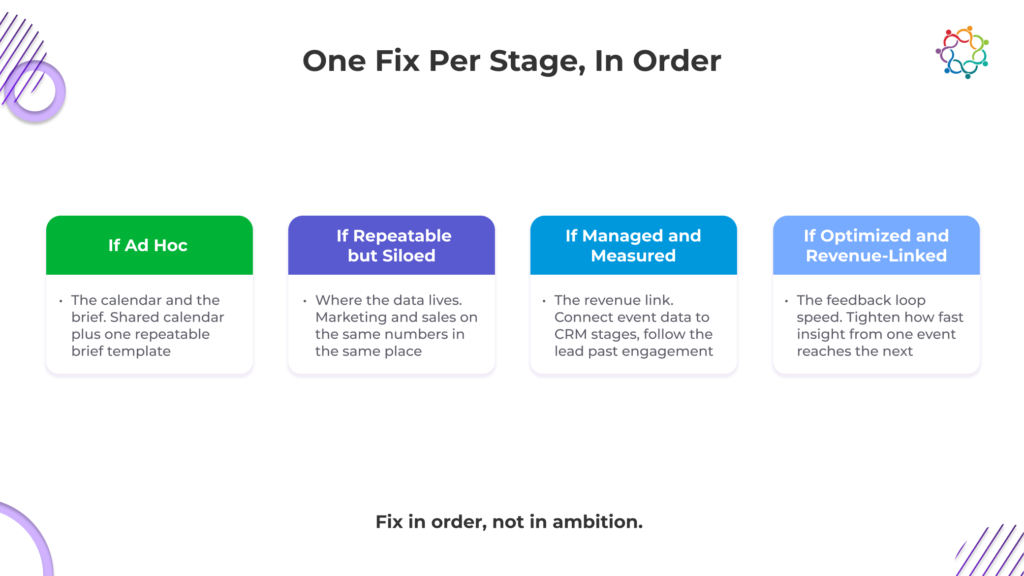
A label on its own doesn’t help. One clear next move per stage does.
The most common mistake is trying to solve a stage-three or stage-four problem while still sitting at stage one. Trying to prove which events drove revenue before the team even has a shared calendar or a single source of data is building on a foundation that isn’t there. The stage-one work has to exist before the stage-three work can stand on it.
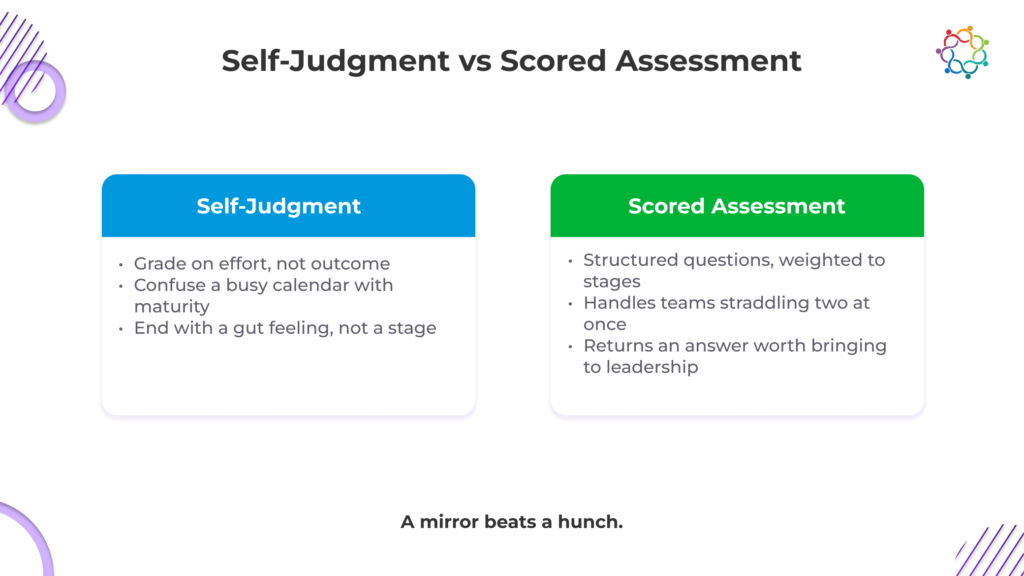
Reading the four stages and guessing sounds easy. Doing it accurately isn’t, for three reasons.
A team close to its own program grades itself on how hard it worked. If everyone worked hard, the program feels mature even when the data trail says otherwise. The stages also look cleaner on paper than in life: most teams sit across two at once, repeatable in one part of the process and ad hoc in another, which makes a single confident label hard to land without scoring it out. And a gut-feel rating is hard to defend upward. A team can feel busy all year and still not be able to say, plainly, where its program actually stands.
A structured set of questions, scored rather than self-judged, replaces the hunch with a defensible answer. And a defensible answer is a far easier thing to take into a QBR or a budget conversation than a feeling.
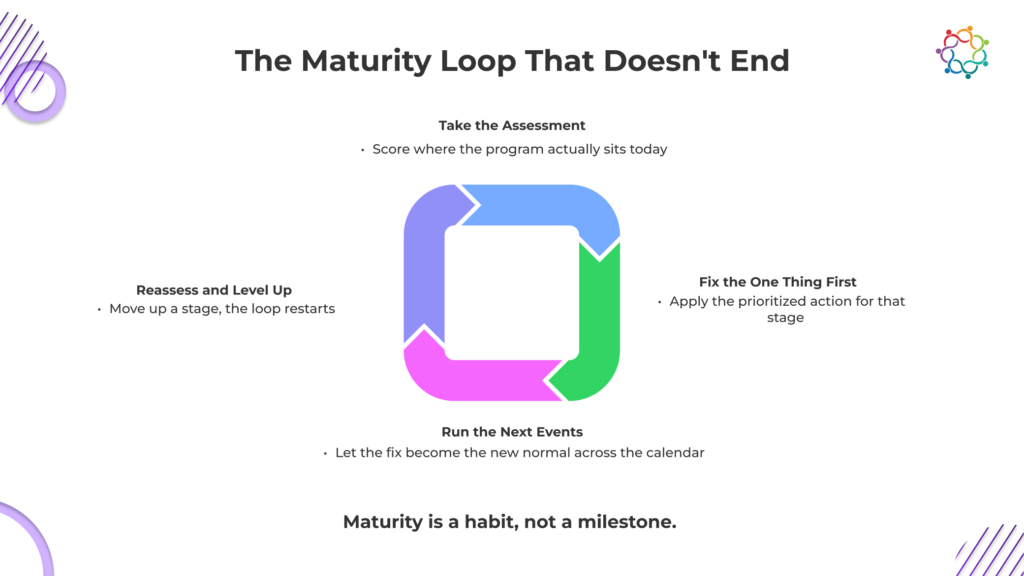
Four stages, a recognizable version of each, and one fix-first move for wherever you land. That’s the whole diagnostic, and it works because it turns a vague “we should be further along” into a specific next step.
So score it, name the stage without flinching, and put the next unit of effort where that stage says it belongs. The next time someone asks how mature your event program is, you’ll have a straight answer: the stage you’re in, and the one thing you’re fixing because of it.
The full version is built into a self-scoring Event Marketing Maturity Assessment that places your team in a stage and returns a short, prioritized list of what to fix first, pulled from the stage you land in rather than a generic checklist. Take the assessment below. It takes your first name, work email, company size, and role.
If the fix turns out to be getting your event data and your CRM into one place, book a walkthrough.