Samaaro + Your CRM: Zero Integration Fee for Annual Sign-Ups Until 30 June, 2025
- 00Days
- 00Hrs
- 00Min


Key Takeaways (TL;DR)
1
2
3
→
Bottom Line:
Keep the stack, lose the glue; the manual export is what costs hours every Monday.
Almost every B2B team operates events on a particular stack, which is consistent across the board: a registration tool, a CRM (Salesforce or Dynamics), a marketing automation platform (Marketo or Pardot) for email communications, a spreadsheet to monitor attendance, a Slack channel for coordination, and a manual export between the tools for each event. Teams are transitioning from that stack to an all-in-one event platform for a straightforward reason: the cost of running events across distinct tools and a hand-built export is hours per event, and leads are lost in the gaps. The platform consolidates registration, promotion, check-in, and lead capturing in a single location, and subsequently establishes a connection to the CRM and marketing automation systems that you currently employ. Clearly stated, this maintains Salesforce or Marketo in their current state. The task is to terminate the hand-stitching between them and the export that sustains it.
That shape, what you move off, what you keep, and what changes after, is the whole story, and it is the honest way to think about the switch. It is also a smaller move than it sounds, because most of what makes events painful lives in the manual layer holding the tools together, rather than in the tools themselves. The teams making this move are after one thing above all: an end to the export.
If you have ever spent a Monday morning exporting and cleaning event data before sales could touch it, you already know why this story exists. Most of it will read like your own week, and the parts that do not are usually the parts worth fixing first.
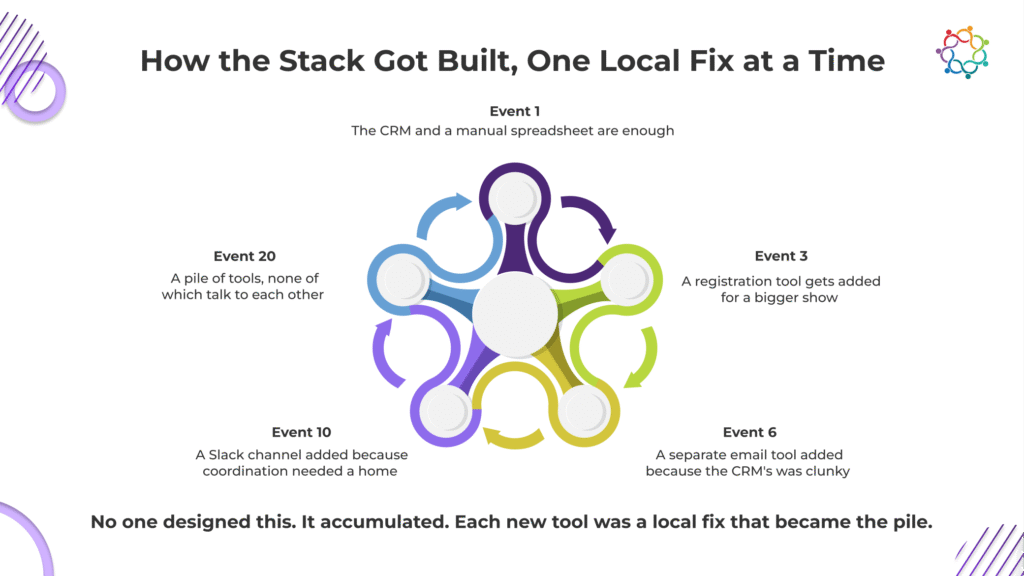
No one sat down and designed this stack. It accumulated. The registration tool came in for one event because it was the fastest option that week. The spreadsheet started as a quick way to track a single guest list. Event email moved to the marketing automation platform because the CRM’s built-in sending was clunky. Slack became the coordination hub because the work needed a home. Each piece solved a real, local problem at the moment it was added. None of them were chosen as part of a plan, and that is exactly why the result is a patchwork.
The stack sticks because it works, more or less. The team has learned every workaround, knows which file to export and which column to clean, and switching feels like more disruption than the daily friction of keeping the pieces aligned. So the pile persists, and it tends to grow rather than shrink. In the 2025 State of Your Stack survey, more than six in ten marketers said they were running more tools than they had two years earlier.
The real reason it survives is that the cost is spread out. It is an hour lost to an export here, a lead that cooled in a spreadsheet there, a report rebuilt by hand for a meeting. No single moment is painful enough on its own to force a change. The cost is real, but it arrives in small pieces, never as one bill. Until, at some point, it does.
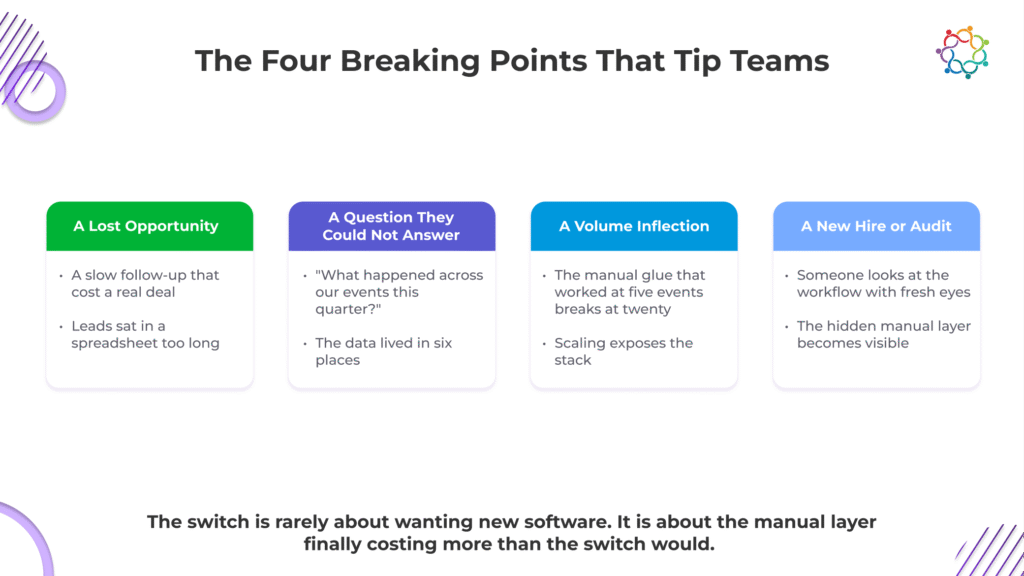
The cost that is dispersed is almost always concentrated in a single instant, and that moment is typically one of a few. The leads were in a spreadsheet awaiting cleaning and uploading, which resulted in a genuine opportunity cooling while the follow-up was sent out days later than anticipated. Or, a leader posed a straightforward inquiry: What transpired during our events last quarter? The truthful response was that no one could provide an answer without manually reconciling data from six distinct tools. Or, the event calendar expanded, and the manual adhesive that had previously held together five events annually began to unravel at twenty. This is due to the fact that handwork does not scale in the same way as a calendar.
Sometimes it is quieter than that. A new hire watches the end-of-event routine and asks why so much of it is manual. An audit surfaces how many hours the stack quietly consumes. Across the conversations we have with B2B marketers, the same picture keeps surfacing under different words: the person running events has slowly become the integration between the tools, the human glue moving data from one system to the next.
The common thread is that none of these is really about the software being bad. The registration tool is fine. The CRM is fine. What stops being sustainable is being the integration, doing by hand, every event, the work the tools should hand off on their own. Teams switch at the moment that manual layer costs more than changing it would.
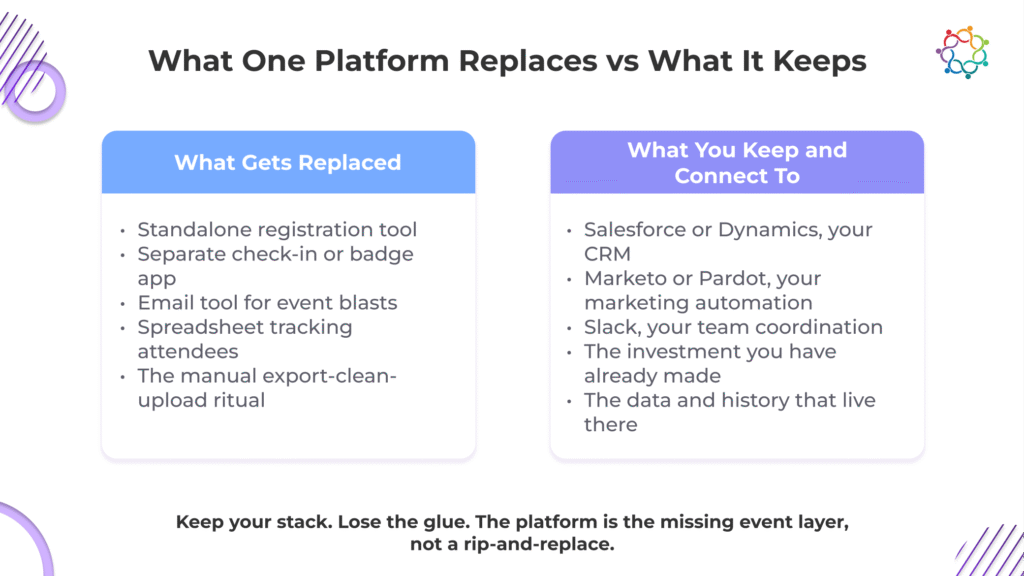
Here is the precise scope of the switch, because precision is what removes the biggest worry about it.
An all-in-one event platform replaces the tools that exist only to run the event, plus the manual work of moving data between them:
What it does not touch is the core stack you have already invested in and built your operation around:
The principle is simple to hold onto. The platform consolidates how events run and connects to the stack you already pay for. Think of it as the missing event layer, the piece that sits in front of your martech and stops you from hand-feeding it, rather than a replacement for any of it.
This is also where the integration question gets real, and it sets up the rest of this piece: a genuine all-in-one platform syncs two ways with the CRM, so event data lands automatically and the records stay in step, with no export to run.
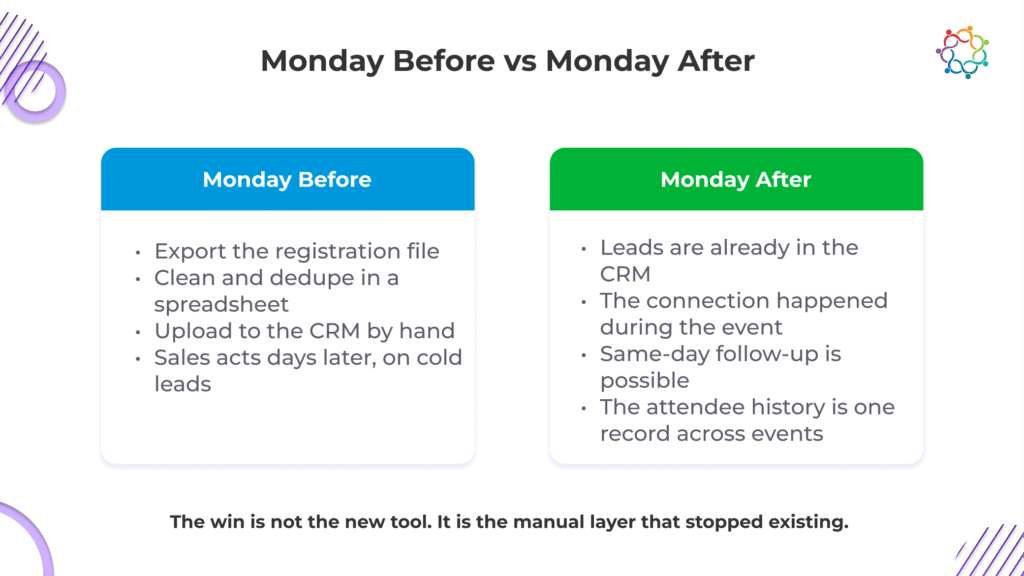
The clearest way to see the switch is to compare two Monday mornings.
Before Monday looks like recovery. You export the registration file, the check-in scans, and the lead list. You clean them, dedupe the overlaps, fix the formatting, and upload the result to the CRM by hand. Only then can sales see the leads and start working them, which by now is several days after the conversations that created them. The event ended on Thursday, and the leads reached a rep the following week.
After that, there is no Monday upload, because there is nothing to upload. Capture and the CRM connection are a single flow, so a lead scanned at the booth is in the CRM as a real record while the event is still running. Sales can follow up the same day, because the data is already where it needs to be the moment it is captured. The spreadsheet step is simply gone.
Connected data changes the picture, too. An attendee who came to three of your events shows up as one record across all of them, instead of three disconnected rows in three separate files, so you can finally see a person’s whole history with your events in one place. And the hours that used to go into moving and cleaning data go back to the team, to spend on the program itself.
This is the part worth being clear about: the real change is subtraction. The switch removes the manual layer, and that removal is the actual win. It already works at this scale, as a 20-person team running more than two hundred events a year on one platform shows.
Two worries come up every time, and both deserve a straight answer.
The first is investment. You have spent years and real budget on Salesforce and Marketo, and you are not about to replace them. You should not, and you do not have to. The event platform sits in front of those systems and feeds them. Your CRM remains the system of record. Your marketing automation remains the nurture engine. What you are connecting to your events is the stack you already built, and what you are removing is the manual handoff in between. This is also where the fair skepticism lives, the experience of being told something would sync when it never really did. The thing to press on is two-way sync: event data should flow into the CRM automatically and stay in step as records change, rather than arriving as a one-time dump you still have to reconcile. Ask exactly how the sync works before you believe it.
The second worry is disruption. Switching mid-stream feels risky, and that is fair. But the move adds the event layer and retires the spreadsheet and the export, rather than tearing anything out. The CRM, the marketing automation, and all the data inside them stay exactly where they are. The disruption of the change is smaller than the daily friction it removes, week after week.
The honest framing of the switch is keep your stack, lose the glue. Nobody is asking you to burn it down and start over. That is what makes this a low-risk move rather than a migration: the expensive, established parts of your stack are the parts you keep.
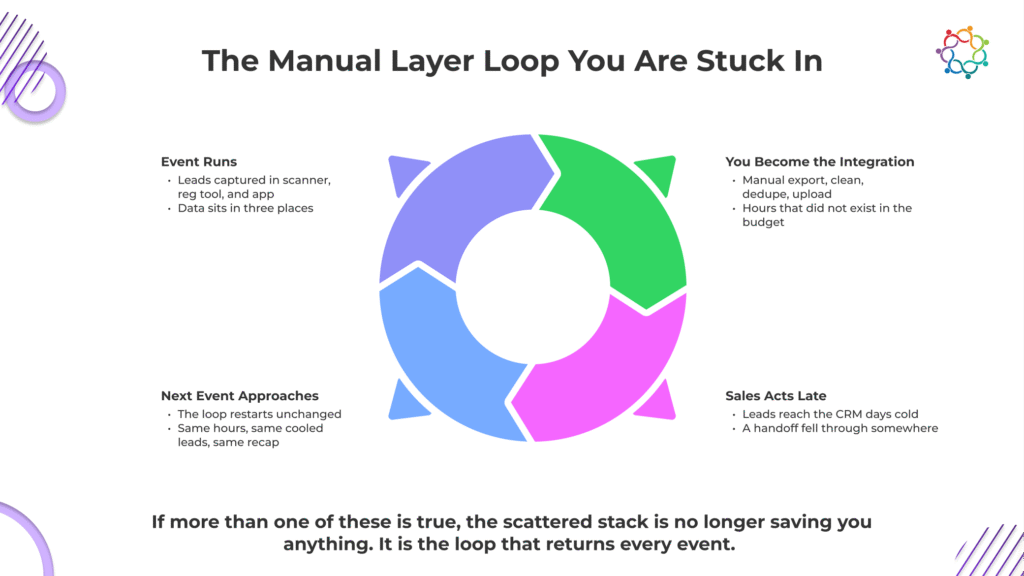
None of this means everyone should switch today. The scattered stack is fine right up until it is not, and the tell is usually a handful of specific signs. If more than one of these sounds like your team, the stack has likely stopped earning its place.
Read those honestly. One of them on its own is survivable, the kind of thing you work around. Two or more of these happening in every event is the pattern that tips teams. At that point, the scattered stack costs more than it saves: lost leads, wasted hours, and the inability to answer for your own program. That cost is the signal teams act on.
Strip the story to its core and it is short. Teams making this move are after one thing: an end to the manual layer. They run events on one platform that connects to the stack they keep, so the whole workflow becomes one flow instead of six tools stitched together by hand. The CRM stays the system of record, the marketing automation stays the nurture engine, and the events finally get a home that talks to both, with the team’s hours going back to the program instead of the cleanup behind it.
The scattered stack was never a decision. It was an accumulation no one stopped to question, and the teams walking away from it are the ones getting their Monday mornings back.
If that stack looks like yours, the fastest way to see the difference is to watch your own event workflow run on one platform. Book a walkthrough.