Samaaro + Your CRM: Zero Integration Fee for Annual Sign-Ups Until 30 June, 2025
- 00Days
- 00Hrs
- 00Min


Key Takeaways (TL;DR)
1
2
3
→
Bottom Line: When designed intentionally, micro-events accelerate the pipeline by revealing intent and momentum.
Sales teams have never lacked leads. What they lack is confidence in the conversations those leads represent. Large-scale events have spent a decade optimizing for reach and volume, but sales outcomes haven’t kept pace. Attendance numbers look impressive, dashboards stay green, and sellers still struggle to tell who’s genuinely interested and why, which is exactly the disconnect pushing more revenue leaders toward smaller, more deliberate formats.
Micro-events change that equation because they feel less like a marketing broadcast and more like an actual sales conversation. When attendance is intentional and discussion is central, intent becomes visible. Sales hears the real questions, the real objections, the real urgency behind someone’s interest, the same signals covered in how micro-events support engagement more broadly.
The tension here is structural. Marketing tends to frame micro-events as lighter experiments, while sales experiences them as genuinely productive working sessions. This piece reframes them as a repeatable sales channel, not just an alternative event format.
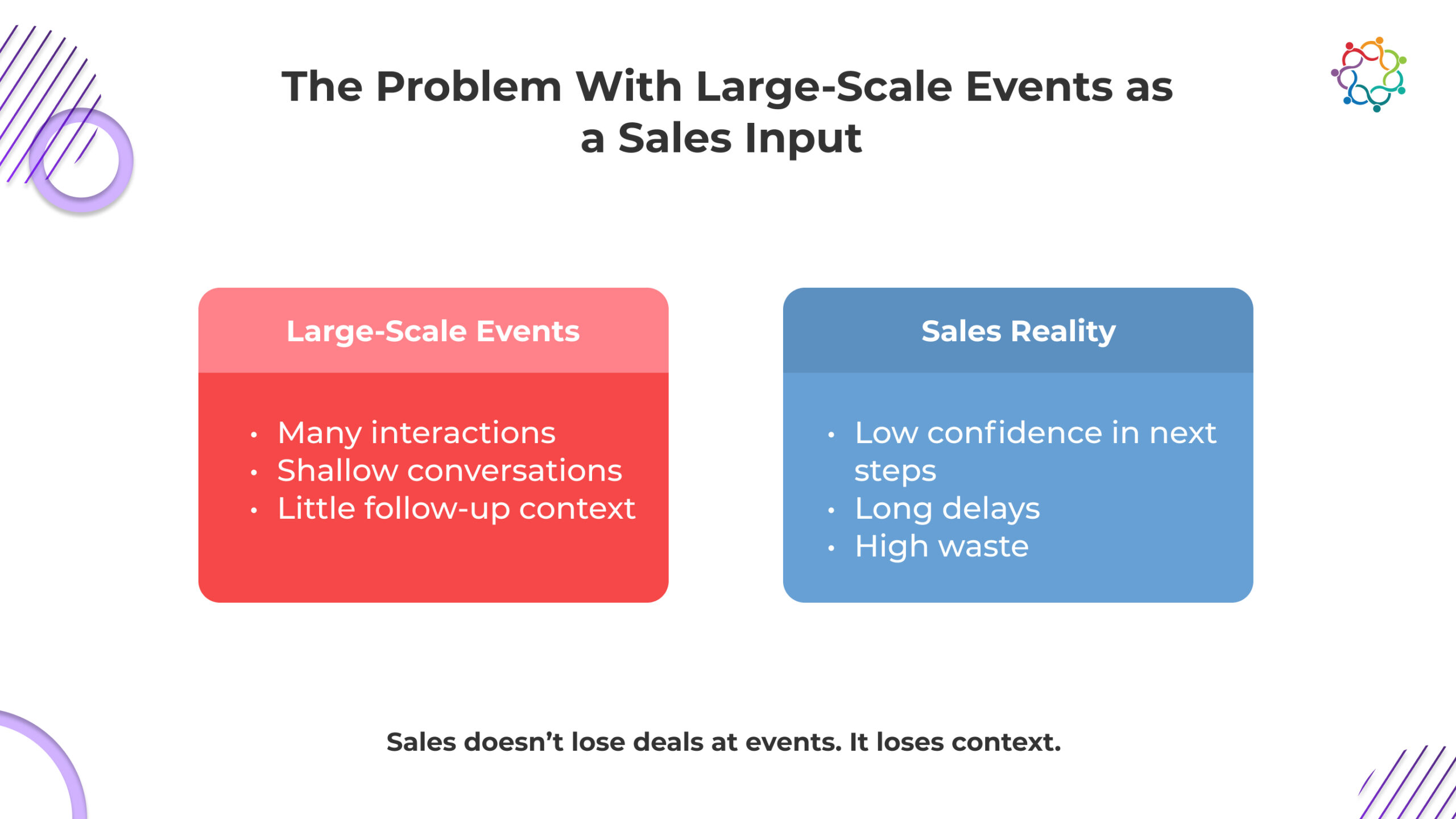
Large events consistently underperform as a sales input, not from poor execution, but because their structure works against how sales actually evaluates value. A few specific problems show up again and again.
Intent gets diluted by scale. A big audience includes plenty of people who aren’t in an active buying stage, and sales ends up unable to separate real intent from casual curiosity.
Conversations lack context. Interactions are short and interrupted, and by the time sales follows up, the details about priorities and timing are already gone.
Momentum breaks after the event. The gap between the interaction and actual sales engagement weakens relevance fast.
Noise outweighs the signal. High lead volume hides low conversion, and sales learns to distrust these lists because qualifying them costs more than they return.
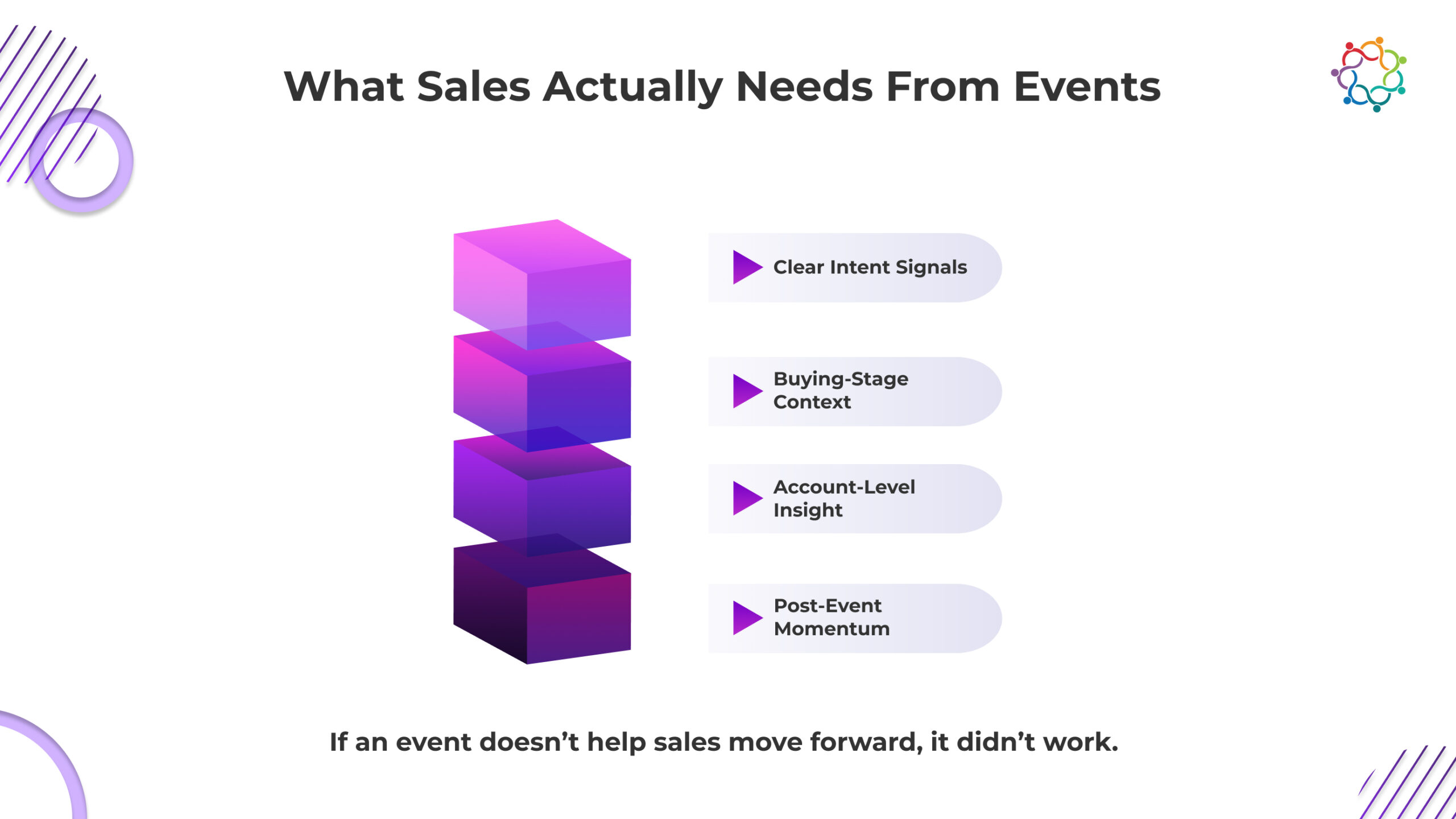
Sellers rarely mention attendance numbers when they describe a valuable event. They talk about understanding where an account stands, who’s actually involved in the decision, and what problem is being actively solved.
Sales-ready events provide insight into buying stage and let sellers watch how stakeholders interact, a rare window into buying committee dynamics. What sales actually looks for: observable intent expressed through real dialogue, a clear read on priorities and objections, visibility into who influences and who decides, and momentum that carries into the next interaction. Micro-events meet these criteria by design, replacing attendance volume with conversation quality as the real measure of success.
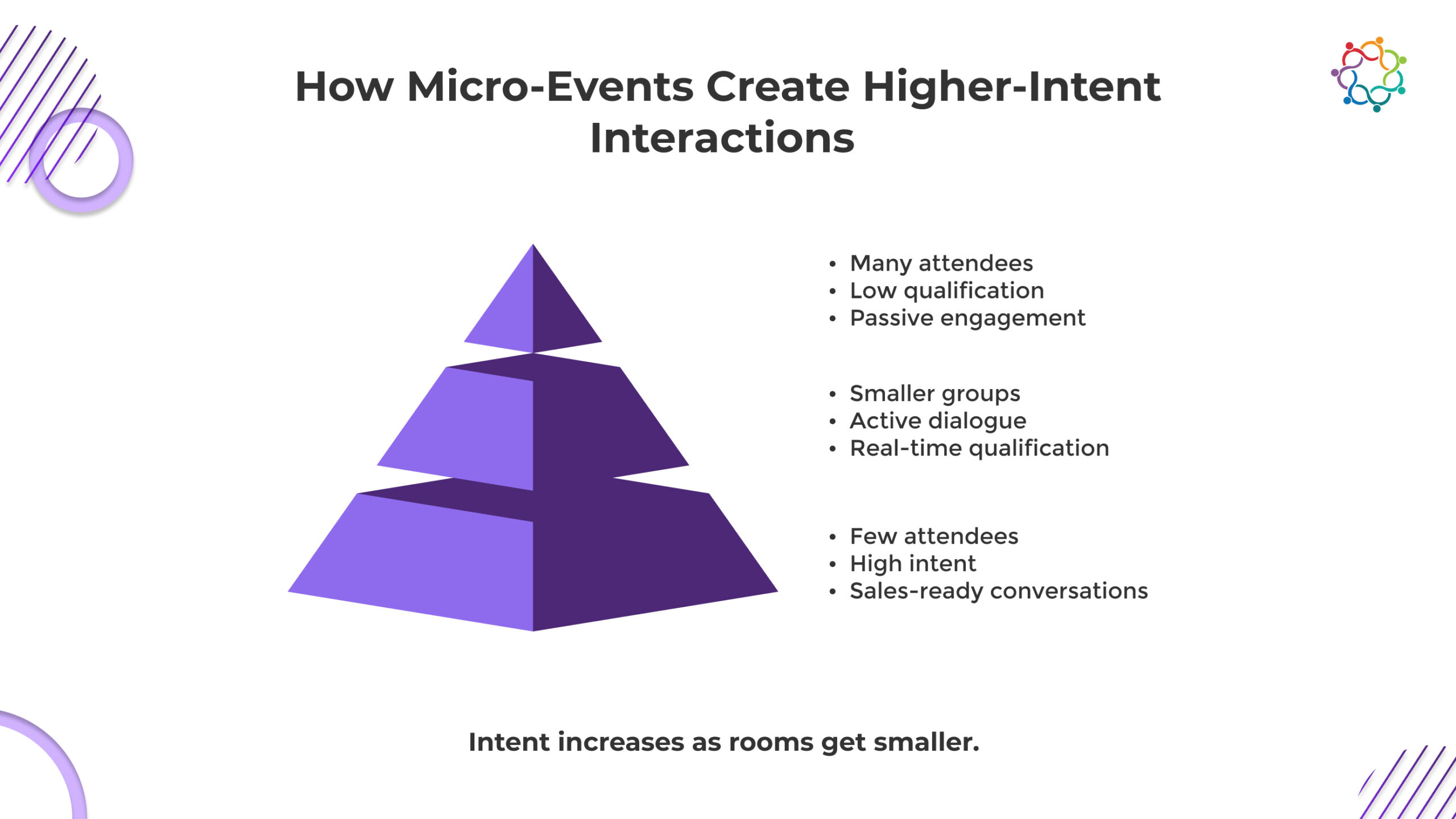
Micro-events change the quality of sales conversations by removing the conditions that hide intent in the first place. A handful of specific mechanics make that happen.
Smaller groups enable real discussion, since limited attendance makes conversations more direct and less performative. Relevance filters out low intent, because a micro-event built around a specific theme or account set naturally discourages passive attendees. Intent shows up in dialogue, in the actual questions and objections people raise, rather than something sales has to infer from a click or a download. And shared context strengthens follow-up, since everyone heard the same discussion, which means sales can reference it directly instead of resetting the conversation from scratch.
For more on what these formats actually look like in practice, this list of micro-event ideas is a good starting point.
The obsession with lead volume persists because it’s easy to measure. Sales outcomes are harder to predict and take longer to show up. Micro-events produce fewer leads that convert at meaningfully higher rates, and for sales, that trade-off is an upgrade, not a compromise.
Volume-driven models also hide inefficiency, creating the illusion of pipeline contribution while masking a long sales cycle underneath. Fewer leads outperform larger lists because they convert to real sales conversations more often, move faster thanks to context that already exists, and create less friction in follow-up.
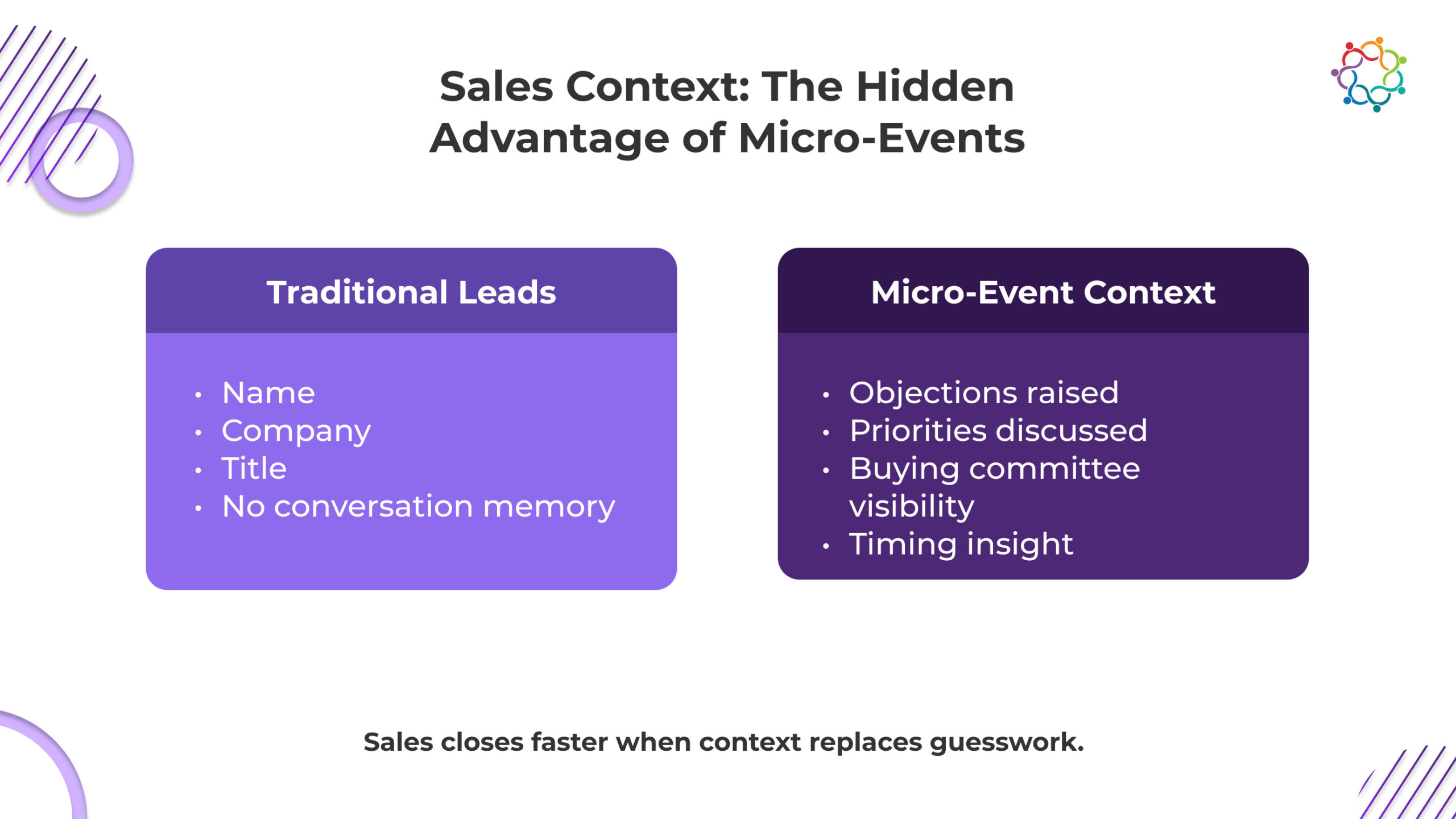
Leads are only part of what a micro-event delivers. The real advantage is depth of context, insight into not just who attended but what actually mattered to them, objections raised, priorities discussed, timing signals rarely captured anywhere else.
That context extends past individuals into buying committee dynamics, and there’s a memory effect too: sellers remember a conversational, participatory session in a way they don’t remember a booth visit, and that recall makes the next interaction feel continuous instead of transactional.
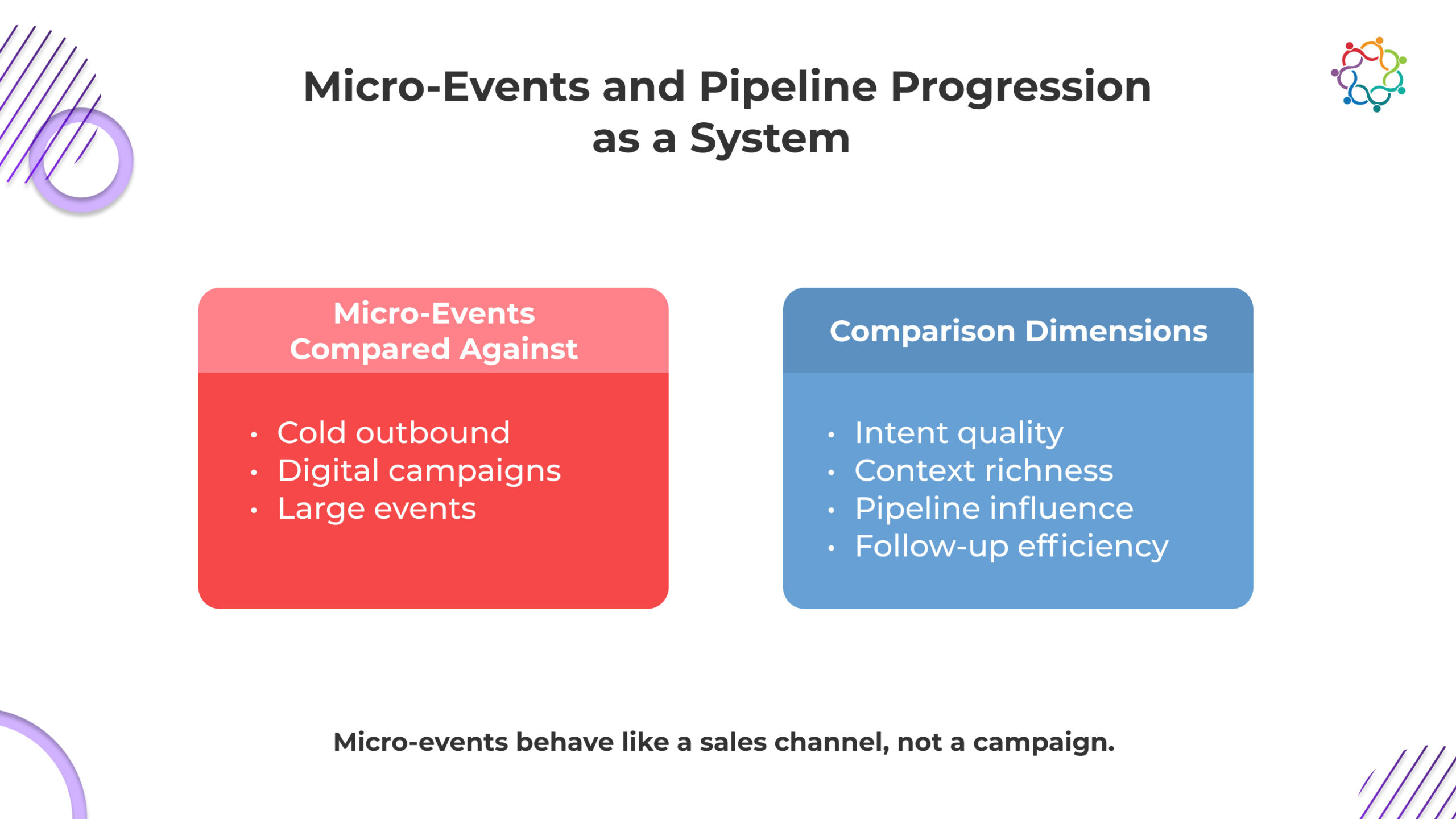
Micro-events move the pipeline forward more often than they create it from scratch. Their impact usually shows up as acceleration, not creation, deals progress faster because trust and understanding already exist, and a dormant account sometimes re-engages after a focused conversation surfaces a new angle.
Late-stage conversations benefit too, with peer perspective or executive alignment helping a buyer gain confidence. Revenue leaders respect honesty about exactly where and how a micro-event contributed. Restraint earns more trust than an inflated claim.
One successful session makes you more confident. Sales teams want reliability, not a story. That means using the same strategic thinking you’d do for outbound or account-based activities.
Consistency over one-off wins: It’s not the one-off event that sticks out that creates trust over time, it’s operating micro-events with a defined rhythm and purpose. Sequencing across the funnel. Some micro-events fit early stage exploration, some reinforce late stage confidence. Forcing every step into the same format wastes the advantage. Matching sales coverage to design: you need the proper sellers involved early so follow-up is educated, not ad hoc. And the actual edge a micro-event has over other sales channels is shared context and live discussion, something few other channels reproduce with the same detail.
Alignment determines whether these events succeed or stall. When marketing owns them alone, they drift toward branding. When sales disengages, follow-up weakens.
Getting this right starts with a shared definition of success, even if measurement stays directional, plus real sales input on audience and topic before the event, and follow-up discipline after it. The goal isn’t more process, it’s clarity: shared success criteria, early sales involvement, clear follow-up expectations, and avoiding marketing-only ownership of the format.
Evaluation should be strategic, not tactical. Ask whether a micro-event actually fits the problem at hand, since not every audience or funnel stage benefits from a small format, and knowing when not to use one is a sign of real maturity.
Worth asking after every event: did it surface a clear intent, did sales gain usable context, was momentum created or accelerated, and was this actually the right channel for the goal. Overusing micro-events, or forcing them into every scenario, dilutes exactly what makes them effective.
Micro-events challenge the assumption that scale equals impact. A smaller audience can produce a stronger signal, deeper trust, and faster progress than a much larger one, and that exposes the real limit of volume-based thinking: it optimizes for appearance over outcome.
High attendance may impress. High intent converts. When an event feels like a real conversation, sales listens, and when sales listens, deals actually move.
Event management software built to capture that context and carry it through to follow-up is what turns a good micro-event into a repeatable one, rather than a one-off that’s hard to recreate.
Curious what this looks like for your next event? Book a demo with Samaaro today.