Samaaro + Your CRM: Zero Integration Fee for Annual Sign-Ups Until 30 June, 2025
- 00Days
- 00Hrs
- 00Min

Key Takeaways (TL;DR)
1
2
3
→
Bottom Line:
The highest-value pipeline from an event is often the deal you already had, but closed sooner because the event moved it forward.
The Deals You Already Had
Ask what an event did for pipeline and most people count new logos. The fresh opportunities that opened because of the show.
Here’s the contrarian version: the most valuable pipeline an event touches is often the deals you already had.
Not the net-new opportunity, but the stuck one that finally moved. The quarter-long stall that closed a month early because the right people were finally in the same room.
Events create pipeline, yes. But their biggest, most underrated effect is often acceleration.
Yes, events can move deals faster. By putting the right people in one room, resolving objections in person, and creating momentum, events compress the time an open deal spends between stages. Though only when a real deal already exists.
This piece walks through why acceleration matters, the levers that compress a cycle, how to spot a deal ready to move, and what actually works versus what doesn’t.
The hub names three ways events move pipeline. Creation, progression, and acceleration. This section zooms in on one of them.
Creation is net-new: an opportunity that didn’t exist opens because of the event. Sourced pipeline. A company that never knew you existed finds out at your booth and opens a deal. That’s creation.
Acceleration is movement: an existing opportunity moves faster. Fewer days between stages. A scoping meeting that would have taken six weeks happens on day two of the event. A skeptical stakeholder finally engages. The deal progresses instead of stalling.
Why is acceleration underrated? Because it’s harder to see and claim than a shiny new opportunity.
A new logo is obvious. Everyone sees it. But a deal that moved from proposal to demo two weeks early? That signal gets buried. The deal closed faster, but nobody attributes it to the event because they’re counting new opportunities instead of stage velocity.
Yet shortening a deal cycle can be worth more than adding a cold lead. A deal that closes ninety days faster is pipeline impact right now, not a maybe in six months.
The Pedowitz Group frames pipeline-acceleration programs as expected to measurably shorten deal cycles. That’s exactly the effect a well-used event can have on an open deal.
In-person time doesn’t move deals by accident. It moves them through specific mechanisms. Here are the ones that actually compress a cycle.
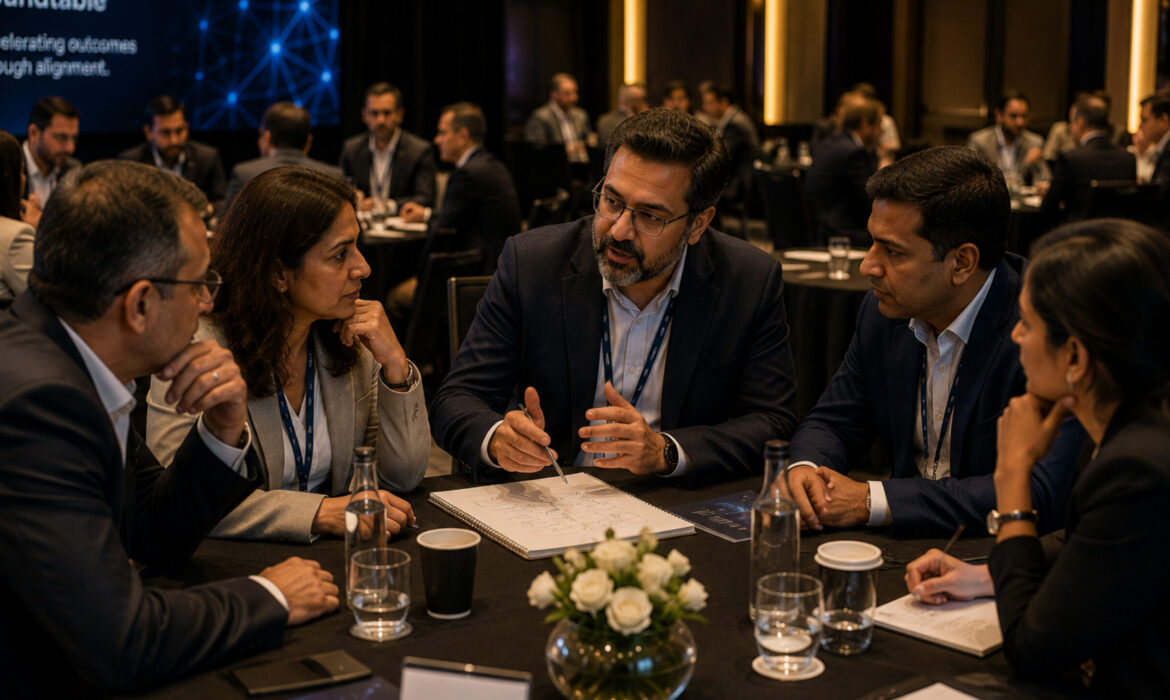
Hours of high-bandwidth, face-to-face time that would take weeks of scattered calls to replicate. A demo. A deep technical conversation. A trust-building dinner with an executive buyer. Those things happen in a few hours at an event. They’d take six scattered conference calls over two months to accomplish the same thing, if they happened at all.
The human bandwidth of being in the same room collapses weeks into hours.
The economic buyer, the champion, and the skeptic together. All at once. Alignment that usually happens asynchronously, waiting for emails and calendar invites, happens in the moment.
The skeptic gets an answer to their objection directly from an engineer instead of through a forwarded email that got shorter with each reply. The economic buyer hears the champion advocate for moving forward in person. The champion hears the economic buyer say what they actually need.
That’s worth weeks of fragmented conversations.
The event creates a natural reason to meet and a soft deadline to decide. “Let’s catch up at the summit” is easier to schedule than a random sales call six weeks out. “We’ll make a call here” creates urgency that a calendar invite doesn’t.
That momentum carries past the event. People decide faster because they’ve been in motion.
A hard technical question answered directly by an engineer. A trust gap closed by an executive face-to-face. The thing that was quietly stalling the deal, the objection nobody was solving because it was hard to resolve on a call, gets handled in person.
And with it gone, the deal moves.
Acceleration doesn’t create momentum on a deal with no momentum. It amplifies the momentum that’s already there.
There’s a real, qualified opportunity. It exists in your CRM. It has value attached. A stage. A timeline, however early.
A cold contact at a booth isn’t a deal. A warm lead who’s in early conversations, early discovery, late proposal stage, that’s a deal ready to accelerate.
The deal is stalled on something that an in-person moment can clear. A specific technical question. A stakeholder who hasn’t engaged yet. A trust gap. A skeptic who needs to meet the founder.
If the deal is stalled because the budget isn’t there, in-person time won’t manufacture a budget. If it’s stalled because there’s no real need, the event won’t create it.
But if it’s stalled on something that face-to-face time can resolve, the event is a lever.
Multiple decision-makers can be in the room, or at least the one person who can unblock everything can attend.
The deal where you’ve been talking to one champion for two months but the economic buyer has never engaged. Bring both to the event. The deal where a technical objection has been bouncing in emails. Bring an engineer.
The practical play: connect open deals to your event deliberately. Invite the right stakeholders. Plan the conversation that resolves the blocker. A platform like Samaaro connects event engagement signals to the CRM, so sales can see which open deals showed up and act while intent is still warm.
Then the event does its work.
Understanding the limits matters as much as understanding the levers.
What accelerates:
Open, qualified deals with a real blocker that an in-person moment can clear. Deals where more of the committee can engage at once. Deals that are stuck on alignment or trust, things that in-person time actually fixes.
What doesn’t:
Cold contacts with no opportunity. An event cannot accelerate a deal that doesn’t exist. Deals with no real blocker. They move on their own timeline whether the event happens or not. Accounts with no genuine intent. In-person time will not manufacture buying intent where none exists.
Acceleration is a multiplier on real momentum, not a substitute for it.
Picture a mid-market software company that brings a set of open, stalled deals to a closed-door executive dinner, all sitting in proposal or negotiation and stuck for weeks on one of three blockers: technical skepticism, executive misalignment, or contract terms. Within a month of the dinner, most have advanced a stage, and several close the following quarter. The event didn’t create those deals. It compressed the time already-open deals spent between stages. Same budget, same effort, just more velocity.
Acceleration is about speed and movement, not about return.
Whether the event’s cost was justified relative to the deals it moved, that’s the Event ROI question. A different calculation. A different timeline. That lives in the Event ROI content.
This is velocity. That is value.
Also, this is the velocity of a specific open deal at an event, not the general argument that events suit long sales cycles in B2B. That case, why companies with year-long sales cycles run events at all, is covered in the B2B Event Marketing content.
An event’s biggest pipeline effect is often acceleration, compressing the time an open deal spends between stages.
Bring real, open deals to your events and the room does the rest.
Bring nothing, and there’s nothing to speed up.
That’s the whole thing. The deals you already had, the ones stuck at some stage, the ones waiting for alignment or a skeptic to move. Those are the ones an event moves faster.
For how acceleration fits the three ways events move pipeline and what sourced versus influenced mean at scale, circle back to the hub.
Ready to turn your next event into a deal accelerator? See it in action with the Samaaro team by identifying which deals are ready to move and tracking their velocity through the event and beyond.