Samaaro + Your CRM: Zero Integration Fee for Annual Sign-Ups Until 30 June, 2025
- 00Days
- 00Hrs
- 00Min

Key Takeaways (TL;DR)
1
2
3
→
Bottom Line:
Curate before you invite; the list builds the room, and the room produces the outcome.
A Full Room Is the Wrong Target
Most teams build a closed-door event guest list by deciding how many seats to fill, then working to fill them. That instinct is borrowed from webinars and trade shows, where headcount is the scoreboard, and it is the single fastest way to end up with a room full of the wrong people.
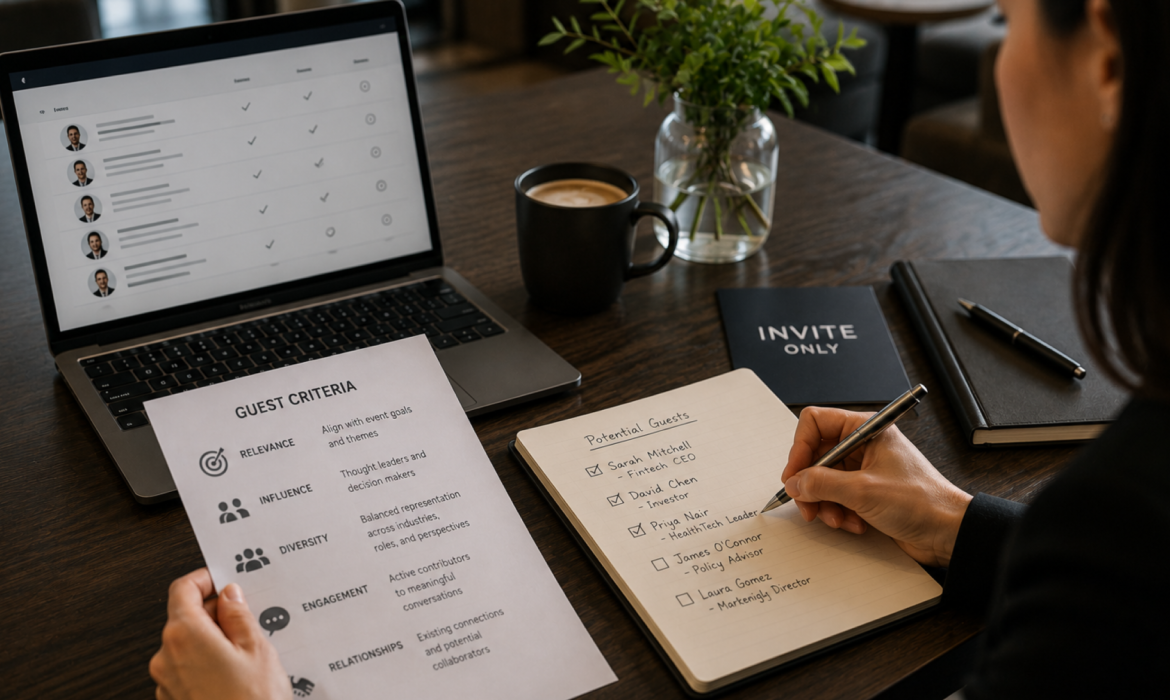
A closed-door event runs on the opposite logic. Its value lies in the quality of the exchange rather than the size of the reach, and the guest list is where that exchange is won or lost before anyone arrives. Curating it means selecting a small group of true peers who map to the live pipeline and inviting them personally, rather than filling chairs to a target number. The list is the event’s design, happening early.
Start with the comparison that decides everything: a twelve-person room of true peers will out-produce a sixty-person room of mixed seniority, every time. Candor scales down, not up. In a small peer room, executives speak as equals, because there is nothing to lose by naming a real problem in front of people who are facing the same one. Put those same executives in a large, mixed room and the senior voices go quiet. Exposing a problem in front of juniors, vendors, and possible competitors carries real risk and no return, so the people you most wanted to hear from say the least, and the format collapses into a presentation with an audience.
The mistake is an imported one. Volume thinking comes from demand generation, where registrations are the scoreboard, and more is better. A closed-door event runs on different physics, so the metric that builds a good webinar quietly wrecks a good evening. Every seat added past the peer threshold does not add value; it removes it. A bigger room is a weaker format wearing the same name.
So the planning question has to change, from how many we can fill to who has to be in the chairs.
Three filters decide who earns a seat, and they apply whatever format the room takes. A name has to pass all three.
The first is a seniority match. Everyone in the room should sit within roughly one level of everyone else. When seniority is mixed, the juniors manage up, and the seniors hold back, and you lose the contribution of both. The test is simple: no one in the room should be performing for someone else who is also in the room.
The second is peer parity, a different test from seniority. Seniority is about title. Parity is about perception. Does the room read as a table of equals, or as a vendor and the people it invited to be sold to? Two guests can clear the seniority bar and still break parity. Picture two executives with the same title and remit: one a satisfied customer, the other running a strategy for a direct competitor. On paper, they match. In the room, the competitor’s presence makes every other guest measure their words, and the candor you built the list for quietly disappears. Parity is engineered through a customer or peer co-host, a neutral theme, and balanced company representation, so no one feels like the audience or the target.
The third is target-account fit. Every seat should map to a named account that matters to the pipeline: a target account with no open opportunity, a stalled deal, or an expansion candidate. A seat that maps to no account is a courtesy invite, and courtesy invites are how a curated room drifts back toward volume.
A name has to clear all three. A perfect-fit account at the wrong seniority breaks the room as surely as a great peer who maps to no pipeline wastes the seat. Record, against each confirmed name, what you want the seat to produce: a first meeting, a stalled deal moved, an expansion opened, or simply a peer relationship kept warm. That intended outcome is what the follow-up plan picks up later.
Curation builds the list. Getting those people into the room is a separate discipline, and it starts with over-inviting. Executive acceptance runs low and lands late, so plan the invite list at roughly two and a half times the target seat count. A twelve-seat room starts from a first wave of around thirty invitations. Treat that ratio as a planning heuristic to adjust for relationship warmth and seniority, not as a fixed number.
How you invite matters as much as how many. A C-level invitation that reads like a mass send is deleted in seconds. The invite should name the recipient, name the kind of peers likely to be in the room, and state the single question the room will sit with. It should be one-to-one, from a person, never from a marketing alias.
Acceptance also rises sharply when the ask carries weight. An invitation co-signed by a senior internal executive or endorsed by an existing customer lands differently, because a peer asking is more credible than a vendor asking. The most senior or most relevant name should make the request.
Finally, sequence the send. Invite the anchor names first, the people whose presence makes the room worth attending. Once they confirm, the next tier’s invitation can honestly name who is already coming, which is the strongest acceptance lever you have, because senior people decide partly on who else will be at the table.
Declines and last-minute drops are normal at this level of seniority. The risk lies in what happens next: the scramble to refill the room back to the target number.
The rule for replacements is strict. A replacement has to clear the same three filters, or the seat stays empty. The filters are non-negotiable. The headcount is flexible. A name added purely to get back to twelve is a name that does not belong in the room.
The hardest version of this is the offered stand-in. When an executive cannot attend and proposes sending a deputy, the deputy does more than fail to contribute. Their presence changes the room for the peer who would have spoken openly, because the table now contains someone taking notes for an absent boss. One stand-in can quiet an entire table. Decline the substitution politely, and either hold the seat for a true peer or let it close.
This points to the principle underneath all of this. An empty chair costs nothing and is invisible by the second agenda item, while a parity-breaking guest costs the candor of everyone seated near them. Eleven peers in a room built for twelve is still a curated room. Twelve with one wrong seat is something less.
Curation is the design work of a closed-door event, pulled forward in time. The list builds the room, and the room produces the outcome. Three filters build the list, a roughly 2.5x send fills it, and the same three filters defend it. Before any invitation goes out, ask one question of the names in front of you: would these specific people speak openly in front of each other? If not, the list is wrong, and no agenda will fix it.
Fewer chairs. Real peers. Every name tied to an account that matters. Seats are left open rather than filled badly. Send that list, and the room does the rest.
If curated events are becoming part of how your team builds a pipeline, talk to the Samaaro team.