Samaaro + Your CRM: Zero Integration Fee for Annual Sign-Ups Until 30 June, 2025
- 00Days
- 00Hrs
- 00Min

1
2
3
→
Bottom Line:
An audience hears and leaves; a peer room argues and remembers who was across the table.
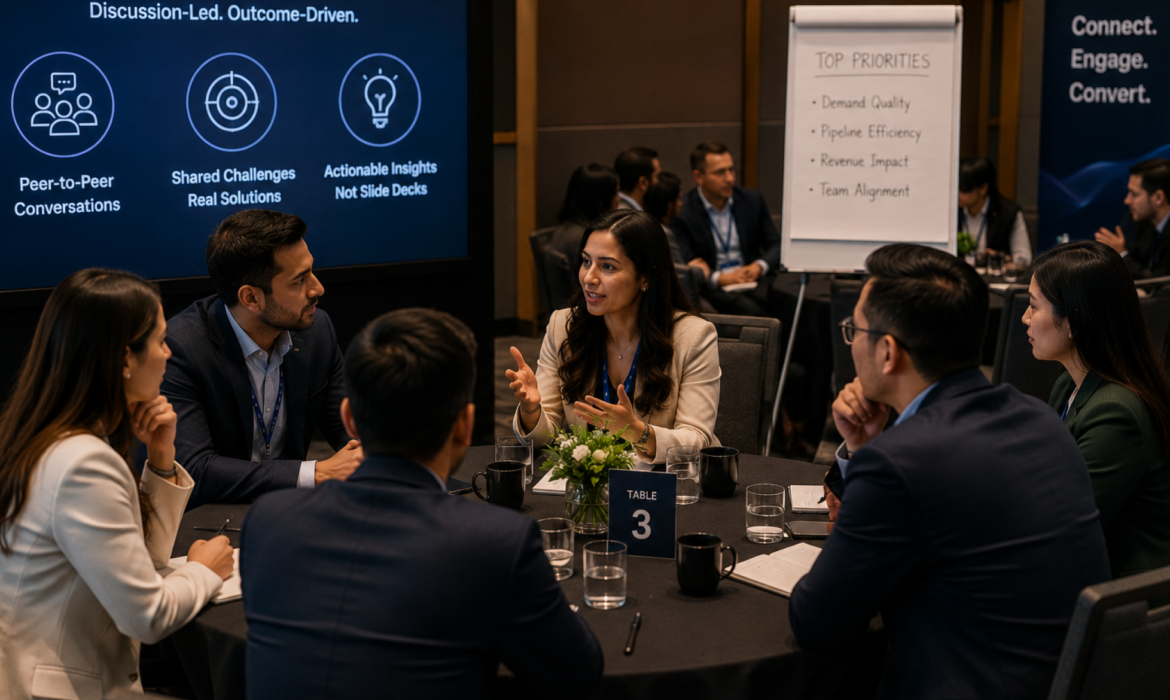
Why do so many closed-door events, planned by capable teams and filled with the right people, still produce a careful, going-nowhere conversation? The answer is usually the agenda. A run-of-show that looks responsible (a welcome, a short scene-set, a customer story, a little Q&A, then dinner) would work for a webinar. But the people in a closed-door room run businesses of their own, and an agenda built to present to them turns peers into an audience. A closed-door event agenda should be built around discussion, not presentation: a single theme, two or three sharp provocations, and a long stretch of structured open conversation, with framing kept short and a hard stop at the end. The moment a deck takes the floor, the room becomes a talk.
A deck does one thing structurally: it points every chair at a screen. The instant that happens, peers become an audience, and an audience does not argue, disclose, or compare notes. It watches and waits for the next slide.
A deck sends a second signal too, and it is commercial. A presentation, however soft, reads as a pitch. Senior buyers recognize the shape immediately, and the room’s posture shifts from open to guarded before the first real question is asked.
So why do capable teams keep reaching for one? Because a deck feels like preparation. It is the artifact that proves work was done, the thing you can send around for sign-off. But preparation for a discussion looks nothing like a deck. It is a set of questions that the host will put to the room.
Underneath all of this is a trade. A presentation transfers what the host already knows to the room. A discussion surfaces what the room knows about each other, and that exchange among peers is the one thing a closed-door event can produce that a webinar never will. Build the agenda to present, and you trade away the only advantage the format has.
A discussion-led agenda has four parts, and the balance of time across them is what makes it work.
It starts with a single theme. The whole room circles a single question for the evening, rather than working through a series of topics on a schedule. A session list is a conference in miniature. A theme is a conversation with a spine.
Next come two or three provocations. These are the questions the host prepares and poses to the room: sharp, slightly uncomfortable, designed to split opinion rather than lead to a tidy answer. Three is the ceiling. Past that, the discussion never deepens on any one of them.
Then, the time architecture, which is where most agendas quietly fail. Framing should be short, a few minutes to set the theme and step back. Open discussion takes the overwhelming majority of the session. The proportion is the whole point: once framing and host input creep past a small fraction of the time, the format has slid back into a talk.
And a hard stop. Senior people respect a clock, and an event that ends when it is promised protects the most valuable contributions, which tend to arrive late, from being lost to fatigue. Set the stop, and hold it.
Theme, provocations, discussion, stop. The structure exists to keep the room talking and the host quiet. Every minute the agenda hands to a presenter is a minute taken from the only thing the room came for.
A discussion needs something to push against, or it opens with an awkward silence while everyone waits to see who goes first. The anchor is the shared material that gives the room something to react to, and it comes in one of two forms.
The first is a pre-read. A single page, sent in advance, and never a deck. It frames the theme and offers one point of view worth disagreeing with, so the room arrives already thinking, and the discussion starts warm. What it must not be is a product overview dressed up as context.
The second is a single number. When a pre-read is too much to ask of busy executives, one well-chosen data point does the same work. A single figure that contradicts what the room assumes is true will start an argument faster than any item on a schedule.
The line that keeps the anchor honest: it should raise a problem the room already recognizes. “Here is what is shifting in your category,” opens a debate. “Here is what our product does” earns a polite nod and closes the room.
Two small rituals bookend the discussion, and they do more structural work than their size suggests.
The opening go-around comes first. Before the discussion proper, each person names, in a single sentence, the one thing they want to leave the room having figured out. This does two jobs at once. It gets every voice into the air early, which makes the second contribution far easier than the first. And it tells the room what its members actually care about, which steers the conversation toward real stakes instead of safe ones.
The closing commitment round comes at the hard stop. Each person names one thing they will do differently, or one question they are taking away. It turns a good conversation into something the attendee carries out the door, and it gives the evening a sense of arrival rather than a slow fade into dessert.
The bookends matter because of what happens without them. A discussion with no opening ritual starts cold and tilts toward the loudest voice. A discussion with no closing ritual evaporates on the drive home. Both rituals are cheap to run, and together they hold the rest of the agenda in place. How a facilitator runs them in the moment is a craft of its own.
The four parts do not change across formats. What changes is how they are spaced.
At a dinner, the conversation moves with the courses, so the provocations are spread across the meal rather than front-loaded, and the opening go-around softens into a single table question so it does not feel staged. The risk to manage is the table splitting into side conversations between courses, so the convener gently gathers the group back as each course arrives.
A roundtable is the tightest fit for the full anatomy. Framing, provocations, a long discussion, a hard stop, and both rituals all run cleanly because everyone shares one table and one conversation, with nowhere to drift.
A briefing allows more host content, because the buyer came to learn something specific, but the discussion-led principle still caps how long the host holds the floor. The agenda front-loads a short briefing, then converts deliberately into discussion. The failure mode is the briefing quietly overrunning until the discussion never arrives.
The throughline is simple. A dinner stretches the discussion across time, a roundtable concentrates it, and a briefing earns a little more host input without ever surrendering the floor. Same components, different proportions.
A closed-door agenda is less a running order of who presents when than a set of decisions about how to keep peers talking and the host quiet: one theme, two or three provocations, a short frame and a long discussion, an anchor to start it, two rituals to bookend it, and a hard stop to protect it.
An audience hears something and leaves. A room of peers says something, argues it, and remembers who was across the table. Design the agenda for the second outcome, and keep the deck in the bag.
When an executive event has to produce a real conversation, the Samaaro team can help you design it.

Samaaro is an AI-powered event marketing platform that enables marketing teams to turn events into a measurable growth channel by planning, promoting, executing, and measuring their business impact.
Location


© 2026 — Samaaro. All Rights Reserved.