Samaaro + Your CRM: Zero Integration Fee for Annual Sign-Ups Until 30 June, 2025
- 00Days
- 00Hrs
- 00Min

1
2
3
→
Bottom Line:
Sales team briefing for events determines whether conversations turn into pipeline before the event even begins.
Your team sponsored a tech summit last month. Forty booth conversations. Fifteen demo requests. Eight one-on-one meetings with target accounts. Six weeks later, the pipeline review shows two deals progressing.
The other thirty-eight conversations produced generic follow-up emails, delayed outreach, or silence. The CRM notes read: “Met at booth, seemed interested.”
That is not a lead. That is a memory with a name attached to it.
The instinct is to blame sales for poor follow-up. But poor follow-up is a downstream symptom. The actual failure happened before the event, in the briefing that either did not happen or covered the wrong things entirely. Shift assignments, booth logistics, branded merchandise, and a one-pager on product features. Operational preparation, not conversion preparation.
The pre-event sales team briefing for events is the single highest-leverage activity for event ROI. It determines what information gets captured during conversations, how reps structure their time on the floor, and whether post-event outreach has enough context to be worth opening. Every downstream outcome leads to quality, response time, personalisation, pipeline velocity, and traces back to what sales knew before they walked into the room.
When the briefing is thin, the follow-up is thin.

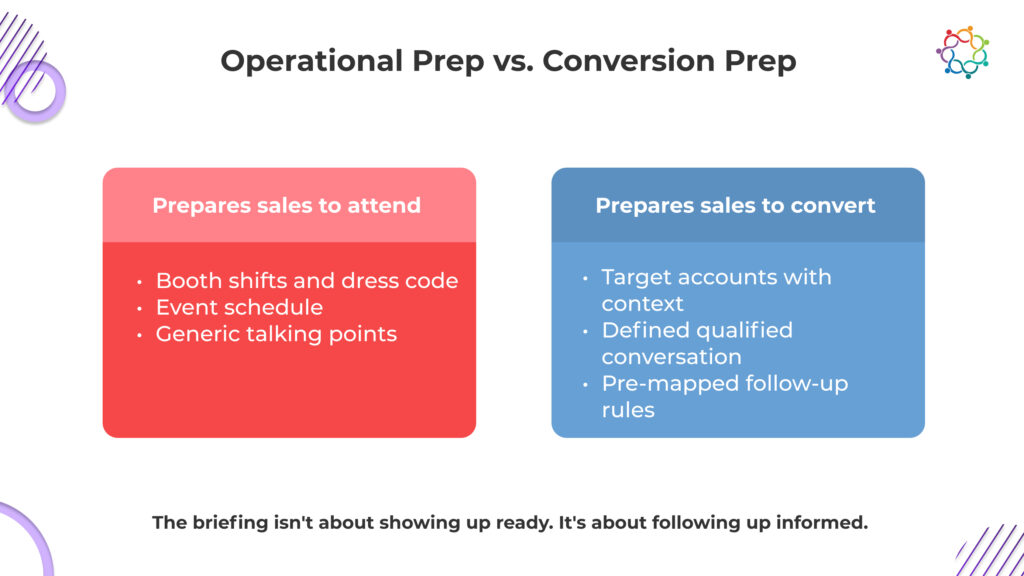
Most pre-event briefings are logistical documents. Shift times, booth locations, dress codes, and a run-of-show for the sponsored session. Sales arrives prepared to be present. They are not prepared to convert.
A conversion-ready briefing looks structurally different:
The briefing is not about preparing sales to attend the event. It is about preparing them to convert after it. Those are different goals that require different inputs, and almost every field marketing team defaults to the first one while hoping for the second.

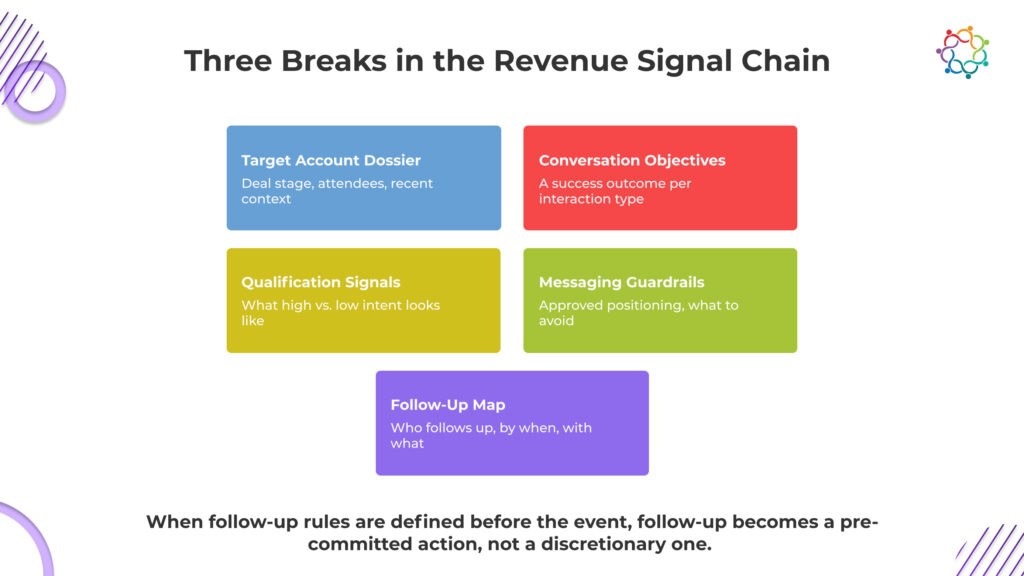
A repeatable sales team briefing for events is built across five components. Each one exists because its absence produces a specific, measurable failure in post-event conversion.
Target Account Dossier
For every priority account attending, provide three to four lines covering: company name, current deal stage, the names and roles of attendees from that company, known evaluation criteria or pain points, and any recent interaction history. Not a spreadsheet dump. Enough context for a rep to open a conversation that picks up where the relationship left off, rather than starting from the introduction.
A useful format: “Acme Corp, Series C fintech, evaluating event platforms for their 2026 roadshow program. CTO and Head of Marketing attending. Had a discovery call in March, went quiet. Last known concern was CRM integration complexity.”
Conversation Objectives by Interaction Type
Not every interaction at an event has the same goal, and treating them as if they do is where context collapses. A sixty-second booth interaction should produce a name, a company, and one pain point. A ten-minute extended conversation should qualify against ICP and identify a next step. A scheduled meeting should advance the deal stage. A networking interaction should build a relationship without selling.

Qualification Signal Cheat Sheet
Reps capture what they have been trained to notice. Without a list of specific high-intent signals for this event, they default to “seemed interested,” which is functionally useless in a CRM and tells sales nothing when follow-up begins.
High-intent signals might include: asking about pricing or implementation timeline, mentioning an internal evaluation process, or naming a competitor they are comparing against. Low-intent signals might include: took collateral, scanned badge with no conversation, asked only generic category questions. The list does not need to be long. It needs to be specific.
Messaging Guardrails
Three positioning statements covering what problem the product solves, how it differs from the alternative, and what the natural next step looks like. Plus two or three explicit things to avoid: competitive claims that are not approved, pricing specifics that belong in a separate conversation, and technical promises that require an engineer in the room.
A prospect who speaks to three different reps at the same event should hear the same story. Inconsistency at the event level destroys credibility at the pipeline level.
Follow-Up Map
Define before the event what happens after each interaction type, who owns it, on what timeline, and with what template or content. High-intent conversation: personalised email within twenty-four hours, owned by the rep, references the specific discussion. Medium-intent conversation: templated but personalised email within forty-eight hours, marketing can support. Low-intent interaction: added to nurture sequence, no direct sales outreach.
When follow-up rules are defined after the event, they compete with an existing pipeline for the rep’s attention. When they are defined beforehand, follow-up becomes a pre-committed action rather than a discretionary one.

Your company is sponsoring a mid-size B2B tech conference. You have a booth, one sponsored speaking slot, and three pre-booked meetings with target accounts.
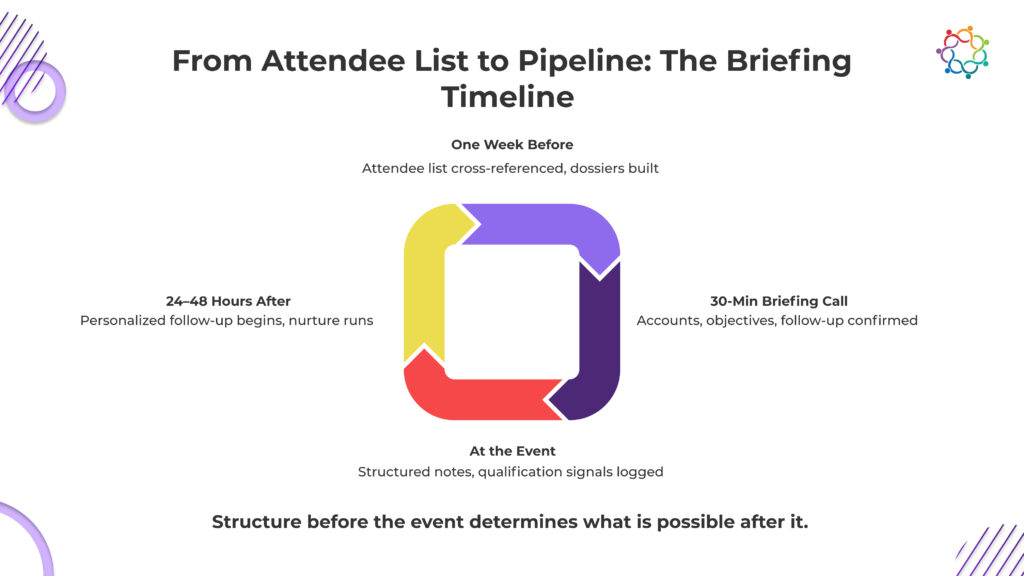
One week before the event, marketing pulls the attendee list and cross-references it against the target account database and CRM. Eighteen priority accounts have registered. A one-page dossier is created for each. A thirty-minute briefing call is scheduled with the four reps who are attending.
The call covers the eighteen accounts with deal stage and attendee context, conversation objectives for booth versus scheduled meetings versus networking, the qualification signal list specific to this event, messaging guardrails for the three pre-booked meetings where competitive positioning is relevant, and the follow-up map with ownership, timelines, and pre-loaded templates.
After the event, the reps return with structured notes mapped to each account. CRM entries include qualification signals, specific topics discussed, and identified next steps rather than “met at the booth.” Follow-up for high-intent conversations begins within twenty-four hours because the decision about what to do has already been made. Marketing runs the nurture sequence for low-intent contacts immediately without waiting for sales to sort through two hundred badge scans.
The structural difference is not in sales effort. It is in the sales information. The briefing is what separates a team capturing the moment from a team remembering it badly three days later.

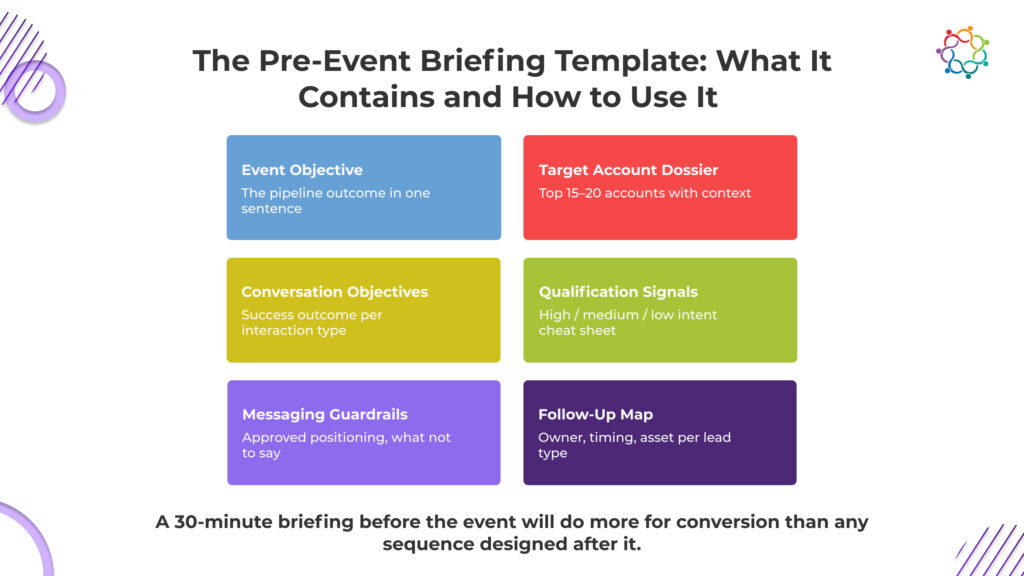
The five-component framework above works as a briefing structure only if it is consistently applied. To make that easier, we have built a single-page pre-event sales briefing template that covers every component described in this blog.
The template includes: a one-sentence event objective, the target account dossier for up to twenty accounts, conversation objectives mapped to interaction type, the qualification signal cheat sheet, messaging guardrails with approved and avoided language, and the follow-up map with ownership columns and timeline fields.
Fill it in one week before the event. Run the thirty-minute briefing call. Share the document in the team channel or attach it to the CRM event record. After the event, use the same document as a debrief framework: which target accounts were engaged, which qualification signals were captured, and where follow-up happened on schedule versus where it stalled.
The template is one page. The briefing call is thirty minutes. Both of these are smaller investments than the pipeline that disappears when neither happens.

Most post-event pipeline reviews focus on what happened after the event closed: how quickly follow-up emails went out, how many meetings got booked, and how many leads entered the CRM. These are real metrics. But by the time they are being measured, the outcome is already largely determined.
A thorough sales team briefing for events does not improve follow-up by giving sales more templates. It improves follow-up by giving sales more context, and context is what converts a conversation into a pipeline entry rather than a CRM note that nobody acts on.
The best follow-up is not a fast follow-up. It is an informed follow-up. And informed follow-up starts before the event, not after the debrief.

Samaaro helps event teams capture the engagement signals and conversation context that make follow-up work, from booth interactions to session attendance to post-event lead scoring, so the briefing your reps walked in with stays connected to the follow-up they run after the event. Talk to our team.

Samaaro is an AI-powered event marketing platform that enables marketing teams to turn events into a measurable growth channel by planning, promoting, executing, and measuring their business impact.
Location


© 2026 — Samaaro. All Rights Reserved.