Samaaro + Your CRM: Zero Integration Fee for Annual Sign-Ups Until 30 June, 2025
- 00Days
- 00Hrs
- 00Min

1
2
3
→
Bottom Line:
One PropTech event must operate like three parallel experiences. Segmentation in design and follow-up is what drives the real pipeline.
A PropTech company launches a flagship event for its platform. The attendee list includes real estate developers evaluating construction management tools, brokers evaluating listing and lead generation platforms, and property buyers who registered because the event was promoted alongside new project launches. Three audiences, one stage, one agenda.
By lunch, the developers are checking email during the broker panel. The brokers skipped the project management demo. The buyers are confused about why a technology company is hosting what looks like a property expo.
This is not an execution failure. The event ran smoothly. The failure is structural, and it is unique to PropTech.
PropTech sits at an intersection that no other B2B tech vertical occupies. The product serves multiple sides of a marketplace, and each side shows up to events with a completely different intent. Developers want operational efficiency and sales velocity. Brokers want listing reach, lead quality, and commission tools. Buyers want property discovery and transaction transparency. These are not three segments of the same audience. They are three different audiences who happen to attend the same events.
The PropTech companies that generate pipeline from events are not the ones running the biggest property expos. They are the ones who structure a single event to serve all three audiences through format design, content architecture, and segmented follow-up without compromising the value for any one of them.

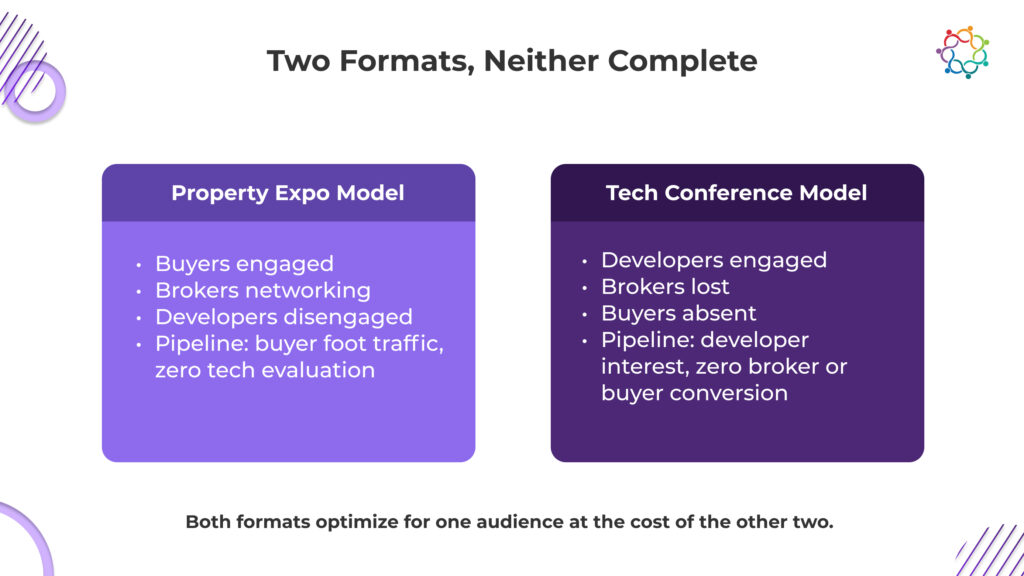
Most PropTech events default to one of two formats, and both leave the pipeline on the table.
Large venue, project displays, broker networking, buyer walkthroughs. The technology takes a back seat to the real estate. Developers get a 20-minute keynote about “digital transformation” and leave before lunch. Brokers network but never engage with the platform. Buyers get what they came for, property viewing, but generate zero technology pipeline because they were never positioned as tech evaluators.
Stage presentations on product features, platform demos, and panels on industry trends. Developers stay engaged. Brokers attend but find the content too technical and disconnected from their daily workflow. Buyers do not attend at all because the event does not feel relevant to their world.
Both formats optimise for one audience at the expense of the other two. The expo generates buyer foot traffic, but no tech pipeline. The conference generates developer engagement but loses brokers and buyers entirely. Neither is wrong. Both are incomplete.
The fix is not a bigger event or a longer agenda. It is a different architecture, one that runs parallel tracks for different audiences under one roof, with shared moments that bring all three together and segmented moments that let each group go deep on what matters to them.

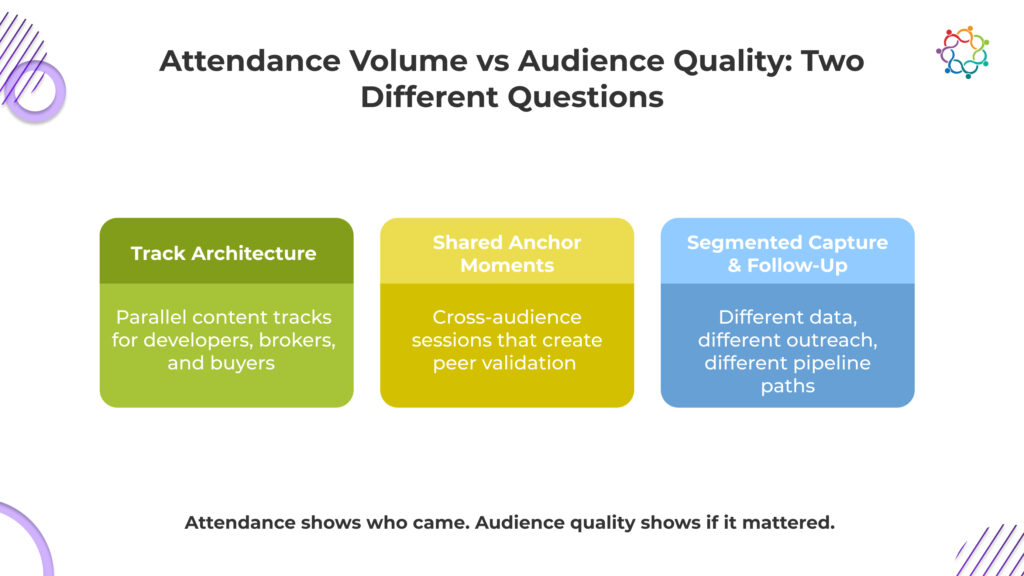
A PropTech event that serves three audiences without losing any of them is built on three structural layers. Each layer serves a different function, and removing any one of them breaks the system.
Design three content tracks that run simultaneously, each tailored to one audience segment.
The developer track covers project sales acceleration, construction-to-handover technology, CRM integration for real estate projects, and data-driven pricing. The content speaks to operational efficiency and sales velocity, the two things developers evaluate technology for.
The broker track covers listing optimisation, lead quality and conversion, digital tools for property showcasing, and commission tracking. The content speaks to the broker’s daily workflow, not abstract technology, but specific tools that affect how they sell and what they earn.
The buyer track covers guided property discovery, transaction transparency, and platform walkthroughs that show buyers how the technology makes their search and purchase experience better. This track doubles as a product showcase framed around buyer value, not vendor features.
Two or three moments in the agenda where all three audiences are in the same room. An opening keynote on the state of the real estate market. A panel featuring a developer, a broker, and a buyer discussing how technology changed their experience. A closing session that ties the three tracks together.
These shared moments serve a specific function: they create peer validation across segments. A developer watching a broker discuss how the platform changed their lead conversion is more persuasive than any demo. A buyer hearing a developer explain how the same platform accelerated project delivery signals credibility that no marketing slide can manufacture.
Registration captures which track each attendee is joining. On-site engagement is tagged by segment. Follow-up is built in three tracks before the event: developer follow-up emphasises implementation and ROI. Broker follow-up emphasises listing tools and lead quality. Buyer follow-up is a product-led nurture that continues the discovery experience.
A single follow-up email to all three segments after a multi-audience event destroys the value the track architecture created. The segmentation must carry through from registration to post-event outreach without flattening at any stage.

Property Finder operates across multiple Middle Eastern markets and serves all three sides of the PropTech marketplace: developers listing projects, brokers managing portfolios, and buyers searching for properties. Their events face the exact three-audience challenge this blog describes, at significant scale.
Rather than choosing one audience and accepting the loss on the other two, Property Finder applies the multi-audience framework structurally.
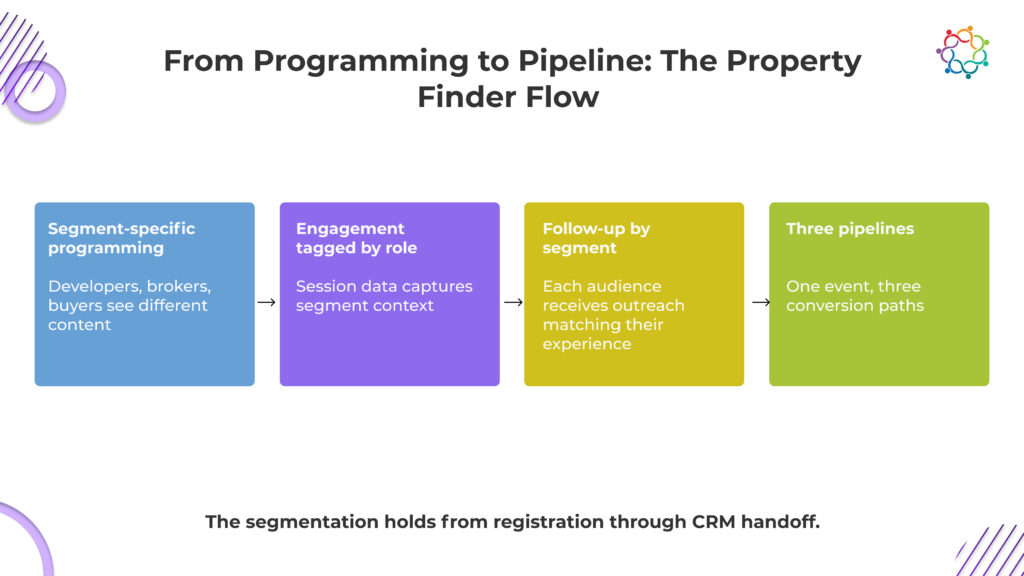
Audience-specific programming. Instead of a single agenda, Property Finder designs event segments that speak to each audience’s specific evaluation criteria. Developers see how the platform accelerates project sales. Brokers see how it improves listing performance and lead quality. Buyers experience the platform through curated property discovery. The content is not diluted to a middle ground; it is built per segment.
On-site engagement segmented by role. The data captured during the event is tagged by audience segment. A developer’s session attendance produces different follow-up signals than a broker’s booth interaction. This is where most PropTech events lose the thread; they capture attendance data without segment context, and the follow-up defaults to generic outreach that ignores what each attendee actually experienced.
Post-event follow-up by segment. A broker who attended a session on digital listing tools receives follow-up content on listing optimisation. A developer who attended a session on project sales velocity receives implementation-focused outreach. The thread from the event carries into the pipeline different threads for different audiences, maintained through CRM handoff.
This is a snapshot of how Property Finder approaches multi-audience events. The full case study covers the scale, the metrics, and the pipeline impact in detail.


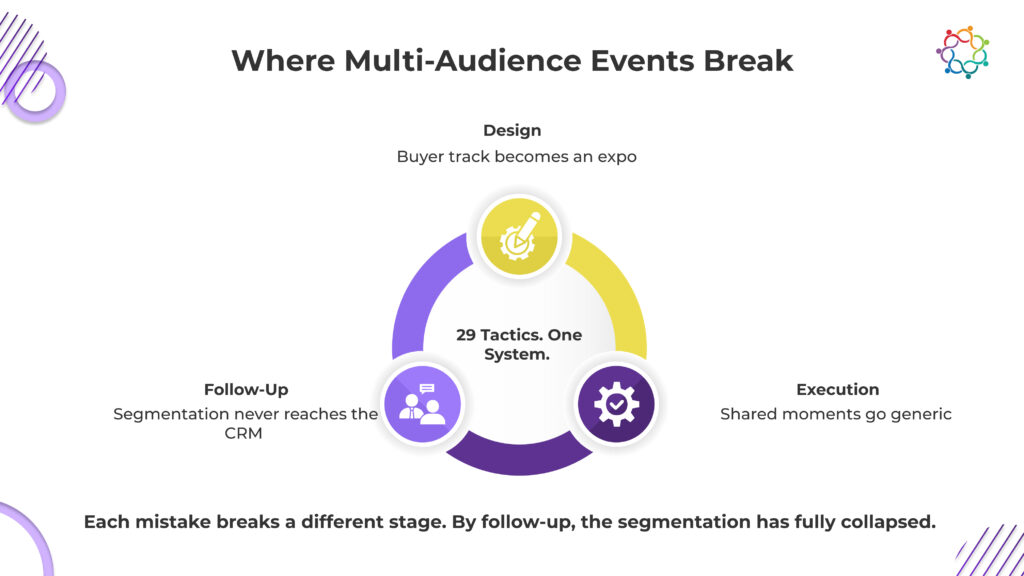
The framework is not complex. The discipline of maintaining it is. These three mistakes are where most PropTech events lose the structure they built.
Mistake 1: Tracks exist on the agenda but not in the data. The content is segmented. The sessions are tailored. But the registration form does not capture which track the attendee chose, the badge scanner does not tag by segment, and the CRM receives a flat list. The follow-up team sends one email to everyone. Track architecture that does not travel with the data functionally does not exist.
Mistake 2: Shared moments become generic moments. The opening keynote tries to be relevant to developers, brokers, and buyers simultaneously and ends up resonating with none of them specifically. The panel features three people from the host company instead of one voice from each audience segment. Shared moments that feel like filler rather than peer validation lose the room faster than no shared moment at all.
Mistake 3: The buyer track becomes a property expo. The buyer segment is the easiest to fill and the hardest to monetise as a technology pipeline. When the buyer track drifts toward property showcasing instead of platform experience, the event becomes a real estate fair with a tech sponsor. Properties can be the context. The platform must be the content. When that inverts, the technology pipeline disappears.
Most PropTech companies treat events as a single pipeline play, fill the room, capture leads, and follow up. That works in verticals where the audience is one segment with one motivation. PropTech does not have that luxury.
The framework is three layers: separate content tracks, shared anchor moments, and segmented capture through to follow-up. The discipline is maintaining the segmentation from registration through CRM handoff without flattening it at any stage.
The best PropTech events do not choose between developers, brokers, and buyers. They design for all three and follow up as if each one came to a different event.
Samaaro helps PropTech and real estate tech companies capture engagement by audience segment from track-level session data to booth interactions and route each segment into separate CRM workflows, so the three-track follow-up this blog describes runs automatically instead of manually. See how it works.

Samaaro is an AI-powered event marketing platform that enables marketing teams to turn events into a measurable growth channel by planning, promoting, executing, and measuring their business impact.
Location


© 2026 — Samaaro. All Rights Reserved.