Samaaro + Your CRM: Zero Integration Fee for Annual Sign-Ups Until 30 June, 2025
- 00Days
- 00Hrs
- 00Min

1
2
3
→
Bottom Line:
Three days of footage can fuel a year of demand only when the team plans output before cameras roll.
Your team filmed the entire user conference: 47 sessions, 23 panels, six fireside chats, and a keynote. Total footage: 89 hours. Six months later, you’ve cut and posted the keynote and one panel highlight reel. The other 87 hours are sitting in a Dropbox folder nobody can find. Marketing spent a meaningful share of the conference budget on production, and the vast majority of what got produced is not in market.
This is what most B2B event programs produce. The capture was expensive. The output was thin. The next conference is already being planned, and the same fate awaits next year’s footage.
Event content repurposing is the highest-leverage marketing investment most teams under-execute. A well-captured three-day event can fuel a year of demand: clips, blog posts, podcasts, sales decks, paid ads, drip emails, customer stories. This guide covers the five decisions that turn 89 hours of footage into year-round content output.
The framework runs across five stages: the capture plan, the asset taxonomy, the 12-month workflow, the distribution map, and the tracking layer. Each stage solves a structural failure mode that leaves event footage on the editing room floor.

Most event content repurposing programs fail before the event happens. The capture stage is where the leverage is created or lost.
The capture-as-afterthought failure.
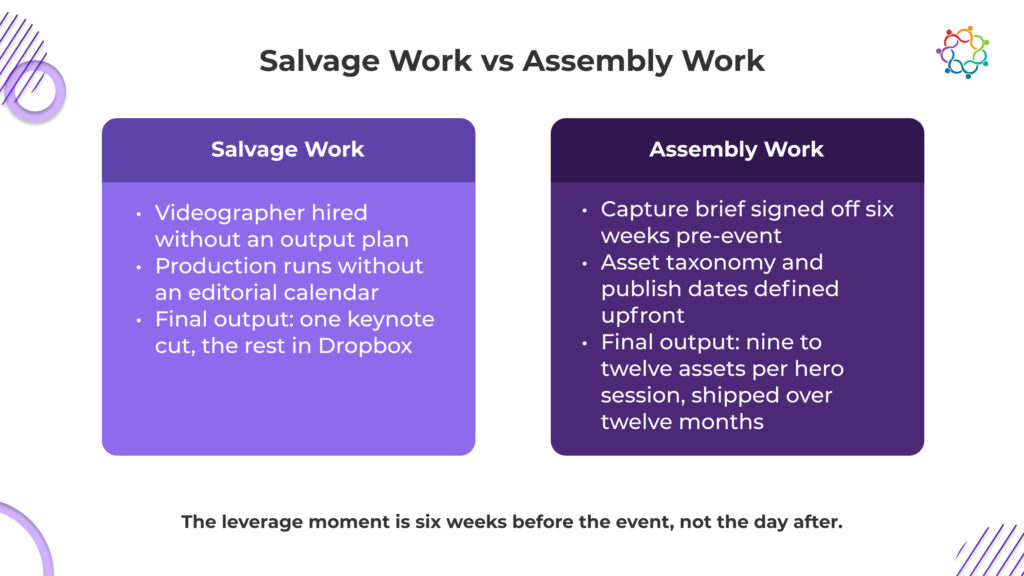
Most teams hire a videographer without a defined output plan. The crew shoots what looks good, the footage gets archived, and post-event, the content team discovers nobody scoped the editing.
The “we’ll figure it out later” failure.
Post-event production runs without an editorial calendar. Assets either get rushed in the first week or never ship at all, because the queue keeps growing without a publish discipline behind it.
The single-channel failure.
Everything that does ship lands on YouTube and dies there. No clips, no social cuts, no sales enablement, no paid creative. A 90-minute session uploaded to YouTube and left there reaches a small organic audience and stalls.
The measurement failure.
Nobody tracks which assets drive the pipeline. The program cannot earn budget for the next event’s capture because nobody can prove the last event’s capture was worth what it cost.
Common trap: starting repurposing the day after the event.
The leverage moment is six weeks before the event, when the capture plan gets written. Production after a poorly captured event is salvage work. Production after a well-captured event is assembly.
Capture-plan decisions made before the event determine the bulk of the repurposing output. The brief gets defined six weeks before the event and signed off by content, demand gen, and event marketing together.
The capture brief.
The brief specifies what is being captured for which output, by which producer, on which timeline. It names the hero sessions (four to six maximum) that get the full repurposing treatment, and the supporting sessions (the rest of the agenda) that get lighter capture. The split matters. Treating every session as a hero session means none of them gets the production attention required to produce the full asset set.
Production specifications.
Hero sessions need multi-camera capture with separate audio feeds for clean speaker isolation. Supporting sessions need a single camera with a lavalier mic. Always-on B-roll capture runs across the event: hallway conversations, booth activity, audience reactions, the texture that makes social cuts feel alive. Live transcription runs throughout the conference so the team can search the footage by phrase the week after.
The interview track that nobody plans.
Fifteen-minute structured interviews with eight to twelve customers and partners during the event, pre-scripted around upcoming campaign themes, captured in a quiet on-site studio rather than a crowded hallway. In our experience, this is the single most underused production decision and one of the highest-yielding asset sources in the entire capture plan.
The asset-output checklist.
Every hero session is captured to feed a defined list of deliverables: full session recording, sixty-second highlight, three short clips, transcript, quote cards, audio cut for podcast, and paid creative variant. The list gets locked at the capture brief stage, so the crew shoots to spec.
Common trap: filming the event without a spec.
Hiring a videographer to “film the event” without a defined output plan produces footage where the audio is unusable for the podcast cut, the framing is wrong for vertical social, and the speaker’s mic cuts out in half the hero sessions. Capture without specs produces unusable footage.

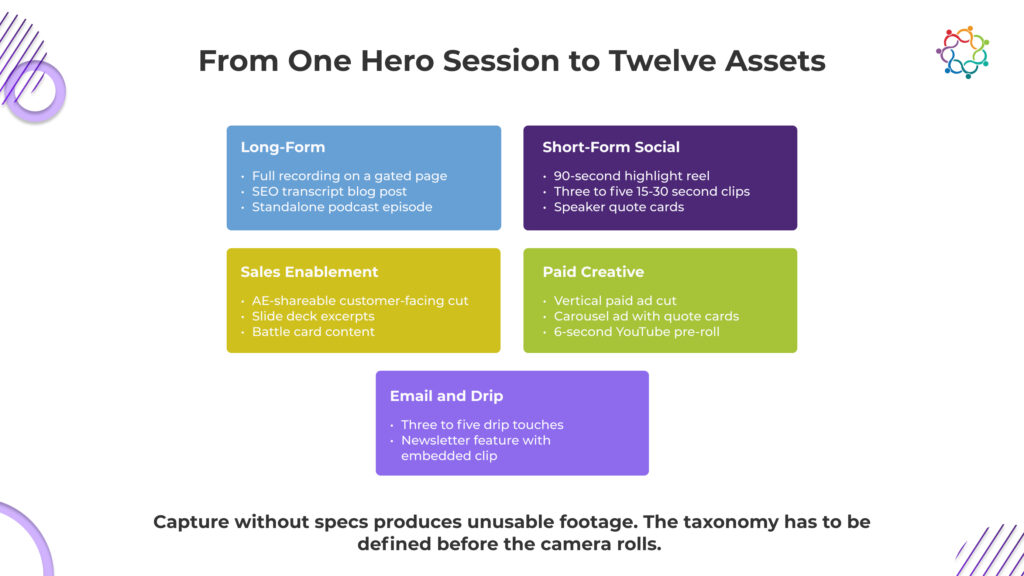
One hour of session footage can produce roughly a dozen distinct marketing assets, but only if the team knows what each asset is for. The taxonomy below describes what is possible from a well-captured hero session: typically, ten to fourteen distinct assets per hour of footage, in our experience. The exact mix varies by session type, speaker permissions, and the team’s distribution infrastructure. What follows is the canonical asset set, organized by where each asset lands in the funnel.
Long-form assets.
Short-form social assets.
Sales and enablement assets.
Paid creative.
Email and drip assets.
Common trap: defining the taxonomy reactively.
When the taxonomy gets defined after capture, the existing footage rarely supports every asset format. A vertical social clip cut from horizontal-only footage looks amateur. A podcast audio cut from a noisy room sounds amateur. The taxonomy must be defined upfront so the capture is shot to feed every output the team intends to ship.

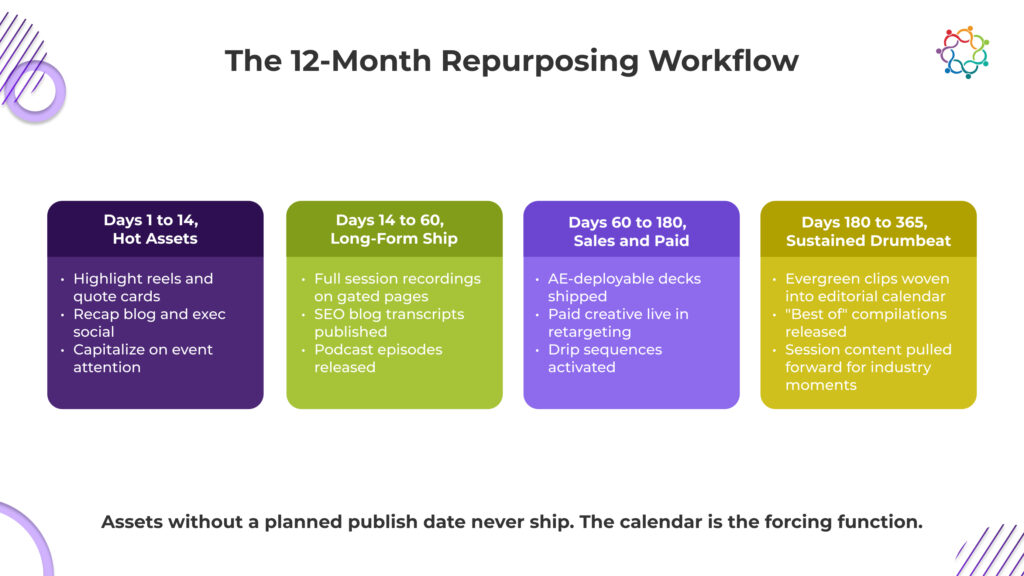
Most teams fail because they try to ship everything in week one. The right approach is a phased workflow that releases content across twelve months, with each phase targeting a specific marketing outcome.
Phase 1 (Days 1 to 14): hot assets.
Highlight reels, quote cards, and short clips for hero sessions get cut and shipped while the event is still fresh. A “we just wrapped” recap blog post lands within the first week. Exec social posts go out the day of and the week of the event. The goal is to capitalize on the attention moment while it is still active.
Phase 2 (Days 14 to 60): long-form ship.
Full session recordings go up on gated landing pages designed for MQL capture. Long-form blog transcripts get SEO-optimized and published. Podcast episodes are released on the existing feed cadence. The hot-asset phase is awareness. The long-form phase is measurable lead capture.
Phase 3 (Days 60 to 180): sales and paid enablement.
Sales-enablement decks get delivered to AEs. Paid creative variants launch in retargeting and prospecting campaigns. Drip email sequences activate with embedded session content. The goal is to arm sales with field-deployable assets that extend the event conversation into the pipeline.
Phase 4 (Days 180 to 365): sustained drumbeat.
Quote cards, evergreen clips, and customer stories get woven into the editorial calendar. Specific session content gets pulled forward when relevant industry moments hit. “Best of” compilations get repackaged for end-of-year summaries. The event keeps earning impressions long after the lights have gone off.
The editorial calendar mechanic.
Every asset has a planned publish date entered in the editorial calendar before production starts. The calendar maps each asset to a campaign theme, a buyer stage, and a distribution channel. The weekly content team standups track production status against the calendar.
Common trap: building a backlog with no publish dates.
Assets that do not have a publish date never ship. The editorial calendar is the forcing function. Without it, week one’s hot assets land, and the rest sit in the queue indefinitely.

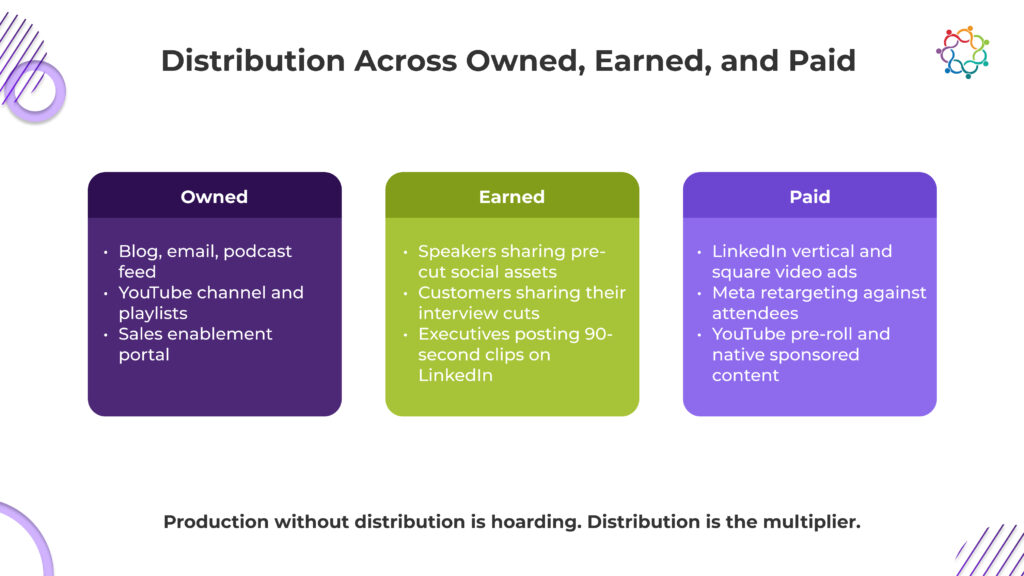
Production without distribution is hoarding. The same session, distributed across owned, earned, and paid channels, reaches a meaningfully larger audience than the same session uploaded to one place and left there.
Owned distribution.
Earned distribution.
Paid distribution.
Common trap: YouTube and LinkedIn organic as the only channels.
A 90-minute session recording uploaded to YouTube and left there tends to earn a small organic audience and stall. The same session, cut into eight or more distinct asset types and distributed across owned, earned, and paid channels, reaches a dramatically larger audience over the following months, often by an order of magnitude or more, though the exact uplift depends entirely on paid budget, audience size, and asset quality. Distribution is the multiplier on production.

Most teams track production volume. The diagnostic insight lives one layer down, in asset-level pipeline attribution. The team that ships 80 assets is not automatically outperforming the team that ships 25. What matters is which assets show up in the influenced pipeline, and which ones earn their place on the calendar.
The tracking infrastructure.
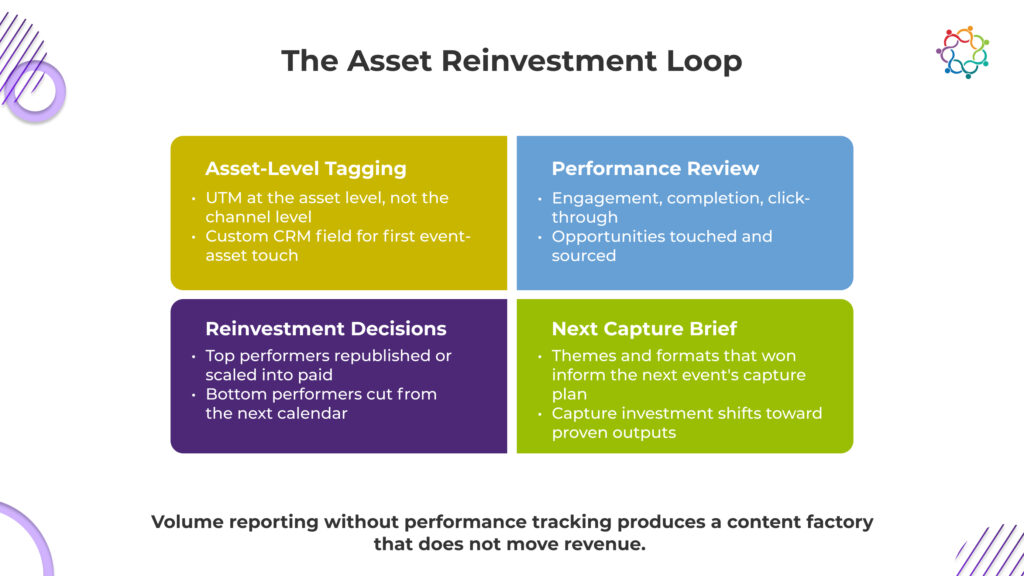
UTM tagging at the asset level, not the channel level. Every clip, every blog, every ad gets its own tag. A custom CRM field for “first event-asset touch” ties any later opportunity back to the originating asset. The attribution model captures multi-touch, because repurposed assets often appear in the middle of the buyer’s journey, not at the start.
The performance dashboard.
Asset-level engagement metrics: views, completion rate, click-through, and lead capture. Asset-level pipeline contribution: opportunities touched by the asset, opportunities sourced by the asset. Asset-level cost-per-opportunity, especially for paid distribution, where the spend is variable, and the attribution is cleanest.
Top-performing assets and bottom-performing assets surface weekly during the active campaign window, and monthly after that.
The reinvestment logic.
Top-performing assets get republished, expanded into full series, or scaled into paid spend. Bottom-performing assets get cut from the calendar, and the production team learns the pattern before the next event. Themes and formats that consistently outperform inform the capture brief for the next conference. The data closes the loop between repurposing and capture.
Common trap: reporting content volume instead of the pipeline.
A team that ships 80 assets and influences three opportunities is not outperforming a team that ships 25 assets and influences fifteen opportunities. Volume reporting without performance tracking produces a content factory that does not move revenue. Asset-level attribution is what tells the next event’s capture brief which production decisions to repeat and which to drop.
Event content repurposing is a planning problem, not a production problem. The leverage is six weeks before the event, in the capture brief. Design the capture brief. Define the asset taxonomy. Run a 12-month phased workflow. Distribute across owned, earned, and paid. Track at the asset level. Three days of an event produce a year of content, but only if the team plans the next year before the lights go on.
If your team is running flagship events and the post-event content output never matches the production budget, the gap usually sits in the capture-to-distribution layer, not the creative talent. Samaaro is built for the reporting layer that ties asset-level performance back to the pipeline.

Samaaro is an AI-powered event marketing platform that enables marketing teams to turn events into a measurable growth channel by planning, promoting, executing, and measuring their business impact.
Location


© 2026 — Samaaro. All Rights Reserved.